
How to study English: choose by your goal and what stops you
Published Updated
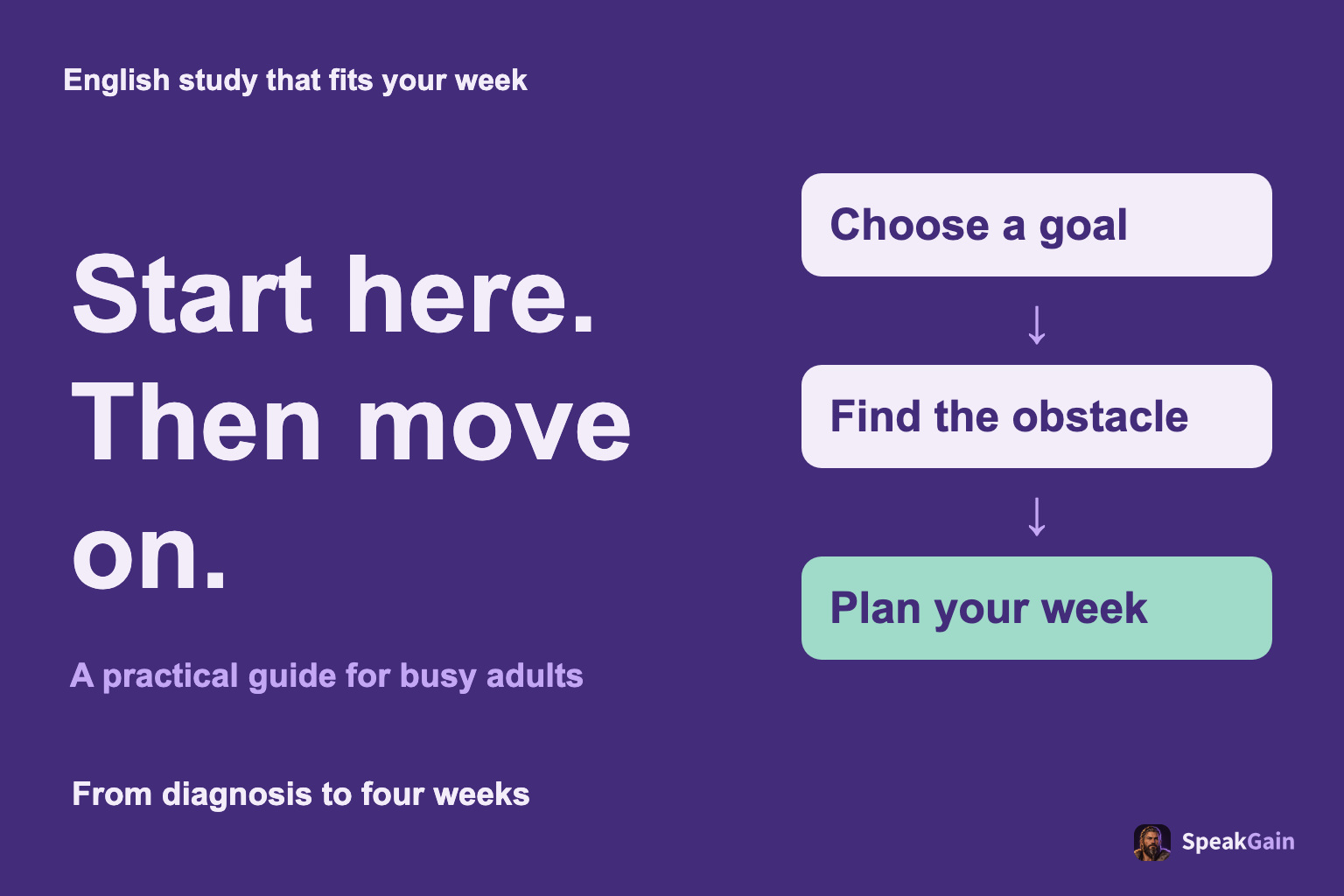
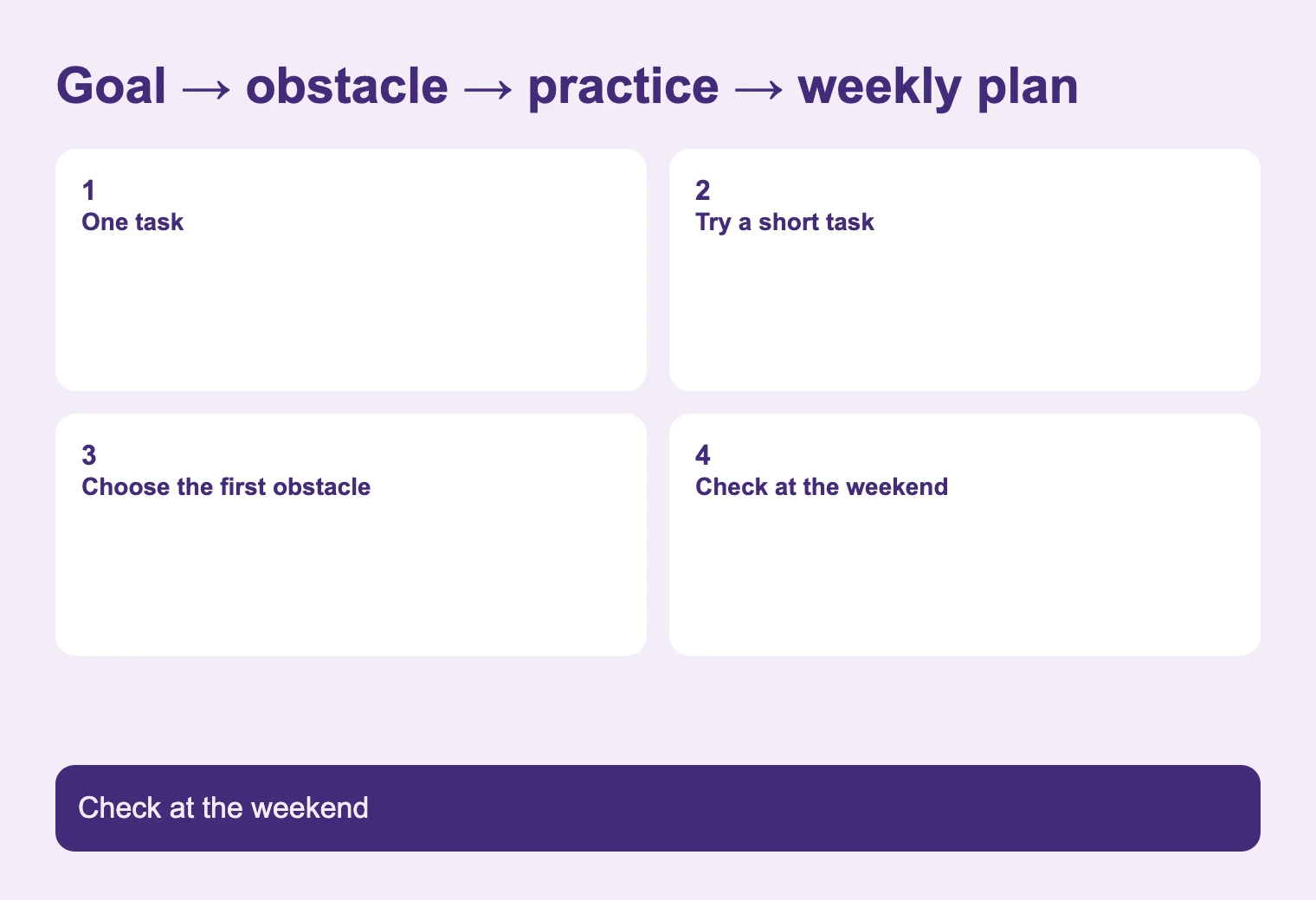
Choose one thing you want to do in English, try a short task, find the first point where you stop, and practise that part. Then put the task into your week and check whether you can use it. If the written sentence is unclear, return to vocabulary and structure; if you understand the text but miss the audio, work on sound; if you understand but cannot say it, practise recalling it without the model. This is a hub for choosing a method. Follow the linked guides for detailed procedures rather than starting every method at once.
For task-specific steps and revision against the public criteria, see our IELTS Writing guide.
If you need to discuss prices, delivery or terms, use English negotiation practice to adapt one sentence per stage to your company and rehearse a reply to push-back before the meeting.
For an assigned-side, judged exchange, see how to debate in English for role-based rebuttals and practice.
For a school test in Japan, GTEC speaking preparation explains type-specific timing and home recording practice.
For Japan’s newer intermediate grade, our Eiken Pre-2 Plus interview guide explains the three-picture task, short reasons and solo practice.
If you need a study-abroad score, TOEFL Speaking preparation helps you identify the current repetition and interview tasks and plan timed practice.
If an employer assigns an oral test, use Versant preparation to confirm the product and plan immediate spoken responses.
For an upcoming trip, use eight travel scenes and a pre-departure practice plan to turn your itinerary into three lines to say aloud.
If English is part of your job, use six customer-service scenes and a five-minute practice routine to prepare short lines for your own workplace.
If you need a one-to-three-minute greeting at school or an event, make preparing a short English speech with examples and keyword practice your next speaking task.
For work-related practice, use four moments for speaking up in English meetings to prepare one line for your next agenda item.
For words of care at the end of a conversation, practice choosing between a farewell, a warning, and your own promise, including what to say before a trip or a journey home.
For a baby, a small item or a thoughtful gesture, choose between cute, adorable and lovely by what you want to praise.
To choose a sound, ending or stress pattern to fix, follow our English pronunciation practice method and compare one feature in a recorded sentence.
For an upcoming TOEIC Speaking test, use our task-specific answer patterns and solo practice guide to plan timed recordings around the official limits.
To connect TOEIC L&R formats with Part-specific practice and a realistic weekly schedule, use our TOEIC study plan.
If you are taking Japan’s EIKEN Pre-2 second stage, use our interview flow, answer patterns and solo practice guide to record an answer and repair one point at a time.
For Japan’s EIKEN Grade 3 second stage, our interview flow, five-question answer patterns and solo practice guide helps you record a response and correct one point at a time.
For a job-related speaking goal, use English interview preparation to build eight answer categories from your experience and record timed responses.
For short contributions in a class or seminar, use joining English discussions to connect speaking patterns with a recording routine.
For a speaking practice task, use English conversation topics and solo practice to prepare two sentences about yourself and one question back.
If you keep translating before speaking, try a daily routine for thinking in English to practise one short sentence from a familiar situation.
If individual words are clear but your sentence sounds flat, use English intonation, stress and rhythm practice to move from word stress to a one-sentence recording comparison.
If familiar words disappear inside a sentence, use connected-speech practice to inspect a boundary and compare a short recording.
To practise explaining what you have read or heard, use English retelling practice to speak from five keyword notes and compare your recording.
If you need a text for read-aloud practice, use our books, apps and free-material comparison to choose one with meaning and matching audio.
When a missing word interrupts speaking, use speaking paraphrase practice to explain category or purpose.
For individual sounds, use our English consonant practice guide to choose a word ending, L/R or th contrast and compare one short recorded sentence.
Add sound-focused tongue twister practice: choose one short line, speak slowly and repair one spot in your recording.
For clues to a word’s reading from its spelling, use phonics for adults to connect common patterns, exceptions and dictionary checks.
To turn useful expressions into ten sentences from your own day, see everyday English conversation phrases and practice.
To choose your solo routine, compare English speaking practice methods by level and goal and select two exercises for your daily menu.
If you need DET for study abroad or admissions, check our Duolingo English Test preparation guide for its current format and speaking practice.
For the big picture first, see our all-grade Eiken comparison and common preparation guide before choosing your grade’s practice.
If you will stay with a family abroad, use English for a homestay to choose personal sentences for daily life and practise them before departure.
If you are considering a paired exam, our Cambridge English levels and Speaking guide explains A2 to C2 and how to respond to a partner’s ideas.
If you are choosing a pronunciation model, British vs American English compares representative differences and shows how to practise with one reference.
If you are starting tutor-led online lessons, use the beginner format guide and first-10-lesson plan to choose support and prepare one useful sentence.
Before attending in Japan, use the Eiken interview-day guide to check clothes, documents, entry and exit, and a short English repeat request.
For a structured conversation resource, use our conversation-book guide to compare level, purpose and audio access.
To choose a manageable reading level and a routine you can continue, see our extensive reading guide with official level comparisons and a first-week plan.
If you enjoy manga, our guide to choosing an official English edition and turning one chapter into your own speech offers a reading-based starting point.
If TED is your chosen material, use our one-talk method for learning English with TED to move from selecting a talk to giving your own opinion.
For TOEIC preparation specifically, our app comparison by purpose, score range and free access also explains how to combine apps with official practice books.
If you need a target IELTS score, use our IELTS study plan to connect the official four-skill format and assessment criteria with your weekly practice.
To combine tools without paying, see our guide to free English learning apps and websites for skill-based choices, ads, limits, trials and a free-only week.
For whole-test preparation, use our TOEFL study plan to organize all four skills and official materials around your target.
If you are targeting Japan’s Eiken Pre-1, use our current-format study plan, including summaries and time-left priorities to organize all four skills.
For the full preparation sequence, including summary writing, see our Eiken Grade 2 study plan by time remaining.
For the written tasks, use our Eiken Grade 2 Writing guide to distinguish official requirements from a practical self-review routine.
For Japan’s Pre-2 exam, our email and opinion-writing guide explains both current tasks, ways to develop reasons and solo review.
For the order of preparation across all four skills and priorities as test day approaches, see our Eiken Grade 3 study plan, based on the current official format.
For a specific writing goal, our Eiken Grade 3 email and opinion guide explains the two tasks and how to review at home.
Before choosing preparation materials, use our guide to choosing your first Eiken grade to compare official levels, test tasks and your purpose.
For priorities across the whole exam and a realistic six-month approach, see our Eiken Grade 1 study plan.
If you are choosing between Pre-2 and Grade 2, our Pre-2 Plus guide compares the official requirements and gives a step-by-step decision process.
For a purpose-based choice of resources and a routine that turns words into your own sentences, see our Eiken Pre-2 vocabulary guide.
For TOEIC Parts 1–4, use our listening practice guide to identify why a sentence was missed and choose the next drill.
To choose IELTS vocabulary materials, see our book and app guide for official band/module information and steps from a word to your own sentence.
1. Turn your goal into a real task
Replace ‘improve my English’ with a task: explain progress in a meeting, ask a hotel to store your luggage, or read a short article and explain its point. Choose one task for the next four weeks. An approaching exam changes the priority; without a deadline, our editorial recommendation is a task you expect to use. The official CEFR global scale includes familiar exchanges and help from the other speaker at beginner levels. One successful task does not certify a CEFR level. CEFR
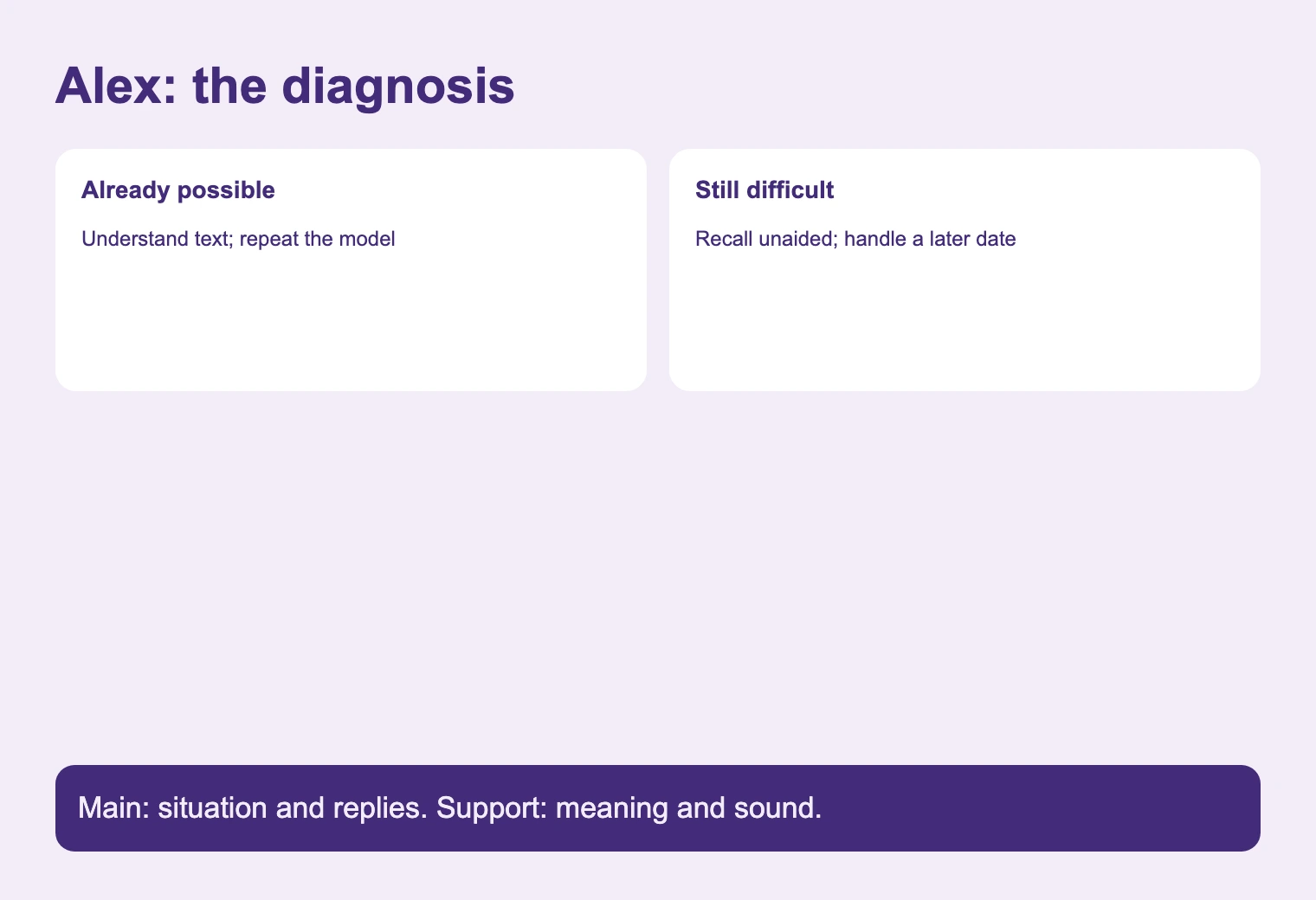
Alex is a fictional office worker returning to English. The available time is 15 minutes on the commute and 15 minutes at home on each weekday, 90 minutes on Saturday and 60 on Sunday: 300 minutes a week. Speaking aloud is impractical on the commute. The four-week task is to ask a colleague for a report by Tuesday, understand the reply and confirm the agreed deadline. Decide on that final check before choosing a textbook.
If familiar written words disappear in audio, try the short transcription and replay routine in our dictation method guide.
2. Choose by your goal and obstacle
Use a short task related to your goal, with a transcript or an answer you can check. Try alone first, then compare with the text, meaning or explanation. This is a decision aid, not a proficiency test. If several rows fit, start at the first obstacle that prevents this particular task. Keep success with familiar material separate from success with a new item.
| Goal | Where you stop | Practice and check |
|---|---|---|
| Speaking | Even the written sentence is unclear | Check meaning and vocabulary; explain who does what. Detailed guide |
| Speaking | You can imitate it but cannot produce it | Recall from a situation; try again next day without the model. Detailed guide |
| Speaking | Your line works, but a reply stops you | Vary the reply; practise clarifying or responding to a refusal. Detailed guide |
| Listening | The transcript is unclear too | Check vocabulary and sentence structure before sound. Detailed guide |
| Listening | Text is clear, but word boundaries disappear | Compare a short recording with text, then listen with it closed. Detailed guide |
| Listening | Pauses help, but continuous audio is too fast | Repeat an understood short part; check a different recording. Detailed guide |
| Reading | Words or subject and verb stop you | Choose easier text and explain a short paragraph. Detailed guide |
| Reading | You understand but keep rereading | Read understood phrases in chunks; note why you went back. Detailed guide |
| Vocabulary | Recognition works; next-day recall fails | Hide the answer and recall it on another day in context. Detailed guide |
| Exam | You cannot solve it even without a timer | Classify errors by vocabulary, sound or structure; try a fresh item. Detailed guide |
| Exam | You can solve it, but run out of time | Use official practice tasks to check pacing and accuracy. |
Alex understands the written request and can repeat the model, but cannot produce it from the situation alone. A colleague offering Wednesday also stops the conversation. The main task is therefore recalling the request and dealing with replies; meaning and sound are supporting work. This does not mean everyone should skip vocabulary: unclear meaning would send Alex back there first.
For food that looks tempting, tastes good or made a great meal, choose a food compliment in English by timing and add one detail you liked.
3. One main task, with supporting practice
Vocabulary and grammar
Check unclear words in a sentence, then close the answer and recall them. Our recommendation is neither to omit grammar nor to postpone all use until a grammar book is finished. Check who does what and what the deadline means, then use the understood sentence. See Detailed guide: How to memorize English words: 4 steps and fixes for forgetting.
Reading aloud and shadowing
Use Detailed guide: Reading English aloud: five steps, benefits and fixes with understood text and Detailed guide: English shadowing: six steps, benefits and fixes to follow an understood recording. When text is clear but audio is not, compare the two first; Detailed guide: How to improve English listening: fix the cause of each miss helps diagnose the cause. Repetition counts alone do not show understanding of an unfamiliar conversation.
Conversation, video and reading
Give each material an output: a reply, a summary or a task completed. Reuse a repaired sentence in conversation: Detailed guide: How to learn to speak English: a self-study roadmap you can use and Detailed guide: How to review an online English lesson in 10 minutes. Choose a short scene with Detailed guide: How to Learn English with Movies Without Pausing Every Minute or Detailed guide: How to Learn English with YouTube: A 5-Step Method That Goes Beyond Watching, or accessible text with Detailed guide: 6 English Books for Beginners: Our First Pick and Classics to Postpone. Time spent watching a whole film is not the same as checking and using a line.
If you understand a written sentence but lose its rhythm, try reading English in sync with audio to locate and repair one short fragment.
4. Make one sentence into usable material
Could you email me the report by Tuesday?
The sentence is a polite request to email a report no later than Tuesday. ‘By Tuesday’ gives a deadline; ‘on Tuesday’ specifies the day. Explain the object and deadline in your own language, listen and repeat with the audio stopped, then close the English and speak from the situation. Check these separately so that meaning, sound and independent recall are not confused.
SpeakGain, which we develop, can store this one sentence and play a model. We entered it through the normal Create flow. Check meaning and appropriateness with a dictionary or teacher as needed. Saving a card is preparation, not proof that the task is learned.
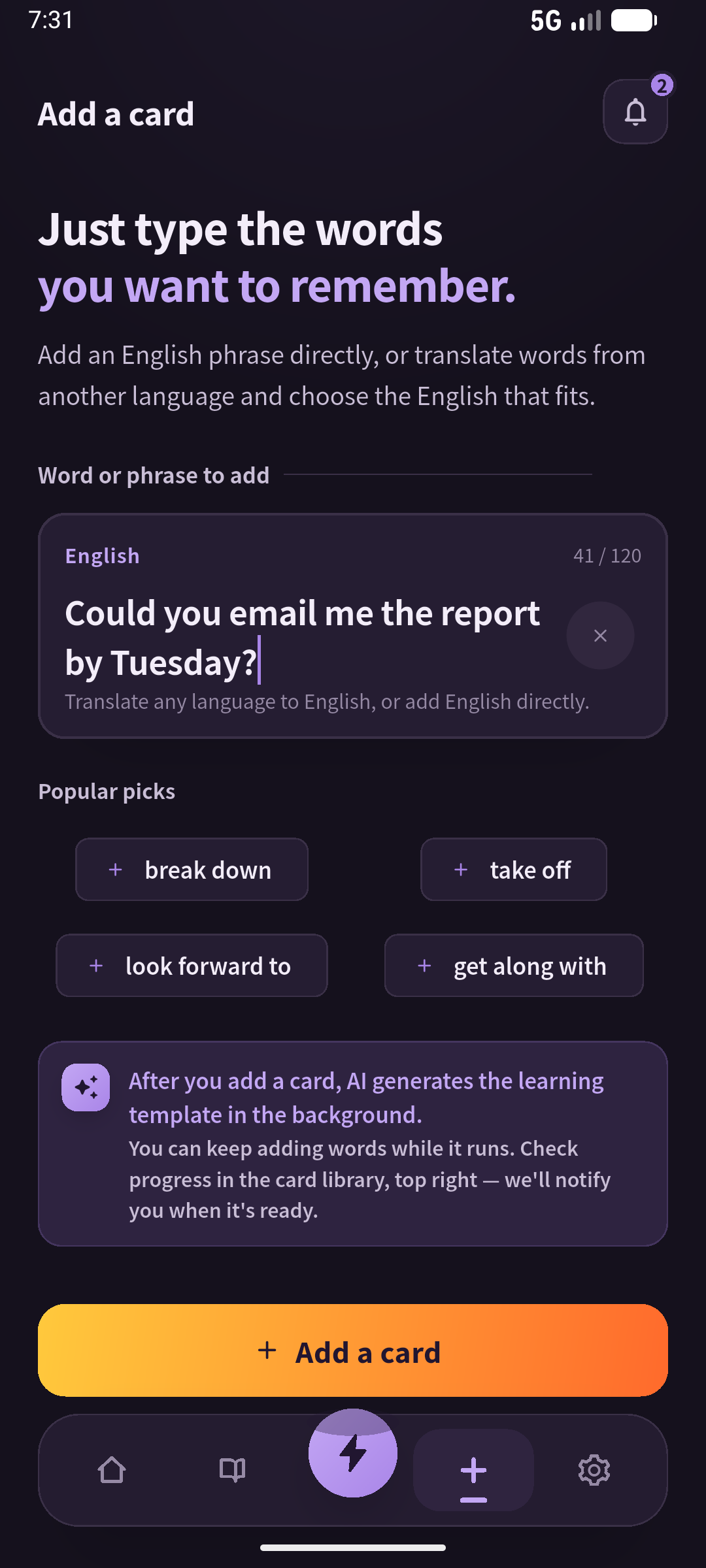
This is the app-generated Deep-voiced Viking model. You do not need to imitate the low voice. Listen for the object and deadline, pause, then say the request. Try situation-based recall before opening the practice screen: that screen plays audio automatically. Its hidden answer is a listening activity, not a silent recall test.
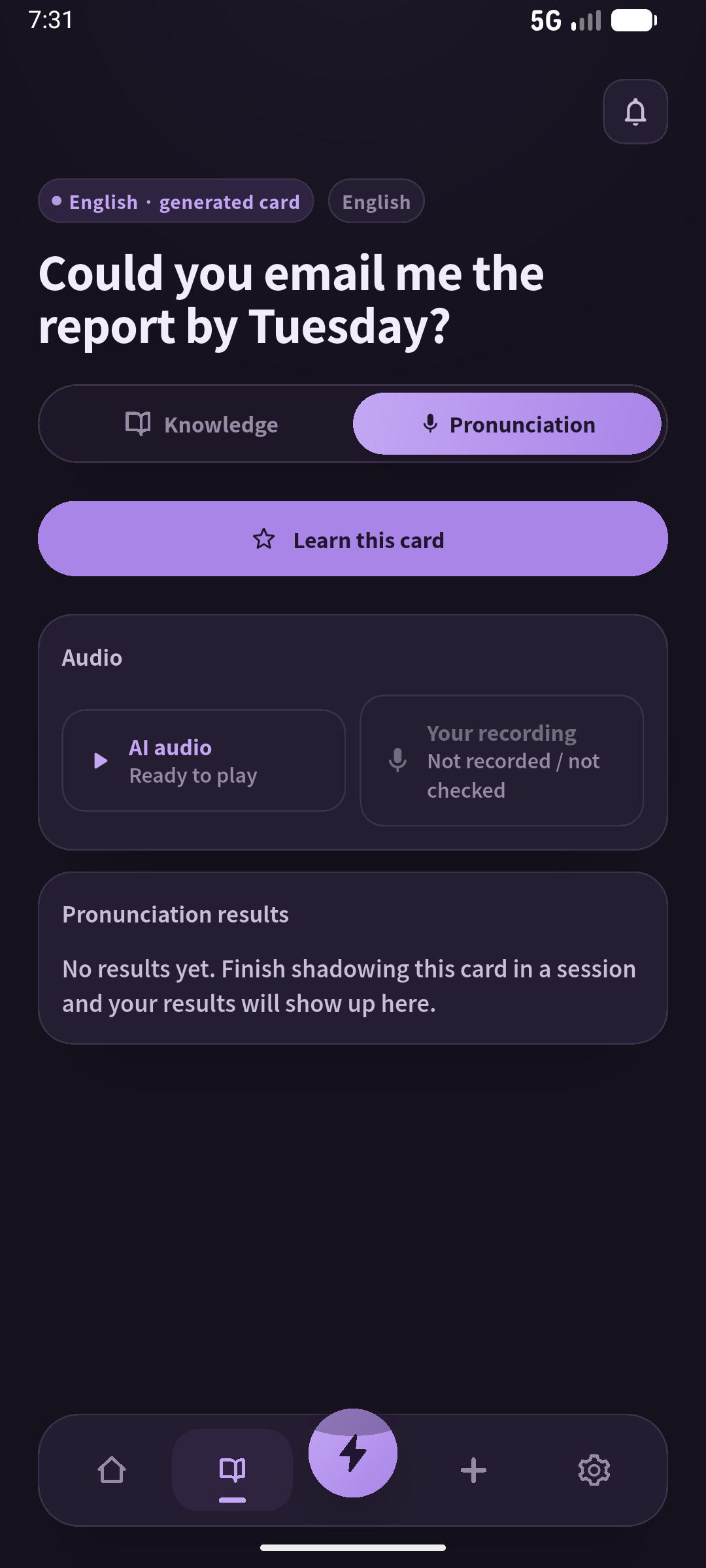
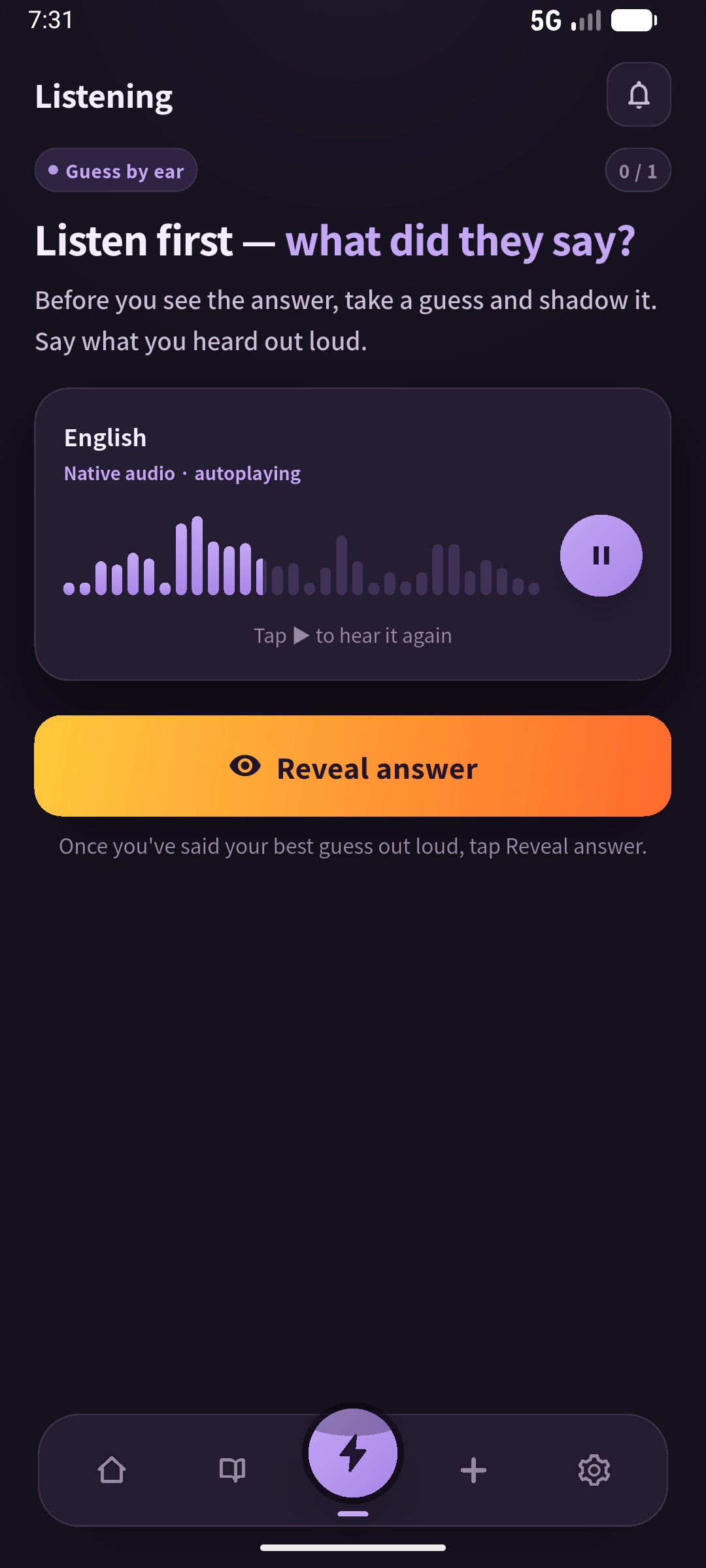
Ask a partner to accept Tuesday in one attempt and offer Wednesday in another. Clarify what you missed, negotiate if the later date is a problem, and confirm the final deadline. Put both sentence practice and an actual exchange in your schedule. Detailed guide: What Is SpeakGain? Learn English Phrases with a Character Voice explains the app; a score or card count is not evidence that a workplace conversation succeeded.
5. Build a five-hour week and a four-week plan
This allocation is an editorial starting plan, not a research-validated optimum. Arrange a willing teacher or learning partner for Saturday. Solo rehearsal can prepare you, but it leaves the check with another person undone. Four weeks are a review interval, not a promise of fluency.
| Time slot | Work | Minutes |
|---|---|---|
| Commute: 15 × 5 | Listen; check meaning only where you stopped | 75 |
| At home: 15 × 5 | Recall from a situation; request and confirm | 75 |
| Saturday | 30 prepare + 30 conversation + 30 review | 90 |
| Sunday | 20 check + 20 support + 20 plan | 60 |
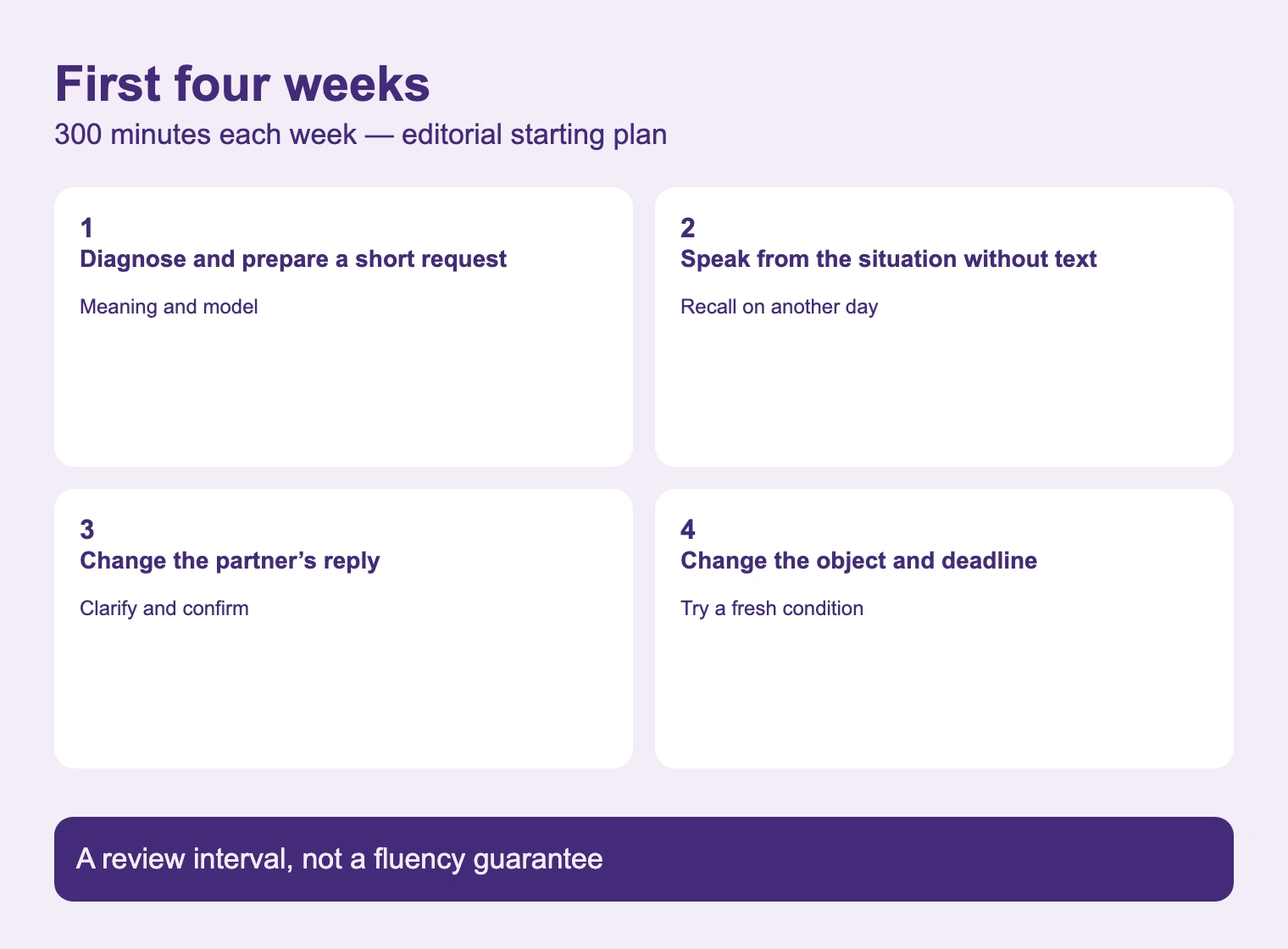
| Week | Main task | Weekend check / return point |
|---|---|---|
| 1 | Diagnose and prepare a short request | Explain meaning and repeat the model; return to words, structure or sound. |
| 2 | Speak from the situation without text | Request on another day without the model; return to the missing sentence. |
| 3 | Change the partner’s reply | Handle acceptance or a later date, clarify and confirm; return to missing replies or sounds. |
| 4 | Change the object and deadline | Use a different document and day in a fresh exchange; return to the part that stopped you. |
6. Choose a restart point
Our editorial advice is to choose what to return to on a tired day before buying more material. Fix both a time and a place where speaking is possible. On an overtime day, try yesterday’s missing sentence before checking it. Five minutes is five minutes, not a completed 30-minute session. On Sunday, adjust the next week’s load. Keep one main resource, a reference and a way to save practice. If a passage is too difficult to explain, shorten or simplify it. A record such as ‘request without notes; heard Wednesday; could not explain why it was too late’ directs the next practice. It is an example, not a real user result.
7. What the research supports
Karpicke & Roediger (2008)
Karpicke & Roediger (2008): full paper inspected. Students learned 40 Swahili–English word pairs and recalled them one week later. Continuing tests after a correct answer supported delayed recall more than dropping those tests while restudying. This measured word-pair recall, not workplace conversation. References
Cepeda et al. (2006)
Cepeda et al. (2006): PubMed abstract only. Their synthesis covered 317 experiments and 839 comparisons of verbal recall. Study spacing and the delay to the final test both related to retention. It does not prescribe universally optimal one-, three- and seven-day intervals or prove that 15 minutes daily improves conversation. References
de Jong & Perfetti (2011)
de Jong & Perfetti (2011): publisher abstract only. In 24 ESL learners, repeated 4-, 3- and 2-minute speeches improved fluency during practice; only the group repeating content maintained gains at post-test. This does not establish benefits from merely hearing one model sentence or transfer to every conversation. References
The diagnosis table, five-hour allocation and four-week sequence are our editorial design. The research did not test this package as superior. Change it in response to what you can actually do; do not infer a guaranteed improvement period from app use.
For the Grade 2 second stage, our Grade 2 interview guide explains the four tasks and how to allocate recording practice.
For a closer look at vowel contrasts, use the English vowel chart and priority-pair drills to check schwa, vowel quality and length in a recorded sentence.
To turn a dictionary lookup into spoken practice, use our guide to reading English phonetic symbols for the main symbols, notation differences and a practical learning order.
Common decisions
Where should a beginner start?
Try one short useful sentence. If its meaning is unclear, check basic words and subject–verb structure. If it is clear, use it rather than restarting every textbook.
How much each day?
Alex’s 30 minutes is an available slot, not everyone’s required dose. Reserve time for understanding, recall and the real task, including conversation or sustained reading.
Finish vocabulary and grammar first?
Check the meaning you need first, then use the understood sentence and return to gaps. Finishing all vocabulary is not a workable condition for starting conversation.
Is background listening enough?
Check what you understood separately from playback time. Compare a short unclear part with text, close it and listen again.
To practice the opening and ending of a conversation, use English greetings and replies to How are you? to choose a reply and one short update.
For choosing a thank you, adding a reason and receiving thanks, practise thanking in English by situation.
For a colleague in the hallway or at the end of work, our guide to otsukaresama in English helps you choose between a greeting, a goodbye and thanks.
What if four weeks are not enough?
Repeat the short task and name the obstacle: material too hard, no unaided recall, or no partner check. Adjust the next week instead of calling every difficulty a lack of effort.
Start today: write one purpose, try a short task and choose one return point from the table. Put the practice and the weekend check into your week.
For casual conversation and chat abbreviations, see English slang: understand more, use selectively and choose for the listener and situation.
For words to use at the table, English meal phrases and the meaning of itadakimasu helps you choose by timing and by whom you are thanking.
For everyday conversations at home, see what to say when leaving and coming home, with short exchanges and an explanation of the Japanese greetings tadaima and okaeri.
If you understand grammar but cannot form a sentence aloud, use our sentence-building practice method to work through five cues and turn one into your own reply.
To choose a tool for vocabulary study, our English vocabulary app comparison separates the purpose, free limits and practice for saying a usable sentence.
To choose a practice tool, compare material types, free limits and the check after listening in our English listening app picks.
If you are preparing for Japan’s EIKEN second stage, use our Pre-1 interview guide to practise four-scene narration and opinions supported by concrete examples.
If your goal requires IELTS, add the part-by-part answer patterns and recording routine in IELTS Speaking preparation to your study plan.
For a timed interview goal, use our Eiken Grade 1 preparation guide to add topic choice, a two-minute speech and follow-up correction to your study plan.
If you are taking Tokyo’s speaking test, our ESAT-J preparation guide explains the current tasks and practice for each part at home.
Families preparing Japan’s Eiken Grades 4 and 5 can use our Speaking Test and home-practice guide to check official entry rules and practise short, relevant answers together.
For admission to a Japanese university, our TEAP Speaking guide explains the four roles and solo recording practice.
If you are choosing an Eiken format in Japan, our S-CBT comparison and recorded-speaking guide helps you check dates, controls and solo preparation.
To choose a pronunciation goal, read English accents and intelligibility and separate sounding native-like from getting your message understood.
If music is your starting point, learning English with songs takes you from choosing a manageable section to saying a sentence you wrote yourself.
If you are still choosing a test, use our English test comparison to narrow the options by purpose, speaking format and the recipient’s requirements.
To choose a book, free audio or video for practice, compare levels and transcript access in our shadowing-material guide.
For a plan covering the first stage through the interview, see our Eiken Pre-2 study plan and priorities by time left.
For writing steps, the limits of memorized outlines and a self-review routine, see our Eiken Grade Pre-1 Writing guide.
For the summary and the essay with three reasons, see our Eiken Grade 1 Writing guide, with official viewpoints and newly written examples.
For Japan’s Eiken Pre-1 vocabulary, see our guide to choosing a wordbook or app and using words in your own sentences.
If vocabulary is your main obstacle in Japan’s Eiken Grade 1, see how to choose vocabulary resources and practise your own sentence for a comparison based on official provider information.
If you are deciding whether to aim for Pre-1, our guide to its official level, CEFR, adjacent grades and self-check steps helps you compare the evidence.
For focused vocabulary work, compare TOEIC wordbooks and the steps from meaning to sound and context against your target and current gaps.
If Reading runs out before you finish, use our TOEIC time-management guide to check official timings, try an editorial 75-minute budget and log where time goes.
References
How to introduce yourself in English: examples and your own 30-second introduction
Practise responding to another person: English listening responses
To turn your daily life into practice sentences, follow the three-sentence English diary: write, check, listen and say.
For a practical call, use English phone-call phrases and how to ask again to rehearse introductions, messages, spelling and number checks.
For apologies, attention requests and thanks, see how to apologize in English and choose a phrase for the situation.
For a visitor asking the way, use giving directions in English to practise one action, a landmark and a check.
For another speaking exercise, use the guide to compliments in English to choose what to praise and add one specific detail.
For workplace speaking practice, prepare an opening, transitions, a closing and Q&A replies with the guide to presenting in English.
For the Japanese phrase yoroshiku onegaishimasu, choose an English line by what you mean: a greeting, a request, future teamwork or thanks.
Practise a request you actually need with polite requests in English, adding a reason and a real option to decline.
For a phrase you can use at your next celebration, how to say congratulations in English helps you choose a birthday or promotion line and practise saying it.
For a phrase that can reassure someone or decline an offer, daijoubu in English shows how to choose a line for checking, reassuring, declining, or asking permission.
For a friend facing an exam or presentation, choose an encouragement line by timing—and a reply for your own effort—in how to say ganbatte in English.
For caring replies and your own sick-day notice, practice the short examples in get-well wishes and talking about feeling sick.
For short workplace replies, practise polite ways to say “understood” by separating understanding, accepting a task, and acknowledging an update.
To practise replying to plans and good news, use positive reactions in English to choose a phrase for the situation and the strength of your response.
For practising a whole sentence from its meaning, see our English sentence-building app comparison, including free limits and our editorial verdicts.
For choosing a speaking partner and checking free limits, see our English conversation app comparison with picks by practice type.
If you play English while commuting or doing housework, our passive-listening guide explains how to choose understandable material and add one sentence of checking each day.
For practice before a trip, use airport and immigration English to make a short answer from your itinerary and say it from a question cue.
If a Japanese employer asks you to take PROGOS, our PROGOS preparation guide explains the official format and CEFR result labels, then shows solo practice for workplace answers.
If you are leaving to study abroad, use the pre-departure speaking plan to choose priorities for three months, one month or one week and prepare a first-week sentence.
For shows to use on your commute or during chores, our English-learning podcast guide compares levels, purposes and transcript access, then adds one spoken sentence.
If you are preparing for an overseas assignment, use our work-and-life speaking plan to choose first-week sentences and practice for accompanying family members by the time you have left.
If you enjoy anime, use our five-stage scene routine to move from subtitle-supported understanding to writing and saying your own short sentence.
For current affairs as study material, our English news sites and apps comparison explains how to choose one manageable item and summarize it aloud.
If you are taking Japan’s Eiken, our Eiken app comparison by skill, grade and free access helps you choose a supplement to books and past papers.
To choose a grammar tool for your goal and level, use our grammar app comparison and speaking routine.
To choose a tool for your own entries, compare English diary and writing apps by correction type, consistency support and free limits.
For Japan’s Eiken Grade 2, our vocabulary resource and practice guide explains how to choose a book or app and use words in your own sentences.
For the official benchmark, CEFR and limits of pass-rate evidence, use our Eiken Grade 2 level guide and its steps for checking your readiness.
For focused practice at Japan’s Grade 3, our Eiken Grade 3 vocabulary guide compares official resource features and explains personal sentences and support at home.
Before choosing your test, use our Eiken Grade 3 level and pass-score guide to check the official reference, CSE thresholds and tasks across all four skills.
To compare the official benchmark, CEFR and the gap to Grade 2, read our Eiken Pre-2 level guide.
Before setting a target, use our TOEIC score-level guide to compare official benchmarks with your purpose.
Before choosing the next target, use our Eiken Grade 1 level guide to compare Pre-1, check official pass thresholds and try the official tasks yourself.
To choose a vocabulary resource and connect remembered words to all four skills, see how to choose and learn from TOEFL vocabulary books for official comparisons and five practical checks.