
What is Eiken Pre-2 Plus? Level, format and whether to take it
Published
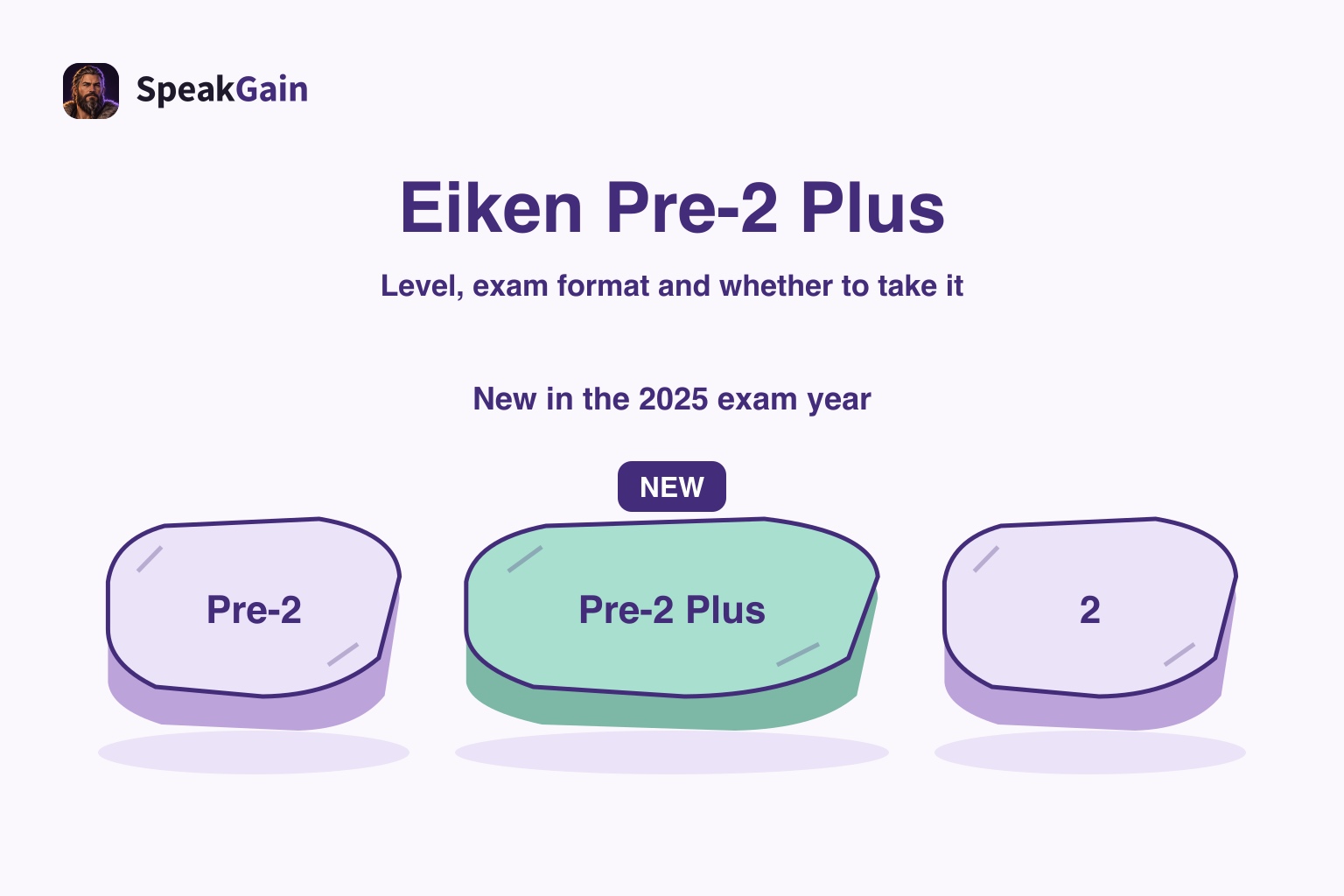
Eiken Pre-2 Plus is a separate grade introduced between Pre-2 and Grade 2 in the first administration of Japan’s 2025 exam year, with an official guideline of advanced high-school English. Compared with Pre-2, it includes an English summary and a three-panel narration task, asking learners to handle familiar social topics in more detail. Our editorial advice is to consider it when Pre-2 foundations are secure but Grade 2 tasks remain a substantial challenge, after checking any school requirements and deadlines.
This guide is for students and parents in Japan, including families who use English at home. Official exam information was checked on 16 October 2026. We describe the conventional two-stage exam; study methods and recommendations are editorial proposals. See the official introduction announcement and Pre-2 Plus site.
Pre-2, Pre-2 Plus and Grade 2 compared
Pre-2 Plus is not another name for Pre-2. Match your materials to the grade you enter. R means reading, W writing and L listening.
| Grade | Official guideline | Overall four-skill CEFR display range | First stage | Second stage | Passing CSE scores | Format sources |
|---|---|---|---|---|---|---|
| Pre-2 | Mid-level high school | A1–A2 | R: 29 questions; email 40–50 words and opinion 50–60 words; R/W 80 min. L: 30 questions, about 25 min | About 6 min; approximately 50-word reading aloud and 5 questions | First 1322; second 406 | Format, writing lengths |
| Pre-2 Plus | Advanced high school | A1–A2 | R: 31 questions; summary 25–35 words and opinion 50–60 words; R/W 85 min. L: 30 questions, about 25 min | About 7 min; approximately 55-word reading aloud and 4 questions, including three-panel narration | First 1402; second 427 | Format, writing lengths |
| Grade 2 | High-school graduation | A2–B1 | R: 31 questions; summary 45–55 words and opinion 80–100 words; R/W 85 min. L: 30 questions, about 25 min | About 7 min; approximately 60-word reading aloud and 4 questions, including three-panel narration | First 1520; second 460 | Format, writing lengths |
All rows checked on 16 October 2026. Common sources: official level guidelines and CSE/CEFR explanation. Reading totals are sums of the official sections. CEFR is determined by the score within the grade’s reporting rules, not by the grade name alone. All four skills are required. Plus reports no overall CEFR below 1550, A1 at 1550–1699, and A2 at 1700–1949; even 1950 or above is capped at A2. See the official Plus examples.
Should you take Pre-2 Plus?
Consider Plus if an intermediate goal would help you work towards Grade 2. If you need Grade 2 for admission, plan backwards from that requirement first. You do not have to pass every grade in sequence: rule 3.2 permits entry regardless of previously taken grades.
| Situation | Editorial suggestion | How to check |
|---|---|---|
| You passed Pre-2 but cannot yet complete Grade 2 reading and summary tasks | Consider Plus as the next goal | Try Plus reading, both writing tasks, listening and speaking |
| Pre-2 grammar, vocabulary or writing still has major gaps | Repair the foundations before deciding | Review a Pre-2 paper and your results; identify why you get stuck |
| You can attempt Grade 2 across all four skills | Going directly to Grade 2 is reasonable | Include writing and speaking, not just vocabulary questions |
| A school requires Grade 2 or B1 and the deadline is close | Prioritise the specified requirement | Check grade, CSE, CEFR, eligible dates and document deadline |
| You want a manageable checkpoint rather than an admission credential | Plus may be useful | Compare your available study time with the official Can-do goals |
| Someone says Plus always helps with university admission | Verify before applying | Read the specific school, year, faculty and admission route’s rules |
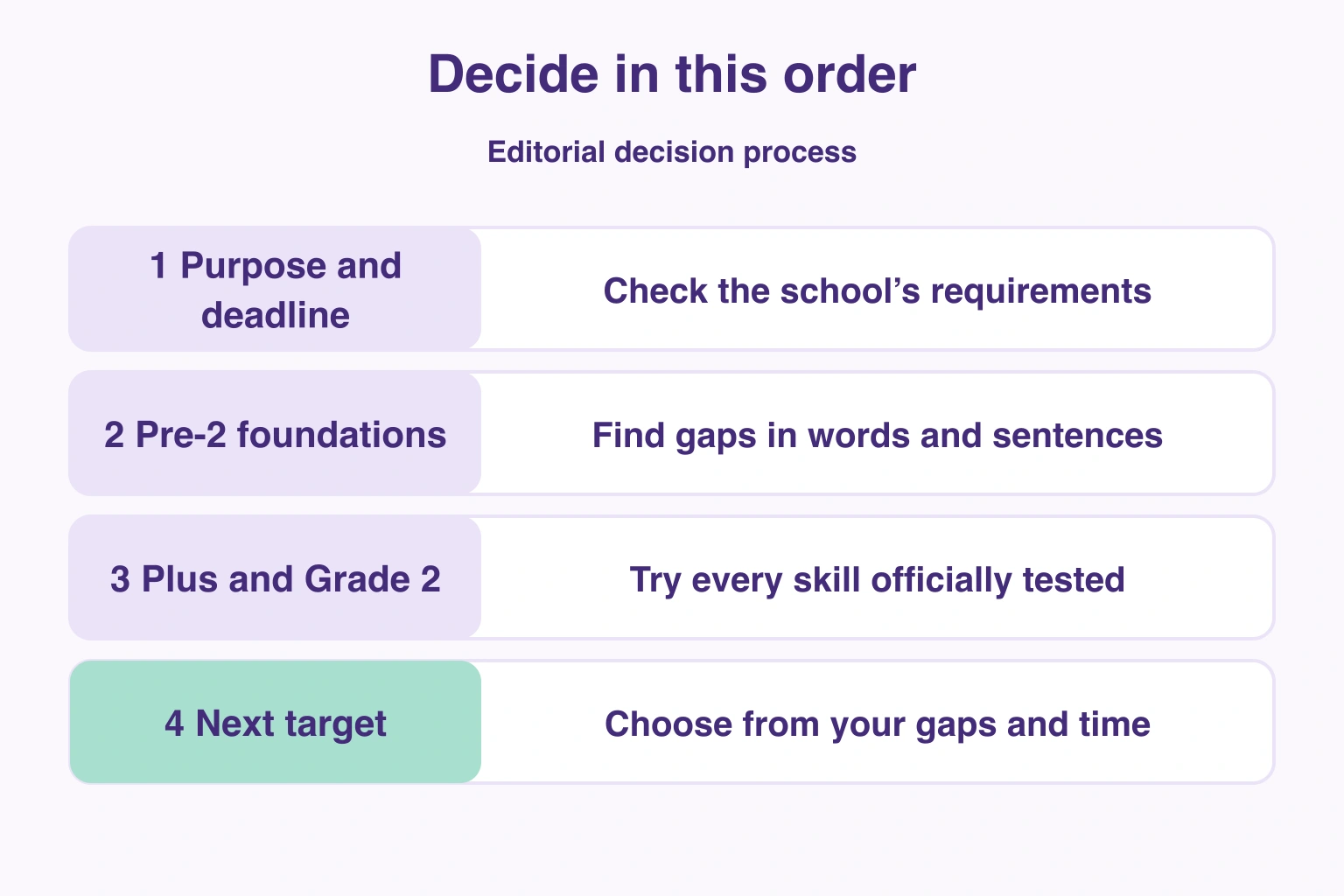
Our decision procedure: purpose and deadline → Pre-2 foundations → try Plus and Grade 2 tasks → choose the next learning target. Do not select a grade from one vocabulary score. A high-school guideline is not an age restriction; rule 3.1 sets no age, occupation or educational-background requirement.
For wider choices, use which Eiken grade to take. Repair foundations with the Pre-2 study plan, or move on with the Grade 2 plan.
Why was the grade introduced, and what changes in level?
The official Plus site describes an intermediate goal intended to support continued learning between Pre-2 and Grade 2. Introducing Plus did not change the existing grades’ scope, format, difficulty settings or names.
The Can-do list focuses on understanding main points and details on familiar social topics and expressing information and ideas in detail with varied language. Pre-2 centres on everyday topics and basic expressions; Grade 2 adds attention to the development of social-topic texts and explanations. Compare the three grades’ Can-do descriptions as well as the task lists.
Our practical interpretation is to practise explaining who benefits from an idea and why, rather than only naming vocabulary or giving a yes/no opinion. This is a learning proposal, not a prediction of exam topics. Universal required study hours, a fixed time to pass or a numerical “difficulty multiplier” are not stated in the official sources checked. Diagnose your own task-level gaps instead.
CSE scores: what does 1829 mean?
The Plus first-stage threshold is 1402; the second-stage threshold is 427. The first stage uses the combined R/W/L CSE scores; the second uses speaking separately, according to the official CSE explanation. The Plus site’s 1829 is the sum of the two thresholds. It does not let a high speaking score cancel a first-stage result below 1402.
| Item | Plus CSE score | Meaning |
|---|---|---|
| Maximum per skill | 625 | Equal maxima regardless of question counts |
| First-stage maximum / threshold | 1875 / 1402 | Three skills combined |
| Second-stage maximum / threshold | 625 / 427 | Speaking assessed separately |
| Four-skill maximum / sum of thresholds | 2500 / 1829 | Does not replace separate stage decisions |
Sources: skill maxima and calculation, pass criteria. Totals are arithmetic sums. CSE is calculated statistically after marking all papers; candidates cannot convert their own correct-answer count directly to CSE. A fixed number or percentage that guarantees a pass is not officially stated. Use practice results to identify errors, not to promise an outcome.
Reading: 17 + 6 + 8 questions
Official format: Plus reading has 17 sentence-completion, 6 passage gap-fill and 8 reading-comprehension questions, all four-option choices. Reading and writing share 85 minutes. No official fixed time per section is stated.
Change from Pre-2: Pre-2 has 15 sentence-completion, 5 dialogue gap-fill, 2 passage gap-fill and 7 comprehension questions. Plus therefore needs its own format practice. Matching Grade 2’s section counts does not mean the same difficulty.
Editorial practice: Classify errors into word meaning, sentence structure, links between ideas and misreading the question. Summarise each paragraph’s role, then locate evidence for the answer. Read a chosen gap-fill word back in context. Start reading alongside vocabulary study so that sentence-level gaps become visible early.
Official materials: Use a matching paper and answer set from the Plus past-paper page. If comparing Grade 2, try its official papers too, recording where the extra difficulty appears.
Writing: separate summary from opinion
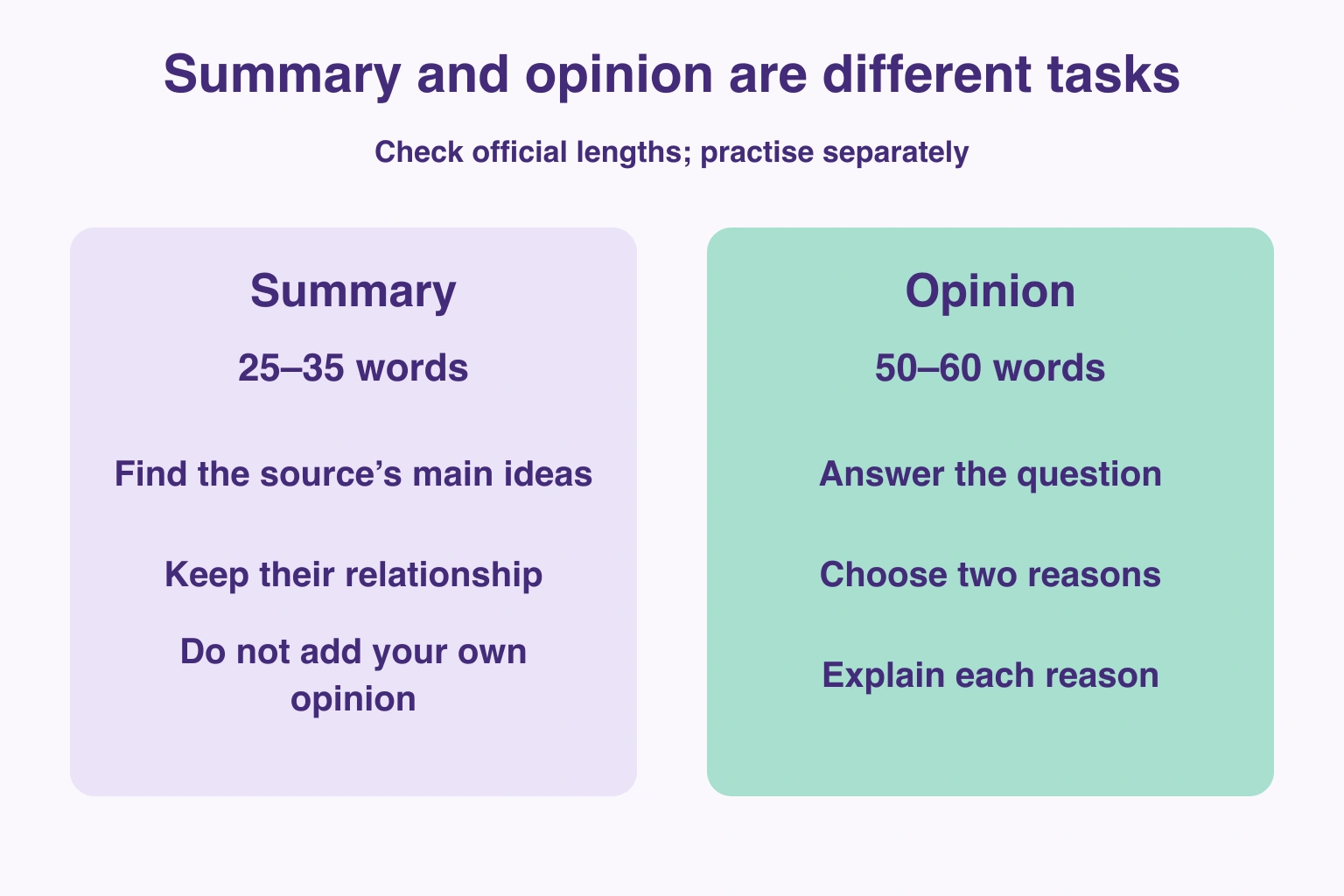
Official format: One summary and one opinion composition. The 2026 second-administration paper, pages 12 and 14 specifies 25–35 words for the summary and 50–60 words with two reasons for the opinion. The English format page agrees. Both fit within the shared 85 minutes.
Change from Pre-2: Pre-2 uses an email reply and an opinion composition; Plus replaces the reply task with a summary. Grade 2 requires a 45–55-word summary and 80–100-word opinion. Check Pre-2 and Grade 2 separately.
Editorial practice: For summary, identify the source’s main ideas and keep their relationship while shortening; do not add your own position. For opinion, answer the question, select two distinct supporting reasons and explain each. Memorising a long model answer is less useful than learning to tell source information from your own argument.
Check meaning and relevance as well as word count. The official Plus FAQ identifies content, organisation, vocabulary and grammar as summary scoring perspectives. Difficult words alone are not a useful goal.
Official materials: Use past papers and answers, the first-stage sample and the Grade 2/Plus summary comparison leaflet linked from the Plus site. We link to official questions rather than reproducing them.
Listening: still 30 questions, different sections
Official format: Plus has 15 dialogue-comprehension and 15 passage-comprehension questions. Each recording plays once, with four printed options. The general format says about 25 minutes; the 2026 second-administration booklet cover says about 24 minutes. Also follow the instructions for your sitting.
Change from Pre-2: Pre-2 has three sets of ten: response selection, dialogue comprehension and passage comprehension. Plus has no separate response-selection section.
Editorial practice: First attempt without pausing. Then distinguish unknown words, words recognised only in print, and losing the relationship between ideas. Check the script, replay a short segment and finally close the text and explain the message. Do not repeat unintelligible audio indefinitely without investigating why it is difficult.
Official materials: Match the recording, script and answers to the same administration. Record what you understood before and after reading the script.
Speaking: narrating three panels
Official format: The second stage is an individual interview of about seven minutes with one examiner: roughly 55 words read aloud, one passage question, one three-panel narration and two opinion questions. Silent reading and narration preparation each have a separate 20-second period.
Change from Pre-2: Pre-2 includes illustration questions about people’s actions and situations. Plus asks you to explain a sequence. Fewer questions does not by itself mean less work.
Editorial practice: Describe who does what and what happens next in short connected sentences. Add reasons to opinions and check that the answer addresses the question before making it longer.
Official materials: Try the sample and virtual second-stage walkthrough. Detailed preparation belongs in our Pre-2 Plus interview guide.
Where are the official papers and samples?
Official past papers are available. On 16 October 2026 the Plus page listed 2026 administrations 2 and 1, and 2025 administration 3, with first-stage booklets, answers, scripts and audio. The second-stage resources are a sample PDF and virtual walkthrough; distinguish samples from administered papers.
The dedicated site also links introductory samples and a summary comparison leaflet. Check provider, grade, year and administration: an unofficial predicted question is not an official past paper. Our suggestion is to use one sitting to diagnose and save another for a later check, rather than judging progress only on answers you have memorised.
What order should you study in?
This is an editorial sequence, not a prescribed number of days:
- Check the current format and try all skills, including both writing tasks and the speaking sample.
- Repair vocabulary, grammar and links between ideas in sentences you could not understand.
- Practise summary and opinion from the start, checking source correspondence and reasons separately.
- Continue listening and spoken explanation alongside written work.
- Use another official paper to check timing and recurring errors; adjust the next week’s allocation.
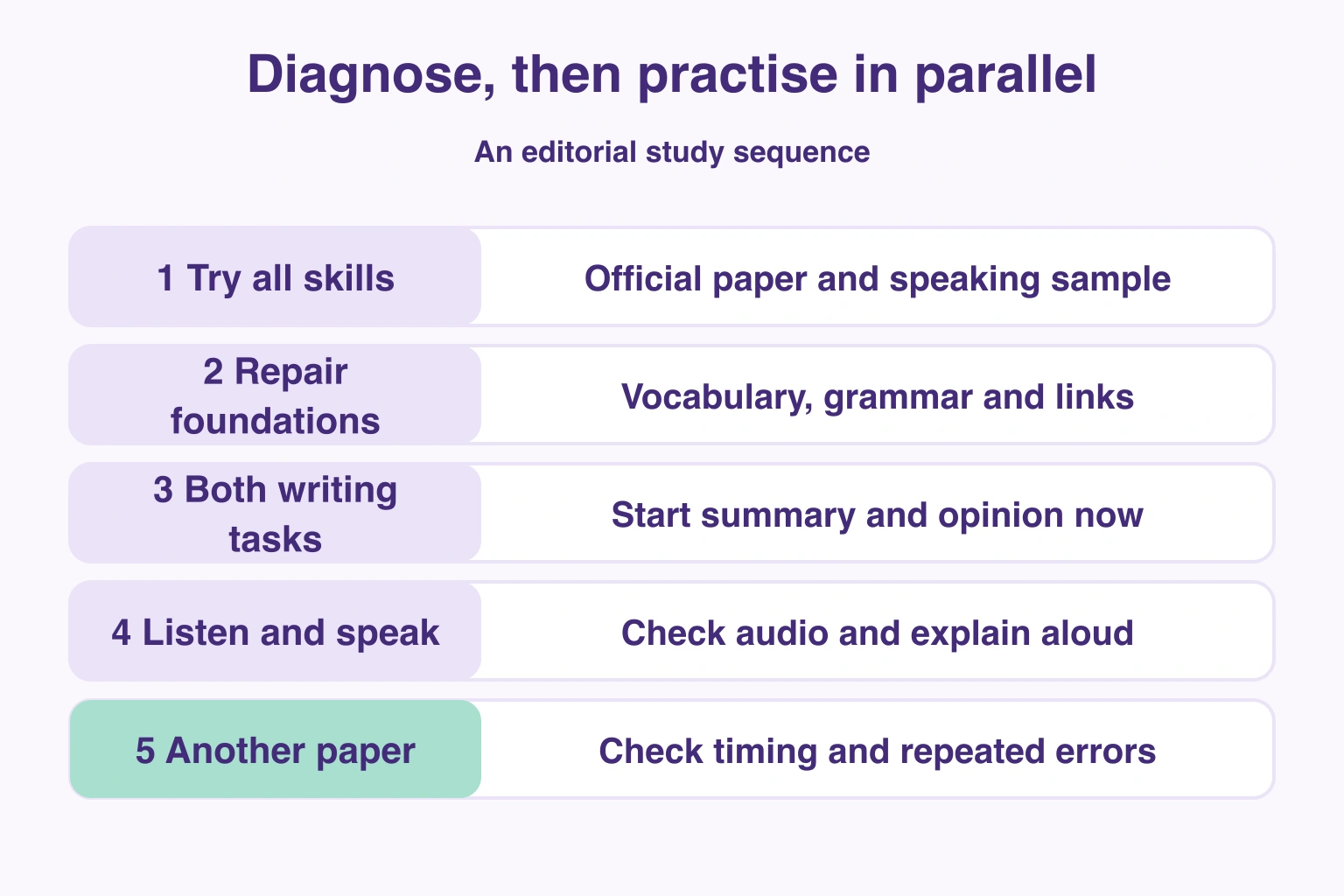
This does not mean finishing one skill before starting another. If a summary is blank, begin it alongside vocabulary revision. With limited time, prioritise an untouched task or repeated mistake over collecting more materials. Parents can ask what the student can now explain, rather than only how many pages are finished. Choose tools after choosing the task; see Eiken study apps by purpose.
A short opinion-and-reason example
Our original practice sentence, not an official question or answer:
I think schools should reuse uniforms because it helps families save money.
Check that the opinion and the benefit to families connect. Read it aloud, close the text and try to express the same meaning. This has one reason and 12 words, so it is not a completed 50–60-word exam composition with two reasons. A real response needs another relevant reason and explanation tailored to its question. We do not recommend pasting the same sentence into every answer.
Listen and restate a short opinion with SpeakGain
In SpeakGain, we saved our original sentence through Add, opened its card in Library and chose “Learn this card.” On the device, Listening hid the sentence and prompted us to listen, guess and say what we heard. “Reveal answer” displayed the saved sentence; the answer screen also offered replay and review intervals. You can use this flow to restate an opinion and its reason aloud.
If Pre-2 vocabulary is still a gap, use our Pre-2 vocabulary guide to connect meaning, examples, sound, your own sentence and review.
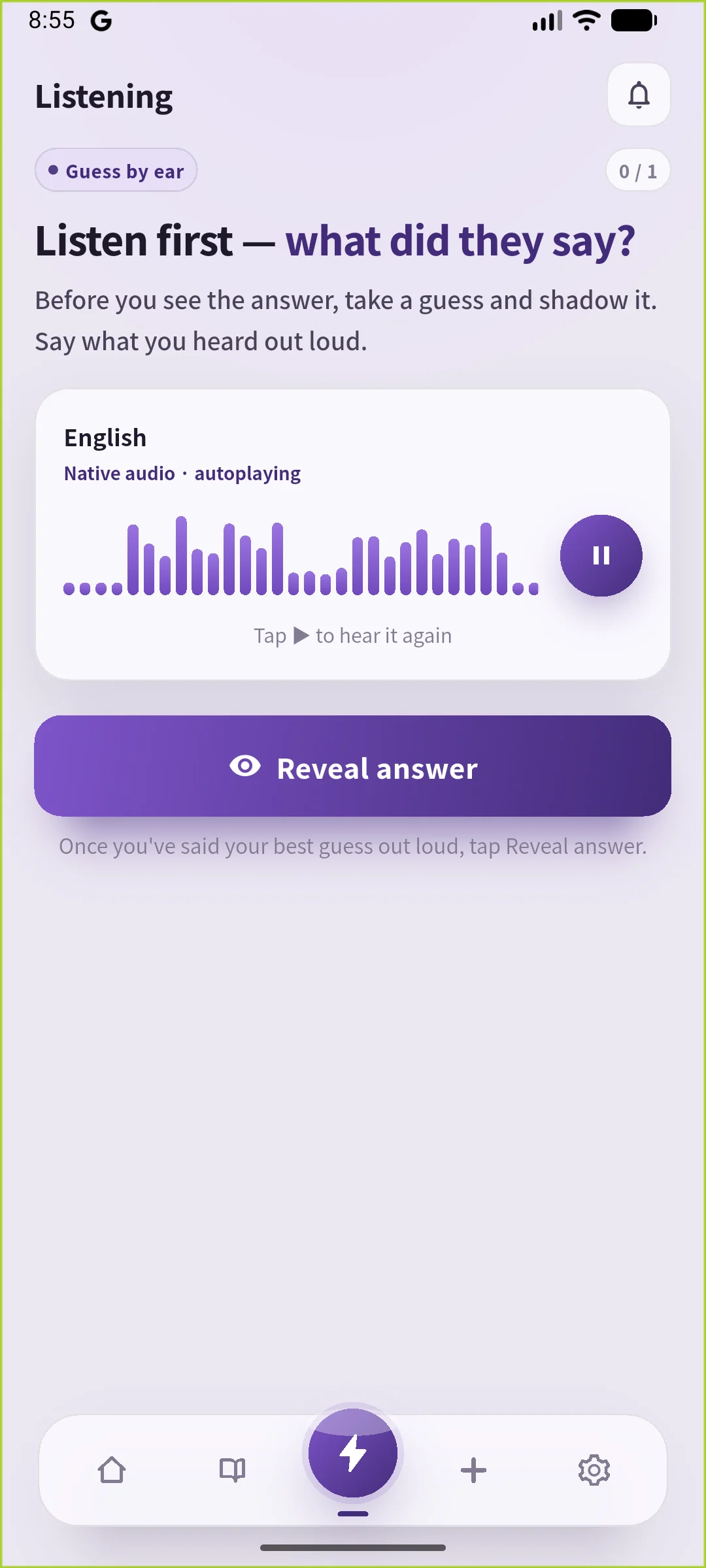
Listen to our original sentence in the Viking voice
This is the same sentence above, with AI-generated audio. Listen, hide the text and try saying it again. This is practice with your own sentence, not an Eiken mock test, answer or pronunciation scoring, or a score prediction.
University admission: check the specific requirements
There is no universal admission advantage for Plus. Use the specific institution’s current requirements for the relevant year, faculty and admission route. The official admission checklist explains checking grades, CSE, CEFR and documents.
Confirm the required grade or score, how it is used, accepted test formats and dates, certificate type and submission deadline. If Plus is not named, do not infer its treatment from Pre-2 or Grade 2; ask the institution. Plus’s overall CEFR display is capped at A2, so it cannot provide a required B1 result. Compare the official reporting rules with the school’s wording.
Frequently asked questions
When did Plus begin?
The conventional exam began in the first administration of 2025; see the official announcement.
Is it closer to Pre-2 or Grade 2?
Its official position is between them, with an advanced high-school guideline. Summary and narration resemble Grade 2 task categories, but lengths and demands differ. Compare formats and Can-do goals.
Can I skip it?
Yes. Rule 3.2 permits entry independently of previous grades. Our advice is to test Grade 2 across all skills before deciding.
Are official papers available?
Yes, through the Plus paper page; samples are also on the dedicated site. Match the grade, year and sitting.
Which CEFR level does it report?
A1–A2 within its reporting rules; below 1550 no overall level is displayed, and above 1949 the cap remains A2. All four skills are required. See official examples.
Is 1829 enough to pass?
Check first-stage 1402 and second-stage 427 separately. Their sum is not a substitute for the two stage decisions.
Does it help with university admission?
It depends on the institution’s requirements. Check the grade, scores, eligible dates, certificates and deadline; do not generalise from another school. Start with the official checklist.
Where should I begin?
Our recommendation is a current official paper plus the speaking sample, followed by targeted repairs and parallel practice across skills. Official sources state no universal study-time guarantee.
Editorial verdict
Choose Plus as an intermediate goal when Pre-2 foundations are secure and Grade 2 tasks still feel too demanding. If you are ready for Grade 2 and need it for your goal, do not take Plus solely to follow a sequence. Today, check any school requirement, attempt both Plus writing tasks and record one thing to repair next.
Official information checked on 16 October 2026. Examples, diagrams and learning recommendations are editorial work, not official questions, answers or pass predictions. Eiken is a registered trademark of the Eiken Foundation of Japan.
To compare the official benchmark, CEFR and the gap to Grade 2, read our Eiken Pre-2 level guide.