
Eiken Pre-2 Plus interview: format, differences and solo practice
Published
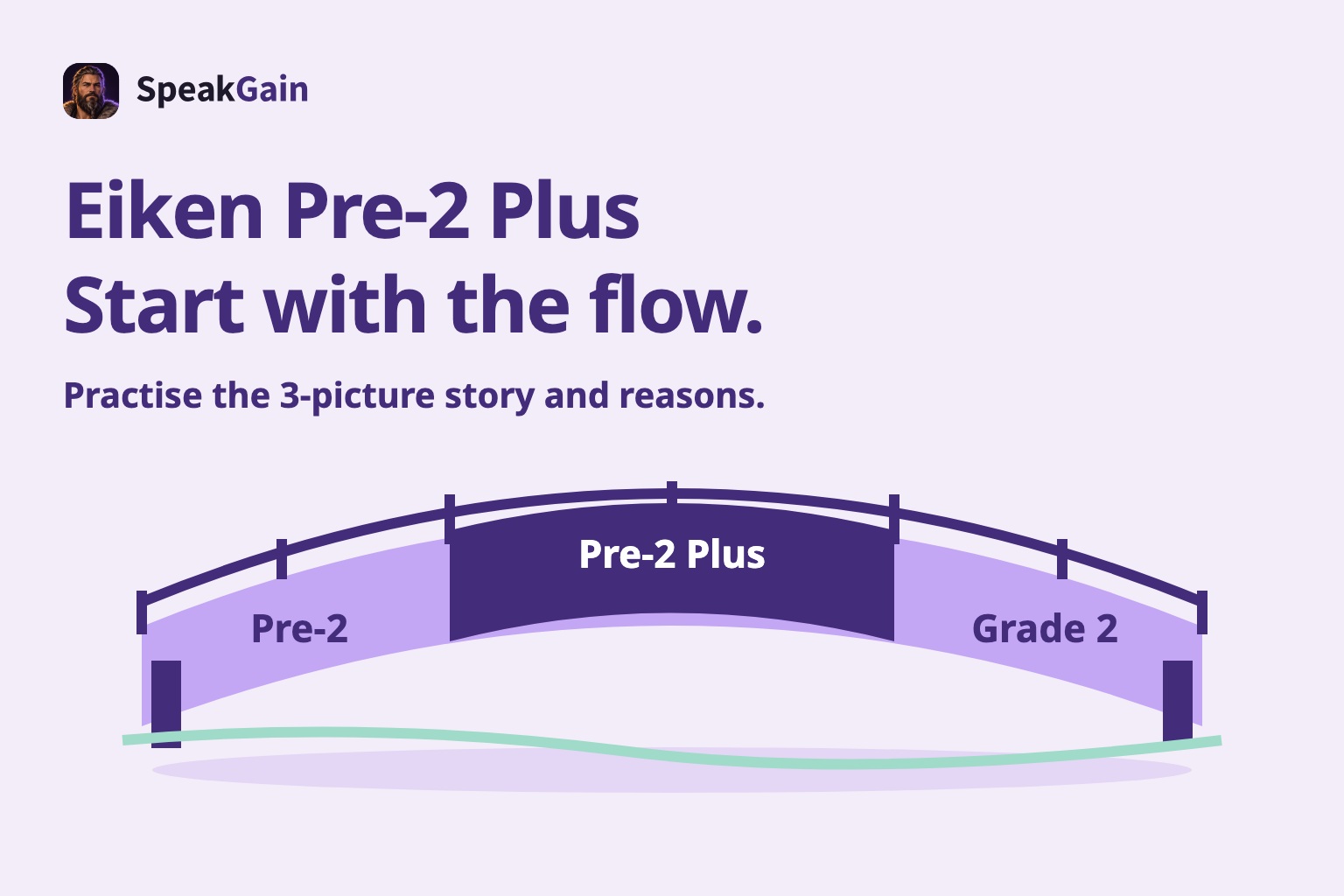
Japan’s Eiken Grade Pre-2 Plus interview takes about seven minutes: you read a passage of about 55 words aloud and answer four questions about the passage, a three-picture sequence and your own opinions. The secondary-test passing threshold is CSE 427; responses are assessed for content, pronunciation, vocabulary, grammar, usage, information and willingness or attitude to communicate. For solo preparation, first learn the official flow, then record a connected picture story and an opinion supported by a concrete reason.
This guide covers the conventional in-person interview, not the first-stage exam or computer-test controls. The grade was introduced in FY2025 between Pre-2 and Grade 2. We checked the official format, new-grade site and CSE thresholds on 14 October 2026. Our examples and practice plans are original editorial suggestions, not official questions or predicted scores.
For the big picture first, see our all-grade Eiken comparison and common preparation guide before choosing your grade’s practice.
If you are choosing between Pre-2 and Grade 2, our Pre-2 Plus guide compares the official requirements and gives a step-by-step decision process.
Interview flow and question structure
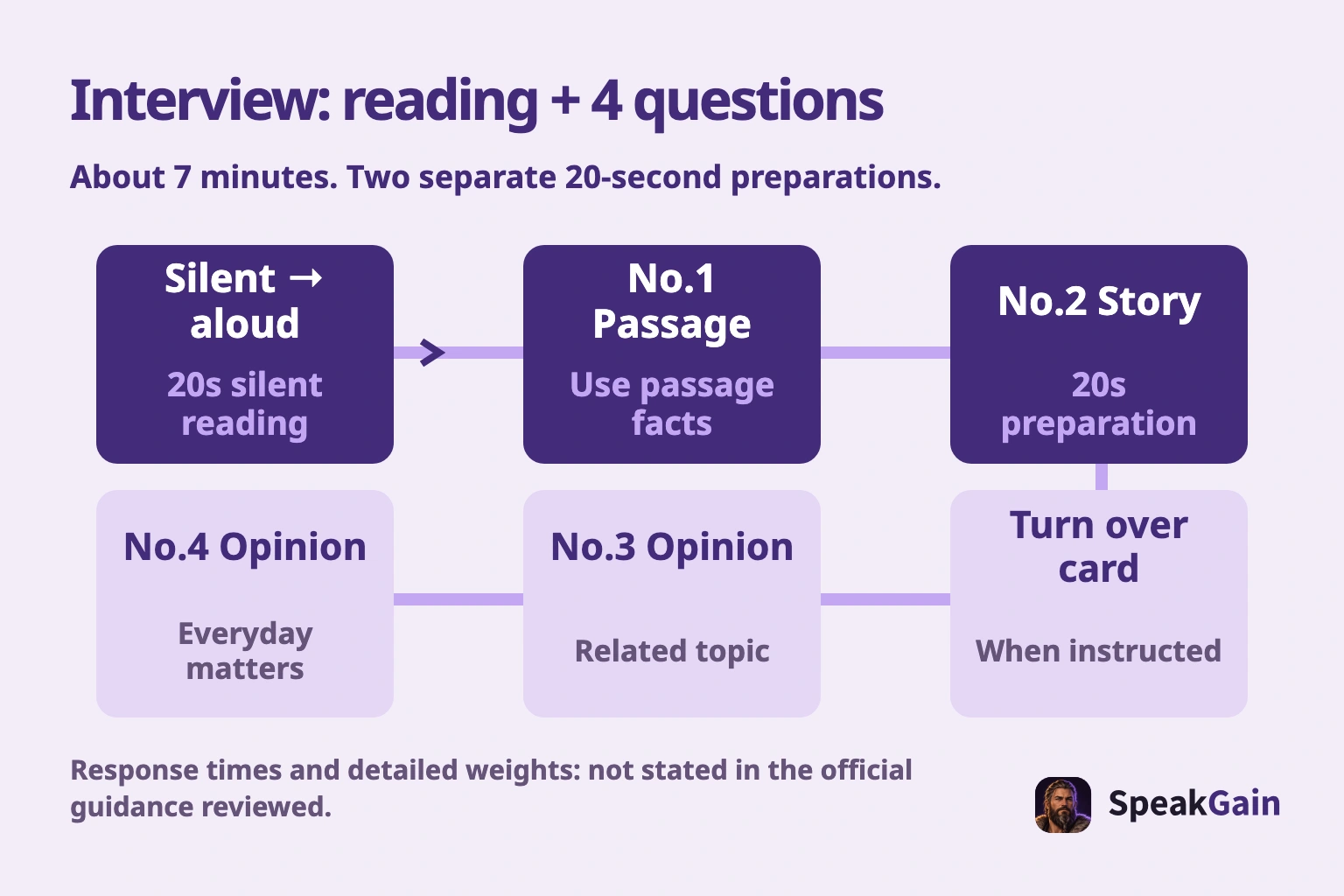
Silently read for 20 seconds, read from the English title, answer No.1, then prepare for No.2 for another 20 seconds. After the three-picture explanation, turn over the card when instructed; answer No.3 and No.4 without looking at it. The examiner is one person and communication is in English. The interview card handed over on entry and the question card you receive are different items.
The table follows the official instructions and virtual interview, checked on 14 October 2026. The last column is our practice checklist based on official evaluation perspectives, not an official allocation of points. Individual response durations and detailed question weights are not stated in the official guidance reviewed.
| Order | Task and card use | Official time or amount | Our practice check |
|---|---|---|---|
| Entry and greeting | Hand over interview card; sit when instructed; confirm name and grade | Individual timing not stated | Respond to instructions |
| Receive card and read silently | Passage and three pictures | 20 seconds | Understand the topic and connections |
| Read aloud | Start with the English title | About 55 words; reading duration not stated | Preserve words and meaningful groups |
| No.1 | Answer about passage; may look at card | One question; response duration not stated | Select the information actually requested |
| No.2 | Explain the three-picture sequence; opening supplied on card | 20-second preparation; one question; response duration not stated | Connect people, events and changes |
| Turn card over | Follow examiner’s instruction after No.2 | Timing not stated | Switch tasks |
| No.3 | Your opinion about a matter related to the card topic | One question; response duration not stated | Position and relevant reason |
| No.4 | General everyday matters, including matters not directly related to card | One question; response duration not stated | Answer the new question |
| Finish | Return question card and leave | Whole interview about seven minutes | Listen through the closing instructions |
Pre-2, Pre-2 Plus and Grade 2: what changes?
Moving up from Pre-2, add practice connecting three pictures into a sequence. A similar structure in Pre-2 Plus and Grade 2 does not mean identical difficulty or interchangeable answers. We inspected each grade’s Pre-2 format, Pre-2 Plus format, Grade 2 format and the CSE table separately on 14 October 2026.
| Feature | Pre-2 | Pre-2 Plus | Grade 2 |
|---|---|---|---|
| Interview | About 6 minutes | About 7 minutes | About 7 minutes |
| Passage | About 50 words | About 55 words | About 60 words |
| Questions after reading | Five | Four | Four |
| Passage question | No.1 | No.1 | No.1 |
| Pictures | Actions in No.2; situation in No.3 | Three-picture sequence in No.2 | Three-picture sequence in No.2 |
| Own opinions | No.4 and No.5 | No.3 and No.4 | No.3 and No.4 |
| Turn card over | After No.3 | After No.2 | After No.2 |
| Main topics | Everyday life | Familiar social topics | Social topics |
| Secondary CSE threshold | 406 | 427 | 460 |
The official new-grade FAQ describes a bridge: more abstract topics than Pre-2, with vocabulary and syntactic structures imposing less cognitive load than Grade 2. Use the actual Plus sample as your reference. Our Pre-2 interview guide, Grade 2 guide and Grade 3 guide help you choose the right grade-specific practice.
Passing score and assessment
The secondary threshold is CSE 427, with a per-skill maximum of 625. The official CSE explanation says the secondary judgement uses Speaking alone and thresholds do not change. The official calculation explanation gives the maximum and says statistical calculation means candidates cannot calculate their CSE score from their own correct-answer counts.
The official format lists response content, pronunciation, vocabulary, grammar, usage, information and communicative willingness/attitude. In the guidance we reviewed, detailed point weights, a raw-score-to-CSE table, minimum sentence counts and mandatory reason counts are not stated. Do not turn 427/625 into a required accuracy percentage or decide a question can safely be discarded.
Our recording checklist asks whether the answer matches the question, the sequence is understandable and an opinion has a relevant reason. A long answer about the wrong person needs a content correction before pronunciation polishing. If the content works but one word is unclear, practise that word within its sentence.
Reading aloud: preserve the meaning groups
Task: after 20 seconds of silent reading, read the roughly 55-word passage from its title. This is reading the printed text, not rewriting it as an opinion.
Our pattern and example: connect subject and verb, continue through meaning groups, and use punctuation to organise the reading.
Some libraries lend tools to local people.
The sentence describes libraries lending tools to people nearby. Keep the subject, action and recipient connected rather than pausing after every word. This original one-sentence exercise does not replace practising a full passage.
Solo practice: use the official sample privately, allow 20 seconds, then record the title and whole passage. Compare the recording with the text; correct one skipped word, ending or awkward pause. Practise a difficult word with its neighbours, then return to the whole text. See our reading-aloud method.
Common mistakes: omitting the title, rushing and dropping endings, or restarting everything after one error. We prioritise an understandable reading; practise a brief correction followed by continuing.
No.1: take the requested information from the passage
Task: answer about the passage while referring to the card. Identify the subject and whether the question requests a reason, method or another detail.
Our pattern and example: question target → supporting passage information → a short response that matches the subject. In our invented situation, residents repair things by borrowing library tools:
By borrowing tools from the library.
This answers how they can do it. A why-question needs a reason instead; do not automatically begin every answer with “By”. None of our examples predicts an actual question.
Solo practice: write two short factual sentences and make a method question and a reason question. In a second version, residents use the service because they need not buy tools. Shuffle the questions, record answers while viewing the text, then check evidence, pronouns or irrelevant additions. Fix one point and repeat.
Common mistakes: selecting a clause just because it contains “because”, using the wrong subject, adding personal preferences or always reading the final sentence. A connecting word is a clue, not a complete answering strategy.
No.2: explain what changes across three pictures
Task: explain the three-picture sequence. You get 20 seconds to prepare and the opening is printed on the card. Explain the actual actions, speech and situations rather than listing objects.
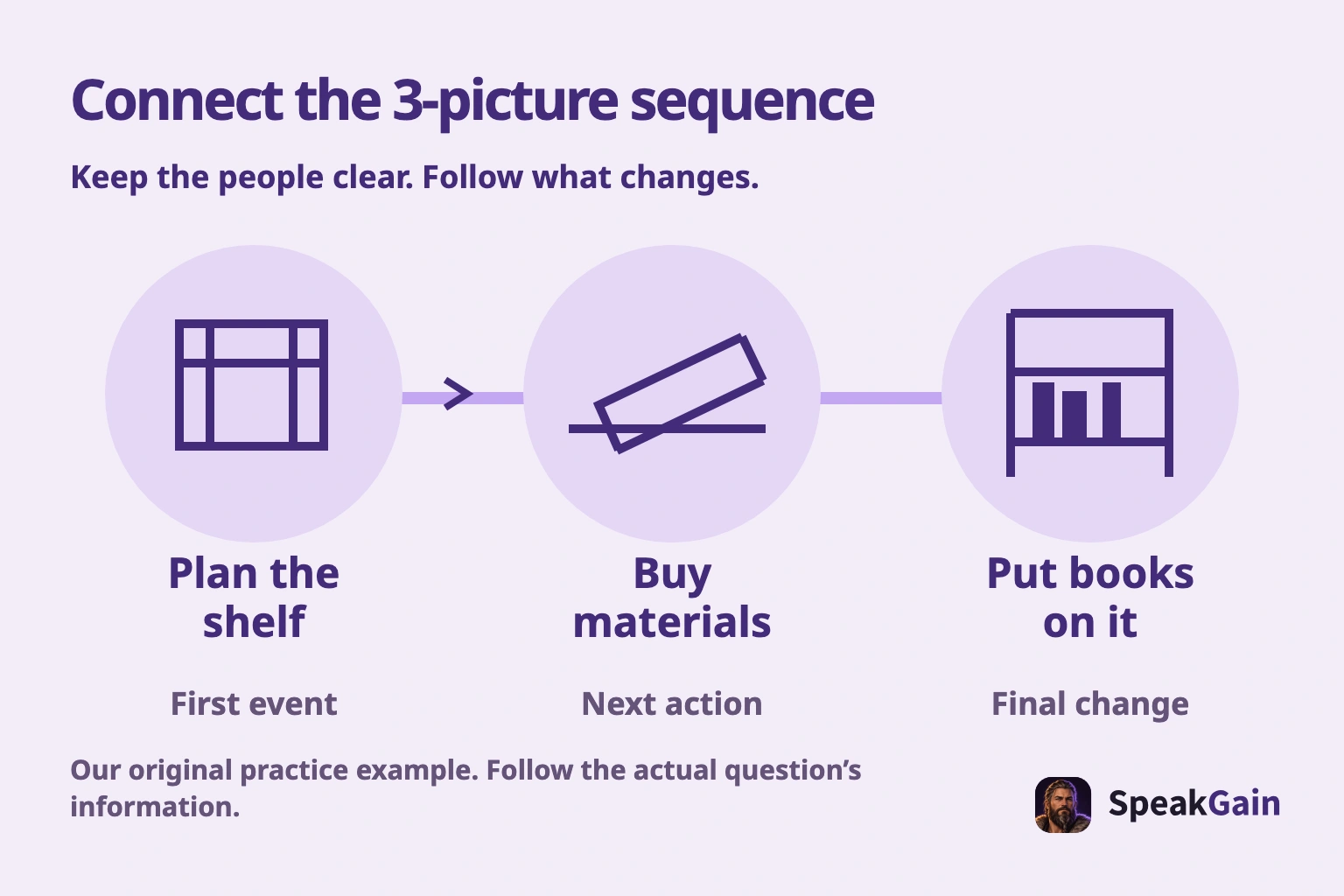
Our pattern and example: supplied opening → first event → next action → final change. Our invented scene involves a brother and sister making a shelf:
On Saturday, a brother and sister planned to make a shelf. Later, they bought some wood at a store. That evening, they put their books on the new shelf.
They plan, buy wood and finally use the completed shelf. The three sentences illustrate a connected explanation; they are not an official minimum. In the real task, use the provided opening and relevant visible information.
Solo practice: make three simple home-practice notes: plan, buy, finish. In 20 seconds, identify who appears, each main event and the final change. Initially use brief notes in your own language; next explain without a prepared English script and record. Notes are for home practice, not the exam. Check whether you skipped the middle, renamed the same people confusingly or failed to convey the ending. Repair that part, record again, then change the scene.
Common mistakes: naming objects only, spending all your time on the first scene, or inventing an argument or background absent from the picture. Our approach is to get each main action clear before adding necessary speech or reasons. During preparation, identify the changes rather than attempting to compose every sentence in your head.
No.3: choose a position and make the reason specific
Task: give your opinion on a matter related to the card topic, with the card turned over. Switch from finding passage information to explaining your judgement.
Our pattern and example: position → concrete reason → brief support if useful. Our original prompt asks whether reserving library books online is helpful:
I think so, because it helps busy people plan their visits.
This states who benefits and how, instead of saying only that it is useful. Optional support is: They can choose books before going to the library. It illustrates choosing books in advance, not a guaranteed passing two-sentence answer.
Solo practice: ask yourself about a service you use. Record a position and reason; a roughly 40-second recording window is our training choice, not an official response limit. Stop when the needed content is complete. If the reason is just “It is useful”, identify a relevant person and action, record again, then test a different service.
Common mistakes: stopping at “Yes”, reusing “convenient” regardless of the question, or giving a reason that contradicts your position. Match the reason before searching for advanced vocabulary. Our instant sentence-composition method can support short sentence building; also test responding to an actually heard question.
No.4: respond to the new everyday-life question
Task: explain your opinion about a general everyday matter; it can be unrelated to the card. Listen for the actual subject and any comparison.
Our pattern and example: answer this question → reason or specific action. For our invented question about whether staying home is better on days off:
I don’t think so. Going outside gives me a chance to try new things.
Optional personal support is: I sometimes visit a new park with my friends. If the question asks your preference rather than agreement, change the opening accordingly.
Solo practice: make three everyday questions, shuffle them and record one at a time. Check that you did not return to the previous online-reservation topic or compare the wrong things. Keep the structure, but change the reason to fit the current prompt.
Common mistakes: carrying over the old topic, reversing a comparison, or describing your whole day before stating a position. Start with the answer and support it with something you can actually explain.
Repetition requests and communicative attitude
The official instructions say a natural request to hear a question again is not penalised; unnatural or repeated requests can be, and a stalled response may lead to the next question. No universally safe number of requests is stated. Practise Could you repeat the question, please? only when needed, then answer what you hear. Repeating every question to gain time is not our recommendation.
Communicative attitude is not a smile-only shortcut. We practise greeting, responding to instructions, listening, asking when necessary and returning an answer. Keep content practice alongside those actions.
Keep a short answer in SpeakGain and listen
We use SpeakGain to save a short sentence and listen before saying it aloud. We added the article’s library-reservation answer once through normal Add and verified the generated reference audio and study sequence on the device.
- Open the new card’s Knowledge from Card library, then choose Learn this card.
- Listening hid the sentence and autoplayed reference audio. Reveal answer opened Answer.
- Answer showed the original sentence, English meaning explanations, playback and review-interval choices. We did not submit a learner recording, test evaluation or choose an interval.
I think so, because it helps busy people plan their visits. — An affirmative opinion about online library reservations.
AI-generated Viking reference audio from normal Create, not a human recording.
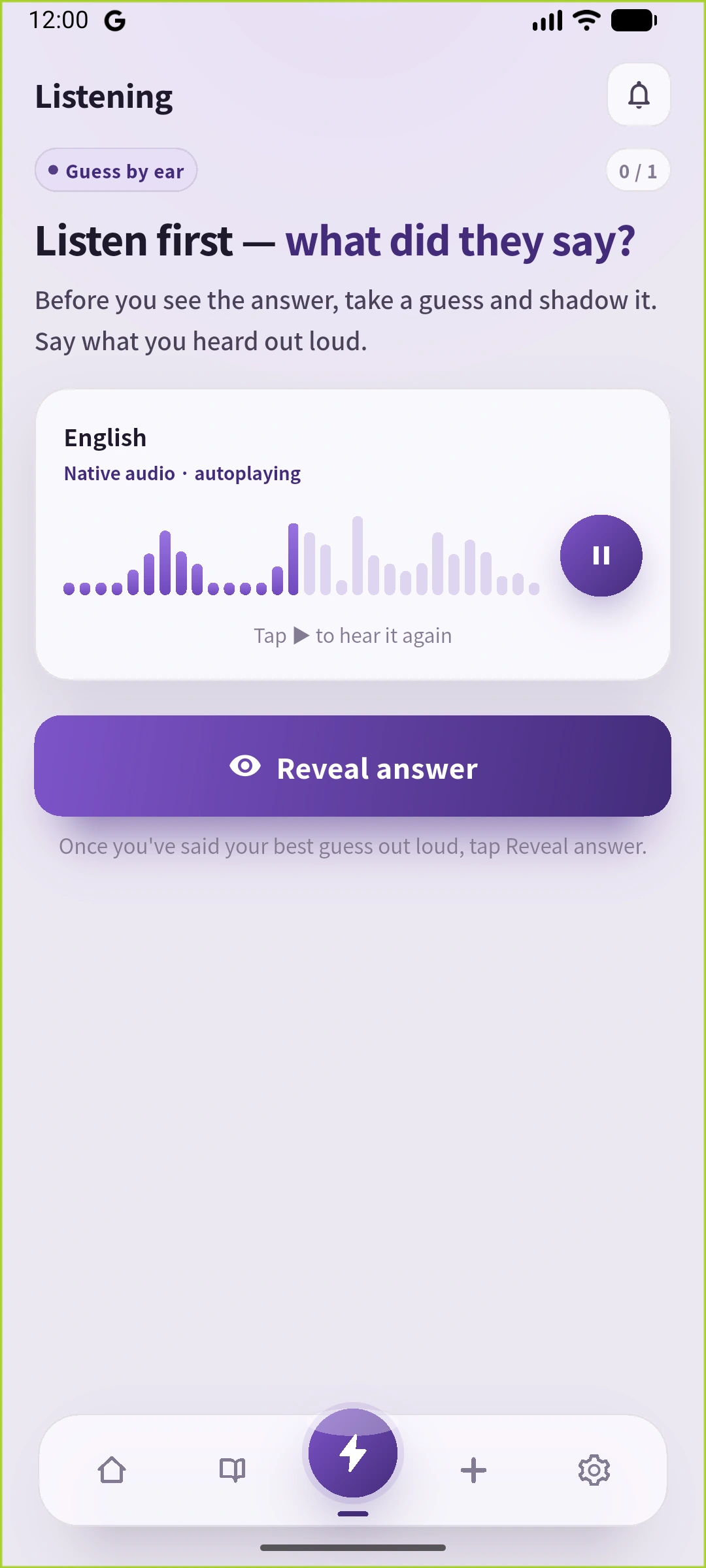
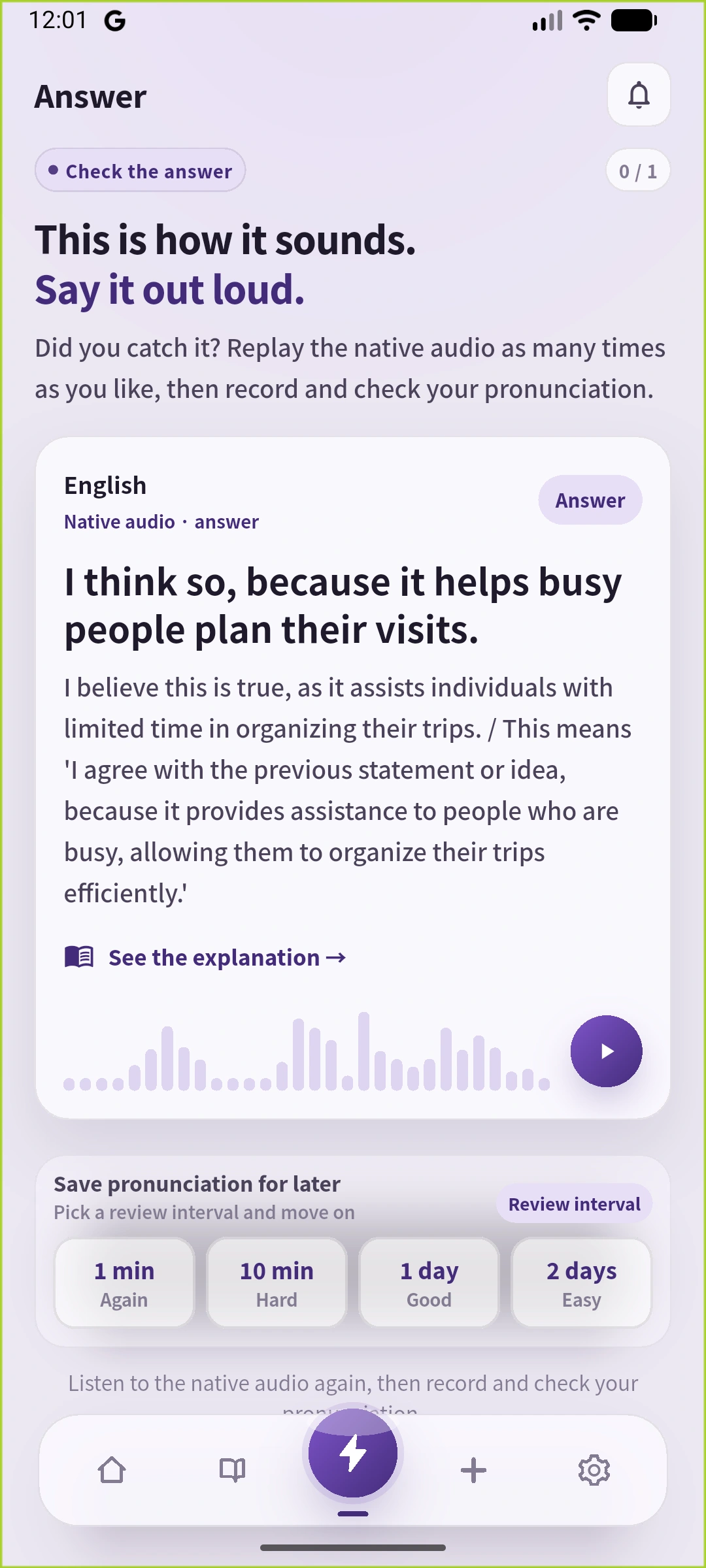
Our division of work is listen, reveal and say the sentence, then return to the prompt and try another reason. We do not present SpeakGain as an Eiken mock interview, answer or pronunciation grader, or passing guarantee. Check task relevance and your own recording with the official sample and home-practice methods above. Basic SpeakGain usage.
Solo loop and the last two weeks
Record the first attempt, including pauses. Match it with the task. Choose one important correction, record again and compare. Finally change the prompt: an answer template should organise information, not make every answer identical. If reading your own question reveals the answer, record questions beforehand and play them in a different order.
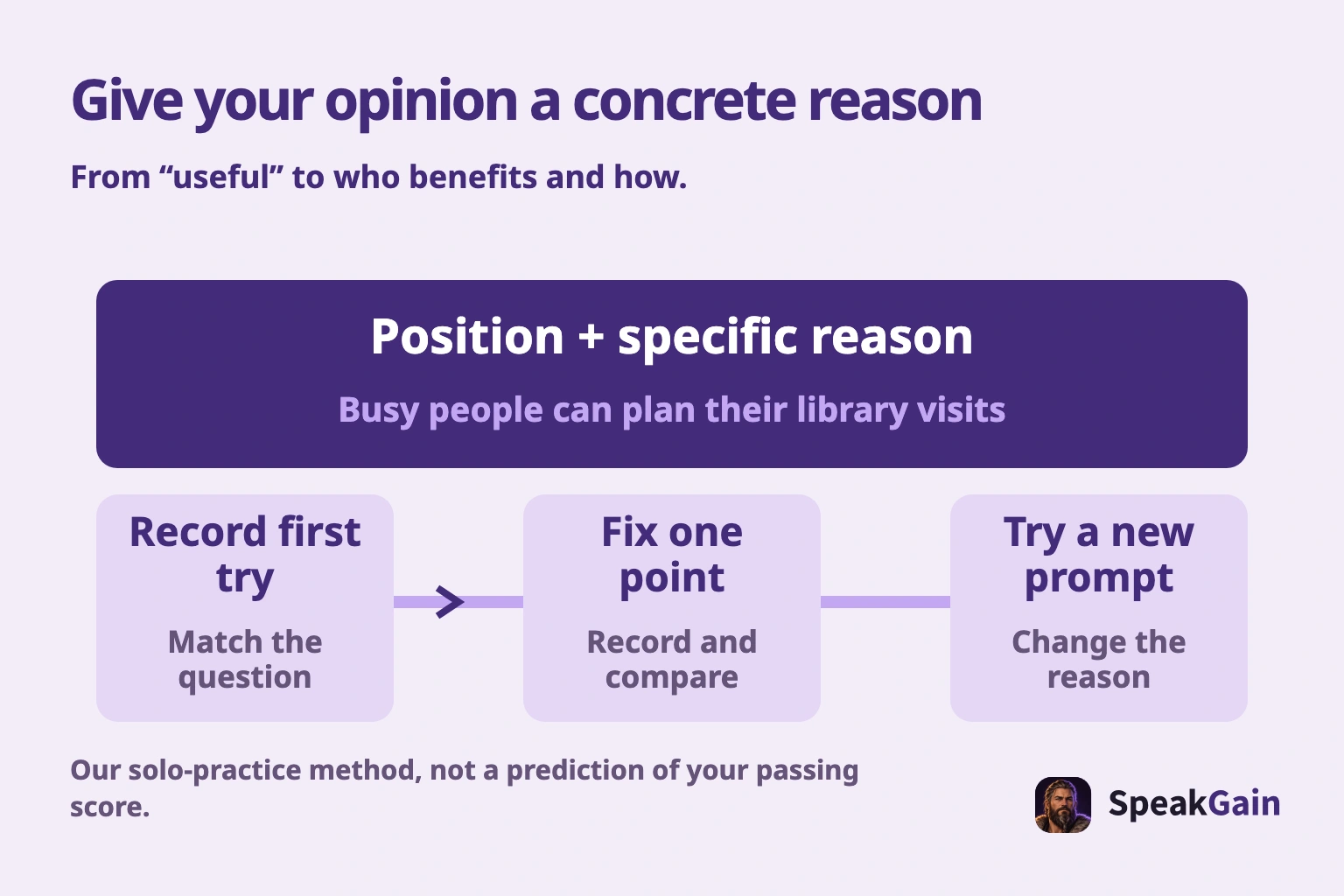
This is our plan, not an official study duration or a two-week passing guarantee. Start with 15–20 minutes on weekdays; on a busy day, complete one question and its correction.
| Time remaining | Our practice | Keep evidence of |
|---|---|---|
| 14–11 days | Watch official flow; privately try sample reading and all four questions | Where you stopped or drifted off-topic |
| 10–7 days | Work on story changes and concrete opinion reasons | First attempt and corrected recording |
| 6–3 days | Run tasks in order, including reading and No.1; change original prompts | Whether the pattern transfers |
| 2 days–eve | Short run, repetition phrase and card handling; check ticket and official notices | One personal focus and practical preparation |
If the story stops at scene one, practise one central action per scene. If reasons do not come, explain who benefits from a familiar service. If the passage has many difficult words, work on that reading before another complete run.
We do not recommend memorising long model answers, universal reasons or “tricks”. Memorisation does not ensure you can select the right information when a prompt changes; a universal reason can miss the question; speculative scoring formulas do not identify what to fix in your recording. Test every short pattern on another prompt.
Official samples and exam-day information
Use the official sample entry and secondary sample PDF privately. We do not reproduce cards, past papers, questions or model answers. For your session’s dates, results and arrangements, consult official scheduling, results and your ticket; one date is not presented as applying to everybody.
The official instructions prohibit notes, photographs and recording during the interview. Home recording is separate. Return the question card, leave promptly and do not return to the waiting room or converse with waiting candidates.
Frequently asked questions
What is the passing score?
CSE 427 for the secondary test, with a per-skill maximum of 625. The official guidance reviewed does not give a raw-score conversion table; do not turn this into a question count or accuracy percentage.
How long and how many questions?
About seven minutes, roughly 55 words read aloud and four questions. Silent reading and No.2 preparation are separately 20 seconds. Fixed response durations are not stated in the official instructions reviewed.
Can I reuse Pre-2 practice?
It can provide a base for reading and short reasons. Add the three-picture sequence and use the Plus four-question structure, not Pre-2’s five-question structure.
Can I ask to hear a question again?
Yes, the official guidance distinguishes natural requests from unnatural or repeated requests. No safe maximum count is provided.
What if I cannot think of an answer?
For our home practice, return to each scene’s main action or a position and one relevant reason; record, correct and try a different prompt. Avoid reaching for a memorised long answer to every question.
Must I give two reasons or a minimum number of sentences?
Those minimums are not stated in the official guidance reviewed. Our short examples are practice starting points, not a passing-answer formula.
Is smiling enough for attitude?
We would practise responding and sustaining communication alongside content; a smile alone is not our strategy.
Can I prepare alone, and when should I start?
Use the official flow, record at home and correct one point. Begin short speaking practice while preparing for the first stage; if two weeks remain, allocate time using the plan above. Needed time varies and is not a guaranteed passing period.
Does this show Eiken mock interviews or grading in SpeakGain?
We verified saving a sentence, reference playback, listening with hidden text and revealing it. We do not present this as Eiken interview simulation, answer/pronunciation grading or a passing guarantee; use official samples and home recordings to check your content.
Our editorial verdict
Prioritise the connected three-picture explanation and concrete reasons, after checking how Plus differs from Pre-2. Record an initial attempt with the official sample, select one observable problem, then try changed material. More lengthy English is not the same as answering the question. Use short patterns as support, and return to the real task to test the content.
Official sources checked on 14 October 2026:
- Plus format and instructions
- CSE thresholds
- Score calculation
- Official sample
- Virtual interview
- New-grade site
- Pre-2 format
- Grade 2 format
- Schedule
- Results
Eiken is a registered trademark of the Eiken Foundation of Japan. This is not its official preparation material; examples, figures and practice plans are our original editorial work.