
EIKEN Grade 2 interview preparation: four questions, narration and solo practice
Published
The conventional EIKEN Grade 2 second-stage interview lasts about seven minutes: read a passage of about 60 words aloud, then answer four questions in English; the passing threshold is 460 out of 650 on the EIKEN CSE scale. Official assessment includes response content, pronunciation, vocabulary, grammar, usage, information and willingness to communicate. Our editors recommend checking the official sequence, recording each task at home, and correcting one problem at a time—especially missing events in the three-illustration narration and weak reasons for an opinion. Format and assessment: official Grade 2 guidance; threshold: official CSE introduction. Checked October 10, 2026.
This guide covers the face-to-face interview in Japan. If you recognize the objects in the pictures but cannot connect the story, or stop after saying “I agree,” practise selecting information before memorizing a long answer. All examples and diagrams here are original editorial practice materials, not past questions, official cards, model answers or predictions. Use the official Grade 2 samples to see the actual task.
For Japan’s newer intermediate grade, our Eiken Pre-2 Plus interview guide explains the three-picture task, short reasons and solo practice.
For the big picture first, see our all-grade Eiken comparison and common preparation guide before choosing your grade’s practice.
For the full preparation sequence, including summary writing, see our Eiken Grade 2 study plan by time remaining.
To turn a written position into speaking material, first develop its reasons with our Eiken Grade 2 Writing guide.
Interview sequence and question structure
After reading aloud, you answer one passage question, narrate three illustrations, and give two answers involving your own opinions. Turn the question card over when instructed after No.2. Grade 3 and Pre-2 have a different sequence; do not bring their five-question structure into Grade 2.
The following order, quantities and timings were checked against the current official instructions on October 10, 2026. The practice checks are the editors’ suggestions, not question-by-question scoring weights. About seven minutes describes the whole interview. This official page does not specify a fixed response limit for each question.
| Stage | Task and card handling | Official time or quantity | Editorial practice check |
|---|---|---|---|
| Enter and greet | Hand over the interview form; sit when instructed; confirm name and grade | No separate duration specified | Respond to instructions |
| Silent reading | Read the passage on the question card | 20 seconds | Topic, subject, verb, reason or method |
| Read aloud | Start with the English title | About 60 words; no fixed reading duration specified | Keep words and meaning groups intact |
| No.1 | Answer about the passage; you may look at the card | One question; no fixed response duration specified | Return information matching the question |
| No.2 | Prepare and narrate the sequence in three illustrations; the opening is printed | 20 seconds’ preparation; one narration task | People, actions and changes |
| Turn card over | Follow the examiner’s instruction after No.2 | No separate duration specified | Continue without the passage or pictures |
| No.3 | Your opinion on something related to the card’s topic | One question | Position and supporting explanation |
| No.4 | Your opinion on everyday matters, including topics not directly related to the card | One question | Answer the question actually asked |
| Return card and leave | Follow the closing instructions | About seven minutes in total | Return the question card |
There is one examiner and the interaction is in English. The official virtual interview shows the entrance and exit procedure. Distinguish the interview form handed over at entry from the question card containing the passage and illustrations.
Did the format change in 2024 or later?
The official 2024 change table lists no change to Grade 2 second-stage Speaking. Changes to first-stage Reading or Writing are separate. We checked the 2024 renewal page against the current Grade 2 page. The 2025 Pre-2 Plus FAQ also says introducing the new grade did not change the scope or format of existing grades.
For your actual arrival time, follow your admission slip and the official time guidance. EIKEN S-CBT records answers through a headset; consult S-CBT instructions rather than applying the face-to-face card handover procedure.
Passing score and assessment
The CSE threshold is 460; the Speaking maximum is 650. The official threshold and current CSE explanation support these figures. The 2024 renewal guidance says the passing thresholds did not change.
CSE scores are calculated statistically after marking. Candidates cannot calculate them from their own number of correct responses. Dividing 460 by 650 does not produce a safe percentage of questions to answer, and we do not invent a raw-score pass mark.
Official assessment includes response content, pronunciation, vocabulary, grammar, usage, amount of information and willingness or attitude toward communication. Our editors use home recordings to check whether the answer fits the question, whether the story includes the final change and whether the opinion is explained. Improving volume alone will not repair missing content.
A solo practice loop: record, listen, fix one thing
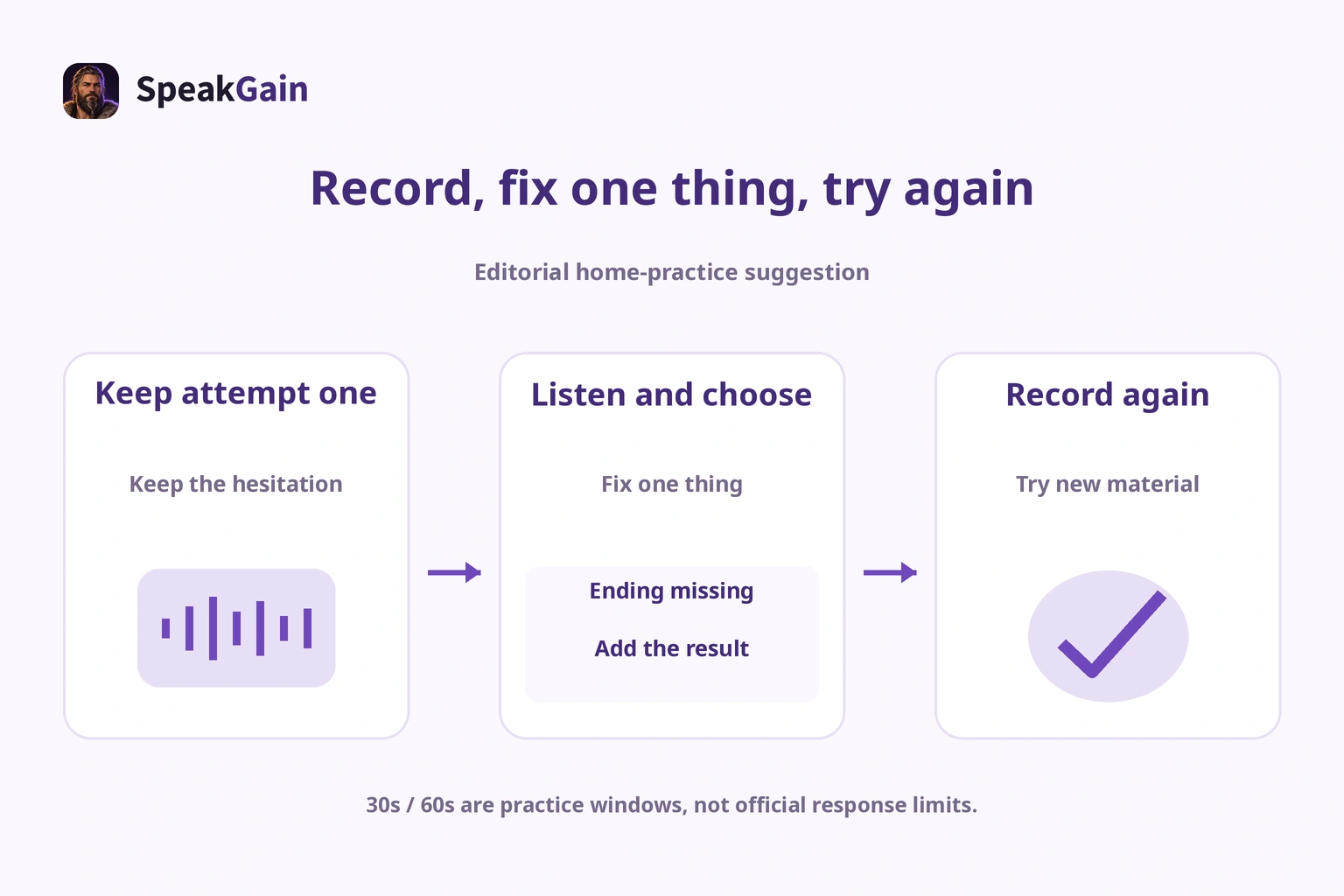
Keep the first attempt, listen to what you actually said, and change one thing before recording again. These are home-practice steps. The official rules prohibit notes, photographs and recording during the real interview.
- Open an official sample and attempt it before viewing an answer. Identify the task: reading, passage information, narration or opinion.
- Record the first attempt, including hesitation. Use the official 20 seconds for silent reading and No.2 preparation. Start with a 30-second response window or a 60-second narration window at home.
- Check content first. Did you omit the last scene, repeat a reason or change the passage’s subject?
- Fix one problem and re-record. Add the missing result before rewriting every word or working on all pronunciation issues.
- Change the material the next day. Repeating a memorized answer is different from answering a new question.
The 30- and 60-second windows are editorial practice suggestions, not official response limits. You do not need to fill them. If an answer is long, remove repeated information; if short, check for missing requested information first.
Do not mentally supply information that never reached the recording. If you remember watering the plants but only said “plant” and “harvest,” listen again for the actual subjects and verbs. At home, writing those down helps you choose a repair.
Reading aloud: retain the passage’s connections
Task: after 20 seconds of silent reading, read the passage of about 60 words, starting with the English title. Look for the topic, subject and verb as well as unfamiliar words; the passage question follows.
Editorial pattern: connect subject and verb → read meaningful groups → settle at sentence endings. Our short original example is:
Some towns turn unused land into small gardens. Local people grow vegetables there.
Some towns create gardens on unused land, and residents grow vegetables there. Keep “Some towns” connected to “turn,” treat “unused land” as a group and identify what “there” refers to. This short example does not replace a full official passage.
Practise alone: read silently for 20 seconds, then record from the title. Compare audio with the original and select one missing word, awkward break or unclear ending. If the end of “gardens” disappears, practise it with the surrounding words and record the whole passage again. Then summarize the meaning briefly at home. Our reading-aloud guide explains this kind of practice.
Common mistakes: skipping the title, restarting after every stumble, racing through without meaning, or copying an accent while dropping words. Our editors prioritize audible words and clear connections.
No.1: answer from the passage
Task: answer one question about what you read, while looking at the card. Personal opinion is not a substitute for the relevant information in the passage.
Editorial pattern: identify the target and question type → locate evidence → give a short answer with a matching subject. In our invented setting, a town makes food growing possible by creating gardens on unused land:
By turning unused land into gardens.
This explains a method: turning unused land into gardens. “Because…” may suit a reason question, but spotting a connector is not enough. A question about what people can do needs the action first.
Practise alone: keep the passage visible, record within a 30-second practice window, and check the evidence afterward. If you answered a method question with “because it is useful,” change that one response into a method. Later, mix reason and method questions; check pronoun references and the -ing form after “by” on separate attempts.
Common mistakes: always reading the final sentence, using “they” for a different subject, or adding outside knowledge. Keep the necessary information rather than quoting a long unrelated section.
No.2: connect people, actions and changes across three illustrations
Task: narrate the illustrated sequence after 20 seconds of preparation, using the opening printed on the card. This is a developing story, not one isolated action. Turn the card over afterward when instructed.
Editorial pattern: printed opening → person and first action → time or place transition → next action → final result or situation. A person as subject plus a verb communicates an event better than a list of objects.
During preparation, scan all three scenes and choose one central “who did what” for each. Then check continuity: the same person or someone new, a change of place or time, and what has changed by the end. If speech or thought appears, identify whose it is. Do not try to compose a polished paragraph entirely in your head within 20 seconds.
Our invented home-practice sequence is a suggestion to grow herbs → planting → a happy harvest. It does not reproduce an official card, opening or time label:
One Saturday, Maya and her father visited a community garden. Maya said, “Let’s grow some herbs.” Later, they were planting seeds. A few weeks later, Maya picked some herbs. Her father was pleased with their first harvest.
Maya and her father visit a community garden; she suggests herbs, they plant seeds, and she later picks herbs while her father is pleased. “Maya said” identifies the speaker; planting becomes picking and a result. The narrative describes past events and uses “were planting” for an action in progress. That is not a rule to force every sentence into one tense. The quoted suggestion retains its own wording. Follow the actual opening, pictures and time labels; never add our names or harvest to an unrelated card.
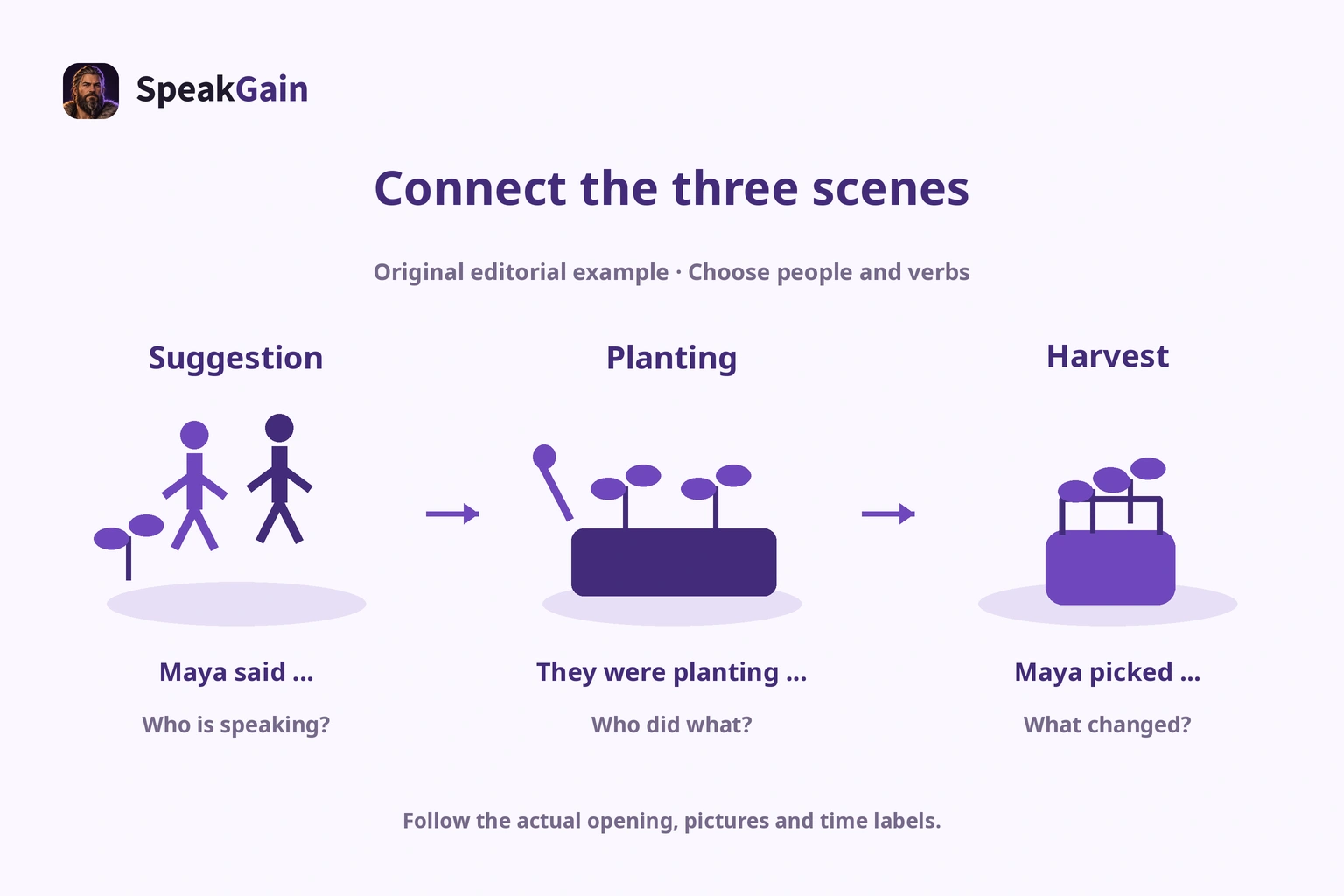
Practise alone: prepare three simple scene notes at home. Scan for 20 seconds and record in a 60-second practice window. Practise the printed opening using an official sample separately. Move from reading notes to looking only at the scenes.
Listen for three things: a person and verb in each scene, an understandable transition, and the final change. If you stopped after planting, add the harvest sentence before upgrading vocabulary. On the next attempt, fix the missing speaker if “Let’s grow some herbs” appeared abruptly. Later check whether “they” clearly means both people and whether the timeline is consistent. One repair per recording makes the improvement easier to judge.
Finally change the story: for example, preparing a community event → cleaning up → participants’ reactions, with different people. Check the events connect rather than merely inserting “Later.” Practise responding to the instruction to turn the card over.
Common mistakes: spending too long on scene one, omitting the ending, listing nouns, losing the speaker, inventing motives or applying the present progressive to every event. Our priority is three central events in sentences that identify the actor.
No.3: state an opinion and develop two distinct reasons
Task: give your opinion about something related to the card’s topic, without looking at the card. This is explanation of a position, not recall of a passage sentence.
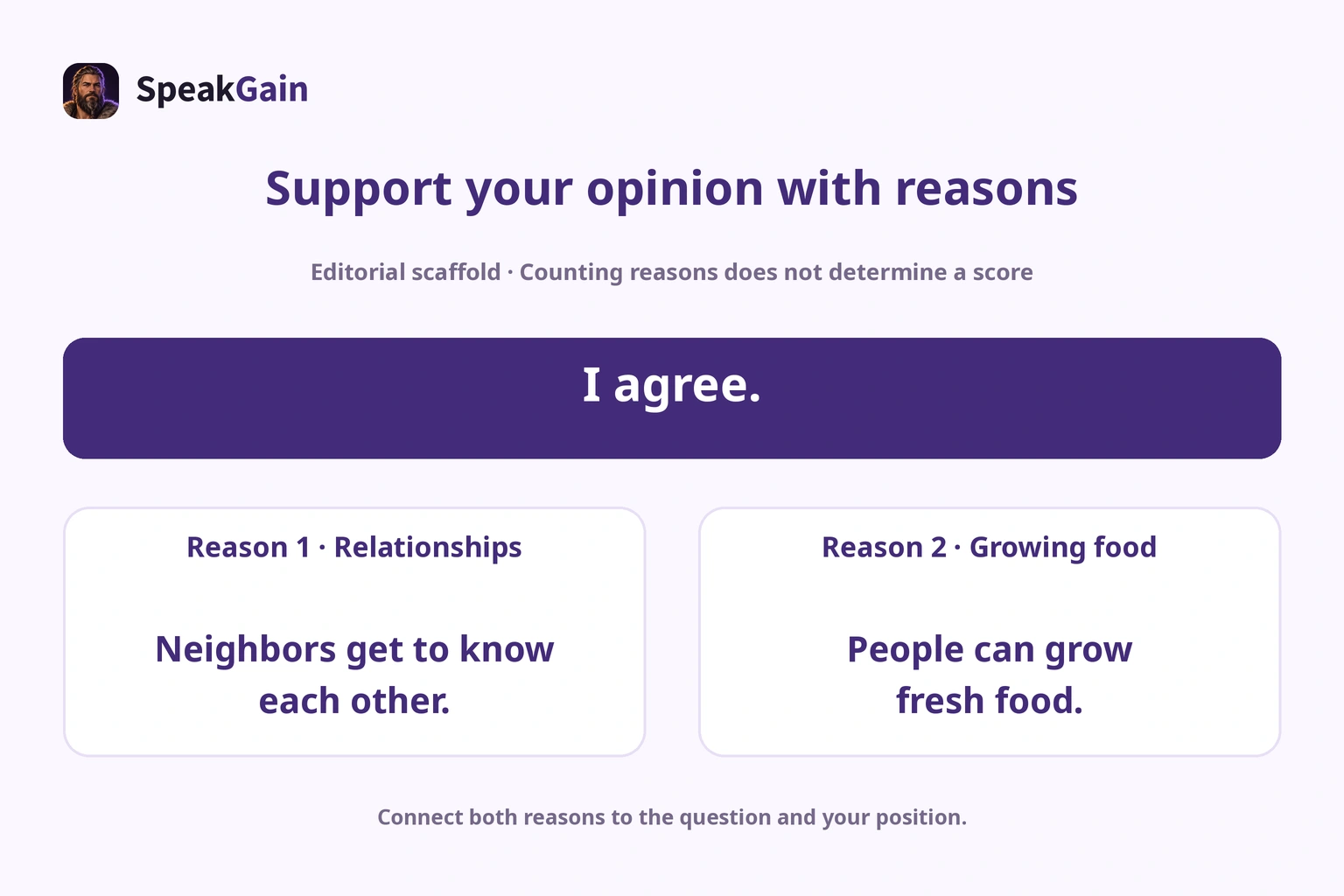
Editorial pattern: position → reason one → reason two from a different angle. Two reasons are our practice scaffold, not an official compulsory count or a pass rule. Follow the actual question and any further instruction. For our original topic of expanding community gardens:
I agree. Community gardens help neighbors get to know each other. They also give people a chance to grow fresh food.
The first reason concerns relationships; the second concerns growing fresh food. These are different benefits supporting the same position, rather than saying “convenient” twice. To practise the opposite position, change the reasons too:
I disagree. Some neighborhoods have very little space. Maintaining a garden can also take a lot of time.
Here the constraints are space and time. Changing only “I agree” to “I disagree” while keeping positive reasons can make the explanation inconsistent. Time, cost, health, relationships, environment and accessibility can help you find angles, but a generic environmental claim belongs only where you can explain its connection.
Practise alone: choose an everyday topic and record a position with reasons in a 30-second practice window without an English script. Listen back and summarize each reason on paper at home. “Convenient” and “easy to use” may repeat one idea. Change only the second reason on the next recording.
If your first reason is meeting neighbors and your second is making friends, both concern social connection. Try growing food as the second and compare recordings. The key is that both reasons answer the question and support your position, not just that you can count two.
If a long opening makes you stop, use two shorter explanatory sentences. Test the opposite side or a new topic the next day. Short sentence-building practice can help before you transfer those sentences into a spoken answer.
Common mistakes: stopping at “I agree,” repeating a reason, supporting agreement only with disadvantages, or staying silent because you lack specialist policy knowledge. Use concrete reasons you can explain. Answer Yes/No questions in the form asked instead of attaching “I agree” to everything.
No.4: switch to the new question
Task: discuss everyday matters, including content not directly related to the card. Do not carry the garden answer into a different topic.
Editorial pattern: matching response → reason → another reason or concrete support. Our original practice topic asks whether more people will walk short distances:
Yes, I do. Walking is an easy way to stay active. People can also save money on short trips.
Health and cost support the response. A prediction about people’s behavior needs more than saying you walked yesterday. Listen for the subject, time and requested judgment: “Will it increase?” and “Is it good?” ask different things.
Practise alone: create prompts about commuting, shopping, holidays or local facilities; shuffle them and answer the last one heard within a 30-second practice window. Listen back for one mismatch between the requested judgment and your answer. Replace “I like walking” with a direct response and a reason explaining people’s behavior. Also practise supplying an explanation when prompted.
Common mistakes: repeating No.3, using the wrong auxiliary in the reply, or answering a social judgment with personal preference alone. Check the relationship between response and reason.
Repetition requests and communication attitude
The official guidance says a natural request to repeat a question is not penalized, while unnatural or repeated requests can be. It also says a stalled response may lead to the next question. Our example is:
Could you repeat the question, please?
It politely asks to hear the question again. Record the reply after the repeated question too; do not practise this as a time-buying trick. Our editors include greetings, responses to instructions and an audible answer in a full run. We do not invent a smiling score or suggest that loudness compensates for missing content. After a difficult answer, practise returning attention to the next question.
SpeakGain as a short-sentence practice aid
We verified a general sentence-card listening and answer-reveal flow, not an EIKEN mock interview or EIKEN scoring. Our new original practice line was:
I support community gardens because they bring neighbors together.
It supports community gardens because they connect neighbors. Generation failed during capture, including one retry of the same card, so the original publication had no audio player; the same card now has Viking audio below. You can practise recording it yourself without waiting for generated audio.
This AI-generated Viking sample comes from a card created through the app’s normal Add flow; it is not a human native speaker’s recording.
I support community gardens because they bring neighbors together. — Support community gardens because they connect neighbors.
We checked the study flow using a different, previously successful card: Library → Knowledge → Learn this card → Listening → Reveal answer → Answer. The captured Japanese interface shows the model playback, sentence and explanation, review intervals and a button leading to recording/scoring. We checked that button’s display, not a completed recording result or accuracy of feedback.
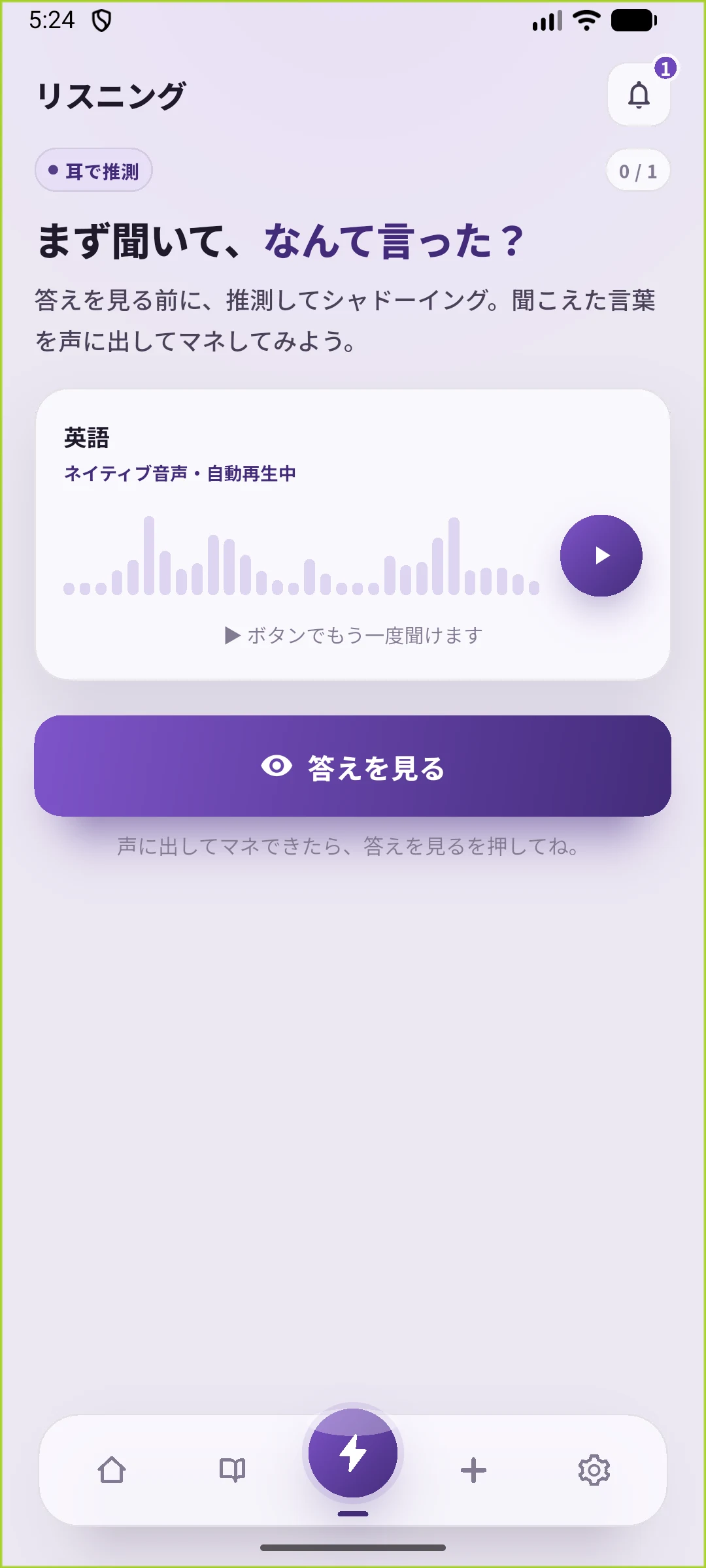
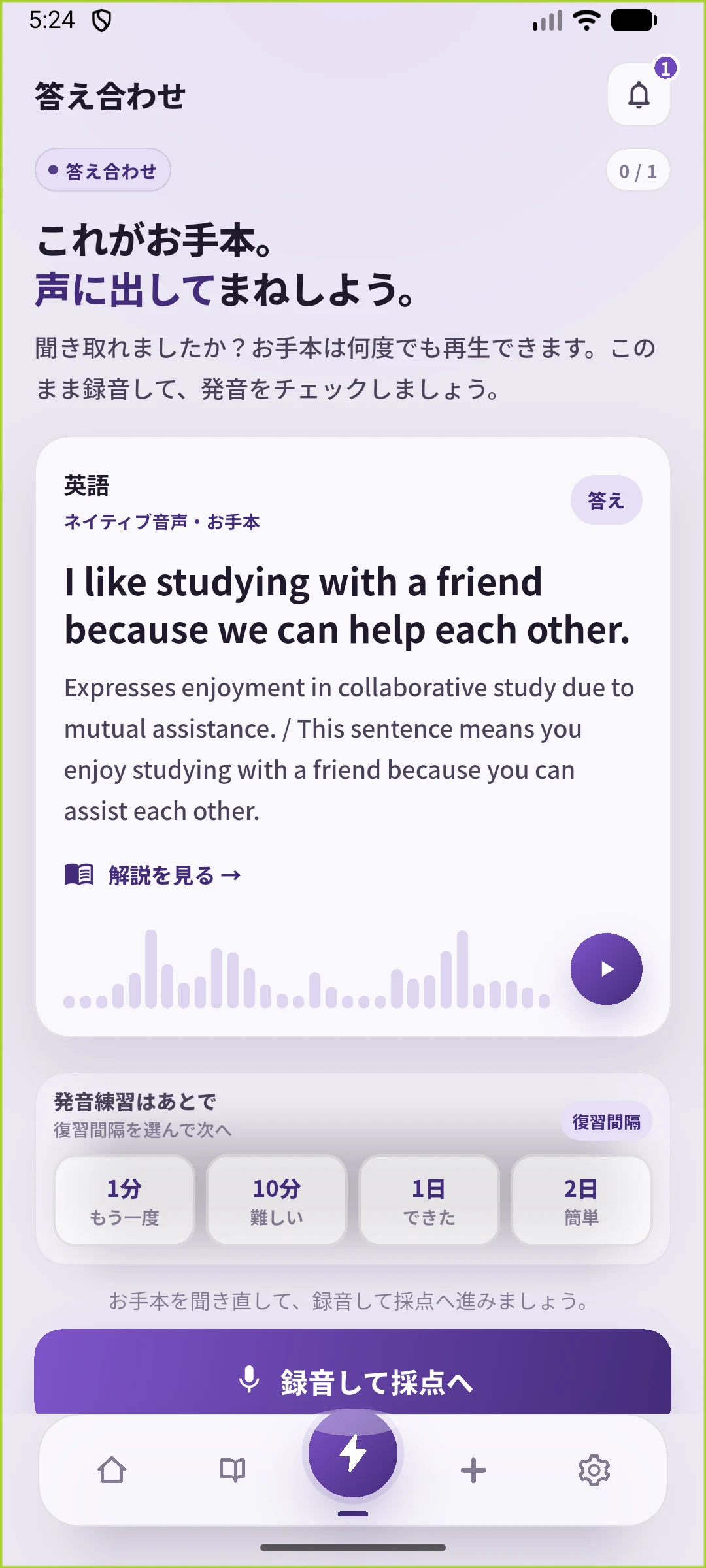
Our editors would listen, reveal and speak a short line, then return to the actual question and try a different reason. Matching sentence sounds and producing a relevant opinion are separate skills. See the SpeakGain introduction for the general product workflow.
A plan up to interview day
Start with one attempt at reading and all four questions. Then allocate time to weaknesses revealed by the recording. This two-week editorial plan is an example, not a promised preparation period or a guarantee.
| When | Editorial practice | Keep |
|---|---|---|
| 14–10 days before | Check the official format; record all tasks and try No.2’s 20-second preparation | One difficulty per task |
| 9–5 days before | Repair narration continuity and opinion reasons; change topics | First attempt, correction, second recording |
| 4–2 days before | Run reading and four questions together, including card-turning and replying after repetition | Whether you answered without a script |
| Previous day | Confirm slip, venue, arrival time and required items; brief familiar practice | Current test-day instructions |
| Test day | Arrive as instructed and follow staff and examiner directions | Slip and required items |
With ten minutes, record one task, listen, fix one problem and record again. For narration, check the ending today and the speaker tomorrow; for opinions, check repeated reasons today and question relevance tomorrow. With only a few days left, still try the entire sequence once, choose the two tasks that stall most and leave time for a final full run.
If someone can listen once, ask what happened or why you agreed, rather than whether you sounded good. Their understanding is useful feedback, not an official score or pass prediction. Our study-method guide helps balance this work with foundational practice.
Test-day instructions and results
Use your admission slip and the latest official schedule for your session. Seven minutes is not the total time at the venue. Consult the official results page for your application method.
Start reading with the title, turn the card over after No.2 when told and return it at the end. Leave the venue promptly; the official guidance prohibits returning to the waiting room or speaking with waiting candidates. Home recording equipment must not be used to record the test.
For comparison of task structures, see Pre-2 interview preparation and Grade 3 interview preparation. TOEIC Speaking practice also uses task recordings, but its format, timings and assessment require separate checks.
Frequently asked questions
What is the passing score?
460 out of 650 on the CSE scale. See the official threshold and calculation guidance. You cannot convert a self-marked raw score proportionally.
How long is the interview and how many questions are there?
About seven minutes, reading about 60 words and answering four questions. Silent reading and No.2 preparation are 20 seconds each. Turn the card over after No.2 when instructed (official format, checked October 10, 2026).
Did Grade 2 Speaking change in 2024?
The official 2024 table says no change. Separate Speaking from first-stage changes and check the renewal guidance.
Must I compose the whole narration during preparation?
Our editors recommend choosing a person, action and change for each scene first. Use the printed opening and retain all three central events rather than composing a long polished paragraph.
Are two reasons compulsory?
Two is our practice scaffold, not an official required count. Relevance and support for the position take priority; two restatements of one reason do not add a different explanation.
Can I ask for repetition?
Natural repetition requests are not penalized; unnatural or repeated requests can be, according to the official instructions. Practise answering after hearing the question again.
What if I cannot think of an answer?
Return to the target of the question and start with short information you can say. Use passage evidence, a person and verb, or a position and concrete reason, as appropriate. This is editorial advice.
Is smiling enough for attitude?
There is no basis for guaranteeing points through a smile alone. Official assessment includes willingness and attitude toward communication. Practise the interaction and check the answer content too.
Can I practise alone, and when should I start?
You can check the format, record, listen and correct alone. The time needed varies. Our editors suggest trying all tasks today and using the remaining time on observed weaknesses.
Does SpeakGain provide EIKEN mock interviews or CSE scores here?
We verified only the general sentence-card listening/reveal flow. Use official samples and home recordings for question relevance and complete interview practice.
Editorial verdict
Our sequence is check the official format → record reading and four questions → repair story continuity and opinion reasons → change material → practise a full run. In narration, verify that the listener hears the changes; in opinions, verify that the explanation supports the position.
Our editors do not recommend relying on memorized long answers or tricks: a different question can make them irrelevant. Today, fix one missing ending, speaker or duplicated reason. Keep a record of choosing information for the question and revising what you actually said.
Moving on to Pre-1? Check its different one-minute preparation and two-minute four-scene task in our Pre-1 interview guide.
If you plan to take the recorded format, see our Eiken S-CBT comparison and speaking practice guide to prepare for screen instructions alongside these interview answers.
Official sources
Checked October 10, 2026. Recheck current guidance and your admission slip before the test: Grade 2 tasks and instructions, samples, virtual interview, CSE threshold, CSE calculation, 2024 changes, 2025 FAQ, test times, schedule, results, S-CBT.
EIKEN is a registered trademark of the Eiken Foundation of Japan. Examples, diagrams, practice windows and plans are created or proposed by SpeakGain’s editors and are not official questions, cards or answers.
For Grade 2 vocabulary, listening and writing alongside interview preparation, see our skill-by-skill Eiken app comparison.