
EIKEN Grade 3 interview: flow, answer patterns and solo practice
Published Updated
Japan’s EIKEN Grade 3 second stage is an individual English interview lasting about five minutes: read a passage of approximately 30 words aloud, then answer five questions. The passing threshold is 353 on the EIKEN CSE scale, out of 550; responses, pronunciation, language use, information and willingness to communicate are among the evaluation criteria. Our editors recommend starting alone with the official procedure, then recording each task, listening back and correcting one thing. Official facts checked 10 October 2026: current Grade 3 format, second-stage threshold and CSE calculation.
If your school also assigns GTEC, GTEC speaking preparation separates reading, interaction, story and opinion tasks from the live interview.
This guide is for speakers preparing to take the conventional face-to-face exam in Japan. It does not compare schools or apps. We do not reproduce exam questions or cards: open the official sample for those. All examples below are original editorial practice material, not predicted questions or official answers.
For the big picture first, see our all-grade Eiken comparison and common preparation guide before choosing your grade’s practice.
Before attending in Japan, use the Eiken interview-day guide to check clothes, documents, entry and exit, and a short English repeat request.
For the order of preparation across all four skills and priorities as test day approaches, see our Eiken Grade 3 study plan, based on the current official format.
Prepare the first-stage written tasks separately with our Grade 3 writing and self-review guide.
Interview flow and question structure
After reading, answer one passage question, two illustration questions and two questions about yourself or familiar everyday matters. After No.3, turn the card over when instructed; answer No.4 and No.5 without looking at it. The official procedure specifies about five minutes overall and 20 seconds for silent reading, but does not specify fixed answer seconds for each question. The checks in this table are our suggestions, not an official points grid.
| Order | Task | Official time or amount | Editors’ practice check |
|---|---|---|---|
| Entry and greeting | Enter as directed, hand over interview card, sit when instructed; name, grade and greeting | No separate seconds specified | Listen, respond, then move |
| Silent reading | Read the passage silently | 20 seconds | Topic, subject and verb |
| Oral reading | Read from the English title | Passage about 30 words; no fixed reading seconds specified | Missing words, meaningful groups, audible voice |
| No.1 | One question about the passage | No fixed answer seconds specified | Select relevant passage information |
| No.2–3 | Two questions on people’s actions or the situation of objects | No fixed answer seconds specified | Target, action, plan, number or location |
| Turn card over | Follow the instruction after No.3 | No separate seconds specified | Stop looking at the card |
| No.4–5 | Two questions on yourself or everyday matters | No fixed answer seconds specified | Answer what was asked, including follow-ups |
| Return and exit | Return the question card and leave | About five minutes overall | Follow instructions, check belongings |
There is one examiner and communication is in English. Official criteria include response content, pronunciation, vocabulary, grammar, usage, amount of information and communication attitude. Start your listening review with “Did I answer the question?”, rather than pronunciation alone. The official virtual interview provides an additional introduction to the procedure.
The 2024 official renewal table lists no change to Grade 3 Speaking and no change to the passing-score threshold. Do not confuse first-stage writing changes with the interview. Check your admission ticket and current time information for arrival time. EIKEN S-CBT is a computer-delivered format; this face-to-face entry procedure is not its delivery procedure.
Passing score: do not convert your recording into CSE points
The official second-stage threshold is 353/550 CSE. EIKEN explains that scores are calculated statistically after all answers are marked, so examinees cannot calculate their CSE score from their number of correct answers. Do not turn 353÷550 into a speaking target or decide to abandon a question. We use neither an unofficial raw-mark threshold nor a predicted pass rate.
Our editors would record observations such as “wrong person”, “missing is” or “follow-up unanswered”. These identify the next exercise; they are not a forecast of your exam result.
Solo practice: record one task and repair one point
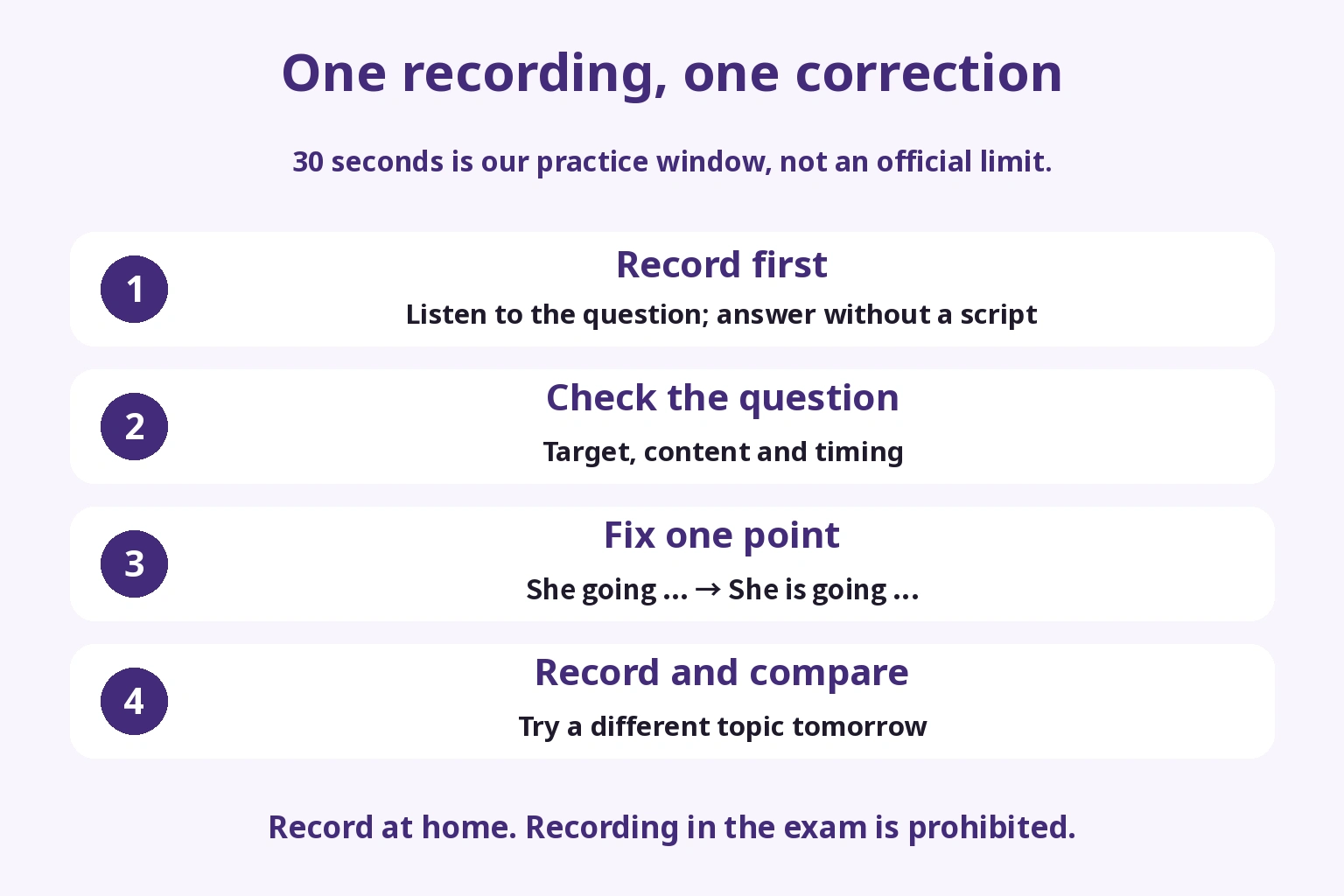
- Check the task in the official sample, hide the answer and speak once.
- For reading, begin with the official 20-second silent reading. For a question, initially give yourself a 30-second practice window and record question and answer.
- Listen back against the question and choose one correction.
- Record again and compare with the first attempt.
- Change the person or topic the next day to test whether the pattern transfers.
Thirty seconds is our editorial practice timer, not an official answer limit or an instruction to speak for all 30 seconds. Finish when your short answer is complete. Keep the first attempt instead of restarting at every mistake. Correct the target and content first, then sentence structure, then one difficult sound. Recording is for home practice: the official interview prohibits notes, photography and recording.
Oral reading: start with the title and keep meaning together
Task: after silent reading, follow the instruction and read the title and passage. Notice who does what, not just how individual words sound.
Editors’ pattern: subject and verb → place or time → next sentence. An original short exercise:
Our school has a small garden. We grow flowers there in spring.
The school has a garden; “there” refers to that garden. This short exercise is not a recreated 30-word official card.
Practise alone: silently read the official sample for 20 seconds, then record its title and passage. Listen with the text and check for dropped words. Choose one word or pause to correct, then read the sentence again. Briefly check the meaning afterwards; this is a home exercise, not a request to explain in another language during the exam. See our reading-aloud method for foundations.
Common mistakes: skipping the title, separating every word or repeatedly stopping before one unfamiliar word. We favour clear meaning and complete words over speed alone.
No.1: choose the information the passage actually gives
Task: answer about the passage; you may look at the card. Do not substitute your personal opinion.
Editors’ pattern: identify the target → find relevant information → form a short answer. With an invented fact about pupils growing flowers, a capability answer could be:
They can grow flowers.
For a reason question, a practice form could be Because they can grow flowers there. Use it only if it gives the passage’s actual reason. Not every answer starts with because.
Practise alone: record within your 30-second practice window, then identify the evidence in the passage. If the question asked where but you answered what they can do, repair the opening. Check who “they” refers to.
Common mistakes: answering from personal knowledge, missing the question word or copying a whole passage sentence without selecting the relevant information.
No.2: express the person’s action or plan with a verb
Task: the official illustration tasks concern people’s actions and objects’ situations. The official No.2 sample asks about a planned action; do not assume every illustration answer uses the present continuous.
Editors’ pattern: person → time expression matching the question → action and object. An invented woman about to open a window:
She is going to open the window.
For an action happening now, practise She is opening the window. The question and picture determine the choice.
Practise alone: use simple actions or your own sketch. Record, then check one of person, timing or verb. If you said She going to …, restore is and record again. Switch between “now” and “going to” practice questions.
Common mistakes: describing the wrong person, omitting be, changing the verb after going to incorrectly or inventing a motive not visible in the picture.
No.3: match the number or situation to the object
Task: another illustration question. The official sample asks a number, but the general task description does not guarantee that every No.3 question is a count question.
Editors’ pattern for counting: There is / There are → number and object → relevant place.
There are three boxes on the shelf.
For one: There is one box on the shelf. For location: The boxes are on the shelf. These are original practice examples.
Practise alone: place pencils on your desk, change the number and record. Check the target or singular/plural form. Repair three box to three boxes, then practise responding to the instruction to turn the card over.
Common mistakes: counting everything before identifying the target, answering about the wrong object or continuing to look at the card after the instruction.
No.4: answer about your own habits or wishes first
Task: everyday matters or yourself, potentially unrelated to the passage. The card is face down.
Editors’ pattern: direct answer → short explanation if needed.
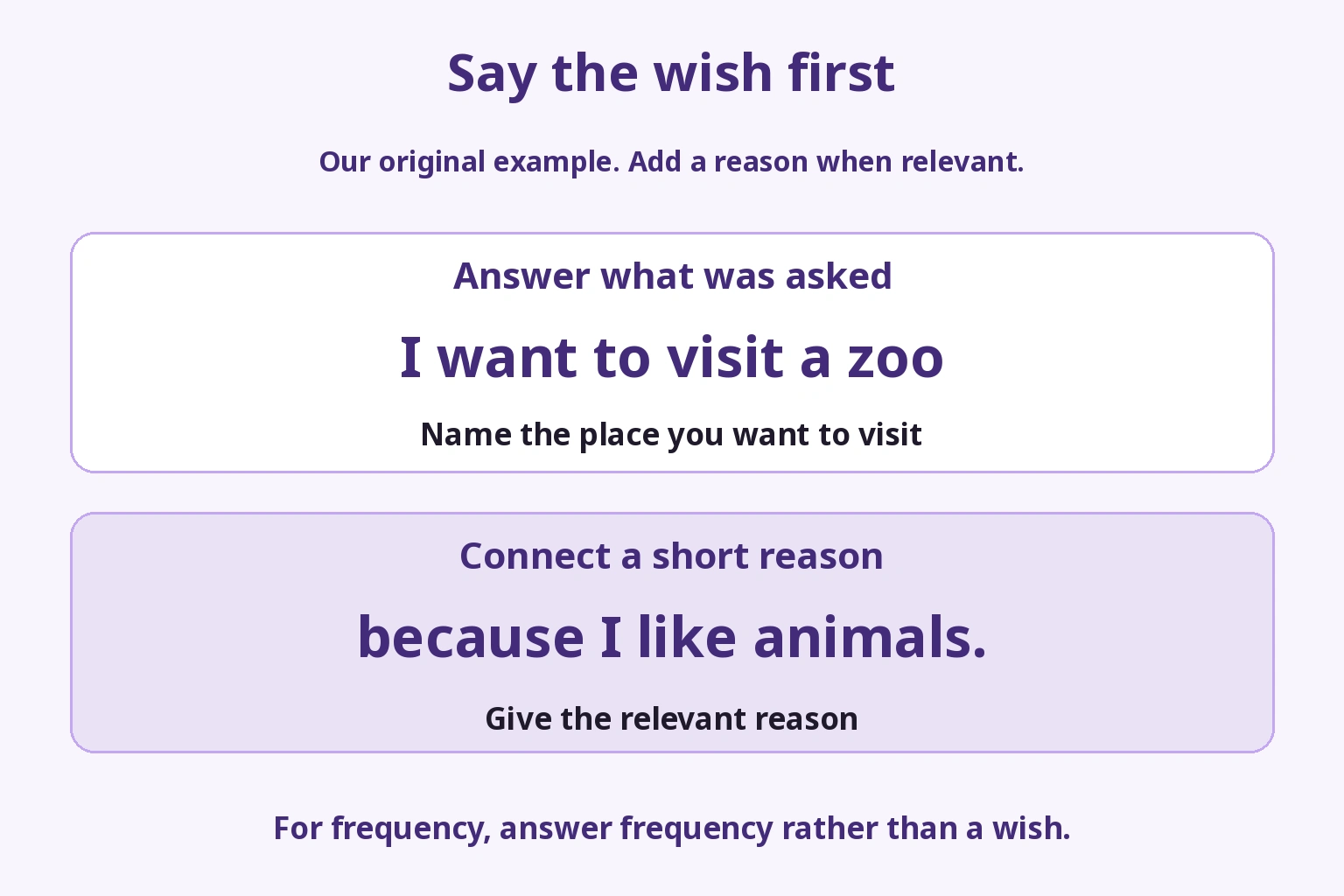
I want to visit a zoo because I like animals.
I want to visit a zoo. gives the wish first. Add the reason when relevant; we are not inventing a rule requiring a reason in every answer. For frequency, practise I play badminton twice a week.
Practise alone: prepare a few true everyday details; shuffle questions and record. Check whether you answered a preference, wish or frequency question. Change the question while keeping the topic. Use short-sentence composition practice if forming the first sentence is difficult.
Common mistakes: always starting I like …, inventing an impressive experience or delaying the answer behind a long reason. Adults should use their own lives rather than pretend to be schoolchildren.
No.5: respond to the follow-up after Yes or No
Task: another everyday question. The official sample includes a Yes/No answer followed by another question. Prepare both branches and listen to the follow-up.
Editors’ pattern: appropriate Yes/No → concrete answer to the next question. With an invented cooking topic, after Yes, I do.:
I cook rice and soup with my mother.
After No, I don’t., a question about what you would like to make could lead to I’d like to make curry. This is our exercise, not a copied official question sequence.
Practise alone: record both branches within the practice window. If asked what you cook but you gave only a reason, add the dish first. Change the follow-up to who or when, and match the first answer’s auxiliary to do, can or have as appropriate.
Common mistakes: stopping after Yes/No, mismatching the auxiliary or practising only the Yes branch.
Asking again and communication attitude
Officially, a natural request to repeat is not penalized, but unnatural or repeated requests can be; a stalled response may move to the next question. Our practice phrase is Could you say that again, please? Practise answering the repeated question too. It is not an unlimited time-buying device.
Attitude concerns willingness to communicate. Our editors suggest greetings, responses to instructions and audible answers. We do not assign invented points for smiling or treat loudness as a substitute for relevant content.
SpeakGain: a short-sentence practice aid
We use SpeakGain to support listening to and saying short answer-pattern sentences, not to conduct or score an EIKEN mock interview. Our new practice line is I want to visit a zoo because I like animals. Its audio was not successfully generated during capture, so the original publication had no audio player; the same card now has Viking audio below.
This AI-generated Viking sample comes from a card created through the app’s normal Add flow; it is not a human native speaker’s recording.
I want to visit a zoo because I like animals. — Express a wish to visit a zoo and give a reason.
We verified the study flow on an already existing audio-ready card: Library → Knowledge → Learn this card → Listening → Reveal answer → Answer. Answer displayed the sentence, explanation, replay, review intervals and Record and check. Pressing that action reached Android’s microphone-permission request; we closed it without completing a recording. We make no claim about subsequent results, feedback accuracy or exam scores.
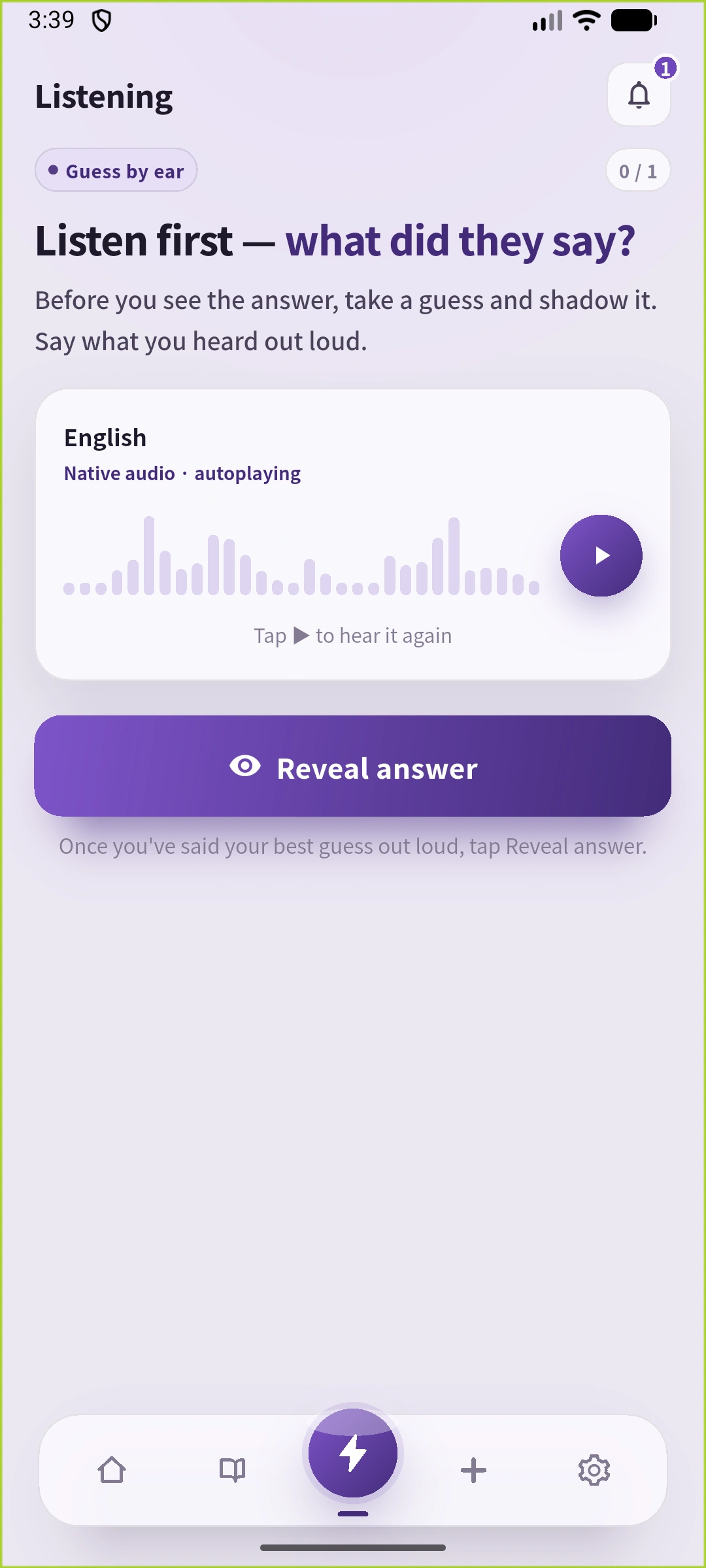
Our suggested division is listen → check and say the sentence → return to the interview question and adapt the content. For the new line, your own home recording still works. See what SpeakGain does.
Plan up to interview day
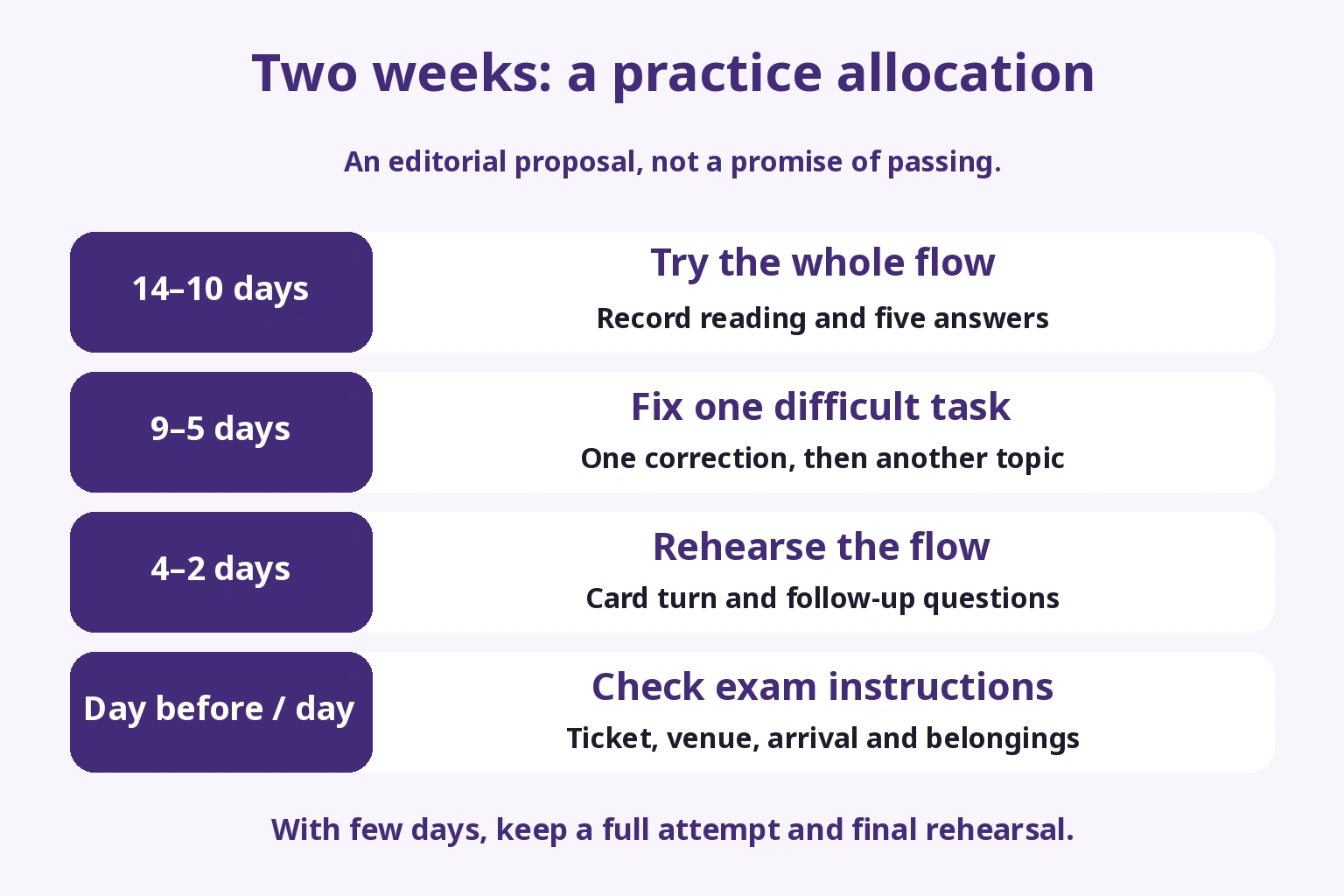
Try reading and all five questions once before allocating your remaining days. This two-week schedule is our proposal, not a promise of passing in two weeks.
| When | Editors’ proposal | Keep a record of |
|---|---|---|
| 14–10 days before | Check official flow; record reading and five answers | One difficulty per task |
| 9–5 days before | Fix one task and try a different topic | First attempt, correction, second attempt |
| 4–2 days before | Run the whole flow, including card turn and follow-ups | Whether you answered without a script |
| Previous day | Check ticket, venue, arrival time and required items; speak briefly | Current exam instructions |
| Exam day | Attend the specified venue/time and follow instructions | Ticket and belongings |
With ten minutes, practise one answer, listen, repair one point and record again. With only a few days, first try everything, then prioritise two difficulties; do not skip reading and illustration questions entirely. A parent or another listener can tell you what they heard, without presenting that opinion as official scoring. Our English-study guide helps organise foundational practice.
Check official dates, result information and your own admission ticket. The five-minute interview is not total venue time. Return the card and leave promptly; the official procedure forbids returning to the waiting room or talking to waiting candidates. For another level, see EIKEN Pre-2 preparation; TOEIC Speaking preparation has different tasks and timings.
If Grade 2 is your next goal beyond Grade 3, our Grade 2 interview guide explains its different four-question structure and narration.
FAQ
What is the passing score?
353/550 EIKEN CSE, not a raw-mark fraction you can calculate from a recording. See the threshold and calculation guidance.
How long and how many questions?
About five minutes, oral reading plus five questions, with 20 seconds of silent reading. Official format.
Did the 2024 changes alter Grade 3 Speaking?
No change is listed for it in the 2024 table. First-stage writing changes are separate.
Can I ask the examiner to repeat?
A natural request is not penalized; unnatural or repeated requests can be. Answer after the repetition. Official cautions.
What if I cannot think of an answer?
Return to the target and choose a short answer you can say. That is editorial advice, not a scoring shortcut.
Is No.3 always about numbers?
The sample is, but the official general description is broader. Listen to the actual question rather than assume.
Is smiling enough for attitude?
No evidence guarantees points from a smile alone. Practise responding and communicating, alongside relevant content.
Can I practise alone?
Yes: check the format, read aloud, record and listen back. Your recording does not predict CSE precisely.
How many days do I need?
There is no universal number. Try all tasks first and allocate your remaining time to observed weaknesses.
Should I memorize complete answers?
Our editors prefer short structures with changeable content. A long memorized answer can miss a changed question.
If you are taking Tokyo’s speaking test, our ESAT-J preparation guide explains the current tasks and practice for each part at home.
Families preparing Japan’s Eiken Grades 4 and 5 can use our Speaking Test and home-practice guide to check official entry rules and practise short, relevant answers together.
If you plan to take the recorded format, see our Eiken S-CBT comparison and speaking practice guide to prepare for screen instructions alongside these interview answers.
Editors’ verdict
Check the official procedure, attempt every task, record one answer and correct one point, then transfer the pattern and rehearse the whole flow. Passage information, picture descriptions and personal answers need different content. Today’s useful step is one recording and one specific correction, rather than another long “universal” answer.
Official sources checked 10 October 2026: format and procedure, sample, virtual interview, CSE threshold, CSE calculation, 2024 renewal, times, dates, results and S-CBT. EIKEN is a registered trademark of the Eiken Foundation of Japan. Our examples, diagrams, timers and plans are editorial material, not official exam content.
Before choosing your test, use our Eiken Grade 3 level and pass-score guide to check the official reference, CSE thresholds and tasks across all four skills.