
Eiken Grade 4 and 5 Speaking Tests: how to take them and practise at home
Published
Japan’s Eiken Grade 4 and Grade 5 Speaking Tests are recorded tests: you read a short passage aloud and record answers on a supported computer or smartphone, at home or at school. Speaking has its own pass decision—CSE 324 for Grade 4 or 266 for Grade 5—and is optional; neither taking it nor its result changes your Grade 4/5 certification. For home preparation, we recommend starting with 5–10 minutes of reading a short sentence and answering one question with a parent (official features, results, FAQ; checked 14 October 2026).
This guide is for elementary and junior-high pupils, parents supporting them in Japan, and adult beginners. “Grade” here means an Eiken test level, not a school year. The tests use recorded responses rather than a live face-to-face interview. Official rules appear with sources; home routines are our editorial suggestions.
Open the official Grade 4/5 samples to see actual tasks. We do not reproduce official questions, cards or audio. Every English example below is our own short practice material, not an official full-mark answer or a predicted test item.
For the big picture first, see our all-grade Eiken comparison and common preparation guide before choosing your grade’s practice.
For the order of preparation across all four skills and priorities as test day approaches, see our Eiken Grade 3 study plan, based on the current official format.
When moving to Grade 3 writing, use our email and opinion guide to learn the current tasks and checks at home.
How to take the test
Applying for the first-stage Grade 4 or 5 test gives you access to Speaking for the same level; a separate Speaking application is unnecessary. Applicants can take it even if they fail or miss the first-stage test. Prepare the Eiken ID and password on the first-stage score report, an internet connection, a supported device and a working microphone. A built-in microphone can be used, but check that your computer actually has one (FAQ, parent guidance; 14 October 2026).
| Step | What you do | Official timing |
|---|---|---|
| 1. Obtain eligibility | Apply for Grade 4 or 5 first stage; Speaking access is for that level | Your application session |
| 2. Check ID and dates | Find your ID/password and the window for your year/session | Opens from first-stage result viewing; check the exact closing date |
| 3. Prepare equipment | Follow PC-browser or official smartphone-app instructions; check connection, playback and recording | Total setup time not stated officially |
| 4. Read the instructions | Log in, select the eligible level and understand the controls | Total instruction time not stated officially |
| 5. Take the test yourself | Read silently, read aloud and record answers as instructed | Grade 5 about 3 minutes; Grade 4 about 4 minutes; silent reading 20 seconds |
| 6. View results | Use ID/password online; optionally register for a marking-completion email | Normally within 30 days of taking it, subject to the session’s viewing start; no postal report |
Sources checked 14 October 2026: preparation, procedure, Grade 5 format, Grade 4 format, results. The approximate test duration does not include a guarantee that equipment setup finishes within those minutes.
Window and number of attempts
There is one attempt per application. Parent guidance describes access from first-stage result viewing and eligibility extending for one year from the relevant session’s second-stage test date. Do not calculate “one year from today”: find your actual year and session in the official window table.
For example, the 2026 second session is listed as 26 October 2026, 13:00 to 14 November 2027, 23:59. It had not opened on our check date. Other sessions have different dates. Put your own closing date on the family calendar and choose a quiet time within that window (features, parent guidance; 14 October 2026).
Phones and tablets: check the specific device
General official guidance lists computers, smartphones and tablets, but the current FAQ explicitly supports iPhone and says iPad is unsupported and not recommended for operation. Do not assume every tablet works. Check both the recommended environment and device FAQ. Universal compatibility for every Android tablet is not stated officially in the pages inspected.
We would use a familiar supported device, check microphone permission and listen to a test recording before the test day. Follow the official smartphone app guidance. Device and browser requirements change; an old family experience report is not a substitute for the current list.
Where parent help ends
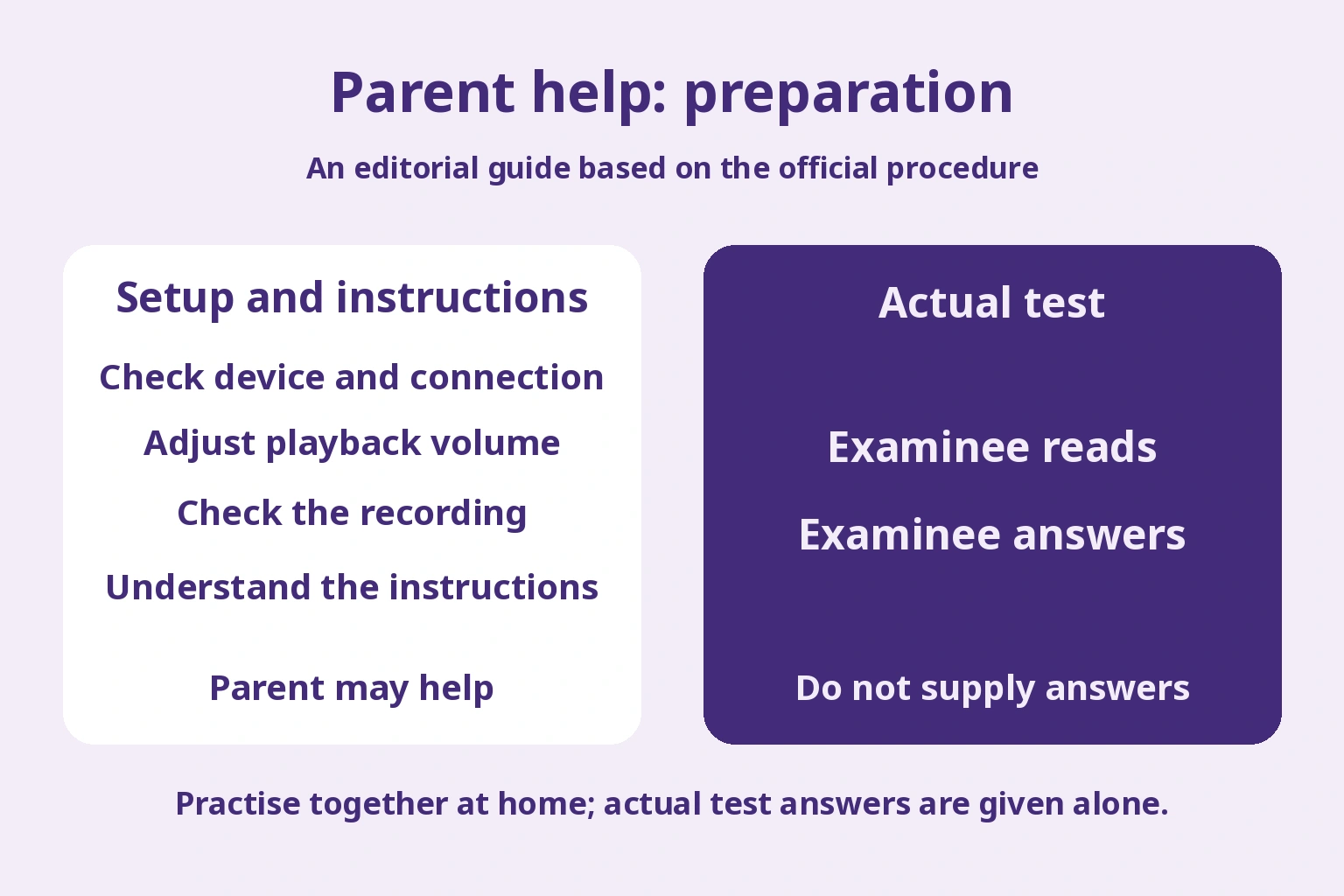
Official instructions allow help with equipment/volume checks and supplementary explanation of how to take the test. The actual test part is for the examinee alone. Being the question partner at home does not authorize whispering answers in the real test (procedure).
In practice, ask whether the sound plays and their recorded voice is audible, then include a run with no parental prompts. If special accommodations are needed, follow the official accommodation guidance linked from preparation, rather than inventing exceptions to ordinary rules.
Grade 4 versus Grade 5
Both have reading aloud, two passage questions and one personal question. Grade 4 adds one illustration question. That extra task calls for describing the indicated action or situation, not a longer memorized introduction.
| Feature | Grade 5 | Grade 4 |
|---|---|---|
| Delivery | Recorded responses on a device | Recorded responses on a device |
| Approximate test time | 3 minutes | 4 minutes |
| Reading aloud | One passage, about 20 words | One passage, about 25 words |
| Passage questions | Two: No.1 and No.2 | Two: No.1 and No.2 |
| Illustration question | No separate task listed | One: No.3, action or situation |
| Personal question | One: No.3 | One: No.4 |
| Speaking pass threshold | CSE 266 | CSE 324 |
| Grade certification | Unaffected by Speaking participation/result | Unaffected by Speaking participation/result |
Sources: Grade 5, Grade 4, procedure, samples/features, results, FAQ; checked 14 October 2026.
Reading and answer seconds
Silent reading is 20 seconds. The procedure’s PC explanation gives 30 seconds for its oral-reading practice; the smartphone/tablet explanation gives 15 seconds. This is a device-section difference, not “30 for Grade 4, 15 for Grade 5.” Follow the instructions for your device and the actual test. Fixed response seconds for each question are not stated officially in the inspected pages. Our 5–10-minute home routines are practice blocks, not official limits or required preparation time (procedure).
Passing Speaking is separate from passing the grade
Grade 4/5 certification depends only on first-stage Reading and Listening. Passing Speaking earns the separate “Grade 4/5 Speaking Test pass” qualification. Failing it does not remove a grade already earned (results, FAQ).
The Speaking thresholds are CSE 324 and 266. A usual-test table converting a number of correct answers to CSE, or detailed item-by-item points, is not stated officially in these Grade 4/5 pages. A parent cannot certify a pass from three successful answers or neat pronunciation.
Results are online, not posted. The results page says normally within 30 days of taking the test, with the session’s second-stage A schedule affecting when viewing begins. Parent guidance also describes the first notification day as 30 days after the second-stage date. Check the actual viewing start rather than promising a particular day. If an optional notification email does not arrive, log in and check (results, parent guidance, FAQ).
Our home notes would say “answered the right information,” “missed one word” or “voice too quiet.” These observations choose the next practice target; they are not an official score prediction.
Reading aloud: understand the short passage
Required: Read an approximately 20-word Grade 5 or 25-word Grade 4 passage after silent reading, recording as instructed. Passage questions follow, so understanding matters too (Grade 5, Grade 4, procedure).
Our pattern: Keep subject and verb together, connect place/time, then pause at the sentence end. Our original mini-passage is:
Our town has a little park. We walk there on Sundays.
Here, “there” means the park. This short starting material is not a card constructed to match official passage length.
Parent-child practice, 5–10 minutes: Spend a minute checking meaning, two reading aloud, then record and listen. The parent checks one omitted word. Look up one difficult sound, return to the sentence and read again. Finish by checking where the walk happens. Parents need not supply a perfect pronunciation model: they can check omissions and audibility while using an appropriate sound reference. See how to read English aloud for the basics.
Common mistakes: Racing and losing words, saying “there” without understanding it, or interrupting after every sound. Let the child finish once, then choose one correction.
No.1 and No.2: select information from the passage
Required: Both grades ask two passage questions. Official procedure lets the examinee look at the card while answering. Select information from it, rather than adding personal preferences (format and samples, procedure).
Our pattern: Identify the requested information → find it → give a short answer. For our own passage, if practice asks when the walk happens, the relevant information is:
On Sundays.
For sentence practice:
We walk there on Sundays.
These show selecting time information; they do not establish an official point difference between a phrase and sentence. Change the question to place so the learner cannot keep repeating the same answer.
Parent-child practice, 5–10 minutes: Choose a time question and a place question from your own material. Begin by checking the question’s meaning in a language the child understands. Then ask in short English and let the child use the passage. After two answers, point to the evidence together. If being the question partner is difficult, use the official sample and listen alongside the child.
Common mistakes: Reading the same whole sentence for every question, adding information not in the passage, or guessing after the first word. Check whether the answer supplies what was asked before lengthening it.
Grade 4 No.3: describe the illustration
Required: Describe the indicated person’s action or an object’s situation. Do not assume it is always a counting question. Grade 5 does not list this separate task (Grade 4 format).
Our pattern: Identify the target → choose the requested action/number/place → make a short sentence. With two pencils and a cup on your own desk:
There are two pencils beside the cup.
This describes two pencils next to the cup. It is not a recreated official illustration or a sentence that answers every picture.
Parent-child practice, 5–10 minutes: Arrange ordinary household objects. Practise number for two minutes, then place for two. On another day, a parent can demonstrate a simple action for the child to describe. Record once and check that question and answer concern the same target. If the wording is uncertain, check the useful word and return later; do not pretend to be an examiner.
Common mistakes: Counting another object, inventing feelings the picture does not show, or using singular wording for several objects. Check the target and content first.
Grade 5 No.3 / Grade 4 No.4: answer about yourself
Required: Respond about familiar everyday matters; the official format notes that the topic need not be directly related to the card. Switch from passage information to your own answer (Grade 5, Grade 4).
Our pattern: Answer what was asked first, then add brief relevant information if needed. Our shared worked example is:
I like to draw small animals.
It expresses enjoying drawing small animals. A child may adapt the activity to their real interests. For a suitable Yes/No practice question:
Yes, I do. I like to draw small animals.
For a place question, I draw at home. supplies the place. Do not attach “Yes, I do” to every question automatically.
Parent-child practice, 5–10 minutes: Choose one genuine interest in the first minute. Check meaning and sound for two minutes, then have the parent ask a short question and the child respond. Record once, checking either relevance or one missing word. Ask what the child wants to say before giving an English model; a long reason is unnecessary on the first day.
Common mistakes: Reciting a whole self-introduction unrelated to the question, answering place when asked preference, or copying the parent’s content without understanding. For a troublesome sound, shorten the task to one word, then return to the sentence; see English pronunciation practice.
A short home routine
Correct one thing, then slightly change the question the next day. Practise the troublesome task in a small block; a full rehearsal is not necessary every evening.
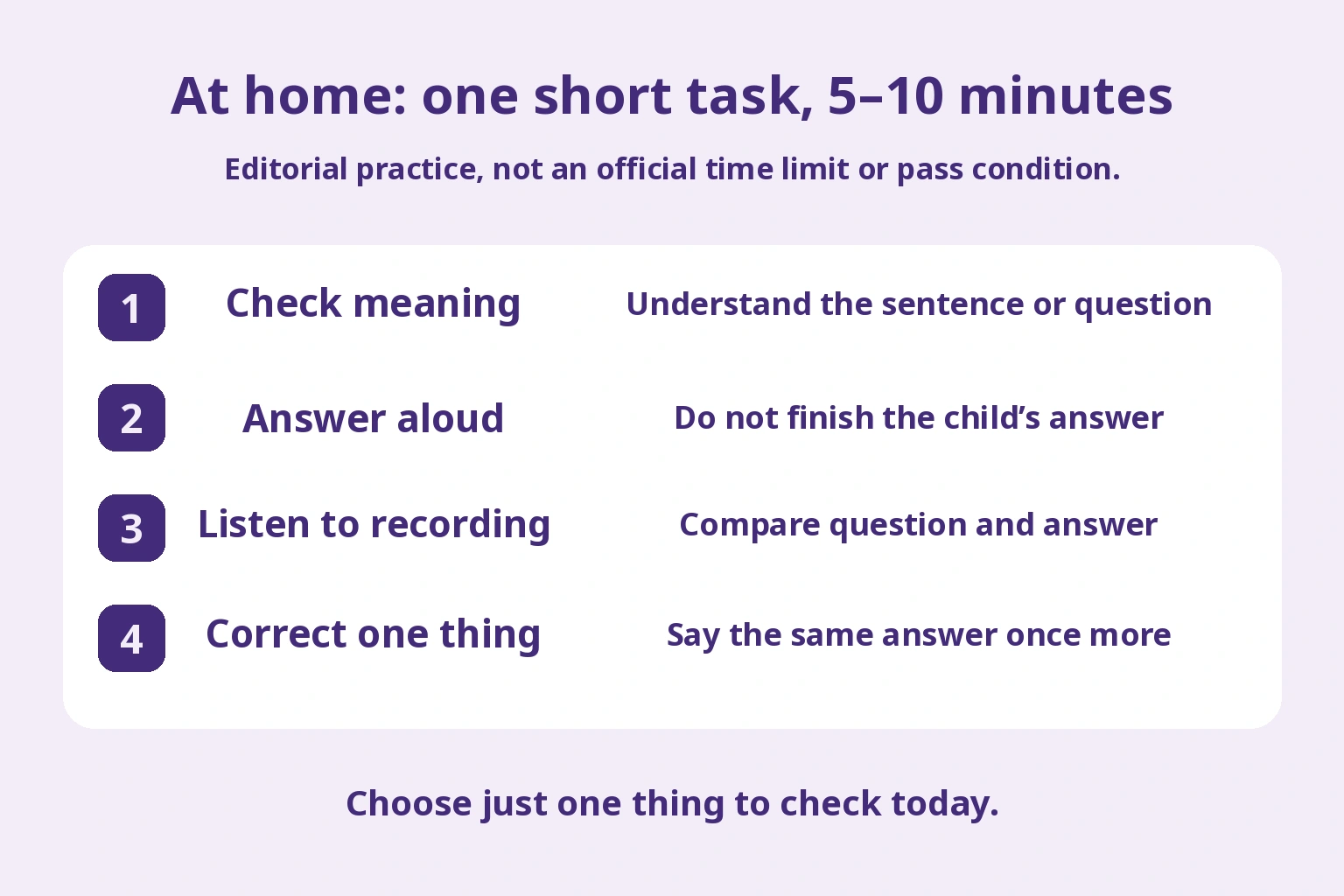
- Check meaning for 1–2 minutes.
- Answer aloud for 2–3 minutes. Let the learner finish without completing the answer for them.
- Listen for 1–2 minutes and compare with the question or written sentence.
- Correct one thing for 1–3 minutes, say it once more and finish.
A recorder and short material are enough to begin; a child does not have to use an app. Keep checking official test format separate from practising an original sentence. Adult beginners can replace the parent partner with a question note, hide the answer and record their own response.
A parent can keep one short sentence in SpeakGain
Children do not need to use an app. A parent may use SpeakGain to save a short practice sentence and listen together. We saved this article’s example through the normal Create screen and verified this flow on the device.
- Enter and save one sentence in Create, then open its card in the library.
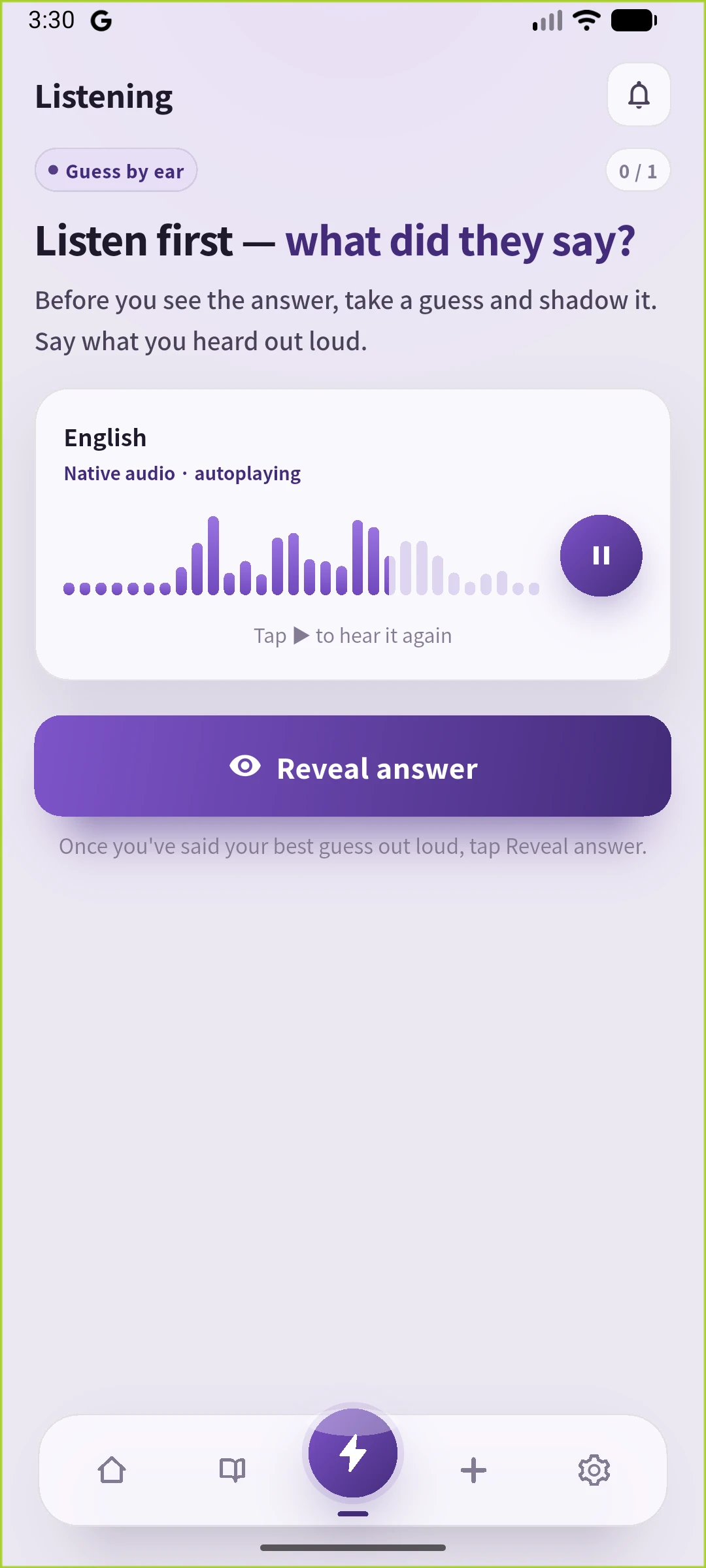
- Start with “Learn this card” on the explanation screen. Listening plays the audio while hiding the sentence.
- Let the child say what they heard, then use “Reveal answer” to show the sentence.
- Read it aloud together. The answer screen has an audio replay button and review-interval choices.
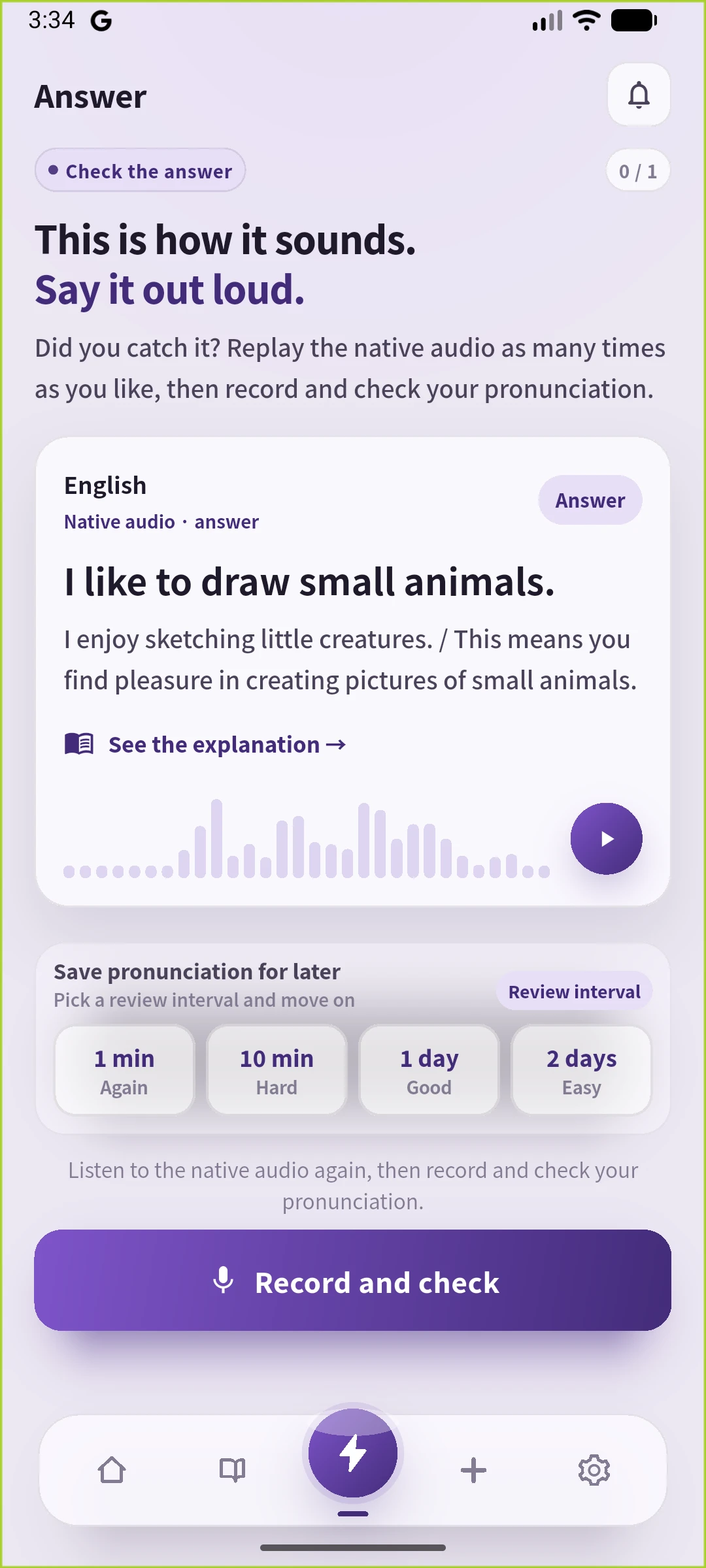
I like to draw small animals.
Our original home-practice sentence, with AI-generated audio from SpeakGain’s Viking voice. This is not official Eiken audio.
For five minutes, listen once, reveal the sentence and say it together once. SpeakGain is a practice helper, not an Eiken mock test, an answer or pronunciation scoring service, or a promise of passing. Check separately whether an answer fits the question. Recording and pronunciation checks were outside our verification for this article.
A two-week family plan
This is our editorial plan, not a two-week pass guarantee or an official preparation period. Move a missed day forward instead of doubling a tired child’s workload.
| Day | Activity | One thing to check |
|---|---|---|
| 1 | Look at official procedure/samples; check session and device | Understand the sequence |
| 2 | Read a short original passage | No omitted word |
| 3 | Record and listen | Audible voice |
| 4 | Answer a passage time question | Time information fits |
| 5 | Ask about place instead | Not yesterday’s automatic answer |
| 6 | Say one genuine interest | Meaning understood |
| 7 | Repeat the hardest question | One improvement |
| 8 | Grade 4: describe objects/action; Grade 5: passage questions | Correct target |
| 9 | Change a personal question | Preference versus place |
| 10 | Read, then answer | Content retained |
| 11 | Check official replay instructions | No unlimited retries assumed |
| 12 | Practise without parent prompts | Follow instructions alone |
| 13 | Correct one point and recheck equipment | Choose content, word or voice |
| 14 | Use familiar sentences, no new long memorization | Calm start |
Notice a concrete success, such as giving the right place today. Parents need not invent a new worksheet daily: use short material to practise a weak point and return to official samples to check format.
Methods we would not choose
Long sentences memorized without understanding can tempt a child to recite the same paragraph whatever the question. We would start with a relevant short answer and change one understood word, rather than praise length alone.
Cramming only the night before introduces reading, answering and unfamiliar device controls together, leaving little chance to identify the actual difficulty or check recall the next day. We prefer several short sessions and familiar sentences/equipment on the final evening. These are editorial judgments, not measured pass-rate claims.
Avoid correcting every sound immediately or comparing answer length with another child’s. If today’s task is understanding the passage, check that first; then work on one pronunciation point.
Replay, interruptions and test day
Official procedure allows up to two listens again when a direction/question is unclear. Using listen-and-retry removes the earlier recording; the answer must be recorded again. This does not mean unlimited saved takes (procedure).
The FAQ allows a restart from the beginning after a freeze or power failure, deleting the earlier record. Restart the PC browser and log in, or close/reopen the smartphone app, as instructed. After a completed test, retaking is not allowed for any reason (FAQ). Check charge, connection, playback and microphone first. Do not use the real attempt as a family practice run.
Frequently asked questions
Must my child take Speaking to pass Grade 4/5?
No. It is optional and does not affect grade certification. First-stage Reading and Listening determine the grade (FAQ).
Can an applicant who failed or missed the first stage take it?
Yes, for the same applied-for level within the applicable window (FAQ, dates).
How many attempts are available?
One per application; no retake after completion. Technical interruption rules are separate (features, FAQ).
Does it work on a phone or iPad?
Use a supported smartphone with the official app guidance. The current FAQ says iPad is unsupported and not recommended (preparation, FAQ).
Can a parent help?
With preparation and explaining instructions, yes; with actual test answers, no (procedure).
What if a question is unclear?
The official explanation allows up to two repeats; record again after retrying (procedure).
Does failing Speaking cancel a passed grade?
No. They have separate pass decisions. A completed Speaking test cannot be retaken under the same attempt (results, FAQ).
Is a result report sent by post?
No. View it online with ID/password, checking the applicable viewing start (results).
Can parents with limited English support practice?
We think so: check meaning, relevance and audibility first. Consult a reference for uncertain sounds; do not treat family observations as official scoring.
Our verdict
We would choose short, relevant answers and 5–10-minute practice over long memorized scripts. Check Grade 5’s reading/two passage questions/personal question; add Grade 4’s illustration question. Choose one thing to notice and include a practice run without parental prompting.
Confirm your window and device officially, keep the grade and Speaking results separate, and use what the learner can now say as a starting point for further study. When progressing to the face-to-face format, see our Eiken Grade 3 interview guide. Do not import its entry/exit or card-turning routine into Grade 4/5.
Official references
Checked 14 October 2026. Recheck your year/session and device before taking the test.
- Introduction
- Features and official samples
- Pass decisions and results
- Preparation and supported environment
- Detailed procedure
- FAQ
- Parent guidance
- Session windows
- Grade 4 format
- Grade 5 format
Eiken is a registered trademark of the Eiken Foundation of Japan. Our examples, diagrams and plan are editorial material, not official Eiken questions or scoring criteria.