
English pronunciation practice: what to fix first and a six-step recording routine
Published
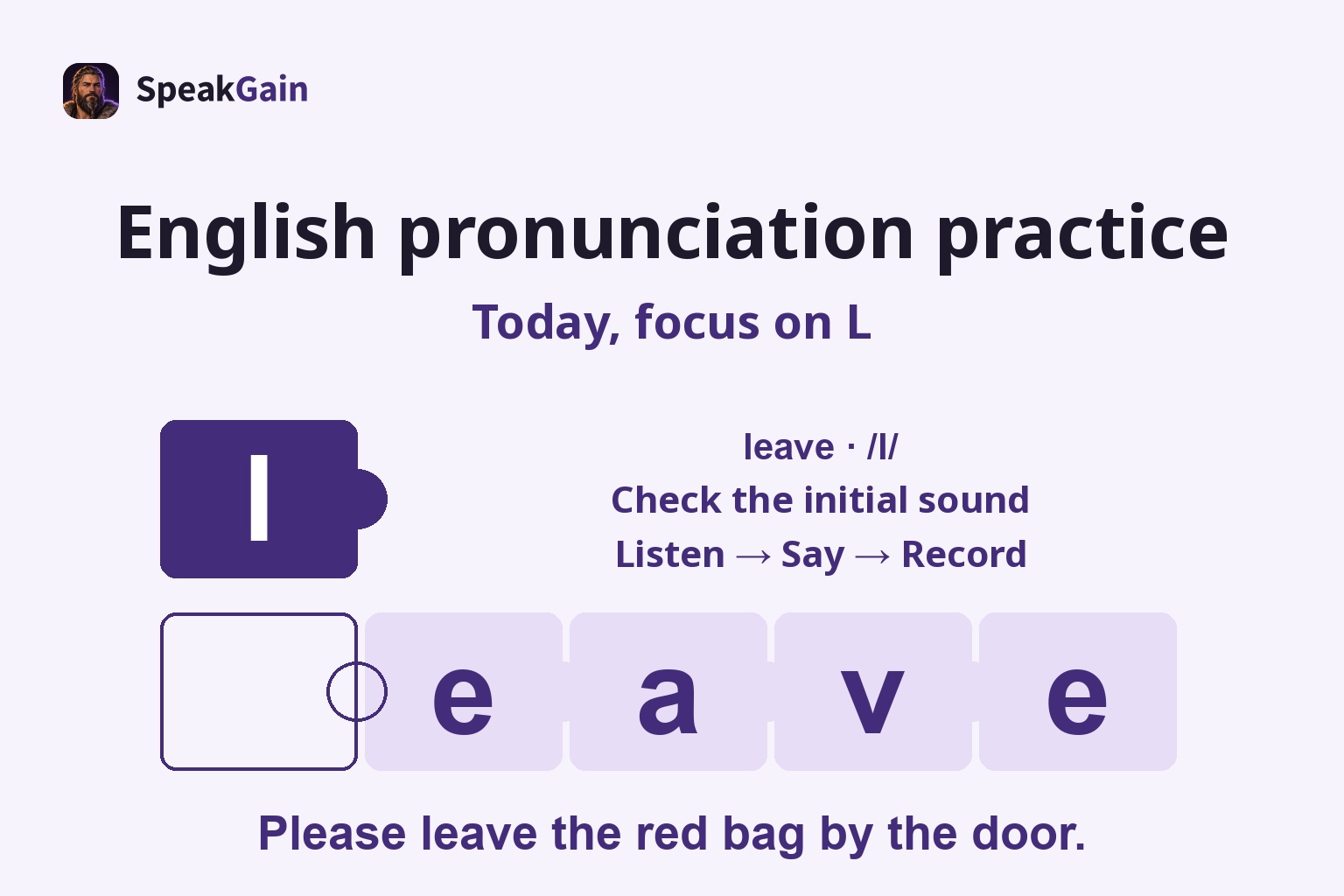
For independent English pronunciation practice, start with a sound, word ending or stress pattern that makes your message harder to understand, and fix one feature at a time. Our editors suggest five to ten minutes with one short sentence: listen, say a word and the sentence, compare a recording, repair one feature, then return to the sentence; this is a starting routine, not a proven optimum or a promise of improvement. Check whether the chosen sound is distinguishable, the words remain complete and the important information stands out, rather than relying only on a score.
You do not need to work through every English sound before speaking. If a listener hears a different word, inspect that word; if you add a vowel after a final consonant, inspect the ending; if individual words sound clear but the sentence is hard to follow, inspect emphasis and pauses. Your first language can suggest useful checks, but it does not diagnose your recording.
This is a method article. For tools, see our English pronunciation app guide; for a wider study plan, see how to study English. We will use one sentence throughout, without ranking apps.
For an upcoming TOEIC Speaking test, use our task-specific answer patterns and solo practice guide to plan timed recordings around the official limits.
After checking individual sounds, use English intonation and stress practice to inspect important words and final pitch movement one sentence at a time.
If you can say words separately but pause between them, try English linking practice to carry a final consonant into the next vowel.
For individual sounds, use our English consonant practice guide to choose a word ending, L/R or th contrast and compare one short recorded sentence.
To keep a sound clear through a phrase, try tongue twisters by target sound and join short chunks before adding speed.
For clues to a word’s reading from its spelling, use phonics for adults to connect common patterns, exceptions and dictionary checks.
If you are choosing a pronunciation model, British vs American English compares representative differences and shows how to practise with one reference.
What should you fix first?
Choose the feature that obstructs understanding in language you actually use. Note a word that someone asked you to repeat, including its surrounding phrase. When the cause is unclear, record a short sentence and examine word identity, endings and stress separately.
| What you notice | What to inspect first | A small task |
|---|---|---|
| The listener hears another word | A contrasting vowel or consonant | Compare light/right or ship/sheep |
| The end of a word is unclear | A missing consonant or an added vowel | Say bag, then the red bag |
| Words are clear separately but the sentence is difficult | Word stress, sentence emphasis and pauses | Listen for the important words |
| Matching the speed makes you lose words | An overlong passage or an unstable phrase | Stop the model and repeat a shorter group |
This is our editorial decision rule, not a universal diagnosis. Low volume, background noise, a wrong word, grammar or unfamiliar context can also cause a misunderstanding. If possible, ask “Which word did you hear?” before assuming everything is a pronunciation problem.
Accent strength, the effort of understanding and the content actually understood are different measures. In their author abstract revisiting earlier research, Munro and Derwing describe these dimensions as related but partly independent: heavily accented speech can still be highly intelligible. This supports distinguishing the goals; it does not establish one teaching order for everyone. Munro & Derwing, 2022
Our editors therefore prioritize the intended words and meaning over removing every trace of an accent. That does not mean ignoring a contrast that changes a word, a missing negative or a buried key detail.
Sounds versus rhythm
A sound concerns a vowel or consonant; rhythm concerns which parts of a word or sentence stand out and which pass more briefly. Working on the mouth position alone does not check whether you can use that sound with its neighbours. Copying rhythm alone does not check a word-changing sound contrast.
| Feature | What to compare | Example |
|---|---|---|
| Individual sound | Tongue, lips, airflow and sound quality | The beginning of leave |
| Word stress | The prominent syllable within a word | reCORD as a verb, REcord as a noun |
| Sentence emphasis | Longer or more prominent parts | Please leave the red BAG by the DOOR. |
| Connection and pauses | Unnecessary breaks between words | the red bag as a group |
Capital letters are practice marks, not the only correct delivery. If you mean “the red bag, not the blue one”, RED may be prominent; if you mean “by the door, not the window”, DOOR may be prominent. Listen to the chosen model and consider the situation. Pronuncian explains sentence emphasis and its relation to stress within words. Sentence stress lesson
Our recommendation is to separate rounds: one for the initial sound in leave, another for emphasis on bag and door. Do not try to control tongue position, pitch, speed and every consonant simultaneously.
Common stumbling points: choose examples that fit your recording
Use these contrasts to find a task, not to label every speaker of a language. Japanese speakers may want to check L/R, th, vowel contrasts, added vowels and stress; other learners may need a different starting point. Even if English L is familiar from your first language, use the drill below to practise keeping one selected feature in a full sentence.
L/R: listen before repeating
Compare light/right or glass/grass without seeing the answer, then check which word you heard. If the distinction remains unclear, do not repeat an imagined sound dozens of times. For initial L, the tongue tip contacts the tooth ridge and air passes along its sides. American R does not use that tongue-tip contact, and there is more than one tongue configuration. “Always curl your tongue” is too narrow a rule. L, R
Move from a word to Turn right. or Leave it here. This L explanation concerns the start of a word; it is not a complete account of final L.
th: distinguish two sounds
Think contains /θ/; this contains /ð/. Both involve airflow through a narrow opening near the front teeth, but /ð/ is voiced. Do not make forceful biting or a greatly protruding tongue the objective. th lesson
Try think → I think so., and this → This is the bag. If three/tree is your target, compare the initial sound. In a sentence, move on into the next vowel rather than holding th indefinitely.
Vowels: more than duration
Ship /ɪ/ and sheep /iː/ differ in quality, not simply in how long you hold one mouth position. Some teaching systems write the latter /i/. Compare the model sounds and tongue descriptions, then record I can see a ship. and I can see a sheep. /ɪ/ lesson, /i/ lesson
Ask someone to identify the word without seeing the text if that is available. Leave has this vowel as another possible target, but do not assess it in the same round as initial L unless you can clearly separate the checks.
Endings: missing sounds and extra vowels are different
Listen to bag. Have you added a vowel after /g/, or lost the ending? Move from bag to the red bag, then the red bag by the door. Red provides another ending to inspect. Reducing an extra vowel does not mean deleting the consonant.
Do not demand a large audible burst on every final stop. Pronuncian explains small aspiration at word endings and the role of the preceding vowel in distinguishing stops. Stop consonants
Stress: make meaning prominent before increasing speed
If every word is equally long, listen for emphasis in the model. Confirm word stress in a dictionary; confirm sentence emphasis against the situation. Meaning groups marked with a slash are not automatically places where the model pauses. Practise the red bag and by the door without inserting a large break after each word.
Step 1: choose one understandable sentence and matching audio
Start with a sentence whose situation you can explain. You need accurate text, its model audio and a way to record. Our editors prefer finishing a small repair to racing through a long video; an expensive microphone is not the first requirement.
Please leave the red bag by the door.
Imagine asking someone to put a particular bag near the door. Here leave means to put or keep something in a place, not to depart. You can understand it in groups—Please / leave the red bag / by the door—but those slashes do not prescribe pauses.
Use one speaker at first. If there are many unknown words, inaccurate subtitles, music or overlapping voices, you have more variables to resolve. Choose an easier, shorter passage for a pronunciation round.
Step 2: listen and choose one target
Listen without speaking first, then choose a sound or rhythm feature. Make an initial recording too. This sentence offers several possible targets; marking all of them does not make the practice more focused.
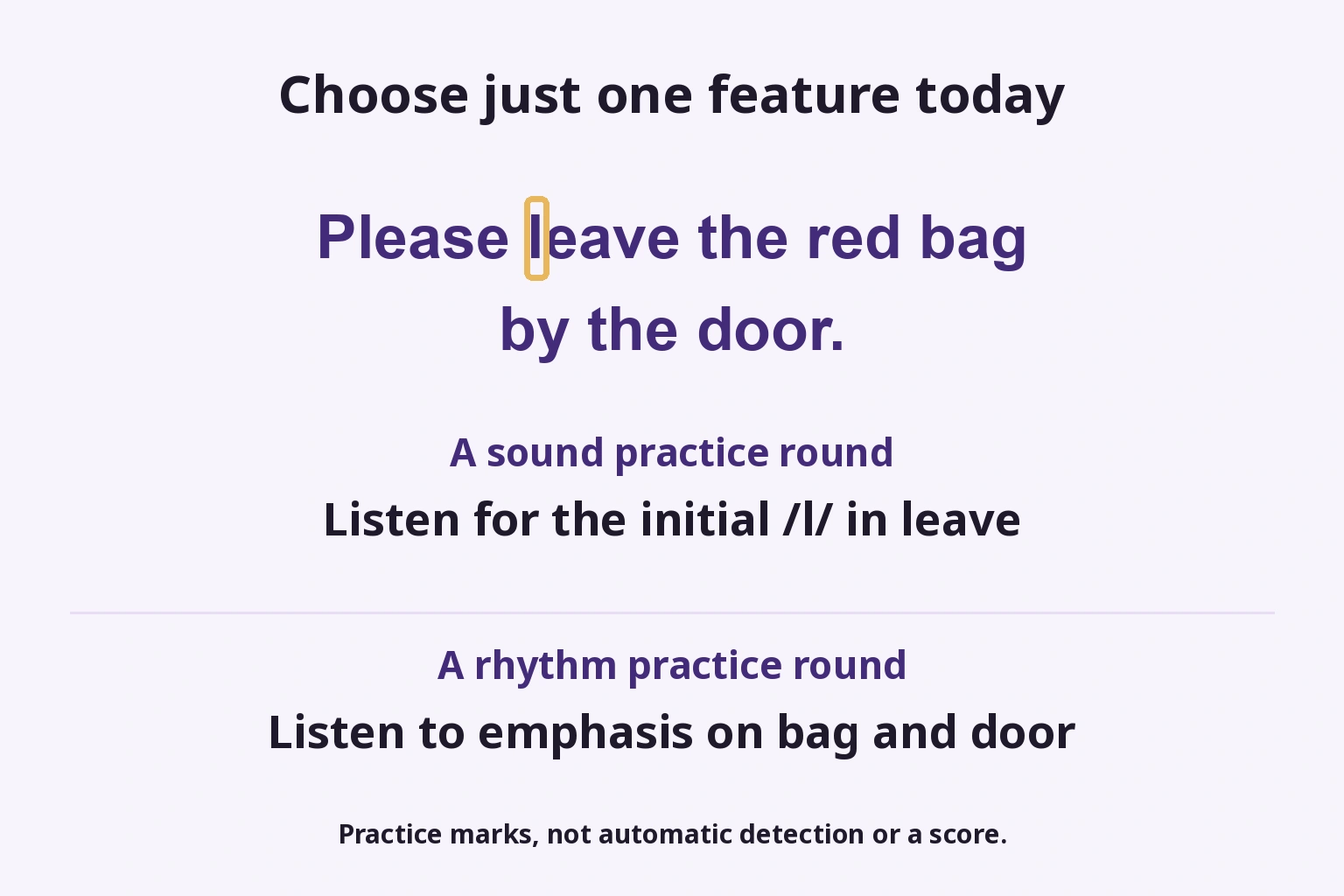
Our starter target is “produce initial L in leave”. If it is already distinguishable and the problem is bag’s ending, choose that instead. Do not invent a weakness just to follow the diagram. Write one line: “Listen to the beginning of leave.”
You do not need to imitate the model’s deep voice. Compare the chosen sound and emphasis within your own comfortable voice range.
Step 3: say a word, a group and the sentence
Shorten an unstable part, then return to its context. Check initial L in leave, say leave the red bag, then say the full sentence.
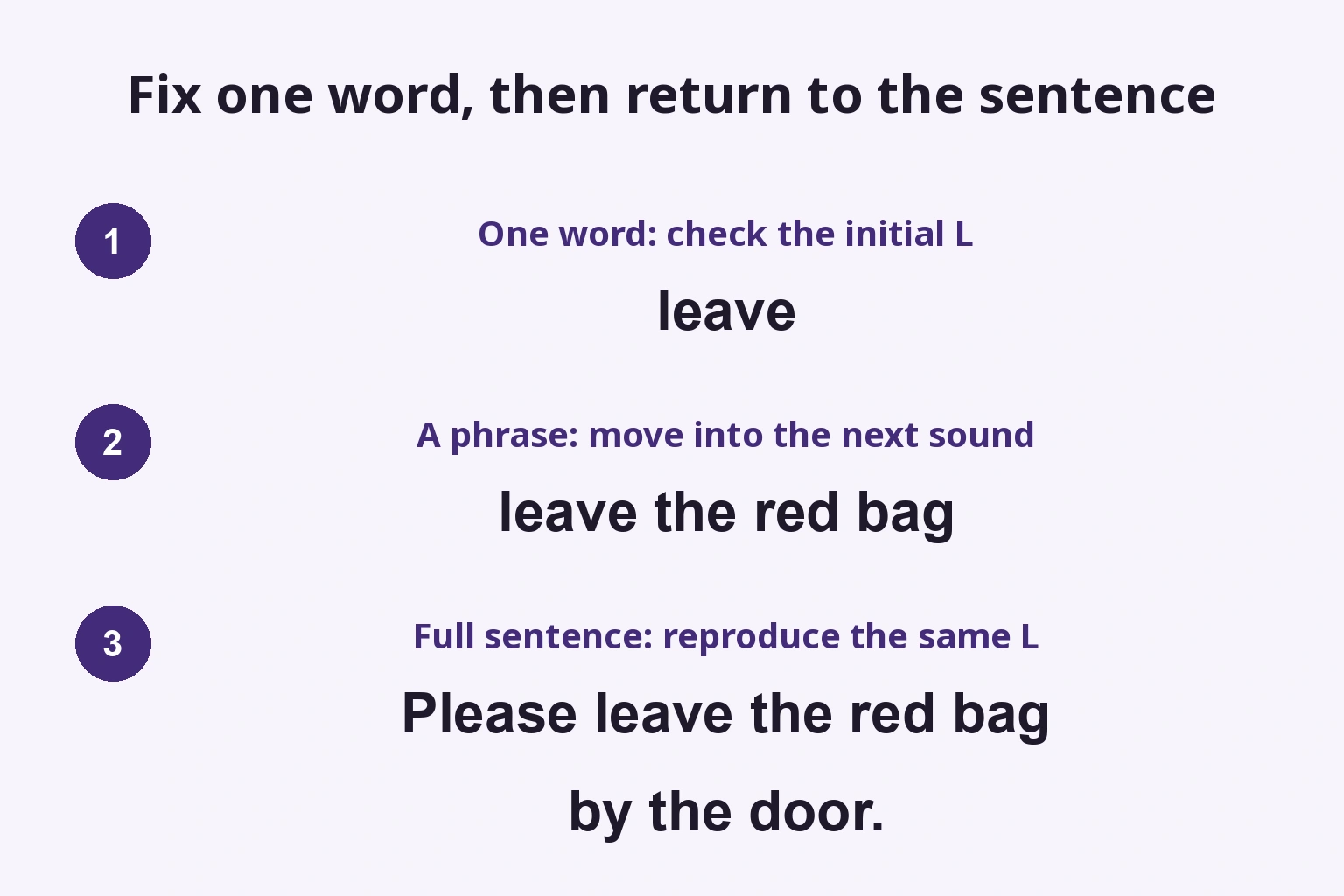
Listen, stop playback and speak alone. Two or three attempts at each size are our suggested starting checkpoint, not an evidence-based success threshold. If you cannot form the initial sound, repeating the whole sentence endlessly makes the target harder to isolate.
The opposite problem is stopping at a word. Once you can say leave, move into the next sound in the phrase. A deliberately prolonged L is preparation; reproduce it at a usable duration within the sentence.
Step 4: alternate the model and your recording
Record yourself after stopping the model, then play the two recordings in turn. An overlapping recording can obscure whose sound you are judging. Use a quiet place and a similar distance from the same device; clipping or background noise can make a comparison inconclusive.
Listen model→you, then you→model, focusing only on leave’s beginning. Replace “I sound bad” with a specific question about that sound. If you cannot decide, ask a teacher to check that particular word rather than requesting a general verdict.
In SpeakGain, we created this sentence through the normal Add flow. On the device, the sequence was Knowledge → Learn this card → Listening / Guess by ear → Reveal answer → Answer. Listening hides the sentence; Answer displays it, the meaning, model playback and Record and check.
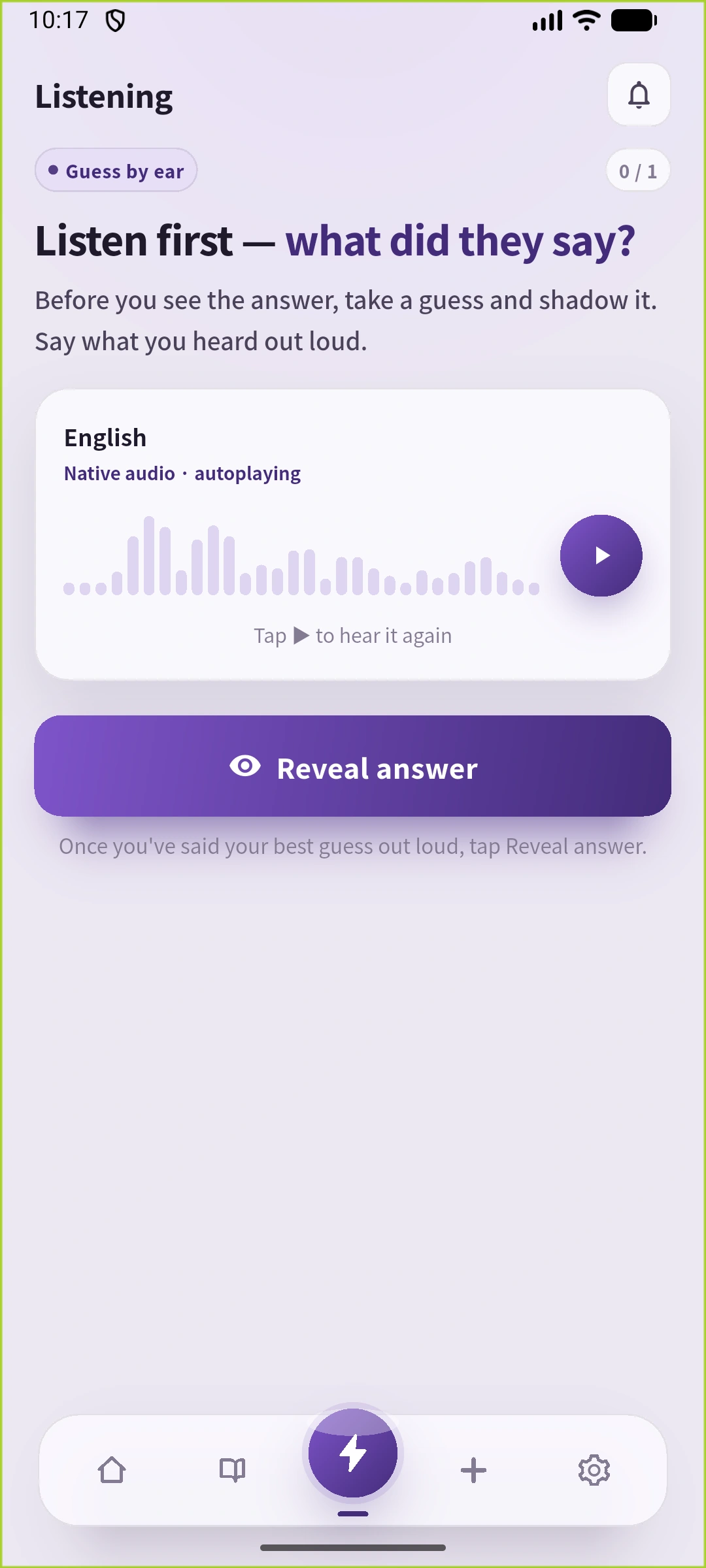
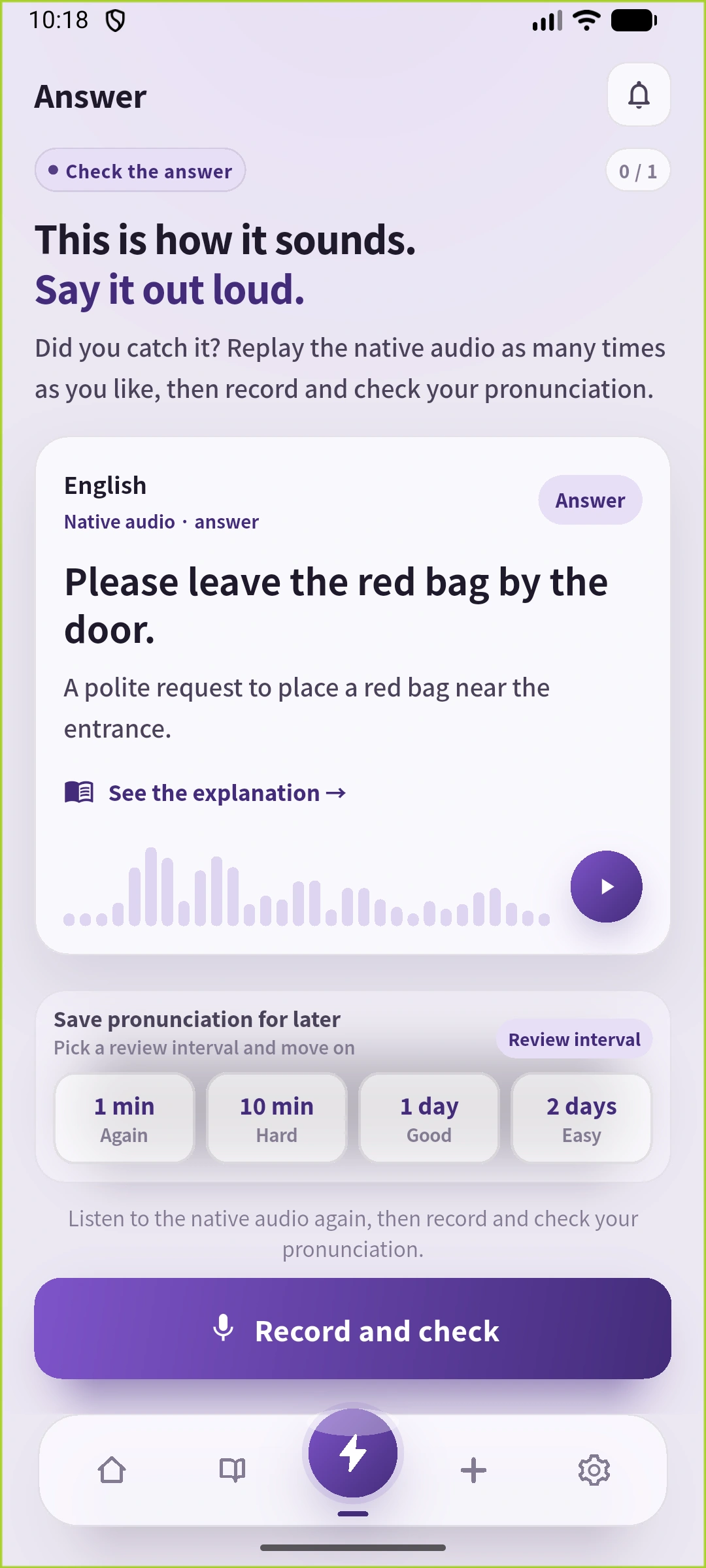
We verified model playback and the recording entry up to Android’s microphone permission prompt. We did not generate a learner recording score or test L/R scoring accuracy or improvement. The screenshots show a saved sentence and its playback/recording entry, not a validated assessment. See what SpeakGain is for the wider product explanation.
If you are learning a particular speaker’s delivery, retain that original audio too. A generated model does not replicate every feature of the original speaker. Treat an app evaluation as a possible clue to investigate with your recording, rather than the final verdict on communication.
Step 5: repair one feature and record the full sentence again
Turn the difference you noticed into the next action. “The beginning of leave is unclear, so I will check it in the word” is more useful than “pronunciation is wrong”.
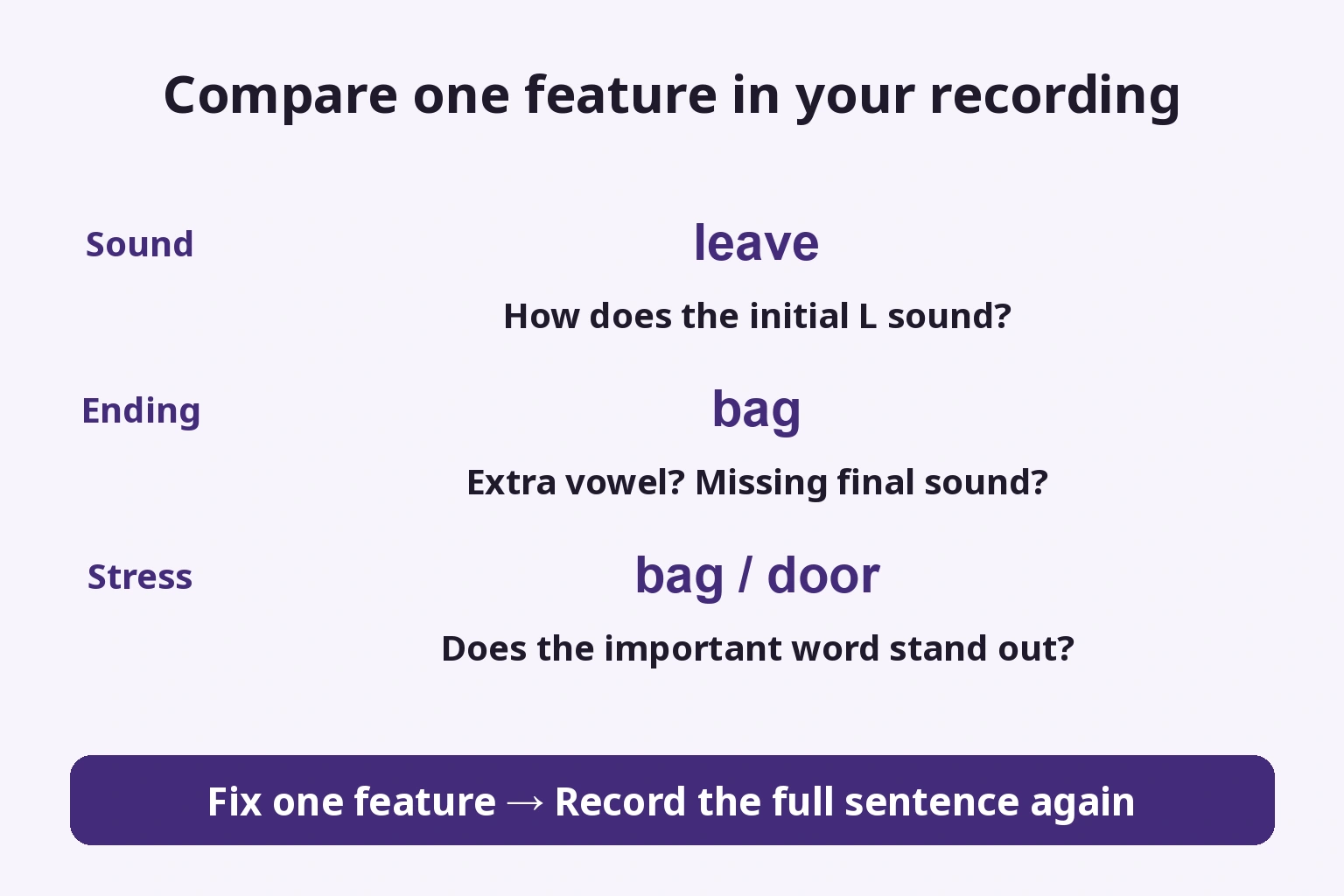
| Target | Question in the recording | Next action |
|---|---|---|
| Initial L | Does the beginning differ from the model? | Check leave, then leave the red bag |
| Final sound in bag | Extra vowel or missing ending? | Practise bag by the door |
| Emphasis | Does the intended word stand out? | Check the model and situation, then give it prominence |
| Pauses | Am I stopping after each word? | Practise a group, then the full sentence |
Compare the original and revised recordings against the same target. If you cannot hear a change, mark it “not yet confirmed”. A louder recording alone does not show that a sound contrast changed. Keep one revised recording and a short note; accumulating files is not the objective.
Step 6: check tomorrow and in another sentence
Separate immediate success from later reproduction. Tomorrow, say the sentence before listening to the model, then check it. If you forgot the words, inspect the text first and distinguish memory from sound production.
Try Leave the light on. as another sentence with initial L. Producing a memorized sentence does not guarantee that an unfamiliar conversation will be understood. Record transfer to another sentence as a separate observation.
For a five-to-ten-minute round, our suggested allocation is one or two minutes for meaning and listening, two or three for words and groups, two or three for recording and repair, and about one for the full sentence. Adjust it to your attention and time. Preserve the return to the sentence when you shorten the routine.
Common mistakes and fixes
When repetition stalls, change the observation rather than only adding repetitions.
| Mistake | Why it is unhelpful | Fix |
|---|---|---|
| Fixing every sound together | You cannot identify the change | Choose one sound or rhythm feature |
| Only reading mouth descriptions | Your produced sound is unchecked | Record a word and compare |
| Only using first-language spelling approximations | Contrasts can collapse into one spelling | Use audio and relevant phonetic symbols |
| Stopping at isolated words | Context is unchecked | Return to a phrase and sentence |
| Treating speed as the goal | Words or sounds may disappear | Shorten the passage, preserve the words |
| Restarting everything after a low score | Attention moves away from the target | Inspect one indicated place in the recording |
| Finishing after immediate success | Retention and transfer are unknown | Check the next day and another sentence |
For uncertainty about what you hear, try dictation. For rhythm with text visible, try reading with the audio; for a broader spoken routine, see reading English aloud. Shadowing is another task, where you follow without relying on the text.
Frequently asked questions
Must I learn every phonetic symbol first?
No. Start with symbols relevant to the contrast you are inspecting, such as /l/–/r/ or /ɪ/–/iː/, alongside dictionary audio. Reading a symbol does not verify your production.
American or British English?
Choose a model that fits your purpose and keep it stable during one drill. Dictionary variants are not automatically mistakes. Our generated example uses an American English voice setting.
How many minutes a day?
Our editors suggest five to ten minutes for one sentence. It is a manageable starting proposal, not an established optimal dose. Include comparison and repair, not just repetition.
Is recording necessary?
This routine uses it to compare your sound. If a sentence feels uncomfortable, record one word first. Judge the chosen feature rather than whether you like your voice; a teacher’s specific feedback is another option.
Can I trust an app score?
Use it as a repair candidate, not the sole test of being understood. Compare its indication with the actual recording. Correct transcription alone does not establish that every sound was appropriate. We did not compare scoring systems here.
Can adults change their pronunciation?
Research has shown change in adults under specific conditions; it does not guarantee every learner’s outcome. Bradlow and colleagues trained eleven Japanese speakers aged 19–22 on L/R identification with multiple speakers; nine returned at three months, and the study examined retained changes in perception and word production. It does not establish the result for every age, sound, app or our short routine. Bradlow et al., 1999
Is shadowing enough?
It is one exercise, not a guaranteed repair for every sound. Return to one word when its sound is unstable, or use text-supported simultaneous reading for rhythm.
How long until I sound like a native speaker?
There is no fixed number of months. Start by checking whether the intended word can be identified and reproduced in a sentence. Our editorial goal is useful communication checks, not a deadline for erasing an accent.
For a closer look at vowel contrasts, use the English vowel chart and priority-pair drills to check schwa, vowel quality and length in a recorded sentence.
Our editors’ verdict
For a first independent session, choose one short sentence, repair one feature and return to the full sentence. We do not recommend starting every difficult sound at once or counting plays of a long video without a comparison target.
Listen to Please leave the red bag by the door., record yourself, and choose initial L, bag’s ending or the intended emphasis. Practise briefly and record the sentence again. Check it tomorrow and in another sentence: that is our recommended starting unit.
To carry pronunciation work into sustained answers, try the Part 2 and Part 3 listening-back steps in IELTS Speaking preparation.
To turn a dictionary lookup into spoken practice, use our guide to reading English phonetic symbols for the main symbols, notation differences and a practical learning order.
Families preparing Japan’s Eiken Grades 4 and 5 can use our Speaking Test and home-practice guide to check official entry rules and practise short, relevant answers together.
When choosing what to repair in a recording, use English accents and intelligibility to prioritize a word that actually caused a misunderstanding.
Sources and verification scope
- Munro & Derwing (2022)
- Bradlow et al. (1999)
- Pronuncian: L
- Pronuncian: R
- Pronuncian: th
- Pronuncian: /ɪ/
- Pronuncian: /i/
- Pronuncian: stress
- Pronuncian: stops
- The order and time allocation are editorial recommendations. Device checks cover saved text, model playback and the recording entry, not scoring accuracy or learning effects.