
English intonation, stress and rhythm: rules and a one-sentence practice routine
Published
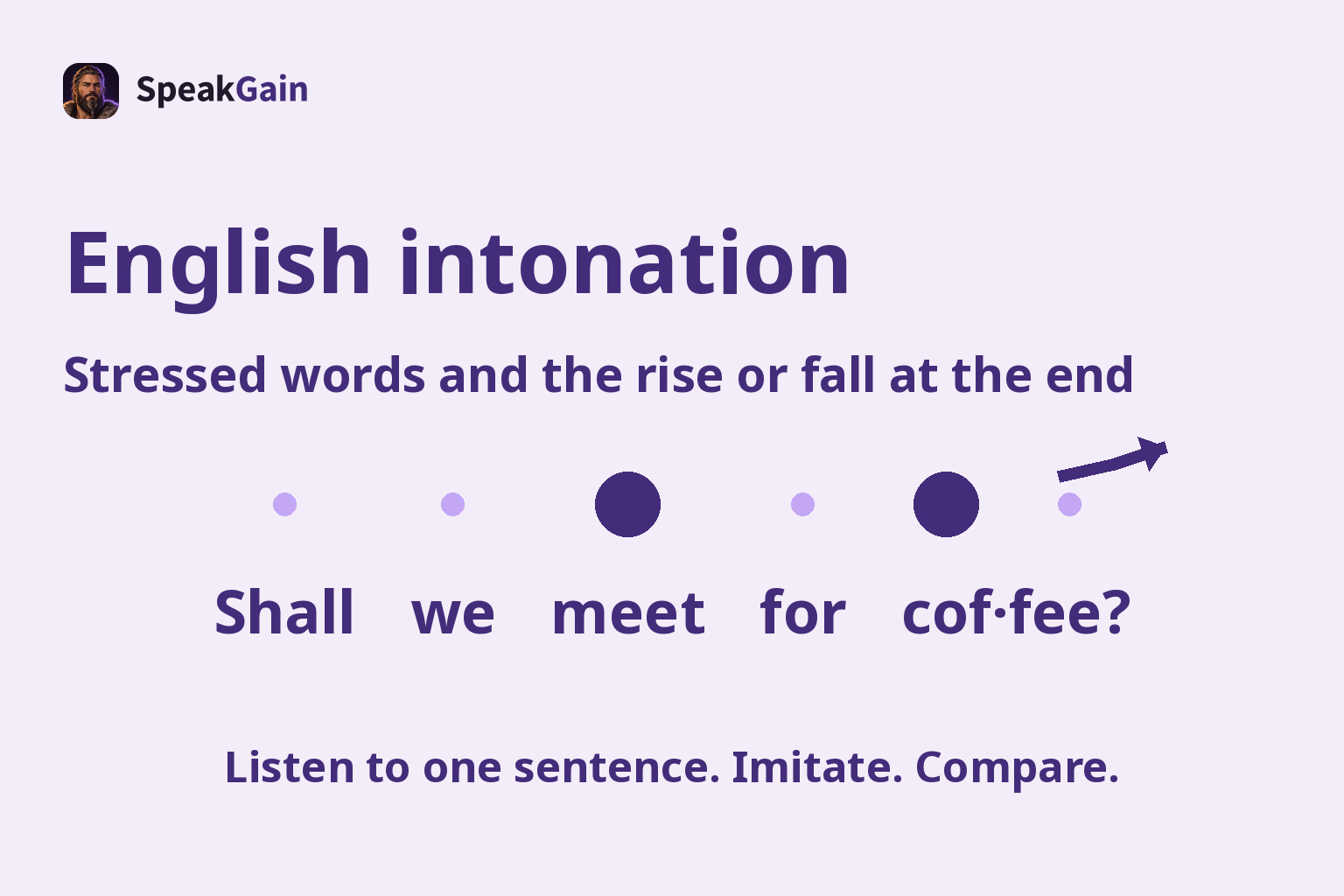
English intonation is pitch movement across a phrase; stress makes a syllable or word stand out; rhythm combines prominence, timing and grouping. Start with word stress, choose the information to emphasize in a sentence, then listen to the pitch movement that suits its context. Our editorial routine is one sentence: listen → mark prominent words → tap → imitate → record and compare → repair one feature.
Accent, stress, intonation and rhythm: different jobs
Decide whether you are examining a word, a message or its timing. “Accent” can mean a pronunciation variety as well as word accent. The comparison with Japanese below concerns mainly Tokyo-style pitch accent, not every dialect or every learner.
| Term | What it describes | Japanese comparison | Example |
|---|---|---|---|
| Accent | Word accent in some teaching contexts; also a regional or language-background variety | Lexical pitch patterns are not identical to English stress | A speaker’s accent is different from stress in coffee |
| Stress | Relative prominence of a syllable; distinguish word and sentence stress | Listen beyond height alone: duration and vowel clarity matter too | COFfee; prominent coffee in a phrase |
| Intonation | Pitch movement across a meaningful group | Do not transfer one question melody to every English question | coffee? with a rise; coffee. with a fall |
| Rhythm | Prominent and weak parts, duration and grouping | Do not build English from equal Japanese spelling beats | MEET for COFfee |
Baruch College describes duration, loudness and pitch as stress cues. You do not need to maximize all three. Stress lesson Also, “stress-timed English” is not a guarantee of equal intervals. Wang and colleagues critically examine that assumption. Our tapping is an attention aid, not a measurement or metronome rule. Wang et al., 2022
For vowels and consonants, use English pronunciation practice. This article works on prominence and phrasing rather than repeating the individual-sound drills.
Core rules: useful tendencies with exceptions
The bold marks below are our context-specific practice choices. They are not automatically detected stress or a prescription to shout every marked word equally.
| Tendency | Original example | Target | Caution |
|---|---|---|---|
| Learn lexical stress with the word | We need a TAble. | First syllable of table | Check dictionary audio rather than spelling |
| Some noun–verb pairs change stress | Keep a REcord. / Please reCORD it. | First versus second syllable | Not a rule for all two-syllable words |
| Content words often stand out | We can MEET for COFfee. | meet and COF | Function words can be emphasized in contrast |
| New or corrected information is prominent | Let’s meet on FRIday. | First syllable of Friday | The preceding conversation matters |
| Ordinary statements and information questions often fall | Where is the KEY? ↘ | Movement around key | Clarification can use a rise |
| Ordinary yes/no questions often rise | Shall we MEET for COFfee? ↗ | Movement from COF toward the end | Rhetorical questions and other contexts differ |
Stage 1: word stress
1. Check the prominent syllable, then its neighbours
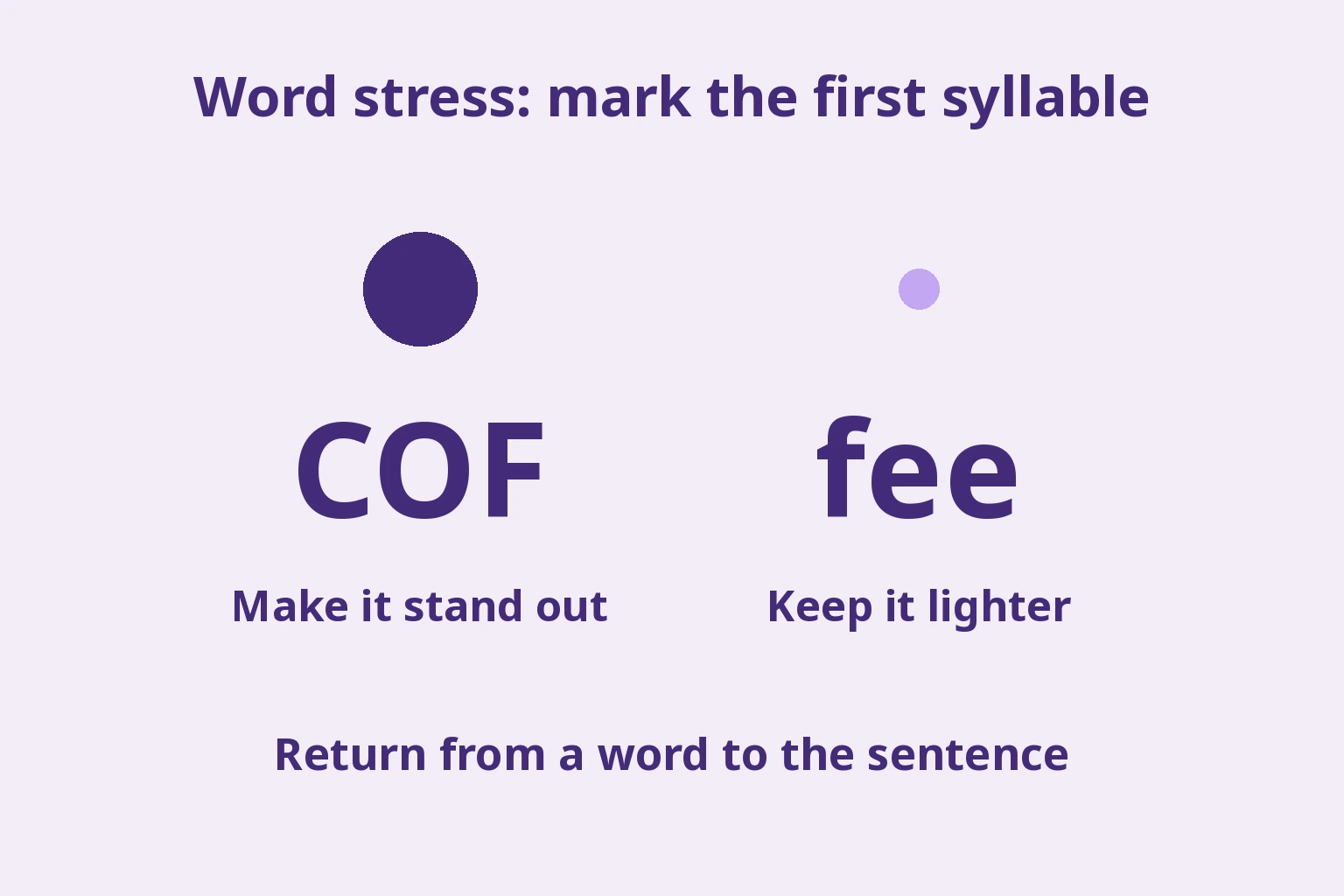
Learn the stress position with dictionary audio. Our example is We need a TAble. Say table alone, mark its first syllable with one finger movement, then return to the sentence. Keep the ending audible.
A Japanese speaker may find an English loanword’s familiar Japanese melody intruding; another learner may give both syllables equal prominence while reading carefully. These are things to inspect in your recording, not diagnoses based on your passport. Check whether the first vowel stands out without making the whole word louder. Baruch: stress
Our main sentence contains coffee. Preserve its first-syllable stress while returning from coffee to meet for coffee and the full sentence.
2. Learn changing noun–verb pairs as pairs
Some identical spellings have different stress in different uses. Keep a REcord. asks for a record to be kept; Please reCORD it. asks for recording. Baruch demonstrates pairs like these. Nouns and verbs
If you use one memorized delivery for both, check the meaning before checking the sound. Do not turn the pattern into “all nouns stress the beginning, all verbs the end”. Practise each word in its short sentence, then compare the chosen syllable only. Learners who already know stress from another language still need the English lexical position.
Stage 2: sentence stress and rhythm
3. Highlight content words; keep the connectors lighter
Nouns and main verbs often receive prominence, while articles, prepositions and auxiliaries are often less prominent. Context can change this. Content and function words
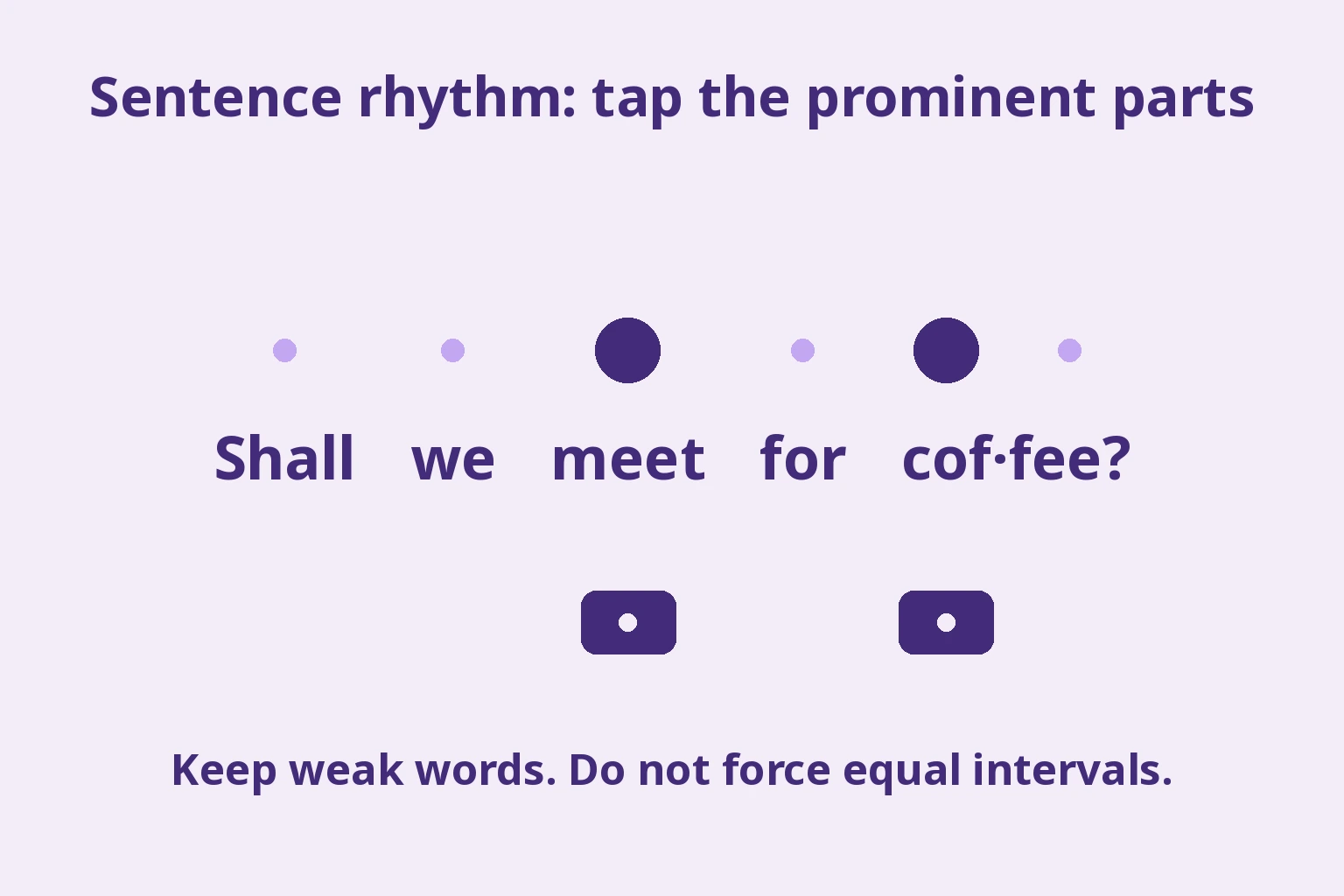
Use We can MEET for COFfee. when meeting for coffee is the new proposal. A careful reading with a full stop after each word can bury that information. A Japanese-beat or equal-syllable approximation is one possible reason, but it is not the only one.
Tap on meet and COF, retaining we, can, for and fee between the prominent parts. Then stop tapping and say the sentence. Do not force equal intervals, drop weak words or assume that “faster” means “better”.
4. Change prominence when the information changes
Emphasis depends on what the listener needs now. Let’s meet on FRIday. answers “When?”; No, FRIday. corrects a suggested Thursday. Friday keeps its first-syllable word stress. New information and contrast
A common practice error is retaining the same marks regardless of the preceding question. Write the context in one line before speaking. If the main question is whether we, rather than someone else, should meet, WE can become prominent in the main practice sentence. Function words are not forbidden from receiving emphasis.
Stage 3: intonation in context
5. Ordinary statements and wh-information questions often fall
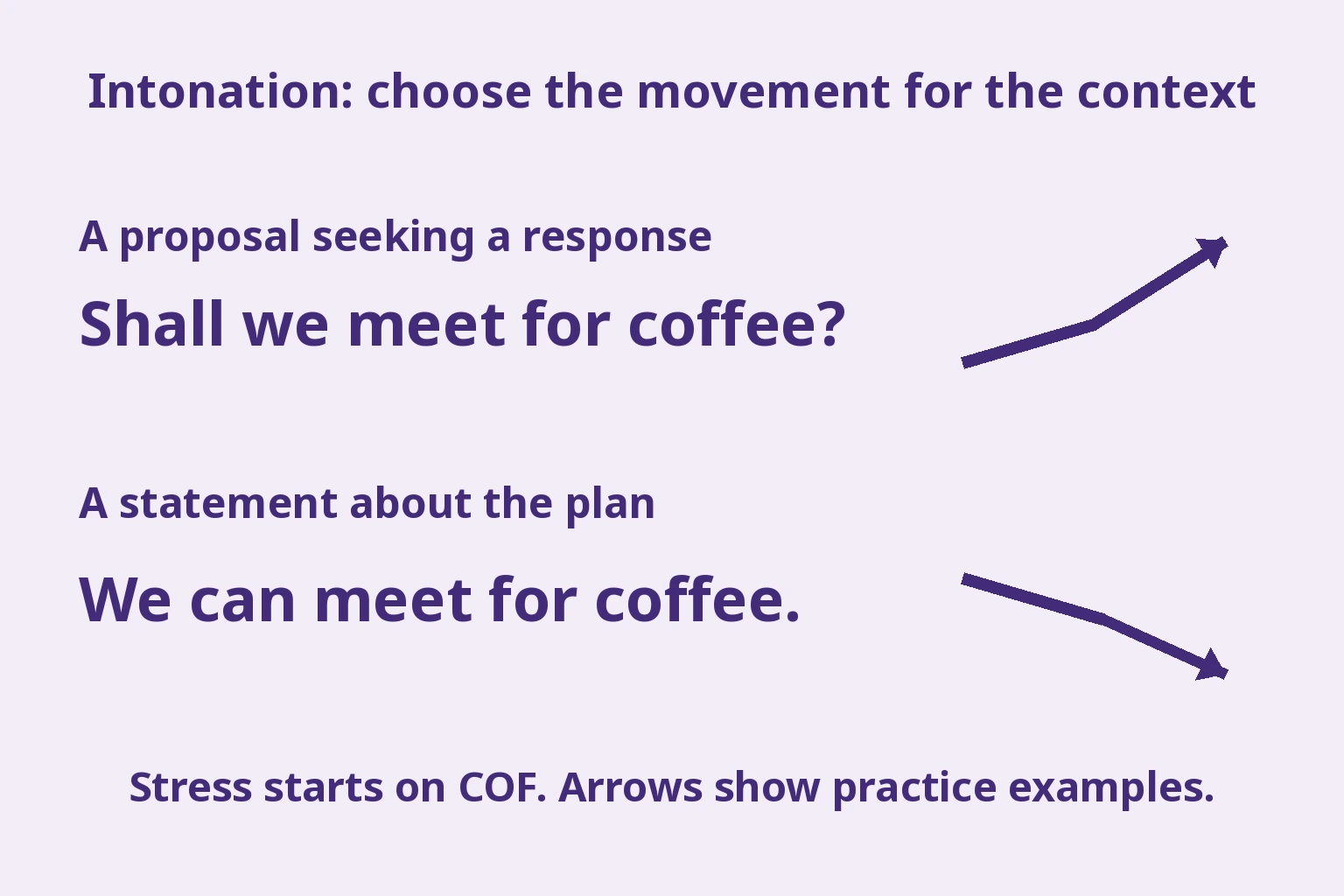
A question mark does not require a rise. Try The KEY is here. ↘ and Where is the KEY? ↘ as an ordinary report and request for location. If “here rather than there” is the contrast, the statement’s focus changes. Wh-questions
Inspect a habitual rise on every question, which may reflect first-language expectations or an overlearned classroom rule. For a clarification request, a wh-question can rise; do not call every rising example wrong. Clarification Keep key audible while moving pitch down rather than simply fading out.
6. Ordinary yes/no questions often rise, with exceptions
Rising delivery is a useful starting option for a question that genuinely awaits a response. Rhetorical questions can differ. Yes/no questions
Our sentence is Shall we MEET for COFfee? Imagine proposing a coffee meeting and waiting for agreement. Listen for the movement from the stressed part of coffee toward the end. Raising the last syllable does not relocate lexical stress to fee.
If your reading stays flat and suddenly jumps only on fee, isolate coffee, then meet for coffee, then the sentence. Avoid raising and lowering every word theatrically. Stay within your comfortable voice range.
One sentence, six actions
Shall we meet for coffee? is our shared practice sentence. Choose matching, understandable model audio. Our five-to-ten-minute starting session is an editorial suggestion, not an established optimal dose.
- Listen: hear prominence first, then the ending’s pitch movement, without speaking over the model.
- Mark: use meet and COF as starting candidates; change your marks if the actual model differs.
- Tap: mark those prominent parts while keeping every weak word. Equal spacing is unnecessary.
- Imitate: stop playback and speak alone. Shorten to coffee or meet for coffee when needed, then return.
- Record and compare: alternate model→you and you→model. Select word stress or final movement for this round.
- Repair one feature: replace “my intonation is bad” with “both coffee syllables sound equally prominent”, then record the whole sentence again.
Use a phone recorder in a quiet place at a similar distance. Do not confuse clipping with stronger stress or judge whether you like your voice. Keep matching text and model audio together for the next session.
Return to the same sentence in SpeakGain
We created one card through the normal Add flow. The observed sequence was Knowledge → Learn this card → Listening / Guess by ear → Reveal answer → Answer. Listening hides the sentence; Answer shows the same text, an explanation link, playback controls and the Record and check entry.
The table and arrows are our contextual exercise proposal, not pitch analysis of this generated clip. If the model differs from your marks, check the meaning and actual audio rather than forcing the marks.
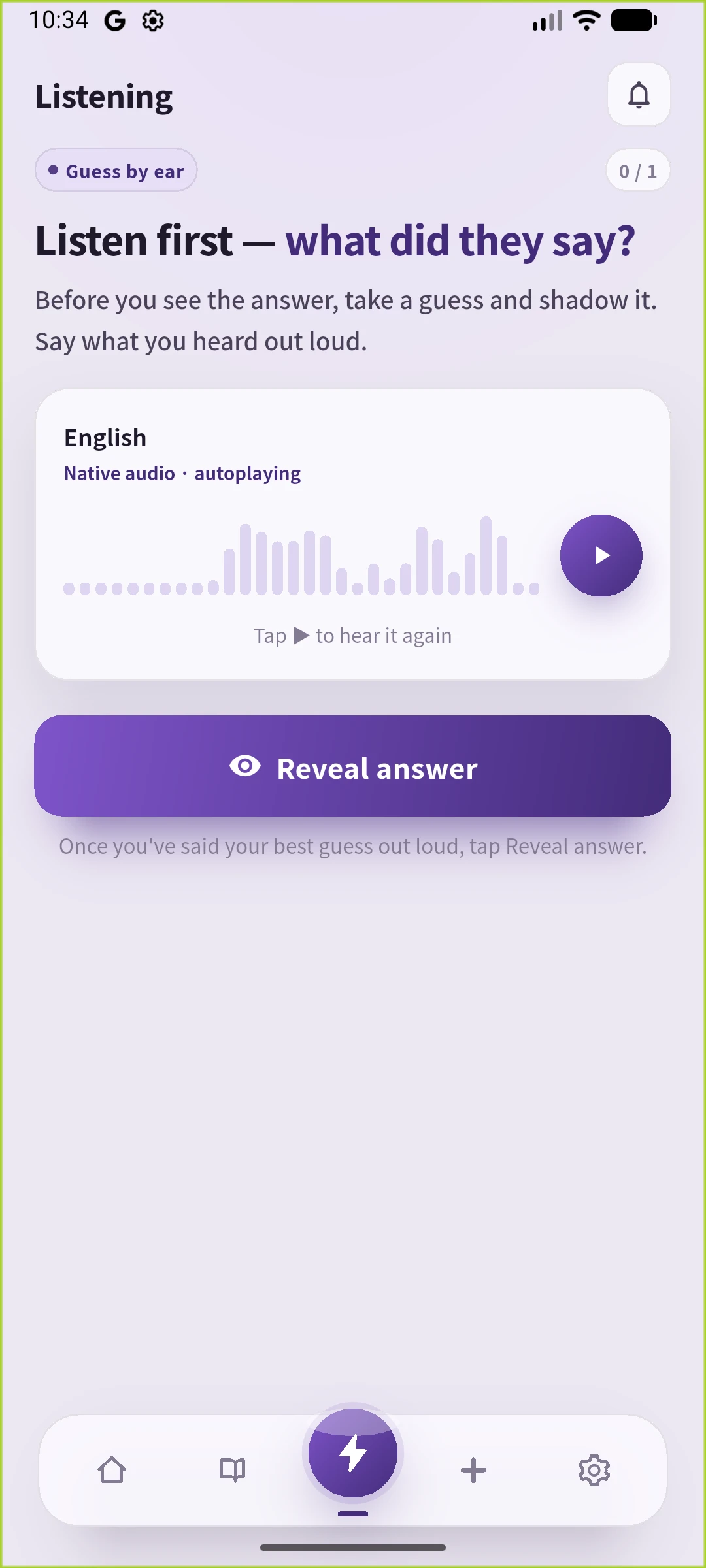
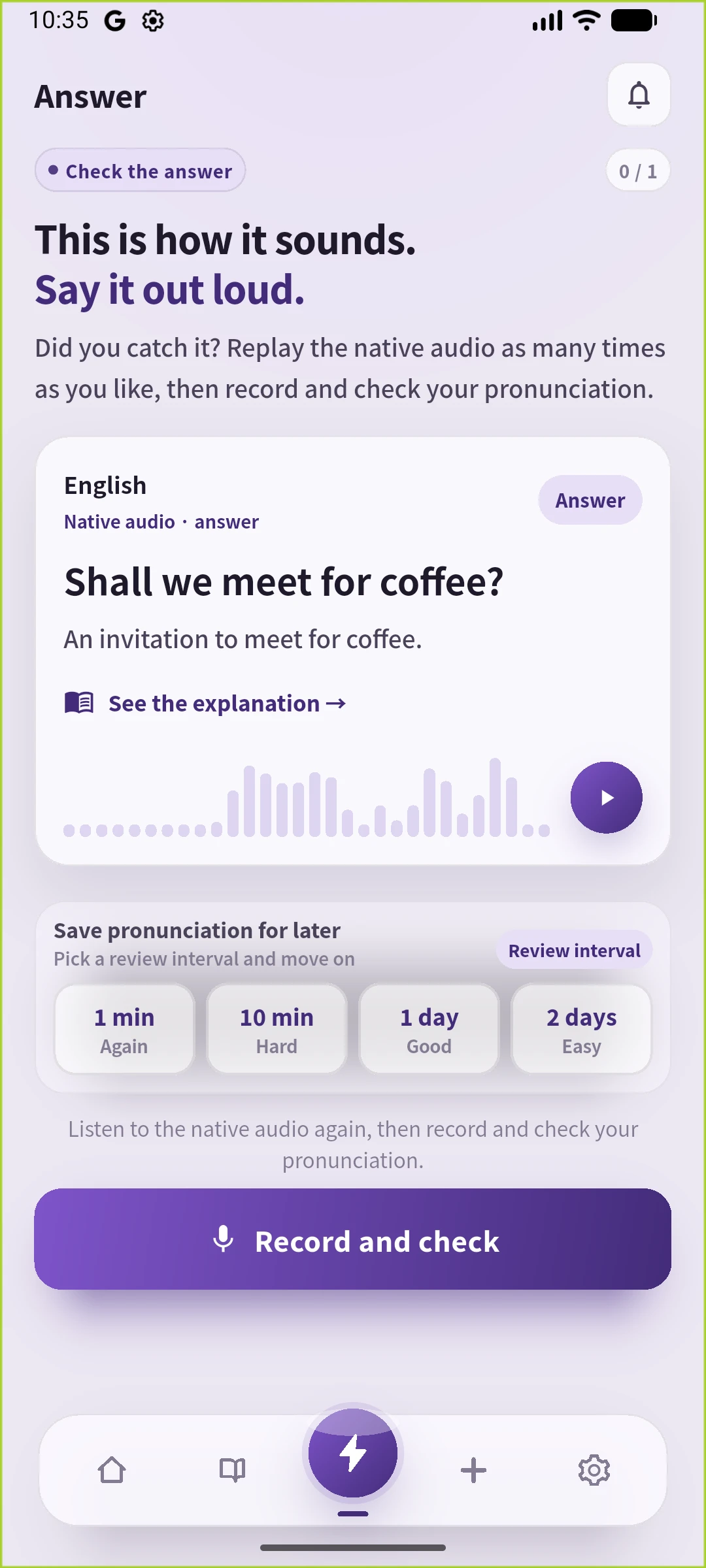
We did not start or submit a learner recording or verify an assessment result. The independent recording comparison above can use a phone recorder. SpeakGain is not presented as judging, scoring or visualizing intonation. See what SpeakGain is.
A seven-day starting plan
This is a practice schedule, not a seven-day fluency promise. Skip what you already do well and revisit an uncertain target.
| Day | Focus | Check |
|---|---|---|
| 1 | coffee word stress | Compare the first syllable with the second |
| 2 | meet/coffee versus weak parts | Retain for and the rest of the sentence |
| 3 | The proposal’s ending | Hear pitch movement without moving lexical stress |
| 4 | Say it before playing the model | Separate forgotten words from delivery |
| 5 | Friday as new information | Match emphasis to a context |
| 6 | Where is the key? | Distinguish information from clarification |
| 7 | Can we MEET at NOON? | Check another sentence with matching audio or a teacher |
Keep three notes: target, audible difference, next repair. Immediate success differs from next-day recall or another sentence. For the larger plan, see how to study English.
Common errors
| Error | Next action |
|---|---|
| Assigning emphasis by grammar alone | Identify the new or corrected information |
| Making everything loud | Compare one syllable with its neighbours |
| Raising every question | Specify whether you ask for information or clarification |
| Deleting weak words for speed | Return to a shorter group and preserve the text |
| Forcing metronomic tapping | Listen again and speak without tapping |
| Memorizing rules without checking speech | Record one feature and describe the difference |
Use reading with audio when text support helps, reading aloud to organize spoken practice, and shadowing once you can follow the short model. These are different tasks, not competing apps.
Frequently asked questions
How is intonation different from accent?
Intonation is phrase-level pitch movement; word accent means the prominent syllable in this context. A speaker’s regional accent is another use of the term. Keep COF prominent even when the ending rises.
Must all questions rise?
No. Ordinary yes/no questions often rise; information wh-questions often fall. Clarification and rhetorical purposes can change the pattern.
How do I reduce a spelling-based or katakana-like delivery?
Check word stress, then the contrast between prominent and weak parts. Individual-sound problems need separate work. Large pitch swings alone do not repair them.
Does stress mean volume?
Not volume alone. Listen to duration, vowel clarity and pitch too, without shouting the sentence.
Should I make stress intervals equal?
No. Tapping is an attention aid. Preserve words and follow the model’s grouping instead of a rigid clock.
Should I aim for native-like delivery?
Our first goal is a message whose important information is easy to follow. We recommend concrete checks rather than a deadline to remove your accent.
This routine or shadowing first?
If you cannot identify prominence in a short sentence, start with visible text and stopped imitation. Then use that same sentence for shadowing.
Can AI audio be a model?
It can provide a repeatable example, but listen to verify its actual delivery. Label it AI-generated, not a human native recording; contextual university recordings provide additional examples.
What if I cannot judge my recording?
Ask a teacher a specific question, such as whether COF stands out or the proposal sounds like it awaits a response. Leave uncertain observations unconfirmed.
For a closer look at vowel contrasts, use the English vowel chart and priority-pair drills to check schwa, vowel quality and length in a recorded sentence.
Our editorial verdict
Start with one word’s stress, choose the sentence’s important information, then compare contextual pitch movement. We do not recommend rule memorization alone or exaggerated sing-song repetition without listening back.
Today, choose COF, the meet/coffee prominence contrast, or the proposal’s ending. Listen, mark, tap, imitate, record and repair one feature. Return to the sentence and check it tomorrow.
Connect prominence practice to your wider goal with English accents and intelligibility, which keeps useful sound contrasts alongside message focus.
Sources
The linked Baruch university materials support the teaching tendencies and exceptions. Wang et al. questions literal stress-timing. Saito & Saito, 2017 studied Japanese EFL learners with a particular instructional programme and read-aloud assessment; it does not validate our short independent routine or guarantee improvement.