
English vowel sounds: chart, priority pairs and schwa practice
Published
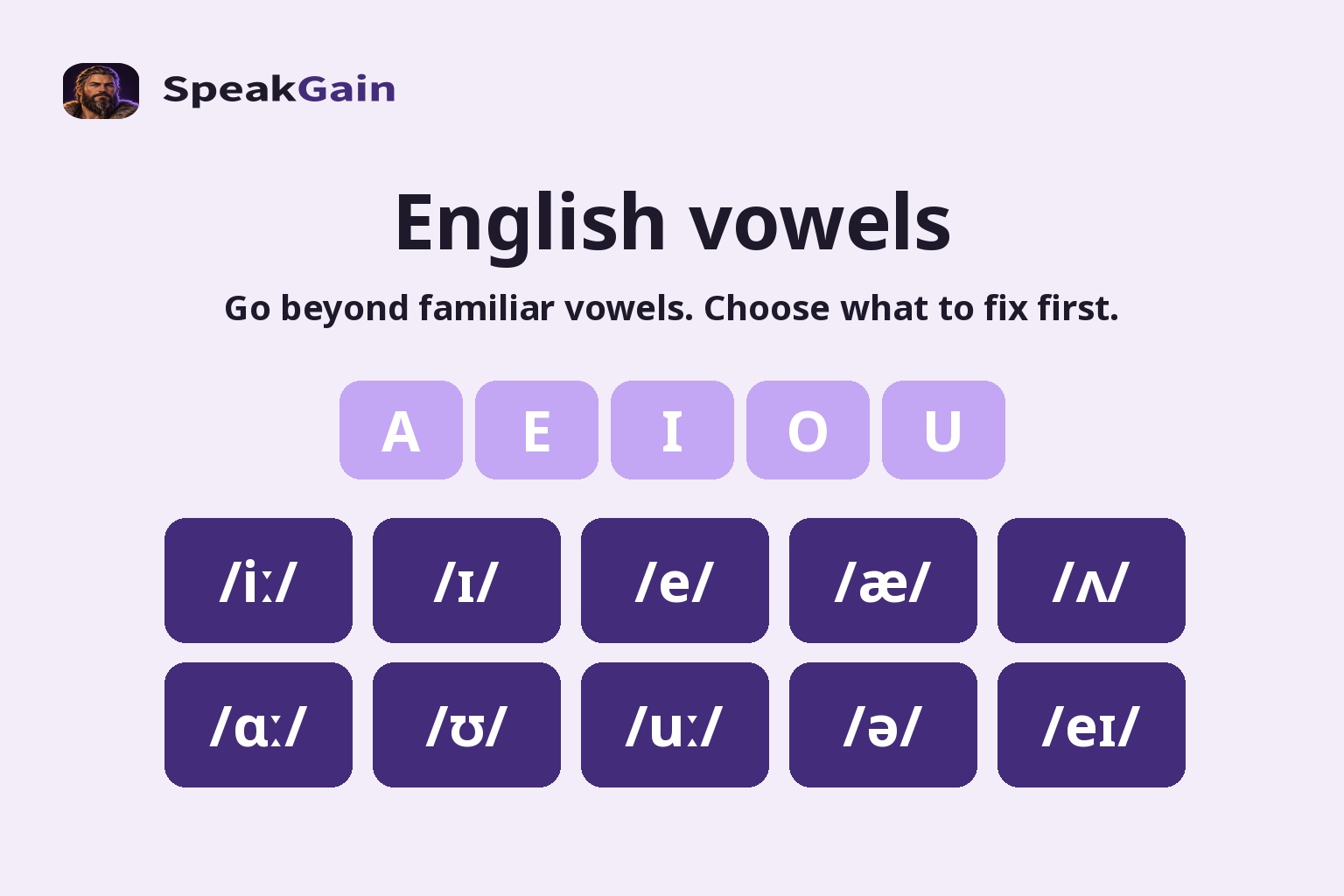
A useful teaching inventory has about 15 main vowels for American English and 20 in a traditional British classification, but the count depends on accent and on how diphthongs, weak vowels and r-colouring are counted. Start with a contrast you actually confuse; if none stands out, our editorial order is weak /ə/, then /æ/–/ʌ/–/ɑː/, quality-plus-length pairs, diphthongs and, for a US model, r-coloured vowels. Listen to two words in one accent, imitate a short sentence, record it and compare one vowel feature at a time.
Your first language changes which pair deserves attention. Five familiar vowel letters do not map to all the sounds of English. We use Japanese learners as one example, not as the assumed background of every English reader. Speakers of a five-vowel system may need to create new quality contrasts; people familiar with vowel length still need to check English quality and context.
For choosing among consonants, vowels and rhythm, use English pronunciation practice. This article goes deeper into vowels rather than repeating that general routine.
Once you can hear a vowel contrast, use the sheep-and-ship example in tongue twister practice to check it in a sentence.
If you are choosing a pronunciation model, British vs American English compares representative differences and shows how to practise with one reference.
How many vowels are there?
Letters and speech sounds are different inventories. The letter a does not have one sound in cat, cake and about. The University of Tokyo presents approximately 15 vowels and uses American audio in its practice site. University of Tokyo A traditional British chart can be organized into 12 monophthongs and eight diphthongs; the main-vowel table below follows that organization and notes US alternatives. It is not a claim that every British or American speaker has exactly that inventory. Oxford pronunciation guide
Some American speakers merge the vowels in lot and thought. The sounds represented by near, hair and pure also vary. Choose a dictionary’s UK or US recording before evaluating your own word. Do not treat a legitimate accent difference as a pronunciation mistake.
Main vowels: an overview, not a memorization target
The shortcut column names tempting approximations, not correct replacements. Its letter labels are reminders of familiar sounds; their value depends on your language. Mouth positions are starting points for exploration, not exact measurements or instructions to strain your jaw.
| IPA | Example words | Tempting native-language shortcut | Mouth and tongue guide |
|---|---|---|---|
| /iː/ | see, seat | i | High and front; compare quality, not just length |
| /ɪ/ | sit, ship | i | Slightly lower and more central than /iː/ |
| /e/ · /ɛ/ | bed, pen | e | Front; less open than /æ/ |
| /æ/ | cat, hat | a / e | Low and front; lower the jaw |
| /ʌ/ | cup, hut | a | More central than /æ/ |
| /ɑː/ · /ɑ/ | father, palm | a | Low and back; unrounded |
| /ɒ/ | lot, hot | o / a | Low and back with rounding; mainly UK |
| /ɔː/ · /ɔ/ | thought, law | o | Back and rounded; US mergers vary |
| /ʊ/ | book, foot | u | Lower and more central than /uː/ |
| /uː/ · /u/ | food, blue | u | High with rounding; position varies by accent |
| /ɜː/ | bird, nurse | a + r | Central in UK; compare US r-colouring separately |
| /ə/ | about, sofa | a / u / e | Relaxed central vowel in a weak syllable |
| /eɪ/ | day, late | e | Glide within one syllable |
| /aɪ/ | my, time | a + i | Open start towards a high front position |
| /ɔɪ/ | boy, choice | o + i | Rounded start towards a front position |
| /aʊ/ | now, house | a + u | Open start towards rounding |
| /əʊ/ · /oʊ/ | go, home | o | Moving quality; starting point differs in UK/US |
| /ɪə/ | near, ear | i + a | UK notation towards centre; US has r |
| /eə/ | hair, care | e + a | UK notation towards centre; speaker variation |
| /ʊə/ | pure, cure | u + a | UK notation; check actual dictionary audio |
The symbols and accent notes follow Oxford; the articulatory guide draws on Hamburg University and INFLIBNET phonetics. The practice choices and shortcut warnings are our editorial additions.
Dictionaries use different conventions. The bed vowel may be /e/ or /ɛ/; see may use /iː/ or /i/. US bird can use /ɝ/ or a vowel-plus-r notation, and a weak r-coloured ending can be /ɚ/ or /ər/. Extra entries for weak /i/ and /u/ also change the number of rows. A different symbol does not automatically mean another contrast to learn.
Priority pairs and original practice sentences
This is an editorial starting order, not a universal difficulty ranking. If people confuse your seat with sit, start there. For Mandarin or Korean readers, a Purdue study examining /ɪ–i/ and /ɛ–æ/ provides a reason to check those contrasts early; its specific participants and task do not establish everyone’s personal ranking. Study abstract
| Pair | Words | Listening cue | Original practice sentence |
|---|---|---|---|
| /ə/ ↔ /ʌ/ | a cup | Weak a versus clear cup; not a minimal pair | I need a cup of tea. |
| /æ/ ↔ /ʌ/ | hat / hut | Front/open versus more central quality | I left my hat in the hut. |
| /ʌ/ ↔ /ɑː/ · /ɑ/ | cut / cot (US) | Central versus low/back; use US cot | The cup is beside the cot. |
| /e/ ↔ /æ/ | pen / pan | Less open versus more open front vowel | Put the pen beside the pan. |
| /ɪ/ ↔ /iː/ | sit / seat | Quality and height as well as duration | This seat is near the window. |
| /ʊ/ ↔ /uː/ | full / fool; pull / pool | Quality as well as duration | The pool is full today. |
| /e/ ↔ /eɪ/ | met / mate | Steady versus moving vowel | My mate met us late. |
| /ə/ ↔ /ɚ/ | sofa / teacher | Weak endings with and without r | The teacher sat on the sofa. |
The first row compares prominence rather than a minimal pair. Cot uses a US model for /ɑ/; British cot usually has /ɒ/. The sentence with seat contains only one member of its pair, so first do a separate two-word check.
Schwa /ə/: locate the weak syllable
Schwa is a central vowel in a weak syllable, as in the beginning of about or the end of sofa. It is not permission to mumble or erase every unstressed vowel. Check its position in the dictionary. Link this to English stress and intonation.
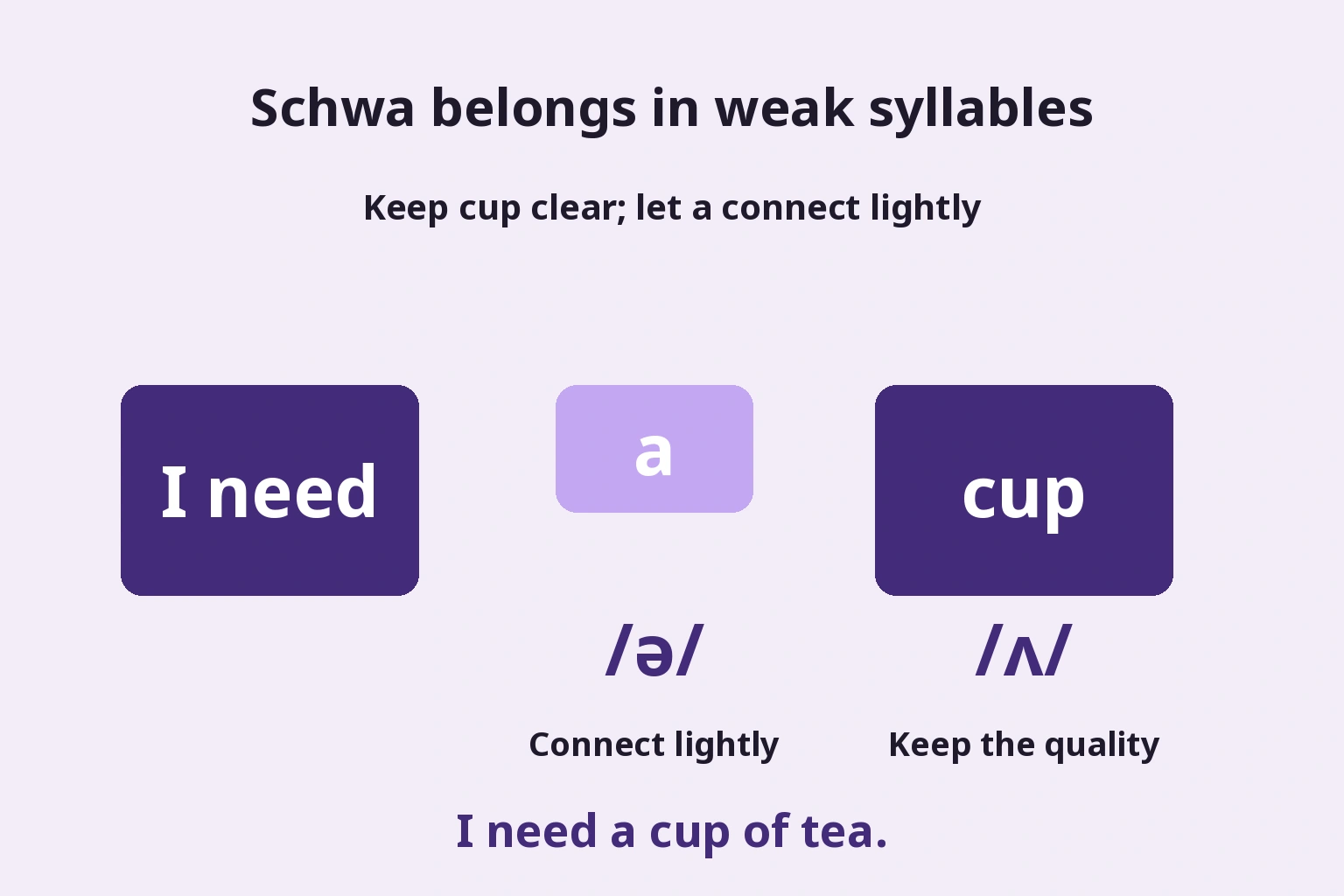
A spelling-driven reading may make the first part of about as prominent as its stressed syllable. Let it connect lightly without losing the word. Practise I need a cup of tea. Compare weak a with the clear vowel in cup. Depending on accent, /ə/ and /ʌ/ can sound close, so do not force an artificial quality gap; listen to prominence and timing too. Central-vowel lesson
In your recording, ask whether a creates a separate heavy beat and whether cup has become unclear. Check a on the first replay, then listen to the whole phrase on the second. Faster is not automatically better.
/æ/ and /ʌ/: keep hat and hut different
/æ/ is low and front; /ʌ/ is more central. Compare hat / hut, cat / cut and cap / cup. Japanese-style approximations can collapse the pair into one “a”; any learner should check whether the same thing happens in their own speech. “Say an a with an e-shaped mouth” is not proof that the contrast is present.
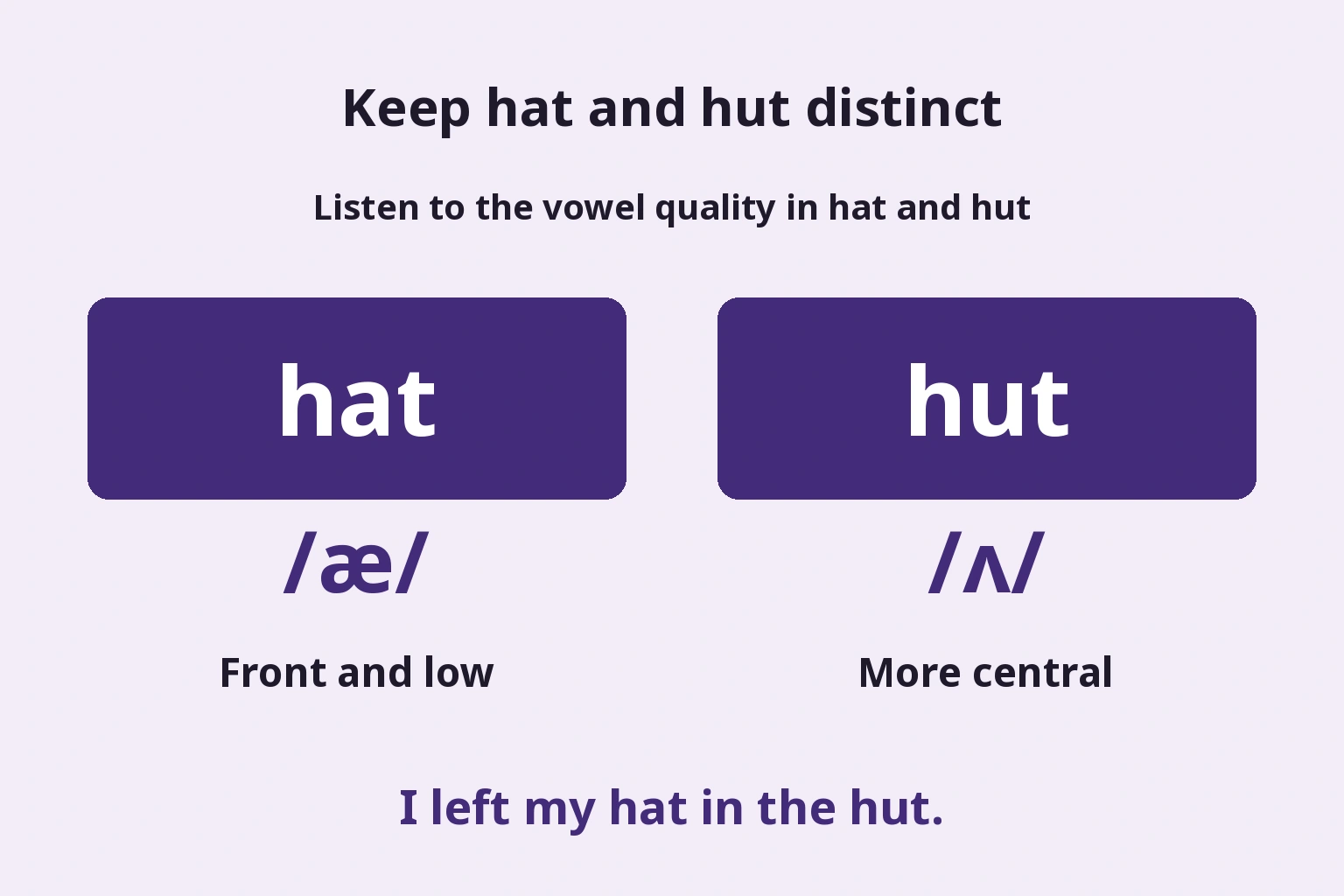
Say I left my hat in the hut. Imagine a hat left behind in a small building. Listen to the two words, alternate them, then return to the sentence. Record the pair and the sentence separately. If both vowels sound alike, change one feature of hat and record again. Ask a listener to identify the two words without seeing their spelling; sentence context can hide a missing distinction.
/ʌ/ and /ɑː/: quality before stretching
/ʌ/ is central; /ɑː/, often written /ɑ/ for US English, is low and back with unrounded lips. Use US cut / cot, then The cup is beside the cot. Cup and cot are not a minimal pair, but both vowels occur in the sentence. Father is another reference for the low/back vowel.
Do not make cot a longer cup, or change your voice pitch to manufacture a “deep” vowel. Record the words first and listen for quality. A British-model learner should follow British cot rather than mark its /ɒ/ as a failed American /ɑ/.
/e/ and /æ/: pen and pan
Both are front vowels, but /æ/ is more open. Compare pen / pan or bed / bad. Tokyo front-vowel lesson A familiar spelling or native-language approximation may keep both at one opening; overcorrecting can also turn pen into pan.
Practise Put the pen beside the pan. Record pen / pan first, then the whole sentence. Check whether the less-open pen quality remains after practising pan. Use the same microphone distance and volume for both takes; a louder recording is not evidence of a better vowel.
/ɪ/–/iː/ and /ʊ/–/uː/: quality plus length
Short versus long is an incomplete description. Tokyo’s heat / hit and pool / pull lesson also discusses lip tension and opening. Length and quality Actual duration varies with context, so there is no fixed number of milliseconds to copy.
For sit / seat, /iː/ is higher and more front, /ɪ/ a little lower and more central. Also compare bit / beat. Say This seat is near the window. This sentence practises seat, not discrimination of both words: record sit / seat separately. If seat is only an extended sit, return to the pair and adjust quality before length.
For full / fool and pull / pool, /ʊ/ is lower and more central than the high, rounded /uː/ guide. The exact /uː/ position varies by accent. Say The pool is full today. Avoid simply stretching a familiar u. Replay for quality in both target words, keeping any separate difficulty with final l for another practice session.
Diphthongs: one syllable with movement
A diphthong changes vowel quality within one syllable. Day, my, boy, now and go illustrate common ones. Two symbols do not mean two separately stressed syllables. Japanese segmentation can split an English diphthong into two beats; other learners may flatten it into a steady vowel. Syllable comparison
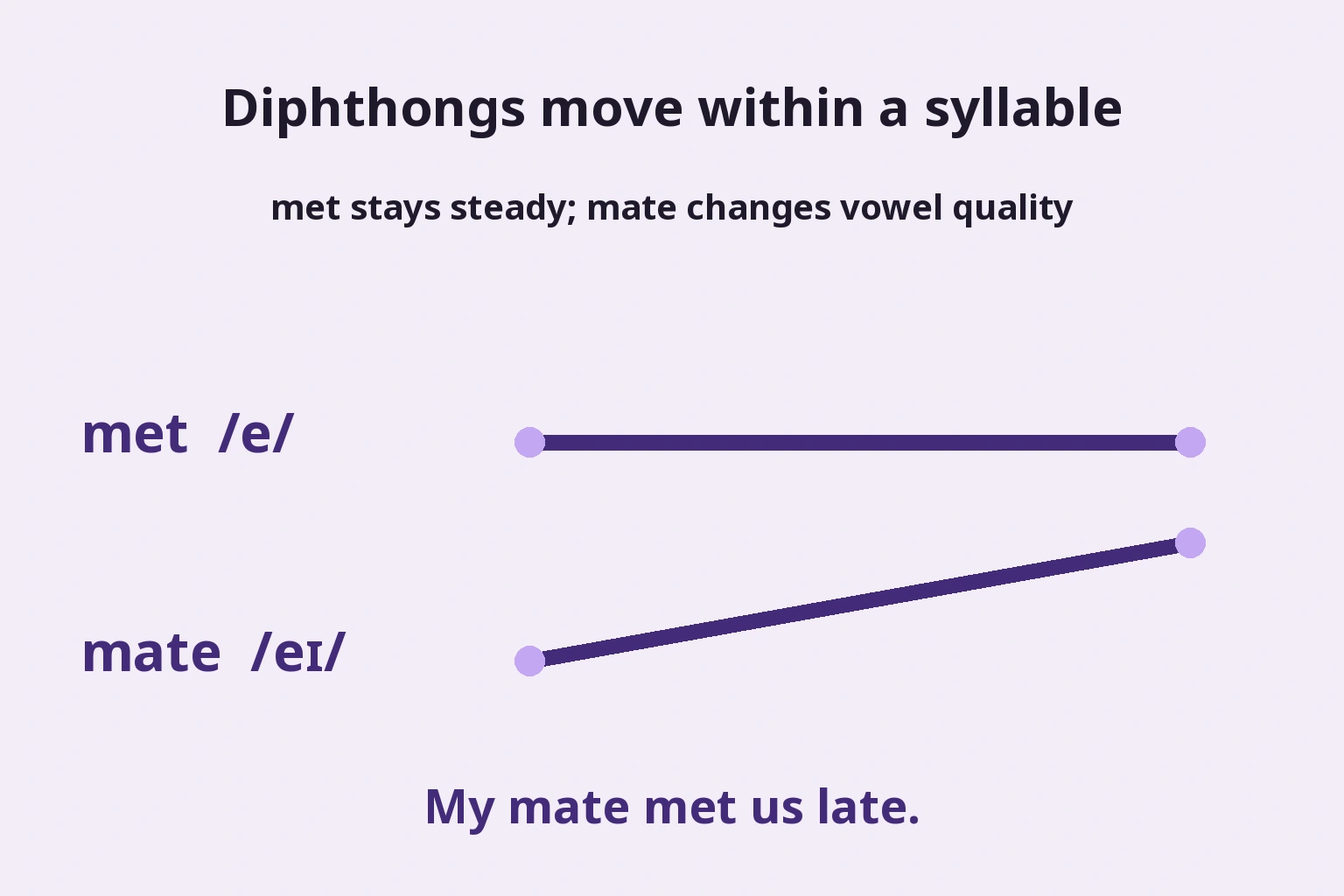
Compare met / mate and let / late. Say My mate met us late. Listen for movement in mate and late but not an added glide in met. Record the pair and the sentence. If the vowel stops halfway, reconnect it; if you exaggerate the end, return to a normal dictionary recording. The schematic shows steady versus changing quality, not measured acoustic data.
R-colouring: relevant to your model
US bird and the ending of teacher contain r-colouring; UK bird has a different model. Phonetics lesson Do not replace it with a native rolled or tapped r, add another syllable, or curl your tongue as far as possible.
Say The teacher sat on the sofa. Compare the weak endings of teacher and sofa in US audio. Replay for r quality in teacher and check that you have not added r to sofa. For a mainly British speaking model, this can wait; hearing accent differences still helps.
A one-pair recording routine
- Choose two words you need and one dictionary accent. Understand their meanings before drilling them.
- Hear the contrast without speaking. A shuffled listening test needs a helper or an unknown order; replaying a sequence you already know is observation, not a discrimination test.
- Record the pair and the whole sentence before practice.
- Change one feature, such as the more front/open quality in hat. Keep speed and volume stable.
- Alternate model and your recording. Listen to vowel quality, then whether the contrast remains in the sentence.
- Try another pair, such as cap / cup, on a later session. Separate memorizing one sentence from transferring the contrast.
Write a specific note: “The pair differs, but hut returns to hat’s quality in the sentence.” If you cannot judge it, ask a teacher or listener about that exact pair and keep the result unconfirmed. A recording is evidence to inspect, not automatic correction.
Return to one sentence in SpeakGain
We created one card with I left my hat in the hut. through the normal Add screen. Library → Knowledge → Learn this card opened Listening with the sentence hidden and reference audio autoplaying. Reveal answer opened Answer with the saved English sentence, a playback button, review-interval choices and a Record and check entry.
We verified listening and revealing the saved sentence, not a submitted recording or an assessment result. This is not presented as scoring pronunciation, judging hat versus hut or testing vowel discrimination. The independent recording comparison in this article can also use an ordinary phone recorder.
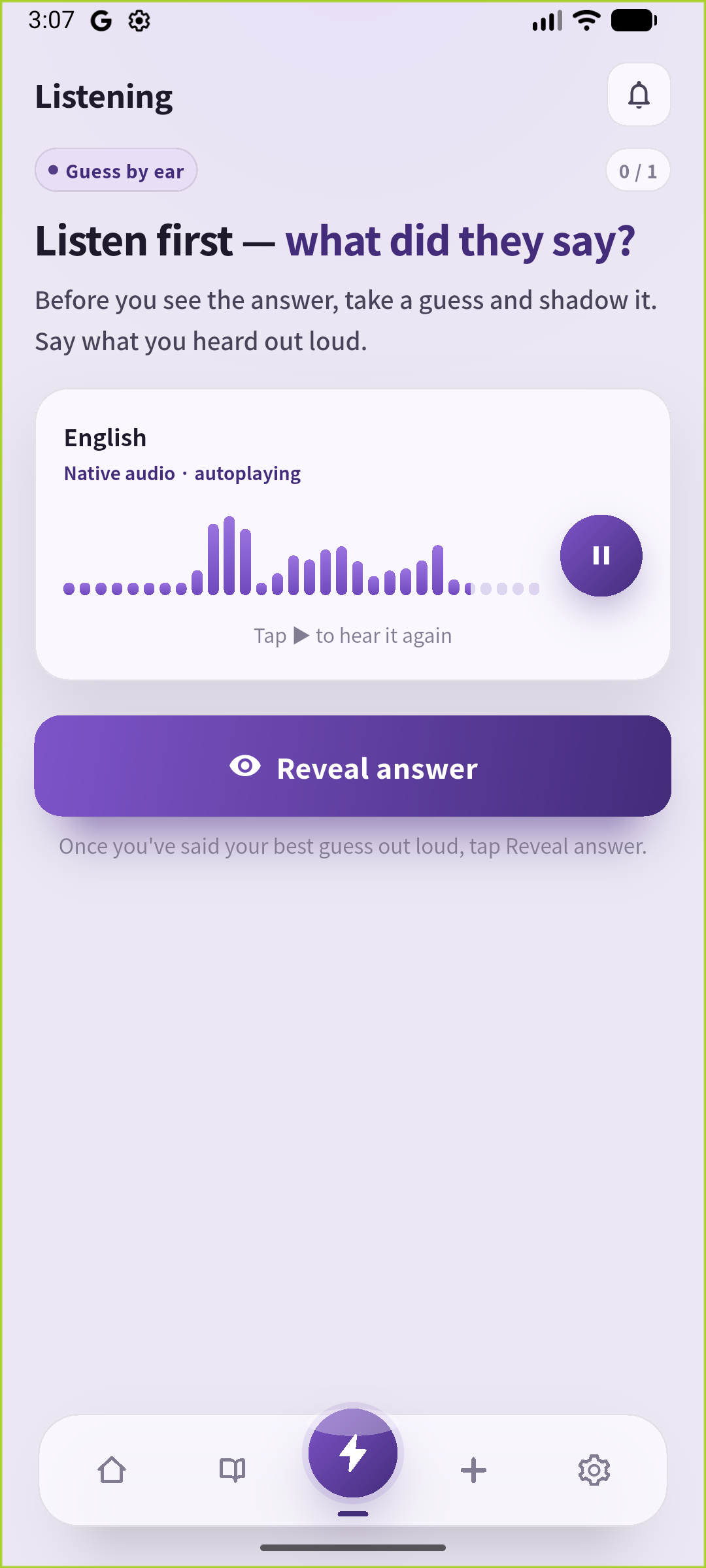
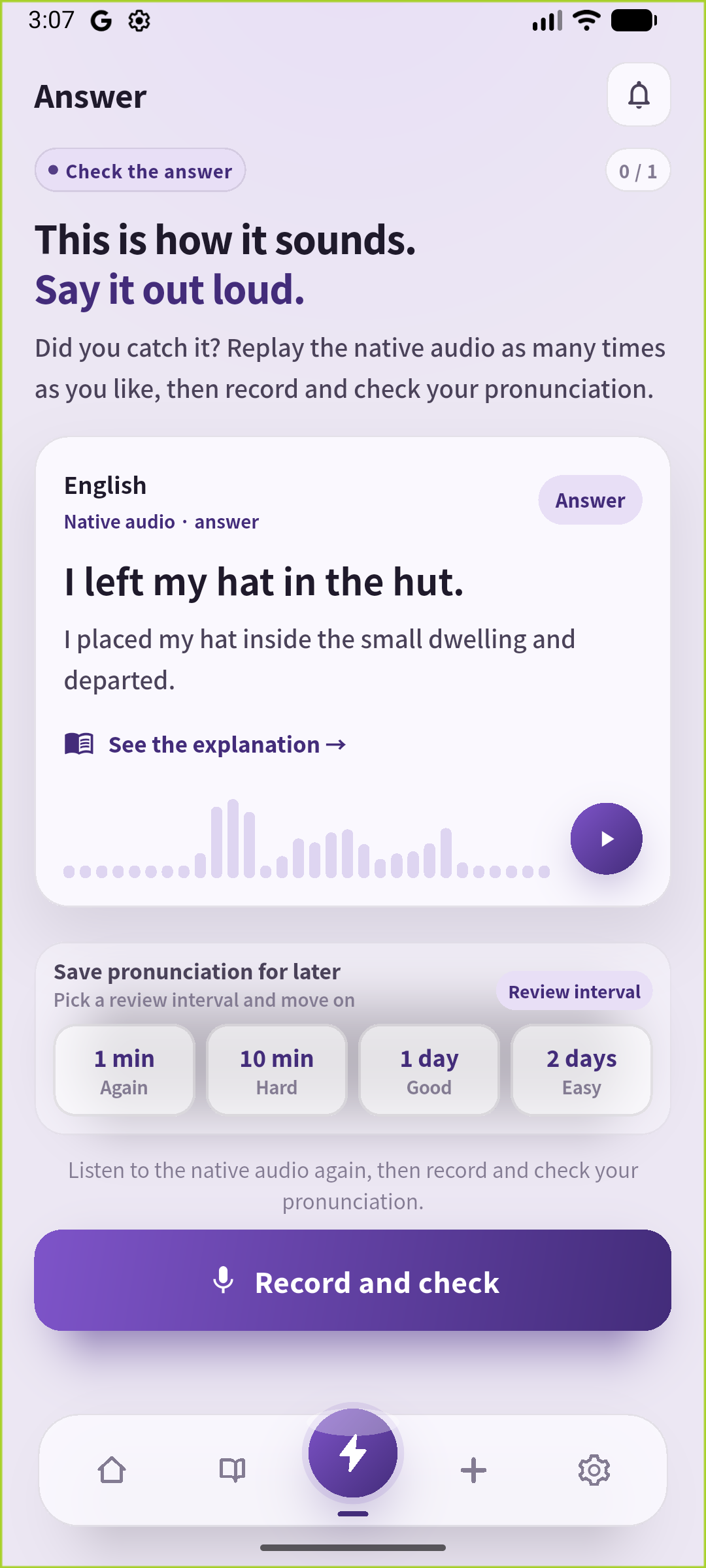
Reference audio for the practice sentence
This is AI-generated Viking audio from the normal SpeakGain Create flow, not a recording of a human native speaker. The screen label Native audio refers to this AI clip in our example. Check the isolated pair separately with one dictionary accent; use the clip for repeated sentence practice.
Methods we do not recommend
- Memorizing only the chart: recognizing a symbol does not show that your two words differ. Record a pair and a sentence.
- Only looking at mouth diagrams: visible lips do not reveal every tongue or quality difference. Use a diagram to choose one action, then listen.
- Native-script respelling as the answer: katakana or another familiar script can erase a contrast. Keep English spelling, a dictionary transcription and audio together.
- Only stretching vowels: move from isolated sound to word and sentence; keep the final consonant too.
- One score or transcription as a verdict: a system may use sentence context. It does not necessarily establish that you produced the vowel contrast.
FAQ
Are there 15 or 20 English vowels?
Both numbers are useful within stated accent and counting conventions. About 15 is common in American teaching material; traditional British classification gives 12 monophthongs and eight diphthongs. It is not one universal total.
Should I choose British or American English?
Choose the accent you hear most often for a speaking model and keep recordings consistent within a drill. Neither is inherently better. Learn to hear the other variety too.
Which vowels should I fix first?
Start with a word people mistake. Otherwise use our weak-vowel → quality contrast → quality/length → diphthong → relevant r-colouring order. Adjust it to your first language and recording evidence.
Must I memorize all IPA symbols?
No. Learn today’s pair and use the symbols as a lookup aid. Do not postpone speaking until you know the whole chart.
Is every weak vowel schwa?
No. Verify the word and position in the dictionary; weak vowels do not all become /ə/, and weakness does not mean deletion.
Can I write pronunciation in my own script?
As a memory note, yes; as the final standard for a contrast, no. If two English words have one respelling, the distinction is missing from your note.
What if I cannot hear my recording’s difference?
Return to two words, alternate with one accent’s model and ask about that specific distinction. Leave the judgement open rather than counting a saved recording as success.
How many days will correction take?
There is no shared deadline. Check two words, the sentence and a new word pair separately. A useful contrast matters more than eliminating every accent feature.
To turn a dictionary lookup into spoken practice, use our guide to reading English phonetic symbols for the main symbols, notation differences and a practical learning order.
Editorial verdict
Choose one contrast, retain it in a sentence and check the recording before moving on. Our default starts with weak schwa, then hat / hut. Use I left my hat in the hut. today, but let your actual misunderstandings change the order. The chart is a map, not a completion certificate.
For choosing the next sound or rhythm feature, return to pronunciation practice; to connect schwa to prominence, use stress and intonation.
References
- Oxford: symbols and accent conventions
- University of Tokyo: inventory and American audio, length and quality, front vowels
- Hamburg: front and central vowels
- INFLIBNET: articulation and r-colouring
- Tokyo University of Marine Science and Technology: syllable comparison
- Purdue: Korean/Mandarin contrast study abstract