
18 English tongue twisters by sound: meanings and a six-step practice routine
Published
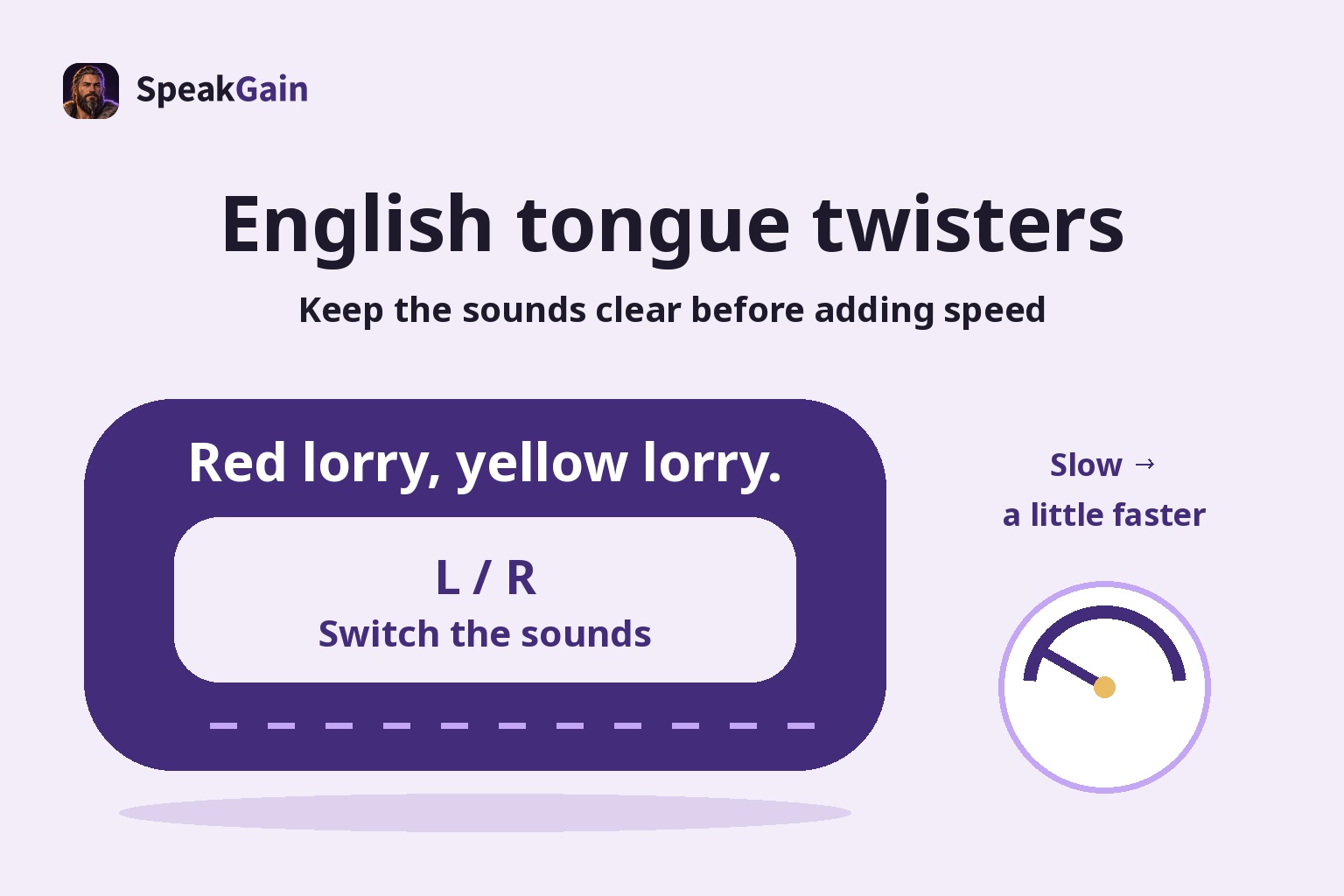
Our editorial starting three are Red lorry, yellow lorry. for l/r, She sells seashells by the seashore. for s/sh, and Three free throws. for th/f. Turn a tongue twister into pronunciation practice by checking its meaning, saying it slowly and accurately, joining short chunks, increasing speed gradually, recording and comparing, then fixing one spot. Preserving the sound contrast matters more than finishing quickly.
Choose a phrase for a sound that gets unclear in your own recording. If p and b merge, start with the editorial balloon line below; if final consonants disappear, try the coffee-pot phrase. Your first language can suggest questions to investigate, but it does not diagnose every individual’s pronunciation.
For a broader repair plan, see pronunciation practice; for vowel distinctions before sentence practice, see English vowel sounds.
For the consonant itself before faster speech, see English consonant sounds and short practice.
18 tongue twisters by sound, difficulty and meaning
Difficulty is our editorial estimate for these specific lengths spoken carefully, not a universal ranking. Even an easy line becomes difficult when repeated rapidly. Choose one line rather than working through the entire list.
| Target | Tongue twister | Difficulty | Meaning | Hard spot |
|---|---|---|---|---|
| L/R | Red lorry, yellow lorry. | Medium | A red truck, a yellow truck. | Switch from the r in red to the l in lorry. |
| L/R + th | Red leather, yellow leather. | Hard | Two pieces of leather, one red and one yellow. | Keep /ð/ in leather while switching l/r. |
| L/R | Truly rural. | Hard | Genuinely of the countryside. | Move through /tr/, repeated r sounds and final l. |
| th/s | Six thin things. | Easy | Six thin objects. | Move from the s in six to /θ/ in thin. |
| th/f | Three free throws. | Medium | Three attempts from the free-throw line. | Keep three and free distinct. |
| /θ/ /ð/ | Not these things here, but those things there. | Hard | Not the objects here, but the ones over there. | Switch between /ð/ and /θ/. |
| s/sh | She sells seashells by the seashore. | Medium | A woman sells shells beside the sea. | Distinguish she/sea and sells/shells. |
| s/sh | Sam’s shop stocks short spotted socks. | Hard | Sam’s store carries short socks with spots. | Switch s/sh while keeping /st/ and /sp/. |
| s + /sl/ /sw/ | Six sleek swans swam swiftly southwards. | Hard | Six elegant swans swam quickly towards the south. | Keep /sl/, /sw/ and the final /dz/. |
| f + /fr/ | Fresh fried fish. | Easy | Fish that has just been fried. | Keep f when moving into r. |
| v + /lvz/ | Eleven elves. | Medium | A group of eleven elves. | Avoid adding vowels inside final /lvz/. |
| v/b/f | Five brave babies wave. (editorial) | Medium | Five courageous babies are waving. | Switch f/v, b/v and final v. |
| p | Peter Piper picked a peck of pickled peppers. | Medium | Peter Piper picked a peck of peppers preserved in vinegar. | Repeated p and the endings of picked/pickled. |
| p/b | Blue balloons pop, big bubbles burst. (editorial) | Medium | Blue balloons burst; large bubbles burst too. | Move from b to p in pop. |
| /ʌ/ /ɪ/ | Betty Botter bought some butter, but she said the butter’s bitter. | Hard | Betty bought butter but said it tasted bitter. | Keep the vowels of bought, butter and bitter distinct. |
| /ɪ/ /iː/ | The big bug bit the little beetle. | Medium | A large bug bit a small beetle. | Compare bit/beetle and big/bug. |
| /ɪ/ /iː/ | Six sheep sit in a ship. (editorial) | Easy | Six sheep are sitting inside a ship. | Compare vowel quality, not just duration. |
| final /t/ | A proper copper coffee pot. | Medium | A suitable coffee pot made of copper. | Do not add a vowel after final t. |
Three entries are explicitly editorial: we wrote them to give short contrasting-sound practice. The others are existing teaching examples or short excerpts from longer familiar versions. We verified their appearance in teaching materials, not their first authors or folk origins. Peter Piper and Betty Botter have different longer versions; use the exact short form shown here. British Council collection, Pronunciation Pro practice sheet.
Pick one sound before you pick a difficult phrase
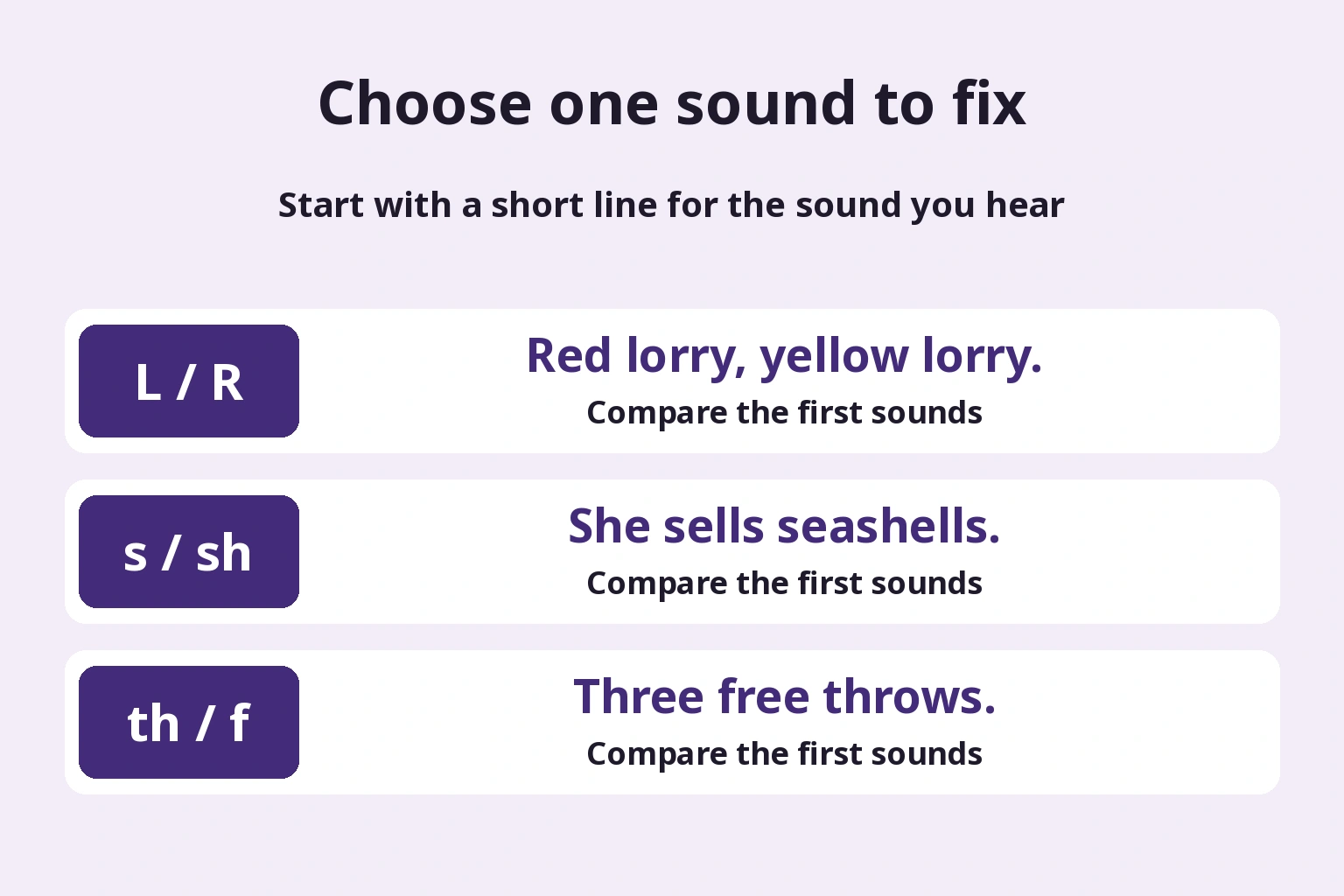
If you cannot hear or say the contrast in separate words, pause the tongue twister and listen to those words first. A short phrase then tests whether the distinction survives the transition to the next sound. It is not a test of how English-like your whole voice sounds.
L/r: change the tongue position between sounds
For the light l at a word’s beginning, the tongue tip touches the ridge behind the upper teeth and air flows around its sides. For American r, it does not touch that ridge; more than one tongue configuration is possible. Do not insist on a strongly curled tongue. L, r.
Red lorry, yellow lorry. names two trucks; lorry is mainly British vocabulary. The hard spot is red → lorry and then the r within lorry. Listen to red and lorry separately, practise red lorry, then add yellow lorry. In your recording, check whether the first sounds of red and lorry remain different; inspect the internal r in a later attempt.
Red leather, yellow leather. adds voiced /ð/ in leather. Practise each pair and check that leather has not become letter. Truly rural. means genuinely of the countryside and combines repeated r with final l. Use it later, checking the last l without inserting another vowel. These are short, but that does not make them beginner examples.
Th: distinguish voicing and the move into f or s
Th represents /θ/ in think and voiced /ð/ in this. Air passes through a narrow space near the tongue tip and upper front teeth; strong biting or pushing the tongue far out is not the goal. Th sounds.
Six thin things. means six thin objects. Start with thin things, then add six; listen for thin becoming sin or tin. Three free throws. is about three free-throw attempts. Compare three/free first: th uses the tongue, while f uses the lower lip and upper teeth. Add throws and record the first two words to hear whether their onsets have merged. British Council sound-focused teaching.
Not these things here, but those things there. contrasts nearby and distant objects. Practise these things / those things before the whole sentence. The hard spot is voiced th in these/those/there versus unvoiced th in things; check that things has not taken the same voiced onset. Imagine the two locations so you can follow the word order.
S/sh: keep she and sea different
Sh /ʃ/ uses friction farther back than s; the lips may protrude slightly. Use the sound, rather than the visible lip shape alone, as your check. Sh explanation.
She sells seashells by the seashore. describes selling shells beside the sea. Compare she/sells and sea/shells, then practise She sells seashells before adding the last phrase. Record and listen only to she versus sea at first. The final sound of sells is /z/, so this is not merely repeated s.
Sam’s shop stocks short spotted socks. describes a store’s stock. Work on stocks short and check whether short starts like sort. Six sleek swans swam swiftly southwards. describes swans swimming south; it extends s-cluster practice rather than contrasting s with sh. Start with swans swam, retain /sw/ without inserting a vowel, and check final /dz/ on a separate attempt.
V/b/f: closure versus continuous airflow
B closes both lips briefly. V and f use airflow between the upper teeth and lower lip; v is voiced and f is not. Do not press the teeth hard into the lip. V, b.
Fresh fried fish. means recently fried fish. Practise the three words separately, then fresh fried; listen for f disappearing before r. Eleven elves. describes eleven elves; practise elves alone and check /lvz/ for an added vowel or v turning into b.
Our Five brave babies wave. has five courageous babies waving. Compare the f/v in five and b/v in brave, then join brave babies / wave. Choose the final v of wave as today’s recording check rather than trying to fix every v simultaneously.
P/b: a p-only line is not a contrast exercise
Both sounds briefly close the lips. P at a stressed word onset generally has stronger aspiration than b; that does not mean blowing hard on every p in every context. P, b.
Peter Piper picked a peck of pickled peppers. uses a peck, a unit of volume, and peppers preserved in vinegar. Its playful meaning need not describe a practical recipe. Split Peter Piper / picked a peck / of pickled peppers. Repeated p must not make you skip the endings of picked and pickled. Record Peter’s p today and an ending on another attempt.
For a real p/b switch, use our Blue balloons pop, big bubbles burst. Start with balloons pop; listen for pop beginning with b. Keep the vowel and ending intact while changing the onset.
Vowels: do not change duration alone
Compare vowel quality as well as length. /ɪ/ and /iː/ differ in tongue position; some teaching systems write /i/ without a length mark. /ɪ/, /i/.
The big bug bit the little beetle. has a large bug biting a small beetle. Choose bit/beetle today and big/bug later. Listen to the pair, then say bit the little beetle; compare the first vowel rather than merely how long it lasted.
Our Six sheep sit in a ship. puts six sheep inside a ship. Picture the animals and vessel, compare sheep/ship, then join six sheep / sit in a ship. Ask someone which word they heard without showing the text if you can.
Betty Botter bought some butter, but she said the butter’s bitter. describes butter with a bitter taste. Practise bought some butter / the butter’s bitter and compare butter/bitter. Bought’s vowel and the sound of medial t vary with accent; use a consistent speaker rather than mixing models.
Final consonants: a loud release is not always required
A proper copper coffee pot. names a suitable copper pot. Start with pot, then coffee pot, then the full phrase. In your recording, check for an extra vowel after t; do not confuse avoiding that vowel with deleting the consonant.
Final stops can have little or no audible release. Do not force a loud explosion to prove the consonant is present. Stops. Picked, pickled and elves also offer ending practice, but inspect one ending per attempt. Then try the same skill in a normal short sentence.
Six steps that turn a tongue twister into practice
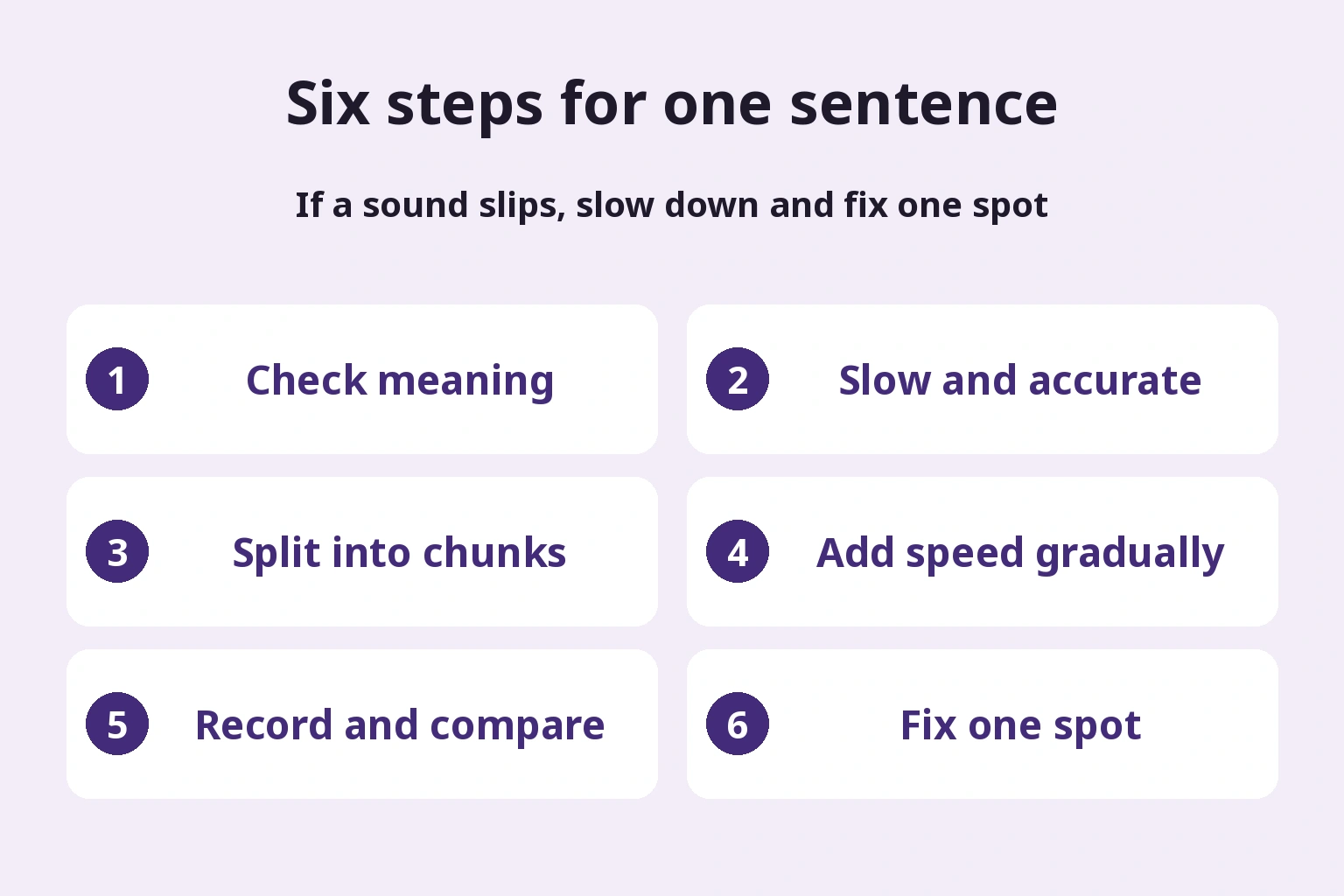
- Check meaning. For Red lorry, yellow lorry., picture the two trucks. Look up unfamiliar words and their sounds; learning an origin story is unnecessary.
- Go slowly and accurately. Listen to red and lorry separately. Join them only when their first sounds remain different.
- Split into chunks. Practise red lorry / yellow lorry. The slash is a temporary practice division, not a command to leave a long pause in the finished phrase.
- Add speed gradually. Our practical starting rule is two slow attempts preserving the target contrast before a faster try. This is editorial guidance, not a research-based pass mark. If words disappear or sounds merge, return to the previous pace.
- Record and compare. Play model → your voice → model at the same spot. Keep microphone distance fairly consistent; louder does not necessarily mean better pronunciation.
- Fix one spot. Repair lorry, then red lorry, then the full phrase. Describe the change as “the two onsets sound different,” not simply “I finished faster.” Finally try the sound in an everyday sentence.
British Council guidance supports listening and beginning slowly. Meaning, the one-spot recording check and the detailed routine here are our editorial method, not a guaranteed training dose.
Our view: accuracy before speed
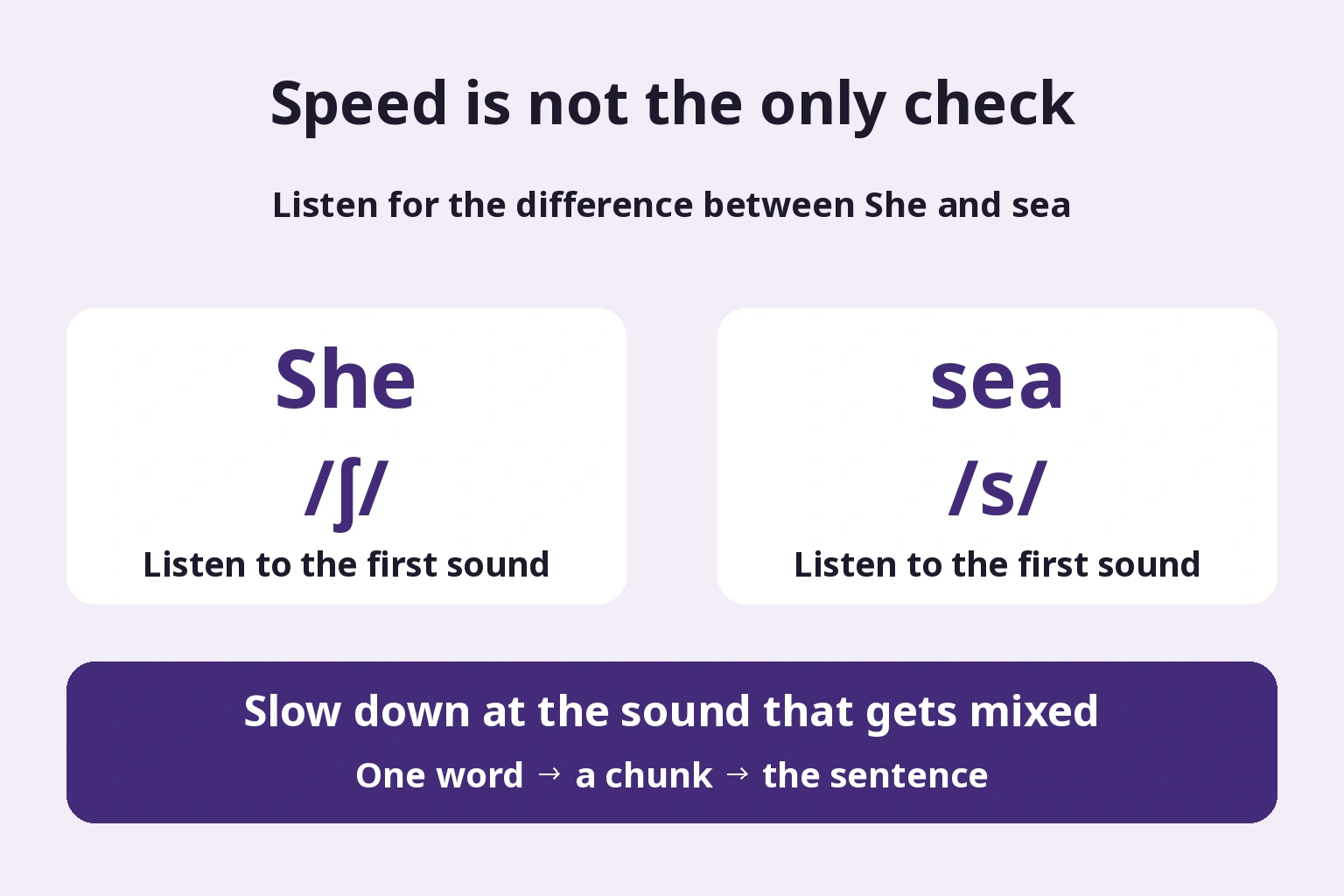
You can finish faster by dropping a word or merging s/sh. That makes speed alone an inadequate check of the sound you wanted to practise. Increase pace to test whether an accurate sound survives the next transition, not to hide an unclear sound.
Tongue twisters are deliberately awkward. Mastering one does not automatically solve vocabulary, listening or explaining something in conversation. Continue with intonation and stress and linking and connected speech, and use the sound in ordinary phrases.
We do not recommend racing without understanding the words, accelerating while the target sound is still wrong, fixing pronunciation to a phonetic spelling in your own language, or changing to a new difficult paragraph every day. Instead, understand one short line, isolate the troublesome pair, use English text with an audio model, and compare the same spot before and after a repair. Speed games can be fun; keep their goal separate from sound practice.
Replay your chosen sentence in SpeakGain
In the verified device flow, we added Red lorry, yellow lorry. through the normal Add screen: a short phrase naming red and yellow trucks. From that same Library card, Knowledge → Learn this card opened Listening with the English text hidden and reference audio autoplaying. Reveal answer opened Answer, where we saw the saved English, playback, review-interval choices and the Record and check entry.
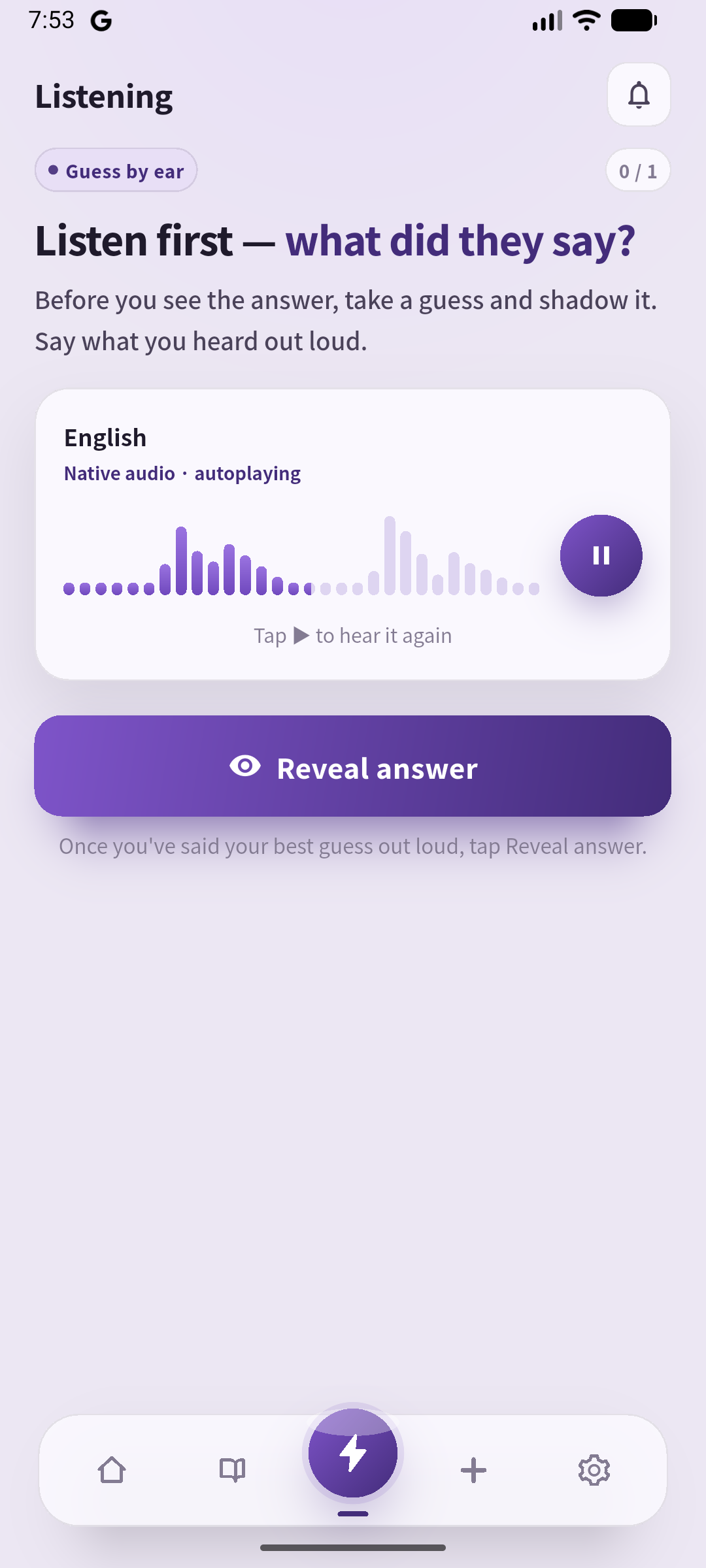
This is AI-generated audio from SpeakGain’s Deep-voiced Viking, not a recording by a human native speaker. Native audio is the screen’s label. One clip from this sentence is shared across all locales; it was not generated again for each translation.
Listen, pause and say red lorry slowly, then return to the whole phrase. Record your own voice separately with a phone recorder and compare lorry’s onset. We did not submit a learner recording or obtain a pronunciation score or assessment. Here SpeakGain’s role is saving one phrase and replaying its audio.
Frequently asked questions
What is the hardest English tongue twister?
There is no hardest line for everyone. Difficulty depends on the sound, length and repetition speed. Truly rural. and a longer Betty Botter version can be challenges; choose your actual unclear spot instead of a universal ranking.
Which tongue twisters suit children?
Our choices are Red lorry, yellow lorry. or Six thin things. because the meanings can be pictured. Listen together and copy one slow chunk. Shorten it further if it is frustrating; age alone does not determine difficulty.
Does saying it faster mean my pronunciation improved?
No. Check that the target sounds stay distinct and words and endings remain. If they merge slowly, return to individual words first.
How many minutes should I practise each day?
We suggest five minutes with one sentence and one sound: meaning, listening, practice, recording and one repair. Five minutes is a starting routine, not a scientifically established optimum or a deadline for improvement.
Can I practise without understanding the meaning?
You can imitate sounds as a game, but our practice method checks meaning first. It helps you notice missing words and changed order. You do not need to memorize etymology.
Should I write the pronunciation in my own language?
Use such notes cautiously as reminders, not as the sound model. They may collapse she/sea or three/free into the same spelling. Start with English text and audio.
Which line should I choose for l/r only?
Begin with Red lorry, yellow lorry. Compare the onsets first and the r inside lorry later. Red leather adds th, so leave it for a later session if you want one task today.
Editorial verdict
Choose a short line whose meaning you know and whose sound you want to repair. Red lorry, She sells and Three free throws are useful starting options, but you need only one today. Understand it, speak slowly, join chunks, record and fix one spot; then keep that sound in an everyday sentence. Use tongue twisters as practice material rather than as a substitute for conversation.