
English consonant sounds: L/R, th and a one-sentence practice routine
Published
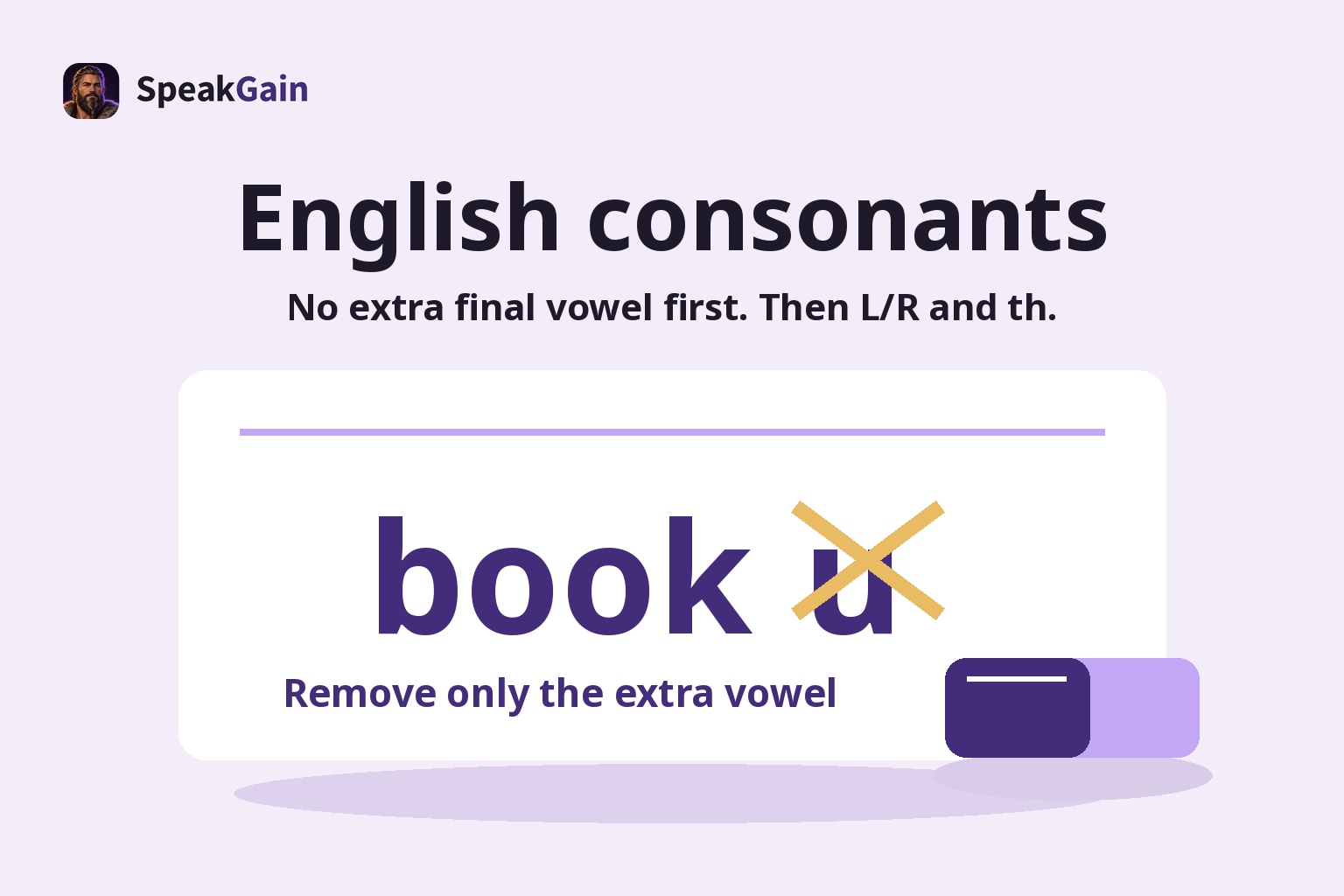
For Japanese speakers, our editors suggest first keeping final consonants without adding a vowel, then working on L/R, th, v/f, s/sh and consonant clusters; other language backgrounds need a different order. Initial L uses tongue-tip contact at the upper tooth ridge with air passing around the sides, American R keeps the tip away from that ridge, and th uses a narrow air passage near the upper front teeth. Practise a short, meaningful sentence by listening, making one word, returning to the sentence and comparing a recording, changing one feature at a time.
This is a pronunciation skill and practice method, not a comparison of products. A familiar spelling does not guarantee a familiar sound: reading book as “booku” adds something that is not in the English word. Conversely, making a word shorter by deleting its final consonant can lose information. Your recording determines which problem needs attention; your first language only suggests where to look.
Use our general pronunciation routine to organize a session, and linking and connected speech guide when an individual word works but its boundary with the next word does not. Here we go further into the consonant movements and what to listen for.
For vowel quality and weak vowels, work in a separate session with our English vowel practice guide, keeping the consonant target out of that session’s checklist.
For clues to a word’s reading from its spelling, use phonics for adults to connect common patterns, exceptions and dictionary checks.
Main English consonants: an IPA overview
Consonants involve a narrowing or closure of the airflow. They are sounds, not alphabet names. Final /k/ in book is neither the letter name “K” nor an entire syllable “ku”. This table covers the main consonants, using a general American model rather than every regional realization. Substitutions are checks, not diagnoses of everyone who speaks a particular language.
| IPA | Example words | Possible substitution or trap | Tongue/lip point |
|---|---|---|---|
| /p/ | pen, cup | /b/ or a vowel after final p | Close both lips, then release |
| /b/ | bed, job | /p/ or “bu” at the end | Close both lips; compare voicing with /p/ |
| /t/ | ten, cat | A dental stop or an extra final vowel | Close with the tip at the upper tooth ridge |
| /d/ | day, red | /t/ or an added final syllable | Similar closure to /t/; compare the sound contrast |
| /k/ | key, book | “ku” instead of final /k/ | Raise the back of the tongue to close |
| /ɡ/ | go, bag | /k/ or an extra final vowel | Back-tongue closure; compare with /k/ |
| /f/ | fan, safe | /p/ or a sound using both lips | Light upper-teeth/lower-lip contact, flowing air |
| /v/ | van, five | /b/, /w/ or /f/ | Similar place to /f/, with voice |
| /θ/ | thin, bath | /s/, /t/ or /f/ | Narrow passage near upper front teeth, no voice |
| /ð/ | this, those | /z/ or /d/ | Similar passage to /θ/, with voice |
| /s/ | see, sip | /ʃ/ before an “ee”-like vowel | Narrow groove near the tooth ridge |
| /z/ | zoo, easy | /s/ or an initial stop-plus-friction | Similar position to /s/, with voice |
| /ʃ/ | she, ship | /s/, or a first-language sh treated as identical | Raise the tongue blade farther back than for /s/ |
| /ʒ/ | vision, measure | /dʒ/ with an extra closure | Similar place to /ʃ/, with voice and continuous friction |
| /h/ | hat, ahead | Omission or a strong velar friction | Airflow into the following vowel |
| /tʃ/ | chair, watch | /ʃ/ or an extra final vowel | Closure followed by sh-like friction |
| /dʒ/ | job, judge | /ʒ/ without the closure | Closure followed by friction, with voice |
| /m/ | map, sum | Replacing all final nasals with one sound | Close the lips; let air pass through the nose |
| /n/ | name, sun | /ŋ/ at the end | Tip at the tooth ridge, nasal airflow |
| /ŋ/ | sing, long | Adding /ɡ/ or a vowel after sing | Close with the tongue back; nasal airflow |
| /l/ | light, feel | A tap, /r/ or a final “lu” | Initial L: tip contact and lateral airflow |
| /ɹ/ (often /r/ in dictionaries) | right, red | A tap, trill or forced tongue curl | Tip does not touch the upper tooth ridge; several shapes work |
| /w/ | we, wet | /v/ or a separate “oo” beforehand | Round the lips and move into the vowel |
| /j/ | yes, young | Confusing the IPA symbol with job’s initial sound | High front tongue position moving into the vowel |
The classification follows Iowa State’s consonant chapter; University of Tokyo materials and Cambridge’s pronunciation guide provide sound/word checks. The wording, examples and error candidates here were independently organized by our editors.
Dictionaries differ in notation. Cambridge uses IPA, while Merriam-Webster’s pronunciation guide explains its own symbols and IPA equivalents. /r/ and /ɹ/ need not mean that two dictionaries prescribe different English R sounds. Check the key and listen; /j/ here is yes, not job.
What to fix first
Start with a problem in words you actually use. If you do not know where to start, the Japanese-speaker sequence below is an editorial starting point. It is not an experimentally established ranking for every learner. For Korean speakers, f/v may deserve earlier attention; Spanish speakers may need b/v; Arabic speakers may need p/b; Thai and Vietnamese speakers may need final consonant contrasts and clusters. English-speaking readers helping someone else should ask what was heard, rather than prescribe weaknesses from nationality.
| Priority/issue | Words | What to check | Original practice sentence |
|---|---|---|---|
| 1. No extra final vowel | book, red, cup | booku, reddo or cuppu-like additions | Put the book back. |
| 2. L/R | light/right, glass/grass | Both become the same first-language liquid | I really like this red coat. |
| 3. Two th sounds | thin, three, this, those | s/t or z/d substitutions | Those three things are mine. |
| 4. v/f | van/fan, five | v becomes b; f loses labiodental friction | Five vans fit here. |
| 5. s/sh, “si/shi” | see/she, sip/ship | s changes to sh before a front vowel | She can see the ship. |
| 6. Clusters | stop, clean, desk | Vowels inserted between consonants | Please stop by the desk. |
Reducing added vowels helps across many consonants. L/R can distinguish words, th needs both airflow and voicing checks, and later steps focus on lips, friction position and sequences of movements. Iowa State discusses functional load and first-language background, not this exact order. Skip what already works. If very repeatedly sounds like berry in your work, prioritize that contrast instead.
1. Final consonants: remove the added vowel, keep the consonant
Make it: for book, close the airflow with the tongue back and do not begin a new vowel. Cat closes with the tongue tip; cup closes with both lips. A final stop does not always need a loud release. Pronuncian’s stop explanation also discusses preceding-vowel duration as a cue, so “no audible burst” does not automatically mean “no consonant”.
Words and trap: book, back, cat, red and cup. A Japanese-style “booku” can add a syllable-like tail; trying to remove it by saying only the vowel portion of book removes /k/ as well. These are different problems. Final /s/ continues friction then ends; final /m/ closes the lips. There is no universal instruction to “cut off everything”.
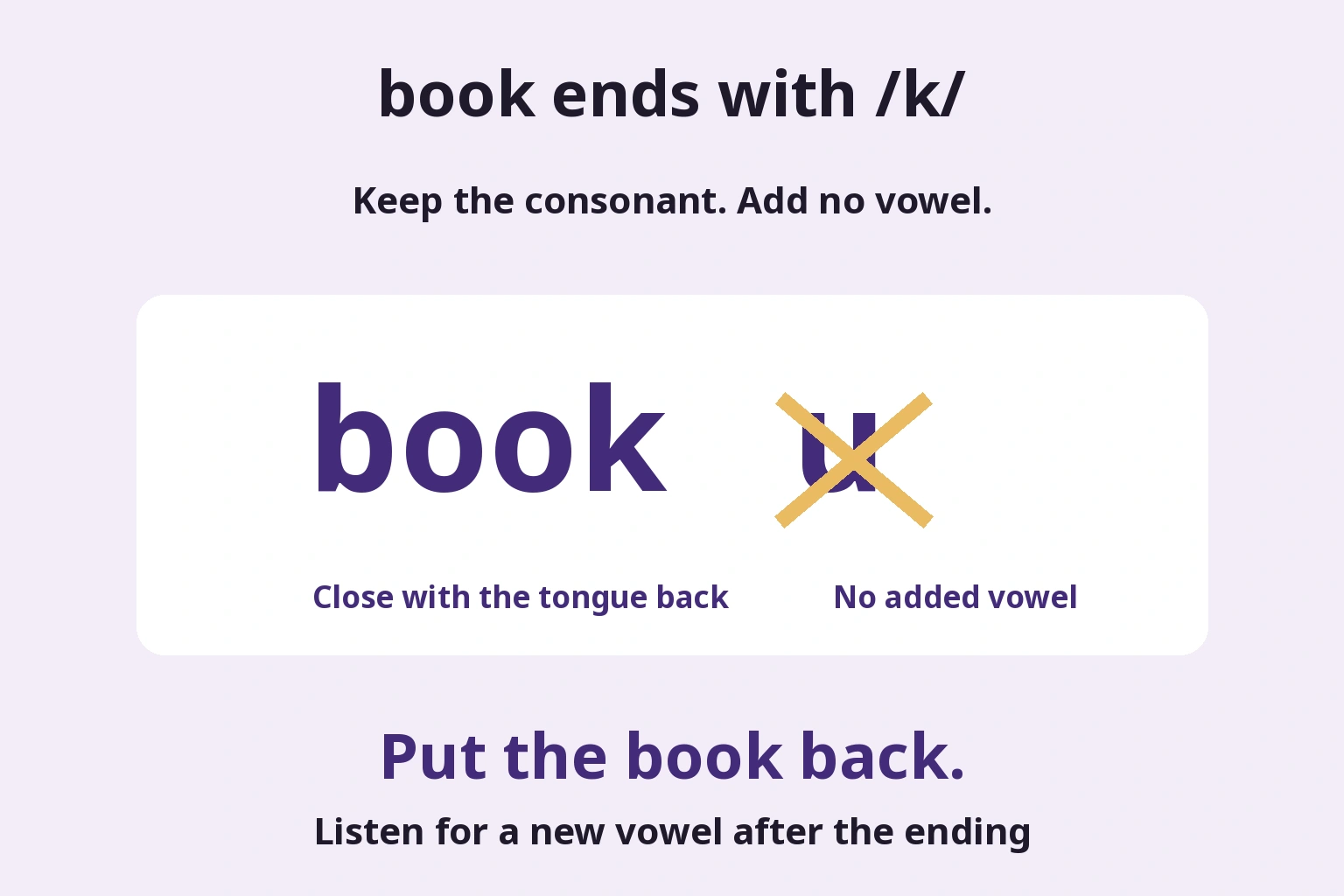
Sentence: Put the book back. This asks someone to return the book. Move from book’s /k/ closure to back’s /b/ without inserting a vowel. First check book alone, then book back, then the whole sentence. Do not also repair put’s /t/ in the same first attempt.
Recording check: compare only the ending of book and the transition to back. Is there a new vowel or an added beat? If you cannot tell, ask a listener specifically about an extra sound after book. Do not delete plural /s/ or tense endings simply to be faster; Iowa State’s endings chapter explains their grammatical roles.
2. L/R: separate initial movement from sentence performance
Make it: initial /l/ uses tongue-tip contact at the upper tooth ridge while air passes along the sides. Keep the sound briefly before moving into the vowel, rather than merely tapping and releasing. American /ɹ/ keeps the tip off that ridge; a raised/curling tip and a bunched tongue are possible strategies. R does not mean the tongue touches absolutely nothing: its sides may contact the back teeth. See the L and R descriptions.
Words and trap: light/right, glass/grass, long and red. Japanese speakers may merge both initial sounds into the same liquid; speakers with a tap or trill may substitute that for English R. An exaggerated “oo” before right adds a separate sound. Check a small pair with known meanings and answer feedback, then speak; you do not have to achieve perfect listening before moving your tongue.
Sentence: I really like this red coat. Imagine discussing a coat you might buy. Practise like’s initial L in one turn, red’s initial R in another. Really contains both, so use it when you are ready to switch movements. This sentence is the shared recording example for all language versions.
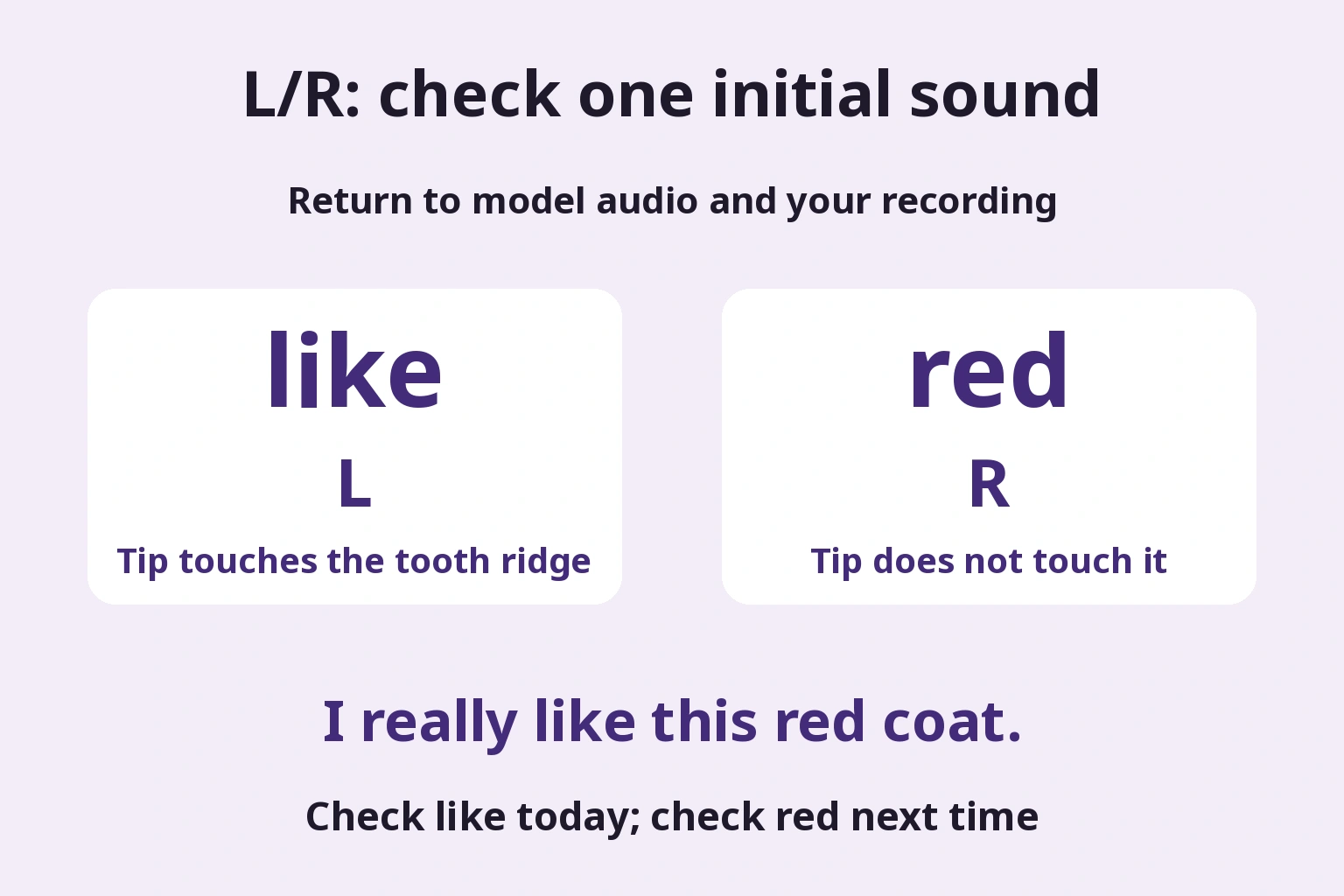
Recording check: alternate the model’s like with your like, then separately compare red. Voice depth is not the target. If possible, ask someone to identify light/right without seeing the intended word; telling them your answer first biases the check.
Final L needs a separate check
In general American speech, feel, full and milk often have a darker L with a raised tongue back. Tokyo’s liquid lesson distinguishes this position. It is not simply an extra “oo” or the initial L exaggerated.
Use The room is full. Record full without appending another vowel. Listen to the model’s whole ending; a recording alone may not tell you exactly where the tongue tip touched. A difficult final L does not invalidate work you have already done on initial L.
3. Th: airflow and voice, not hard tongue biting
Make it: place the tip near the back of the upper front teeth or lightly between the front teeth, leaving a narrow air passage. Thin’s /θ/ is voiceless; this’s /ð/ is voiced. Strong biting and a far-out tongue are not goals. Pronuncian explains both positions and why an excessively forward tongue can make transitions harder.
Words and trap: thin, three and bath versus this, those and mother. Thin may become sin, three may become tree, and those may begin with /z/ or /d/. Check each word in a dictionary; spelling th does not select one sound. Continuous friction differs from completely closing and bursting for /t/.
Sentence: Those three things are mine. This identifies three objects as yours. Work on those first, then three in a different turn, moving smoothly into the vowel. Do not prolong every th for several seconds in the actual sentence.
Recording check: compare those’s voiced start and three’s voiceless start separately. Lightly feeling throat vibration can help for the isolated sound, but the following vowel also vibrates, so vibration across the whole word does not prove /ð/. If /θr/ in three is difficult, find /θ/ before a vowel in think, then return to three.
4. V/F: teeth and lower lip, not a b-like closure
Make it: bring the upper front teeth lightly to the lower lip and let air pass. /v/ adds voice to a similar position; /b/ instead closes both lips. There is no need to bite hard or curl the lip far inward. F and V describe the difference.
Words and trap: fan/van, fine/vine, five, very and safe. A van beginning like ban or five ending with a b-like burst is a useful check. A first-language spelling with an equivalent-looking letter does not settle the sound. For Spanish speakers, the usual b/v spelling relationship makes this especially worth checking; bilingual and regional experience varies.
Sentence: Five vans fit here. Imagine a parking area. Choose vans’s /v/ or fit’s /f/, not every target at once. In another turn, check whether five’s final /v/ reaches vans without an extra vowel.
Recording check: listen for continuous friction versus closure and burst. Loudness alone is not voicing. Return to one word if the sound is unclear, then re-record the sentence.
Optional check: w/v
W rounds the lips and moves into the vowel, without v’s upper-teeth/lower-lip contact. Listen to we, wet and van, then use We can walk to the van. Choose we’s w or van’s v for one recording check. Do not insert a separate oo before w.
5. S/SH and “si/shi”: preserve the contrast before front vowels
Make it: /s/ uses a narrow groove near the tooth ridge; /ʃ/ raises the tongue blade farther back. A first-language “sh” need not be identical. Compare the friction, using the s and sh explanations.
Words and trap: see/she, sip/ship and seat/sheet. “Si/shi” here labels a sound contrast before an ee-like vowel, not a rule that every written si has one pronunciation. Japanese speakers may make see and she start alike; other speakers should also check their own recording rather than assume an error.
Sentence: She can see the ship. Compare she and see first, then ship in another turn. Maintain the /s/ you made alone as you enter see’s vowel.
Recording check: compare initial friction in see/she, where the vowel is matched. Ship and she have different vowels, so their total length does not isolate the s/sh issue. Tokyo’s fricative lesson supplies contrasts before front vowels.
6. Clusters: pass the movement on without inserting a vowel
Make it: in stop, move from /s/ airflow to /t/ closure, then directly into the vowel. Clean moves from back-tongue closure to L; desk moves from /s/ friction to /k/. CUNY’s st lesson explicitly warns against vowels before or between the consonants.
Words and trap: stop, clean, desk and next. Start with two-consonant combinations; more complex endings can wait. “Sutoppu” and “desuku” illustrate inserted vowels, not recommended spellings. Removing /s/ to make desk shorter creates another problem.
Sentence: Please stop by the desk. Check stop’s /st/ first, desk’s /sk/ next time. Stop by also lets you inspect the lip closure between /p/ and /b/ without adding a vowel.
Recording check: compare slow and ordinary-speed versions. Did a vowel return between /s/ and /t/ or /s/ and /k/ when you sped up? Preserve needed sounds without demanding a loud burst for every consonant. In book it, it already supplies a vowel: do not delete it in the name of “no extra vowel”. Continue that boundary work in the linking guide.
A solo routine with one sentence
Choose I really like this red coat. and write one target: “no new vowel after coat”, “initial L in like” or “initial R in red”. Use a model with a clear matching transcript. A quieter room and an ordinary phone recorder are enough to begin.
| Step | Action | Keep |
|---|---|---|
| 1. Listen | Choose one word and sound | A one-line target |
| 2. Make one word | Check like or coat alone | A workable movement |
| 3. Return to the sentence | Stop exaggerating the isolated sound | A short recording |
| 4. Alternate playback | Model, then you; also reverse the order | One specific difference |
| 5. Change one feature | Re-record after one adjustment | Before and after recordings |
| 6. Try later | Say the line without the model | A sentence-level check |
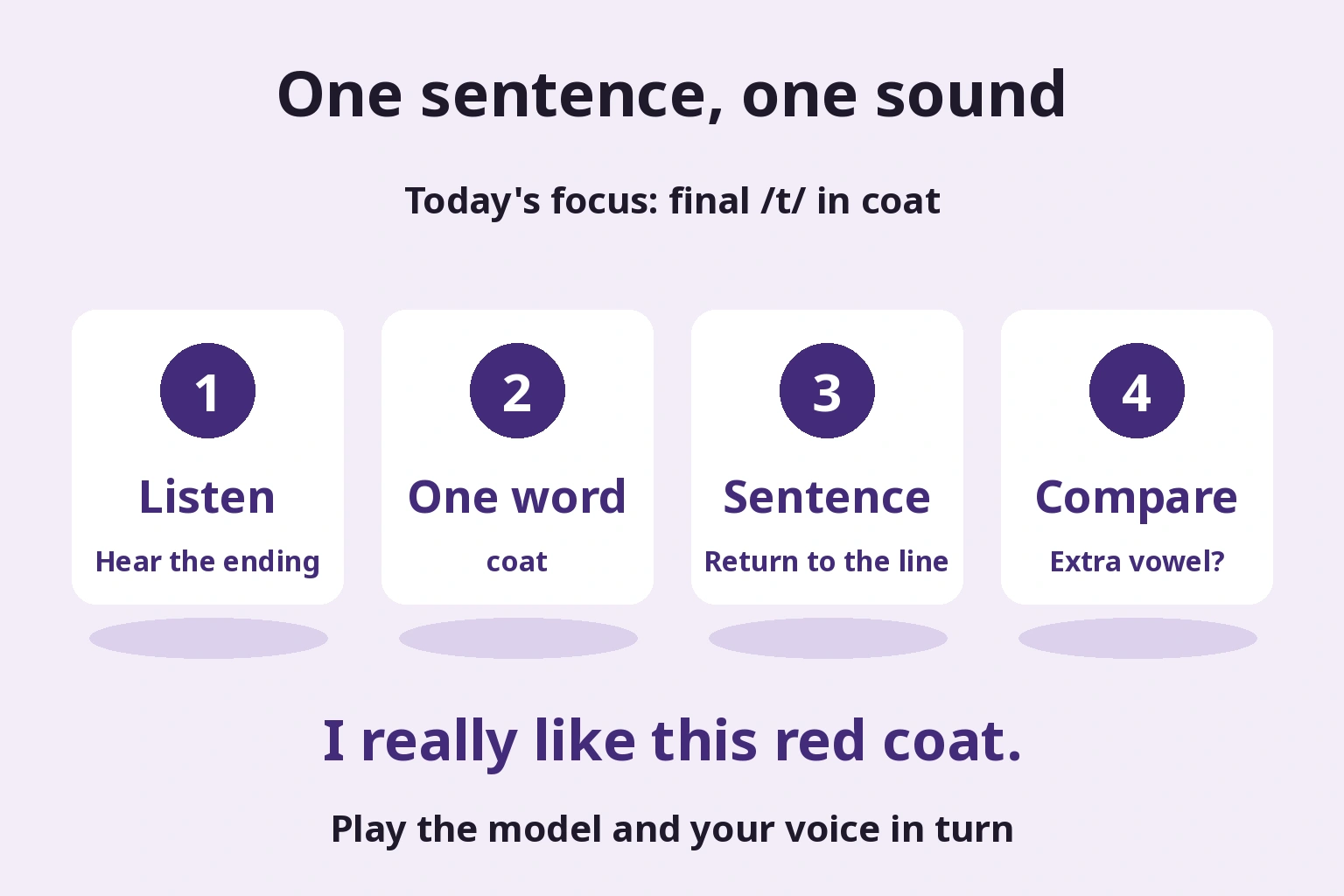
Five minutes is an editorial starting suggestion, not a proven ideal or an improvement guarantee. Do not repeat a word dozens of times without checking the sentence. Record your voice separately from the model: overlapping voices make it harder to tell whose consonant you heard. If the clip is distorted or noisy, retake it before judging.
Write “I hear a vowel after coat”, not “my English is bad”. If nothing changes, shorten the material or ask a teacher to check that specific place. Recognizing an intended word from context does not prove that every consonant was accurate.
Return to the same sentence in SpeakGain
We created one card with I really like this red coat. through the normal Add screen. Library → Knowledge → Learn this card opened Listening with the sentence hidden and reference audio autoplaying. Reveal answer opened Answer with the saved English, playback, review-interval choices and a Record and check entry.
We verified listening and revealing the sentence, not submitting a recording or an assessment result. This is not presented as judging or scoring L/R, or as a consonant discrimination test. The independent recording comparison above can use an ordinary phone recorder.
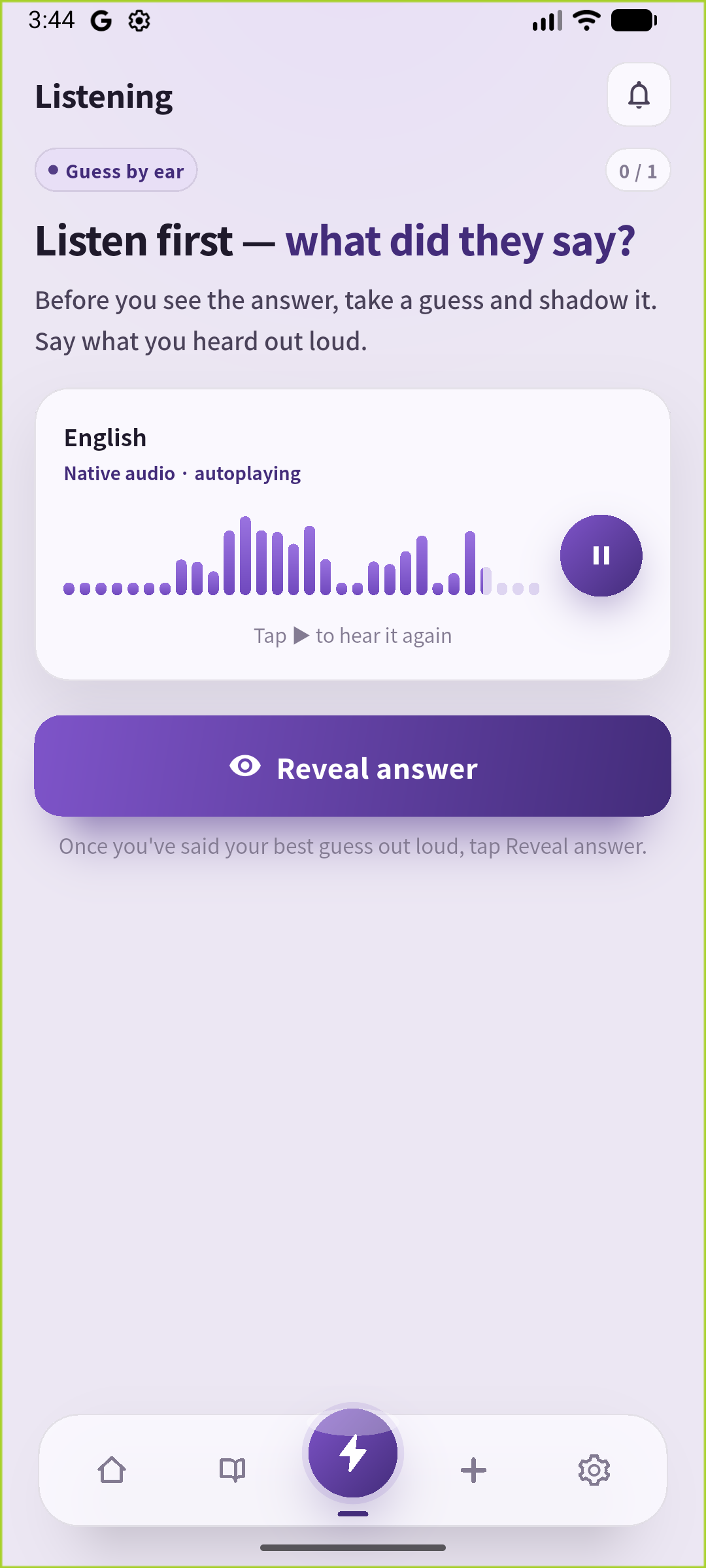
Reference audio for the shared sentence
This is AI-generated Deep-voiced Viking audio from the normal SpeakGain Create flow, not a human native-speaker recording. Native audio on this screen refers to that AI clip in our example. Check isolated word pairs separately in one dictionary accent; use this clip for repeating the sentence.
Methods we do not recommend
| Method | Missing check | Better next action |
|---|---|---|
| Memorizing the chart only | Can the sound survive in a sentence? | Choose one word, then record a sentence |
| Looking only at mouth diagrams | What sound did the movement produce? | Listen and compare your recording |
| Biting hard for th | Is air flowing into the next vowel? | Light contact, then a real word |
| Forcing one extreme R curl | Does this movement match the model? | Try a documented alternative |
| Treating katakana or respelling as the correct sound | Are contrasts preserved? | Use spelling, IPA and audio together |
| Racing through tongue twisters | Were endings and clusters retained? | Slow meaningful line, then ordinary speed |
Notes in your own script can help you remember meaning. They become a problem when one spelling stands for several English sounds. IPA literacy is useful, but is not evidence that your sentence worked either. Always return to actual audio.
FAQ
Which consonants should Japanese speakers fix first?
If the difficulty is unclear, check extra vowels after final consonants first, then L/R, th, v/f, s/sh and clusters. Skip stable features and prioritize a repeatedly misunderstood word. This is our editorial starting order, not a universal rule.
Listening or speaking first for L/R?
Listen to a small, answered pair, then make the sound and compare your recording. Perfect discrimination is not a prerequisite for speaking practice. If the difference remains unclear, return to the known pair instead of repeating an imagined sound indefinitely.
Do I bite my tongue for th?
No hard bite is needed. Keep a narrow passage near the upper front teeth, compare voice/no voice, and return to thin or this. A tongue that looks far forward is not automatically a better sound.
How do I stop adding “oo” at the end?
Make the final closure in book, finish without beginning a new vowel, then try book back. Record the boundary. If /k/ disappears too, restore the closure rather than treating omission as success.
Are there exactly 24 consonants?
Many introductory inventories list 24 main consonants. Regional realization and whether extra sounds such as the glottal stop are counted affect the number. This table is a practical overview, not every sound of every English variety.
Should I choose US or UK pronunciation?
Start with one model relevant to your listening or speaking context. These movement descriptions mainly use American English. Post-vowel R varies by accent, but that is not permission to omit initial R in right. Check dictionary labels and audio together.
How is this different from phonics?
Phonics links letters and spellings to sounds. This routine checks the physical sound and its realization in a recorded sentence. Knowing the letters th does not itself establish /θ/, /ð/ or a clean word ending.
Can I practise without a pronunciation score?
Yes. Alternate model and recording, comparing one chosen feature. Get focused human feedback when you cannot hear the difference. A self-rated similarity or a recognized sentence does not guarantee understanding in every conversation.
Our editorial verdict
Change one ending before trying to perfect an entire inventory. If you know an explanation but revert to the old sound in the sentence, that sentence needs practice. Keep two recordings of I really like this red coat., selecting coat’s /t/, like’s /l/ or red’s /ɹ/. The goal is reproducible distinctions in words you use, not changing every consonant simultaneously.
The sources linked beside the relevant claims explain articulation and contrast. Our sentences, exact priority order, five-minute starting point and recording prompts are editorial practice proposals; they are not measured learning outcomes or a promise of native pronunciation.