
English linking and connected speech: five changes to practise in one sentence
Published
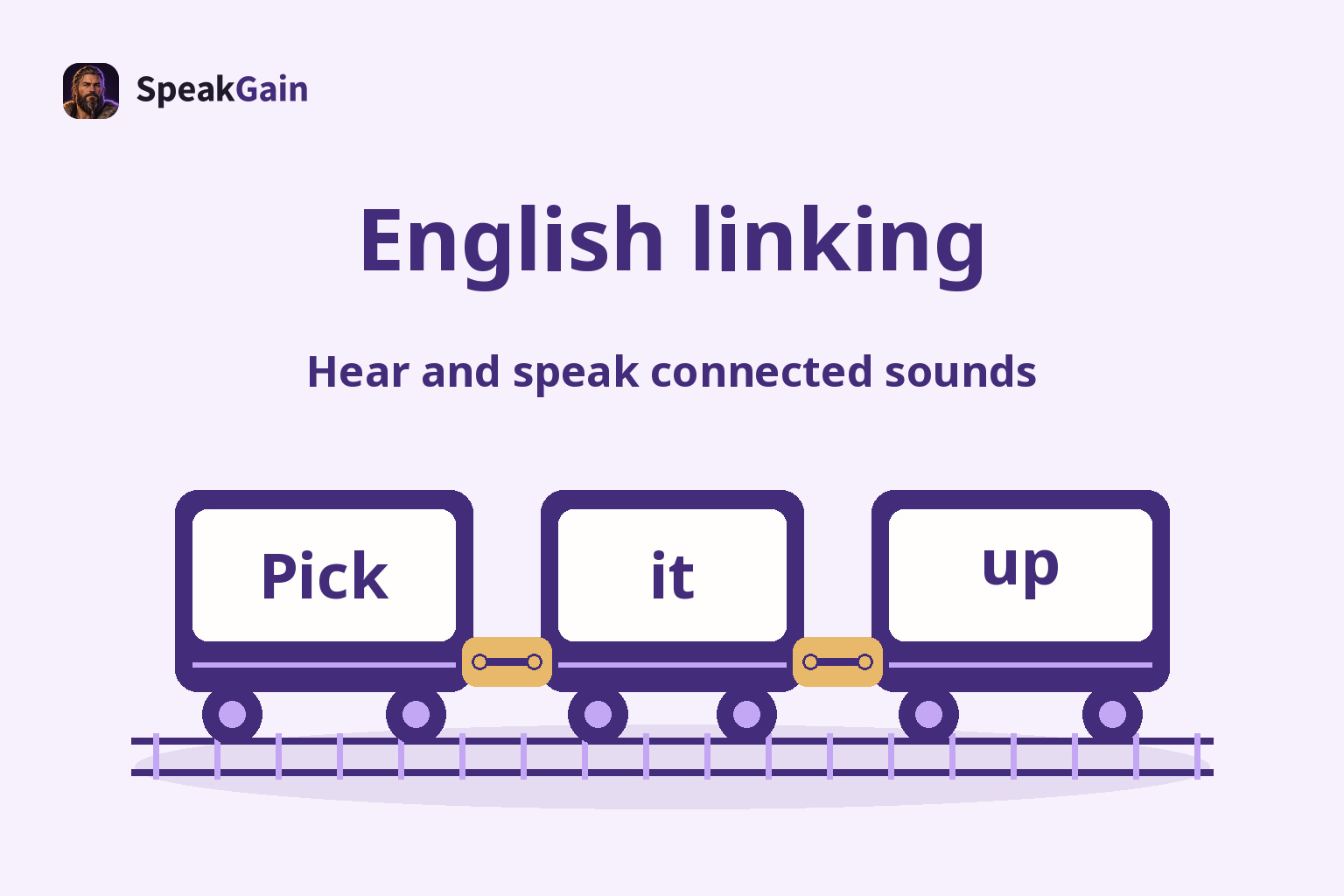
English linking connects the last sound of one word with the first sound of the next. Connected speech also includes deletion, weak forms, assimilation and flapping; their use varies with the speaker, accent, emphasis and situation. Practise a short sentence by listening, marking a boundary, saying it slowly and at normal speed, recording it, comparing, and fixing one detail.
For individual sounds, use our English consonant practice guide to choose a word ending, L/R or th contrast and compare one short recorded sentence.
Linking, liaison, reduction, assimilation and flap: what do they mean?
Use the terms to choose what to listen for, rather than to memorise a new spelling. Teaching materials organise connected speech differently. This article separates five useful observations without claiming they are the only classification.
| Term | Meaning here | What to notice |
|---|---|---|
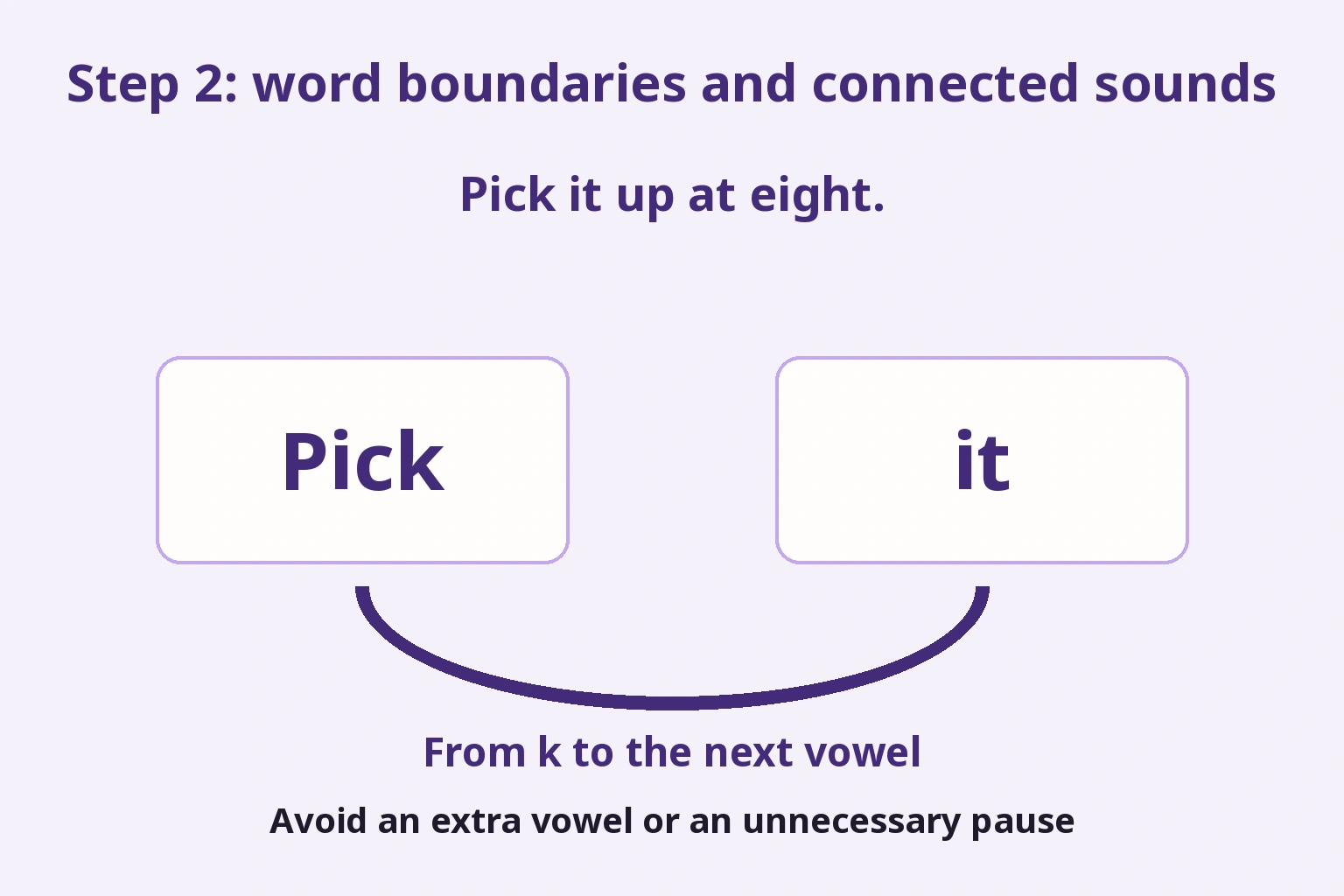
| Linking | Continuing across a word boundary without an unnecessary break | The /k/ in Pick‿it moving into the next vowel |
| Liaison | A French term sometimes borrowed by Japanese English-learning materials to mean linking | French liaison and English Pick‿it do not follow identical rules |
| Reduction | A sound becoming weaker or shorter; some materials use this broadly enough to include deletion | An unstressed can pronounced /kən/ |
| Assimilation | Adjacent sounds influencing one another’s articulation or combining | /t/ and /j/ in Put‿your sometimes becoming [tʃ] |
| Flap | A very brief tongue contact [ɾ], often a realization of /t, d/ in North American English | A short tap at the first t in Get‿it |
French liaison involves a consonant that is normally unpronounced appearing before a following vowel in particular contexts. That differs from continuing an already-present English consonant into the next vowel. See UT Austin’s French pronunciation material. If you encountered “liaison” in a Japanese resource, start with the linking exercise below rather than importing French rules.
Written spaces are not reliable instructions to stop speaking. Three written words can form one continuous stretch of sound. CUNY Baruch’s introduction explains that connected speech occurs even in formal situations; it is not simply careless pronunciation.
Five common tendencies, not five compulsory rules
Predict where a change might occur, then check the recording. Speed, region, register and contrastive emphasis can change its realization. More than one process may occur in the same phrase. Iowa State’s pronunciation chapter discusses these distinctions and variation.
| Pattern | Common environment | Original example | Listening clue | Caution |
|---|---|---|---|---|
| Linking | Final consonant followed by a vowel, within a continuous phrase | Pick‿it‿up at‿eight. | A consonant seems attached to the next vowel | Words and spelling remain unchanged |
| Deletion | Consonant clusters in which /t, d/ may be absent | Move the las(t)‿box. | No separate t release is audible | A quiet release is not proof of deletion |
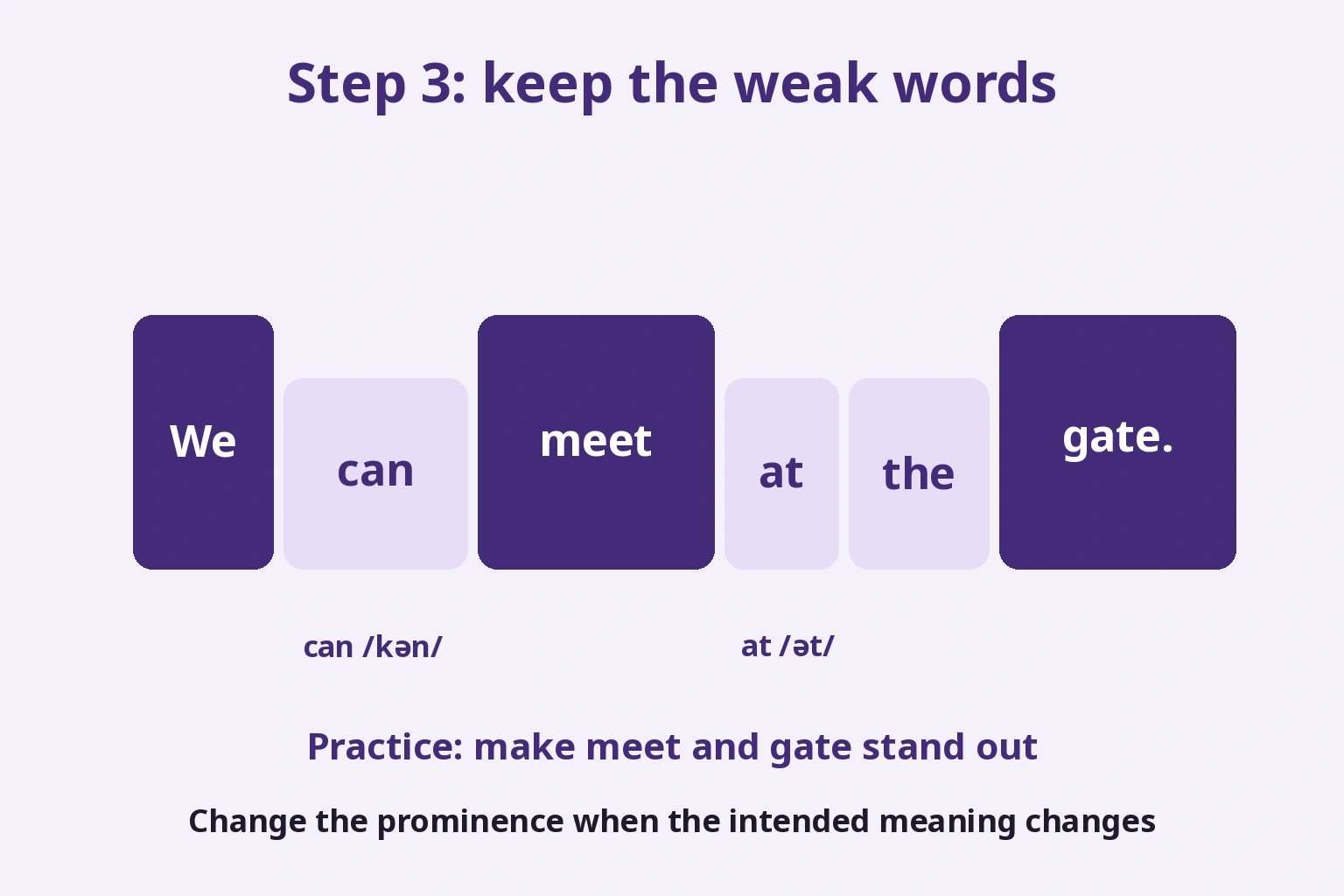
| Weak forms | Function words without emphasis | We can meet at the gate. | can /kən/, at /ət/ are possible | Emphasis can favour stronger forms |
| Assimilation | Adjacent articulatory movements influence one another | Put‿your bag here. | /t/ + /j/ may combine as [tʃ] | This is about sounds, not every written t + y |
| Flapping | /t, d/ between vowels, often before an unstressed syllable, in accents that use it | Get‿it ready. | A very brief [ɾ] | Not every t or every accent behaves this way |
The join ‿, bold type and parentheses are editorial practice marks, not an acoustic analysis or automatic detection. They point to an observation; they do not instruct you to alter every occurrence.
1. Linking: carry a final consonant into the next vowel
Why it happens: articulatory movements continue through a phrase instead of restarting after each written word. A final consonant can therefore sound like the beginning of the following word. British Council’s explanation describes consonant-to-vowel linking.
Pick‿it‿up at‿eight.
Imagine arranging to collect a parcel at eight o’clock. Notice /k/ into the vowel of it, /t/ into up, and the final /t/ of at into eight. The boundary up at is another candidate, but you need not work on all of them today.
Reading or mishearing to check: if you add a vowel after final consonants, or stop after each word, your version may have extra beats. If you expect a separate final sound before recognising it, you may miss the next word. These are observation prompts for any language background, not a diagnosis.
Listening practice: hide the sentence and identify the action and time. Then read it while replaying only pick it. Listen for continuity rather than three clearly separated dictionary forms.
Pronunciation practice: say pick, then pick it, then pick it up, and return to the whole sentence. Check that you are not adding an extra vowel after /k/. Leave detailed /t/ realization for a different practice round.
2. Deletion: an unheard release does not mean you must remove a sound
Why it happens: neighbouring consonant gestures can overlap, and a segment may be absent in a cluster. British Council gives /t, d/ cluster examples. A small or unreleased stop, however, is not automatically a deleted stop.
Move the las(t)‿box.
Move the final box in the group.
The /s, t, b/ sequence in last box is the observation point. Parentheses mean that /t/ can be absent in some realizations, not that last must always lose its final sound.
Reading or mishearing to check: perhaps you insert a vowel between last and box; perhaps you reject last as a possible word when no independent t release is heard. Keep the written word available while checking the sentence sound.
Listening practice: replay last box with and without the transcript. If you cannot determine deletion, write “no separate release heard” rather than pretending to have identified every articulatory gesture.
Pronunciation practice: start slowly with the consonants retained and avoid added vowels. Try a reduced cluster only when you have confirmed it in your model. Do not delete word endings indiscriminately to sound fast; number, negation or tense information may become unclear.
3. Weak forms: quieter words still do a job
Why it happens: function words can have shorter, weaker forms when they are not prominent. Some use schwa /ə/; not every weak vowel is schwa. CUNY’s Reduced Speech material includes can /kən/ and exercises comparing stronger and weaker parts.
We can meet at the gate.
A suggestion about where to meet.
For an ordinary suggestion, listen to how meet and gate stand out relative to can and at. In a correction such as “we can, rather than cannot”, can may be prominent instead. Grammar class alone does not fix the emphasis.
Reading or mishearing to check: equally long words can conceal the difference between weak and strong parts. In listening, a short can or at may be missing from your notes even though you know the word.
Listening practice: note what you heard, then locate the missing function words with the transcript. Separate a word inferred from grammar from one you actually identified in the sound. For can versus can’t, do not rely only on an audible t; consider prominence and context too.
Pronunciation practice: keep can and at while shortening them relative to meet and gate. Compare vowel quality and transitions, not just volume. Also try the sentence in a contrasting context so you can use a stronger form when the meaning needs it.
4. Assimilation: nearby sounds affect the movement
Why it happens: preparing the next sound can influence the current one. Sometimes two gestures combine, such as /t/ and /j/ becoming [tʃ]. Essentials of Linguistics explains this across word boundaries.
Put‿your bag here.
An instruction about where to leave a bag.
Reading or mishearing to check: sharply separating put and your can differ from a combined realization. Conversely, memorising a single invented spelling may make you forget which words are present. Listen for the ownership conveyed by your as well as the sound.
Listening practice: identify the two words and inspect whether the model keeps /t/ and /j/ relatively separate or combines them. Do not mark an assimilation that the recording does not contain.
Pronunciation practice: say the two words slowly, imitate the transition actually heard, then restore bag here. A large exaggerated “ch” is not the goal; an understandable instruction is.
5. Flapping: t is not always a strong stop
Why it happens: in North American English and some other varieties, /t, d/ can be realized with a brief tongue contact [ɾ], commonly between vowels before a weak syllable. Essentials of Linguistics describes this unstressed-syllable realization. It is not a rule replacing every written t with d.
Get‿it ready.
Prepare it for use.
Reading or mishearing to check: if you expect a strongly released t every time, a brief tap may prevent you from recognising get it. If your first language already has a tapped sound, do not assume it must be identical in duration or context to this model.
Listening practice: inspect the first t in get it, then check that you also recognise the phrase from a speaker who retains a different /t/ realization. “All Americans tap; no British speaker does” is an unhelpful absolute.
Pronunciation practice: begin with a clear slow version. Try the brief contact only when the model uses it, and keep the work within these two words before returning to the sentence. Learning to recognise different realizations comes before trying to reproduce every reduction.
One-sentence routine: listen, mark, slow, normal speed, record, compare, fix
Complete the loop with the same sentence. Our editorial starting point is one boundary in Pick it up at eight.; the sequence and times below are suggestions, not a scientifically established optimum.
Step 1: check the meaning, then hide the words
The marks and tables are observation candidates, not analysis of this generated clip. If the sound differs from a mark, check the recording.
Listen for collecting something at eight. Record whether you understood the action and time before examining every consonant. Use a short audio clip with an accurate transcript. A written sentence alone cannot provide listening practice.
If the transcript itself is difficult, work on vocabulary or grammar first. Use listening-study diagnosis to separate these problems and movie-listening practice to return to a manageable scene.
Step 2: mark a boundary you will inspect
Open the transcript and select pick‿it. Distinguish a predicted join from one checked in the recording. Uncertain details can remain unconfirmed.
Step 3: speak a short phrase slowly, then return to normal speed
Say pick it, pick it up, and the full sentence. Slow speech should let you inspect the movement without creating a compulsory pause after each word. Then return to the model’s normal speed.
If individual sounds are the difficulty, use pronunciation practice. If the problem is which words to highlight or how the voice moves, use intonation and stress practice. Do not repair all of these at once.
Step 4: compare the model with your separate recording
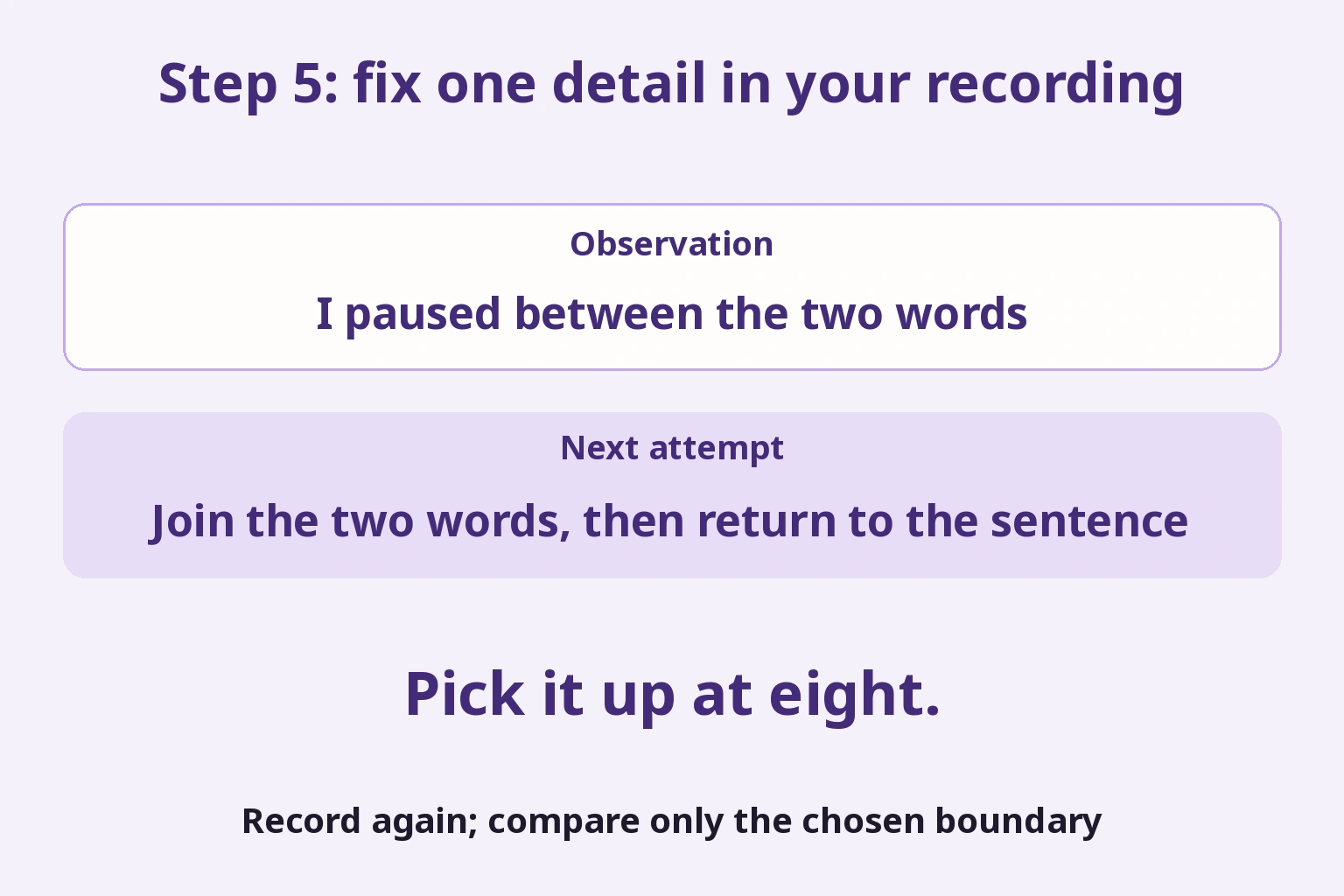
Stop the model, record yourself, and alternate model–you and you–model. Listen only to pick it. Describe a concrete difference, such as an extra vowel or a pause. Voice depth is not the target. A recording made while both voices overlap can make comparison difficult.
If the sound clips, is too quiet or contains competing voices, record again before judging it. If you need feedback, ask a specific question such as “Did I stop between pick and it?”
Step 5: fix one detail and record the whole sentence again
Practise the two-word transition, then restore the sentence. “Faster” alone is not a useful correction target. Check that the words remain and the request is understandable.
Use short dictation if writing a gap helps, but do not confuse spelling errors with listening errors. Keep the model and your recording easy to return to instead of continually searching for new material.
Return to the same sentence in SpeakGain
We created one practice card through the normal Add flow. The observed sequence was Knowledge → Learn this card → Listening / Guess by ear → Reveal answer → Answer. Listening hides the sentence; Reveal answer opens the answer. Answer showed the saved sentence, an explanation link, playback controls and the Record and check entry.
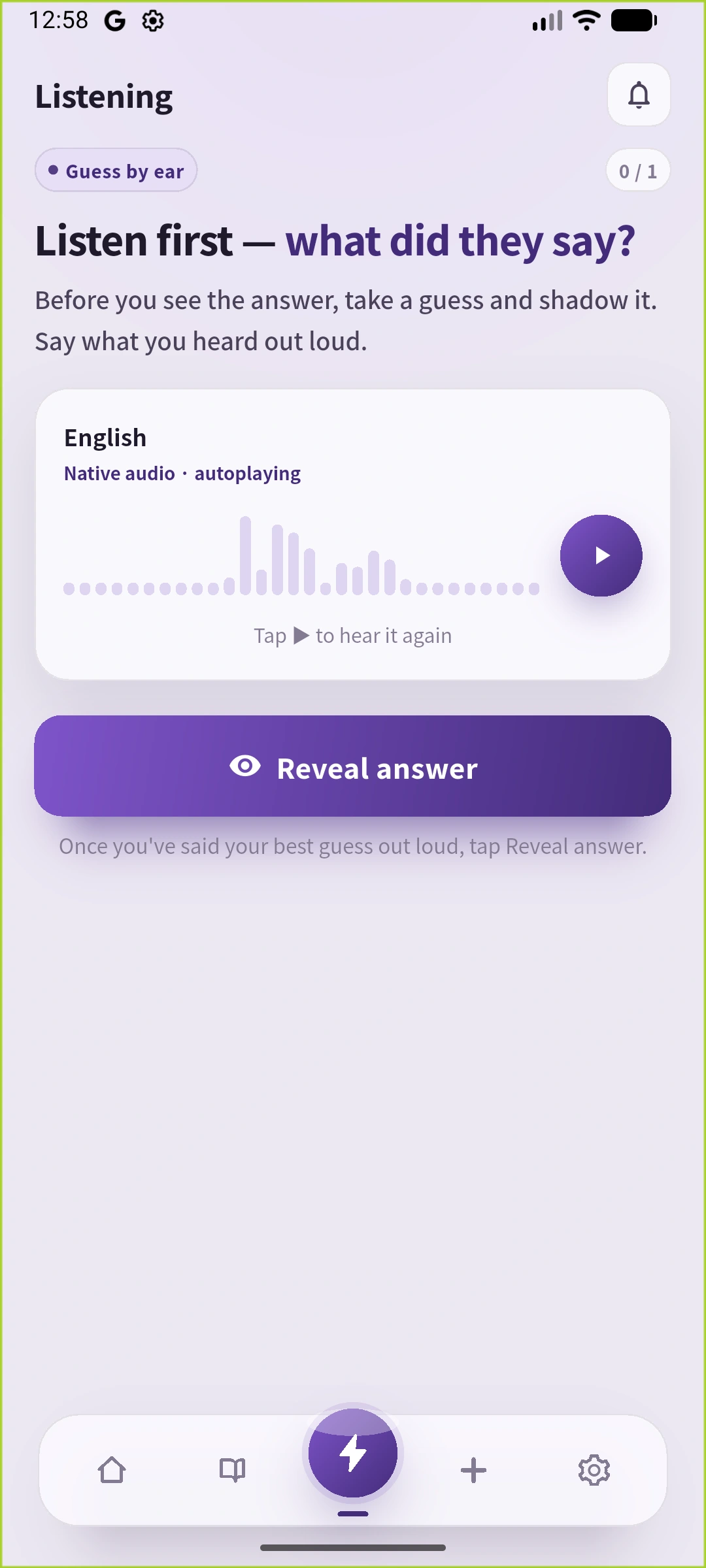
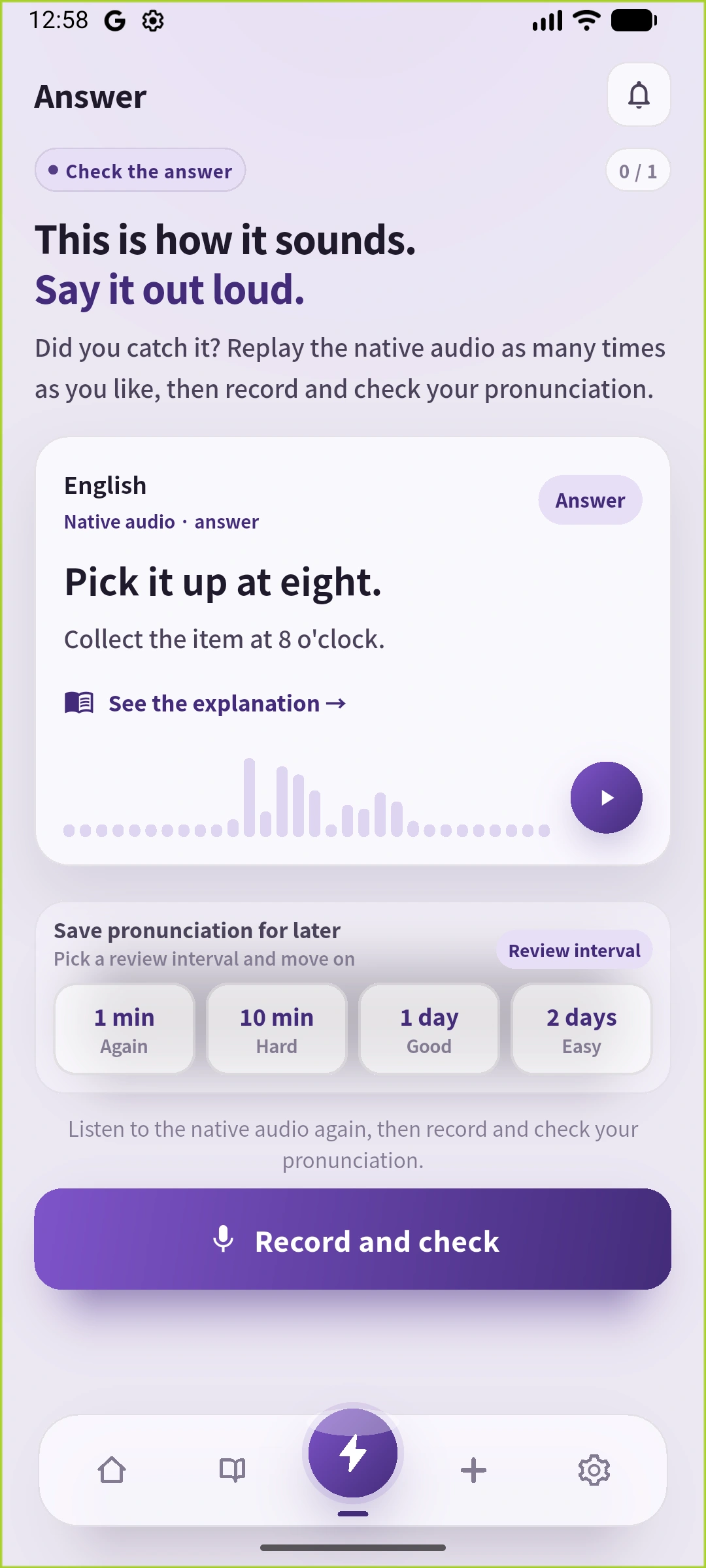
We verified the saved text, reference-audio screens and recording entry, without submitting a learner recording or checking an assessment result. The independent recording comparison above can use a phone recorder. See what SpeakGain is for its broader features.
A ten-minute starting plan
Begin with one sentence and one detail; try a different sentence in a later session. Ten minutes is an editorial convenience, not a promised dose or deadline.
| Approximate time | Task | Note to keep |
|---|---|---|
| 2 minutes | Listen without the transcript | Action, time and any uncertain word |
| 2 minutes | Check the text and mark one boundary | Today’s target, such as pick‿it |
| 3 minutes | Two words, phrase, sentence; slow to normal speed | Extra vowel or unnecessary pause? |
| 3 minutes | Record, compare, fix one thing and record again | The movement to change next |
Start with linking, then inspect a weak word in another round. Add deletion, assimilation or flapping where you actually encounter a problem. Later, use an unfamiliar short sentence with a similar boundary to distinguish recognising a pattern from memorising a recording. Change speakers gradually rather than jumping straight to a long crowded movie scene.
Common mistakes and the next useful action
We do not recommend rule memorisation alone or copying speed while losing words. Neither leaves a clear correction to test.
| Habit | Problem | Next action |
|---|---|---|
| Memorising an invented phonetic spelling | Losing the original words | Keep the text and mark a boundary |
| Removing or tapping every t/d | Ignoring conditions and accents | Use only the verified short phrase |
| Counting a guessed word as heard | Mixing inference and recognition | Hide the text and replay |
| Correcting every sound at once | No clear before/after comparison | Compare one boundary |
| Changing long videos daily | No completed correction loop | Re-record a short sentence first |
Language background can influence perception, but it is not a universal diagnosis. Dupoux and colleagues’ Japanese/French experiment examined illusory vowels in particular nonword consonant clusters, not the effectiveness of this routine. Our learner notes are conditional checks, not experimental results about every reader.
FAQ
Are liaison and linking the same?
Some Japanese English-learning materials use both for linking. French liaison has its own phonetic and grammatical conditions; it is not a general name for all English sound changes.
Must I use connected speech when speaking?
You need not imitate every reduction. Avoid unnecessary word-by-word pauses inside a phrase and prioritise meaning and clarity. UTS’s pronunciation workshop distinguishes understanding these features from using them extensively.
Does American English differ from British English?
Both have linking and weak forms, but realizations such as /t/ vary by accent, speaker and context. Learn one model first, then listen for differences in other voices.
Will learning the rules solve listening problems?
It can guide attention but does not replace vocabulary, grammar, topic knowledge or suitable audio. Reconnect familiar words with their actual sentence sounds.
How does this relate to shadowing?
First pause to understand and imitate a short section independently. Then follow the model. Compare the chosen boundary in a recording rather than chasing an unknown fast stream.
Can I use it for TOEIC or films?
Yes, for a short line whose meaning is clear in writing but hard to recognise by ear. A mastered practice sentence is not evidence that you can follow an entire test or film.
How do weak forms differ from deletion?
A weak form is a reduced pronunciation such as can /kən/. Deletion is a segment not being realized. They can occur together, but “weak words all disappear” is not a rule.
Editorial verdict: start with linking and weak forms
We would inspect linking and weak words first, then add the other patterns at the remaining listening gaps. This is an editorial entry point, not a universal research-established order. Listen to Pick it up at eight., mark pick‿it, say it slowly and at normal speed, compare a recording, and fix that boundary. Leave a note about what you heard and changed instead of treating a new spelling or faster delivery as success.
To notice connected sounds in music, try the song-learning routine, then return to an original sentence spoken without a melody.
Sources
- CUNY: Linking & Connected Speech and Reduced Speech.
- Iowa State: Connected Speech.
- British Council: Connected speech, part 2.
- Essentials of Linguistics: Transcribing Casual Speech.
- UT Austin: French liaison.
- UTS: Practising Pronunciation.
- Dupoux et al.: Epenthetic Vowels in Japanese. Specific perception experiment; no claim about this routine’s learning effect.