
How to improve English listening: fix the cause of each miss
Published Updated
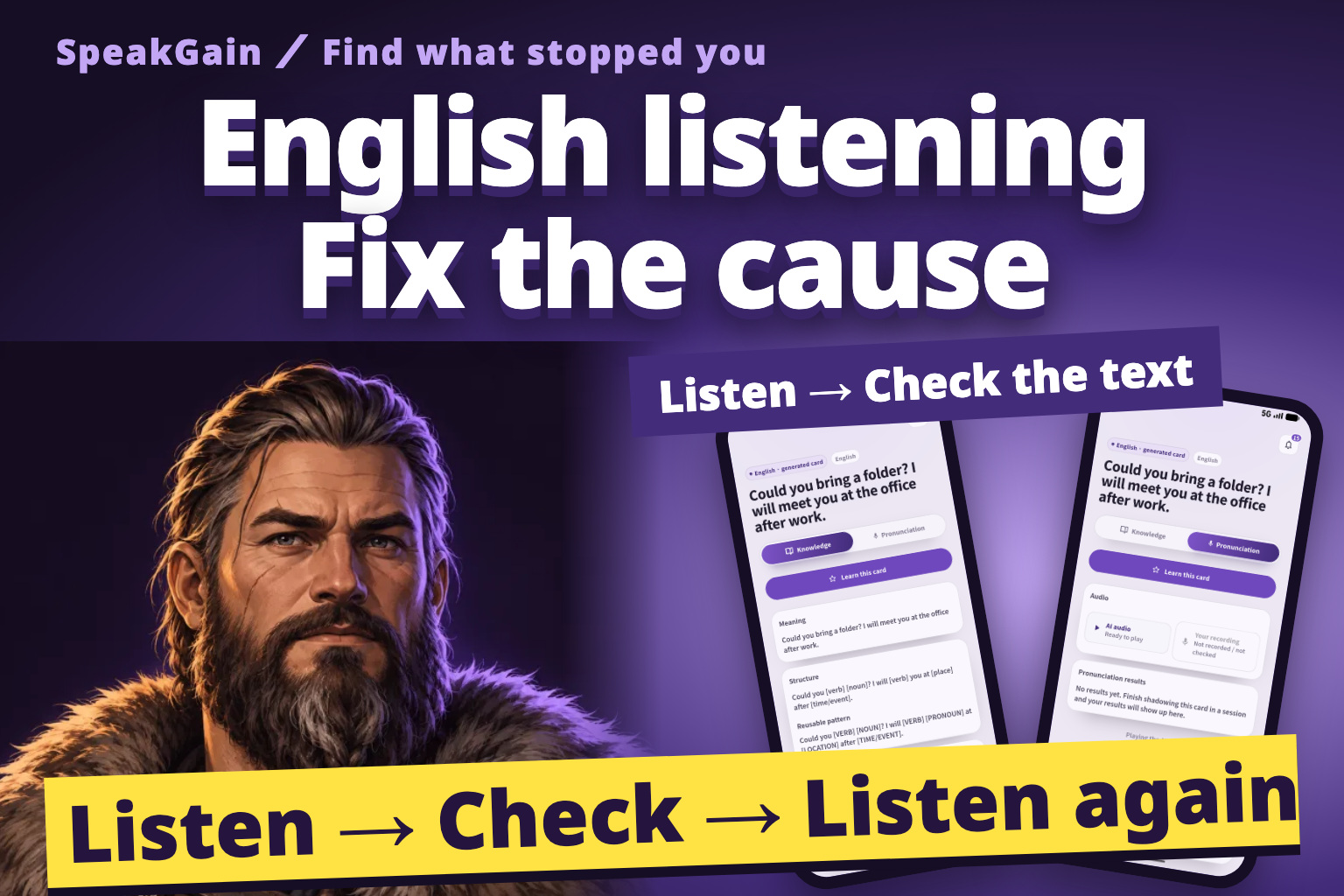
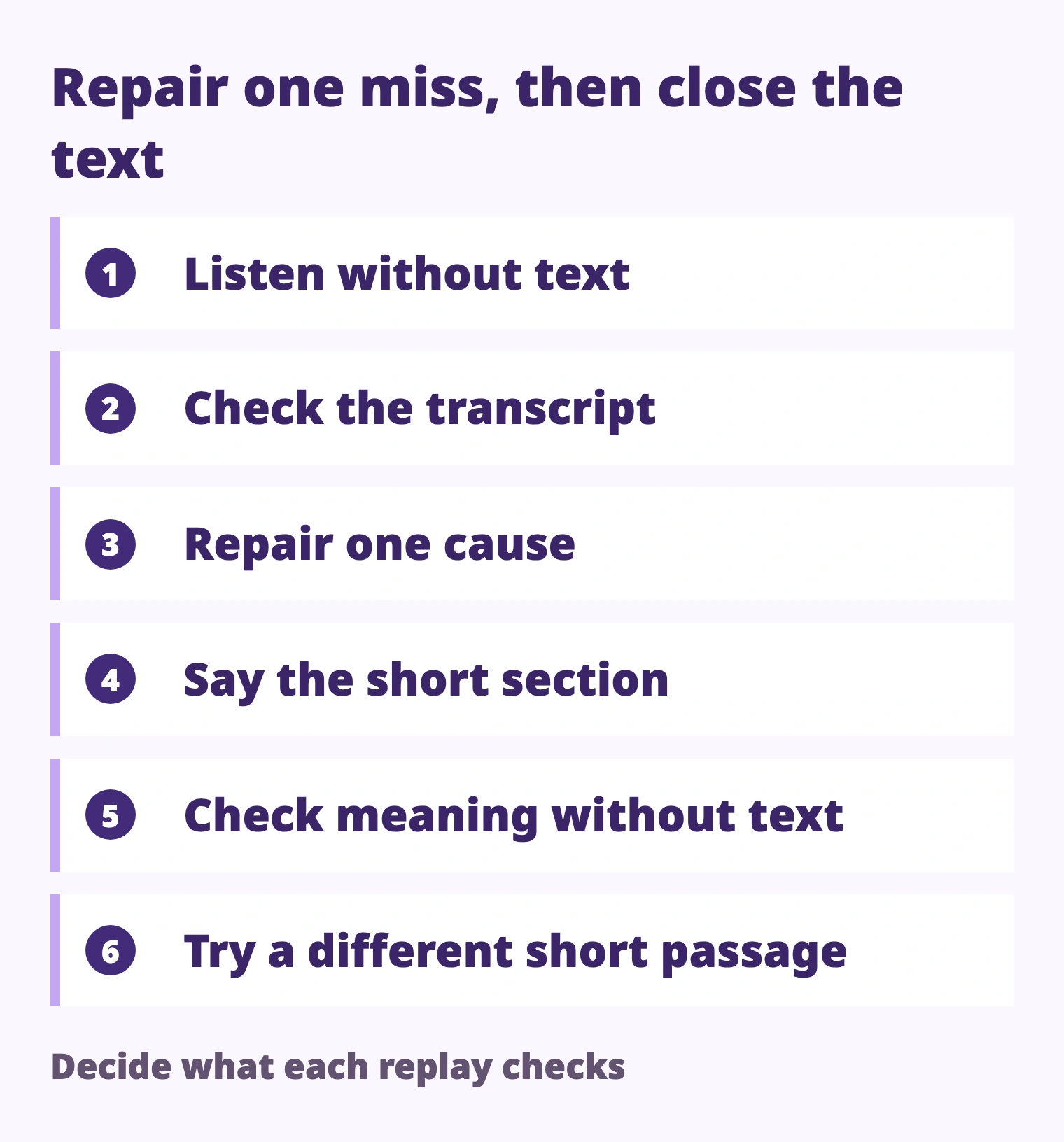
To improve English listening, find why you missed a short passage, then listen → check the text → repair one difficulty → say it → listen again without text. If reading is unclear too, start with meaning. If reading is easy but the sound is unfamiliar, compare a small section with its transcript. If pauses help, practise connecting meaning in chunks.
Our editorial recommendation is to finish this cycle with two sentences before starting a long news broadcast. More replays are useful only when you know what you are checking. You do not need to do every listening exercise at once.
How to study English: choose by your goal and what stops you
For words you understand in writing but miss in a continuous stream, use linking and weak-form practice to reconnect the sounds with the sentence.
For TOEIC Parts 1–4, use our listening practice guide to identify why a sentence was missed and choose the next drill.
Diagnose the miss before choosing an exercise
Listen once without reading. Say what the speaker wants and what happens next. Then read the transcript. Notice whether the problem disappears after reading, after pausing, or after learning the situation.
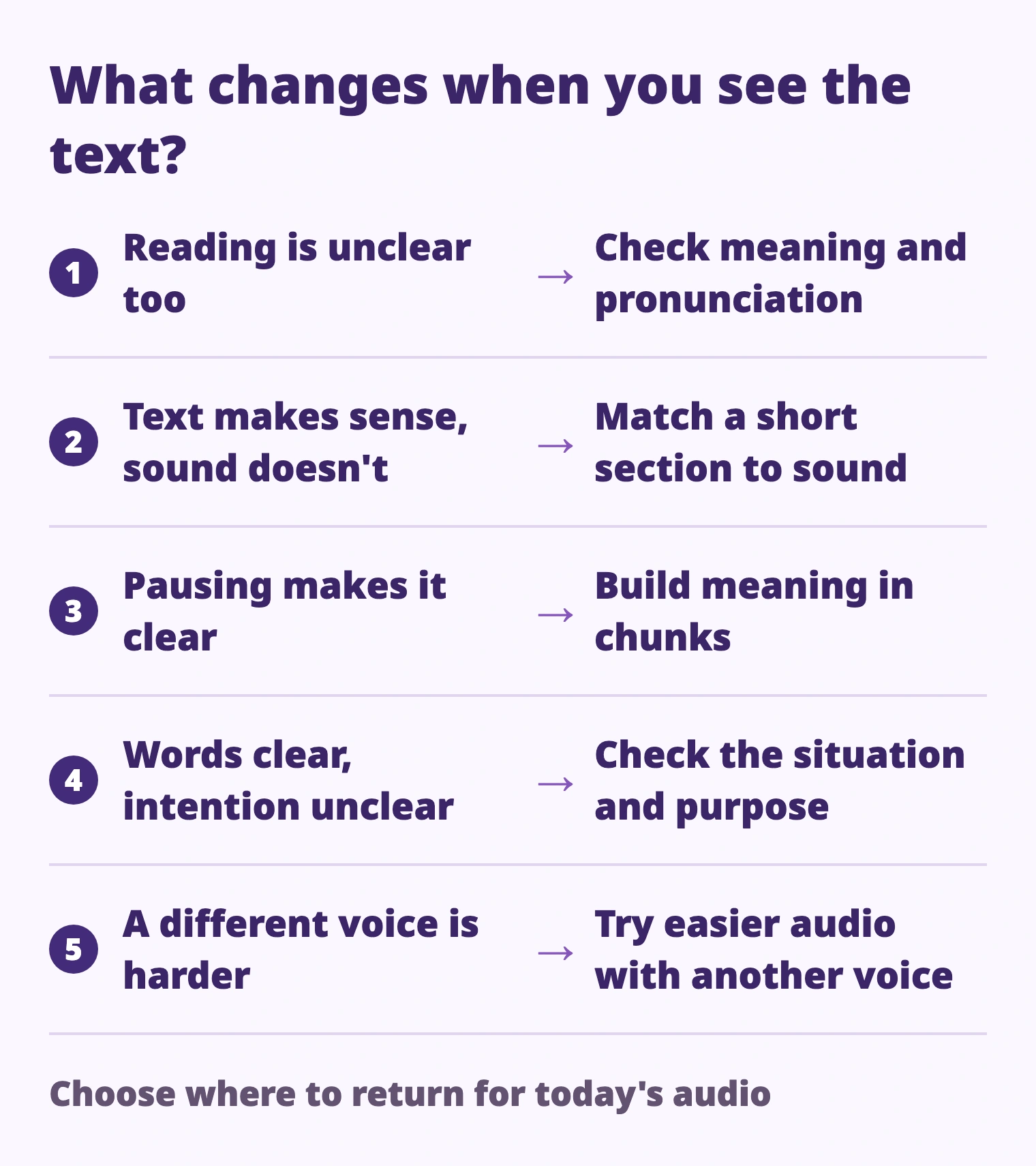
| What happens? | First task |
|---|---|
| You cannot explain the written sentence | Check vocabulary, phrases and sentence structure |
| You understand the text but cannot locate words in the sound | Compare pronunciation and word boundaries in a short section |
| You understand when you pause, but lose the continuous message | Build the situation one meaning group at a time |
| You recognise words but miss the speaker’s intention | Check who is speaking, to whom, and why |
| One voice is easy and another is difficult | Compare easier recordings, changing one condition at a time |
This is a practical decision aid, not a validated diagnostic test. Several causes can occur together. Start by checking meaning rather than labelling yourself a “bad listener”.
To locate a missed word and distinguish sound, knowledge and writing load, follow the worked example in English dictation practice.
One short passage for the whole routine
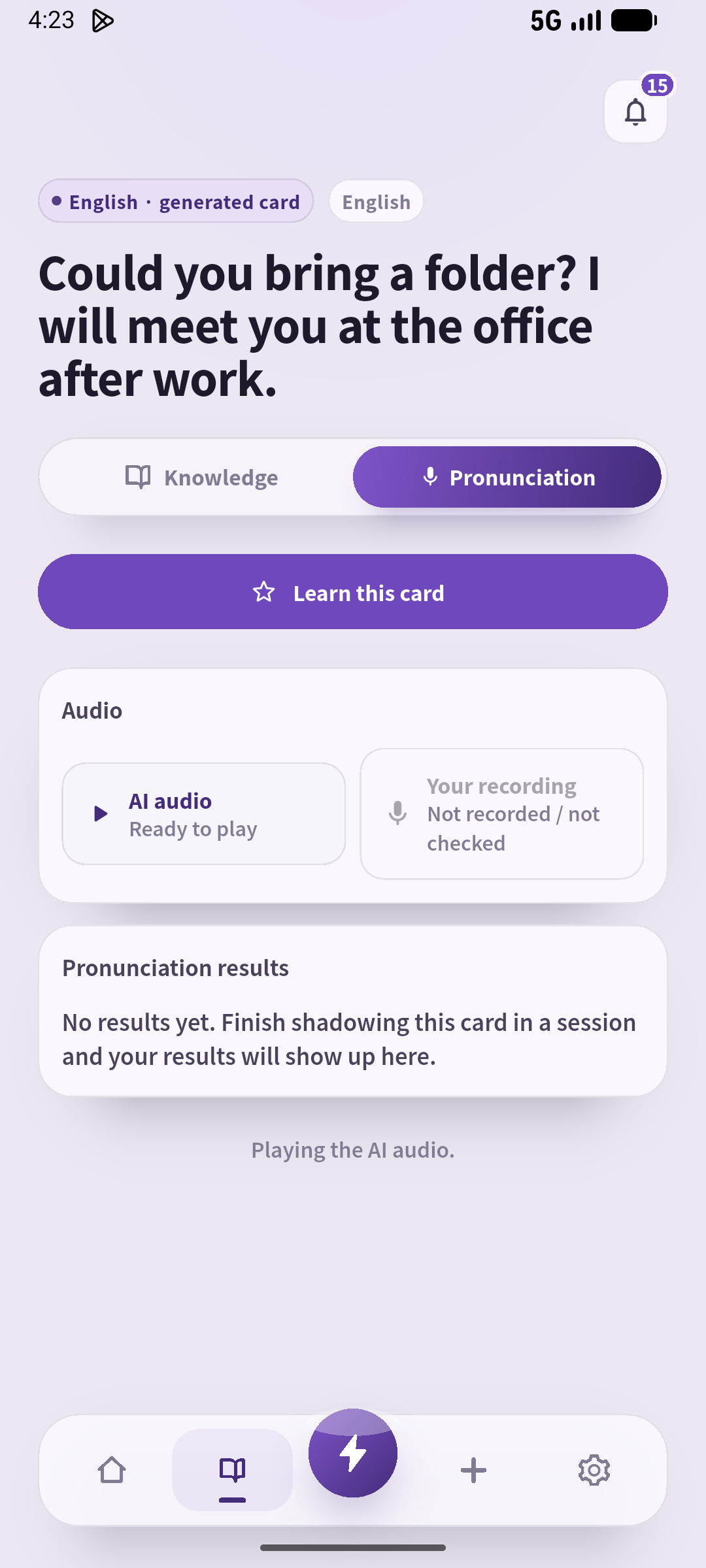
Before the first play, close the text below. Listen for three things: what to bring, where to meet, and when.
Check the text
Could you bring a folder? I will meet you at the office after work.
A request to bring a folder, followed by an arrangement to meet at the office after work.
The passage is original. Its model is SpeakGain’s AI voice, Deep-voiced Viking. A low voice is a practice example, not a voice you must copy. Write “object ?, office ✓, time ?” if that is what you understood. Preserve your first answer so you can compare it with the text later.
1. You know the words on paper, but not in continuous speech
Spoken words do not always have clear gaps matching the spaces on a page. Weak forms and connected speech can make familiar words harder to locate. The British Council explanation describes these features and teaching activities; it is guidance, not a controlled test of our routine.
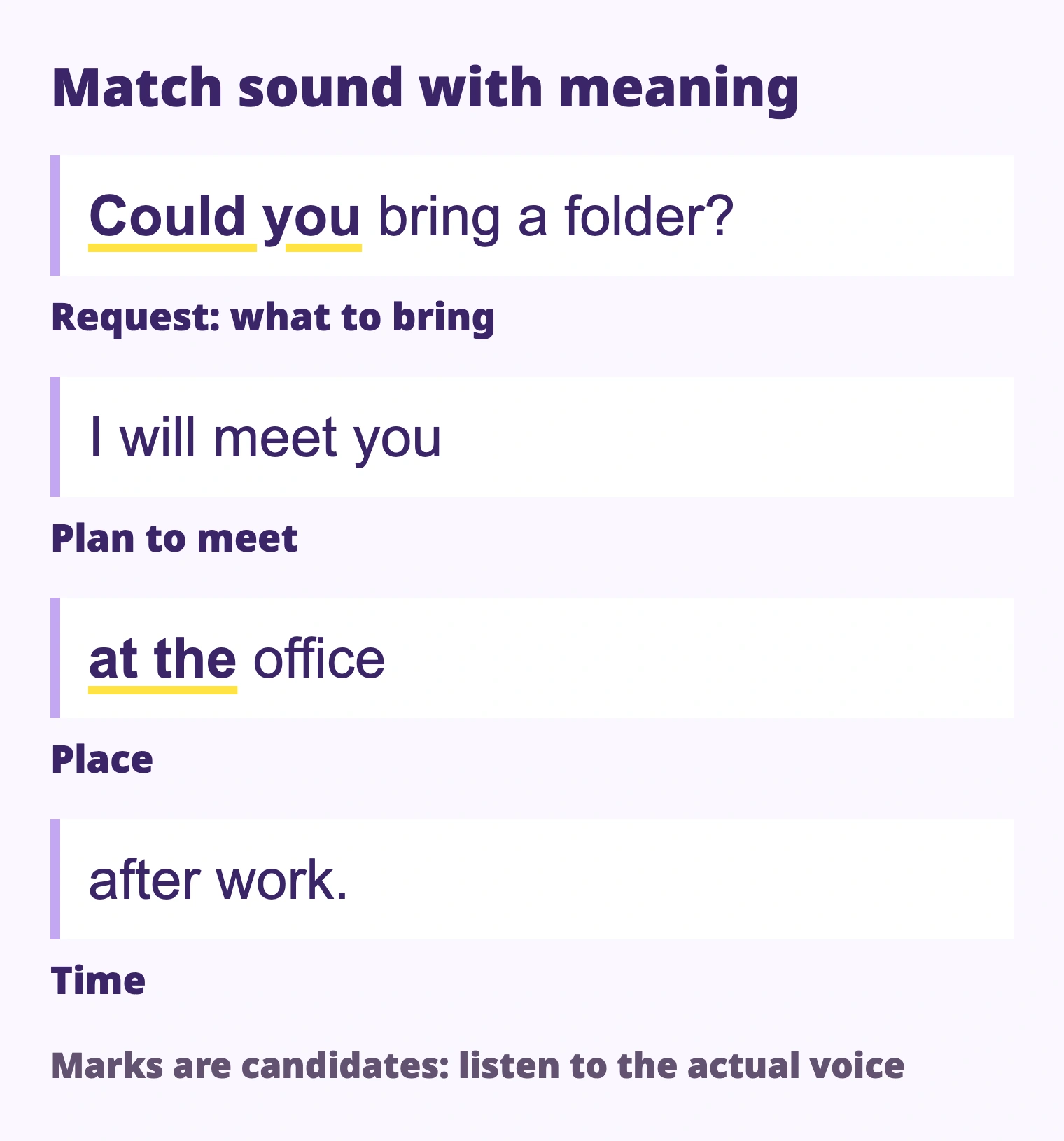
Inspect Could you and at the. These are candidates to check, not a promise that every voice reduces them identically. Listen to the short section, read it, then listen again. Ask where each written word occurs in the actual sound.
If three attempts leave you guessing, reveal the text and compare a dictionary pronunciation with the word in the sentence. Three is our suggested stopping rule, not an experimentally optimal repetition count. Say the small section once, return to the sentence, then check it without text. Being able to say it does not prove that you can recognise it in another voice.
If films are especially difficult, movie dialogue conditions include other problems such as noise and missing context. Treat those separately.
2. The meaning is unknown, or arrives too late
If you do not know folder, sound-boundary work cannot supply the missing meaning. Check the object, its pronunciation and its role in the request. Learn bring a folder as part of this situation, not just an isolated spelling and translation.
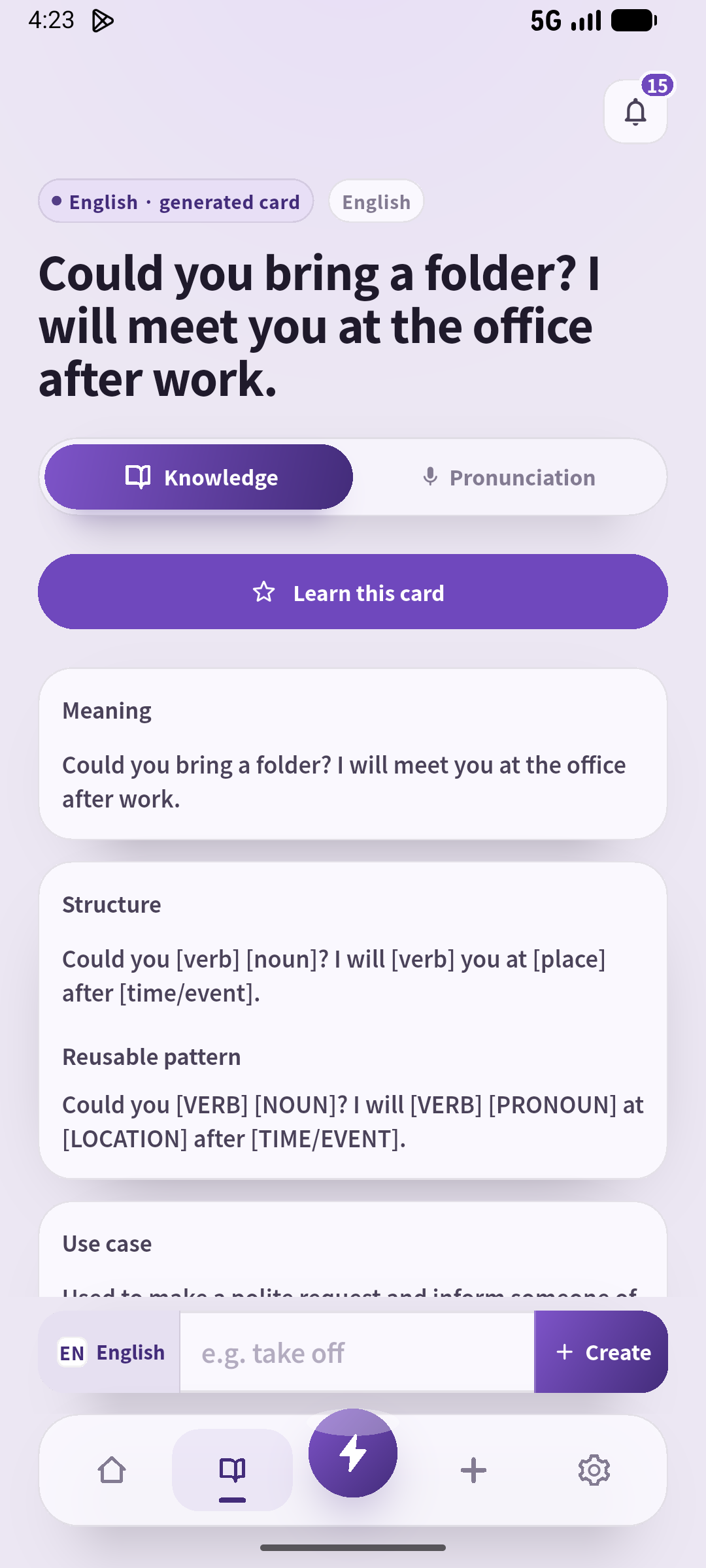
We develop SpeakGain. Saving a sentence and checking its explanation and model audio is one way to organise this stage; the product overview explains the features. A textbook with matching text and audio can support the same listening routine. The immediate goal is to explain the sentence yourself.
Some words are familiar but take too long to retrieve. In Goh’s study, learners reported both failure to recognise known words and loss of the next section while thinking about a meaning. That observational finding helps distinguish causes; it does not prove the effects of our short exercise.
3. Meaning processing falls behind the audio
If pausing helps, work with meaning groups: the request, the plan to meet, the place, then the time. Stop after a group and describe its meaning briefly. Combine two groups, then listen to both sentences continuously.
You may use a translation to check meaning. During the final listen, try to follow the situation instead of rebuilding a full translation word by word. If your chosen player supports slower playback, use it temporarily and return to the original speed. We do not claim that faster playback produces greater learning benefits.
On the first listen, keep following the message after a missed word. Save detailed writing for a separate pass. Otherwise the act of writing may obscure whether the next miss came from listening, memory or the writing task.
4. You hear words but miss the situation
The two sentences make a request and arrange a meeting. Recognising folder, office and work is not enough if you think the meeting is before work. Answer: what should the other person bring, where will they meet, and when? The answers are a folder, the office, after work.
| Check | What it tells you |
|---|---|
| Did you recognise “folder”? | Word recognition |
| Did you understand “after work”? | Sentence meaning |
| Can you explain the request and arrangement? | Situation and intention |
For unfamiliar news, read the headline and basic topic information before listening again. Use the context to focus attention, then test the sound without text. Predicting a likely answer is not the same as hearing it. Goh’s paper also reports understanding words without understanding the intended message.
5. The material changes too many conditions at once
Understanding this voice does not guarantee understanding announcements or overlapping conversation. Try another easy short recording before increasing length, vocabulary, noise and number of speakers together.
Our material-selection criteria are: accurate matching text, meaning you can explain after reading, a section you can replay, and a situation relevant to you. Check a sample before buying. If reading reveals unknown words everywhere, choose something easier for detailed listening.
Use our YouTube practice guide for short video sections and series-selection guide for choosing a show. The task here is choosing material that lets you repair a specific miss.
Use each method for a purpose
| Method | Useful role here |
|---|---|
| Dictation | Write the unclear section; leave blanks, then compare |
| Intensive listening | Match one difficulty with its text and explanation |
| Extensive listening | Follow the main ideas in easier, varied material |
| Reading aloud or repeating after a pause | Say a section whose sound and meaning you have checked |
| Shadowing | Follow ongoing audio once its sound and meaning are reasonably clear |
Our editorial view: do not start by shadowing a long passage you cannot understand. You will struggle to tell whether the obstacle is meaning, perception or speaking. See shadowing steps and reading aloud for those separate tasks.
Finish with a meaning check, not a pronunciation score
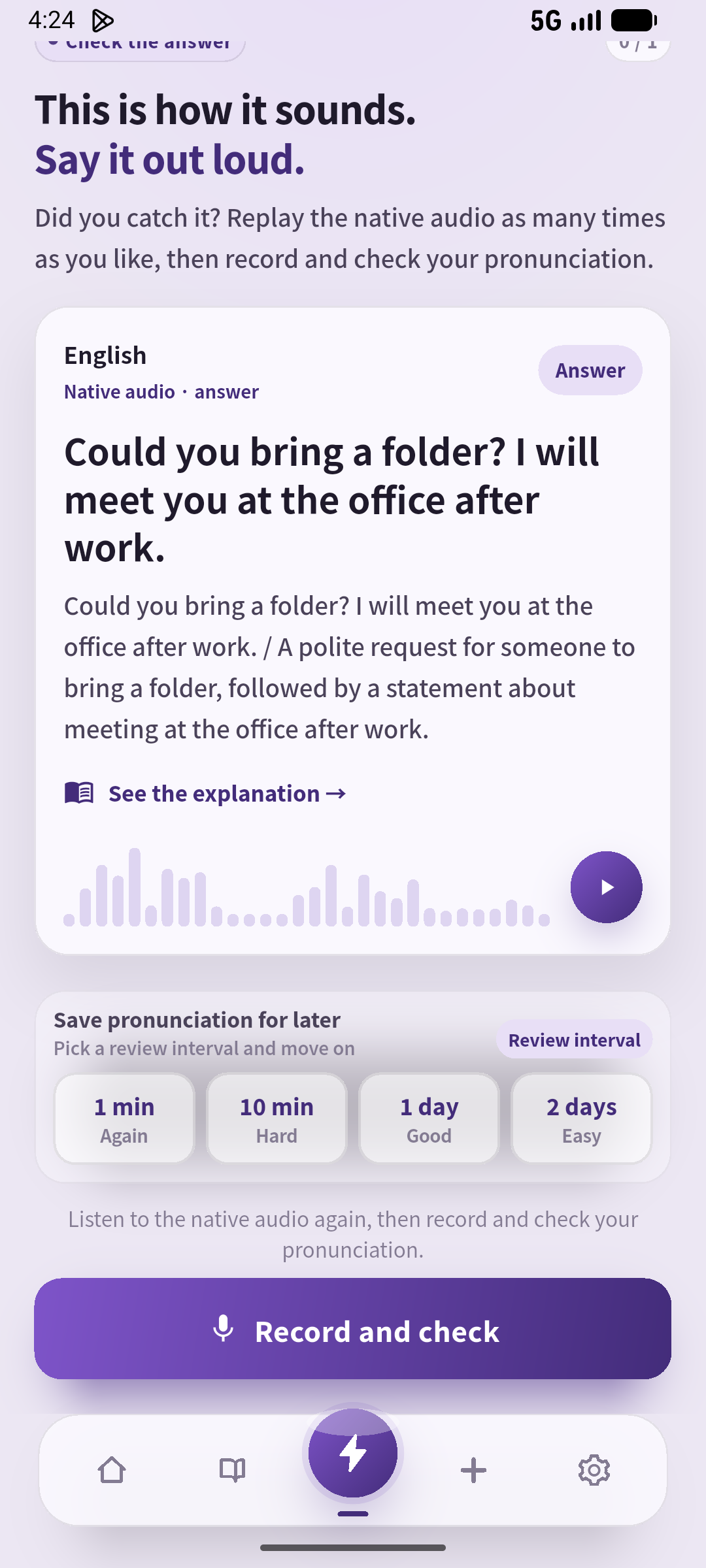
After saying the repaired section, stop speaking, close the text and listen. Answer the same three questions. Keep a one-line record: “First: place only. Repair: after work. Final: all three answers.” Tomorrow, try the familiar passage without text and a different short passage. Separate remembered answers from understanding new audio.
A ten-minute example is two minutes listening, three checking, three repairing and two checking without text. These timings are editorial planning suggestions, not a scientifically established dose.
What the research measured
Goh (2000) analysed diaries and other self-reports from 40 tertiary ESL learners, identifying ten listening problems across perception, parsing and utilisation. We read the author manuscript’s methods, results and discussion. It is an observational analysis, not a trial comparing this routine with other exercises.
Vandergrift and Tafaghodtari (2010) compared a semester of listening instruction among 106 French L2 learners. With the same texts and listening frequency, the process-guided group outperformed the comparison group on final comprehension after initial differences were controlled. We read the abstract only. The result does not directly measure English self-study, these two sentences, a ten-minute routine or SpeakGain.
| Source | What we read | Finding and limit |
|---|---|---|
| Goh (2000) | Full author manuscript | Reported difficulties; no test of our routine |
| Vandergrift et al. (2010) | Abstract only | Semester of French instruction; not English self-study |
| British Council | Guidance article | Connected-speech teaching; not an intervention trial |
Our practical interpretation is to decide what each replay checks. Background listening can remain part of your enjoyment; reserve a separate attentive session for locating and repairing mistakes. We do not promise a score gain or a fixed timescale.
To choose a practice tool, compare material types, free limits and the check after listening in our English listening app picks.
For unfamiliar speakers, try the transcript-to-new-speaker routine in English accents and intelligibility.
If you enjoy music, choosing and practising with a song gives you a short meaning-and-sound task before moving into conversation.
Common questions
Should I use subtitles? Use them to learn meaning. Close them for an unaided check, record your answer, then open them to compare.
How many times should I listen? Until the pass has served its purpose. If the same difficulty repeats, inspect the text, shorten the section or choose easier material instead of adding replays blindly.
Is background listening enough? It gives you time with English, but playback time alone does not show what you understood or corrected. Our recommendation is to keep the attentive repair cycle as a separate task.
Your goal today is to identify one missed section and know where to return. Apply that decision to the next recording too.
For a practical call, use English phone-call phrases and how to ask again to rehearse introductions, messages, spelling and number checks.
If you play English while commuting or doing housework, our passive-listening guide explains how to choose understandable material and add one sentence of checking each day.
For shows to use on your commute or during chores, our English-learning podcast guide compares levels, purposes and transcript access, then adds one spoken sentence.
To connect listening with speaking, use our English news sites and apps comparison to check level, matching text and audio before summarizing a short item.
To connect TOEIC L&R formats with Part-specific practice and a realistic weekly schedule, use our TOEIC study plan.