
How to study for TOEIC: Part-by-Part practice and plans for 600, 730 and 860
Published Updated
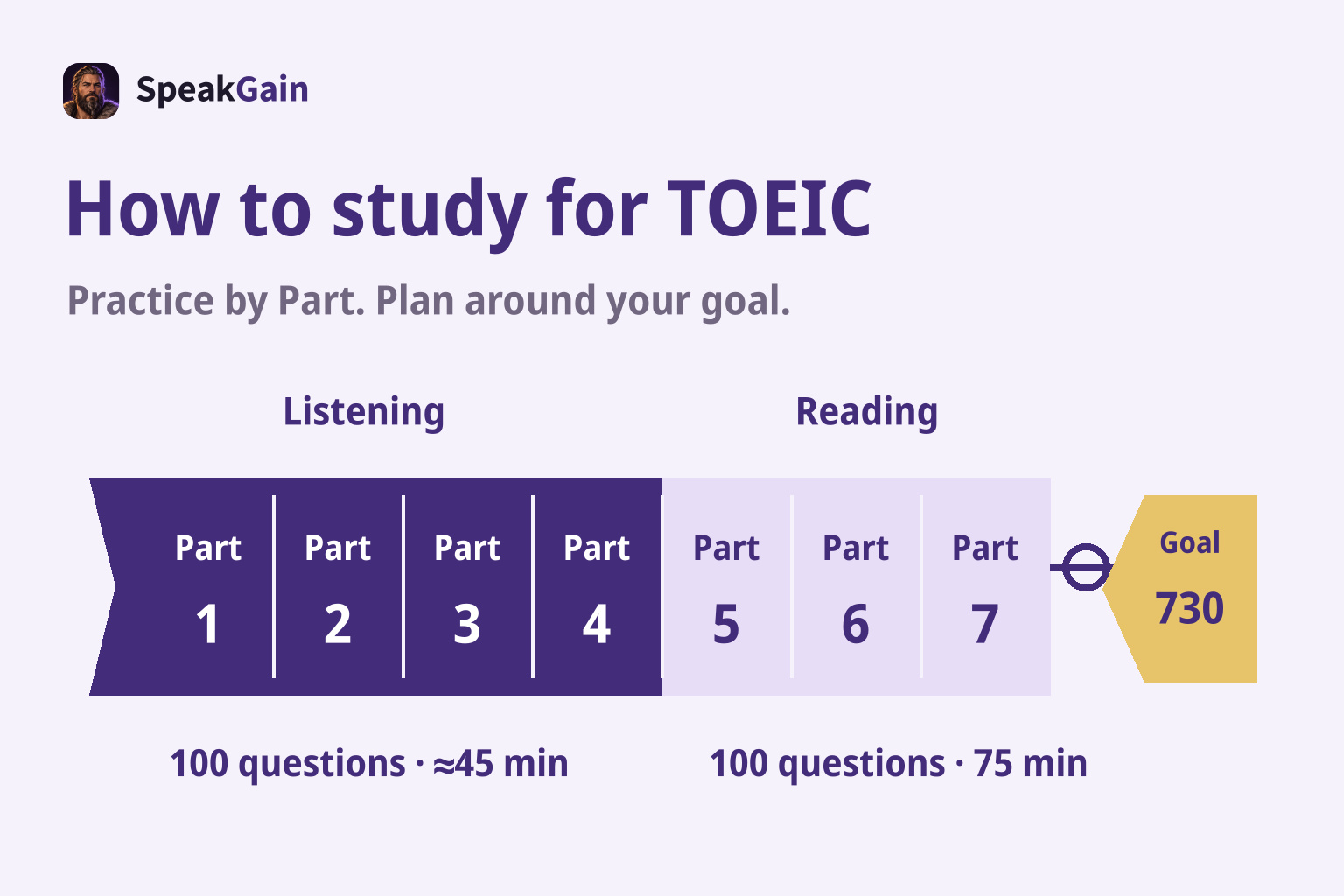
Start TOEIC L&R preparation by checking which test format and score your university or employer accepts, then try the official samples for Parts 1–7. Sort mistakes into vocabulary/grammar, sound recognition, context and time pressure, and combine focused review with unseen questions. Plan toward 600, 730 or 860 from your current level and available time; no fixed number of hours guarantees a score.
This guide uses Japan’s IIBC information, checked on 15 October 2026. Public-test and Institutional Program (IP) arrangements below are Japanese procedures, not worldwide rules. Outside Japan, confirm arrangements with your local official administrator and the organisation requesting your result. Practice methods, suggested periods and time allocations are editorial proposals.
For TOEIC Parts 1–4, use our listening practice guide to identify why a sentence was missed and choose the next drill.
Know the format before choosing practice
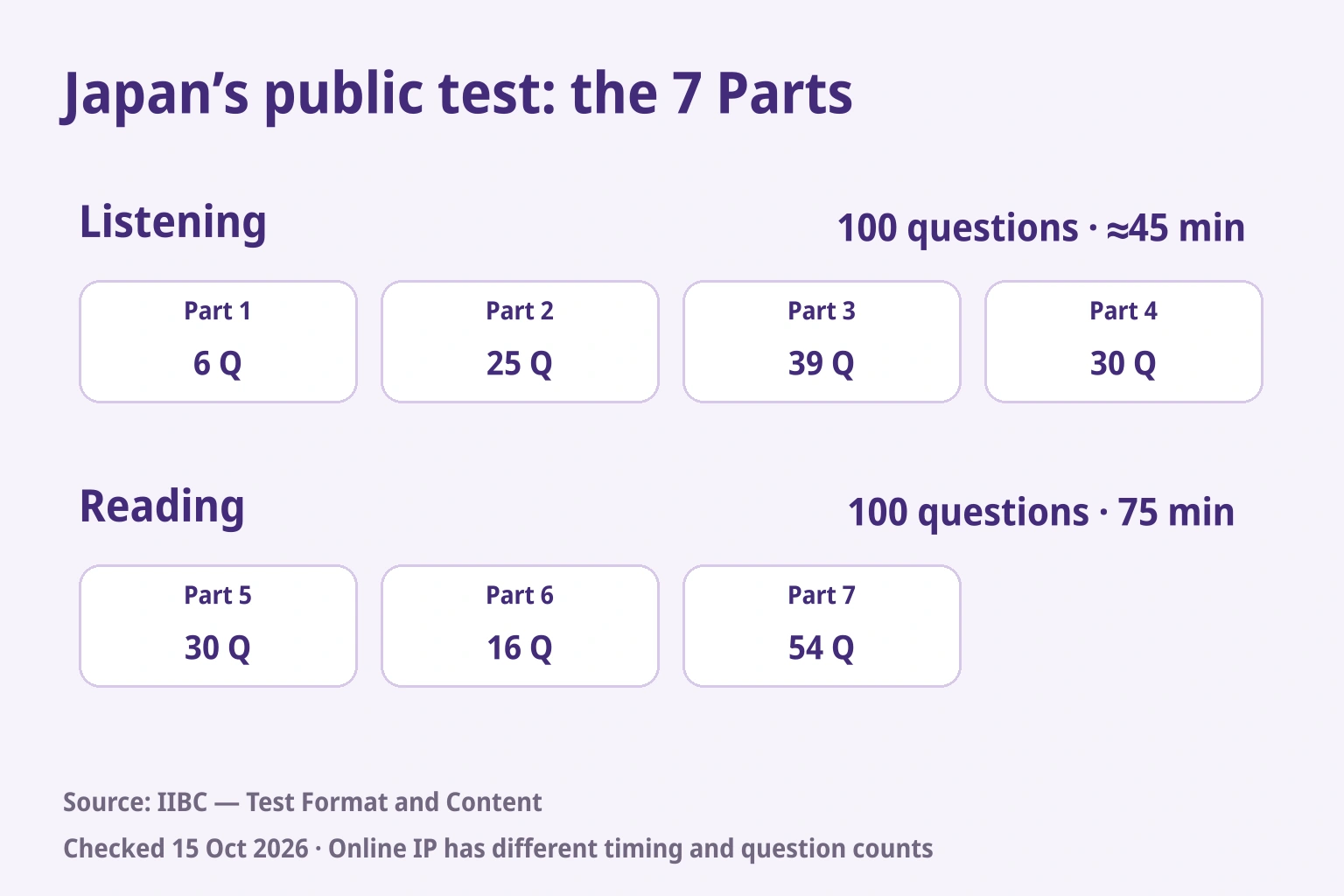
The paper-based public L&R test has Listening, approximately 45 minutes/100 questions, and Reading, 75 minutes/100 questions: about two hours and 200 questions overall. These figures do not describe online IP. IIBC format and official samples.
| Part | Task | Questions | Time | Source |
|---|---|---|---|---|
| 1 | Photographs | 6 | Listening section: ≈45 min total | IIBC |
| 2 | Question–response | 25 | Same section | IIBC |
| 3 | Conversations | 39 | Same section | IIBC |
| 4 | Talks | 30 | Same section | IIBC |
| 5 | Incomplete sentences | 30 | Reading section: 75 min total | IIBC |
| 6 | Text completion | 16 | Same section | IIBC |
| 7 | Single / multiple documents | 29 / 25, total 54 | Same section | IIBC |
Individual time limits for each Part are not stated on this official format page. A suggested Reading split is a practice choice, not an official rule.
Listening and Reading each report 5–495 points, with a 10–990 total in five-point increments, rather than pass/fail. Scores are statistically equated scaled scores, not “five points per correct answer.” Incorrect answers carry no deduction. Use the skill results, Score Descriptors and Abilities Measured to inform review. IIBC scoring and results.
Study plans for 600, 730 and 860: reserve time, then reassess
These are editorial examples of a first study cycle, not the hours required or predicted to achieve each score. Starting ability, your recent L/R results and the need to rebuild basic grammar change how many cycles you need.
| Goal | First cycle: editorial time budget | Main focus |
|---|---|---|
| 600 | 8 weeks × 5 h/week = 40 scheduled hours | Basic vocabulary and grammar, short Listening passages, sentence structure; try every Part |
| 730 | 12 weeks × 7 h/week = 84 scheduled hours | Follow conversations/talks, locate evidence in longer texts; adjust using unseen performance |
| 860 | 12 weeks × 9 h/week = 108 scheduled hours | Diagnose remaining errors, paraphrases and cross-document evidence; check consistency under time pressure |
Forty hours is not a claim that 600 is attainable in forty hours. These are reviewable blocks of time. At the checkpoint, examine unseen work and decide whether to change the content, extend the plan or begin another cycle.
An expert column hosted by IIBC mentions data suggesting about 300 hours of native-speaker-led conversation training for a 100-point L&R increase. The page says its methods reflect the author’s experience rather than ETS/IIBC recommendations. Sample size, baseline-score breakdown and detailed research methods are not stated on that page. We do not turn this into a universal self-study formula or a guarantee. The schedules above were not calculated from it. IIBC-hosted expert column.
For a seven-hour week, one editorial option is five weekdays of forty minutes plus two weekend sessions of 110 minutes: 420 minutes total. A weekday could contain fifteen minutes of listening, fifteen of reading and ten of vocabulary/grammar. A full test needs a separate uninterrupted block of about two hours; reduce other work that week to make room. University deadlines, shifts and commuting conditions matter more than an ideal daily streak.
Diagnose before adding materials
Use the official sample entrance to see each Part’s instructions and task. We do not reproduce the questions. A few samples reveal unfamiliar formats; they cannot establish a reliable full-test score prediction.
| What happens during review? | Editorial next step | Check afterwards |
|---|---|---|
| The printed sentence is unclear | Vocabulary, subject/verb and modifiers | Explain the sentence without the explanation open |
| Reading is clear, audio is not | Compare a short audio segment with its script | Hide the text and listen again |
| Content is clear, answer is wrong | Identify what was asked and the evidence | Explain why the other choices do not fit |
| Correct only without a timer | Review rereading and hesitation | Try a different unseen set with timing |
When several causes overlap, start with what you cannot understand even in print. For a broader routine, see how to study English.
Listening: a different review task for each Part
The official facts below come from IIBC’s Part descriptions; the stumbling points and methods are our editorial suggestions.
Part 1: match the whole description to the photograph
Official format: Four short descriptions are played once for a photograph; the descriptions are not printed. Common difficulty: recognising an object but missing the action or position. Practice: attempt the item first, then check subject, verb and location in the script. Explain how the description fits, read it aloud and listen again with the text hidden. Official materials: start with Part 1 samples, then use Part 1 audio and explanations in Official Workbook 12, introduced below. Repeating remembered answers is review, not an unseen assessment.
Part 2: identify what kind of response is needed
Official format: A question or statement and three responses are played once; they are not printed. Common difficulty: missing the beginning or choosing a response because it repeats a word. Practice: identify the purpose—request, information or a question about timing—then explain why the response works. Read the exchange aloud. If necessary, transcribe only the unclear fragment and compare it with the script. Official materials: the Part 2 samples and Workbook 12; the 500+ guide can support basic task understanding.
Parts 3 and 4: follow the message, then locate evidence
Official format: Part 3 uses conversations between two or three speakers; Part 4 uses talks such as announcements. Each conversation/talk has three questions, and some items combine audio with a graphic. Audio is played once. Common difficulty: getting stuck on one word, confusing speakers or failing to recognise a paraphrase. Practice: summarise the setting, purpose and next action, then locate the answer evidence in the script. Compare its wording with the choice. Repeat a short understood section aloud or shadow it, then listen to the whole passage again. Official materials: Part 3/4 samples and the official workbook’s audio and scripts.
Do not begin by chasing a long passage you do not understand: it becomes hard to identify whether meaning or speech production is causing the problem. See listening practice and how to shadow English.
Reading: explain the answer before increasing speed
Part 5: separate grammar from vocabulary
Official format: Choose one of four options to complete an incomplete sentence. Common difficulty: examining options without understanding the blank’s grammatical role. Editorial practice: classify the error as grammar, usage or vocabulary. Identify the required part of speech or explain the complete sentence’s meaning. Check why the other choices fail before timing another unseen set. Official materials: Part 5 samples, Workbook 12, or the grammar explanations/drills in 500+ when foundations are weak. Official format.
Part 6: read around the gap
Official format: Select a word, phrase or sentence from four choices; each passage has four questions. Common difficulty: using only the sentence containing the blank. Editorial practice: check the surrounding meaning, tense and pronoun references. For a sentence insertion, read through the resulting paragraph. Explain the connection rather than translating everything mechanically. Official materials: Part 6 samples and the corresponding workbook passages; check the method again on a different text. Official format.
Part 7: show evidence across documents
Official format: Answer questions about single or multiple documents; sentence-position items also occur. The paper-test split is 29 single-document questions and 25 multiple-document questions. Common difficulty: confusing people, missing an updated condition or searching only for matching words. Editorial practice: initially remove the timer and point to the evidence. For several documents, explain which facts you combined. Then time a new set and record where you reread. Official materials: the different Part 7 samples and both single/multiple-document sets in the workbook. Official format.
An editorial Reading experiment is ten minutes for Part 5, ten for Part 6 and fifty-five for Part 7. This is not an official per-Part limit or a universal optimum. Adjust after recording your own difficulties; do not cut off necessary vocabulary or grammar review simply because a practice timer expires.
Use official samples and books for different jobs
These two Japanese-edition titles are listed by their official publisher, IIBC; they are not ranked. Their contents were checked on 15 October 2026. We provide no retailer links or cover images.
| Resource | Officially described contents | Editorial use |
|---|---|---|
| Official format and samples | Directions and samples by Part | Learn the task without predicting your score from a handful of items |
| Official TOEIC L&R Workbook 12 | Two ETS-created tests, 400 questions, official speakers and a reference-score-range table | Use one test for diagnosis/review; keep the other unseen |
| Official TOEIC L&R 500+ | For first-time test takers/learners initially targeting 500; Part explanations, one full test and grammar/sound drills | Work through explanations when basic task handling is difficult |
Check the current official catalogue before choosing. If you own a workbook, first inspect unused material rather than accumulating titles. Follow its reference-score-range instructions; repeated attempts at memorised questions do not establish a new predicted score. See the official audio instructions. We do not recommend copying official questions or scripts into a study app.
App choices belong in our TOEIC study apps guide. Choose the practice responsibility before choosing another tool.
Our editorial plan for a 730 goal
We would use a twelve-week reassessment cycle, not predict a score at the end. Confirm the submission conditions, diagnose with unseen material and keep weekday work short enough to review properly.
| Editorial phase | Work | Decision before moving on |
|---|---|---|
| Weeks 1–2 | Format, unseen diagnostic work and cause classification | Can you explain the mistake and identify what to revisit? |
| Weeks 3–6 | Short Part-specific repairs | Does the reasoning work beyond a remembered answer? |
| Weeks 7–10 | Longer conversations and texts | Can you follow the message/evidence and explain time use? |
| Weeks 11–12 | The reserved unseen test | Consider reference range, L/R weaknesses and timing together |
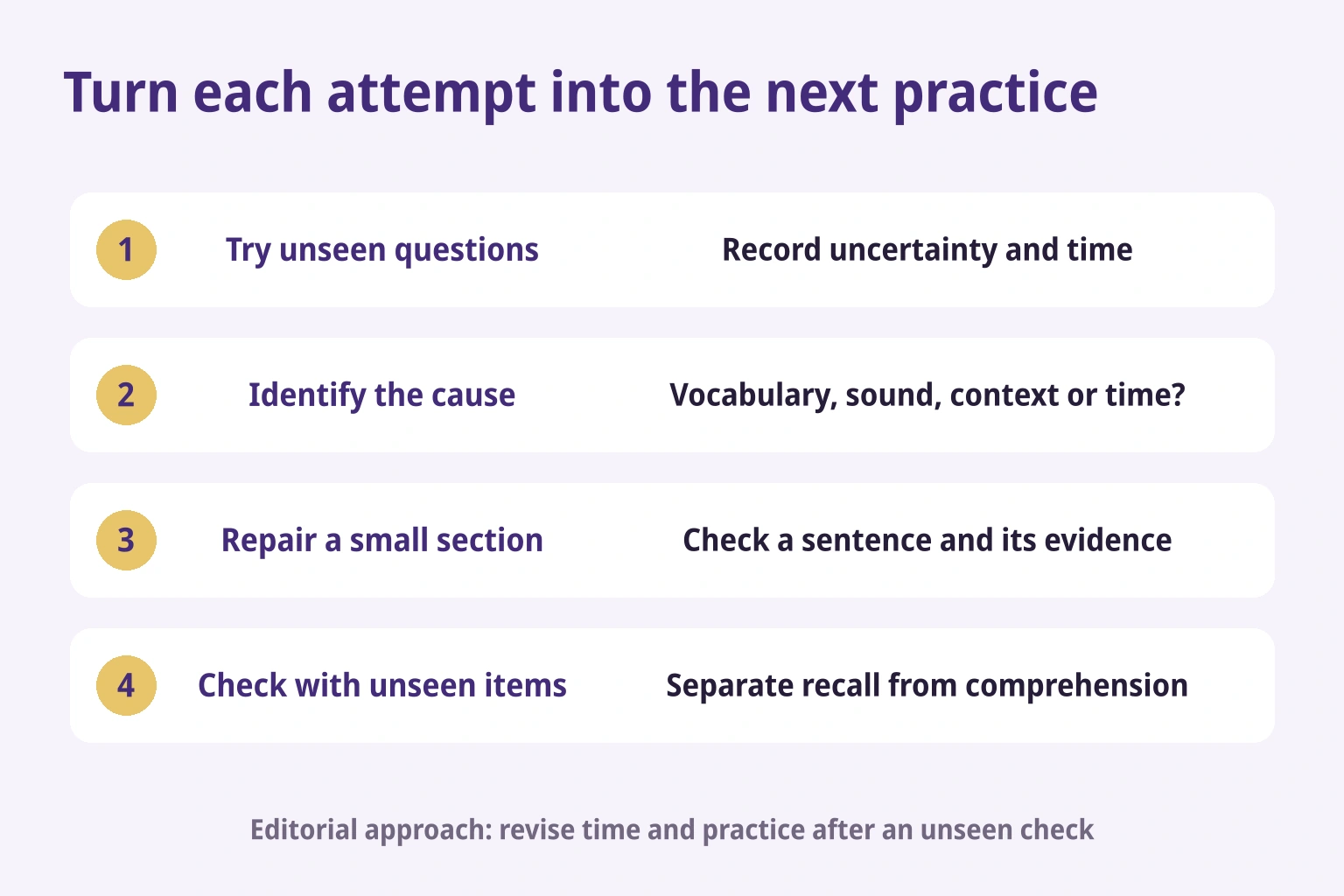
If written Listening scripts are clear but the audio is not, shift time to sound/script comparison. If vocabulary blocks Reading, reduce rushed long-text volume and repair vocabulary. Do not preserve the original allocation after the evidence changes. When work or classes interrupt the week, reduce exercise volume rather than letting review disappear.
We do not recommend only taking mock tests: answer checking alone leaves the cause untouched. We do not recommend memorising answer tricks: a repeated word or choice position does not explain the evidence. We do not judge readiness only from rehearsed items: knowing the answer after review and understanding a new question are different observations.
A short workplace sentence to practise
This is an original editorial example, not an official test question:
Would you check the room booking before lunch?
A polite request to check the room reservation before lunchtime.
After listening, identify the requested action and time. Compare an unclear fragment with the sentence, understand it, say it aloud, then listen with the text hidden. Focus on a small section such as “booking” or “before lunch” rather than fixing everything at once. Reading it quickly is not a TOEIC score measure.
Listen to the sentence with SpeakGain
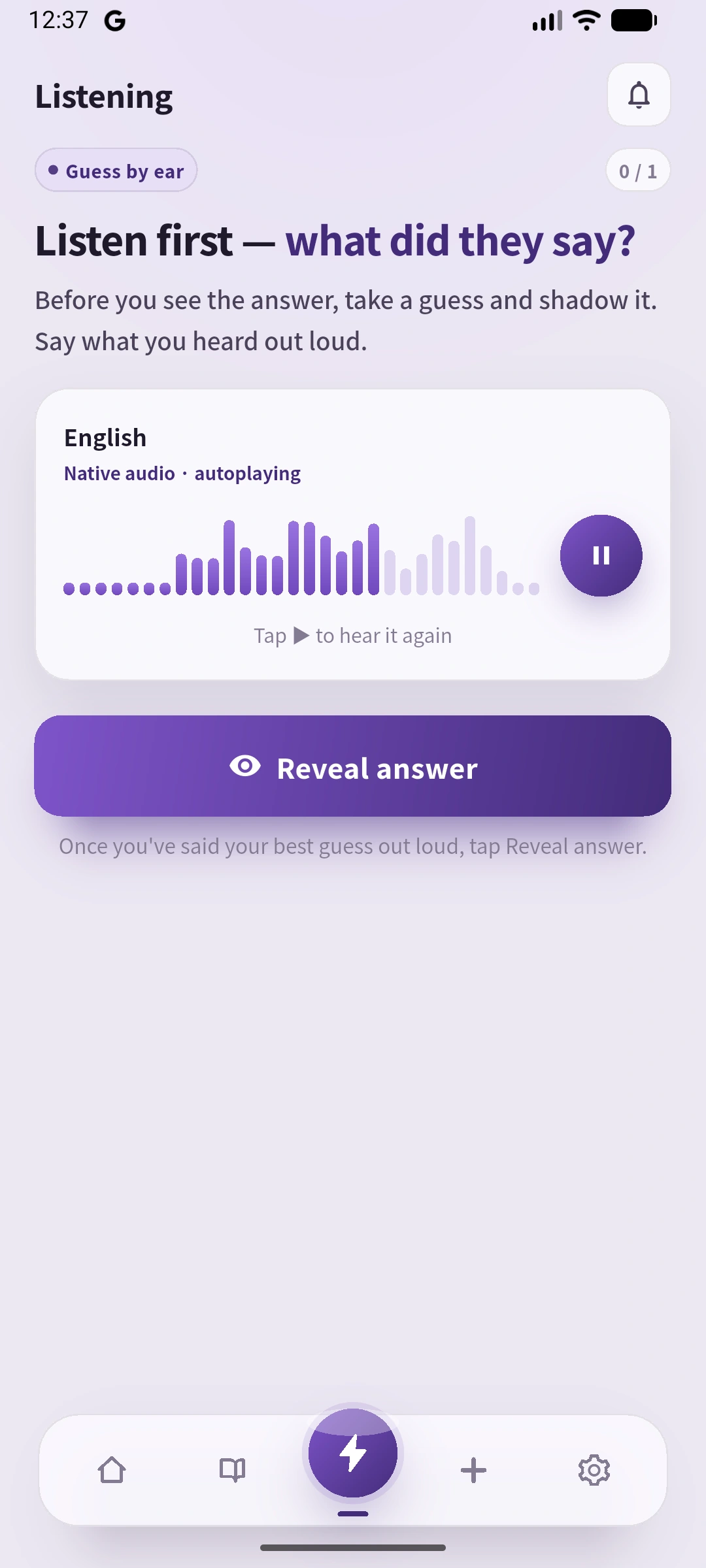
On the device, we saved the original sentence above as one card through the normal Add flow. Library → Knowledge → Learn this card opened Listening, which hid the English and played the model audio. The screen instructed us to guess and say what we heard before choosing Reveal answer. Answer displayed the exact sentence we had entered.
Use SpeakGain here for the short sentence’s listening and read-aloud practice, not as a TOEIC mock test, answer or pronunciation assessment, or score prediction. Continue Part-specific evidence checking with official material.
Workplace sentence: Viking model audio
AI-generated audio of the same original sentence shown above. Pause after listening and try saying it yourself.
Public test, paper IP and online IP in Japan
Japan’s IIBC distinguishes the public test from Institutional Program tests. Online IP is offered through organisations, not through individual registration. IIBC online IP.
| Japan arrangement | Format | Result delivery | Official source |
|---|---|---|---|
| Public test | Paper, ≈2 h / 200 questions | Online score and digital official certificate; paper usually requires an application-time request | Format, results |
| Paper IP | ≈2 h / 200; organisation sets date/venue | Score report; confirm distribution with the organisation | IP |
| Online IP | Computer, ≈1 h / 90; adaptive CAT | Score viewable immediately; PDF result, distinct from a public-test official certificate | Structure, CAT, PDF |
The public-test guide normally states online scores after 17 days, digital certificates after 19 days and requested paper certificates dispatched within 30 days. Holidays and the specific test-date schedule can affect this; check the actual issue dates. Group bulk public-test applications have a paper-certificate exception. Paper-IP dispatch is based on IIBC receiving materials, not simply the test day. Do not use the public 17-day rule for your university’s distribution date. IP result arrangements.
Do not infer online Part counts by halving the paper table. Individual Part time limits are not stated in the online overview consulted. Follow the organisation’s current operating instructions. Record the accepted test type, goal, test date, result deadline and required proof. If choosing between exams, use our English tests comparison.
Frequently asked questions
Should a beginner start with vocabulary or tests?
Start with official samples and classify the difficulty. Rebuild vocabulary/grammar when print is unclear; compare sound and script when only listening fails. You need not finish an entire vocabulary list before seeing the format.
How many hours do 600, 730 or 860 require?
The consulted official sources do not establish one required duration for all starting levels. The conditional 300-hour column is separate from our editorial 40/84/108-hour first-cycle budgets. Reassess with unseen work; do not treat either as a score promise.
Can I study independently?
We would try a self-study cycle when explanations help you identify mistakes and verify understanding on new questions. Ask a teacher about a specific sentence or sound if the cause remains unclear. Self-study itself guarantees neither a score nor a deadline.
Which official book should I use?
Workbook 12 offers full-format practice; 500+ offers basic guidance. Choose by the kind of help needed and check the official catalogue. Keep some material unseen.
Listening or Reading first?
Try both, then give more time to the observed weakness without abandoning the other. The same total score can conceal different skill profiles.
Is online IP easier because it is shorter?
Length alone does not show difficulty. IIBC describes an adaptive CAT system, and access is through an organisation. Check whether the recipient accepts that test arrangement.
Does L&R certify my speaking?
No: it measures listening and reading. IIBC’s L&R description. For speaking/writing preparation, see TOEIC S&W practice; saying a practice sentence is not a Speaking test result.
If you are considering another exam, the IELTS study plan compares planning across four skills. For another study-abroad option, see the TOEFL study plan.
For focused vocabulary work, compare TOEIC wordbooks and the steps from meaning to sound and context against your target and current gaps.
If Reading runs out before you finish, use our TOEIC time-management guide to check official timings, try an editorial 75-minute budget and log where time goes.
Our final editorial view
Confirm the accepted test and goal, diagnose using official material, then return to the cause of each error. Give short audio, grammar, context and timed reading different practice tasks. For a 730 goal, we would choose a sustainable weekly budget and thoroughly review a small number of official materials, checking new understanding on unseen questions before updating the plan.
Official information checked 15 October 2026. Procedures refer to Japan. TOEIC is a registered trademark of ETS. This article is not an ETS or IIBC official preparation resource.
Choose your next target with the official TOEIC levels and Japan’s averages, checking both L/R sections.