
What is a good TOEIC score? Official levels from 500 to 900
Published
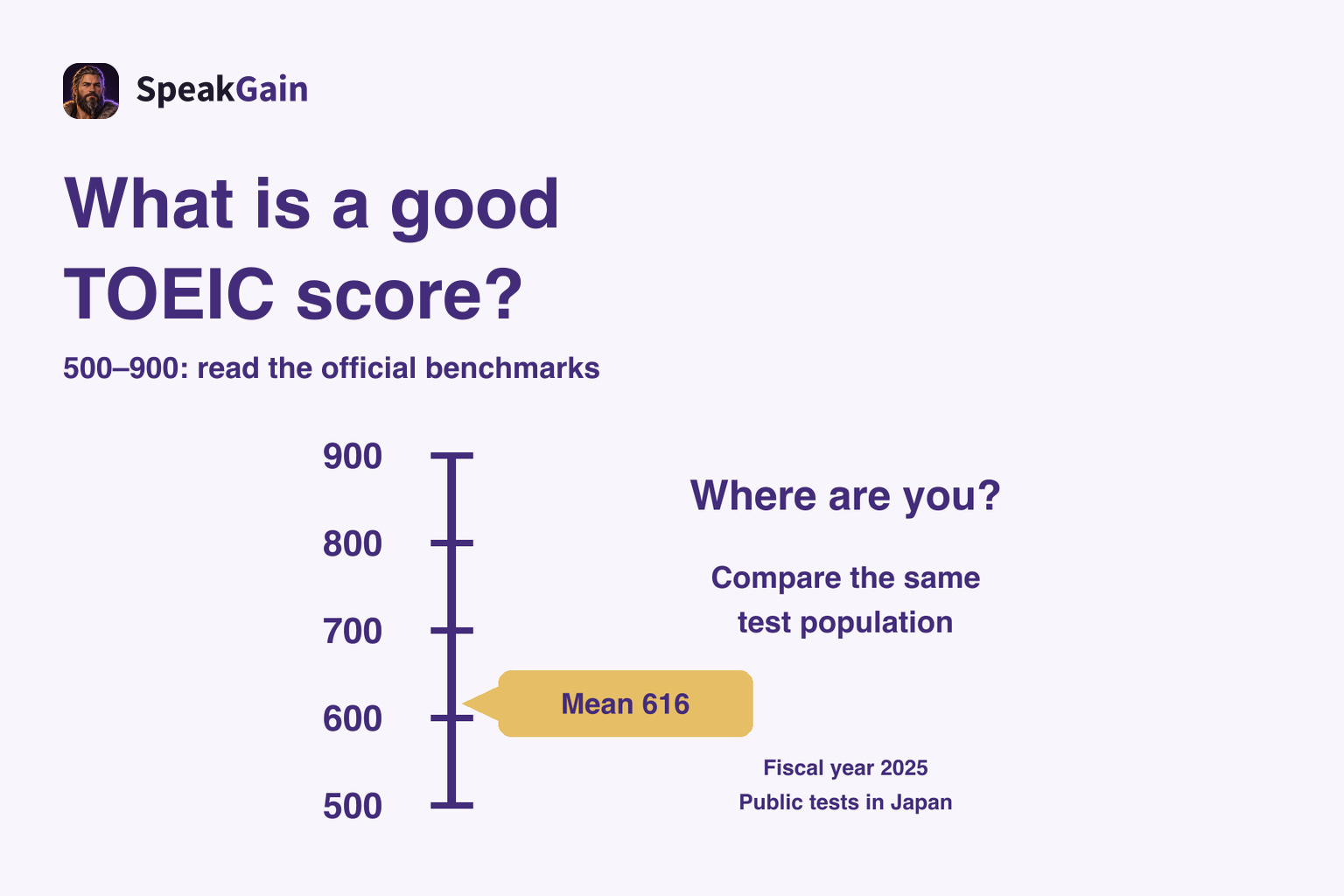
There is no official TOEIC L&R threshold for an “impressive” score; Japan’s fiscal 2025 averages were 616 for public tests and 492 for IP tests. As checked on October 16, 2026, the latest published session was the September 5, 2026 afternoon public test, with a mean of 611.5: use an official proficiency guide, the relevant distribution and your intended use together. In the official correlation guide, 500, 600 and 700 fall in C, 800 in B and 900 in A; CEFR requires separate Listening and Reading scores (IIBC data, annual report, proficiency scale).
This guide helps students and working adults interpret a result, rather than rank people. All averages below concern test takers in Japan, not a worldwide average or a local average for your country. For weekly schedules and Part-specific practice, use our TOEIC study plan.
If vocabulary is the obstacle, our TOEIC vocabulary-book guide explains material selection and practice that connects a word with a sentence and its sound.
Official levels at 500, 600, 700, 800 and 900
The familiar hundred-point targets are not the official category boundaries. IIBC’s correlation scale uses 470, 730 and 860; a separate official article offers more detailed illustrations. These are complementary guides, not guarantees for every individual.
| Band / focal score | Official indication, paraphrased | Official CEFR interpretation | Source |
|---|---|---|---|
| 500–595 / 500 | C; an illustration is understanding a newspaper topic already known in advance | No uniform mapping for total 500 is stated; check L/R | Scale, examples, CEFR |
| 600–695 / 600 | C; familiar news and details such as product features and prices | Total 600 alone does not establish one level; B1 minimum L275/R275 | Scale, examples, CEFR |
| 700–795 / 700 | 700 is C; B begins at 730. Illustrations include original-language fiction and a waiter’s recommendations | Check each section, not just the total | Scale, examples, CEFR |
| 800–895 / 800 | 800 is B; A begins at 860. Illustrations include unfamiliar films and articles on social events | 800 does not necessarily mean both sections are B2; minimum L400/R385 | Scale, examples, CEFR |
| 900–990 / 900 | A; a guide to understanding and expressing ideas beyond one’s own specialist field, within one’s experience | 900 does not establish C1; minimum L490/R455 | Scale, CEFR |
C broadly concerns everyday needs and communication within limited work contexts; B indicates a foundation for broader situations; A indicates sufficient communication as a non-native speaker. The scale itself says interpretation depends on the environment and the person or institution using the result. The finer score-band article has no separate 900–990 entry; the 900 row therefore uses category A. Likewise, “in the 700s” does not automatically mean B.
What is the average TOEIC score?
Specify the period, test type and population before comparing. These are IIBC figures for Japan, checked October 16, 2026. Fiscal 2025 means April 2025–March 2026.
| Session / period | Test type and population | Mean | Source |
|---|---|---|---|
| September 5, 2026, afternoon | Public test, that session | 611.5 | Session data |
| Fiscal 2025 | Public tests, all | 616 | Annual report, p4 |
| Fiscal 2025 | Public tests, working adults | 649 | p4 |
| Fiscal 2025 | Public tests, students | 592 | p4 |
| Fiscal 2025 | IP tests, all | 492 | p6 |
“Students” does not mean university students only. The IP figure is not an online-only mean. Neither is the mean of everyone in Japan. A score of 600 is below the public-test mean of 616 but above the IP mean of 492: this arithmetic does not establish which test is harder.
What can be confirmed officially?
| Question | Available official evidence | What it does not establish |
|---|---|---|
| What counts as impressive? | Proficiency guides, identified averages and distributions | A universal prestige cutoff: not stated |
| What can a score holder do? | Correlation guide, illustrative examples, section Can Do tables | Identical performance in every workplace |
| What CEFR level? | Minimum score for each L/R section | A four-skill rating from a total alone |
| What percentile is 900? | Published interval counts and shares | Relabelling 895+ as 900+ |
| Eiken, IELTS or a deviation score? | No direct official concordance found in the sources checked | A score-to-grade equality |
| What score for a job or university? | The receiving institution’s particular requirements must be checked | One common minimum for all institutions |
See the scale, CEFR table, data page and ETS score-use guidance. “Not stated” describes the checked sources, not a claim that every possible publication has been searched.
Find your position without inventing a percentile
A mean is a summary of a group, not the percentage scoring below you. IIBC explains Percentile Rank as the share below a specified score on its session-data page. Keep the period and population consistent.
| Fiscal 2025 public tests in Japan | People in the interval | Share of all |
|---|---|---|
| 795–840 | 53,003 | 7.0% |
| 845–890 | 37,288 | 4.9% |
| 895–990 | 32,348 | 4.3% |
Source: annual report, p4, total 755,473. These are interval shares, not cumulative upper-tail percentages. In particular, 4.3% includes 895 and cannot be described as the share scoring 900+. Exact cumulative shares at 500/600/700/800/900 are not stated in this grouped annual table. Do not interpolate them or assume a normal distribution.
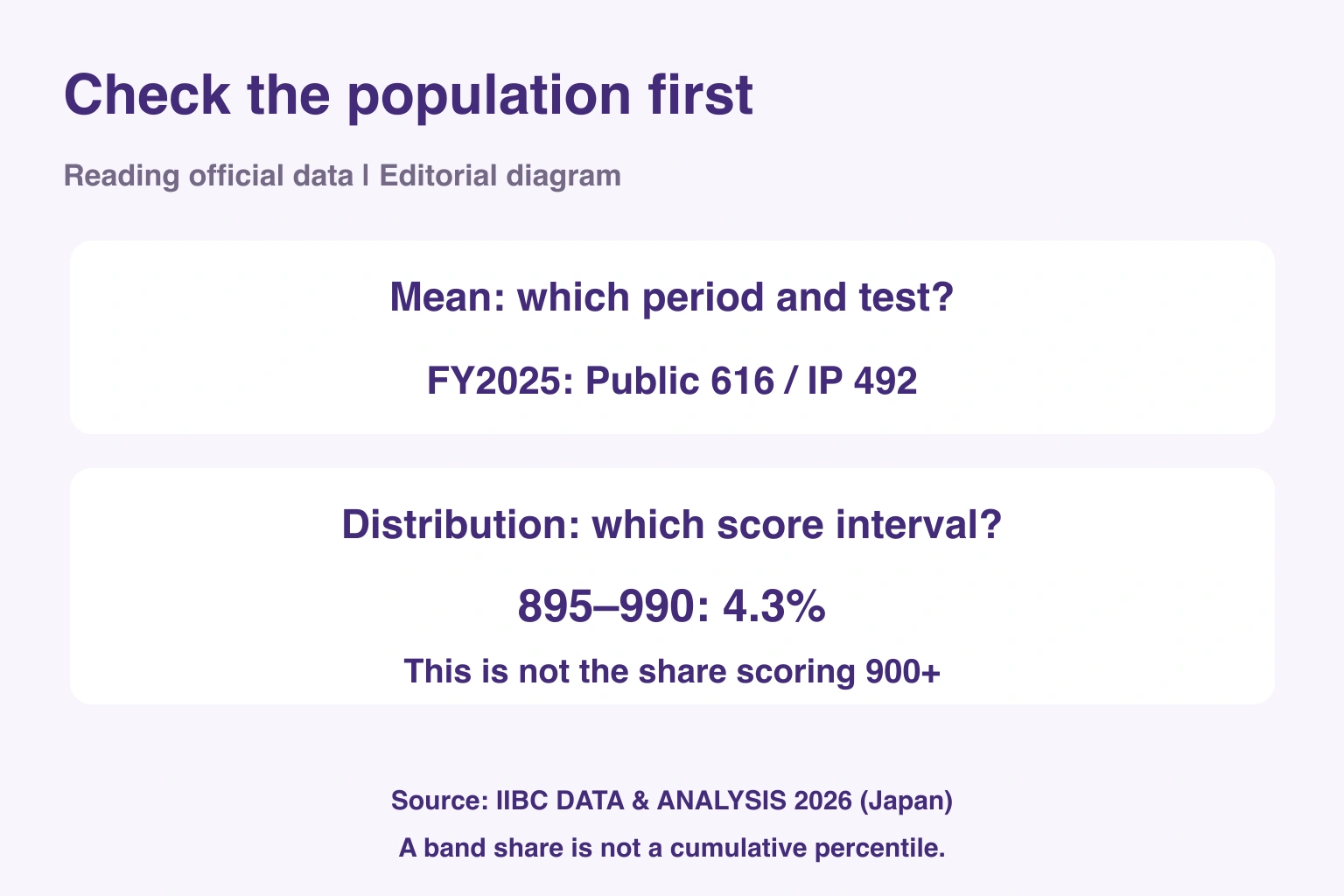
IIBC attributes differences in session means mainly to different test-taker groups (official explanation). Our editorial advice is to decide whether you are checking a submission requirement or planning practice before choosing a comparison. A different session’s mean should not, by itself, change your interpretation of the same attained score.
CEFR and Can Do: open the section breakdown
IIBC’s official CEFR table gives minimum section scores:
| CEFR | Listening minimum | Reading minimum |
|---|---|---|
| A1 | 60 | 60 |
| A2 | 110 | 115 |
| B1 | 275 | 275 |
| B2 | 400 | 385 |
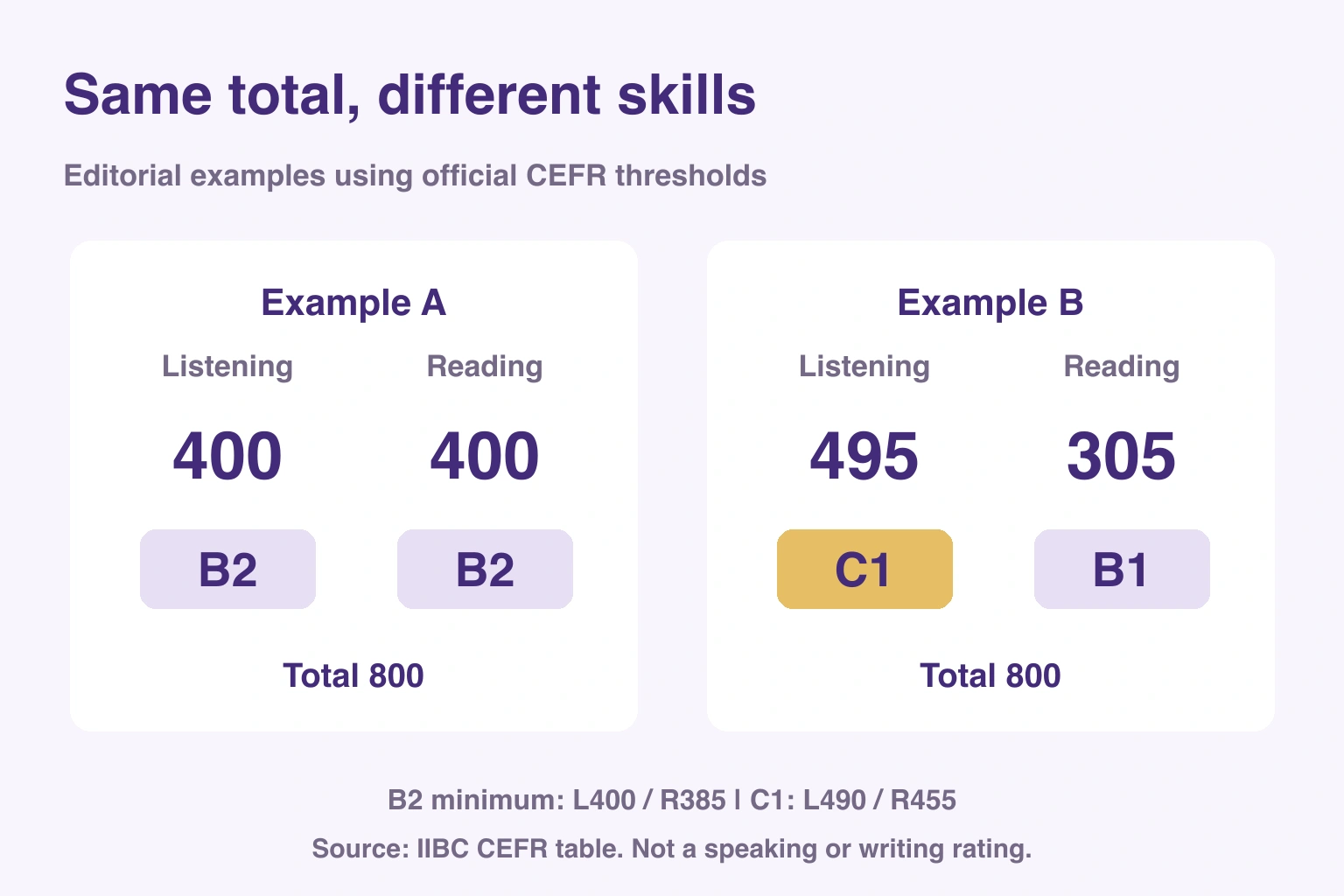
| C1 | 490 | 455 |
For an editorial calculation, L400/R400 totals 800 and clears both B2 thresholds. L495/R305 also totals 800, but meets the Listening C1 threshold and only the Reading B1 threshold. These are applications of the published cutoffs, not official individual case studies or speaking/writing assessments.
The Can Do guide also separates the sections. In its working-adult Listening table, understanding a meeting’s time and place is marked “can do” from 350–395; understanding colleagues discussing a workplace problem is marked that way at 450–495. These are Listening scores, not total scores. The guide is based on test-taker self-report, so use it as a reference for your own tasks, not a promise that every meeting will be understood. The section descriptors provide another way to examine strengths and weaknesses.
TOEIC 500: check understanding in a familiar situation
Official indication: 500 falls in C. The 500–595 illustration includes reading about a topic whose content is already known in advance (IIBC examples). It does not guarantee understanding unfamiliar specialist documents.
Original workplace sentence: “The client will call after lunch.”
Toward 600 — editorial suggestion: Identify who, what happens and when. If the written sentence is clear but “after lunch” disappears in audio, compare the sound with the text. If the written meaning is unclear, return to vocabulary and structure. Diagnose one actual difficulty rather than restarting everything because of the number 500.
TOEIC 600: connect the information and its reason
Official indication: Still C; the finer 600–695 examples concern familiar news and product information (IIBC examples).
Original shared example: “I prefer the morning meeting because our team can join.” The preference is a morning meeting; the reason is team availability.
Toward 700 — editorial suggestion: Do more than catch “morning” and “team.” Explain who prefers what and why, then check whether you hear the same relationship. Read aloud after clarifying the meaning. Memorising a long unfamiliar script is not our recommended goal.
TOEIC 700: remember the actual boundary is 730
Official indication: 700 is C; B starts at 730. The official 700–795 illustration spans that boundary (scale, examples).
Original workplace sentence: “Please check the revised schedule before you book the room.”
Toward 800 — editorial suggestion: Check the order of the two actions, especially “before.” Familiar words do not guarantee that the condition was understood. Choose 730 or 800 as a goal using your receiving institution’s rule and your L/R breakdown.
TOEIC 800: follow unfamiliar information precisely
Official indication: 800 is B and 860 begins A; the 800–895 illustrations refer to unfamiliar media and social topics (scale, examples). Category B and CEFR B2 are different frameworks.
Original workplace sentence: “We can approve the order once the supplier confirms delivery.”
Toward 900 — editorial suggestion: Even after a correct answer, explain the condition for approval and what remains unconfirmed. Check that understanding with a different first-seen sentence. Do not split study time equally between sections solely because the total is 800.
TOEIC 900: distinguish a high total from a work role
Official indication: 900 is A. This correlation guide is not certification for every specialist task, and the finer official article has no separate 900–990 entry (scale).
Original workplace sentence: “The proposal is workable, provided we keep the original deadline.” This distinguishes conditional agreement from unconditional approval.
Next step — editorial suggestion: If a higher L&R result is required, examine section-specific errors and unfamiliar material. If the real goal is explaining or negotiating, also try the actual speaking task. L&R measures listening and reading (IIBC); for a test of productive skills, see our TOEIC Speaking & Writing preparation.
Set the next goal from the requirement
Our recommendation is to open the current application or institutional rules first. Check the test name, acceptance of public versus IP results, required score, eligible test dates and submission method. For universities, match the faculty, admissions route and year; for employers, match the role, vacancy or internal scheme. Last year’s rule or another department’s experience is not your current requirement.
Without a submission rule, the next hundred-point band can be a provisional learning goal. Pair it with something observable this week: understanding a sentence’s reason or a notice’s condition. That is a practice proposal, not a score-gain or working-ability guarantee. Use the study plan, TOEIC app guide or English-test comparison for their separate purposes.
Turn one workplace sentence into listening and speaking practice
I prefer the morning meeting because our team can join.
Our proposed exercise is to listen without text, restate the preference and reason, then check the words you missed. Read the understood sentence aloud and listen again with the text hidden. This is an original editorial exercise, not a TOEIC question or scoring rubric.
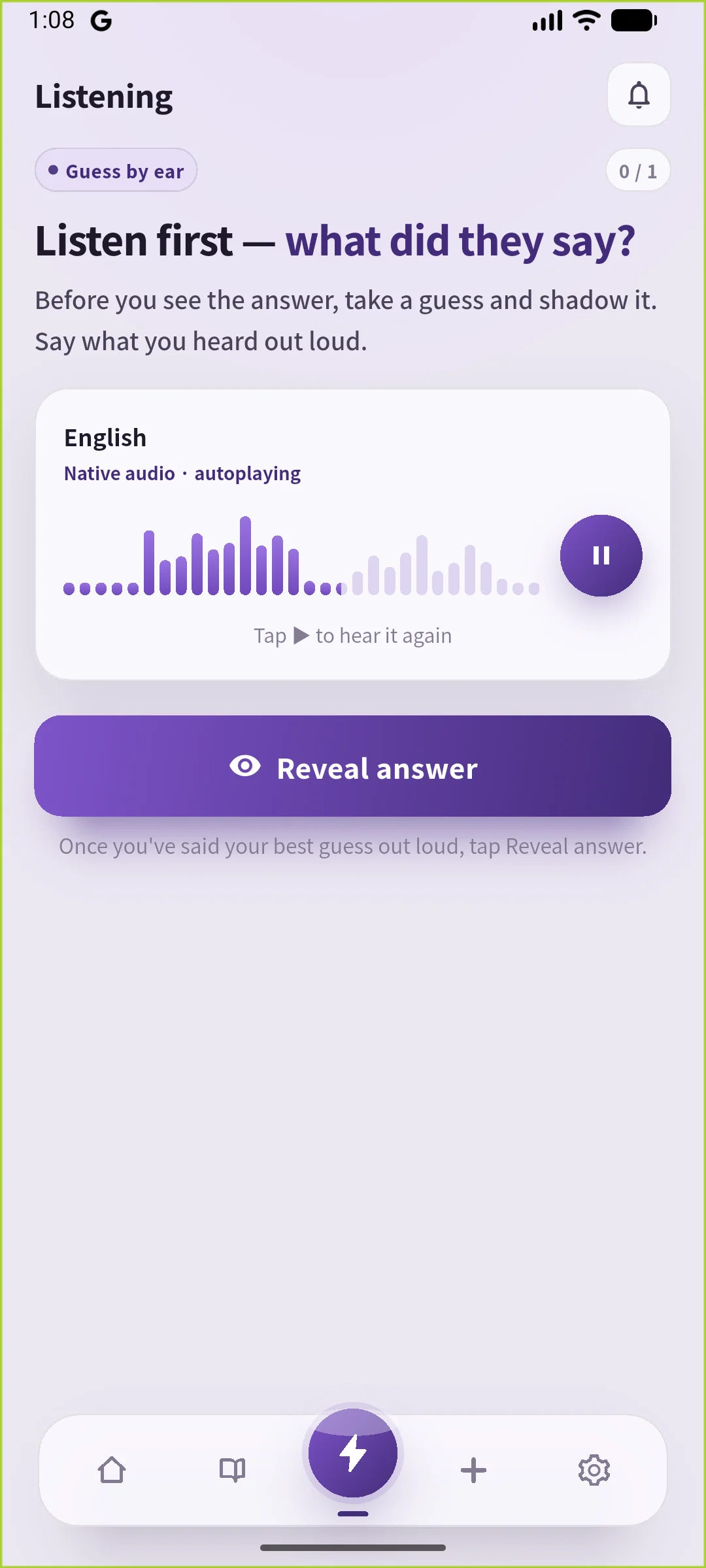
In SpeakGain, we added this sentence as one card through Add. We opened View for that card in Library, then selected Learn this card under Knowledge. Listening played the audio with the English text hidden. We verified the instruction to say what we heard aloud and the Reveal answer button showing the sentence. This provides a way to save a short sentence, listen first and then check the text.
Common misconceptions and FAQ
What is an impressive TOEIC score?
There is no official universal cutoff. Use the relevant average and distribution, then separately check your intended use (annual report).
What is the latest average?
At the October 16, 2026 check, the latest published session was September 5 afternoon, 611.5. Fiscal 2025 averages were public 616 and IP 492, all for Japan (session, annual).
Can I put 600 on my CV?
The checked official sources give no universal “below 600 cannot be listed” rule. We recommend following the vacancy’s instructions and accurately stating test name, score, date and format. The recipient decides how to evaluate it (scale).
How do 700 and 800 differ?
700 is C, 800 is B; the boundaries are 730 and 860. Specific abilities and CEFR require the section breakdown (scale, CEFR).
Does 900 mean C1?
No. The official C1 minimums are L490 and R455. A total of 900 alone does not meet those two thresholds (CEFR).
Is 900 the top 4.3%?
The annual figure is for 895–990, not exactly 900+. It is also specific to fiscal 2025 public tests in Japan (p4).
What Eiken grade, IELTS band or deviation score is equivalent?
No direct official TOEIC L&R concordance was found in the IIBC/ETS sources checked. We do not turn CEFR alignment into an equality between tests or calculate a deviation score from an assumed normal distribution (official resources, ETS).
What score is needed for hiring or promotion?
No common minimum for all employers or roles is stated. Check the particular current requirement; meeting a score condition is not a promise of selection (scale).
Editorial verdict
Read three things together: the official guide, the comparison population and your purpose. Check the period and format, open the section scores, then choose one submission check or one practice task. We would spend some of the time searching for score prestige on understanding a missed workplace sentence instead. Keep the larger goal alongside a small task you can actually check today.
Official references
- Score-to-proficiency correlation guide
- Official score-band illustrations
- Session averages and distributions
- DATA & ANALYSIS 2026
- Section-level CEFR table
- L&R Can Do guide
- Section descriptors
Checked October 16, 2026. Averages and distributions are IIBC figures for Japan, not local statistics for other countries. English sentences and practice suggestions are original editorial work. TOEIC is a registered trademark of ETS. This is not an official ETS/IIBC publication.