
TOEIC vocabulary books: choose for 600, 730 or 860 and learn words in context
Published
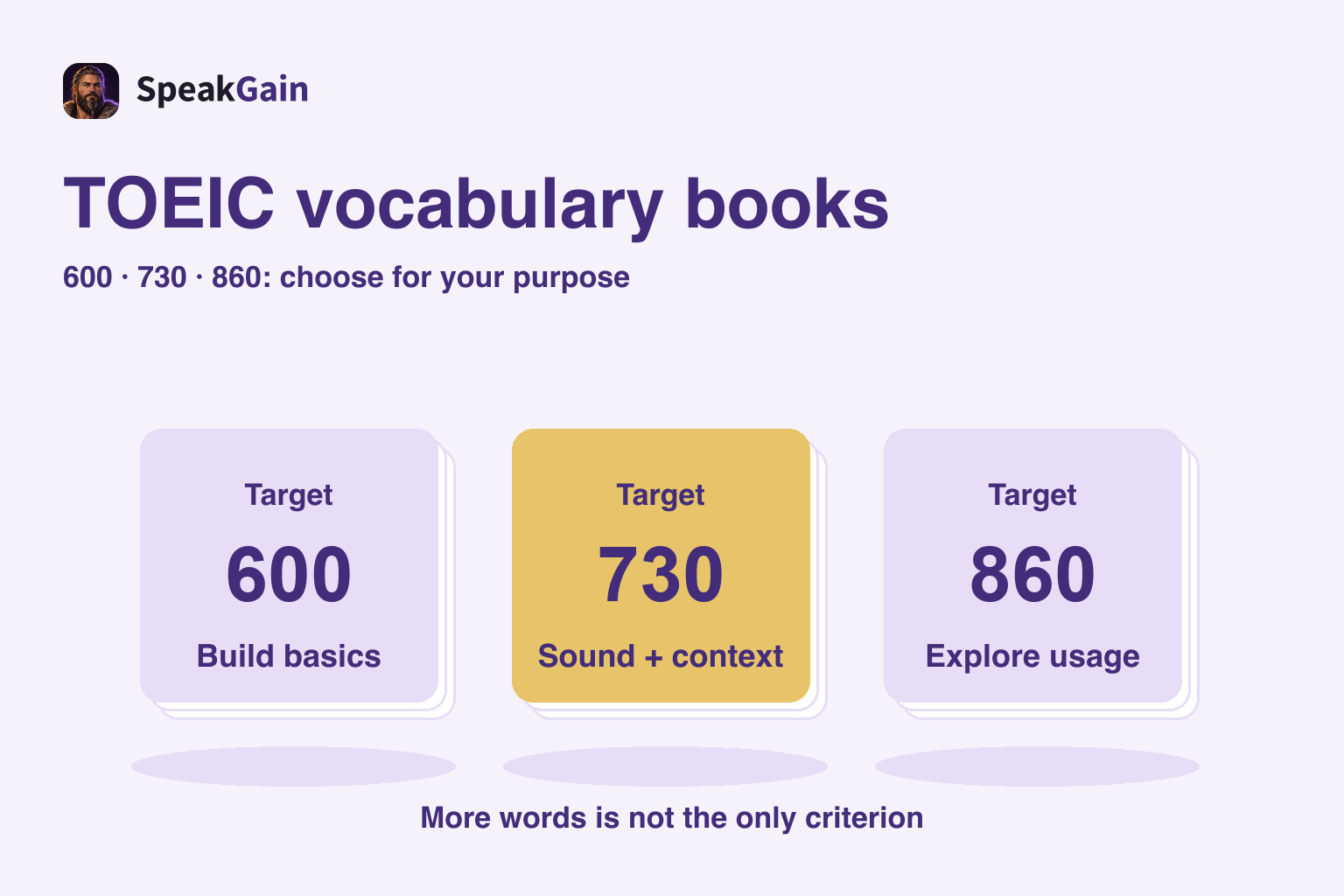
Choose one TOEIC vocabulary book or app around your current gaps and your ability to revisit examples and audio, using your target score as a starting point. Our suggested sequence is meaning → example → sound → your own workplace sentence → spaced recall, followed by checking understanding in unseen Part tasks. A book’s entry count is not the number of words required for 600, 730 or 860: no universal requirement for those scores is stated in the official pages inspected.
Vocabulary books and apps: choose by purpose
These are mainly Japanese-language materials for learners in Japan. IIBC is Japan’s TOEIC operator; readers elsewhere should check their local official test organisation for local test information. This comparison summarises publisher/provider pages checked on 16 October 2026, not hands-on reviews. “Suits” is our editorial opinion, and the order is not a ranking.
| Name | Publisher/provider | Entries, officially stated | Official target score | Audio | Official features | Suits, in our view | Checked |
|---|---|---|---|---|---|---|---|
| Gin no Phrase | Asahi Shimbun Publications | 1,000 words | 600 | Free word/phrase audio | Basic vocabulary through phrases | Learners rebuilding basics toward 600 | 2026-10-16 |
| Kin no Phrase, expanded revised edition | Asahi Shimbun Publications | Not stated on the product page inspected | Not stated on that page | Free word/phrase audio; smartphone app support | January 2026 edition; English-only and headword-only downloads linked | Learners repeating phrases with sound | 2026-10-16 |
| TOEIC L&R Official Vocabulary Book | IIBC; produced by ETS | 1,000 headwords + 155 other items = 1,155 | Not officially stated | US/UK headwords, Japanese meanings, English examples | Grouped by part of speech; full sentences from past tests | Learners checking usage in official contexts | 2026-10-16 |
| Official TOEIC L&R English Vocabulary | IIBC; authored by ETS | 1,800 words/phrases | Not officially stated | Headwords, meanings and examples; US/UK headwords | Basic/advanced words and collocations; book and app editions | Learners wanting the same vocabulary in book and app form | 2026-10-16 |
| mikan | mikan Inc. | Overall catalogue advertises 63,000+; no TOEIC-only total stated | No app-wide target stated | Audio-based study; check material/plan | Multiple choice, card flipping, TOEIC materials | Short practice sessions during a commute | 2026-10-16 |
| abceed | Globee Inc. | No TOEIC-only total stated | No app-wide target stated | Free material audio, speed control and section repeat | Pro includes MY vocabulary notebook; audio and digital exercises have different conditions | Repeating audio for a supported material | 2026-10-16 |
The 2026 Kin no Phrase edition is not described using the 2017 edition’s counts or score bands. Its author’s 990 score is not the book’s official target. App-wide word totals do not describe TOEIC coverage or guarantee a score. Check the exact edition, material and plan rather than treating free audio as access to every exercise.
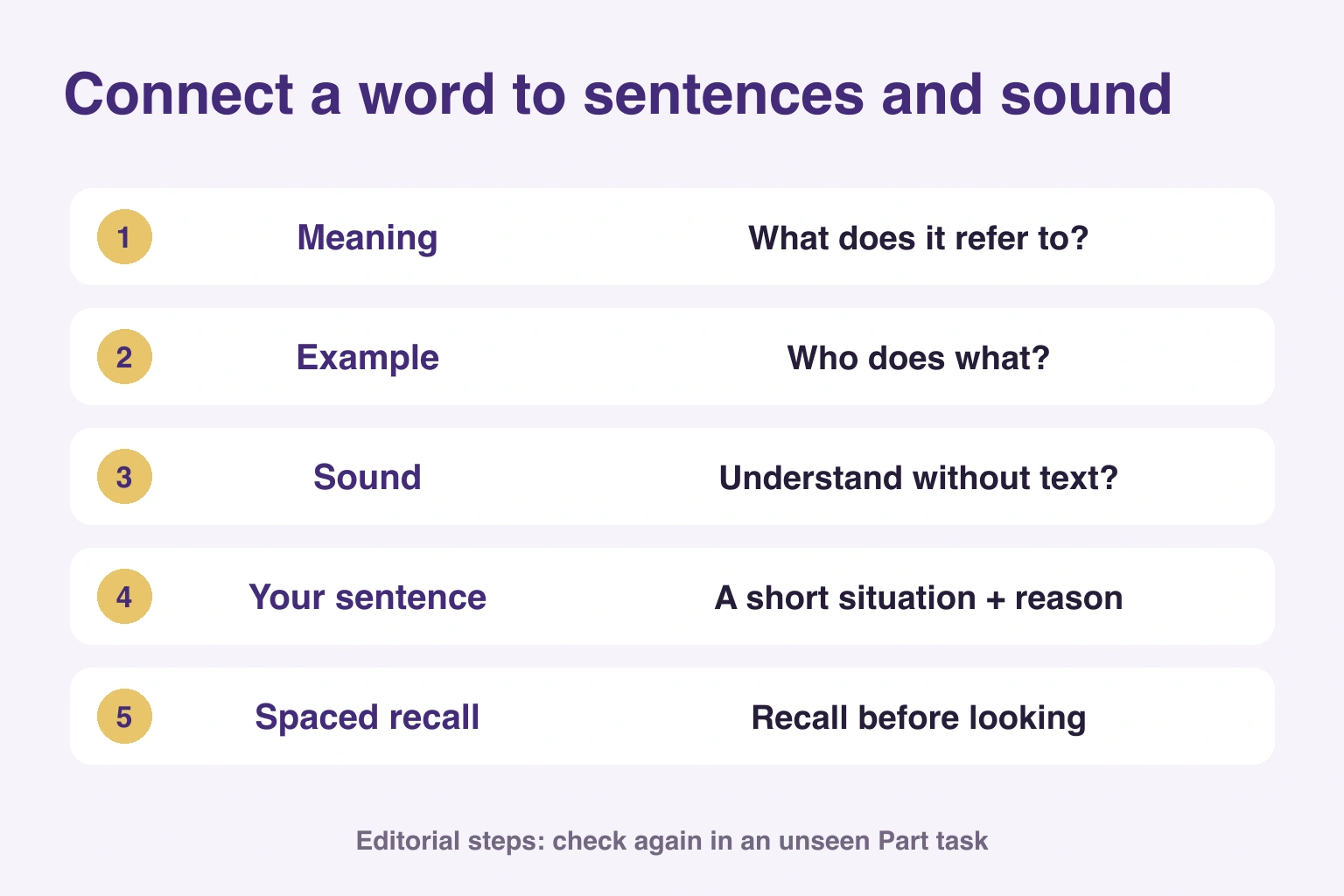
Five stages for each word
| Stage | What to do — our suggestion | How to check |
|---|---|---|
| Meaning | Identify its meaning and part of speech in this sentence | Hide the translation and explain what it refers to |
| Example | Read who does what and which words go together | Explain the sentence, not just the isolated word |
| Sound | Listen, match with text, then read aloud | Hide the text and understand the main point |
| Your sentence | Write a short workplace, class or part-time-job sentence | Check that the action, situation and reason make sense |
| Spaced recall | Start with tomorrow, a few days later and next week | Recall before looking; adjust the interval to difficulty |
Those intervals are an adjustable editorial example, not a universally optimal schedule. General memory methods and research belong in how to memorise English words. Here we focus on selecting TOEIC materials and returning to listening and reading contexts.
Targets of 600, 730 and 860: what should change?
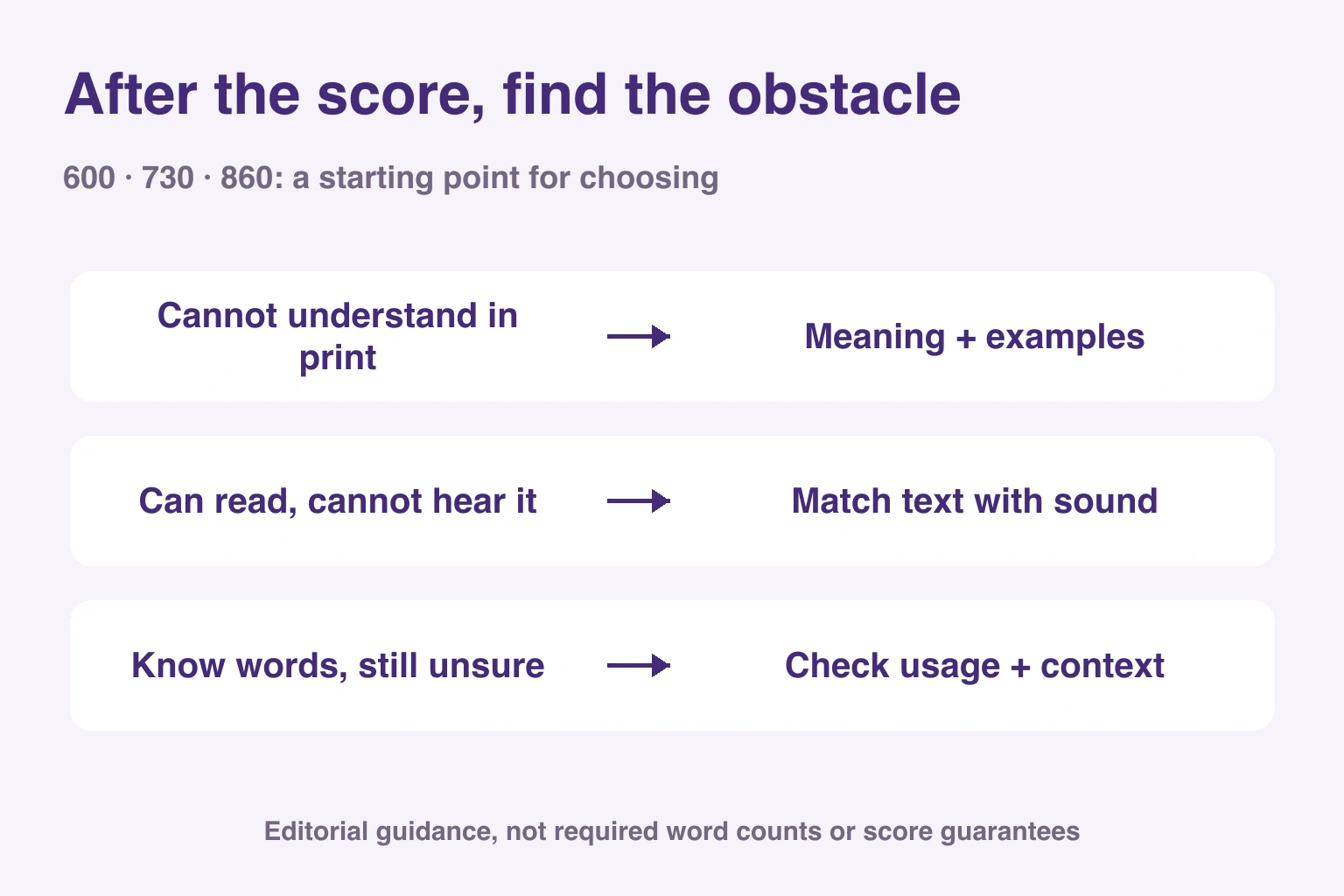
A score helps frame your choice, but two people aiming for 730 may have different problems. Try the official sample tasks and separate unknown meanings from words you recognise only in print.
| Target | Our selection advice | Check in your current material | Required vocabulary count |
|---|---|---|---|
| 600 | Prioritise basic meanings and short phrases; Gin no Phrase officially mentions 600 | Can you understand basic examples without the translation? | Not officially stated in the pages inspected |
| 730 | Choose a material you can revisit for audio, examples and recall | Separate sound recognition from unfamiliar paraphrases | Not officially stated in the pages inspected |
| 860+ | Review multiple meanings, word combinations and context before adding rarer words | Can you identify the evidence in an unseen conversation or text? | Not officially stated in the pages inspected |
We would not automatically buy a new book for each score target. First check whether familiar basic words still cause trouble in sentences. Students may need to understand workplace settings unfamiliar from class; working adults should distinguish having seen a term at work from understanding it in audio. Neither specialist work vocabulary alone nor a memorised word order covers every task.
Do you need IIBC’s Official Vocabulary Book?
It is an option for studying full official example sentences, rather than a compulsory purchase for everyone. The older Official Vocabulary Book groups 1,000 headwords by part of speech and adds 155 other items. The separate 2026 English Vocabulary title contains 1,800 words/phrases across basic words, advanced words and collocations.
Our choice would depend on whether we wanted part-of-speech organisation or frequency-based study with an app edition covering the same items. More entries alone do not decide suitability. If your current book already supports examples and audio, spend time checking vocabulary in official tasks before starting a second main book.
The older book’s audio guidance specifies free abceed registration for downloading and its app on smartphones. Audio being included does not necessarily mean every download works without registration. The newer book’s “20 items a day for 90 days” describes its structure; it is not a promise of 730 in three months or permanent recall.
Paper or an app?
Pick one main resource that lets you return to examples. For paper, consider how you will mark difficult uses and find their audio. For an app, check whether you can hide answers, recall without choices and use sound. These are selection criteria, not claims that we operated other companies’ products.
Official pages describe multiple-choice/card-flip modes in mikan and audio repeat plus Pro’s MY vocabulary notebook in abceed. Selecting a correct choice and understanding a sentence without choices should be checked separately. A paper purchase does not imply all related app features are free. Broader functions and costs belong in our TOEIC app comparison; other vocabulary-learning purposes belong in our vocabulary app guide.
Make one word usable in a sentence
We wrote this short workplace opinion and reason for this article. It is not an official question or a sentence copied from a publisher.
I recommend this supplier because delivery is reliable.
- Meaning: identify supplier as the business providing goods here. Explain whom the speaker recommends, rather than memorising several translations at once.
- Example: read the reason as well. What aspect of delivery makes the recommendation reasonable? Understanding only supplier is not understanding the whole sentence.
- Sound: listen, consider the meaning, reveal the text and match the unclear section. Read it aloud, then listen again with the text hidden. Check the recommendation and its reason, rather than speed alone.
- Your sentence: imagine selecting a supplier for a class project or workplace. Use a short situation and one reason you understand. Do not enter real clients, prices or confidential information. This example is fictional.
- Spaced recall: tomorrow, try to recall who is recommended and why before reading. If you cannot, check and shorten the next interval. Revisit after a few days and next week, adjusting new vocabulary so reviews do not pile up.
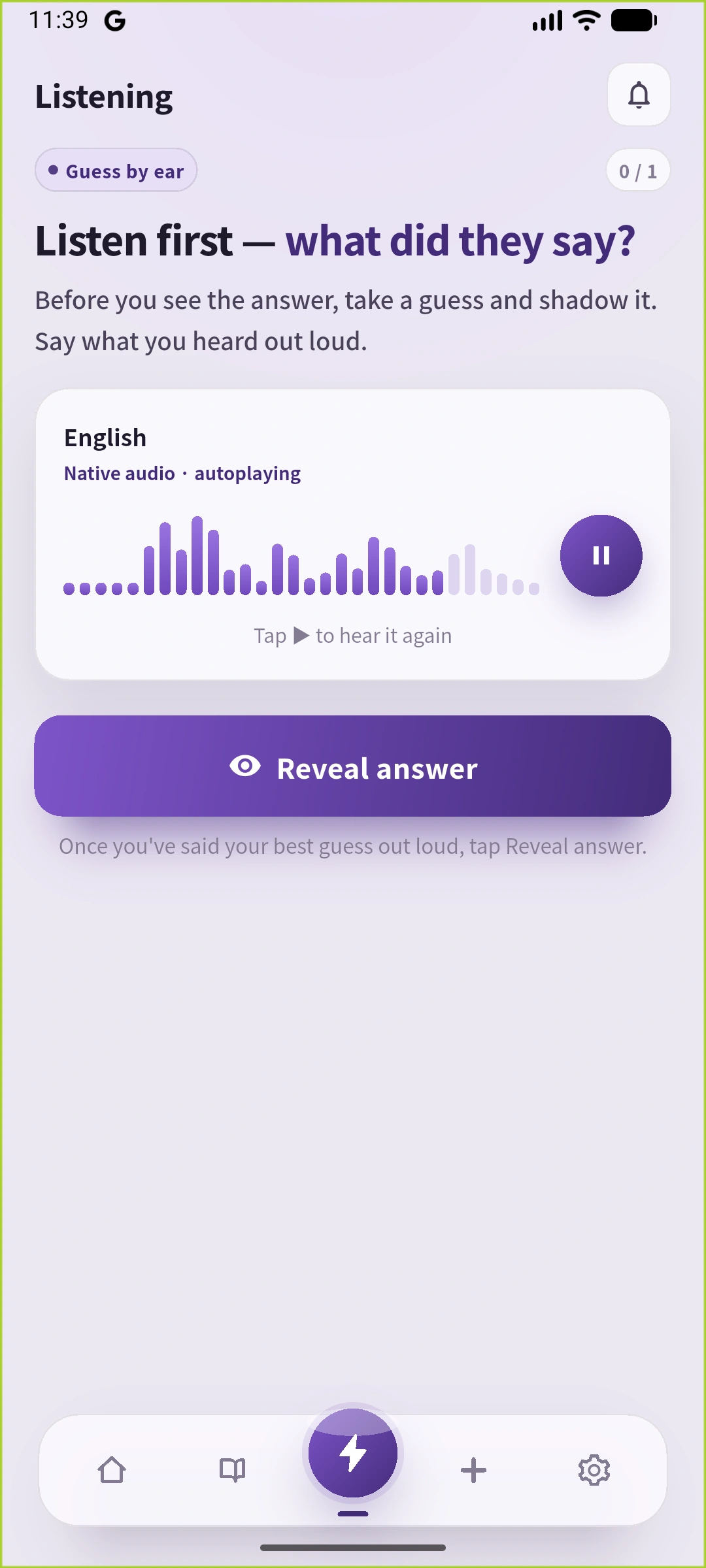
Listen to your own sentence in SpeakGain
On the device, we saved the original supplier sentence as one card through the normal Add flow. From Library → View we opened Knowledge, then Learn this card led to Listening. Listening hid the sentence and showed audio playback with instructions to guess what we heard and say it aloud. Reveal answer displayed the exact saved sentence on Answer.
Here we use SpeakGain to save, listen to and read aloud a short sentence. Our editorial suggestion is to check a word in sound and context, then recall the same sentence after a gap. Continue checking the evidence for Part answers with official materials.
Workplace sentence: Viking reference audio
AI-generated audio of the original sentence used in this article. Pause, explain who is recommended and why, then try saying it yourself.
Return to each Part
Formats below summarise IIBC’s official guidance for the paper-based L&R test. The practice suggestions are ours; full timing and mock-test planning stay in the TOEIC study plan.
| Part | Where vocabulary appears | Our suggested practice |
|---|---|---|
| 1: photographs | Short spoken descriptions | Match actions/states to the picture; do not select on one noun alone |
| 2: responses | A question or statement and replies | Identify the purpose of the utterance and whether the reply fits |
| 3: conversations | Speakers, questions and options | Return unclear words to the conversation; identify whose request it is and how an option paraphrases it |
| 4: talks | Announcements and short talks | Summarise purpose and next action; match only the unclear audio section |
| 5: incomplete sentences | A gap and options | Separate part of speech, word combinations and sentence meaning as reasons for choosing |
| 6: text completion | A gap with surrounding sentences | Use the connection before and after the gap, not just one sentence |
| 7: reading | One or several documents | Check paraphrases, people, dates and conditions; word matching alone is not evidence |
If a word becomes clear only in print, return to audio matching rather than adding meaning-only drills. If you know the meaning but cannot choose a form, check grammar and part of speech. If you misread conditions across documents, review those relationships. Not every mistake is a shortage of words. Reading aloud here supports checking sound and meaning; it does not convert an L&R result into a speaking score. See TOEIC Speaking preparation for that separate test.
How we would work toward 730 over three months
Editorial opinion: this example assumes you can already read basic English. It does not promise 730 within three months. Start with an affordable weekday vocabulary slot, perhaps 15–20 minutes, and reserve separate time for Part tasks.
| Period | Vocabulary work | Weekend check |
|---|---|---|
| Weeks 1–4 | Choose one main resource; check basic meanings, examples and sound; note why unseen tasks were difficult | Can you distinguish unknown meanings from sound-only problems? |
| Weeks 5–8 | Add new material while recalling earlier items; write short sentences for words worth keeping | Do you understand the sentence in audio? Are reviews accumulating? |
| Weeks 9–12 | Prioritise uncertain usage and test it in unseen Part tasks | Identify remaining sound, form, paraphrase or condition problems and adjust the next phase |
Reduce new items if reviews remain unfinished. Plan around exams, work and busy weeks. A simple record — unknown, understood in print, understood in audio, understood in another context — is more useful here than counting book completions alone. Keep some tasks unseen for checking, rather than measuring only remembered answers. Coordinate the wider schedule with the overall study plan.
Methods we would not recommend
Meaning-only drills as the entire routine: useful for first recognition, but they leave sound and usage unchecked. Return at least difficult words to examples and audio, then understand without choices.
Starting several books together: separate lists make it harder to track what was reviewed and when. Add another resource when you can explain its specific role, such as an uncovered use, rather than replacing every book you own.
Counting background listening as proof of learning: exposure and retrieval are different checks. Pause after a short section, explain it and compare with the text.
Adding harder words as the only answer to a plateau: basic meanings, forms and conditions may be the obstacle. Identify a reason for the mistake before choosing vocabulary, grammar or Part practice.
Frequently asked questions
How many words do 600, 730 or 860 require?
No universal count is stated in the official pages inspected. The books’ 1,000 or 1,800 items describe their contents, not score requirements or guarantees.
Which book should I choose for 730?
Our recommendation is one that exposes basic gaps and supports regular examples/audio review. Compare official contexts, phrase practice and your available study time; the target alone does not select one book for everyone.
Is the Official Vocabulary Book compulsory?
We do not consider it compulsory. It is an option for full official example sentences. If your current resource works, continue it and check understanding in official tasks.
Are apps better than paper?
Use whichever supports examples, audio and recall consistently. Paper plus supported audio is also an option. Check each material and plan’s limits.
Can one book be enough?
We would begin with one main material. Add a second for an identified gap; assess unfamiliar contexts, not just the number of books finished.
What if I remember words but my score stalls?
Separate unknown meanings, audio recognition and form/context mistakes, then consider timing or reading problems. Repeating the same meaning quiz may not address the cause.
If Reading runs out before you finish, use our TOEIC time-management guide to check official timings, try an editorial 75-minute budget and log where time goes.
Editorial verdict
Use your score target as an entry point, then choose one material by your current gaps and review habits. Even toward 730, we would connect basic words to meanings, examples, sound and our own short sentences, then practise recall after a gap. Before adding books or counting more repetitions, check the meaning and evidence in unseen Part tasks.
Official information checked 16 October 2026. Learning steps, suitability and the three-month example are editorial opinions. TOEIC is a registered trademark of ETS. This article is not an official ETS or IIBC material.