
How to memorize English words: 4 steps and fixes for forgetting
Published Updated
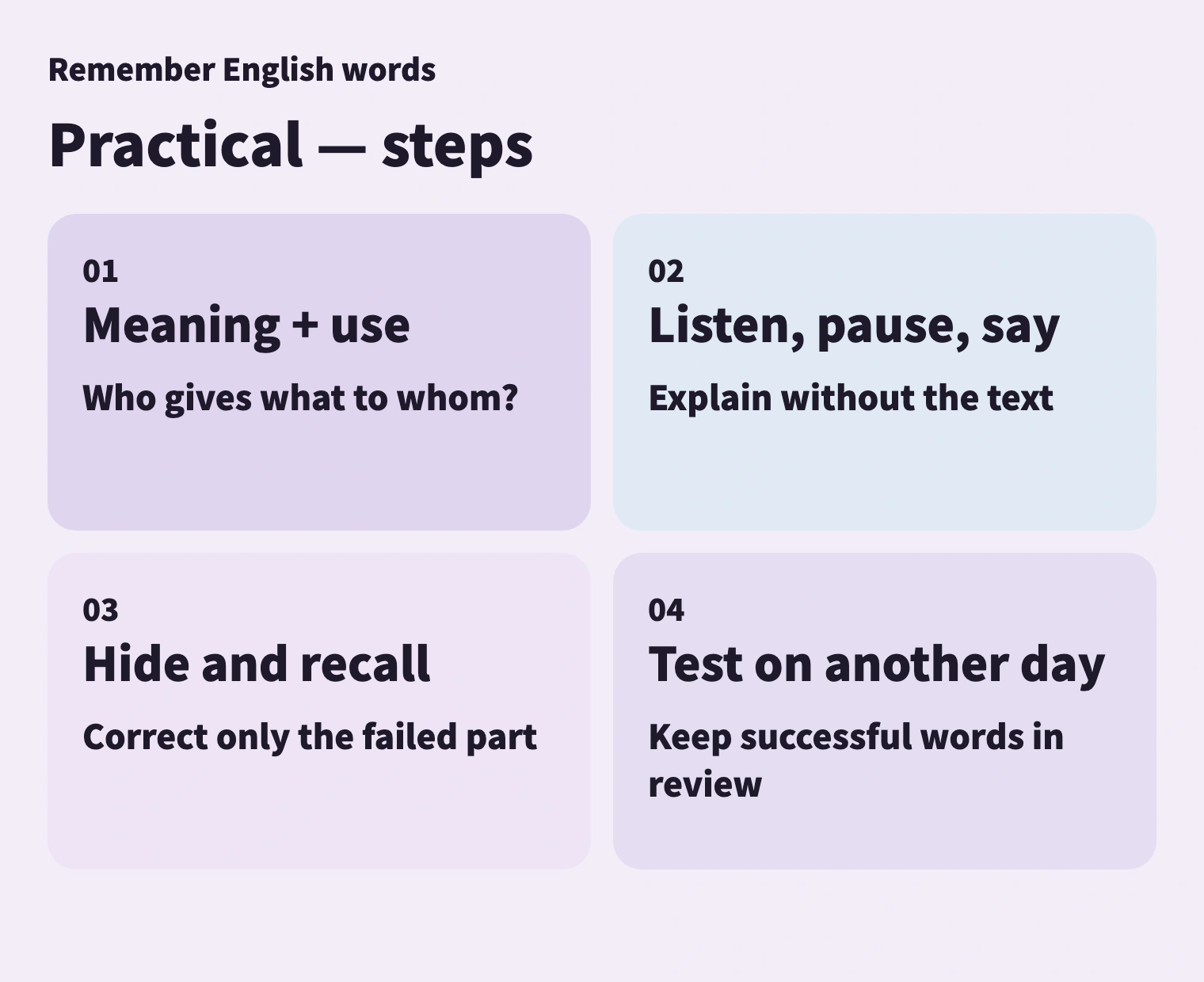
Check a word in a short sentence, listen and say it, hide the answer and recall it, then test it again after a delay. Record what you produced before looking, rather than how many pages you reread. When a word disappears, identify whether meaning, sound or usage failed and repair that part.
If familiar-looking vocabulary still vanishes in conversation, turn review into answering a question. We will use lend, borrow, return, remind and arrange from preparation through the next review. This is a procedure for recovering forgotten words, not a promise that one encounter makes them permanent.
How to study English: choose by your goal and what stops you
For clues to a word’s reading from its spelling, use phonics for adults to connect common patterns, exceptions and dictionary checks.
For a purpose-based choice of resources and a routine that turns words into your own sentences, see our Eiken Pre-2 vocabulary guide.
To choose IELTS vocabulary materials, see our book and app guide for official band/module information and steps from a word to your own sentence.
Decide what ‘remembered’ means
Recognising a printed word, understanding audio and producing a word for a situation are different checks. For reading, explain the meaning without seeing the definition. For listening, explain an audio sentence without the text. For speaking, start with a situation. For a spelling test, write the word from memory. Our editorial recommendation is five new words on day one. Five is a manageable starting workload, not a scientifically established optimum. Reduce it to three if corrections take too long.
Five words to work through
Imagine borrowing everyday items and arranging when to return them. The five sentences below were written for this article. You do not need to recite them as one conversation: each demonstrates one use of a word.
| Word | Meaning here | Example and meaning |
|---|---|---|
| lend | give temporary use | Could you lend me your umbrella? — Ask someone to lend their umbrella. |
| borrow | take temporary use | May I borrow your bike? — Ask permission to borrow a bike. |
| return | give back | I will return it on Monday. — Promise to give the bike back on Monday. |
| remind | prompt someone’s memory | Please remind me before lunch. — Ask for a reminder before lunch. |
| arrange | organise | Let us arrange a call this week. — Suggest organising a call this week. |
In the return example, it refers to the bike. Remind asks another person to prompt your memory; it does not mean that you already remember. Arrange means organise a call here. Choose the meaning needed in the situation before trying to learn every dictionary sense.
Listen to the five examples
These examples were generated in SpeakGain with the Deep-voiced Viking voice. Listen to one sentence, check its meaning, then practise it. The voice is a model for the phrase, not evidence of a learning effect.
lend: Could you lend me your umbrella?
borrow: May I borrow your bike?
return: I will return it on Monday.
remind: Please remind me before lunch.
arrange: Let us arrange a call this week.
1. Check meaning and the surrounding words
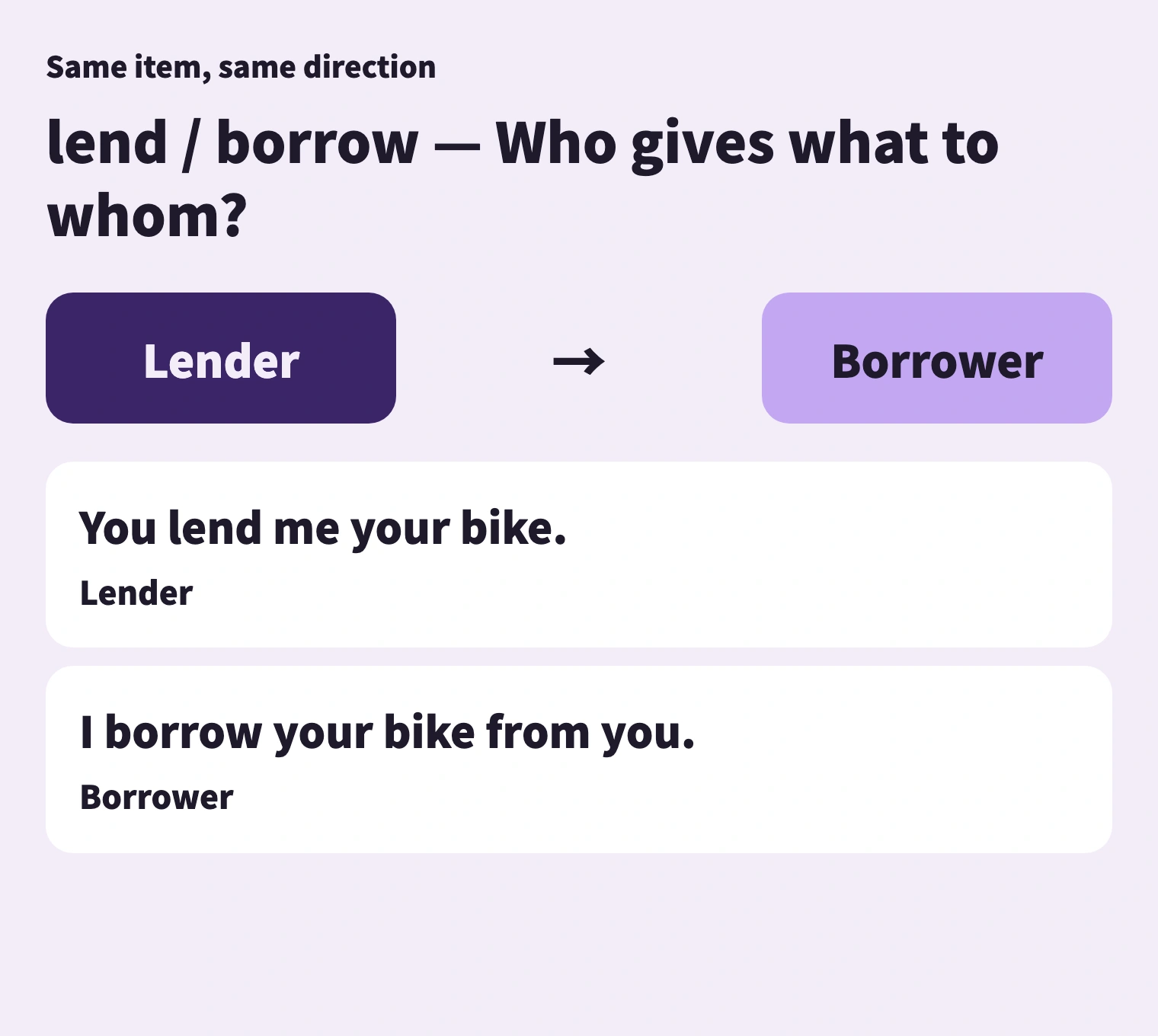
For lend, identify who gives temporary use of what to whom. In the first example, you is the lender and me receives the umbrella. In the borrow example, I is the borrower. Explain the direction of the item before translating the verb. These two verbs describe the same transfer from different subjects’ viewpoints.
Read remind me before lunch as a useful chunk. Check an unfamiliar construction in a dictionary or with a teacher before practising it. We use short sentences to make subjects and word order visible, not because adding any sentence guarantees better memory.
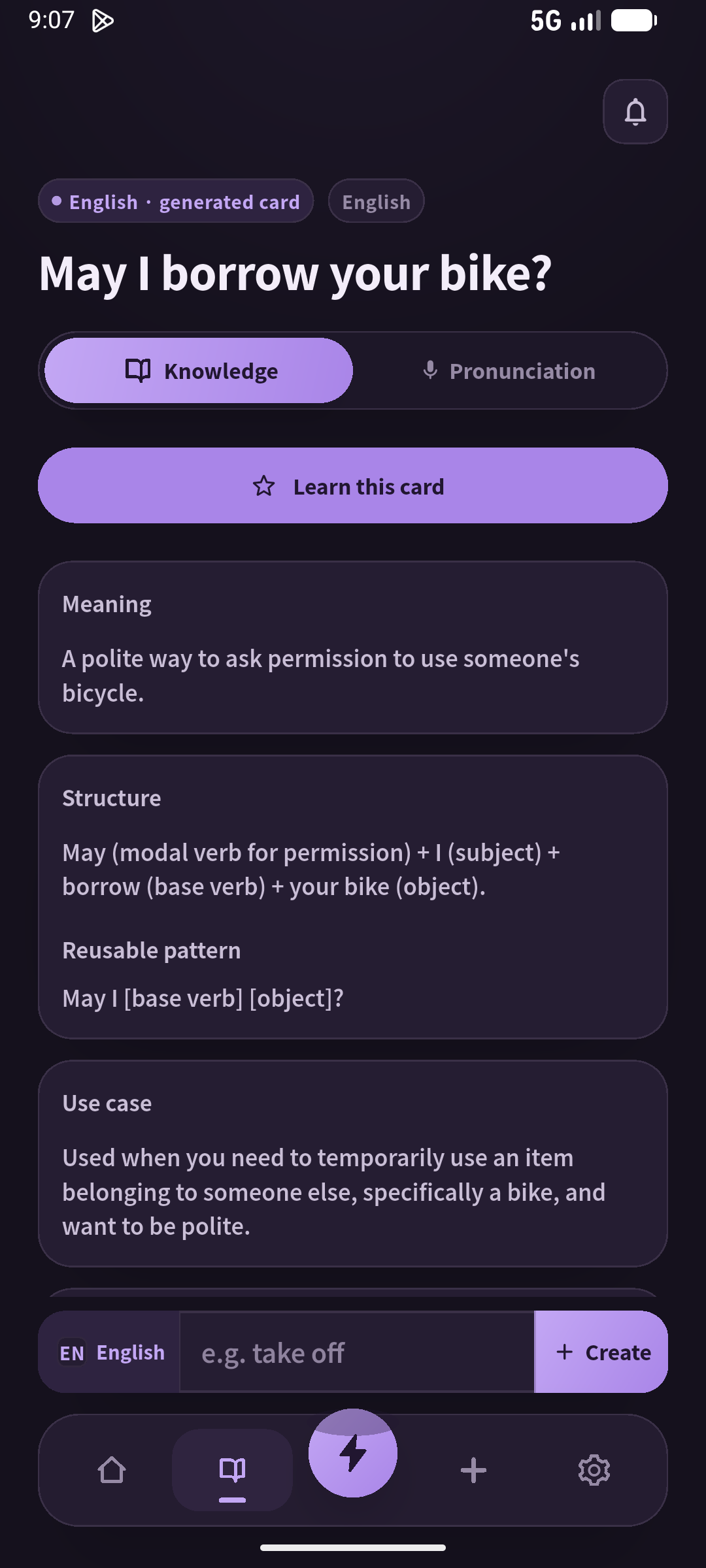
If you save examples in SpeakGain, the app we develop, add one short sentence through Create. Read the generated explanation and check that it matches the intended meaning. Generated explanations can contain mistakes; saving a card does not establish that its analysis is correct.
2. Listen, pause and say it
Play one example without speaking, replay it with the text, then stop and say it once yourself. Focus on the word’s sound within the sentence, rather than imitating the Viking’s low voice. If remind is recognisable on paper but not in audio, find it in the full sentence and compare the dictionary’s individual-word audio.
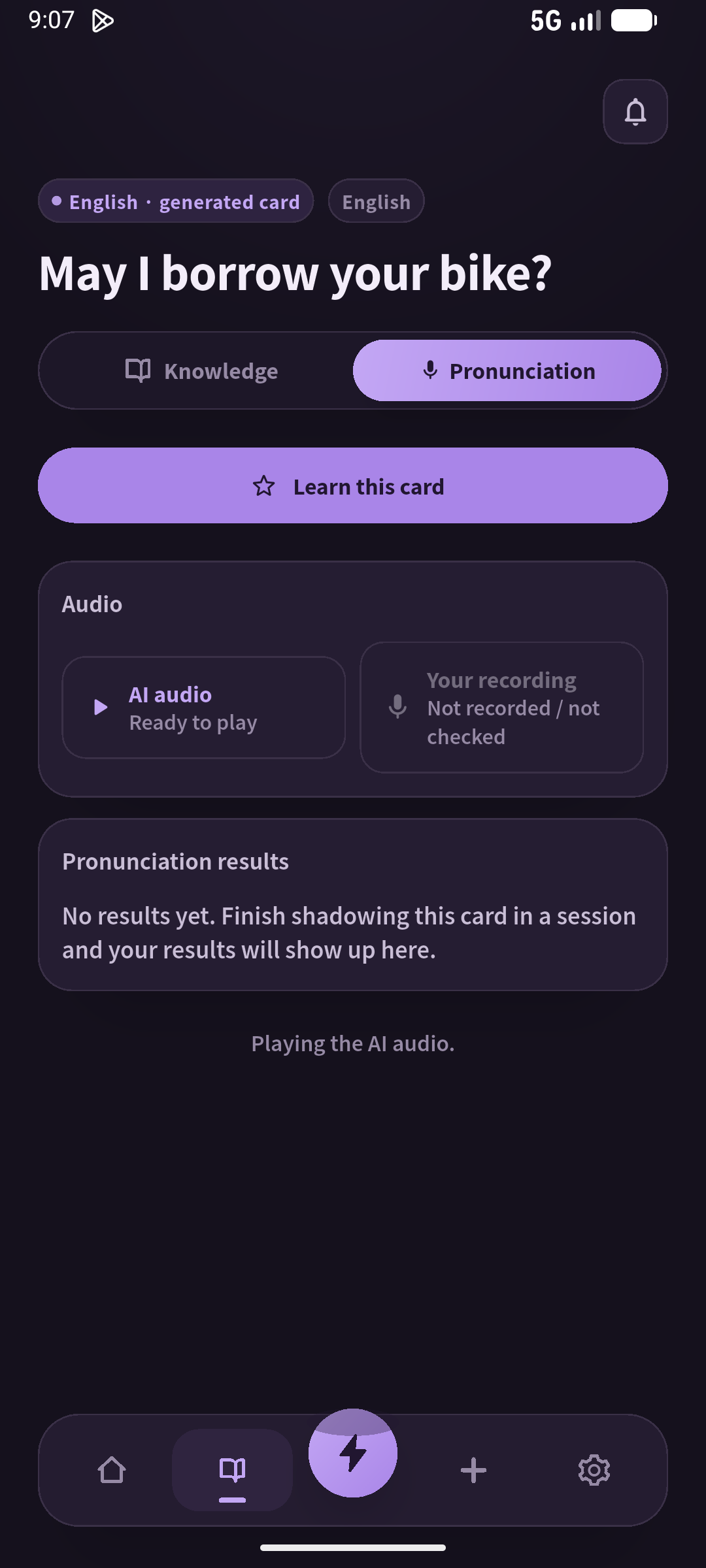
Hide the text and listen again. Explain the message in your own words. Saying the sounds and understanding the request are separate checks. During a commute, pause after a sentence and answer mentally; add speaking when you have a suitable place. Leaving audio running during another activity does not tell you what you understood.
Practise reading English aloud
3. Hide the answer and retrieve it
Cover the definitions and explain each English word. Then hide the English too and use the five situations below to produce a word and a short sentence. Exact wording can differ if the meaning and construction work. Cover the answer column with your hand or paper before starting.
| Situation: cover the answer first | An answer to try |
|---|---|
| Ask someone to lend an umbrella | lend — Could you lend me your umbrella? |
| Ask to borrow a bike | borrow — May I borrow your bike? |
| Say when you will give the bike back | return — I will return it on Monday. |
| Ask someone to prompt your memory | remind — Please remind me before lunch. |
| Organise a call | arrange — Let us arrange a call this week. |
Record ‘meaning came back’, ‘sound missing’ or ‘mixed up lend and borrow’. If you cannot answer after a brief attempt, check the answer rather than struggling for minutes. Repair the borrower/lender distinction, say the sentence, try another word, then hide this answer and test it again. Immediate repetition alone is not the same check.
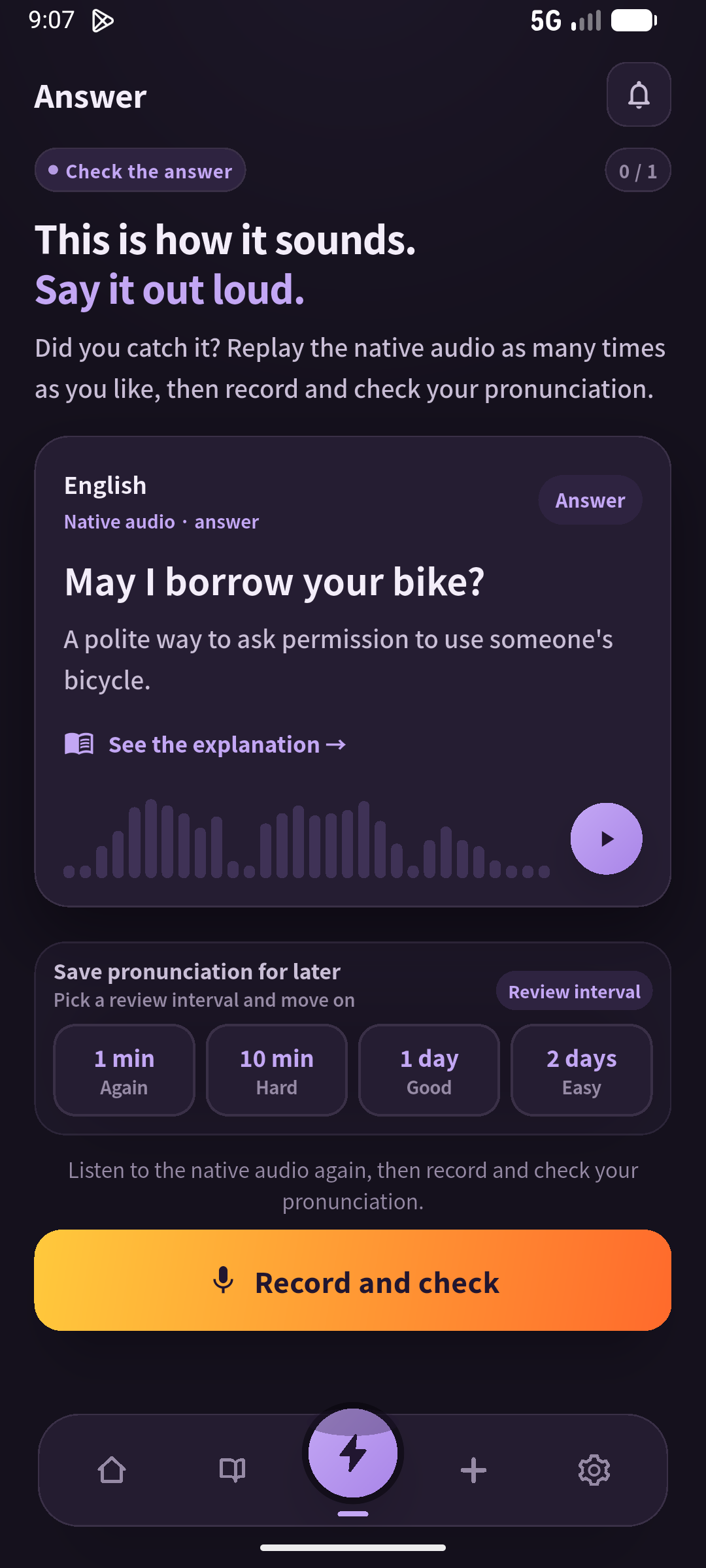
For spelling, write just the target word without looking and compare it with the answer. Repair the missing letters and retest. We do not prescribe copying a whole sentence ten times: copying and producing from memory answer different questions. Make the first situation-based attempt before playing or revealing a card in the app.
4. Return later and test before looking
Before finishing, schedule the next test. Our starting plan is tomorrow, three days later and one week later. This is an editorial example, not a universally optimal schedule established by research. Test before opening yesterday’s sentences or audio. Bring back failed words sooner and lengthen the interval when recall is reliable.
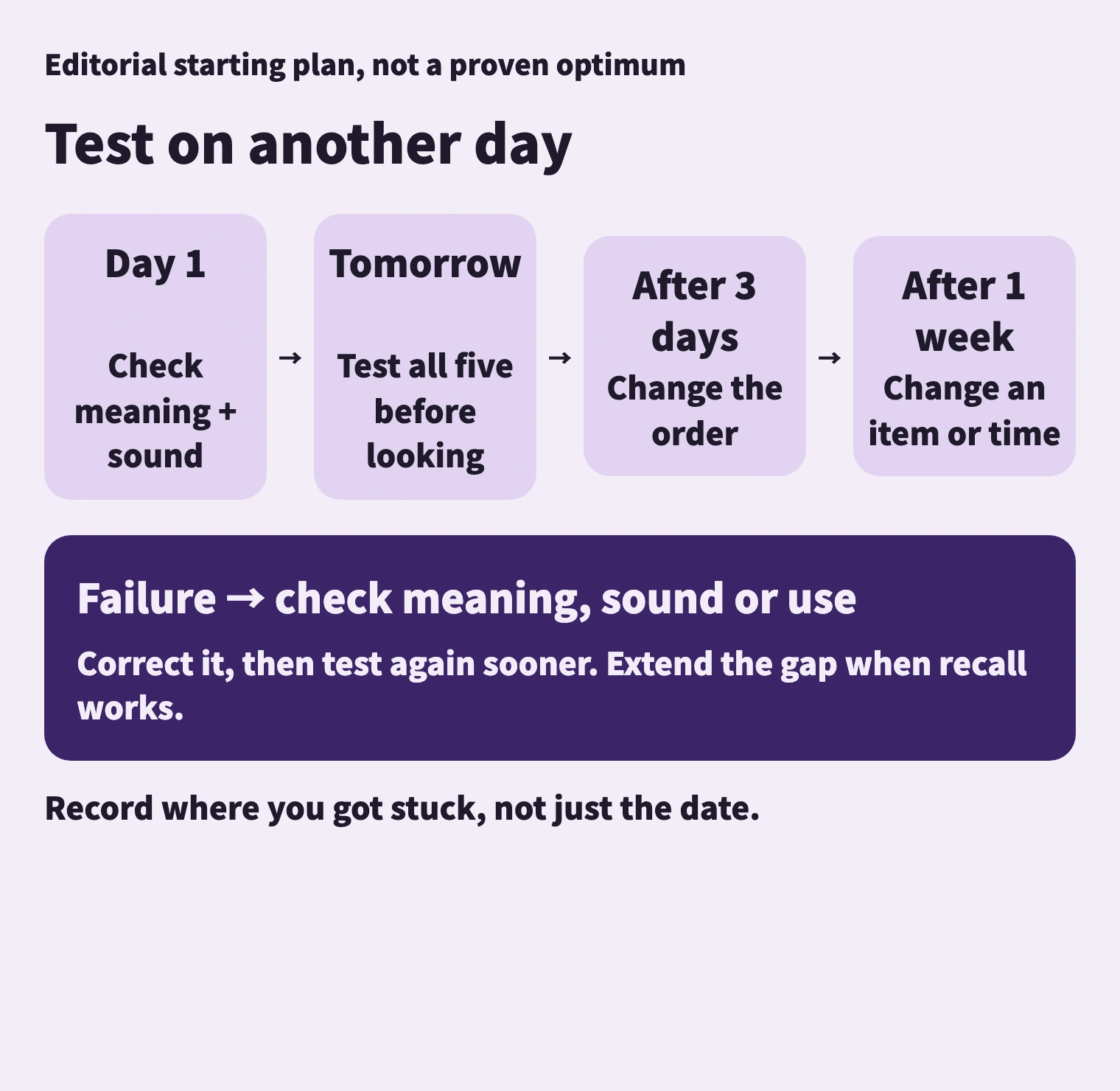
A hypothetical next-day record might say: lend, return and arrange came back; borrow was confused with lend; remind’s meaning came back but its sound did not. Retain the successful words for a later test, correct the transfer’s subject for borrow, and listen then retest remind. These are example records, not measured learner results.
After a week, change a small detail: ask for a coat instead of an umbrella, or change Monday to Friday. Check whether you can choose the word outside the memorised list order. Do not remove a word forever after one correct answer. If the same word repeatedly fails, reconsider meaning and cues as well as the interval.
Memorise whole English sentences
What the research actually supports
Retrieval: keep successful words in later tests
Karpicke and Roediger (2008) studied 40 Swahili–English word pairs. A week later, conditions that continued testing after an initial correct answer outperformed conditions that dropped those words from testing. We inspected the authors’ full paper. Our practical interpretation is to keep later retrieval opportunities. The experiment measured word-pair recall, not free conversation, this five-word routine or SpeakGain’s effectiveness. Full paper
Spacing: the retention goal changes the interval
Cepeda and colleagues (2008) studied more than 1,350 people learning facts. The public abstract reports that, for a given final-test delay, increasing the study gap first helped and then harmed performance; the best gap depended on the test delay. We inspected the abstract only. This was not a validation of our next-day/three-day/week plan or a vocabulary-only study. Publisher’s abstract
Context: sentences are not a universal memory advantage
Webb (2007) compared word pairs and single glossed sentences with Japanese learners of English, assessing vocabulary knowledge in ten ways. The public abstract reports no significant difference between conditions. We inspected the abstract only. We use sentences to check who does what and the surrounding words, not to promise a multiplied memory benefit. Word–meaning pairs still have a role. Publisher’s abstract
Eight mistakes and their fixes
Only looking: familiarity replaces answering
Cover the meaning, answer from the English, then cover the English and answer from a situation. Log answers obtained after a peek separately from genuine recall. Make one hidden-answer test your stopping point.
Only copying: a full notebook, no independent spelling
Write once without looking before increasing copying. Repair only the missing letters, try another word and retest. If the meaning is missing, add a meaning question instead of more spelling lines.
Too many new words: no time left to review
Start with five, or three when corrections pile up. Test yesterday’s words first. We do not recommend 100 new words every day as a universal starting rule for speaking. For a large exam list, distinguish recognition targets from words you need to use.
No example: the translation is known, the sentence breaks
Return to one short sentence and include the words around the target. Check the recipient after lend and the subject before borrow. Finish one usage instead of memorising an unnecessarily long example.
No sound: readable words become unknown in audio
Listen without text, check the text, then listen again without it. Separate sound failure from meaning failure. Hearing one familiar recording does not prove that you understand every speaker.
No return date: day one is the whole routine
Schedule tomorrow’s test before finishing. After missing three days, test the five words first and repair failures rather than restarting every preparation step. Stop new additions when reviews are backed up.
Similar words mixed up: lend and borrow reverse
Decide who lends and who borrows. Say ‘you lend’ and ‘I borrow’, check the item’s direction and rebuild the sentence. Compare this pair today rather than adding ten more similar words.
List order memorised: the word vanishes alone
Shuffle the five cues and start with arrange. Change an object or time. If a word appears only at the bottom of a page, replace position with the actual situation as its retrieval cue.
Choose tools that let you test yourself
Paper and apps can both support this routine. Check for short examples, replayable audio, a way to hide answers, a return date and space for your own troublesome phrases. Before changing tools, see whether your current notebook can already do these jobs.
Handle unknown words while reading
SpeakGain lets you save a phrase, hear its model and return to speaking practice. Add your own situation-based recall attempt before opening the answer. App use itself is not proof that you remembered. For whole-sentence memorisation or unknown words in a book, use the related guides below rather than collecting every word indiscriminately.
Questions about the routine
Are mnemonics allowed?
We support a mnemonic as an initial cue for a stubborn word. Return to the real sound and a short sentence afterward. Remembering a clever story while failing to recognise the spoken word does not meet a listening goal. You need not invent a story for every word.
How long should a session take?
A complete pass through meaning, sound, hidden-answer testing and corrections is the unit. About ten minutes can be a starting allowance, not a research-defined dose. Reduce the word count when time is short while preserving a later test.
What if the exam is tomorrow?
Do not wait a week. Find the missing words today, check the answers and retest after a short break. Prioritise the spelling and usage the exam requires, then schedule later tests for words you want to keep using. Last-minute success and long-term retention are different goals.
Today, check these five words with examples and sound, hide the answers for one test, and note the failure and next test date. Decide your next practice from what appeared before looking tomorrow, rather than from the number of passes through a word list.
To choose a tool for vocabulary study, our English vocabulary app comparison separates the purpose, free limits and practice for saying a usable sentence.
For Japan’s Eiken Pre-1 vocabulary, see our guide to choosing a wordbook or app and using words in your own sentences.
If vocabulary is your main obstacle in Japan’s Eiken Grade 1, see how to choose vocabulary resources and practise your own sentence for a comparison based on official provider information.
For focused vocabulary work, compare TOEIC wordbooks and the steps from meaning to sound and context against your target and current gaps.
References
-
Karpicke & Roediger (2008): The Critical Importance of Retrieval for Learning — Full paper
-
Cepeda et al. (2008): Spacing Effects in Learning: A Temporal Ridgeline of Optimal Retention — Publisher’s abstract
-
Webb (2007): Learning word pairs and glossed sentences: the effects of a single context on vocabulary knowledge — Publisher’s abstract
For Japan’s Eiken Grade 2, our vocabulary resource and practice guide explains how to choose a book or app and use words in your own sentences.
For focused practice at Japan’s Grade 3, our Eiken Grade 3 vocabulary guide compares official resource features and explains personal sentences and support at home.
To choose a vocabulary resource and connect remembered words to all four skills, see how to choose and learn from TOEFL vocabulary books for official comparisons and five practical checks.