
Eiken Grade 2 vocabulary: choose a book or app and make words usable
Published
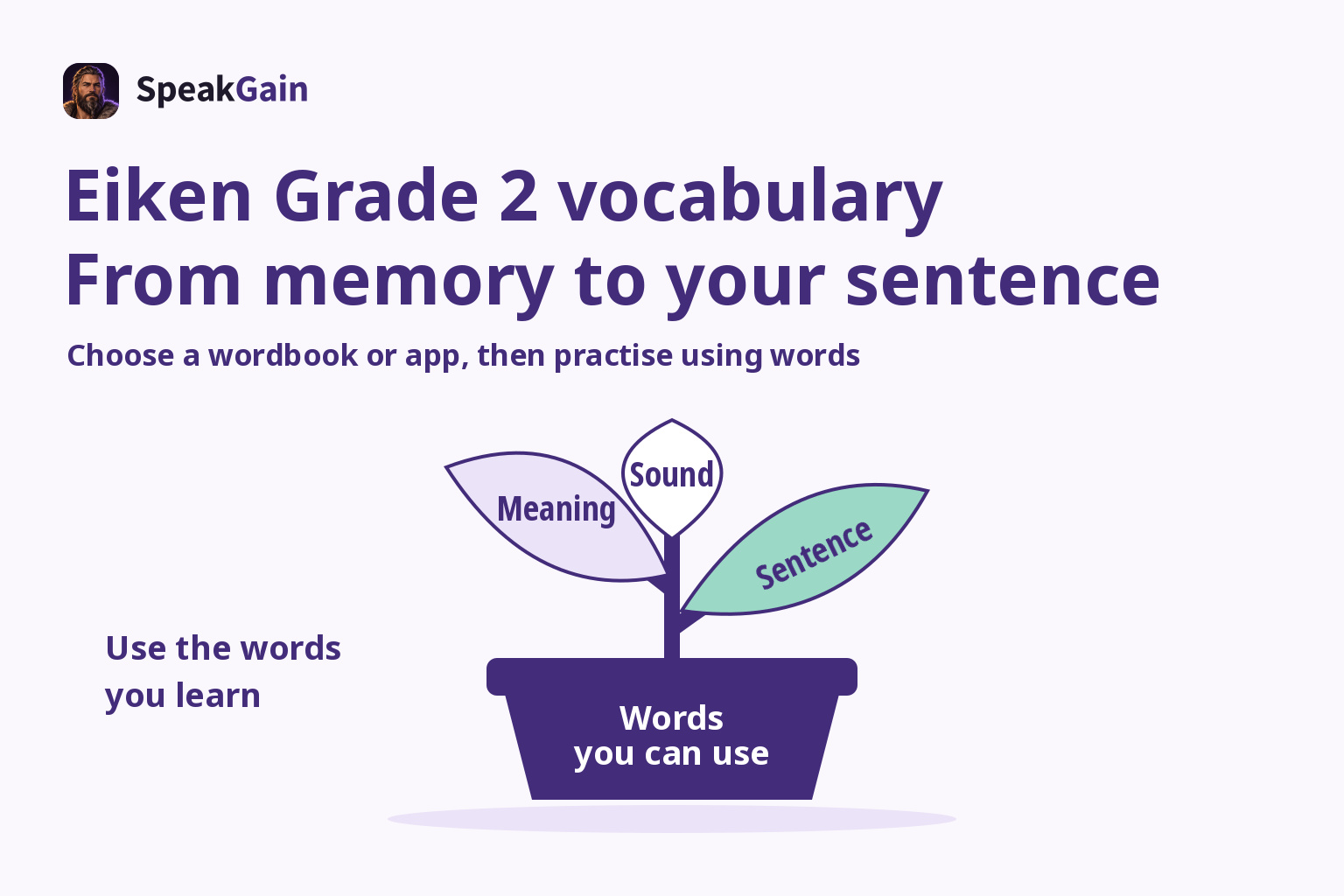
For Japan’s Eiken Grade 2, our editorial recommendation is to choose one main vocabulary book or app, then practise meaning → example → sound → your own sentence → review after a gap. In vocabulary questions, check context and word combinations; in passages, follow the connections; in writing and the interview, practise expressing your own point. A fixed vocabulary total required to pass and a complete list of test words are not stated in the current official Eiken guides we checked.
This guide is for secondary-school and university students and adults moving up from Pre-2. Eiken is a Japanese English qualification; the books below are Japanese study materials. We checked publishers’ and providers’ pages on 16 October 2026. The comparison describes their published specifications, not books we have read or apps we have tried. Suitability judgments and practice plans are editorial opinions.
Choose by the work you need to do
Use a book if you want an overview on paper, or an app if short sessions on your phone fit your routine. Check examples, audio and recall practice rather than choosing the largest entry count. These are purpose-based options, not a ranking; links go to official descriptions, with no shopping or affiliate links.
| Resource | Provider | Entries [official] | Audio | Features [official] | Suits [editorial opinion] | Checked |
|---|---|---|---|---|---|---|
| Eiken Grade 2 Derujun Pass Tan, newly covered 5th revised edition | Obunsha | Contents list: 1,300 words; 400 idioms; 100 conversation expressions; composition section 38 | Free download; Eigo no Tomo app support | Frequency order from past-test analysis, usage examples, word/idiom checks; Grade 2 | Learners who want paper-based, frequency-grouped sections | 2026-10-16 |
| Rankjun Eiken Grade 2 English Words 1750, new cover edition | Gakken | 1,750 words, idioms and conversation expressions | Downloadable audio for those categories | Frequency groups, usage explanations, companion quiz app; Grade 2 | Learners who want usage notes plus companion checks | 2026-10-16 |
| Eiken Grade 2 Hinshutsudojun Eitango 1700 within mikan | mikan; included material published by Takahashi Shoten | Provider specifies 1,755 words, idioms and conversation expressions | Audio playback listed | Multiple choice, card flipping, example cloze, audio; this Grade-2 resource requires Premium | Learners who want short phone sessions and example-based checks | 2026-10-16 |
These are resource counts, not an official passing requirement. The Pass Tan numbers preserve its contents categories; the composition section is not simply added to a “word total.” The mikan resource’s name says 1700, while its description specifies 1,755 across categories. That is not the app’s overall vocabulary size.
Check what the audio actually covers: headwords, meanings and full examples support different tasks. A free companion app for a book does not mean the same content is free in mikan. Plans and features can change; check the relevant provider page before use.
If you prefer paper
We would consider a book when you want to revisit neighbouring words and usage notes on a spread. If you already own one, check its edition and official audio instructions before replacing it. Obunsha explicitly says the newly covered fifth revised edition has the same content as the fifth revised edition. Paper alone is not a learning method: you still need to hide answers and try later recall.
If you prefer short phone sessions
An app can be the main resource, but a correct multiple-choice answer is not proof that you can write or say the word independently. Add a check without options and an original sentence. The mikan features above are provider statements, not our device-test results. For wider choices see 7 English vocabulary apps compared: purpose, free limits and speaking; for other exam skills see 8 Eiken Study Apps: Skills, Grades, Free Access and Books.
Five stages, with a check at each one
This is an editorial sequence, not an official syllabus. Write short sentences for words you want to use in writing or speaking; you do not need a long composition for every entry.
| Stage | What to do [editorial proposal] | How to check |
|---|---|---|
| Meaning | Identify the sense and part of speech in this context | Hide the gloss and explain this meaning |
| Example | Read who does what and how neighbouring words fit | Explain the whole sentence |
| Sound | Listen, match the written form and say it aloud | Hide the text and recognise the word in the audio |
| Your sentence | Write a short point and reason you understand | Check usage, then say it without looking |
| Spaced review | Return the next day and later, before looking at the answer | Recall what you can and return to the part you missed |
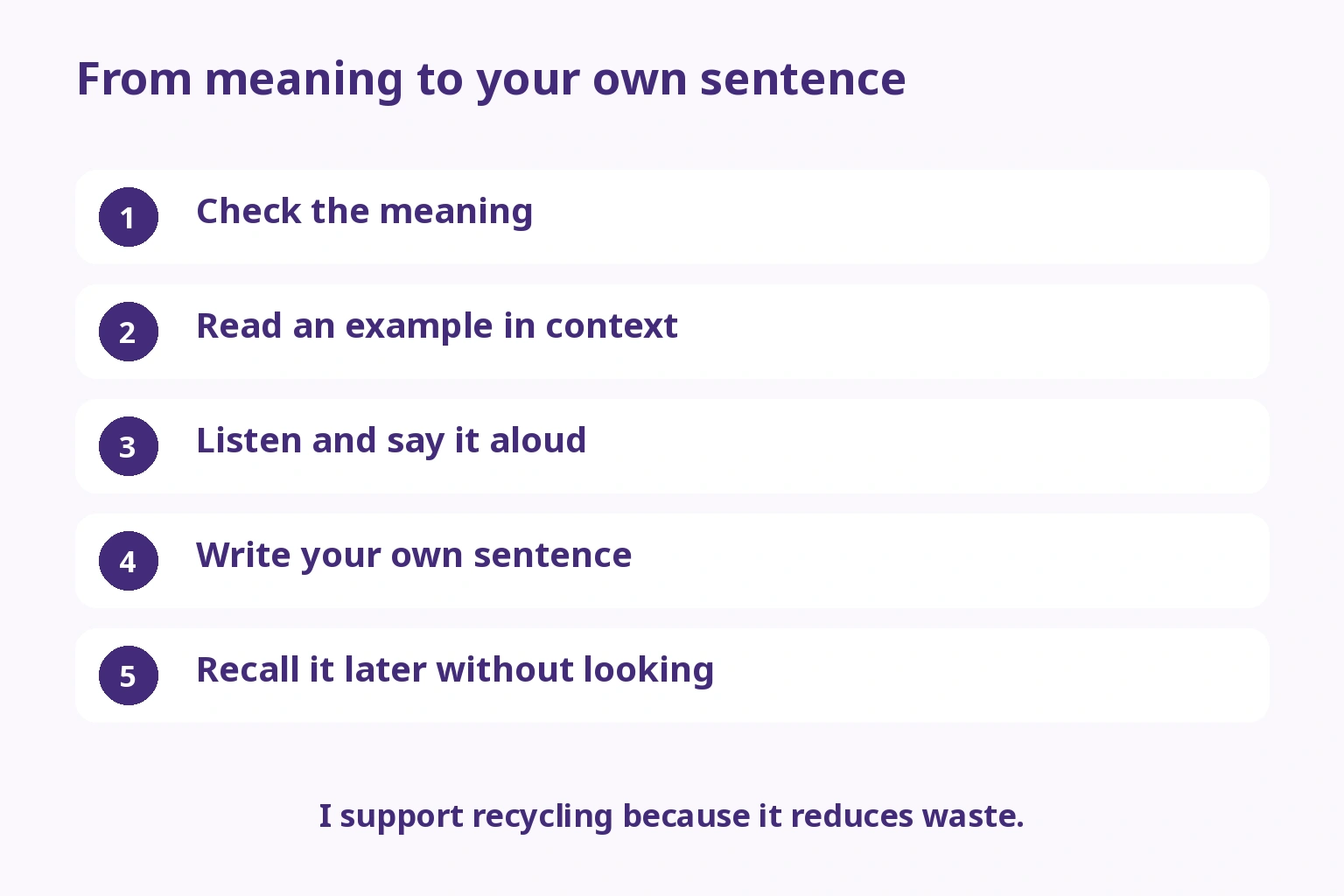
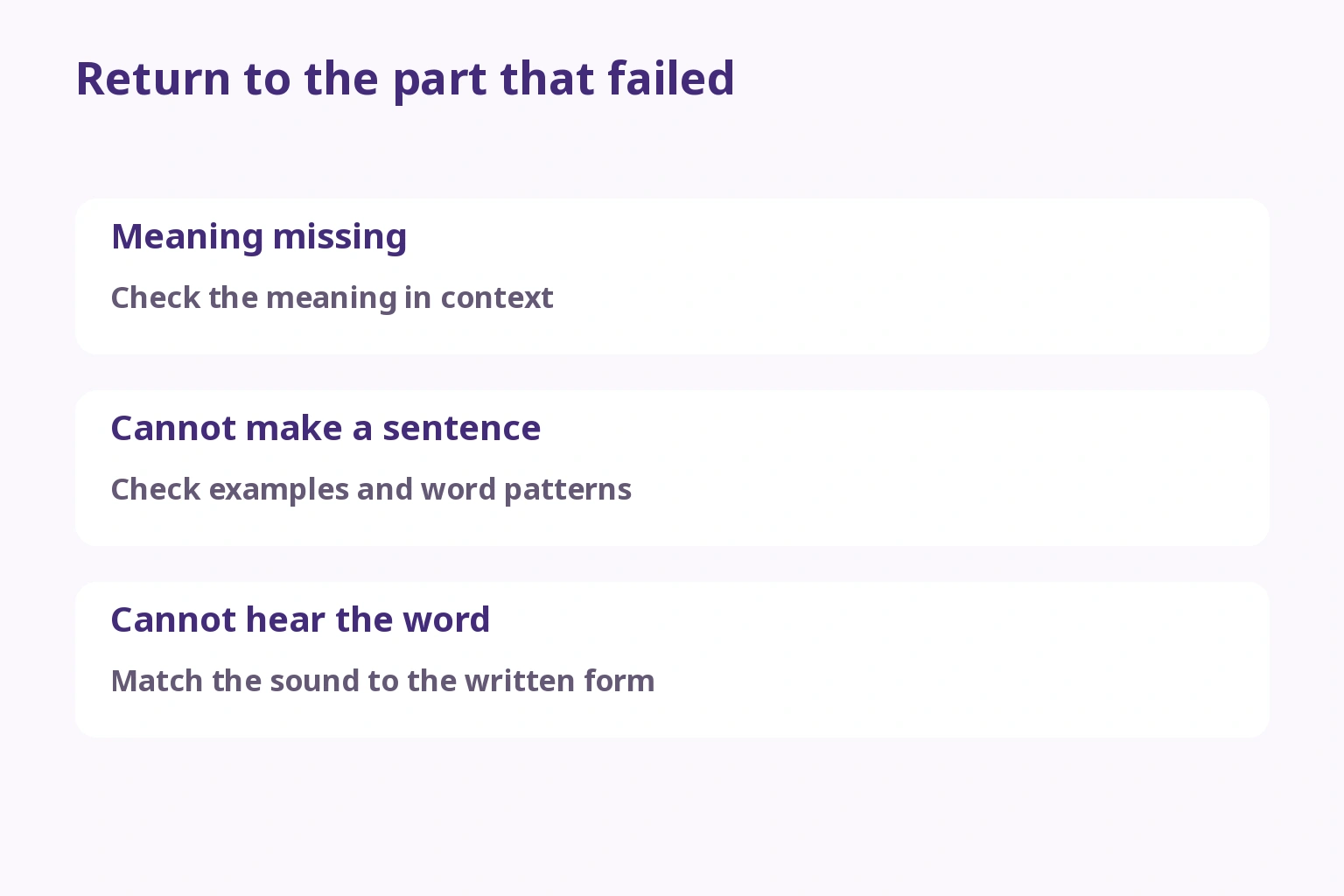
If you know the translation but cannot read a passage, spend more time on context and structure. If written words are familiar but audio is not, revisit sound. See How to memorize English words: 4 steps and fixes for forgetting for broader memory methods and common difficulties.
A new sentence, not a copied answer
Our worked example was written for this article:
I support recycling because it reduces waste.
Here, the speaker supports recycling and gives a reason: it reduces waste. Focus on support as a verb followed by what you support. Explain the relationship between the opinion and the because-clause, rather than memorising only a translated gloss. Check the word’s pronunciation and usage in your resource or dictionary, then say the sentence aloud.
Try recalling it from the intended meaning without the English. If you stop, check the opinion first and the reason second, then retry the whole sentence. If it is not an opinion you agree with, do not memorise it as your own view: write a short sentence about something you can explain. Verify uncertain usage before repeating it. This is a small practice unit, not a full exam response or an official sample.
Recall before rereading
We would provisionally revisit a small set at the end of the session, the next day, a few days later and the following week. Those intervals are a planning example, not a measured optimum. Shorten the gap if you cannot recall the word; extend it cautiously if recall is easy.
Check English-to-meaning, then intended meaning-to-word, and finally audio. Note whether an error concerned meaning, a word combination, spelling or sound. That tells you what to revisit. Reduce new entries when review is already filling the session.
How many words does Grade 2 require?
The current Grade-2 guide describes a high-school-graduation level and English needed in social life. The assessment criteria contrast Pre-2’s everyday-life focus with Grade 2’s social-life focus. A fixed required vocabulary count and complete test-word list are not stated in these current guides.
A book containing 1,750 entries therefore does not mean that learning 1,750 entries guarantees a pass. Some entries may already be familiar, and a familiar word may have an unfamiliar sense. We would start with difficulties in official questions instead of setting an unsupported total.
Try part of an official past paper and distinguish an unknown word, a known word with an unclear contextual meaning, and a sentence whose structure is unclear. The third needs sentence analysis, not just more vocabulary. Prioritise expressions that affected your answer or the paragraph’s point, then reread that short section later. Also retain unfamiliar passages for fresh checks; remembering an answer is not the same as reading a new text.
Use vocabulary differently across the test
Tasks below come from the official Grade-2 format. The practice suggestions are ours.
| Area | Official task | Vocabulary check [editorial proposal] |
|---|---|---|
| Vocabulary | Short-text word/phrase gap fill | Explain why the meaning, part of speech and combination fit |
| Reading | Passage gap fill and comprehension | Follow reasons, contrasts and references, not isolated glosses |
| Writing | Summary and opinion composition | Preserve source meaning in a summary; choose accurate words for your own reasons in an opinion |
| Interview | Reading aloud, passage and picture questions, personal opinions | Separate reading a visible word from producing your own short answer |
| Listening | Conversation and passage comprehension | Recognise a familiar written word inside spoken language |
For an incorrect vocabulary answer, explain why the correct option fits before trying to memorise every alternative. Learn idioms as combinations, including what follows them. After looking up a passage word, return to the paragraph and its logic; do not store an unverified guess as its meaning.
For writing, an uncertain difficult word can change the source meaning or obscure your reason. Use words you can control instead of decorating an answer with difficulty. Consult Eiken Grade 2 Writing: summaries, opinion essays and the limits of templates for the complete writing process. A memorised sentence is not useful if it does not answer the actual question.
For the interview, practise an opinion and reason without looking, separately from reading aloud. In listening, compare the text with what you missed and replay the full sentence. Pronouncing one word does not complete interview preparation.
Our three-month vocabulary plan [editorial opinion]
Keep one main resource and start small amounts of original writing and sound practice in the first month. This is not a promise that everyone can finish in three months. How to study for Eiken Grade 2: summaries, skills and a realistic study plan covers the whole-test plan.
| Period | Main work | Check before moving on |
|---|---|---|
| Month 1 | Diagnose with official questions; separate known, uncertain and unknown entries; check examples and sound; begin short sentences | Can you explain a contextual meaning without the gloss? Do you know what needs review? |
| Month 2 | Revisit uncertain entries, idioms and combinations; transfer them into reading, writing and speaking | Can you retrieve some words without options? Are earlier passages clearer? |
| Month 3 | Focus on errors, missing words in writing and listening confusions; check unfamiliar questions too | Can you explain your choice and produce your sentence again later? |
For a 20-minute vocabulary slot, we might begin with eight minutes reviewing, six on a new section and examples, and six on sound and a sentence. These are adjustable planning numbers, not proven dosages. Other exam tasks still need time. When review overflows, reduce new material. When words will not come in writing, give sentence production more time.
Do not count only “words per day”: familiar words and completely new usage take different effort. Use a weekly error check to spot repeated causes. If your schedule slips, restart with uncertain items instead of piling all missed work onto one day.
Methods we would not recommend
- Large meaning-only drills as the whole method. They leave context, sound and independent use unchecked. Use them as a first check, then add examples and production.
- Starting several wordbooks at once. Overlap makes unfinished review harder to track. Add a second only when a specific gap remains after the first resource and official questions.
- Counting copying alone as progress. After correcting spelling, hide the model and retrieve it.
- Reciting a long answer full of difficult words without considering its point. A changed question may need different reasons. Begin with short sentences you can explain.
The issue is the work you perform, not a rule that paper or apps are always superior.
Turn your own sentence into listening and speaking material
After checking the meaning and usage in a vocabulary resource or dictionary, the original example above can become material to hear and say aloud. This is the stage where SpeakGain belongs in the article. Choosing words and deciding an answer’s content still depend on your resource and official questions.
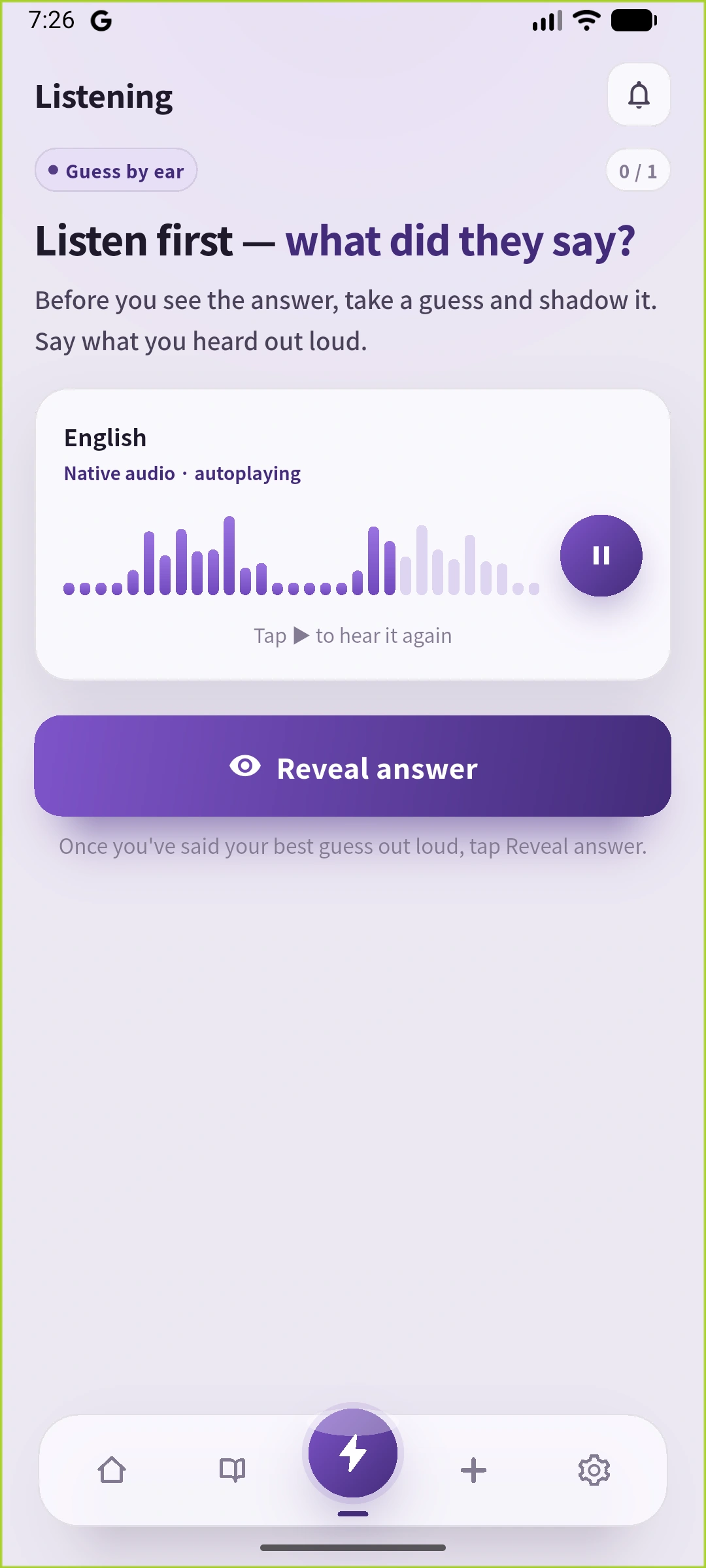
In SpeakGain, we made one card from this original sentence through Add. We opened Knowledge in Library and selected Learn this card. Listening played the generated audio while hiding the English sentence, with instructions to guess what was heard and say it aloud.
Reveal answer opened Answer with the same saved sentence. In this example, you compare what you heard with your own saved text. We submitted no recording or review rating. This demonstrates hearing and saying one sentence, not an Eiken vocabulary test, mock test, answer or pronunciation grading, or score prediction. Continue exam-task practice with official materials.
Original sentence audio — generated by Viking AI
I support recycling because it reduces waste.
One generation of the same original English sentence, for reference; not an official Eiken recording or a complete answer.
Frequently asked questions
How many words must I learn?
The current official guides checked do not state a fixed required total. A publisher’s entry count is not a passing condition. Use official questions to identify contextual gaps.
Is one wordbook enough?
We recommend one main book, not a guarantee that one book alone prepares you to pass. Supplement specific gaps and practise the other test tasks.
Is an app better than a book?
Choose paper for overview and usage notes, or an app for short phone sessions. Check which parts of meaning, examples, sound, production and review your routine covers.
What about idioms?
Check the whole expression and its usage in a sentence, including what follows. Do not simply add the meanings of its component words or keep postponing the idiom section.
What if I keep forgetting?
Attempt recall before revealing the answer, identify the part that failed and shorten the next gap. Do not assume one encounter should be enough.
How many months will it take?
That depends on your starting point and available time. Our three-month plan organises work; it does not predict completion or a pass.
Must I finish Pre-2 vocabulary first?
Try some Grade-2 official questions. Return to basic gaps where necessary while working on Grade-2 usage. Do not postpone all writing and audio until every basic word is perfect.
Does a correct multiple-choice answer mean I can use the word?
Check separately whether you can retrieve it from your intended meaning, write a correct sentence and say it without looking.
When you later move beyond Grade 2, switch to the Pre-1 vocabulary guide; this article stays focused on using Grade-2 words.
Editorial verdict: choose one, and use a little each time
Choose one Grade-2 resource and start using some of its words in short original sentences immediately. Retrieve them later, then check them again in official contexts, writing and speech. Measure more than pages completed: can you explain why a word fits and express a short reason yourself?
Sources checked 16 October 2026. Comparisons use official publisher/provider descriptions, not hands-on reviews. Examples, figures and schedules are editorial creations. Eiken is a registered trademark of the Eiken Foundation of Japan.