
How to study for Eiken Grade 2: summaries, skills and a realistic study plan
Published
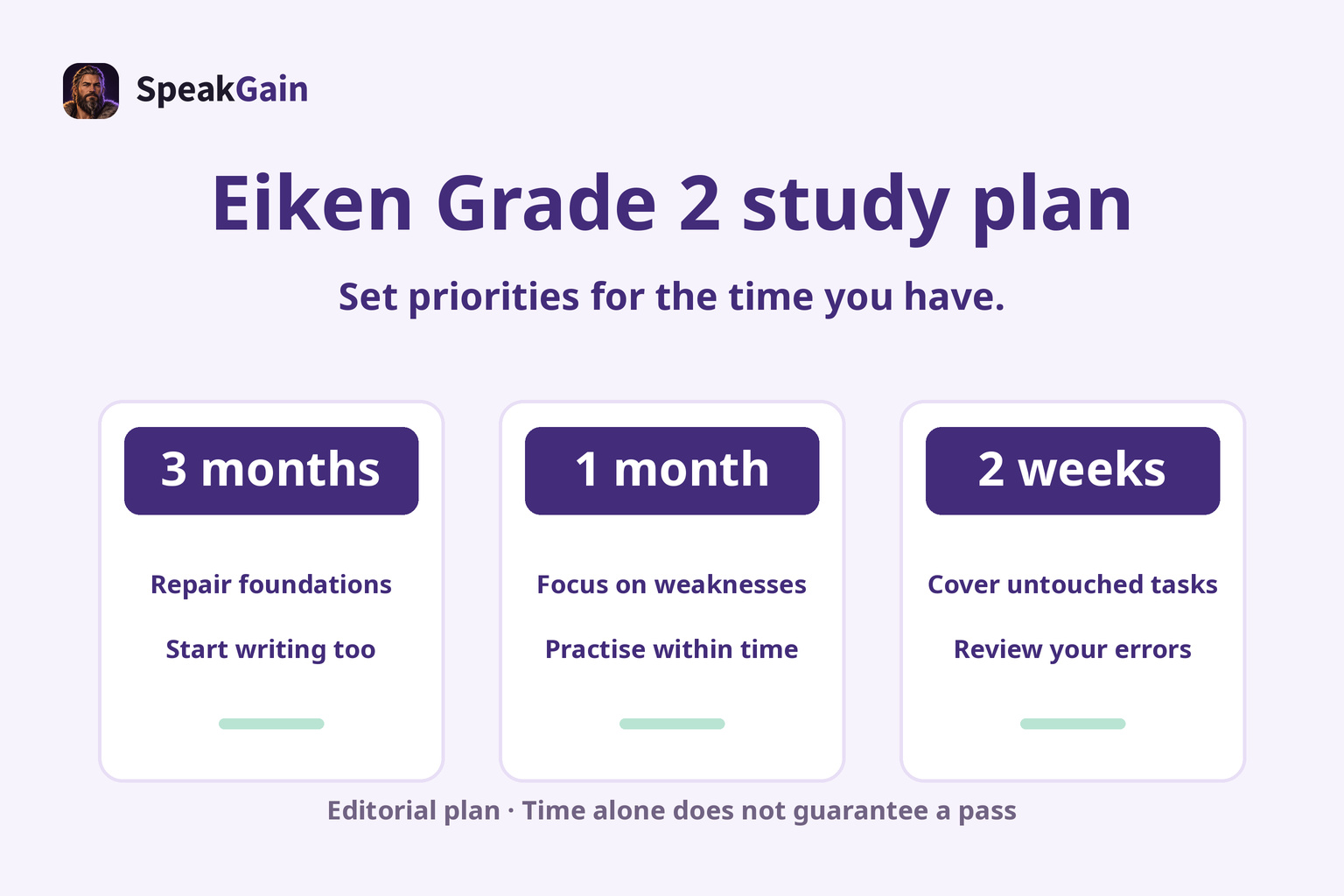
Start Eiken Grade 2 preparation with one current official paper, then separate problems with reading, writing and listening. Since the 2024 renewal, writing includes both a summary and an opinion essay: our editorial advice is to start writing immediately while building vocabulary. With three months, repair foundations; with one month, focus on weaknesses and timing; with two weeks, cover neglected tasks and review recurring mistakes.
Eiken is a Japanese English qualification. This guide covers the conventional Grade 2 first stage and interview for students and working adults, including readers living in Japan whose first language is not Japanese. Official format information was checked on 16 October 2026. All study schedules and practice durations below are editorial examples, not measured time requirements or promises of a pass.
Check the current format and CSE pass criteria first
The 2024 renewal added summary writing and reduced reading to 31 questions. The table follows the current official format and current published paper; it does not reproduce test questions.
| Skill | Task | Questions or length | Time | Official source |
|---|---|---|---|---|
| Reading | Short-text vocabulary gaps | 17 | 85 minutes shared with writing | Format |
| Reading | Passage gaps | 6 | Same shared period | Format |
| Reading | Passage comprehension | 8 | Same shared period | Format |
| Writing | English summary | 1 task, 45–55 words | Shared with reading | Paper p.12 |
| Writing | Opinion essay | 1 task, two reasons; suggested 80–100 words | Same shared period | Paper p.14 |
| Listening | Conversations and passages | 15 each, 30 total; played once | About 25 minutes | Format |
| Speaking | Read aloud, passage question, three-picture narration, personal opinions | About 60 words read aloud, then 4 questions | About 7 minutes overall | Format |
Separate compulsory time limits for reading, summary and essay are not stated in the official guidance checked. Our initial trial allocation is 50 minutes for reading, 15 for the summary, 15 for the essay and 5 for checking. Adjust it using your own first attempt; it is not an official recommendation. If the summary remains unfinished, examine where reading consumed the time.
| Stage | Maximum CSE | Pass criterion |
|---|---|---|
| First | 650 each for reading, writing and listening; 1950 total | 1520 |
| Second | Speaking: 650 | 460 |
Sources: official CSE explanation and Grade 2 pass criteria, cross-checked with the renewal notice stating that pass criteria did not change. Each stage has its own threshold. You cannot calculate your CSE score from your number of correct answers. The foundation calculates scores statistically after marking, with equal maximum scores across skills. Do not turn 1520/1950 into a required raw percentage, or assume writing will always compensate for another skill. Use home scores to track mistakes instead.
What should you prioritise with three months, one month or two weeks?
Time remaining alone cannot tell you whether you will be ready. First check your starting level and available time, then adapt this editorial plan.
| Time left | Priorities — editorial | Avoid — editorial | Check — editorial |
|---|---|---|---|
| 3 months | Diagnose with one paper; repair vocabulary and sentence structure; write both tasks weekly; begin audio review and short speaking | Delaying writing until the vocabulary book is finished | Can you explain a previously difficult sentence and finish both tasks? |
| 1 month | Choose two weaknesses; combine timed attempts with rewriting; trial a reading cut-off | Adding several new resources | Can you complete both writing tasks and checking within 85 minutes? |
| 2 weeks | Try every current task; repair repeated errors, summary omissions and overlapping essay reasons | Difficult-word marathons and back-to-back papers without review | Is any task untouched? Can you correct the same error independently? |
A learner who cannot understand passages needs different work from someone whose only problem is timing. Give the former short vocabulary and grammar repairs; give the latter timed full attempts. Neither plan should discard a writing task from the outset. We cannot promise a pass in two weeks.
Diagnose causes rather than collecting scores
Choose a paper from the official materials page. Work without the answers and write both responses. If work or school prevents a full sitting, split the practice, but do not record that as proof that you finished within the full time limit.
Classify reading errors as unfamiliar vocabulary, misunderstood structure, wrong evidence or time pressure. For listening, ask whether you understand the transcript: if not, repair language first; if you do, work on connecting sound to meaning. For writing, check required information rather than guessing a mark. Give a teacher your first draft, the task and your specific question when requesting feedback.
Reading: return to evidence
Official format: 17 short-text gaps, 6 passage gaps and 8 comprehension questions (source). Common traps include choosing a familiar word, missing a negative or comparison, and confusing whose opinion is being reported.
Our practice sequence is answer → locate the supporting sentence → explain why the wrong choice differs → reread the difficult sentence. For passage gaps, inspect the following sentence as well as the preceding one. For comprehension, compare subject, time and degree. Keep useful vocabulary in short contexts and verify its meaning and part of speech in the original sentence.
Use the official question booklet and answers. A correct answer number does not explain every distractor: consult a dictionary, grammar reference or teacher when needed. A repeat score on memorised answers is not an unseen-paper score.
Summary writing: select information before shortening
Official format: one English summary of 45–55 words (current paper p.12). This task asks for the passage’s content, not your personal opinion.
Typical problems are summarising only the opening, retaining too many examples, dropping contrasting information and inventing a conclusion. Elaborate synonyms do not help if they change the meaning. Our method is:
- Identify the topic and each paragraph’s role. Do not assume every passage has the same advantages/disadvantages pattern.
- Select the central information and important reasons, contrasts or results. Ask whether an example is essential.
- Write while preserving subjects, cause and effect, and positive or negative meaning.
- Check content and word count separately. Remove repetition; if too short, look for missing information rather than filler.
- Match each sentence to evidence in the original, then rewrite. Later, hide the model and select the information again.
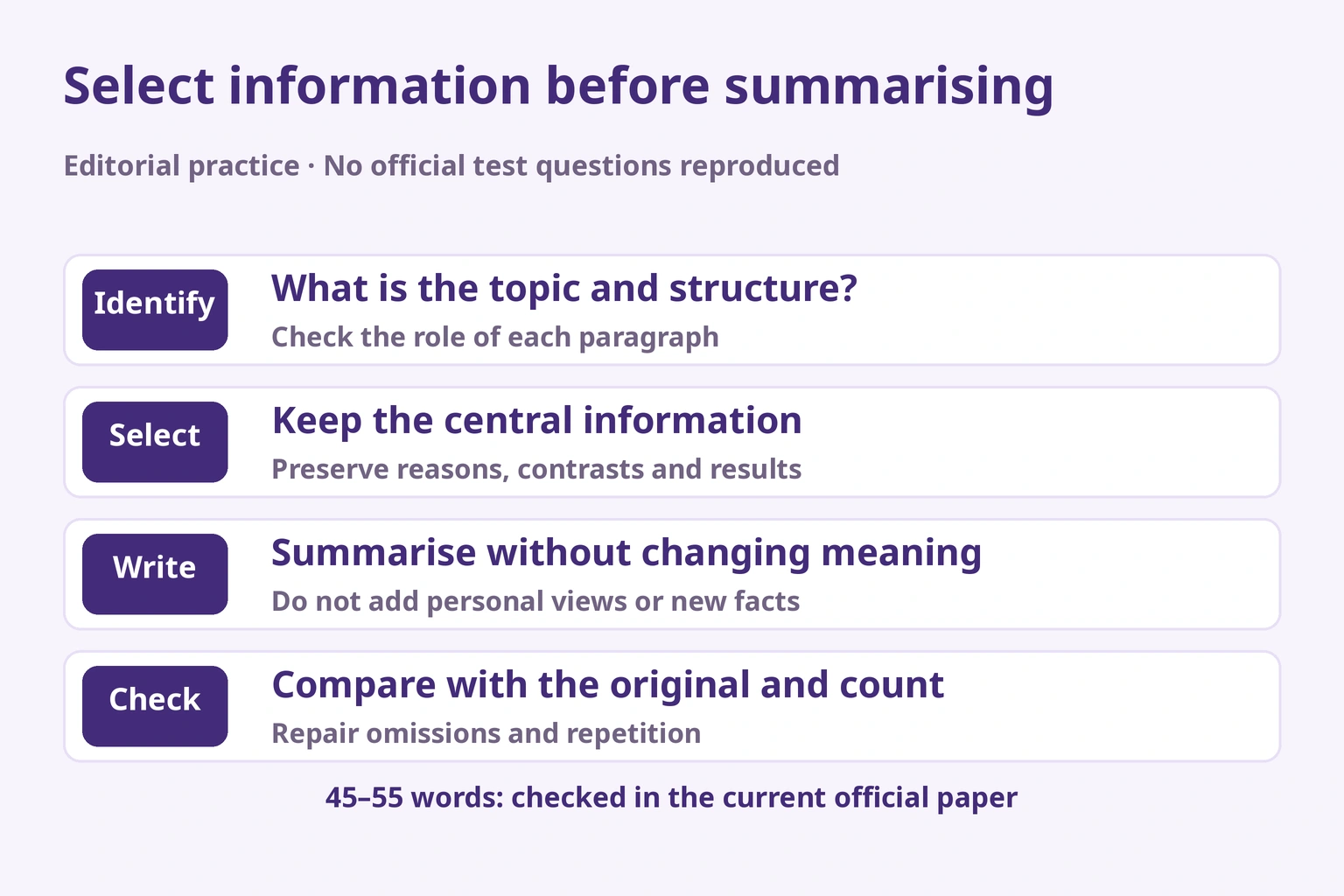
For a small original preparation exercise, imagine notes saying that school cooking classes are increasing, they teach independent-living skills, and ingredients and facilities create costs. “Cooking is fun, so every school must make it compulsory” adds a judgement that was not in those notes. Preserve the relationship between the trend, benefit and difficulty. This is an information-selection exercise, not an official task or a full 45–55-word answer.
Use the official current papers and sample answers. Compare which information each answer retains, rather than memorising its wording. Do not invent a rule such as “exactly three sentences always scores well.”
Opinion writing: develop two distinct reasons
Official format: an opinion and two reasons, with a suggested length of 80–100 words. The provided POINTS are optional perspectives (current instructions). The official essay criteria cover content, organisation, vocabulary and grammar.
Common problems are answering a different question, giving the same reason twice and leaving reasons unexplained. Plan your position, reason one with explanation, and reason two with explanation before drafting. Our original shared practice sentence is:
I think students should learn to cook because it helps them live independently.
It gives one opinion and one reason. It is not a complete essay and does not supply two reasons. Develop the idea of preparing meals independently, then consider a distinct reason such as understanding nutrition when choosing ingredients. Check that both actually address the task.
Keep the first draft. Revise the reasoning and language in separate passes so you know what changed. Prefer words whose meaning you can explain over impressive-looking vocabulary. Writing a short English diary can support a writing habit, but diary entries do not replace timed exam tasks.
Use official papers and sample answers alongside the essay criteria. Agreement with the model’s opinion is not the goal; relevance and explanation are. Official guidance warns that an off-topic response can receive zero marks.
Listening: separate language gaps from sound gaps
Official format: 15 conversation and 15 passage questions, about 25 minutes, played once (source). Keep your first, transcript-free result separate from reviewed attempts.
Learners may lose a familiar word in connected speech, stop at an unknown word, or choose an option because it repeats a word they heard. Review correct guesses too. Our sequence is attempt once → state the meaning briefly → inspect the transcript → replay the difficult sentence → check again without text. If the transcript is unclear, investigate vocabulary and grammar first. If it is clear, connect its words with the sound and say the sentence at a manageable pace.
Use the official audio and transcripts. You do not need to transcribe every recording in full. One understood sentence with a recorded cause of error is a clearer task than uncomprehending background listening. Keep original practice audio separate from official exam audio.
Speaking: begin short responses before the first stage
Official format: about 7 minutes, a roughly 60-word passage read aloud and four questions (source). Typical problems include knowing a written reason but being unable to say it, listing objects instead of narrating events, and delivering a prepared answer to the wrong question.
We would say an essay opinion and its reason aloud during first-stage preparation. That alone does not cover the interview: practise reading aloud, passage responses and three-picture narration with the official sample and virtual interview. Record only at home; recording, photography and notes are prohibited during the real interview.
Keep detailed task practice in our Grade 2 interview guide. For wider context, use the Eiken interview overview, Pre-2 Plus interview guide, S-CBT speaking guide and English-test comparison.
Study hours: budget for review as well as attempts
A universal number of hours needed to pass is not stated in the official guidance checked. Your school learning, retained Pre-2 knowledge and writing experience affect where you start. We therefore do not claim that a particular total is necessary or sufficient.
An editorial example is 60 minutes on five weekdays and 90 minutes on each weekend day: 8 hours per week, or 64 scheduled hours over eight weeks. 64 hours is a calendar budget, not a pass requirement. A possible 60-minute session is vocabulary 10, reading or audio review 20, drafting or revising one writing task 25, and recording the next action 5. Alternate the two writing tasks across days, and reserve a separate long slot for full timed practice.
School students can connect repairs with class texts; university students should allow for assignments; working adults can reserve desk time for writing and use travel time for short audio or vocabulary. After a missed day, restore a workable plan rather than automatically doubling the next session.
Our editorial plan with two months left
We would write summaries in week one, to discover whether the barrier is vocabulary or selecting information.
| Period — editorial | Work | Check |
|---|---|---|
| Week 1 | Diagnose with one official paper, write both tasks, inspect the interview sample | Can you name why each task stopped? |
| Weeks 2–3 | Repair vocabulary and structure, review short audio, revise both writing tasks | Can you explain the passage and your corrections? |
| Weeks 4–6 | Use another paper; trial the 85-minute allocation; reserve review days | Can you separate time pressure from misunderstanding? |
| Weeks 7–8 | Use an unseen paper, revisit errors and omissions, continue short speaking | Can you attempt everything and leave checking time? |
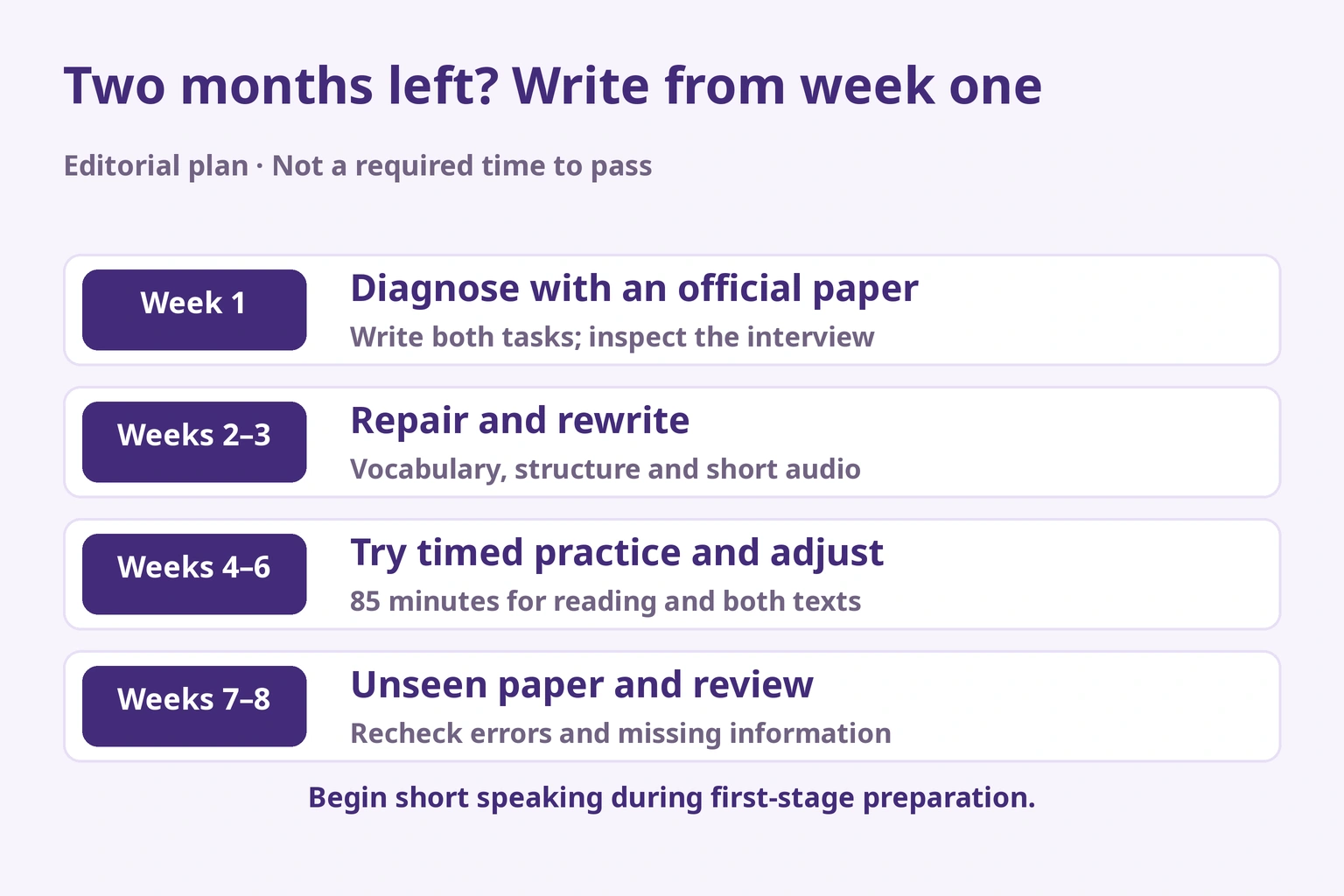
Keep new attempts and correction sessions separate. If a summary reverses cause and effect, repair the information relationship rather than merely adding a connector. Finishing the schedule and fixing the weakness are different checks.
Use official papers, audio, transcripts and answers together
The official Grade 2 page publishes one year, three administrations of first-stage papers and answers as PDFs, with listening audio and transcripts. Downloads cover main venues and quasi-venues on schedule F. At checking, the listed sets were 2026 sessions 2 and 1 and 2025 session 3. Recheck the page because the selection changes.
For the interview, use the sample PDF and virtual interview, not a supposed three-session archive of second-stage papers. The renewal notice identifies papers from 2024 session 1 onward as renewed-format papers. We would use one set to diagnose, another to adjust timing and an unused set to check transfer. Three sets are not a universal required amount. Finish useful review before opening the next set.
Three methods we would avoid
- Memorising complete essays or universal templates only: the content may not answer a new question. A short organising frame can help, but choose reasons for the task and never add an opinion template to a summary.
- Vocabulary books only: they leave information selection, writing and one-play listening unpractised. Build vocabulary alongside actual tasks.
- Past papers without review: repeated misunderstandings survive. Explain and correct the last error before simply increasing the paper count.
Choose tools after identifying the missing practice; our Eiken study-app comparison covers app selection without turning this plan into an app ranking.
Turn the practice sentence into something you can say
Use the cooking sentence above to check that your English matches your intended opinion, then practise saying the reason aloud. Continue full task practice with official materials.
In SpeakGain, we added this original sentence as one card through Add. From Library we opened Knowledge, then Learn this card. Listening hid the English and played the generated audio; after guessing and saying what we heard, Reveal answer showed the saved sentence.
We did not submit a recording or verify pronunciation assessment, answer marking or an Eiken score prediction. Develop the essay reasoning in the exercises above; use this short saved sentence as listening and speaking material.
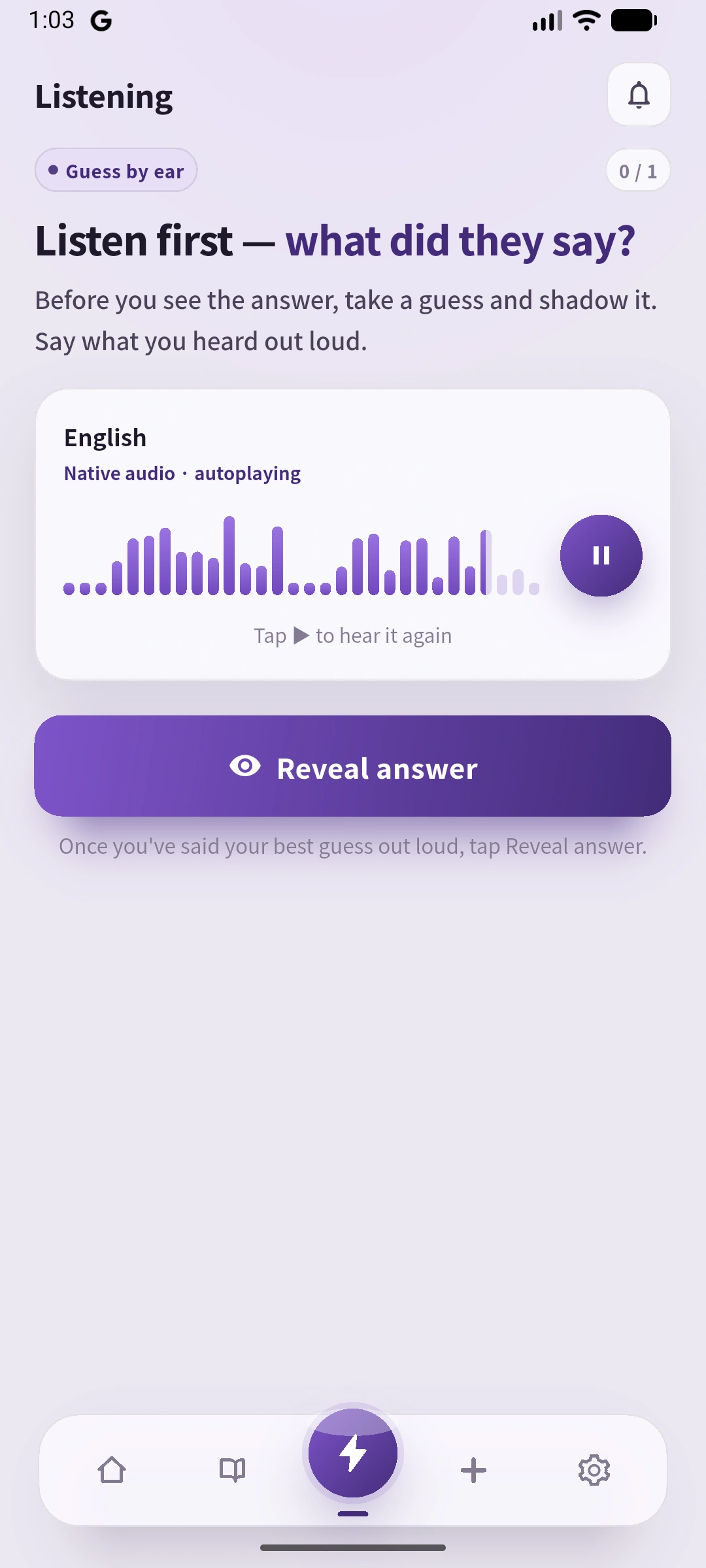
Original practice sentence · Viking AI audio
I think students should learn to cook because it helps them live independently.
Generated once for the original sentence above; not official exam audio or a complete answer.
Frequently asked questions
What should I do first?
Try all current tasks with an official paper and classify the causes of difficulty. Start both writing tasks alongside vocabulary work.
How many hours do I need?
The checked official guidance gives no universal requirement. Our 8-hour week and 64-hour example are planning budgets, not research-based pass thresholds.
Can one month be enough?
That depends on your starting point. Diagnose immediately, choose two weaknesses and combine timed attempts with review. Do not leave an unfamiliar summary task until the final week.
What if I only have two weeks?
Cover untouched tasks and repair recurring errors. Use full timed attempts if you understand the material; use short language repairs if you do not. A pass in two weeks is not promised.
How do I practise summaries?
Identify paragraph roles, select the main information and relationships, write, then compare with the original and check 45–55 words. Do not add personal views.
Can I convert a raw score into CSE?
No. The pass criteria are first stage 1520/1950 and second stage 460/650, but the official scoring explanation says candidates cannot calculate CSE from correct-answer counts.
What is easy to miss when studying alone?
Time to revise content and listen to your own speech. Compare with official examples and criteria, and ask a teacher when you cannot judge a response. Self-study alone does not determine the result.
How many past papers should I do?
The official page provides three administrations from one year. That is an available collection, not everyone’s required workload. Diagnose, adjust and test on unseen material, with review between attempts.
Should I jump from Pre-2 to Grade 2?
Try current Grade 2 material first and identify the reading, summary and explanation demands. Consider Pre-2 Plus if you want an intermediate step rather than judging readiness from vocabulary alone.
Editorial verdict: summaries from day one, review throughout
Diagnose with official material, reserve writing time immediately, and change the allocation according to the causes of errors. With less time, prioritise untouched tasks and repeated mistakes before adding resources. End a session able to say what you repaired, not only how many minutes you studied.
Official sources checked 16 October 2026. Examples, figures and schedules are editorial creations, not official test content, model answers or pass predictions. Eiken is a registered trademark of the Eiken Foundation of Japan.
For Japan’s Eiken Grade 2, our vocabulary resource and practice guide explains how to choose a book or app and use words in your own sentences.
For the official benchmark, CEFR and limits of pass-rate evidence, use our Eiken Grade 2 level guide and its steps for checking your readiness.