
Eiken Grade 2 level: CEFR, pass criteria and how to check your readiness
Published
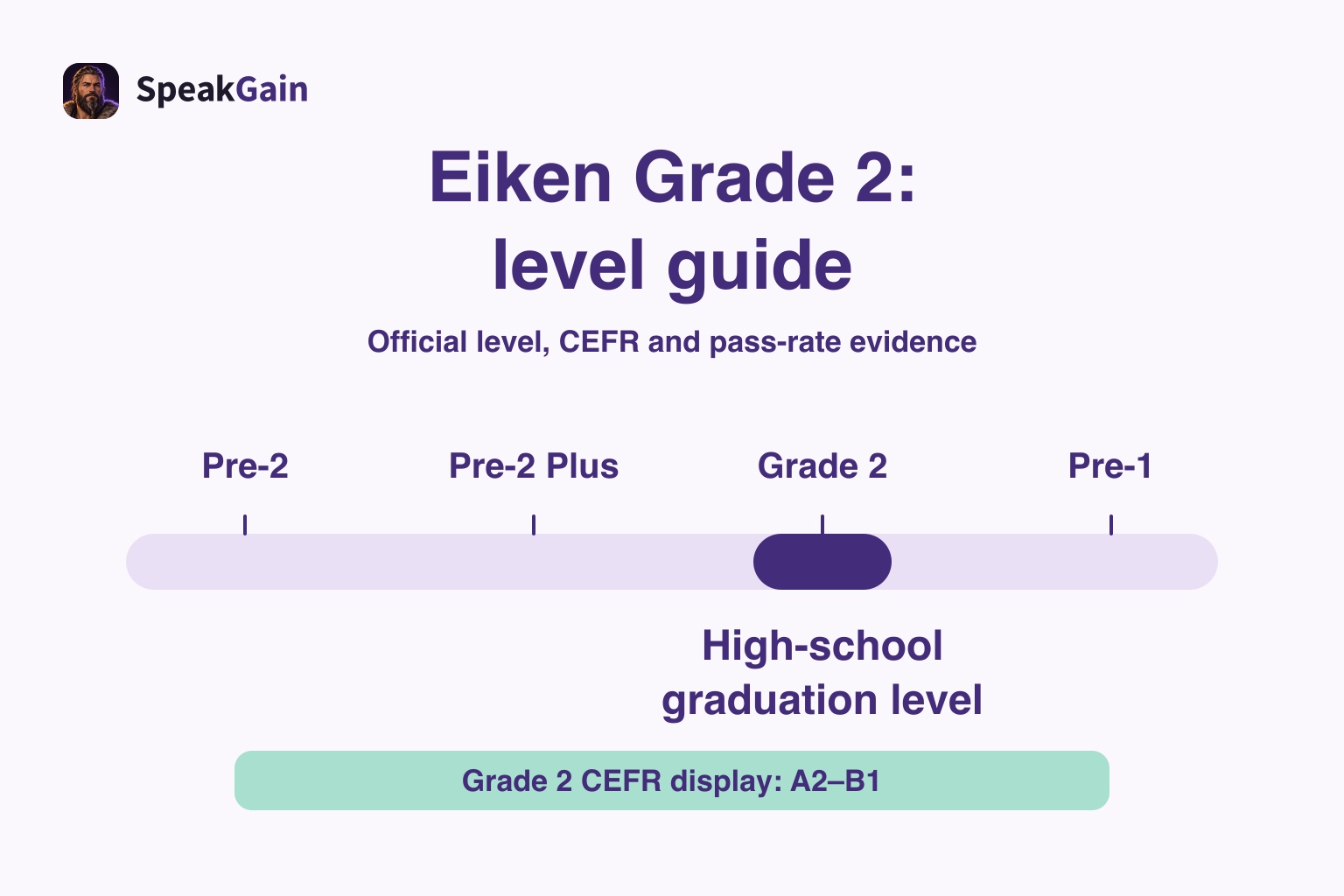
Japan’s Eiken Grade 2 has an official benchmark of high-school graduation level; the official comparison places its passing level at CEFR B1. No current official Grade 2 pass rate is published. To check your readiness, attempt all four skills with official past papers and the interview sample. Sources: grade benchmarks, CEFR comparison and participation data.
This is a guide to the Japanese qualification, for students, adults and parents, including English-speaking families in Japan. The school-stage description is a benchmark, not an age requirement or a statement that every graduate has this ability. The regulations allow candidates regardless of age, occupation or education, and without first passing a lower grade. Official information was checked on 16 October 2026. Practical judgements below are editorial advice.
Compare the four neighbouring grades first
This table describes the conventional two-stage test. R means reading, W writing, L listening and S speaking. The CEFR column separates the passing-level comparison from the range that can appear on a result.
| Grade | Official benchmark | CEFR: passing level / display range | Structure | CSE pass criteria: first / second stage | Official sources |
|---|---|---|---|---|---|
| Pre-2 | Mid high-school level | A2 / A1–A2 | R/W 80 min + L about 25 min; email reply and opinion; S about 6 min | 1322 / 406 | Benchmark, format |
| Pre-2 Plus | Upper high-school level | A2 / A1–A2 | R/W 85 min + L about 25 min; summary and opinion; S about 7 min | 1402 / 427 | Benchmark, format |
| Grade 2 | High-school graduation level | B1 / A2–B1 | R/W 85 min + L about 25 min; summary and opinion; S about 7 min | 1520 / 460 | Benchmark, format |
| Pre-1 | Mid university level | B2 / B1–B2 | R/W 90 min + L about 30 min; summary and opinion; S about 8 min | 1792 / 512 | Benchmark, format |
Shared sources for the numerical columns: official grade comparison, current CSE/CEFR ranges and CSE pass criteria. Stage one combines R/L/W; stage two assesses S separately. These numbers are CSE scores, not counts of correct answers.
What can and cannot be confirmed officially?
| Item | Official status in the current guidance checked | Treatment here |
|---|---|---|
| School-stage benchmark | Published: high-school graduation level | Not an age limit or a national attainment rate |
| CEFR and CSE thresholds | Published | Distinguish passing from the displayed CEFR range |
| Test structure and time | Published | Use current official tasks and timings |
| Current Grade 2 pass rate | No current official publication | No old or estimated percentages |
| Direct conversion to TOEIC or a deviation score | Not stated; no official direct conversion found | Do not assert “Grade 2 = TOEIC X” |
| Nationwide share of high-school students holding Grade 2 | Not stated | No claim that it is “normal” for a school year |
| Universal study hours or difficulty multiplier | Not stated | Check your own task gaps and available time |
| Universal admissions or hiring advantage | No common rule stated | Check each institution or employer |
We checked the Grade 2 guide, benchmarks, CSE, participation data and admissions guidance. “Not stated” refers to those current sources, not a claim that no historical document ever mentioned a number.
What changes between grades?
The official criteria move from everyday life at Pre-2, to familiar social topics at Pre-2 Plus, social topics at Grade 2 and more socially complex content at Pre-1. We would judge the difference through understanding and explaining relationships, not vocabulary totals alone.
Pre-2 asks for an email reply; Grade 2 asks for a summary. In the interview, Pre-2 includes describing people’s actions and situations; Grade 2 includes narrating a three-picture sequence. See the Pre-2 and Grade 2 formats. A learner may recognise words yet miss the argument, or understand a passage but struggle to explain events.
Pre-2 Plus and Grade 2 share task names and broad timings, but their targets differ: familiar social topics versus understanding and organising the development of social topics. Compare actual official material rather than assuming identical difficulty from the label “summary” (benchmarks). Pre-1 also has a four-picture, two-minute narration, a different task from Grade 2 (Pre-1 format). Use our guide to choosing an Eiken grade for the wider decision.
For the intermediate grade itself and how to decide whether to take it, see our Pre-2 Plus guide.
B1 as a benchmark, A2–B1 on a Grade 2 result
CEFR is a common framework for describing what a language user can do. In the official CSE explanation, B1 includes understanding main points on familiar topics and producing straightforward connected text on topics of interest. It does not mean every Grade 2 candidate receives B1.
For Grade 2, an overall four-skill CSE below 1728 produces no overall CEFR display; 1728–1949 gives A2, and 1950–2299 gives B1. At 2300 or above, the Grade 2 display remains capped at B1. All four skills must be taken for an overall CEFR result (official ranges).
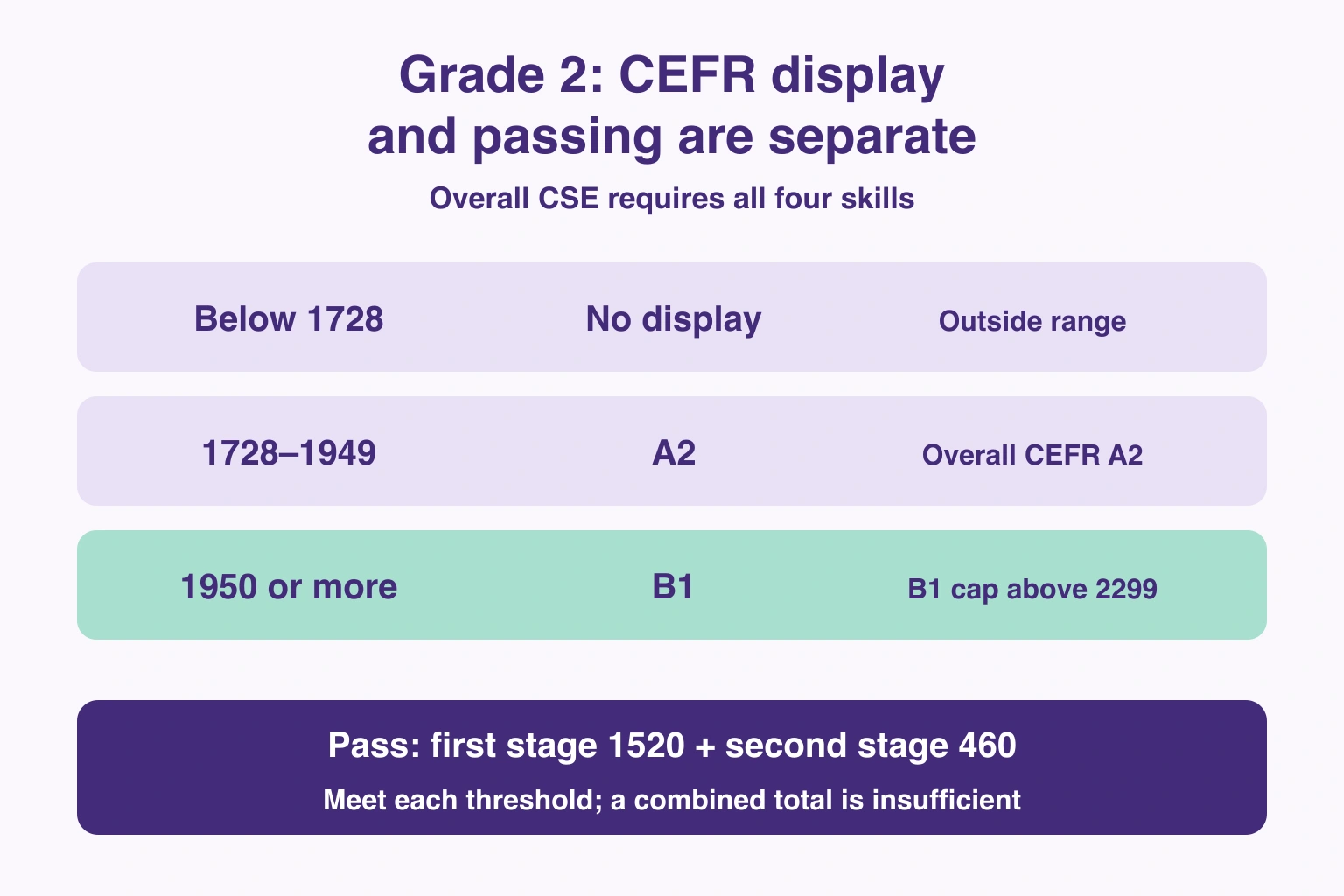
A B1 display alone does not prove you passed both stages. Admissions may require the grade, a total, skill scores or CEFR. Check the actual condition. We found no current official direct conversion from Grade 2 to an individual TOEIC score or deviation score. CEFR comparison is not a promise of another test’s score. See our English-test comparison for choosing the qualification your destination accepts.
Format and CSE: what you actually need to attempt
The current Grade 2 format gives R/W 85 minutes and L about 25. Reading contains 17 short-text gaps, 6 passage gaps and 8 comprehension questions. Writing has one summary and one opinion task. Listening has 15 conversation and 15 passage questions, each played once. The 2026 session 2 booklet specifies 45–55 words for the summary and a suggested 80–100 for the opinion. Write both; merely reading model responses will not reveal your information-selection difficulty. Detailed composition belongs in our Grade 2 writing guide.
The interview lasts about 7 minutes: read roughly 60 words aloud, then answer a passage question, explain a three-picture sequence and answer two opinion questions. Silent reading and preparation for the picture explanation each allow 20 seconds (format). See our Grade 2 interview guide for task practice.
Stage one requires 1520/1950 CSE, stage two 460/650. Each skill has a maximum of 650. Adding the two thresholds gives 1980, but a combined 1980 does not replace meeting each stage’s condition. The official scoring explanation states that candidates cannot calculate CSE from correct-answer counts. We would use home scores to locate weaknesses, not declare a guaranteed pass or ignore writing.
Why no current pass-rate percentage?
No current official Grade 2 pass rate is published. The current participation page reports combined applications for Eiken, Eiken IBA and Eiken Jr.; those figures are not Grade 2 candidates or passes. They cannot produce a Grade 2 pass rate.
When a percentage appears elsewhere, ask about its year, stage and population. An old figure or a school’s cohort is not a current nationwide rate. Also distinguish the share of candidates passing from your percentage of correct answers. Neither gives a personal pass probability. We do not fill the evidence gap with an estimate.
Four skills in the official Can-do list
The Can-do list describes skill goals towards passing. Below we summarise the current Grade 2 list. All example sentences are ours; they are neither test items nor a one-sentence level assessment.
| Skill | Official goal, summarised | Our brief example and what to check |
|---|---|---|
| Reading | Follow the development, main points and detail of social-topic texts | The city plans to plant more trees to keep streets cool. Separate the action from its purpose. |
| Listening | Follow the flow and relevant detail of speech on social topics | The recycling center will open an hour later tomorrow. Identify the changed time and day. |
| Speaking | Organise and convey information and ideas in detail, using varied language | I think public parks are important because they give people a place to relax. Connect an opinion to its reason. |
| Writing | Develop information and ideas in a detailed, organised text | Schools should reduce food waste because it saves resources. Make the claim–reason link clear. |
The real goals extend beyond understanding these short sentences. Use longer official reading, recordings, writing and interview tasks to check them. Conversational familiarity alone does not demonstrate all four skills; equally, recognising a written reason is different from producing it in response to a question. These are editorial distinctions for self-checking, not statistics about candidates.
Six steps to check your readiness
This is our editorial sequence, not an official diagnostic test or pass prediction.
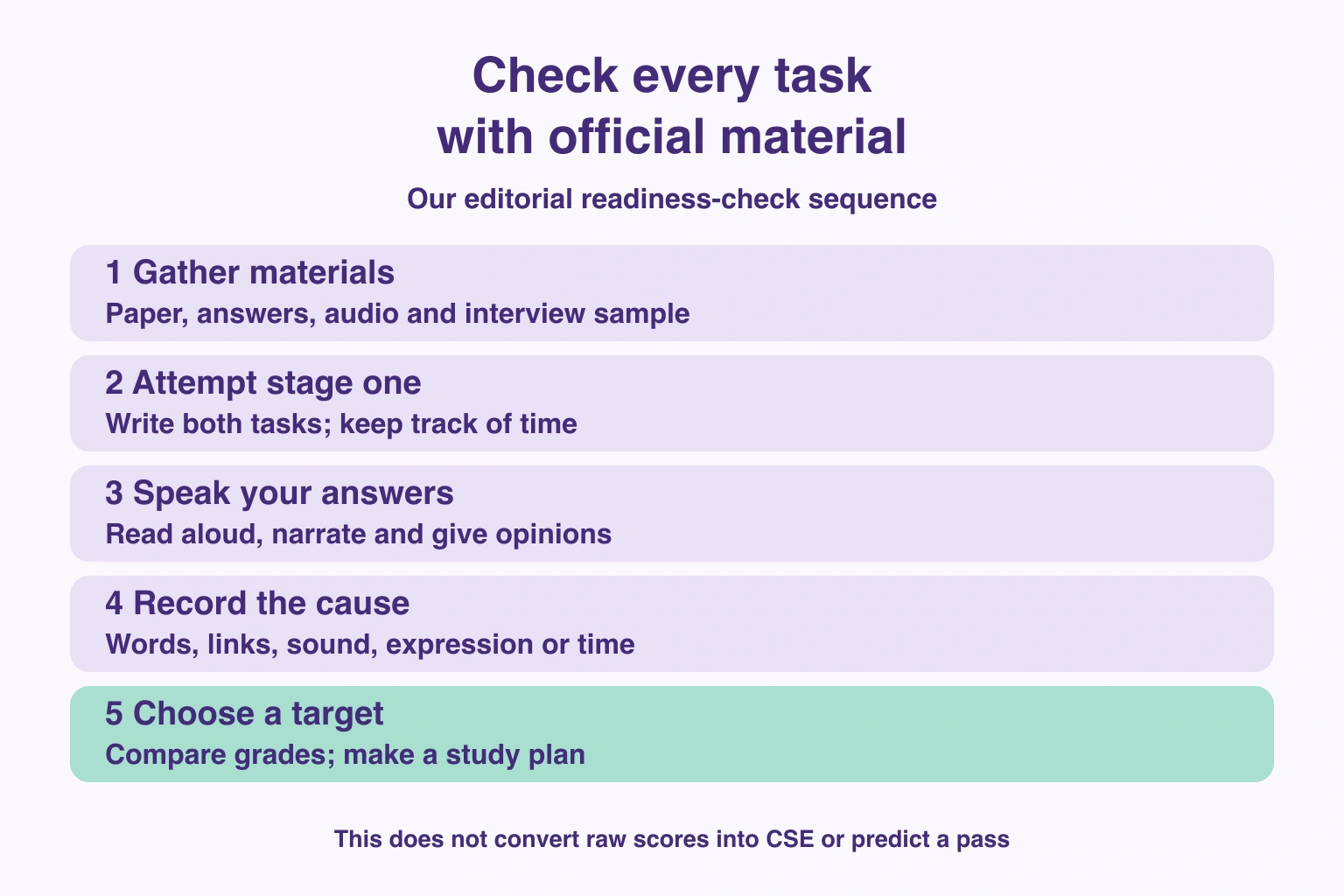
- Gather matching official material. Open the Grade 2 page for one administration’s booklet, answers and listening audio. At checking, one year’s three administrations were available. For stage two, use the sample and virtual interview linked there.
- Time the whole first stage. Include both written tasks in the 85 minutes; play listening without pausing. Follow the selected booklet. Record unanswered tasks separately from wrong answers. Understanding a model afterwards does not mean you completed the task on time.
- Separate answer checking from reviewing writing. Compare R/L with the official answers. For writing, compare selected information, omissions, added opinions and relevance with the model. Ask a teacher when you cannot judge it; do not invent a favourable mark and convert it into CSE.
- Speak through the interview sample. Try reading aloud, passage responses, narration and opinions using the official sample. You may record yourself in home practice. Recording, photography and notes are prohibited in the real interview (official rules).
- Record why you stopped. We would distinguish vocabulary, sentence relationships, sound recognition, information selection, expression and time. For listening, compare “I understand the transcript” with “I still cannot understand it in writing.” Record actions such as “found evidence” or “could not finish the summary,” not just a total.
- Compare neighbours and choose a next step. If social-topic explanation or summary writing is a barrier, try official Pre-2 Plus material; revisit Pre-2 gaps if needed. Passing every grade in order is not required (regulations). When choosing Grade 2, use our study plan and vocabulary guide for methods rather than treating this level guide as a whole course.
Admissions and employment: check the actual destination
Grade 2 does not guarantee a benefit at every university or employer. Start with official admissions checks, then consult the destination’s current rules. Our checklist is:
- Identify the university, faculty, admission route and year, or the employer’s specific role and vacancy.
- Check which tests and Eiken formats are accepted, and whether the condition is passing a grade, total CSE, skill scores or CEFR.
- Distinguish eligibility, extra marks, score substitution and credit; do not assume one means another.
- Confirm eligible test dates, submission deadline, certificate and delivery method. Ask the admissions or hiring office when unclear.
Do not derive selection results from the words “high-school graduation level.” Parents can discuss the required condition and the child’s untried tasks instead of comparing them with an unsupported idea of what is normal.
Make an opinion and reason your own
Our shared original sentence is:
I think public parks are important because they give people a place to relax.
It links “parks matter” to “they provide somewhere to relax.” This 14-word sentence is not a complete 80–100-word opinion response or interview answer. Check that it expresses your meaning, then try explaining the reason another way. We would use short original thoughts before memorising long model responses, checking relevance against each official task. An app screen is not evidence of your Eiken level or predicted score.
Use SpeakGain to listen to the sentence you understand
In SpeakGain, we added the original parks sentence above as one card through Add. We opened View in Library, then Learn this card. Listening hid the English and played the generated audio; its instructions asked the learner to guess and say what they heard. Reveal answer displayed the saved sentence.
We did not submit a recording or verify pronunciation assessment, answer marking or an Eiken score prediction. Continue developing content with official tasks, and use this short, understood sentence as listening and speaking material.
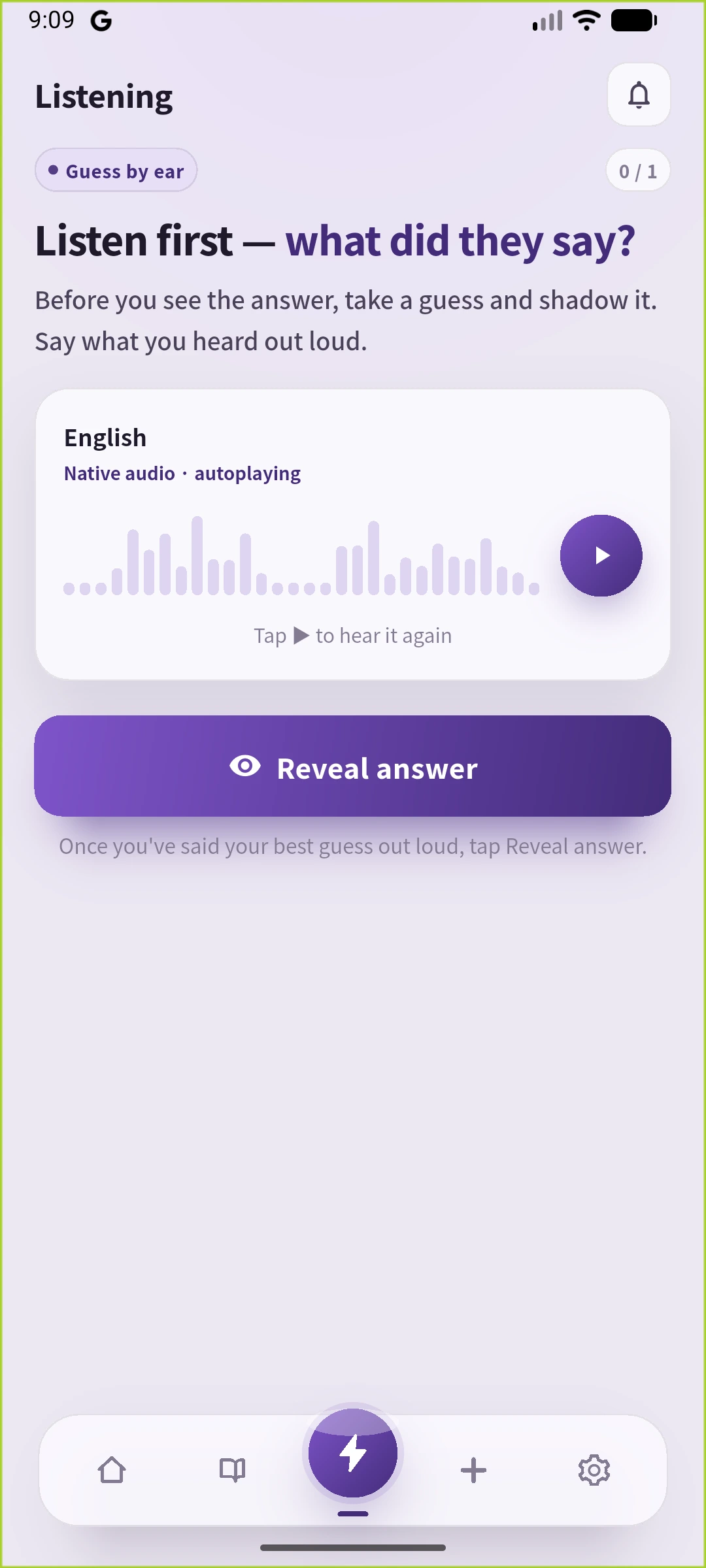
Original practice sentence · Viking AI audio
Generated once for the original parks sentence above; not official exam audio or a complete response.
Frequently asked questions
What level is Grade 2?
The official benchmark is high-school graduation level, with B1 as the passing-level comparison. A Grade 2 result can display A2–B1 depending on overall CSE and its calculation range (benchmarks, CSE).
Is it an “impressive” qualification?
The checked guidance does not define that subjective label. Use the Can-do goals, your purpose and the destination’s requirements.
What percentage passes stage one or two?
No current official Grade 2 pass rate is published. The application totals cannot establish either stage’s rate.
What TOEIC or deviation score is equivalent?
We found no current official direct conversion. CEFR offers a shared yardstick, not an individual score prediction (CSE).
Is Grade 2 normal for high-school students, or late for adults?
The checked guidance provides no national holding rate or “late” threshold. The regulations do not restrict age, occupation or education.
Can I use it for university or work?
That depends on the institution and route or the employer and vacancy. Check grade, score, test date and documents; use official admissions guidance as a starting point.
How much harder is it than Pre-2?
The benchmark and tasks differ, including summary writing and picture narration. No universal difficulty multiplier is stated (Pre-2, Grade 2).
Can I prepare alone, and how many hours are needed?
The checked current guidance states no universal number. Try all official tasks, then plan around gaps; seek feedback on writing you cannot judge. See our Grade 2 study plan.
Does 60% on a past paper guarantee a pass?
No. Candidates cannot calculate CSE from correct-answer counts. Distinguish your practice percentage from the stage thresholds (official scoring).
Editorial verdict: use official tasks to find your starting point
Understand the high-school-graduation/B1 benchmark, then attempt every official task before deciding whether Grade 2 is your next target. Check whether you found main points, completed a summary and supported an opinion. Those observations suggest a next action more clearly than an unsupported conversion or pass-rate estimate.
Today, open the official paper and interview sample, identify an untried skill and schedule a complete check. If you need the qualification for an application, confirm the destination’s conditions alongside practice.
Official sources checked 16 October 2026. Examples, diagrams and the self-check sequence are editorial creations, not official questions, answers or pass predictions. Eiken is a registered trademark of the Eiken Foundation of Japan.