
Eiken Grade 2 Writing: summaries, opinion essays and the limits of templates
Published
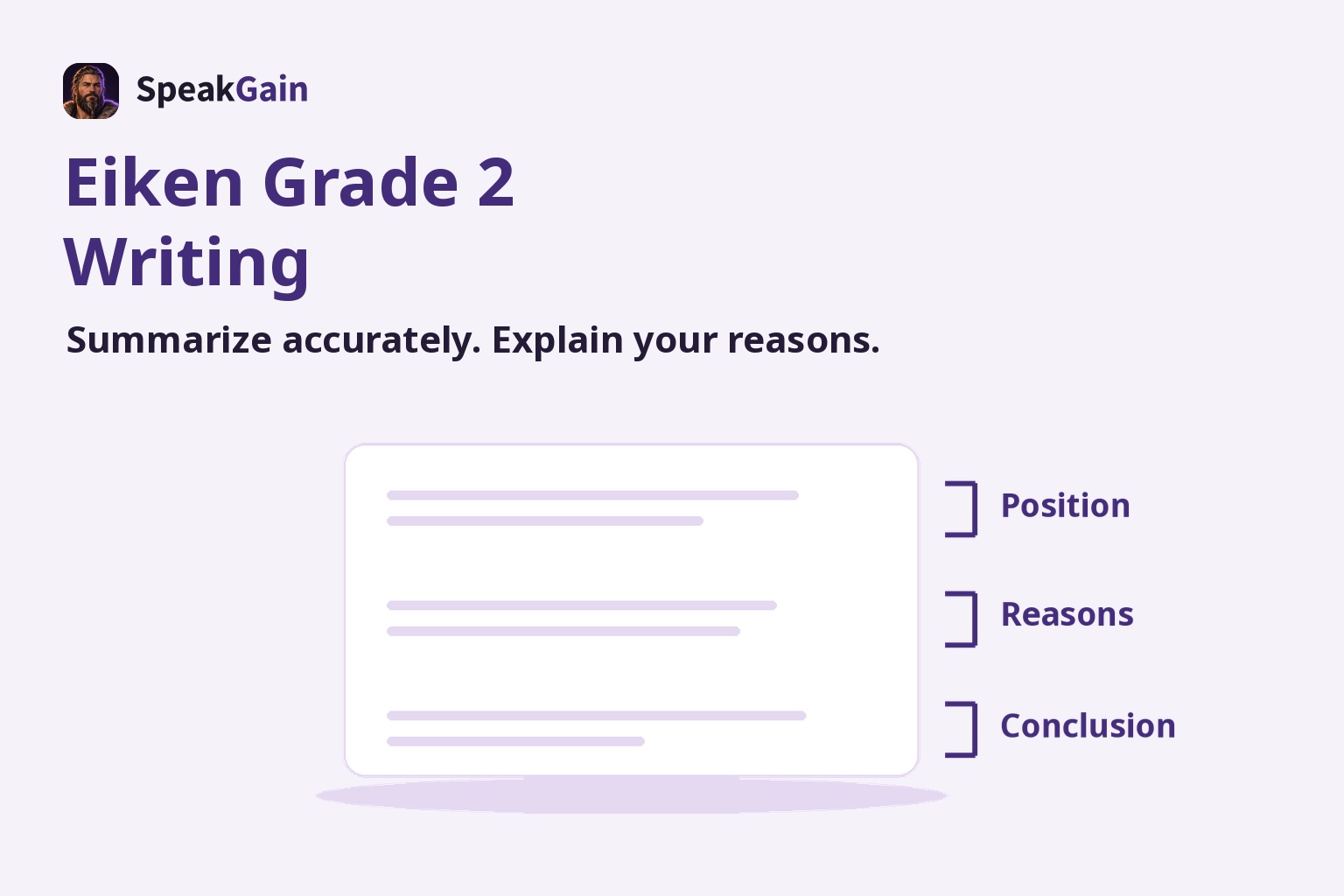
Japan’s Eiken Grade 2 Writing has two tasks: a 45–55-word summary and an opinion essay with two reasons, with a guideline of 80–100 words. The official essay viewpoints are content, organization, vocabulary and grammar; our editorial advice is to practise answering the question, explaining reasons and preserving a source text’s meaning as separate skills. Use a template to organize information rather than forcing a memorized paragraph into every topic.
This guide is for students and adults preparing for Japan’s conventional Grade 2 examination, including English-speaking residents of Japan. Requirements were checked on 16 October 2026 against the current official task list, 2026 session 2 question booklet and official essay scoring guidance. Every practice passage, question and answer here is newly written by our editorial team. None is an official question, a prediction or a scored model answer.
For Reading, Listening, the interview and a schedule based on the time remaining, use the whole-test Grade 2 study plan; this article stays focused on Writing.
Current tasks and word counts
| Task | What to write | Length | Official source |
|---|---|---|---|
| Summary | Condense the supplied text in English; do not add your own opinion | 45–55 words | Booklet, printed page 12 |
| Opinion essay | Answer the topic and give two supporting reasons | Guideline: 80–100 words | Booklet, printed page 14 |
The current official list gives one question of each type. The booklet says that the suggested POINTS are reference angles for reasons; other angles are allowed. Inserting a POINTS word does not replace explaining a reason. Reading and Writing share 85 minutes. There is no separate signal to start Writing, and both writing tasks must be answered. Fixed minutes for each task are not stated in the official materials inspected. The practice allocation below is our suggestion, not an examination instruction. Use the official samples and answers to check the actual format.
Four essay viewpoints: what to check before difficult language
The second column paraphrases the official essay guidance. Mistakes and checks are our editorial applications, not a penalty schedule.
| Viewpoint | Official meaning, summarized | Common mistake | How to check alone |
|---|---|---|---|
| Content | Include the required opinion and supporting reasons | Describe the topic without answering the question | Underline the answer; check that both reasons support it |
| Organization | Make the sequence and development logical and understandable | Use connectors while contradicting the opening | Name each sentence’s job in your preferred language |
| Vocabulary | Use suitable words correctly in context | Replace a familiar word with an inaccurate synonym | Check meaning and word combinations in a dictionary |
| Grammar | Use a range of sentence structures accurately | Make sentences longer but lose subject–verb relationships | Check subjects, verbs, number, tense and clause connections |
Checked 16 October 2026. This official page mainly explains opinion essays. Detailed summary-specific descriptors and marks for our checklist items are not stated in the official materials inspected. For a summary, check the source’s information rather than adding an opinion to fit an essay checklist.
The official essay guidance warns that an answer which does not address the question, or discusses an unrelated topic, may receive zero across all viewpoints. The current summary instructions also warn that an answer judged not to be a summary may receive zero. A fixed deduction per missing or extra word, or automatic zero solely for missing the length range, is not stated in the inspected official materials. This is not permission to ignore the range. Revise to the instruction instead of relying on an invented “safe” tolerance. The booklet also says that writing outside the answer area is not marked.
Summary: select information and preserve its relationships
Official task and review focus
The current booklet asks for a 45–55-word summary. Our steps below are practice advice: retain the topic, important explanations and relationships such as contrast or cause. Do not import the “I agree” opening from opinion writing.
Steps
- Read the whole passage before naming its topic. The first sentence alone may not reveal the complete focus.
- Note what each paragraph adds: benefits, problems, causes, consequences or other information. Do not assume every source follows a benefits-versus-drawbacks pattern.
- Separate examples from main explanations. Ask whether removing a product name or individual scene leaves the point intact. Keep both sides of a meaningful contrast.
- Connect the selected information in short English sentences. Preserve qualifications: “may happen” must not become “always happens.” Meaning comes before replacing vocabulary.
- Compare with the source, then count words. Remove invented opinions, clarify pronouns, restore missing main points and cut repetition.
Original short passage and summary
This short passage explains the method; it does not reproduce the length or difficulty of an official mock test.
Some neighborhoods have started lending household tools to local residents. People can borrow items such as drills and ladders instead of buying them. The tools are kept in a shared room, and volunteers manage the service.
Borrowing can save residents money, especially when they need an item only once. Sharing also means that fewer new products need to be made. However, volunteers must inspect returned tools carefully. Broken equipment can be dangerous, and repairing it takes time. Residents may also have to wait if several people want the same item.
Our summary: 49 words, counted by spaces
Some neighborhoods lend household tools to local residents. This can reduce spending and the need for new products. However, volunteers have to check and repair the equipment to keep it safe. Residents may also need to wait when a tool is popular and several people want to borrow it.
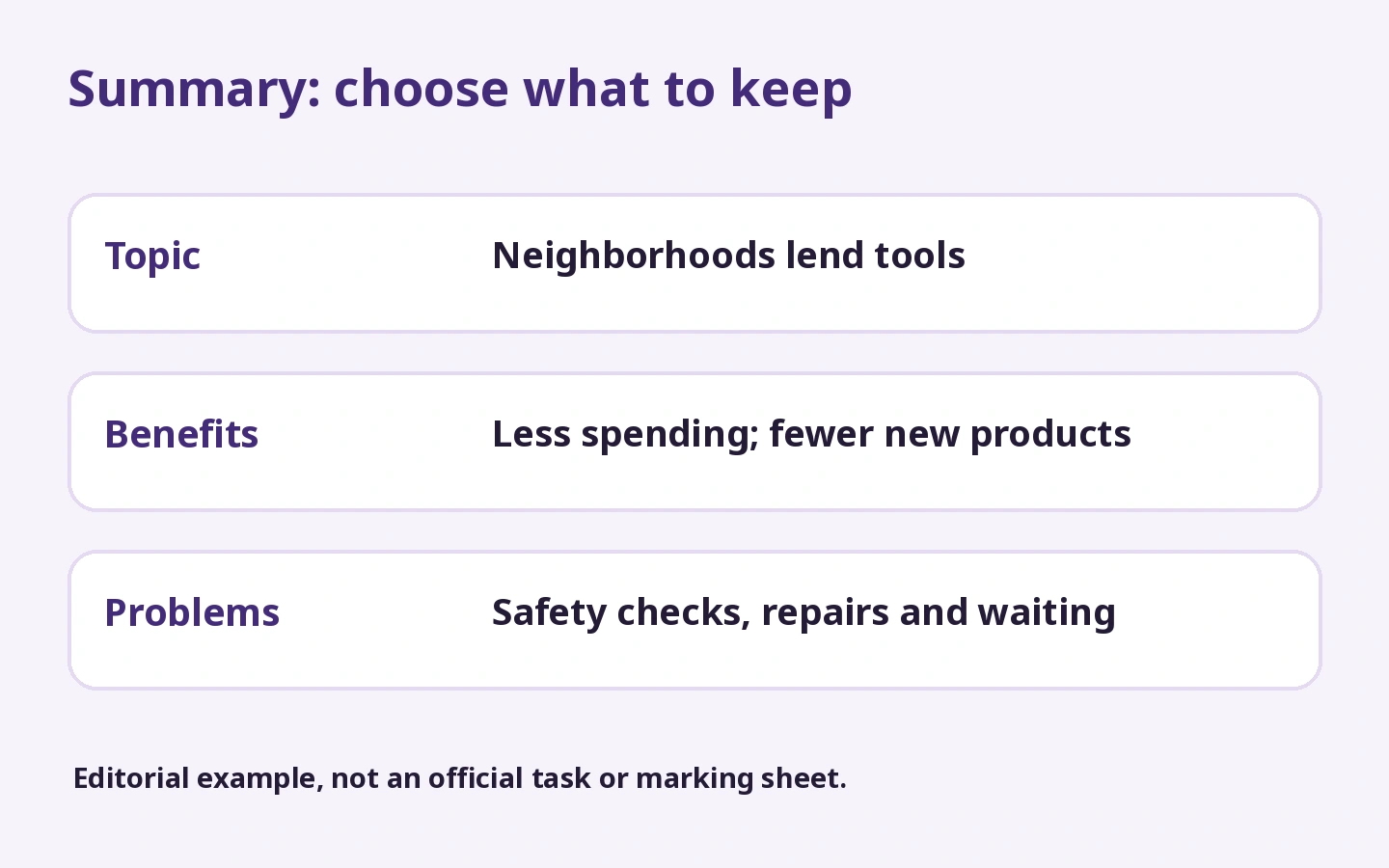
The topic is neighborhood tool lending. The benefits are lower spending and less need for new products; the problems are safety checks, repairs and waiting. Specific tool names can disappear while those relationships remain. “Can” preserves possibility rather than promising savings in every case. We add neither a personal borrowing experience nor a policy recommendation. Before shortening a sentence, check whether it carries a main point. This example has no claimed Eiken score.
Common mistakes
Rewriting only the opening loses the later information. Return to your paragraph notes. Replacing every word can also change meaning: necessary terms such as “household tools” may remain, while examples are generalized or sentences combined. See meaning-preserving paraphrasing. Finally, do not insert “However” unless the surrounding ideas actually contrast, and do not erase the source’s problems to make a positive-only description.
Self-review checklist
- Can a reader identify the source topic?
- Are the main points from the relevant paragraphs retained, rather than only examples?
- Have you avoided personal opinions and unsupported facts?
- Are possibility, negation, comparison and cause still accurate?
- Is it 45–55 words, with clear subjects, verbs and pronoun references?
Point from each summary sentence back to its source evidence. If you cannot find support, reconsider that sentence even when it sounds polished.
Opinion essay: choose a position and explain two reasons
Official task and viewpoints
The current instructions require an opinion and two reasons, with an 80–100-word guideline. The official viewpoints emphasize relevant content, development, consistency and appropriate language. Merely counting two reason labels does not show why they support your answer.
Steps
- Identify the exact judgment: is something a good idea, or will it become more common? Recognizing the topic noun is not enough.
- Choose a position you can explain with two reasons. This is our practical choice, not an official rule favoring agreement or disagreement.
- Pick reasons that differ. “Saving money” and “being cheap” can repeat the same point; choose another relevant angle such as safety or time.
- Ask “why?” after each reason. Who benefits, what becomes easier, or which cost falls? Do not invent survey numbers.
- Try position → reason and explanation → another reason and explanation → conclusion. This is an editorial structure, not a mandatory official paragraph count.
- Compare the opening, conclusion and question before checking length and language.
Original practice essay
Our practice question: Should towns lend household tools to local residents? This is not an official or past-paper question.
Our essay: 90 words, counted by spaces
I think towns should lend tools because sharing them saves money. First, residents would not have to buy expensive equipment for small jobs. For example, someone who needs a drill once could borrow one instead. Second, a town service could help people use safe equipment. Staff could check each tool and explain how to use it before lending it out. This would be useful for residents who have little experience with repairs. For these reasons, I believe a tool lending service would be a good idea for the whole community.
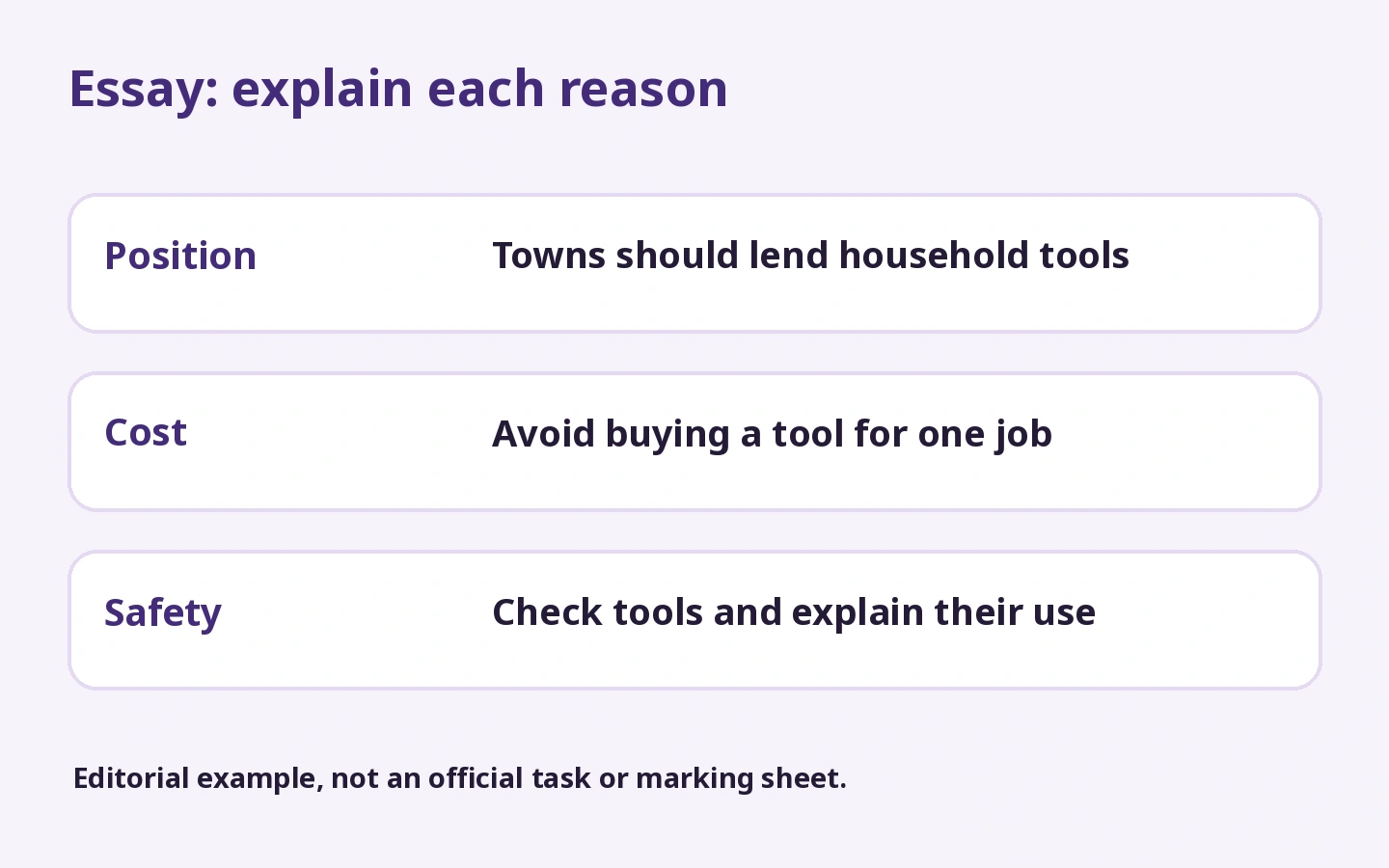
The first reason develops the cost of buying something for one job. The second develops safety checks and instructions. The topic overlaps with the summary example, but this essay supports a personal position instead of reporting a source. No official mark or passing prediction is attached.
Common mistakes and self-review
“Cheap” or “safe” without explanation leaves the reader asking how. Add a mechanism or example rather than just a harder word. A second reason that says the service should not exist contradicts this essay’s position; check the official warning on contradictory reasons. A memorized sentence about “society’s development” adds little unless its relevance is explained.
- Does the opening answer the question’s actual judgment?
- Are there two distinct reasons supporting the position?
- Does each have an explanation or example tied to the question?
- Is the conclusion consistent, with no irrelevant filler?
- Does it follow the 80–100-word guideline, using accurate words, verbs and tenses?
Keep the first draft. Revise one issue, such as the missing explanation after the second reason, and compare the versions.
Templates: remember jobs, not complete paragraphs
A structural template can remind you to state a position, explain reasons and conclude. It cannot supply the content. “First” does not create a reason; “I have two reasons” does not make repeated ideas distinct. If space is tight, our editorial choice is to remove the announcement and develop the actual reason.
For summaries, forcing benefits and drawbacks onto a passage about causes and solutions changes its organization. For essays, a preference statement does not necessarily answer a question about future trends. Change the structure and wording to fit the source or question.
Permission rules or automatic bonuses and penalties for specific template phrases are not stated in the official materials inspected. Our objection to memorized paragraphs follows the official viewpoints: relevance, explanation, consistency and accurate language still have to be demonstrated.
Practise alone: content, structure, language, length
Compare the first draft with the source or question before opening the official answer. First check information and reasons; then name each sentence’s role; next check vocabulary and grammar with a dictionary; finally count words. Record one recurring issue and try to notice it with a new topic the next day. Fixing grammar first can leave a fluent answer to the wrong question.
Keep specific uncertainties such as “these two reasons might overlap” rather than simply writing “bad essay.” If you can ask a teacher or study partner, show the relevant sentence. Self-review finds fixable problems; it does not reproduce official marking.
English diary practice helps you keep writing, but recording events alone does not practise source selection or answering an examination question. The diary and writing app guide discusses tools for recording and revision; the Eiken study app guide organizes tools by skill.
If you use AI correction, treat its output as a proposed wording. Compare every change with the source or your intended position. Check that facts have not been added and that you can explain the change. We do not rank scoring services or interpret an AI number as an official Eiken mark or passing prediction. Return to a sentence you understand instead of memorizing an unexplained rewrite.
Our editorial two-week writing routine
This is our practice proposal, not an official plan or a guarantee. It covers Writing only; split drafting and review across days if needed.
| Days | Work | Keep a record of |
|---|---|---|
| 1–2 | Read official instructions; try both tasks | First drafts, time and difficulties |
| 3–4 | Select summary points and compare with the source | Examples removed and points missed |
| 5–6 | Separate essay reasons and explain each | Repetition and revised explanations |
| 7 | Review both; select one recurring problem | One focus for the next week |
| 8–10 | Alternate tasks using different material | Whether the structure still fits |
| 11–12 | Write and review with a clock | Drafting and checking time |
| 13 | Try official material with Reading | Time left within the shared 85 minutes |
| 14 | Fix recurring problems rather than adding phrases | Your own checking order |
As an initial practice allocation, we would try 15 minutes for summary, 20 for essay and 5 for checking: 40 minutes of Writing within the shared session. These are editorial starting points, not official task limits. Test them together with Reading and adjust if one answer is left blank.
Three methods we do not recommend
- Memorizing whole paragraphs: it can hide whether you can adapt the content. Point out the position, reasons and explanations in a new answer.
- Padding the word count: unrelated text adds words without restoring a main point or explanation. Official guidance warns that irrelevant or contradictory content can affect organization.
- Memorizing predicted answers: recalling a response does not show that you can answer a differently phrased question. Change the judgment and test whether the reasons still work.
Take one written sentence into interview practice
Use this sentence from our essay: I think towns should lend tools because sharing them saves money.. It contains a position and a reason. Try saying the idea without looking, then answer a different question. Repeating one sentence and responding to a new question are separate activities. Our Grade 2 interview guide covers practice for the oral tasks.
Listen to one sentence and reveal it in SpeakGain
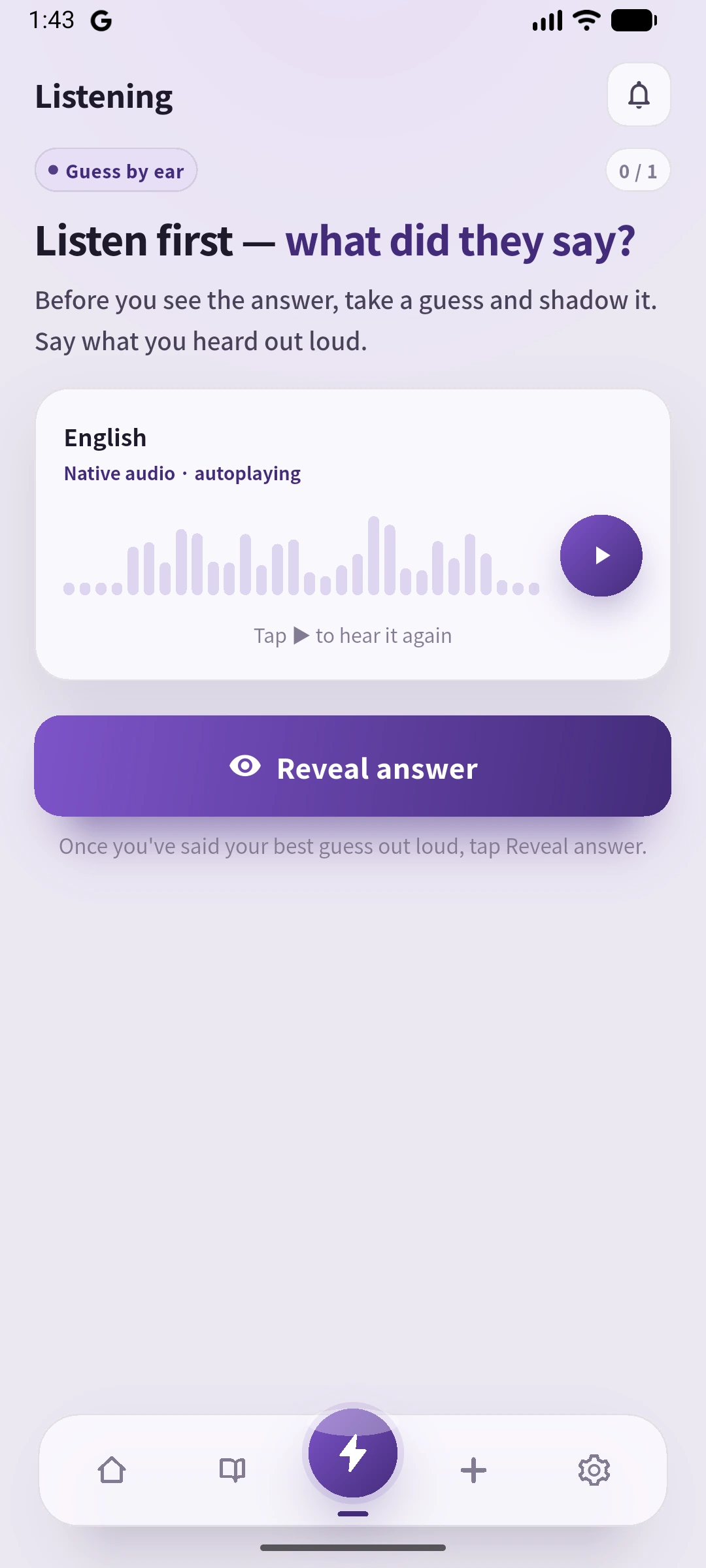
On the device, we saved the sentence above through SpeakGain’s normal Add flow, then opened Library → Knowledge → Learn this card → Listening. Listening hid the sentence and automatically played the audio, with instructions to say what we heard before tapping Reveal answer. Answer then displayed the original sentence. We did not submit a recording or verify an assessment. Continue checking full summaries and essays against their source, question and the official viewpoints described above.
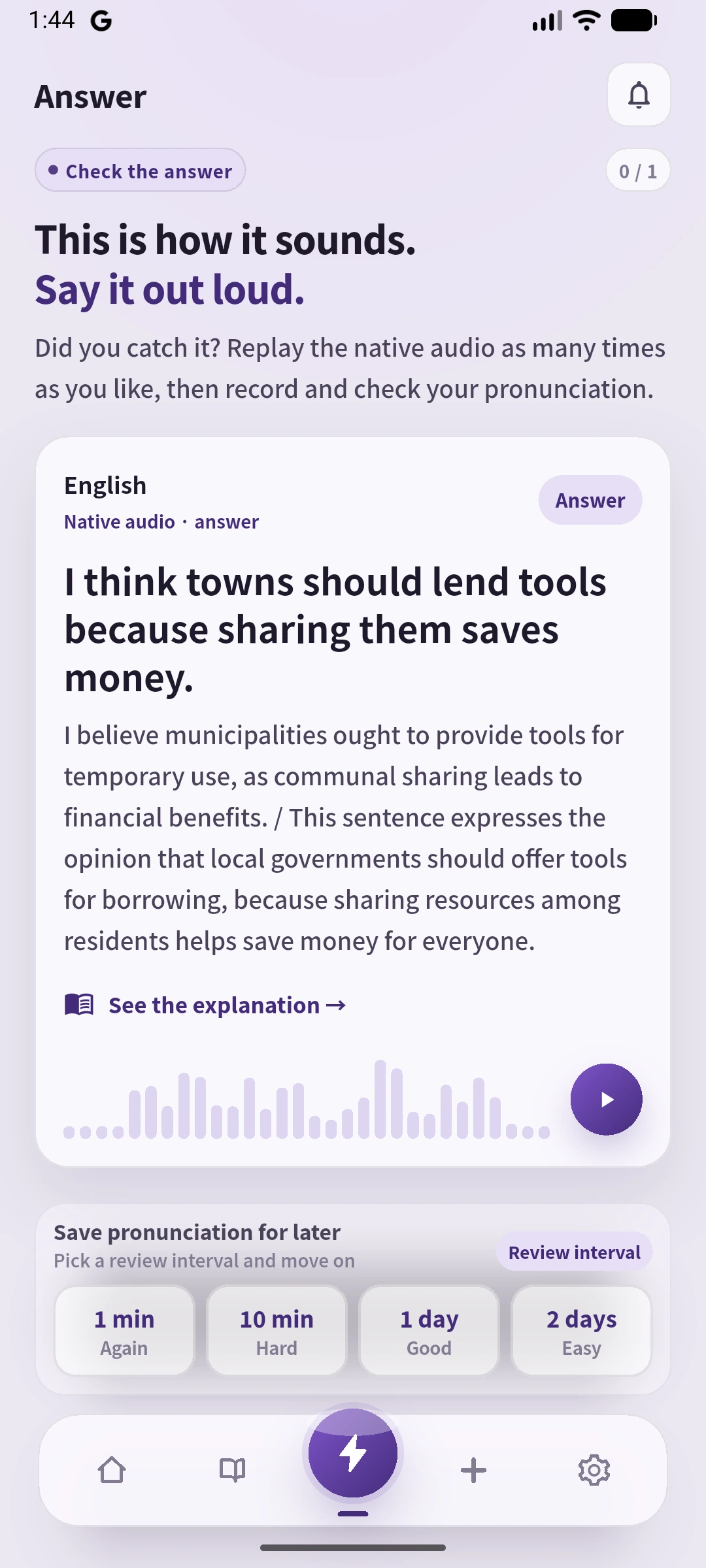
Original practice sentence · Viking AI audio
I think towns should lend tools because sharing them saves money.
Generated once for this sentence; not official exam audio or a complete essay.
Frequently asked questions
How many words do I write?
A summary of 45–55 words and an opinion essay with an 80–100-word guideline and two reasons, according to the current booklet, checked 16 October 2026.
Can I use a template?
Our advice is to use it for structure. The inspected official materials do not state automatic phrase bonuses or penalties. Check the actual content against the official viewpoints.
What if I write too little or too much?
A universal deduction rule is not stated in the inspected official materials. Follow the instructions; add missing main information or explanations and cut repetition. Do not confuse length uncertainty with the official warnings on off-topic answers.
Which task should I practise first?
Try both once. If selecting information is difficult, work on summary notes; if explaining reasons is difficult, develop essay reasons. Do not leave either task unpractised.
Is there a fixed time allocation?
Reading and Writing share 85 minutes. The current official materials inspected do not prescribe minutes per writing task. Test your allocation with Reading too.
Can I revise without a teacher?
You can compare content with the prompt, detect repeated reasons and check verbs and word count. Record unresolved questions and ask about specific sentences when possible. This is not official scoring.
Is memorizing an AI correction enough?
We do not recommend it. Check meaning and position, understand each change and do not treat AI feedback as an official score.
Does writing practice help with the interview?
A short opinion and reason can become speaking material. You still need to practise answering the question actually asked, rather than reciting a saved answer.
Editorial verdict
Build a checking order before collecting universal answers. Return to source information for summaries and to the judgment plus two reasons for essays. Check content, organization, language and length; use a structure only when it helps that work, and test it on a new topic.
For writing steps, the limits of memorized outlines and a self-review routine, see our Eiken Grade Pre-1 Writing guide.
Official references
Checked 16 October 2026: current Grade 2 content, 2026 session 2 instructions, essay scoring viewpoints and warnings, official samples and answers. Eiken is a registered trademark of the Eiken Foundation of Japan. This article is independently written and is not official examination material.