
Paraphrasing when speaking English: explain words you do not know
Published
“To paraphrase” means to express something another way; “in other words” introduces a restatement.
For task-specific steps and revision against the public criteria, see our IELTS Writing guide.
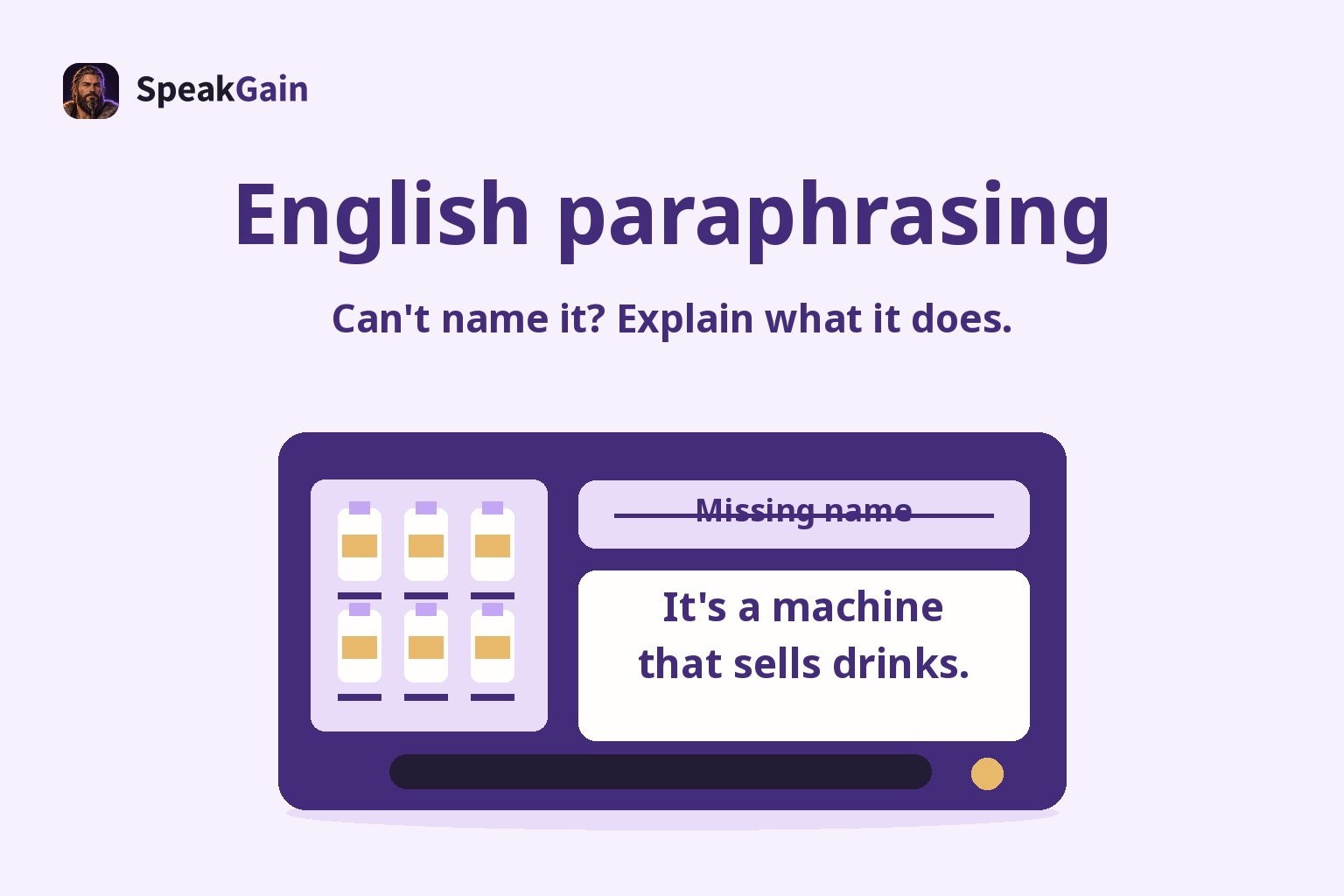
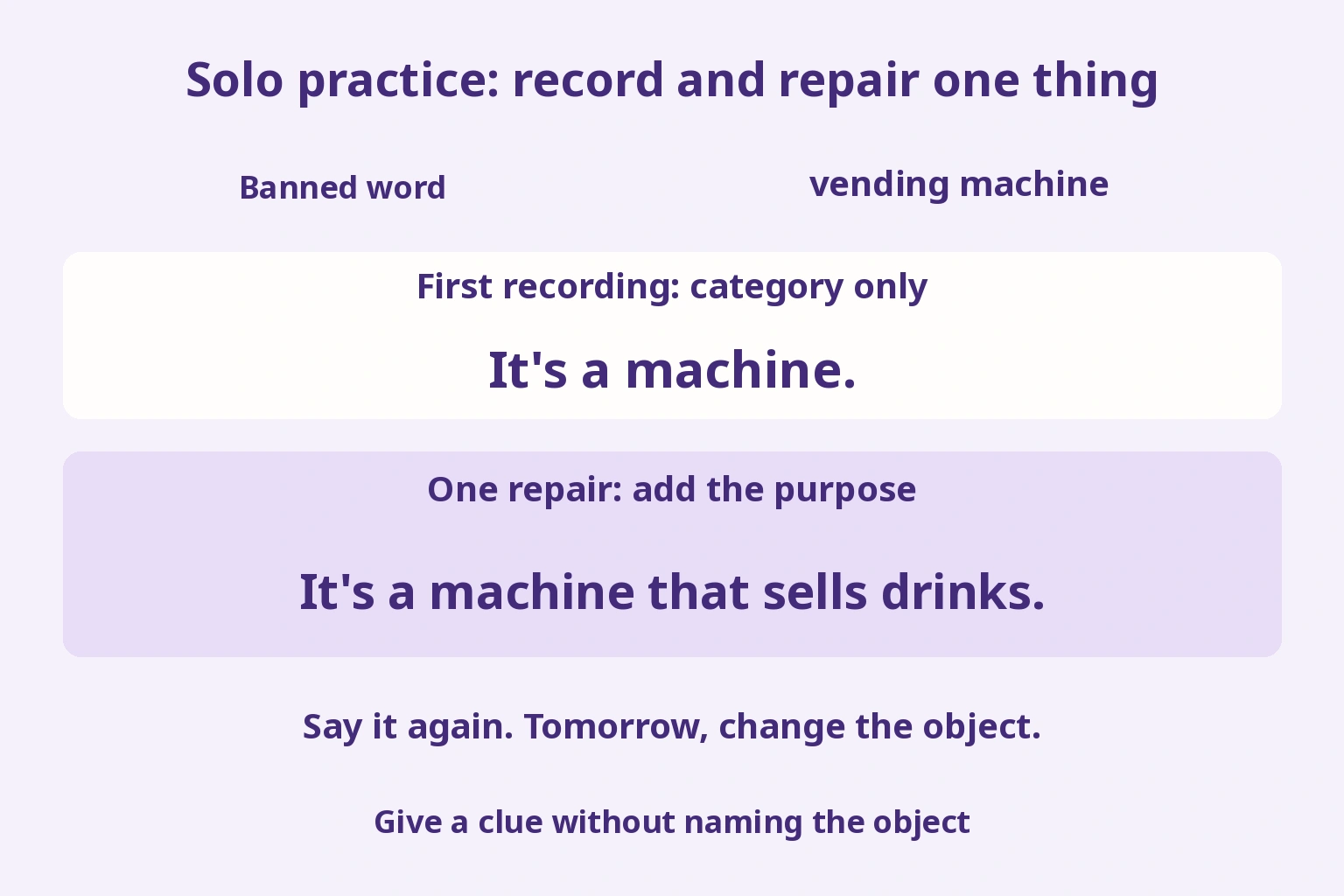
When an English word will not come, explain the object’s category, purpose or appearance with words you already know. If you cannot recall the name of a vending machine, say It’s a machine that sells drinks. For solo practice, ban one word, describe the object or event aloud, record yourself, then repair one thing and say it again.
The task is to choose information the listener needs, rather than replace an unfamiliar word with another difficult synonym. The examples, five-minute routine and weekly plan below are our editorial proposals, not validated optimal doses.
For meaning-preserving paraphrases in an exam summary, see the original examples and checks in our Eiken Grade 2 Writing guide.
Five explanation patterns: choose one first
Category or purpose usually gives you a practical starting sentence. Add one distinguishing feature if needed; do not work through every pattern.
| Pattern | When to use it | Original example | Caution |
|---|---|---|---|
| Category: It’s a kind of… | You know the larger group | Serving tray: It’s a kind of tray. | The group alone may not identify it |
| Purpose: You use it to… | You know its use | Serving tray: You use it to carry cups. | Use the base form of the verb after to |
| Appearance: It looks like… | Shape helps identify it | Serving tray: It looks like a flat plate. | Resemblance does not establish its function |
| Comparison: It’s like…, but… | The listener knows a similar object | Kotatsu: It’s like a table, but it has a heater underneath. | Include the difference too |
| Negative distinction: It’s not… | The listener has confused two things | Vending machine: It’s not a fridge. It sells drinks. | Follow the negative with a positive clue |
The Japanese example obon here means a serving tray, not the festival with the same name. For the festival, decide whether you need to explain a family gathering or a custom concerning ancestors. One label can require different explanations. Use it only when the listener knows which object you mean; otherwise establish the context first.
Unpack a difficult first-language expression
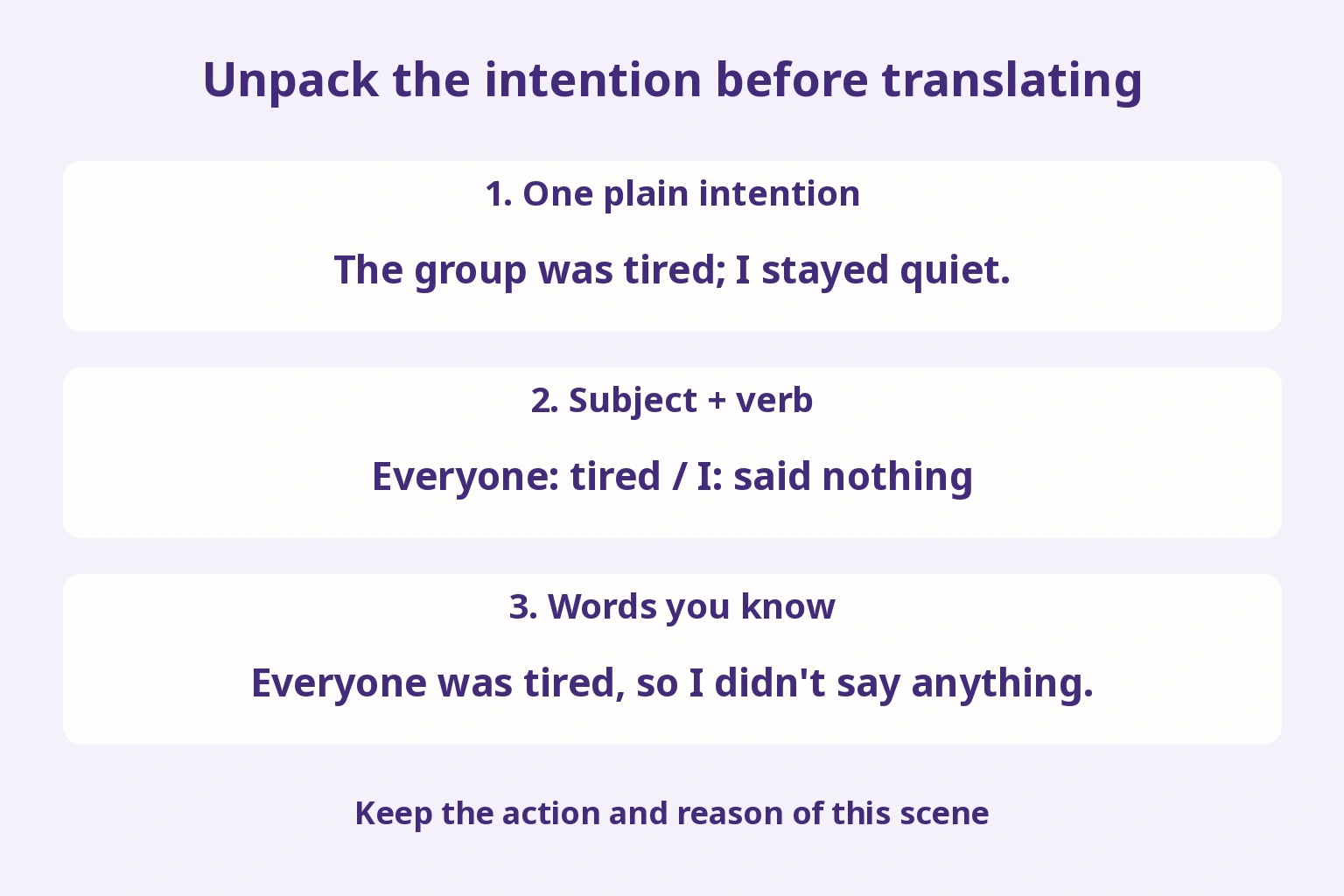
Start with your intention, choose a subject and verb, then use familiar English. A Japanese expression about “reading the atmosphere” can describe different actions. In our specific scene, everyone was tired and you decided not to speak.
| Step | Question | This scene’s example | Check |
|---|---|---|---|
| 1. One plain intention | What happened that matters? | Everyone was tired, so I stayed quiet | Do not invent a reason |
| 2. Subject and verb | Who did what? | Everyone: tired; I: said nothing | Describe actions rather than literally translating atmosphere |
| 3. Familiar English | Can I say it with known words? | Everyone was tired, so I didn’t say anything. | Preserve the time, negative and reason |
If you meant avoiding interrupting your manager, that sentence would not fit. Nor must every nuance fit one sentence: I didn’t say anything. Everyone was tired. can convey the same scene in two short units. Simplify the form while preserving the relevant information.
Use instant English composition to practise building short sentences. Here we add the choice of what to communicate, beyond reproducing a supplied answer.
Speaking paraphrase is a communication strategy
This article focuses on circumlocution: explaining around a vocabulary gap. The Council of Europe’s CEFR Companion volume describes explaining an unnamed concrete object’s features and using paraphrase to compensate for vocabulary or structural gaps. These are ability descriptors, not an experiment validating our routine or awarding you a level. CEFR, page 69
Our interpretation is that one missing word need not make you abandon the whole message. For gaining thinking time or repairing a stalled conversation, see when English words will not come out. Here the next decision is which clue to give.
Pattern 1: category — It’s a kind of…
Scene: someone asks about a Japanese serving tray. If you know tray, use it; if you do not, begin with purpose instead.
Pattern and example: It’s a kind of tray. You use it to carry cups. The first sentence supplies a category; the second distinguishes its use. Both depend on vocabulary you can actually use.
Adapt it: choose a broad word such as machine, food, tool or event. For a vending machine, It’s a machine that sells drinks. gives category and function together. Change drinks if the real machine sells something else.
Practice point: choose one object and give one category plus one feature. Check an uncertain category word before recording rather than preparing five alternative sentences.
Common mistake: It’s a thing. supplies almost no distinguishing information. Move to purpose if you lack a category word. After It’s a kind of… use a noun category, not an action phrase.
Pattern 2: purpose — You use it to…
Scene: the listener asks what a table-top object is for. Answer the use before giving several sentences about its shape.
Pattern and example: You use it to carry cups. Here you expresses a general use, not only this listener’s personal habit.
Adapt it: replace the action and object with the real use. You use it to keep food warm. describes an appropriate container’s function. Check meaning before selecting an easier verb.
Practice point: imagine loading the cups and carrying them. Read once to check the form, then hide the sentence and speak from the object or scene. Keep both action and object.
Common mistake: “It’s useful” or “I use it often” does not explain its purpose. Use a concrete action. If you say to carrying, repair that verb form in the next recording.
Pattern 3: appearance — It looks like…
Scene: the listener is looking for your object among similar items on a shelf. Shape can help them select it.
Pattern and example: It looks like a flat plate. This is a resemblance, not a claim that the tray is a plate. The example fits a flat tray, not every design.
Adapt it: add a familiar shape or its position. Choose a feature that separates the objects; listing every colour and size can bury the useful clue.
Practice point: imagine two objects on the same shelf. Listen to your recording and ask whether the description could still refer to either one. Add purpose if necessary.
Common mistake: forcing an action into the appearance pattern. For use, choose You use it to… . If your explanation fails, change the clue rather than repeat it louder.
Pattern 4: comparison — It’s like…, but…
Scene: the listener has never seen a kotatsu, a Japanese heated table with a blanket.
Pattern and example: It’s like a table, but it has a heater underneath. If the listener wants the next detail, add You put a blanket over it. This is an introductory explanation, not complete construction or safety guidance.
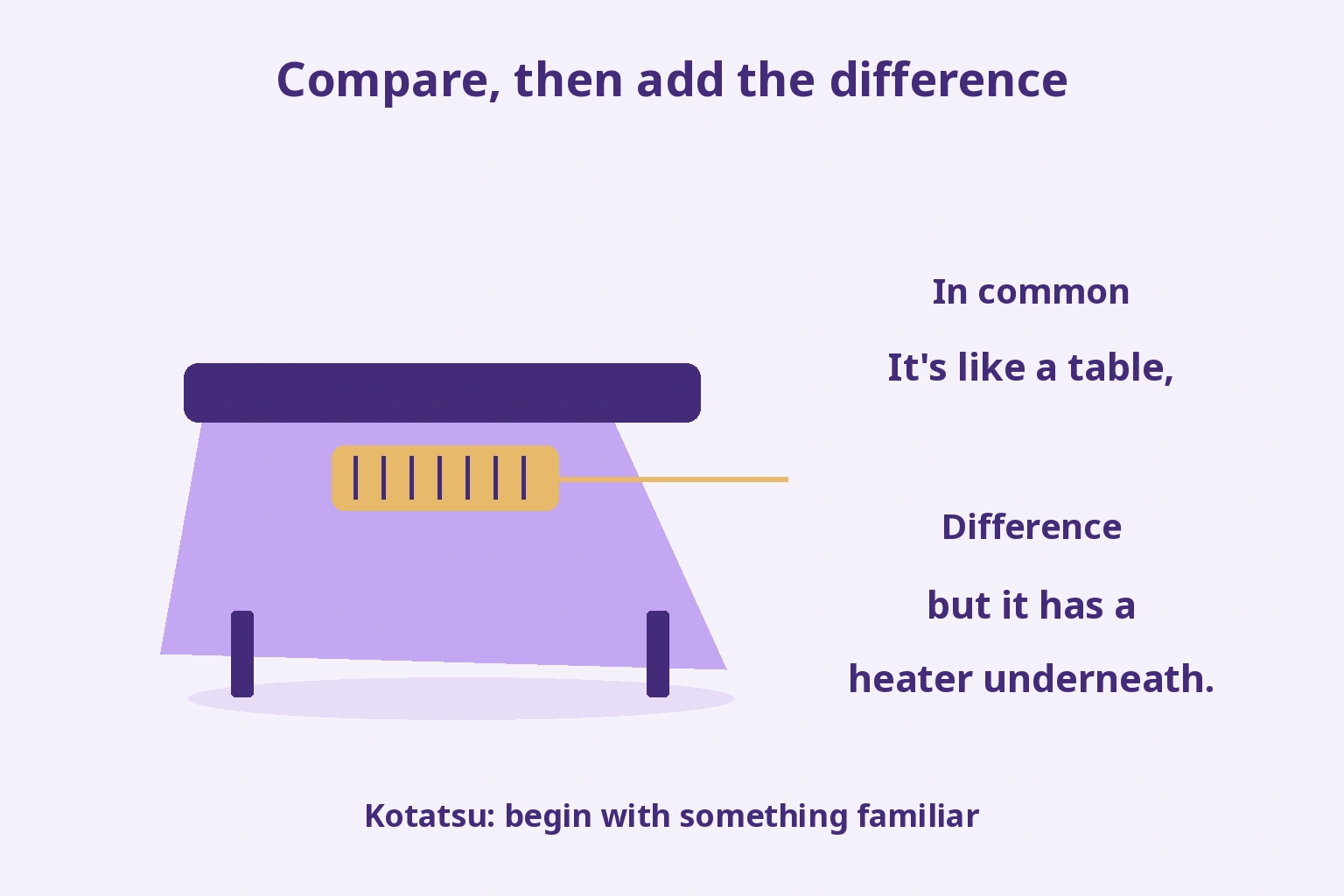
Adapt it: choose a comparison the listener knows. If heater is unavailable, It keeps your legs warm. can convey purpose with familiar words.
Practice point: record one similarity and one difference. Do not omit the but part just because the first half is easier to say.
Common mistake: It’s like a table. alone suggests an ordinary table. If the full comparison is too long, split it: It’s like a table. It keeps your legs warm.
Pattern 5: negative distinction — It’s not…
Scene: the listener thinks the vending machine is a fridge. Use a negative to repair that actual misunderstanding.
Pattern and example: It’s not a fridge. It sells drinks. The positive function gives a replacement idea. Without an existing misunderstanding, our first choice is It’s a machine that sells drinks.
Adapt it: negate the mistaken category briefly, then give category or purpose. Do not manufacture a misunderstanding just to use this pattern.
Practice point: imagine “A fridge?” and answer. Then imagine “Where can I buy a drink?” and answer that new question instead of repeating the correction.
Common mistake: several It’s not… sentences without saying what it is. Return to a positive clue after one correction. Listen to your tone as well as the wording.
Solo routine: ban a word, record, repair one thing
The banned word is a practice constraint, not a real-conversation rule. If you know the exact word in conversation, use it.
- Choose an object or today’s event. Ban vending machine and explain it with category and purpose. Later, change what the machine sells. For an event, ban postponed: The meeting was moved to Friday. fits only when the new date really is Friday. If unknown, The meeting is not happening today. states what you know without inventing details.
- Hide the full answer and record one or two sentences, aiming at 20–30 seconds. Stop and simplify your intention if needed. A phone recorder is enough; this is not a test of uninterrupted length.
- Replay and choose one repair: missing purpose, incorrect verb form or invented date. Check uncertain English in reliable examples or with a teacher. Hearing yourself does not establish that your meaning is accurate.
- Record again, then change the object tomorrow. Use thinking in English to practise selecting a short sentence from a scene.
Our first-week plan
Five minutes a day is a manageable starting proposal, not a fluency deadline. Spend one minute choosing, one recording, two selecting a repair and one saying it again.
| Day | Task | Check |
|---|---|---|
| 1–2 | An object: category and purpose | Can you finish without naming it? |
| 3–4 | Two similar objects | Does one appearance or comparison clue distinguish them? |
| 5 | Today’s event without a convenient word | Are intention, time and negative preserved? |
| 6 | An earlier object using a different pattern | Can you explain rather than only recite? |
| 7 | An imagined follow-up question | Can you add the information requested? |
Track an available first sentence, relevant clues, preserved meaning and use with a different object. Solo success does not show how a listener will understand you; try the explanation in a real conversation too.
Keep your chosen explanation in SpeakGain
You choose and check the sentence first. Paper notes and a general recorder can support this routine. Our product SpeakGain is relevant when keeping a chosen English sentence as a card; see what SpeakGain is.
We created one explanation card through the normal Add flow. On the device we observed Knowledge → Learn this card → Listening / Guess by ear → Reveal answer → Answer. Listening hides the sentence; Reveal answer displayed the saved text. Answer also showed an explanation link, playback controls and the Record and check entry.
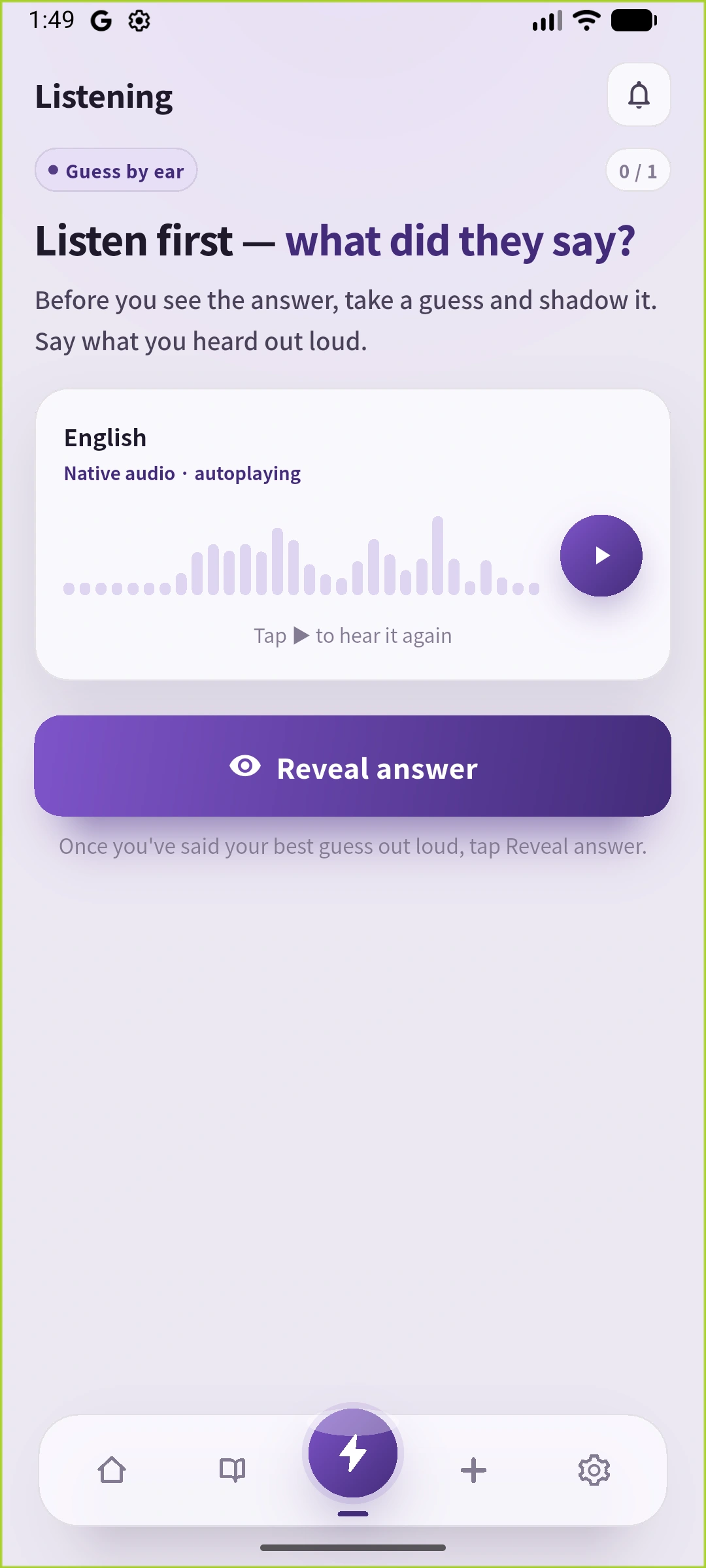
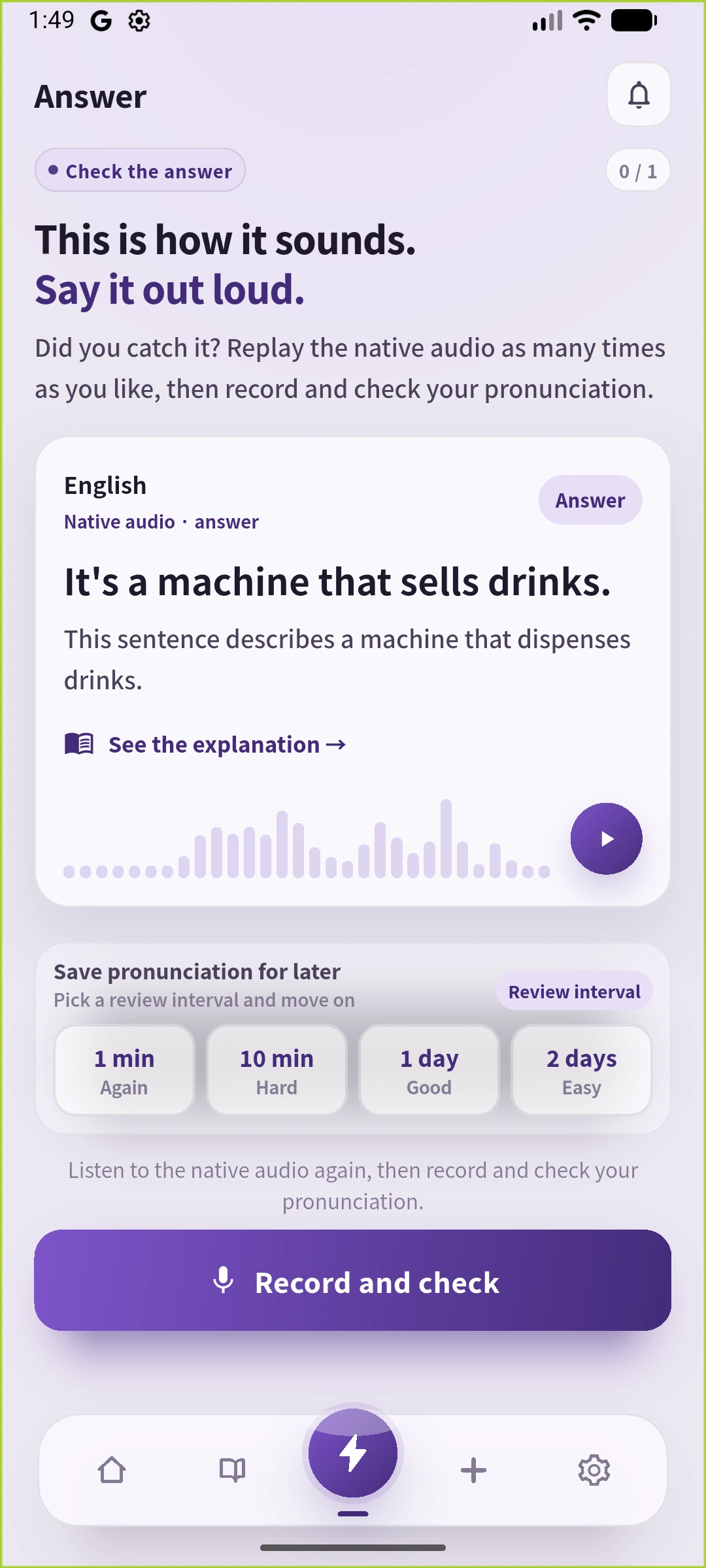
We did not submit a learner recording, verify an assessment result or select a review interval. Native audio is the reference-audio interface label; this example is AI-generated. The bars are not presented as analysis of whether your paraphrase is correct.
This is not a procedure for receiving automatic paraphrase suggestions, correction or scoring. Confirm that your explanation fits the object before saving it. Practising a fixed sentence differs from adapting an explanation to a listener’s response.
Test paraphrase: TOEIC and IELTS
TOEIC Listening & Reading tests receptive understanding; IELTS Speaking includes spoken production. ETS describes L&R as multiple choice. Our object-description exercise therefore differs from that task. ETS format IELTS’s lexical-resource descriptors mention paraphrase, alongside separate fluency/coherence, grammar and pronunciation criteria. Five templates do not guarantee a score. IELTS criteria Check the skill and format you are preparing for; see IELTS speaking preparation.
Writing paraphrase: changing words still needs attribution
Someone else’s information does not become yours because you changed its wording. Purdue’s writing guidance requires attribution for paraphrase. Purdue OWL Comparing with the original and citing it belong to writing tasks; this speaking routine is not a recipe for evading plagiarism checks.
Methods we do not recommend
- Memorizing long lists without scenes: synonym pairs do not decide which clue your listener needs. Explain one object, then change it.
- Silently searching for a perfect translation: offer a useful short message, then check the term afterward. Where an exact technical term matters, say you need to verify it rather than make an unsupported assertion.
- Using only thing and nice: simple language should preserve relevant information. Add function or a distinguishing feature.
- Repairing everything each time: choose one meaning-changing error or missing clue, verify it, then return to the full explanation.
Frequently asked questions
Does constant paraphrasing sound unnatural?
Use the known name normally. Explain around it when the word is unavailable or the listener does not know it. Learn a frequently needed name after the conversation.
Vocabulary or paraphrase practice first?
Check basic nouns and verbs while practising short explanations. Do not wait until you know every word. Use learning English vocabulary for useful names too.
Is this the same as TOEIC or IELTS paraphrase?
Preserving meaning is common, but the tasks differ. L&R is receptive; IELTS Speaking is productive. This exercise does not replace all test preparation.
What if I cannot tell whether they understood?
Check what they imagined or the question they ask. Is that clear? can invite feedback; if it is vague, add one purpose or concrete example rather than repeat yourself.
Does simple English sound childish?
Familiar words can express precise reasons and differences. Choose a correct explanation over a difficult word whose meaning you cannot control.
What about a cultural word without an exact equivalent?
Give the name and a short category or function. With a kotatsu, begin with its table-like form and warming purpose; add background in response to questions.
Can solo recordings show whether I will be understood?
They reveal pauses and omissions, not the listener’s interpretation. Test the explanation in conversation and use their questions for your next repair.
Our editorial verdict: start with category and purpose
Describe one unnamed object by its category and purpose first. Add appearance or comparison when needed; use negatives to repair actual confusion. Today, explain a vending machine, record, add one useful clue and say it again. Tomorrow, change the object. Measure whether you conveyed your intention with familiar words, not how many difficult words you used.
For the summary and the essay with three reasons, see our Eiken Grade 1 Writing guide, with official viewpoints and newly written examples.