
IELTS Speaking preparation: Parts 1–3, band criteria and solo practice
Published Updated
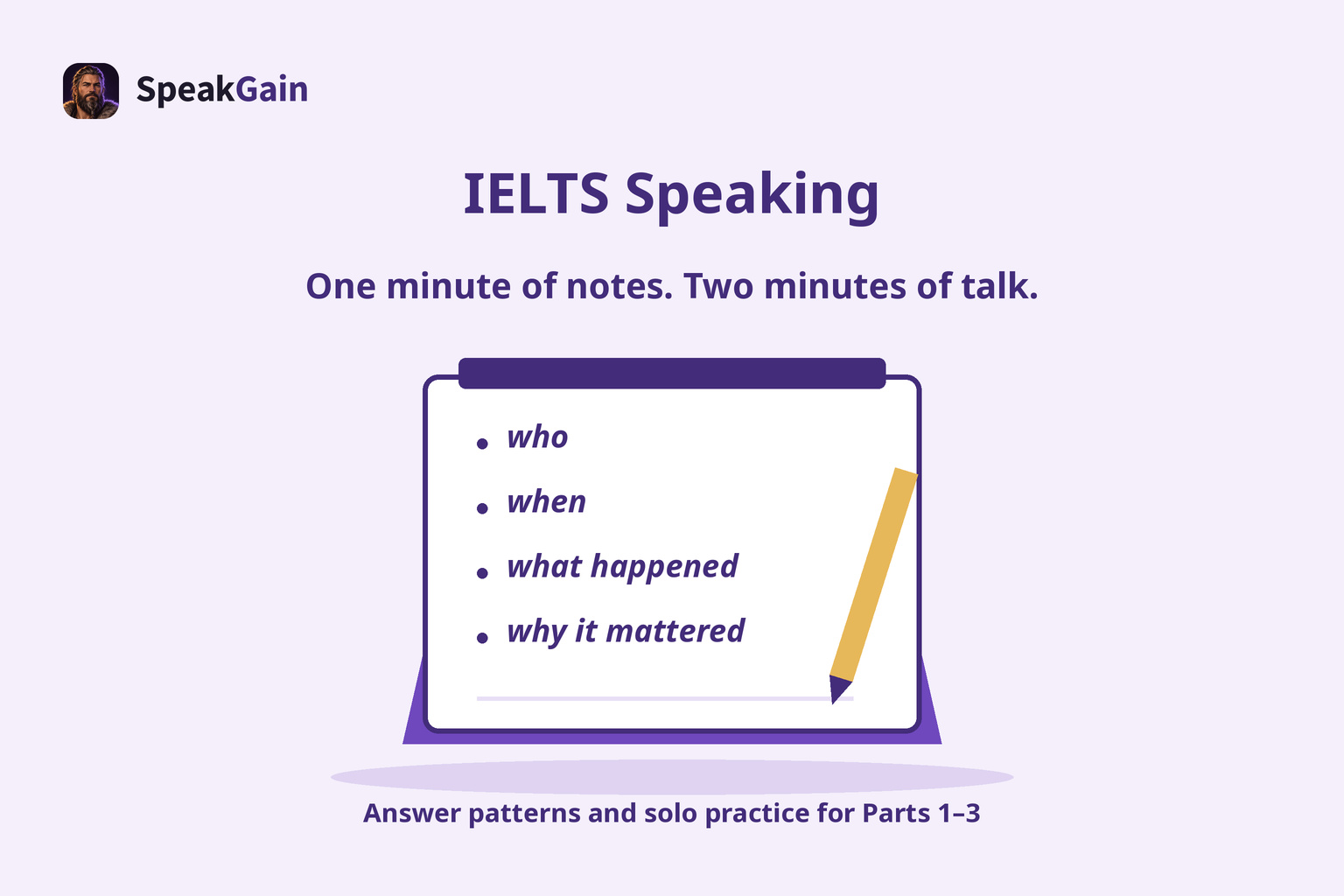
IELTS Speaking is a three-part conversation with an examiner lasting 11–14 minutes, assessed on fluency and coherence, lexical resource, grammatical range and accuracy, and pronunciation (official format, scoring; checked 10 October 2026). Our editorial starting point for solo preparation is simple: answer the question directly in Part 1, turn one minute of notes into a two-minute practice talk in Part 2, and explain a position with a reason and an example in Part 3. Record yourself, listen back, fix one thing, then try another question.
For task-specific steps and revision against the public criteria, see our IELTS Writing guide.
If you also take TOEFL, TOEFL Speaking preparation separates its 2026 tasks and 45-second interview practice from IELTS.
If you also face an automated speaking test, Versant preparation separates its format and recording practice from the interview.
Knowing an answer when you read it is different from choosing what to say when someone asks. A long script can also turn Part 2 into a search for the next line. Practise deciding what the question needs before polishing sentences. This article separates official facts from our suggested answer patterns, practice windows and plan. Every prompt, answer and note below is our own exercise, not a copied official cue card or a certified band-level answer. Use the official samples to check the task shape. For your wider routine, see how to study English.
If you need DET for study abroad or admissions, check our Duolingo English Test preparation guide for its current format and speaking practice.
If you are considering a paired exam, our Cambridge English levels and Speaking guide explains A2 to C2 and how to respond to a partner’s ideas.
For the balance between Speaking and the other three skills, see our IELTS study plan with official criteria and editorial target-band plans.
To choose IELTS vocabulary materials, see our book and app guide for official band/module information and steps from a word to your own sentence.
What happens in IELTS Speaking?
Familiar questions come first, then a long turn, then a more general discussion. Academic and General Training share the Speaking test. The interview is recorded; assessment considers performance across the test (format, shared test and samples; checked 10 October 2026).
| Part | What you do | Official time | Preparation | Assessed skill |
|---|---|---|---|---|
| Part 1: introduction and interview | After identification, answer about home, work, study and familiar interests | 4–5 minutes | No Part 2-style one-minute preparation period | Information and opinions on everyday topics |
| Part 2: long turn | Speak about the task-card topic and specified points; there may be one or two related follow-up questions | 3–4 minutes including preparation; the talk lasts 1–2 minutes | One minute; note-taking materials are provided | Organise and sustain a long turn |
| Part 3: discussion | Discuss issues related to Part 2 more generally and abstractly; explain, analyse and speculate | 4–5 minutes | No Part 2-style preparation period | Explain, analyse and speculate |
IELTS.org describes paper and a pencil for Part 2. IDP Japan’s current guidance describes a tablet and pen. Follow the instructions for your booked centre. The British Council format page also confirms the 1–2-minute long turn. These are part timings, not a rule that every question must take 30 seconds. At home we recommend aiming to sustain a Part 2 talk for two minutes; duration alone does not determine a band.
Computer-delivered IELTS still involves an examiner for Speaking. Centre delivery can be in person or by video call; check your booking, Speaking appointment and local centre instructions. A video call at a test centre is not the same booking as IELTS Online at home. Do not replace speaking practice with typing practice.
What do the four assessment criteria mean?
The four criteria carry equal weight. Speaking is not assessed solely on Part 2, or on whether your story is entertaining (IELTS scoring; checked 10 October 2026).
| Criterion | Official focus, paraphrased | One editorial listening check |
|---|---|---|
| Fluency and coherence | Continuing speech, hesitation, logical order and connections | Does the explanation change direction halfway through a reason? |
| Lexical resource | Range, precision, appropriate use and paraphrase | Can you explain a missing word instead of stopping? |
| Grammatical range and accuracy | Variety and accurate, appropriate use of structures | Are past events and current habits distinguished? |
| Pronunciation | Speech a listener can understand without excessive effort | Are important words and phrase groups clear? |
Choose one listening check per recording rather than trying to repair everything at once. The public band descriptors describe integer bands; they do not provide a separate checklist for 6.5. In paraphrase, band 6 can sustain speech but hesitation and repair may disrupt coherence; band 7 sustains longer turns more readily and retains coherence despite some hesitation. Vocabulary and grammatical flexibility also differ. The pronunciation description for 7 draws on positive features of 6 and some of 8. No single fluent sentence lets you assign your own band.
Our editorial goals would be to express the same reason in different words and add a condition without losing the connection. IELTS has no universal pass mark. Check both overall and Speaking requirements with the receiving organisation, rather than turning a template into a promise of 7.0.
A solo practice loop: record, listen, fix one thing
- Prepare only a question. You can record your own prompts first; consult official samples for the task shape.
- Answer without pausing the recording whenever you make a mistake. Repair and continue.
- Listen first for whether you answered and whether the reason supports the conclusion. On another attempt, focus on vocabulary, grammar or pronunciation.
- Identify one change and its location: a past-tense verb, an unexplained example, or a long pause after the reason.
- Record the same question again, compare, then change the question. Transfer matters as well as remembering a corrected answer.
Twenty minutes a day is an editorial starting allocation, not an experimentally established optimum. Save the date, part and chosen correction. If you cannot judge whether your explanation is understandable, ask another listener what they understood from a short recording.
If words disappear when a question arrives, use practice for when English words will not come out to identify the obstacle, then return to timed answers.
Part 1: answer first, then add a relevant detail
What is asked: familiar personal topics. A preference, frequency, reason or change over time requires different information. Our original practice prompt is: “When do you usually cook?”
Our answer pattern: direct answer → reason or specific detail.
I usually cook at weekends. I have more time then, so I can try a new recipe.
The first sentence answers when; the second explains why weekends suit the activity. “I like cooking” alone would not answer that question. For our other prompt, “Do you cook more now than you used to?”, the contrast changes:
Yes, I cook more often now. When I was a student, I mostly bought ready-made meals.
These are short exercises, not official sentence-count requirements. Practise alone: shuffle preference, frequency, reason and change questions. Use an editorial 20–30-second window per question and listen to the first sentence: does it already answer? Add one concrete action rather than a long introduction. After correcting the order, try shopping or exercise instead of cooking. If producing a sentence is the obstacle, use short sentence-building practice, then return to hearing a question without a written answer.
Common mistakes: ending with “Yes”, giving a memorised self-introduction, or using the same because-clause for everything. Choose a detail that fits the question; equal answer lengths are not the aim.
Part 2: one minute of notes into a two-minute talk
What is asked: develop the task-card topic and points into a connected long turn. Our original exercise is to describe a skill you recently learnt with someone’s help, including who helped, when, what happened and why it mattered. It is not an official cue card.
Our answer pattern: subject → background → one event → change and meaning. Here is a short extract, not a complete two-minute model:
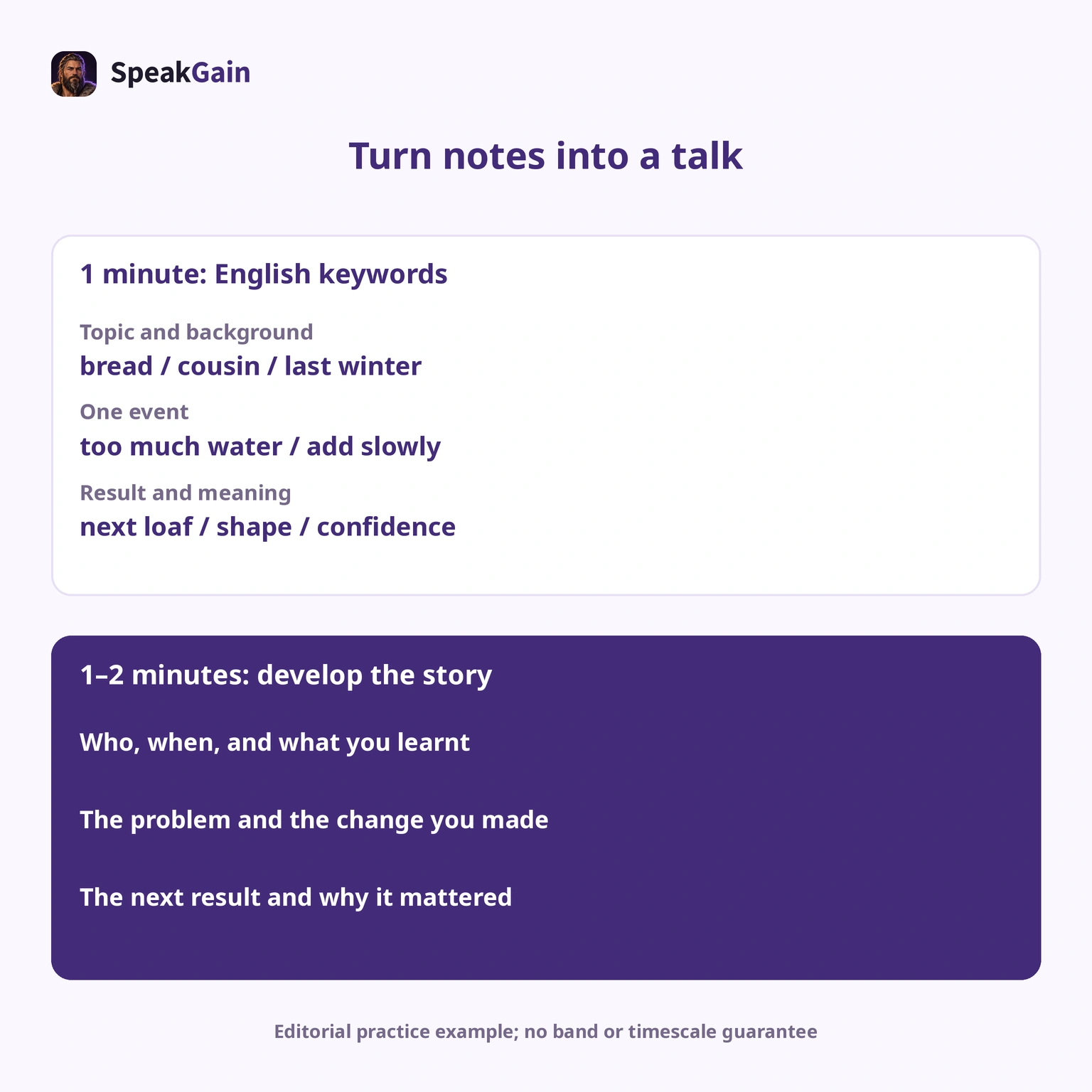
I learned to bake bread with my cousin last winter. At first, I added too much water and the dough was hard to handle. She showed me how to add it little by little. The next loaf kept its shape, and I felt more confident.
The cousin, last winter, too much water, slower addition, next loaf and increased confidence form a sequence. You can follow it without a remarkable life story.
Prepare with keywords, not a complete script
Our suggested division of the minute is about 10 seconds to choose, 35 seconds for useful notes, 15 seconds to check the ending and order. Only the one-minute total is official; this division is editorial.
| Stage | What to note | Our bread example |
|---|---|---|
| Choose | A topic you can actually explain | bread / cousin |
| Gather | Background and one specific event | last winter / kitchen / too much water / add slowly |
| Check | Result, meaning and sequence | next loaf / shape / confidence |
Use short English keywords you can say, rather than drafting long sentences and translating them while talking. Match your notes to the task’s points, but connect the points into events rather than reading a list. A useful memory is better than spending the minute searching for an unusual one. Make people and places easy for the listener to follow; a cousin and a kitchen may be enough context.
Develop a scene instead of filling seconds
At home, set two minutes and keep the notes beside you. Name the subject, establish the background, describe one event and explain the result. If the recording runs out at 40 seconds, add what happened at a particular moment instead of repeating “It was wonderful”. Our expansion sentence is:
One moment I remember clearly was when the dough stuck to my hands.
Continue with the difficulty and your response: how you added water and what you changed on the next attempt. This sentence has no special scoring status. End by explaining what you learnt. When the examiner stops you, respond to the next instruction rather than insisting on finishing a rehearsed script; a timed interruption is not itself evidence of a low band.
Practise alone: record the preparation minute and the two-minute practice talk in one sequence, and keep the notes. Compare points written but never spoken with details you managed to add. Correct one missing event, then record again. On another day choose a different skill, place, helper or decision. The goal is choosing suitable material quickly, not becoming able to recite only the bread story. For grammar, listen just to the transition from past event to present feeling; for pronunciation, briefly repair an important phrase and then return to the complete talk. Pronunciation practice supports rather than replaces sustained speaking.
Common mistakes: spending the whole minute choosing a topic, writing full sentences, listing isolated words, never leaving the background, and repeating feelings. Explain the difference between the first and next attempt instead.
Part 3: explain causes, comparisons and conditions
What is asked: discuss the related topic beyond your own experience. Explain why something happens, what differs, and which conditions change your view. Our original prompt asks whether a practice partner helps adults learning a new skill.
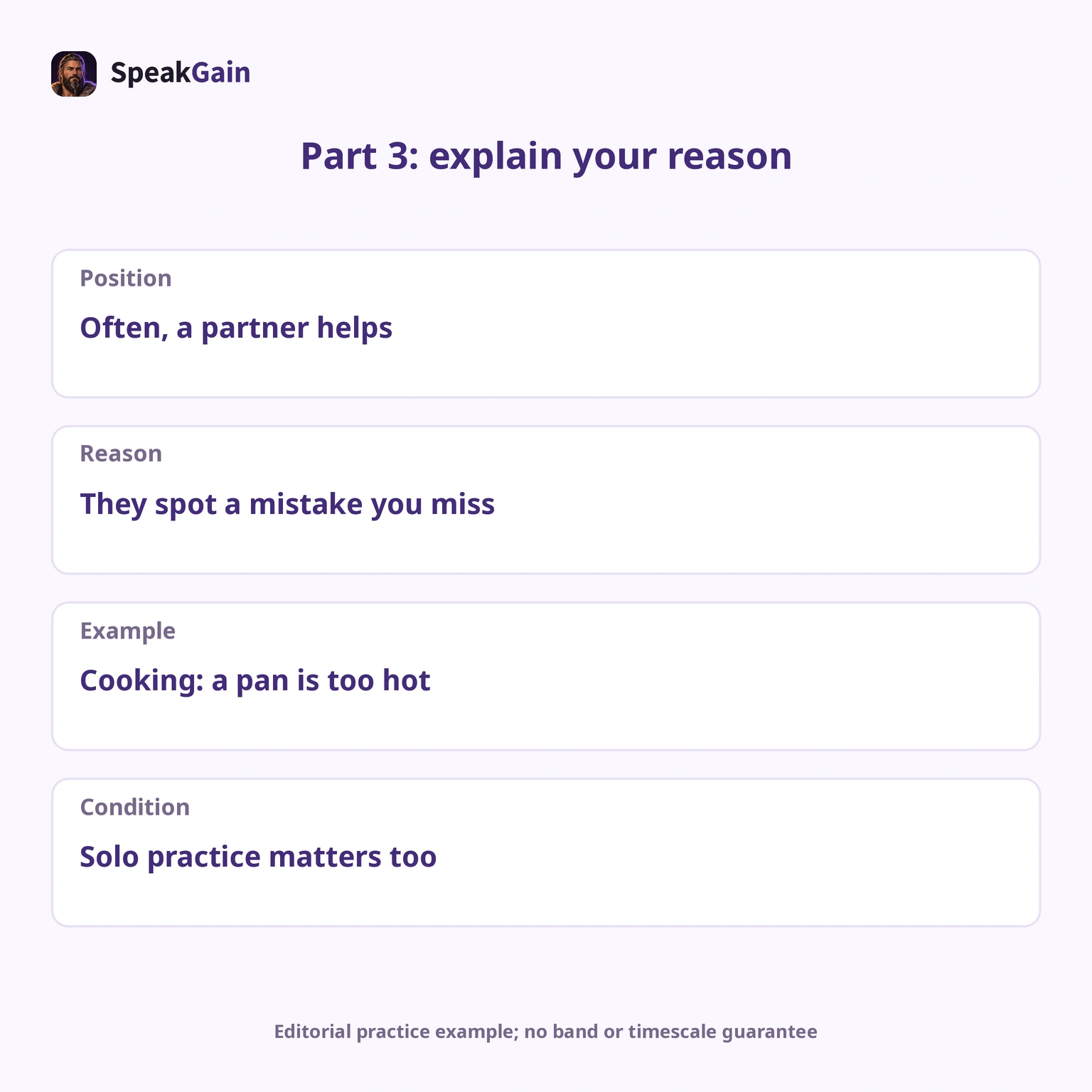
Our answer pattern: position → how the reason works → concrete example → condition if useful.
In many cases, yes. A partner can notice a mistake that the learner misses. For example, someone learning to cook might not realise that the pan is too hot. However, people also need time to practise on their own.
The hot pan illustrates how another person might notice an error; it is a hypothetical situation, not research evidence. The condition leaves room for independent practice. You do not need “However” in every answer. Use a condition to show the reach of your claim, not to erase your position.
| Our question type | Decide first | Short opening |
|---|---|---|
| Why can adults struggle to keep learning? | A cause and its effect on action | Work schedules can make regular practice difficult. |
| How do online and in-person learning differ? | One shared comparison axis | Online lessons are easier to fit around work, while in-person lessons allow more direct help. |
| How might learning change in future? | A prediction and its reason | Short online lessons may become more common because people can use them during a break. |
Develop who is affected and how. Compare both options on one axis rather than listing convenience, price and support without connections. Use “may” or “might” for speculation and avoid invented statistics. If the question changes to who should teach, reconsider responsibilities instead of repeating a convenience answer.
Practise alone: make reason, comparison and future prompts on one topic. Use an editorial 40–60-second practice window, not an official per-question limit. Listen for circular reasoning: “partners help because they are helpful” needs a mechanism such as noticing mistakes. Fix that once, then change the axis to support at school versus at work. Part 3 remains a dialogue; for a full rehearsal, ask someone else to choose the order and follow-up questions.
Common mistakes: answering a social question only with “my cousin”, hiding the reason behind technical vocabulary, and balancing both sides without a position. Link a personal example to a more general situation and retain your judgement after adding a condition.
Practising one useful sentence with SpeakGain
We develop SpeakGain. It can be introduced here as a tool for studying a short sentence within the wider recording routine. Our new article sentence is:
I find it easier to learn a new skill when I practise with someone else.
It connects a personal judgement to a condition; it is not a complete Part 3 answer or a band promise. We entered it through the normal Create flow, but generation did not finish after one retry of the same card. The original publication had no audio player; the same card now has Viking audio below. No additional cards were created.
This AI-generated Viking sample comes from a card created through the app’s normal Add flow; it is not a human native speaker’s recording.
I find it easier to learn a new skill when I practise with someone else. — Explain that practising with someone makes learning a new skill easier.
We verified the general study flow with an existing working card:
I like studying with a friend because we can help each other.
The screenshots show this existing English card in Japanese UI; they are not successful generation of the new sentence. From management search we opened the card’s Knowledge view and “Learn this card”. A saved Answer state was resumed; selecting a review interval led to Listening. We then verified “Reveal answer” → Answer. Listening hides the sentence and offers model playback. Answer shows the English sentence, its existing English explanation, playback, review interval controls and an entry to recording assessment. We did not verify a completed recording assessment or its accuracy.
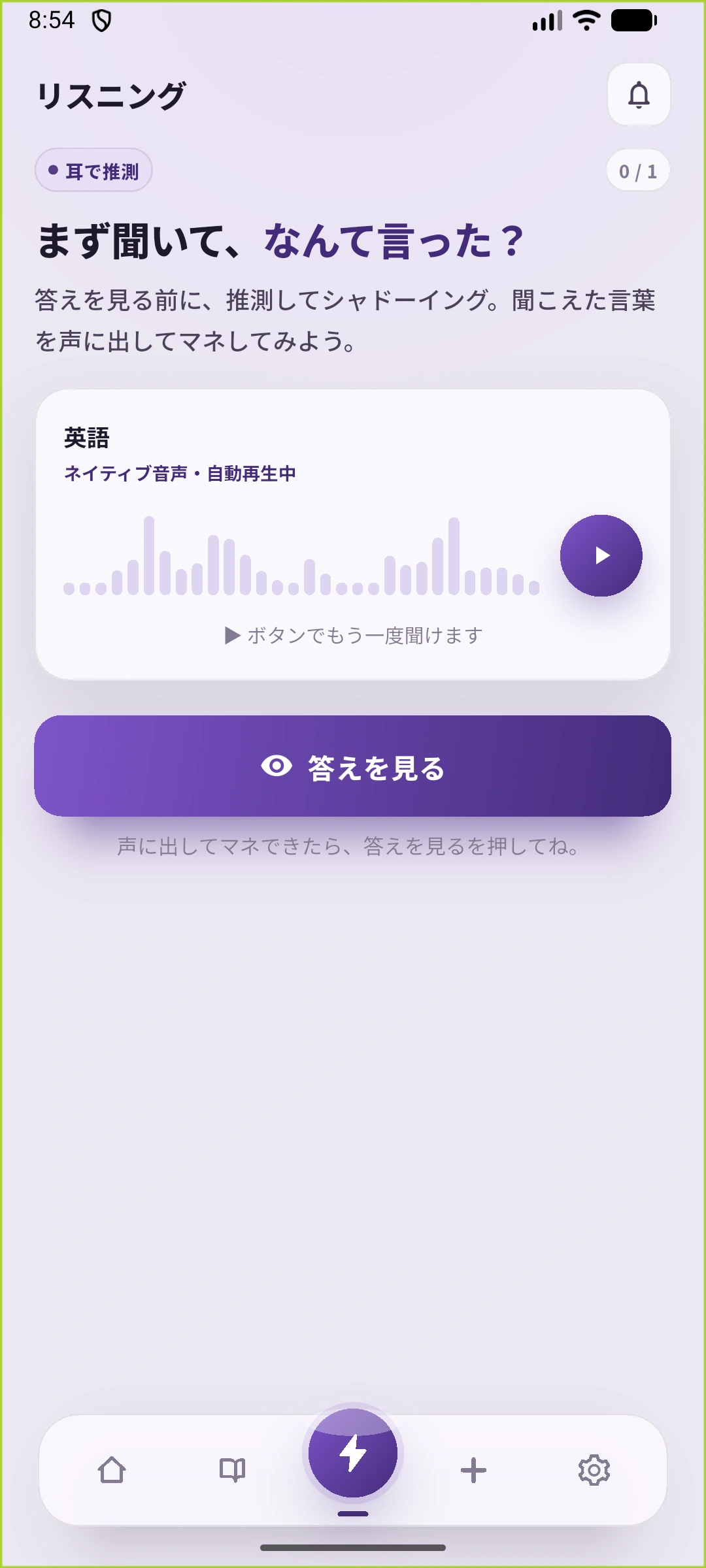
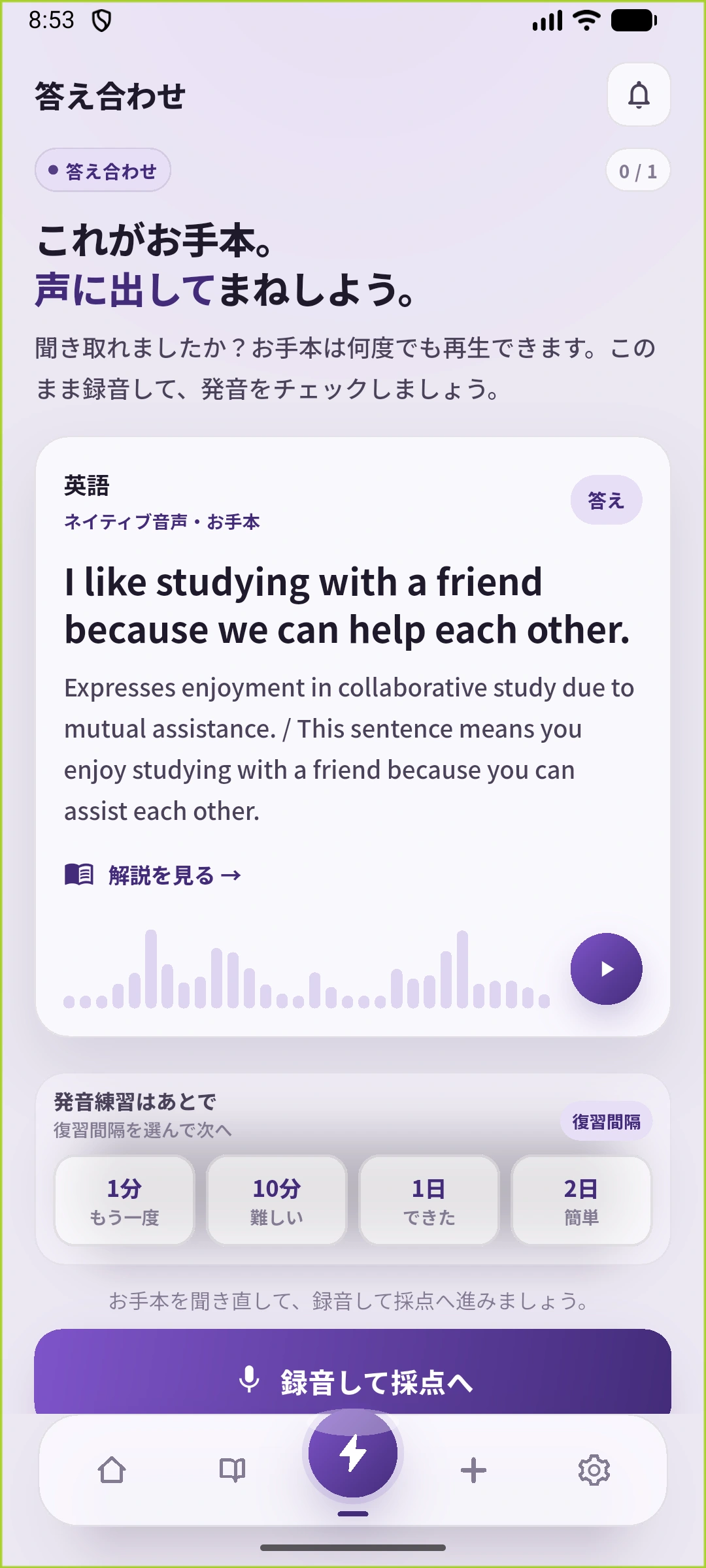
After a short card exercise, hide the text and return to choosing your own reasons and examples in a full timed answer. Listening to a card alone does not finish Part 2 practice. See what SpeakGain is for the broader product explanation; this article claims no IELTS assessment feature.
A practice plan up to test day
This is our editorial four-week example, with roughly 20 minutes a day, not a guarantee of a band or preparation period.
| When | Practice | Keep |
|---|---|---|
| 4–3 weeks before | Check official samples; record all three parts; Part 2: prepare one minute, talk two | First recording, notes, stopping points |
| 3–2 weeks before | Work separately on direct answers, concrete events and reasons | One change before and after |
| 2–1 weeks before | Change topics and question types; connect Part 2 with related Part 3 | Whether you can leave memorised answers |
| Final week | Rehearse the flow, ideally with someone choosing follow-ups | Responsiveness across the test |
| Day before and test day | Check booking, identification, venue and Speaking appointment; warm up briefly | Travel and documents |
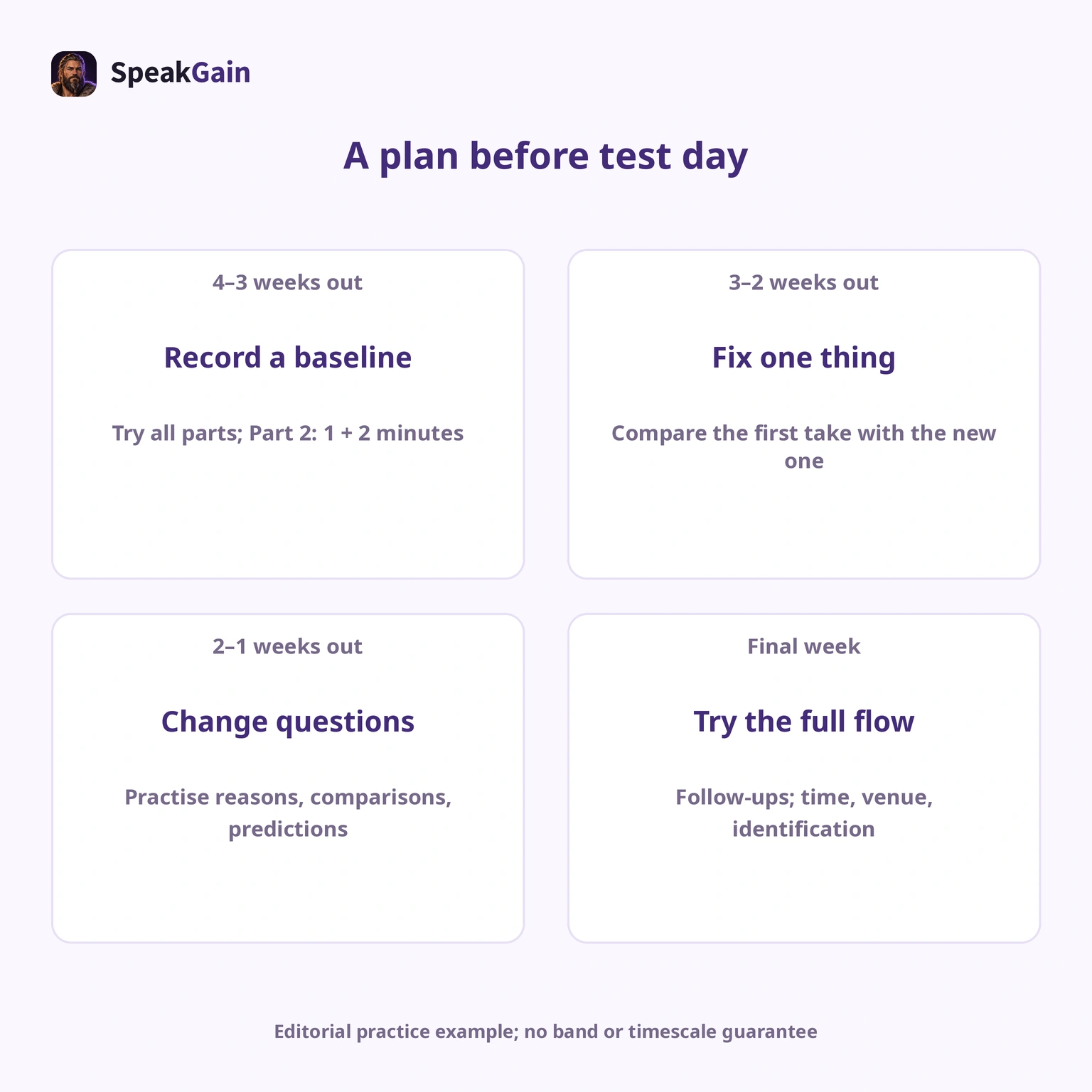
With one week, record everything first, focus on the two biggest difficulties, and keep a full rehearsal at the end. With three days, keep baseline → one correction → full flow. On a ten-minute day, do one recording/listening/correction cycle and change the question tomorrow. More attempts without listening can simply repeat the same gap. Follow centre instructions on test day; do not expect to bring and read your home notes. If preparing other tests, treat TOEIC Speaking and the EIKEN Pre-1 interview as different formats.
Can One Skill Retake cover Speaking?
Yes, if you meet the eligibility conditions. The official scheme requires a full computer-delivered test at a participating centre, a retake within 60 days, and only one skill, once per original test. Check that the receiving organisation accepts the result before booking (IELTS One Skill Retake; checked 10 October 2026). Availability, centre participation and UKVI arrangements depend on location; British Council Japan is one local example, not a worldwide availability promise. Retaking is different from requesting a remark.
Frequently asked questions
Can I prepare on my own?
You can check the format, record timed answers, listen back and correct one point alone. Our editors also recommend a listener for understanding and unexpected follow-ups. A recording is not a reliable official self-band assessment.
How long do I prepare and speak in Part 2?
One minute of preparation and 1–2 minutes of speaking; 3–4 minutes for the whole part. Related follow-ups may follow (official format). At home, practise sustaining two minutes.
What if I run out of ideas?
Develop one event rather than repeating your opinion. Our editors suggest describing what you tried, what went wrong and what changed. Listen to where the story ended; do not calculate a band from silence alone.
Is there a phrase that guarantees 6.0, 6.5 or 7.0?
No such condition appears in the public descriptors. Integer band descriptions cover four criteria across performance, not certified model sentences.
Do I need a particular accent?
Check intelligibility, stress, rhythm and sounds rather than imitating a nationality. The descriptors do not support treating every trace of a first-language accent as an automatic deduction.
Can I ask for the question again?
You can ask the examiner to repeat it (IDP guidance). Our practice phrase is Could you repeat the question, please?. Practise answering after repetition; repeated requests are not a promise of no assessment impact.
Are Academic and General Training different here?
Their Speaking test is shared (official samples). Check which test type your receiving institution needs.
Does computer delivery mean speaking to a machine?
Speaking involves an examiner. Check your centre’s in-person or video-call arrangements and appointment (IDP Japan example).
How many weeks do I need?
It depends on your baseline, target and time. Our editors suggest recording a baseline when you book; the four-week plan is an example, not a required or sufficient duration.
Should I memorise a complete model answer?
Our editors recommend choosing details for each question instead. A short structure helps you start, but a memorised essay may answer a different question.
Can SpeakGain predict my IELTS band?
This article makes no such claim. We verified a general sentence-card study flow, not IELTS mock tests, IELTS marking or band prediction.
Our editorial verdict
Prioritise a direct Part 1 answer, a concrete Part 2 story and an explained Part 3 reason. Use a structure as an initial support, then change the question and material. Today, record Part 2 with one minute of notes and two minutes of talk, add one missing event, and answer a related Part 3 question with a position, reason and example. Listen back, retain one correction, and choose a new question tomorrow.
If you also take Japan’s Eiken exam, check our Grade 1 interview guide for its no-note preparation, two-minute speech and related questions.
If your Japanese university application also uses TEAP, consult our TEAP Speaking guide for its interview format and part-specific practice.
If you are still choosing a test, use our English test comparison to narrow the options by purpose, speaking format and the recipient’s requirements.
Official sources
Checked 10 October 2026: IELTS Speaking format, scoring, public band descriptors, official samples, British Council format, assessment and pass marks, IDP Speaking guidance, IDP Japan delivery, One Skill Retake and British Council Japan OSR. Answer patterns, examples, graphics and the plan are our editorial work. IELTS is a registered trademark jointly owned by the British Council, IDP IELTS and Cambridge University Press & Assessment. This material implies no endorsement or score guarantee.