
Cambridge English exams: levels and Speaking preparation from A2 to C2
Published
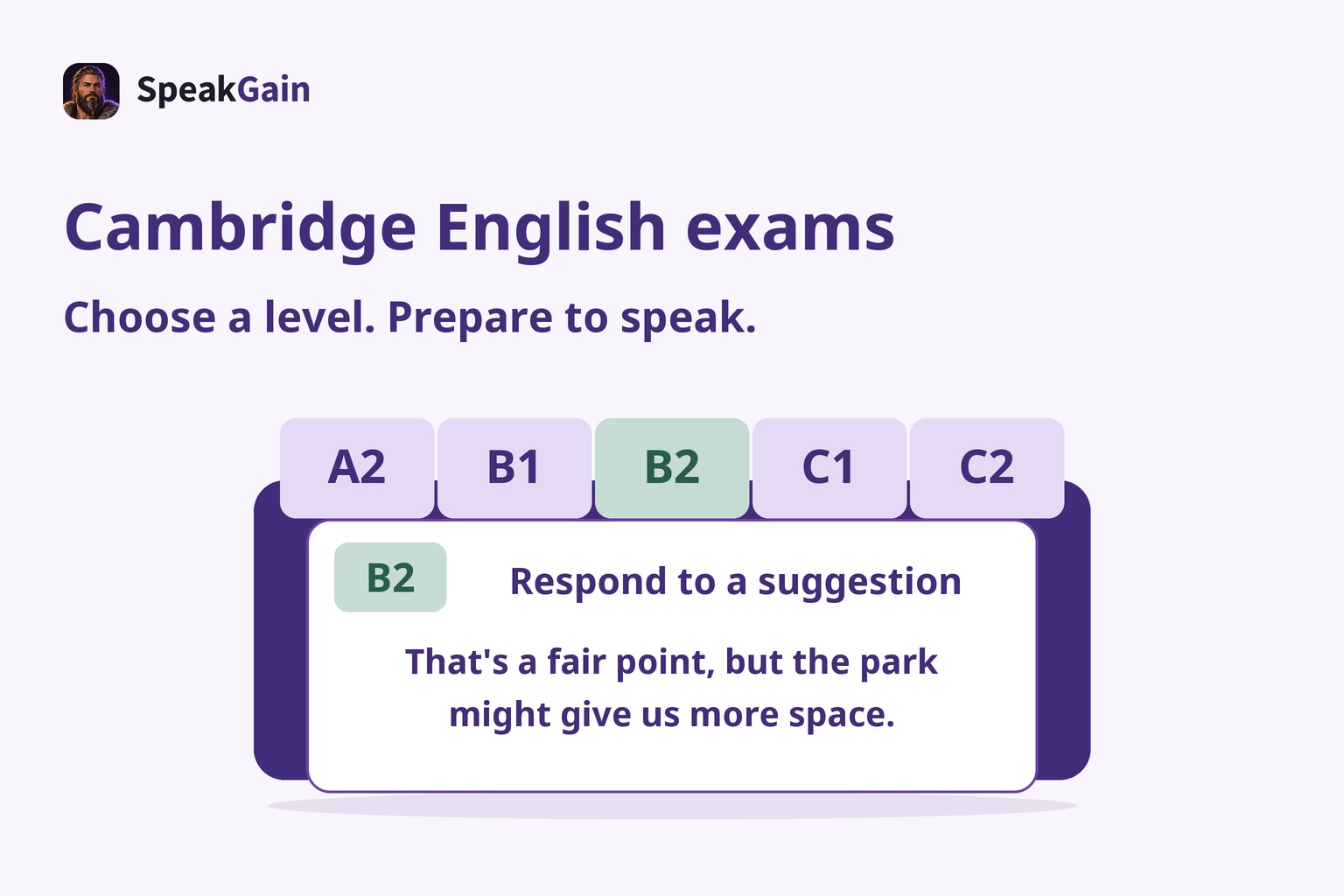
Cambridge English Qualifications test reading, writing, listening and speaking at specific CEFR levels. Choose an exam from A2 Key to C2 Proficiency using your institution’s requirements and the official samples. Our first speaking practice recommendation is to answer a question with a reason, then listen to a partner and respond to their point.
This guide is for school pupils, university students, adults and parents supporting preparation. Examination facts were checked on 15 October 2026; the examples and practice plans are our own, not official tasks.
Exams, levels and Cambridge English Scale scores
An exam’s target level is different from the full range of scores it reports. Sitting B2 First does not by itself mean you have achieved B2.
| Exam | Target CEFR | Scores at target level | Full reported range | Intended context |
|---|---|---|---|---|
| A2 Key / for Schools | A2 | 120–139 | 80–150 | Basic communication; adult or school-age interests |
| B1 Preliminary / for Schools | B1 | 140–159 | 102–170 | Practical everyday English; adult or school-age topics |
| B2 First / for Schools | B2 | 160–179 | 122–190 | English for living, working and studying |
| C1 Advanced | C1 | 180–199 | 142–210 | Advanced study and work |
| C2 Proficiency | C2 | 200–230 | 162–230 | Particularly advanced English use |
These are Scale scores, not raw marks or percentages. For example, B2 First reports 180–190 as Grade A/C1, 160–179 as Grade B or C/B2, and 140–159 as B1. Scores of 122–139 are reported without a certificate. See the official results tables.
Results show skill scores, an overall score, a grade and a CEFR level. Some exams also report Use of English; the overall result averages the reported scores. A Speaking score alone is not the overall outcome (Scale explanation, results).
For A2, B1 and B2, for Schools has the same CEFR level and format as the ordinary version, with topics suited to school-age learners. The ordinary version is designed for adults. It is not a lower qualification because it has “Schools” in its name (A2, B1, B2).
Speaking format: two examiners and two or three candidates
One examiner leads the interaction and another listens. Current official summaries allow the interlocutor to examine remotely: do not assume every examiner will be physically in the room.
| Exam, including Schools versions | Parts / time for a pair | Group of three | Sequence |
|---|---|---|---|
| A2 Key | 2 / 8–10 min | 13–15 min | Interview → preferences and reasons |
| B1 Preliminary | 4 / 10–12 min | 15–17 min | Interview → one photo → suggestions → conversation |
| B2 First | 4 / 14 min | 20 min | Interview → photo comparison → collaboration → discussion |
| C1 Advanced | 4 / 15 min | 23 min | Interview → choose two of three photos → collaboration → discussion |
| C2 Proficiency | 3 / 16 min | 24 min | Interview → picture-based collaboration → long turns and discussion |
Sources: the official format link in each row, checked 15 October 2026. These are test durations, not uninterrupted time for each candidate. Part timings below refer to pairs.
Digital, paper, registration and validity
The five exams offer digital and paper-based formats; their official pages state that the formats are the same. Ordinary A2 Key paper-based testing will end after its last December 2026 session; A2 Key for Schools paper-based testing continues (current A2 notice). Digital does not mean a solo recorded Speaking test.
Register through an authorised exam centre and ask it about dates, delivery options and fees (official handbook). A single worldwide fee or availability of every exam at every centre is not stated in the official pages checked. We do not infer local options from a translated exam name.
The certificate does not expire, but a university or employer may set its own acceptance period. Check the receiving institution’s rules (official validity guidance).
Which level would we choose?
Editorial view: if you need a qualification for an application, start with the institution’s named exam and required scores. If it is a learning milestone, try the official samples across all four skills before choosing. Age alone does not mean “B1 for teenagers” or “B2 for adults”.
As a starting point, consider A2 when you are building short everyday answers, B1 when you want to describe experiences and a photograph, and B2 when you want to develop comparison and collaborative discussion. These are practice suggestions, not eligibility rules or pass predictions. C1/C2 candidates should actually attempt their longer turns and discussion. The short B1–B2 examples below are starting structures, not complete C1/C2 answers.
Eiken and IELTS comparisons
Cambridge provides official CEFR/IELTS Scale comparison guidance. Use that source rather than inventing a conversion; a shared CEFR label does not make tasks or pass outcomes identical. A current complete one-to-one mapping of all Eiken grades to these five exams is not stated in the official material we checked.
Compare accepted qualifications, required scores and dates first. Our IELTS guide, Eiken interview guide, Eiken Pre-1 preparation and TOEFL guide cover their own tasks; their answer structures should not simply replace Cambridge’s collaborative work.
1. Personal questions: answer, then give a reason
Part 1 concerns personal or factual information across these exams. It lasts 3–4 minutes at A2 and 2 minutes at B1/B2/C1/C2. B2 also describes questions about past experiences, present circumstances and future plans (official format tables above).
Our structure is direct answer → reason or example: I usually study at home because it’s quiet. A possible response for partner practice is I do too, but I prefer the library at weekends. Match the actual tense and question. In an individual interview turn, do not interrupt the other candidate just to use your partner-response sentence.
Alone, record answers about today, last week and next month. In pairs, alternate asking and answering, changing the question rather than repeating a fixed script. A common mistake is delivering a prepared introduction regardless of the question: first answer what was asked, then add one detail.
2. A2 Part 2: preferences with reasons
A2 Part 2 discusses likes, dislikes and reasons for 5–6 minutes (official format). It is not B2’s photo comparison or decision task.
Try preference → reason → invitation: I like parks because I can walk there. What about you? A partner can respond Me too. I like being outside.
Alone, say one sentence about somewhere you like and somewhere you do not. With a partner, deliberately choose different preferences and respond before adding your own reason. The common mistake is agreeing every time without contributing content. You do not need to disagree artificially, but do give a reason of your own.
3. Photographs: describe at B1, compare at B2, select at C1
B1 Part 2 asks for about one minute on one photograph; the part lasts 3 minutes. B2 gives two photographs and a one-minute turn, followed by a roughly 30-second partner response. C1 gives three photographs: choose two, speak for one minute, then the partner comments for roughly 30 seconds (B1, B2, C1).
For B1, use people/place → action → visible detail: Two people are studying outside. One of them is writing in a notebook. Do not invent a relationship or occupation as a visible fact.
For B2/C1, start with common point → difference → answer to the actual question: Both places look useful for studying, but the park seems quieter. A short response example is I’d choose the indoor space because the weather could change. Respond to the examiner’s question, not merely to a summary of your partner’s speech. B1 does not have this same 30-second partner-response requirement.
Alone, use your own photographs and retain your first one-minute attempt. In pairs, swap speakers and include the short response where your exam requires it. A common mistake is spending the whole turn searching for a tiny detail’s name. Give the main comparison and answer before expanding detail.
4. Collaborative tasks: acknowledge, add a view, invite a response
B1 Part 3 allows 4 minutes for suggestions, alternatives and agreement. B2/C1 Part 3 has 2 minutes of discussion plus 1 minute to decide. C2 Part 2 combines picture reactions and a joint decision in 4 minutes (official format sources above).
Our invented practice situation is choosing somewhere to study together; it does not reproduce a Cambridge task. Try proposal → reason → invitation: We could meet at the library because it has large tables. What do you think?
Our shared practice sentence is That’s a fair point, but the park might give us more space. It acknowledges the other person’s reason, introduces a different consideration and makes that consideration concrete. Do not use “but” simply to manufacture disagreement.
Continue with Which matters more for our group, tables or space? When it is time to decide, try Shall we choose the library, then? Practise exploring options before rushing to a decision.
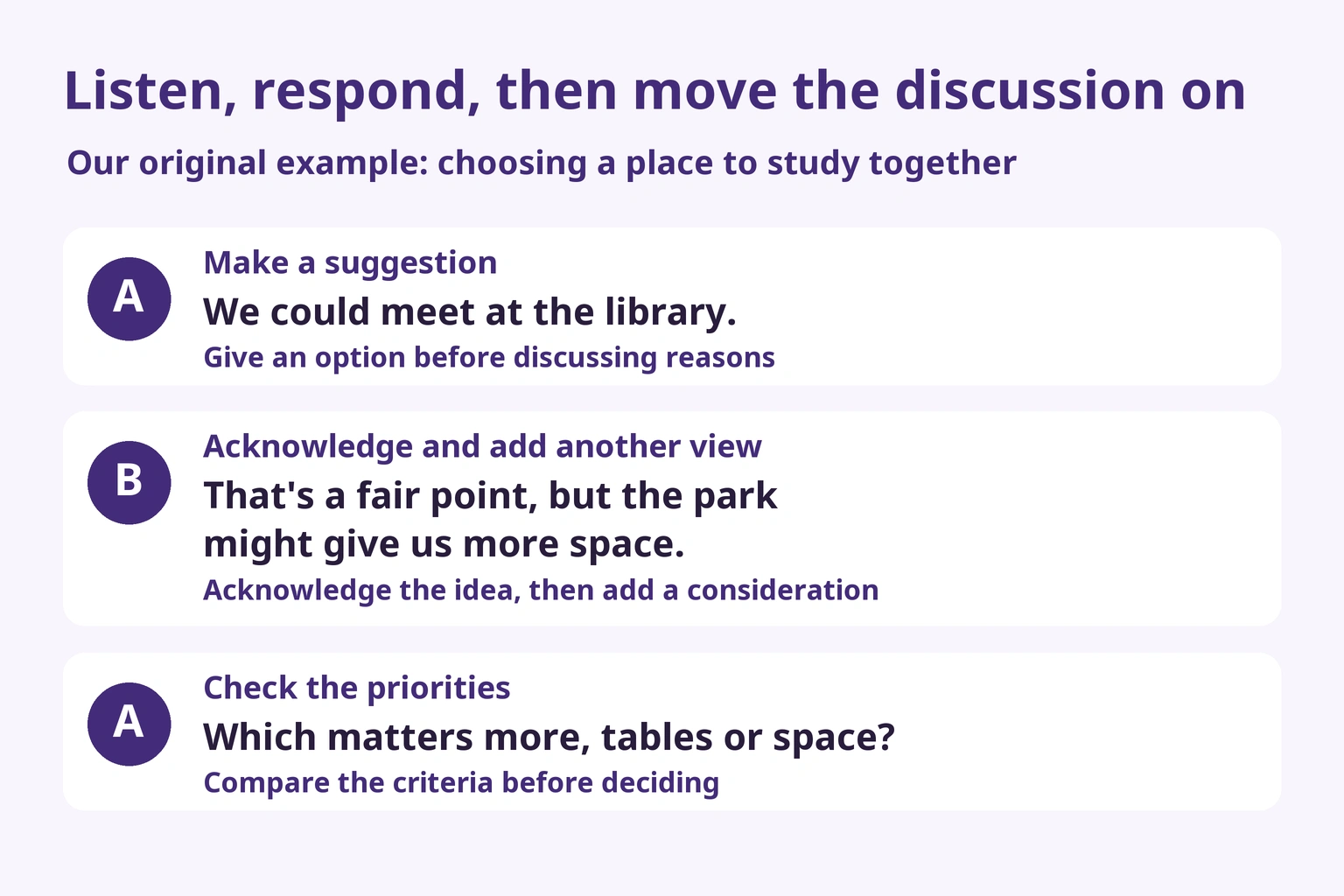
Alone, record a suggestion, play it back and respond without reading. With a partner, start with a script, then change the places and reasons without warning. Common mistakes are talking only about your own choice or stopping at I agree. Pick up one point and add a reason, alternative or question. Our discussion participation guide offers further practice.
5. Conversation, discussion and C2 long turns
B1 Part 4 is a 3-minute conversation about experiences, preferences and opinions; B2 Part 4 is a 4-minute discussion; C1 Part 4 lasts 5 minutes. C2 Part 3 totals 10 minutes, including roughly 2-minute individual turns, partner comments and discussion (official format sources above).
Use view → reason → example → condition or alternative. A short start is Shared spaces help people study because they can exchange ideas. A response is I see what you mean. It also depends on how noisy the place is. These two sentences alone do not fulfil a C1/C2 task.
Alone, develop an example and an exception before connecting them without a script; C2 candidates should also practise their longer time frame. In pairs, add conditions to each other’s reasons without forcing the same conclusion. A common mistake is repeating abstract agreement or disagreement: explain one situation where your claim applies.
A four-week practice plan
This is an editorial starting plan, not a promise of passing in four weeks. Adapt the amount to your available time while retaining both individual and paired work.
| Week | Alone | With a partner | Keep |
|---|---|---|---|
| 1 | Check the format and samples; try every task | Alternate questions and short answers | Where and why you stopped |
| 2 | Record descriptions/comparisons; fix one point | Listen, then give a short response | First and revised recordings |
| 3 | Respond to a proposal without a script | Separate discussion from decision; vary topics | The point you responded to |
| 4 | Review weak tasks and practise to your exam’s time | Run the sequence including listening and responses | One next change and exam-day checks |
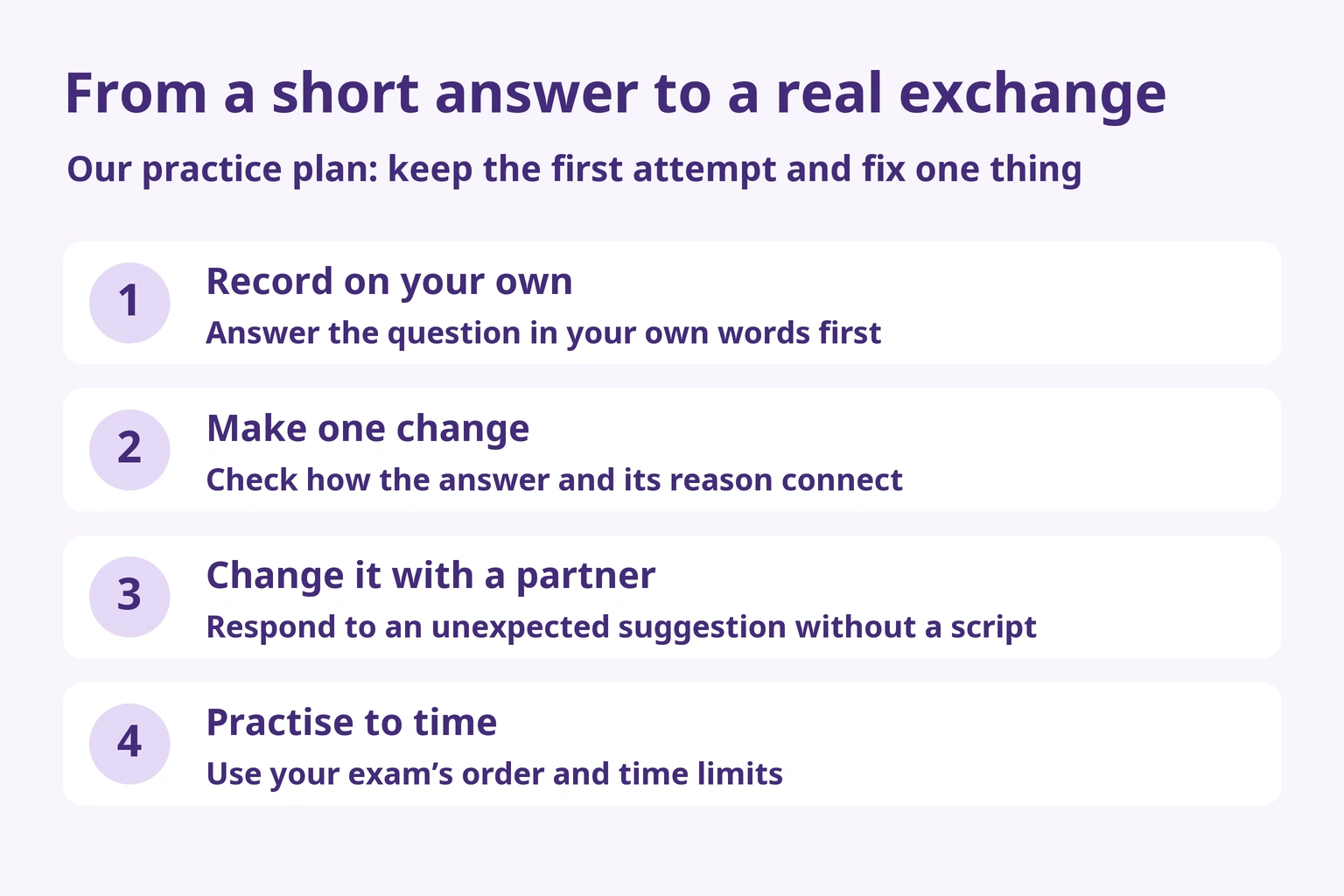
Ask a parent or friend to explain what they understood, rather than supplying every answer. Check whether you answered the question, connected a reason and responded to the partner. This is a practice check, not official marking or a score prediction.
For short-sentence practice, say That’s a fair point, but the park might give us more space., then change the place and reason. See what SpeakGain is for its learning context.
To compare the American-English audio example with another model, see our British and American English guide for representative pronunciation, vocabulary and grammar differences.
Save a short response in SpeakGain and listen
We created this sentence once through the normal Add a card screen and verified generated explanation and Viking audio. Viking is an AI-generated American-English example, not a human speaker’s recording. The screen’s “Native audio” label refers here to that generated audio.
That's a fair point, but the park might give us more space.
On the device, we opened the new Library card through Knowledge → Learn this card → Listening. Listening hid the sentence and autoplayed the audio. Reveal answer opened Answer with the saved sentence, generated English explanation, playback controls and review intervals. We selected Good and confirmed this card’s review count became one. We did not start a learner recording or pronunciation evaluation.
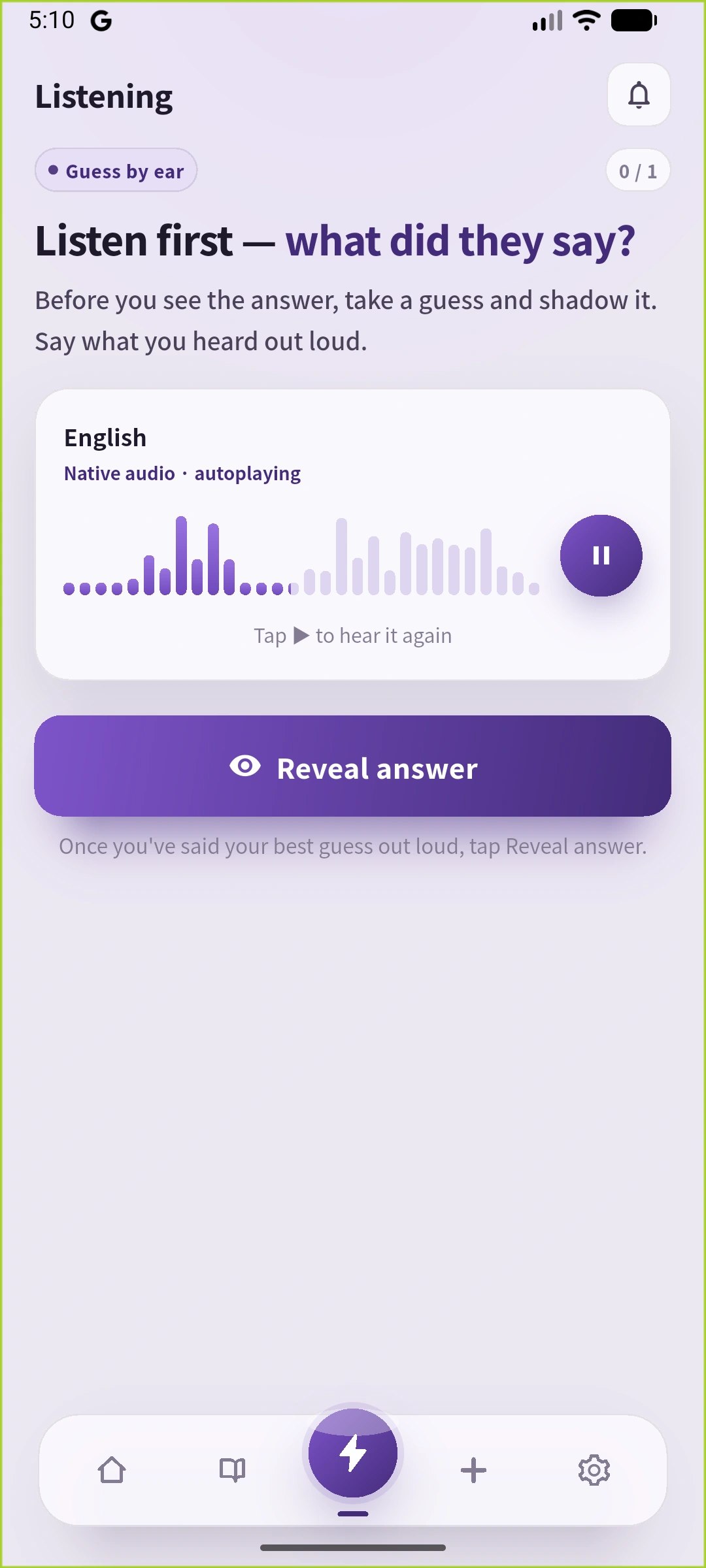
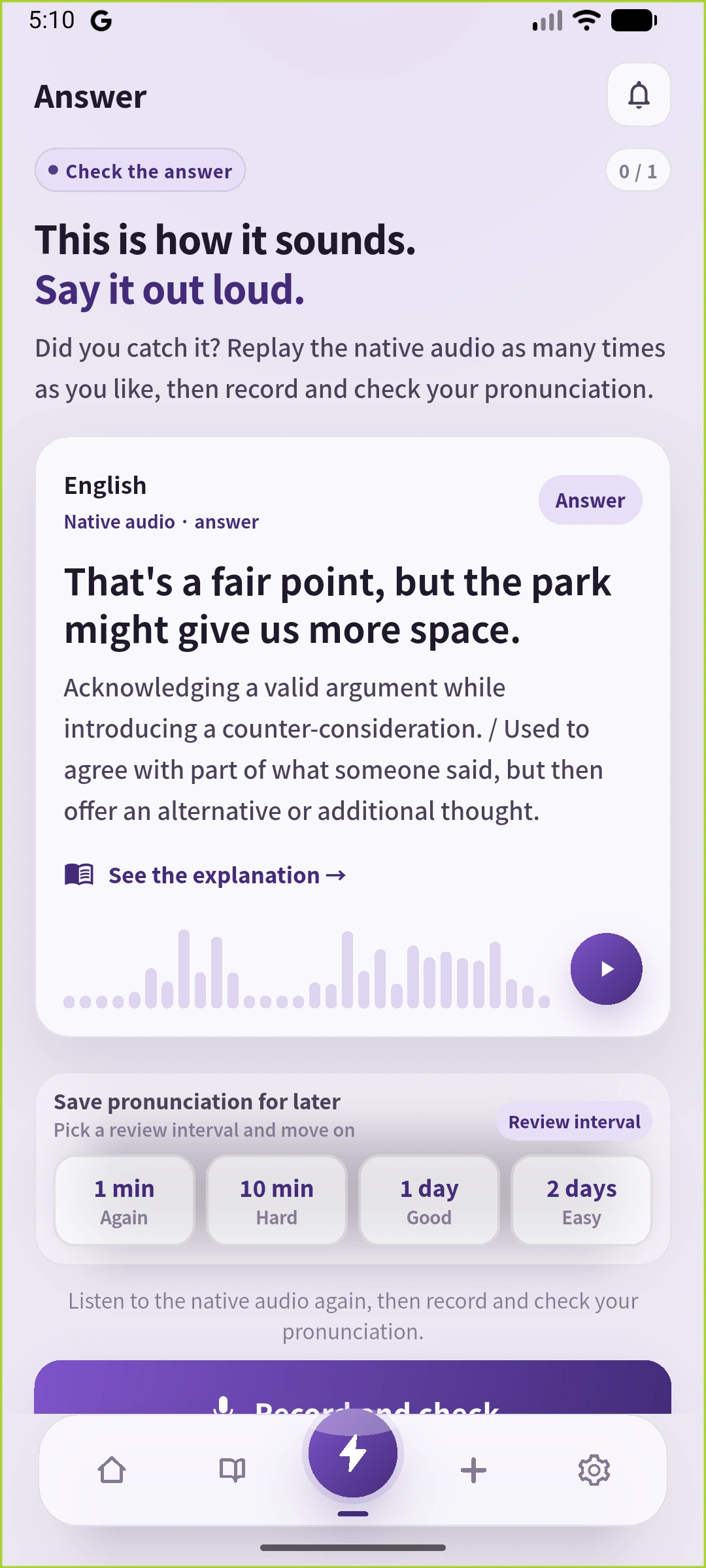
Our suggestion is to listen, say the sentence yourself, then change the place or reason. Return afterwards to official samples and unscripted work with a partner. This is short-sentence support, not a Cambridge mock examination, answer or pronunciation scoring, or a pass guarantee.
Methods we do not recommend
Do not make memorised long answers the centre of practice. Replaying a fixed answer can distract from a changed question or unexpected suggestion. If you learn a short structure, also replace its subject, place and reason.
Do not ignore the partner or hand all the work to them. Collaboration needs an exchange: acknowledge a point and add your own reason or question. Do not treat “I agree” as a complete discussion. A guaranteed pass from one difficult word or a universal template is not stated in the official material checked.
Keep the first recording as well as the polished one. Smoothly reading a practised answer and responding to an unfamiliar proposal are different checks.
Frequently asked questions
Which exam should I start with?
Check your institution’s requirement, then try official samples across the skills. For a learning milestone, our advice is to choose tasks you can attempt in your own words, rather than assign a level by age.
Is for Schools easier?
It has the same CEFR level and format; topics reflect school-age experience (A2, B1, B2). It is not a lower-level award.
Can I register alone, and will Speaking be individual?
Contact an authorised centre for registration; the usual Speaking format uses two or three candidates. An obligation to provide your own partner is not stated in the format pages checked. Ask the centre about arrangements (handbook).
What if my partner speaks much better?
Our advice is to respond to their point and contribute your own reason, rather than compete on speed. An automatic scoring consequence based only on the partner’s ability is not stated in the format pages checked.
Is digital Speaking a solo recording?
No: the official formats describe interaction with candidates and examiners for both delivery modes. An interlocutor may examine remotely; follow the centre’s instructions.
How long is the certificate valid?
It does not expire, but receiving institutions may limit how old accepted results can be (official results guidance).
How does it compare with Eiken or IELTS?
Use the qualification your institution accepts. For IELTS, consult the official comparison; we do not publish an invented Eiken equivalence or use a comparison as a pass guarantee.
Where are official practice tasks?
Use the Preparation page for your exam: A2, B1, B2, C1 or C2. Our examples are independent practice, not official sample answers.
Editorial verdict
Choose the exam for your purpose, check its actual tasks, then work on short answers and partner responses before running the whole test sequence. B1 description, B2/C1 comparison and C2 extended speech need different practice.
Today, respond to a suggestion with That’s a fair point, but the park might give us more space. Then replace the place and reason. Return to an unscripted exchange and your exam’s timings, rather than treating one fluent memorised answer as the whole preparation.
Official sources
Checked 15 October 2026. The linked exam overviews, formats, results, Scale and A2 handbook support the factual tables and guidance. See the linked Preparation pages for official samples. Confirm current arrangements with your centre.
Cambridge English is a trademark of Cambridge University Press & Assessment. Our examples, diagrams and practice plan are independently written editorial suggestions, not Cambridge examination tasks or official answers.