
EIKEN Grade Pre-1 interview preparation: narration, opinions and solo practice
Published
Japan’s conventional EIKEN Grade Pre-1 second-stage interview takes about eight minutes: prepare for one minute, narrate four illustrations for two minutes, then answer four questions in English. The passing threshold is 512 out of 750 on the EIKEN CSE scale. Assessment includes narration, response content, pronunciation, vocabulary, grammar, usage, information and willingness to communicate. Our editors recommend recording the story first, then practising an opinion with a reason and a concrete example, listening back and repairing one problem at a time. Official format; CSE threshold and calculation. Checked October 10, 2026.
This is a guide for people preparing for the face-to-face test in Japan, rather than a general job interview or a different country’s proficiency exam. Every English example, scenario and diagram below is original editorial practice material, not a past question, official card, official answer or prediction. Open the official samples for actual test material.
For the big picture first, see our all-grade Eiken comparison and common preparation guide before choosing your grade’s practice.
For preparation beyond the interview, our Eiken Pre-1 study plan also covers reading, listening, summaries and opinion writing.
Interview sequence and question structure
Pre-1 does not begin with reading a passage aloud. After brief conversation, you narrate the four illustrations and answer No.1 while the card remains visible. Turn it over after No.1. No.2 and No.3 concern its topic; No.4 concerns a more broadly related social issue. The table follows the Japanese instructions and official English page, checked October 10, 2026. The final column contains editorial checks, not question-by-question score allocations. The official guidance does not give a fixed answering time for each Q&A question.
| Stage | What happens | Official time or quantity | Editorial practice check |
|---|---|---|---|
| Enter and sit | Hand over the interview form; follow seating instructions | No separate seconds specified | Respond to the instruction and do the action |
| Identification and conversation | Confirm name/grade; brief everyday conversation, not assessed according to the English page | 1–2 conversation questions | Answer what was asked, briefly |
| Prepare | Read the instructions silently and consider the four scenes | 1 minute | Identify the opening, actors and changes |
| Narrate | Use the printed opening and describe the development | 1 task, 2 minutes; stopped even mid-story at the limit | Reach the final change |
| No.1 | Illustration-related question; looking at the card is allowed | 1 question; no fixed response seconds stated | Match the specified person and situation |
| Turn the card over | Follow the examiner after No.1 | No separate seconds specified | Continue without looking at the illustrations |
| No.2 | Opinion related to the card’s topic | 1 question | Match your reason to your position |
| No.3 | Another opinion related to that topic | 1 question | Listen to this question rather than recycling No.2 |
| No.4 | Opinion on a somewhat related social issue | 1 question; topic introduction added in 2024 | Explain your reason through a concrete example |
| Return and leave | Return the question card and leave | About 8 minutes for the whole interview | Follow the closing instruction |
One examiner conducts the interview, entirely in English. The virtual interview shows entry and exit; distinguish the interview form handed over at entry from the task’s question card.
The change from 2024
A topic introduction was added to Pre-1 No.4 from the first 2024 session. The official renewal table also says the passing standard did not change. Listen through the introduction to the actual question. A background statement about libraries helping internet access is not itself a question about whether local government should increase their budget. Our editors practise with an invented one-sentence background followed by an original question; this does not reproduce official wording.
This guide covers the conventional face-to-face test. S-CBT uses recorded speaking and different on-the-day procedures; check its own instructions rather than copying physical card handling.
Passing threshold and assessment
The second-stage threshold is CSE 512, with a speaking maximum of 750. The official introduction supplies the threshold; the current CSE explanation supplies the maximum and calculation method. Its historical first-stage writing format is not evidence for today’s interview.
CSE is calculated statistically after scoring all responses; you cannot derive your score from your own correct-answer count. Dividing 512 by 750 does not produce the required interview accuracy. We do not invent a raw-score “safe zone” or recommend sacrificing a question. Our editorial recording checks ask whether all scenes were conveyed, the question was answered directly and the reason made sense; they are not official marks.
The solo-practice loop
Use an official sample, a timer and a recorder at home. Notes, photography and recording are prohibited during the actual interview (official rules).
- Attempt a sample before reading an answer, or choose a clearly separate original practice scenario.
- Record narration after one minute of preparation and stop at two minutes. For opinions, start with a 40-second practice window. Forty seconds is our editors’ suggestion, not an official Q&A limit.
- Listen for missing information before judging pronunciation: did you reach the ending, use the right person and support your position?
- Change one thing. If the ending disappeared, shorten repeated background and reserve space for it. Do not rewrite every sentence with harder vocabulary at once.
- Record again, then change the material. A new actor or question shows whether you can select information rather than recall an answer.
Keep a short note such as “First attempt: no final reaction. Next: remove one opening sentence and add the reaction.” Retain the initial silence in the recording so you can distinguish delayed starts from hesitation while choosing information.
Brief conversation
Asked: identification and short everyday conversation. The English guidance says the conversation is not assessed; still listen and respond to instructions.
Editors’ pattern: direct reply, then one relevant detail if needed. An original example about recent reading:
I’ve been reading about local history recently. I enjoy learning how towns have changed.
The second sentence adds a reason for the activity. Use it only for a matching question, rather than delivering it after every greeting.
Alone: shuffle a few personal prompts and record in an editorial 20-second window. Listen to whether the first sentence answers the actual prompt; correct one mismatch, then try another. Twenty seconds is not an official allowance.
Common mistakes: giving an entire memorized introduction, ignoring instructions because this part is unassessed, or rushing to hide nervousness.
Four-scene narration: carry the changes through to the end
Asked: think for one minute, begin with the card’s printed opening, and narrate the four illustrations for two minutes. The examiner ends the task at the limit, even if you are unfinished (instructions).
Editors’ pattern: required opening → initial situation → proposal/event → following action → final situation/reaction. “Situation, proposal, action, result” organizes our invented material; actual cards need not follow that plot. Describe what is shown rather than forcing every story into a happy ending.
Our scenario has few participants at an evening library computer class, a suggestion to move the next class to Saturday, preparation and publicity, then a crowd requiring more staff:
One evening, a librarian noticed that only a few people had come to a computer class. She suggested holding the next class on a Saturday. Her colleague agreed to try the idea. During the following week, they prepared the materials and put up a notice. On Saturday, many residents arrived, and the room became crowded. The librarian was pleased, but she realized that they would need another staff member to help everyone.
This is a short skeleton, not a finished answer intended to fill two minutes. On a real sample, select relevant speech, actions and time/place information from the illustrations. Never add our library, Saturday or staff problem to an unrelated official card.
During home preparation, our editors try roughly 15 seconds for the instructions/opening and whole sequence, 30 seconds for the central actor/action of each scene, then the remainder for speech, transitions and the ending. That subdivision is editorial, not official. Adjust it as needed. Trying to compose flawless full sentences mentally can consume the minute before you reach scene four. First identify the four actions; then check who “she” and “they” refer to. Eventually practise without notes, as required in the exam.
During speaking, establish all central events before polishing details. We do not assign 30 seconds or an identical sentence count to every scene: information density differs. If the opening consumes most of the recording, shorten it next time rather than race through the ending. Name who speaks: “She suggested holding…” makes the proposer clear. Direct speech is also usable when the speaker is identified; converting everything to reported speech is not the goal.
The example’s past-tense narration follows its chronology. “Had come” precedes the librarian’s noticing; “would need” looks forward from that moment. Complex tense does not guarantee marks. Start by conveying actions and order, and do not mechanically change the tense inside all quotations.
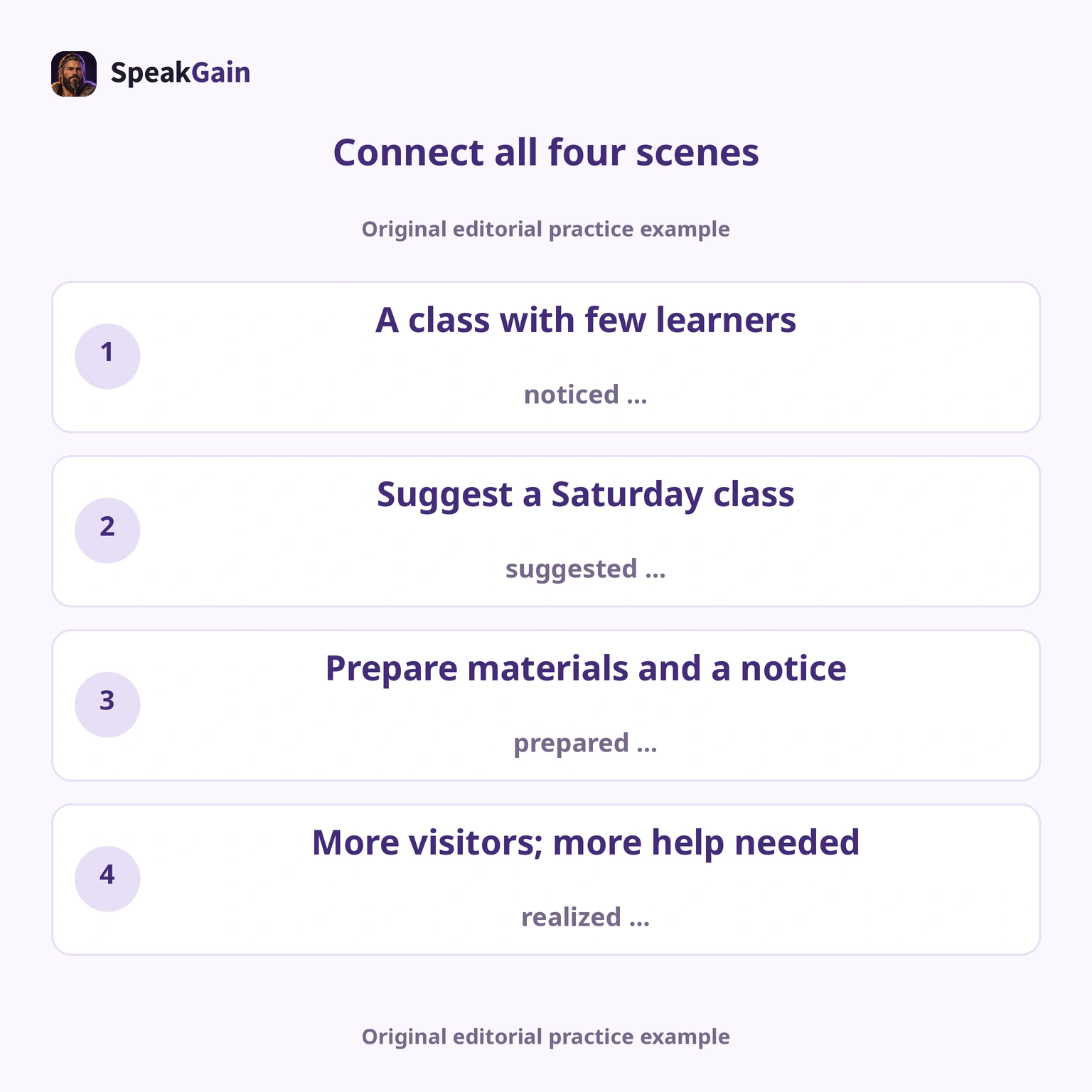
Alone: record with one-minute preparation and a two-minute stop. Mark where each scene appeared after listening. If the final staffing problem is missing, remove unnecessary opening detail and re-record. Next time check the proposer; another time repair a hesitation inside “put up a notice,” then return to the whole story. Reading aloud can help a pronunciation-related stop, but cannot replace selecting the story’s information. Finally attempt an official sample from its own printed opening without looking at an answer.
Common mistakes: listing every object in scene one, giving nouns without actions, changing pronoun referents, inventing motives or a sequel, and missing a difficulty at the end. Our editors fix omissions and connections before adding difficult expressions.
No.1: answer from the specified situation
Asked: a question related to the illustrations; the card may remain visible. The official description does not guarantee one fixed English question. Do not import Grade 2’s passage-search method.
Editors’ pattern: if asked to take a character’s perspective, identify that role → thought/feeling → scene-based reason or next need. Our librarian example:
I would be thinking that we needed more help. There were too many visitors for the two of us to assist.
The thought is the need for help, explained by the number of visitors and staff. This pattern fits a hypothetical perspective prompt; it is not compulsory wording for every No.1.
Alone: use a 40-second editorial window, listen for the specified person and evidence from that scene, then repair one mismatch. Change the person or scene next time.
Common mistakes: answering about the wrong scene, confusing your role with the character’s, retelling the entire narration, or inventing circumstances absent from the picture.
No.2: position, reason and a small example
Asked: your opinion on something related to the card’s topic, after turning it over.
Editors’ pattern: direct position → reason → concrete example. An original example about evening access:
Yes, I think libraries should stay open in the evening. Many people cannot visit during working hours. For example, a parent could borrow books after picking up a child from school.
The parent’s action explains why longer opening hours matter; this is a hypothetical illustration, not a visitor survey. A “should” question needs a judgment about what should happen, while a prediction needs a prediction. Match your first sentence to the actual question.
Alone: record for 40 seconds, listen for the link between position and reason, and check that the example says who does what. Replace one repeated “useful/convenient” adjective with a concrete action; record again. Later try the opposite position to practise selecting an explanation under different conditions.
Common mistakes: stopping at “Yes,” giving only a personal preference unrelated to the judgment, or adding an example that contradicts your position.
No.3: listen again and make conditions clear
Asked: another opinion related to the topic. The official format does not assign No.2 and No.3 different fixed themes. We use a conditional opinion here to broaden practice, not because No.3 always requires conditions.
Editors’ pattern: clear position → necessary condition → reason/example:
I think basic computer classes should be free. However, libraries should keep the groups small enough for staff to help each learner. A beginner may need someone to explain how to use an online form.
Free classes and small groups can coexist: the condition preserves individual support. The example expresses an editorial practice opinion, not an official correct policy answer. “It depends” alone leaves the judgment unexplained; say what condition changes your view and how.
Alone: shuffle two related but different prompts and record each in a 40-second window. Listen for remnants of the previous question. If asked about fees but answering about opening hours, repair your opening position. Then check whether the clauses around “however” contradict each other; change one condition or reason and re-record.
Common mistakes: repeating No.2, listing both sides without deciding, or adding connectors instead of explaining your judgment.
No.4: make a social opinion concrete
Asked: an opinion on a social issue somewhat related to the topic. Listen to both the topic introduction added in 2024 and the final question.
Editors’ pattern: position → reason → concrete example → explanation linking the example back to the judgment:
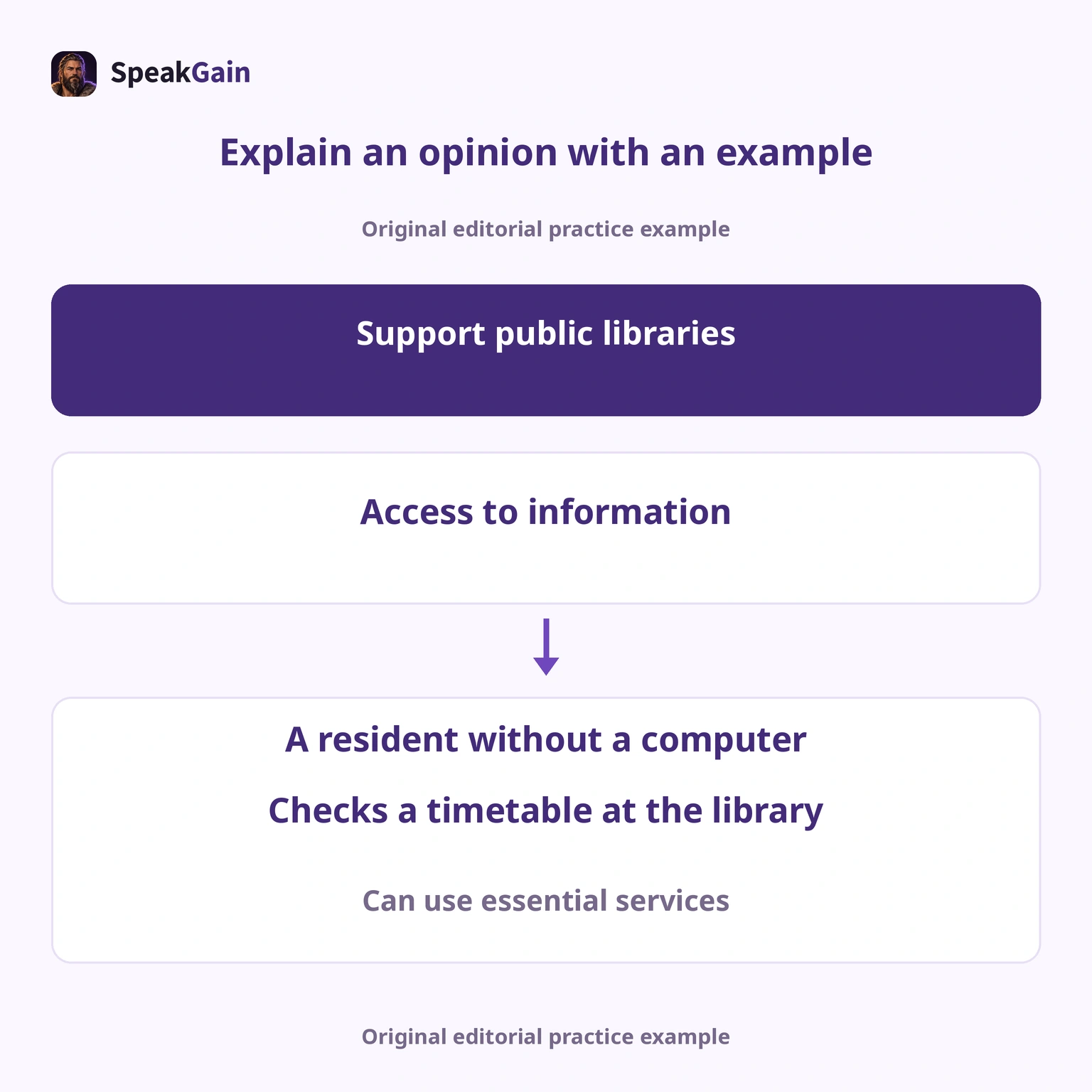
I support public libraries because they give everyone access to information. For example, an older resident without a computer could use a library computer to check a bus timetable. This helps people use essential services even when they cannot afford their own equipment.
Checking a bus timetable makes the information-access reason tangible; the last sentence links it to essential services. This is an invented situation, not research into a real municipality. If asked specifically about increasing funding, answer that funding judgment first rather than relying only on “I support…”.
Turn “it is convenient” into who → under what condition → can do what → why that matters to this question. Here, an older resident has no computer, uses one at the library and gains access to transport information. Merely mentioning “older people” and “computers” does not explain the action. A hypothetical “a person could…” is enough; never fabricate percentages, organizations or research to sound persuasive. The practice claim about access is not a guarantee that every real library has adequate equipment or assistance.
Explain one reason before collecting more. Two reasons do not guarantee a pass. An opposing view can discuss spending or alternative support, but should still explain its own judgment. Aim for agreement between position and explanation rather than guessing the examiner’s preferred policy.
Alone: record an original background statement and question, then answer without a script in the editorial 40-second window. Listen for where position, reason or example stops. Replace circular “convenient because it is convenient” with a resident’s action. On the next attempt, add the link to the question if the timetable example feels disconnected. Change to education, travel or work another day so you select a new example. Building short English sentences can help; do not first write a complete essay in your own language and translate it word by word.
Common mistakes: talking only about the introduction, giving a vague social opinion, switching topics mid-example, or reciting a memorized library answer to a different question.
Saving one answer-pattern sentence: what we verified in SpeakGain
We develop SpeakGain. Complete interview practice still uses official samples and home recordings. The new sentence selected for this article is:
I support public libraries because they give everyone access to information.
It is a line for speaking a reason, not an answer suitable for every social question. We entered it through the normal Create flow; generation failed after one retry of the same card. The original publication had no audio player; the same card now has Viking audio below. No additional cards were created.
This AI-generated Viking sample comes from a card created through the app’s normal Add flow; it is not a human native speaker’s recording.
I support public libraries because they give everyone access to information. — Support public libraries because everyone can access information.
We verified the learning flow using a previously working card:
I like studying with a friend because we can help each other.
The screenshots show that older card, rather than successful generation of the library sentence. We searched in Library and followed Knowledge → Study this card → Listening → Show answer → Answer check. Before revealing English, Listening offers model playback. Answer check shows the sentence, explanation, model playback, review intervals and an entry to recording/scoring. We verified the screens and navigation, not an EIKEN answer score or CSE result.
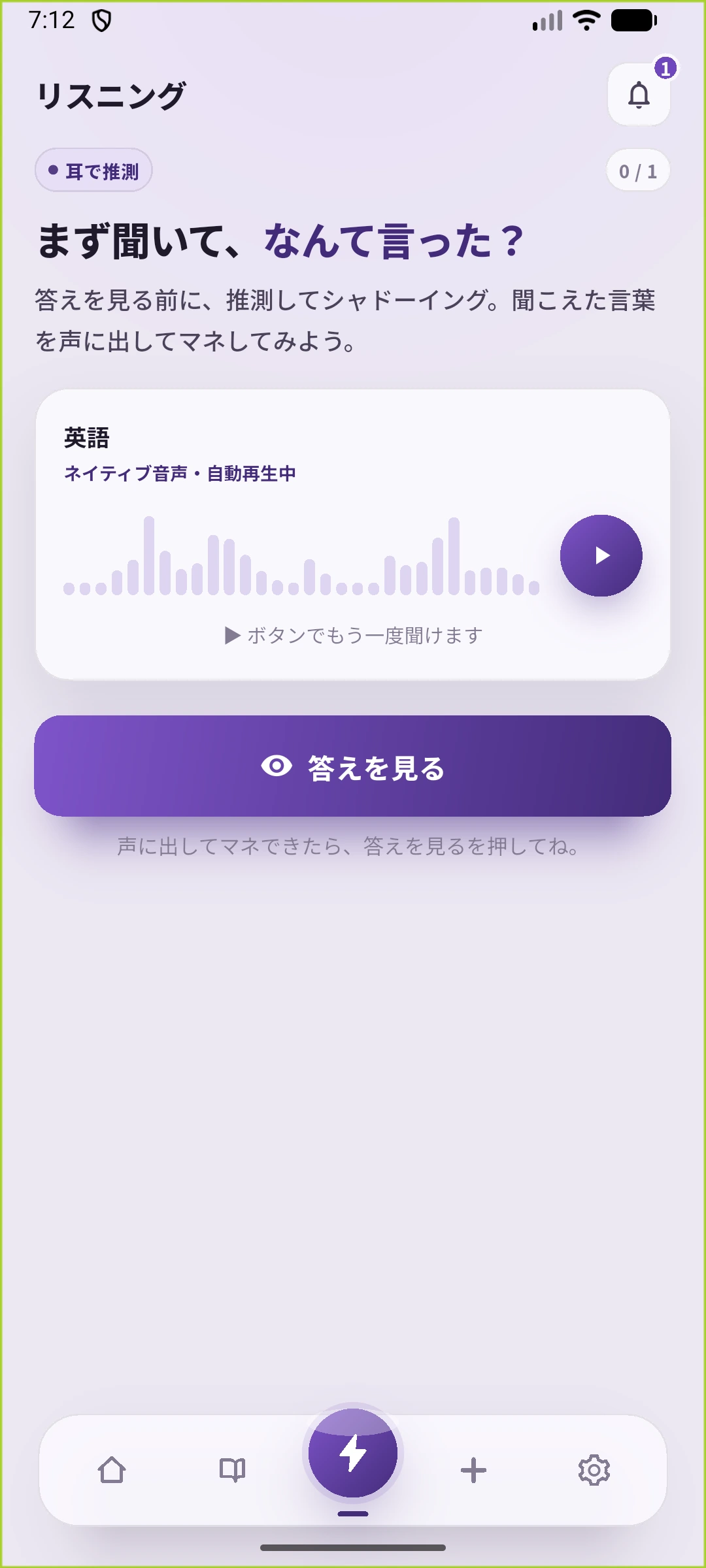
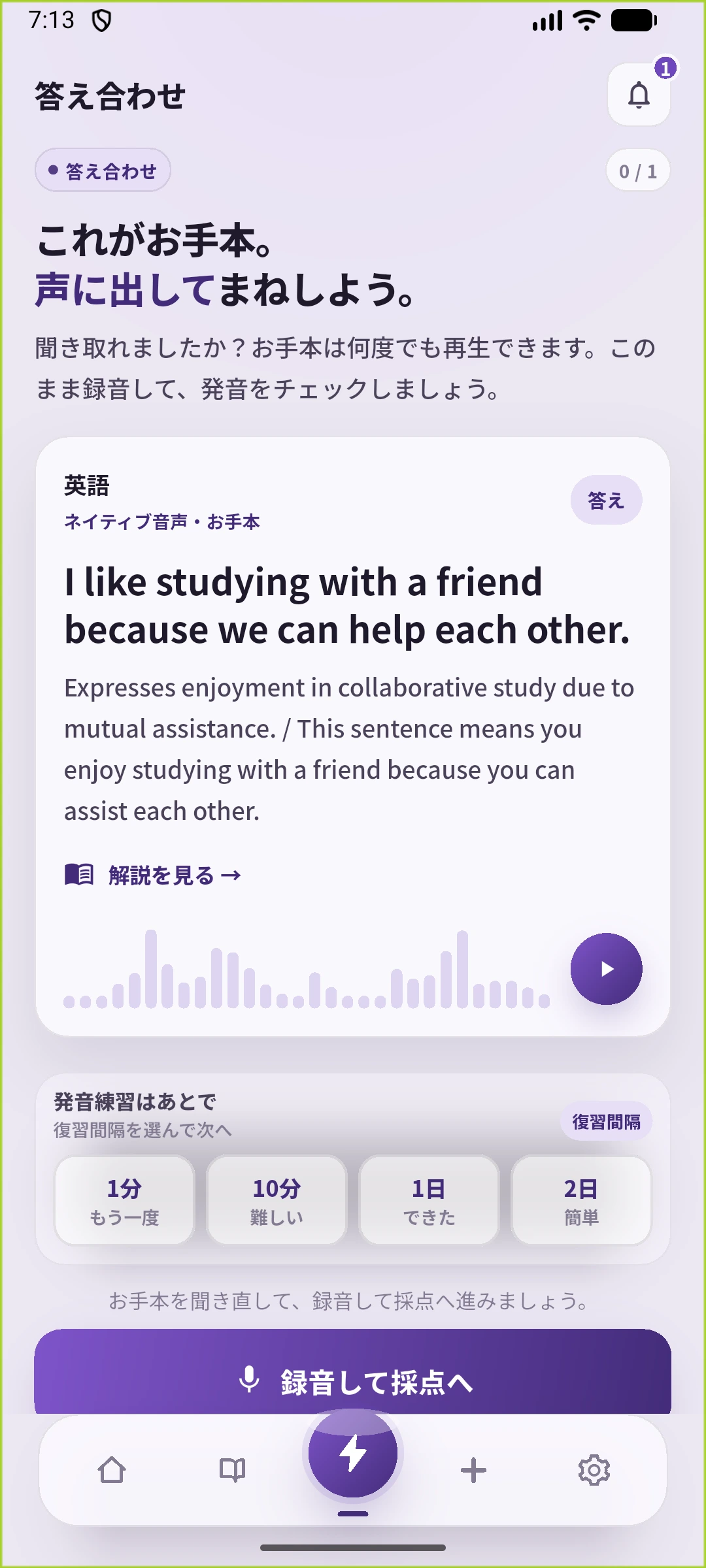
The screenshots retain the device’s Japanese UI: the first shows Listening and Show answer; the second shows Answer check. Use the English sentence and the translated sequence above to follow them. After practising a line, hide it and return to choosing your own reason and example. We do not present SpeakGain as an EIKEN mock interview or CSE scoring tool. See what SpeakGain does.
A practice plan through interview day
Our editors start from the first recording’s weakness, not a promise of passing in a set number of days. Around 20 minutes a day is an example allocation; on busy days, repair and re-record one task.
| Stage | Home practice | Check before advancing |
|---|---|---|
| First day | Check the format/2024 change; record narration and one opinion | Name one missing scene or explanation |
| Early days | Repair four-scene actions and No.1 perspective | Reach the last change and use the right person |
| Middle days | Vary No.2/3; connect No.4 reasons and examples | Select a new position/example when the question changes |
| Last 2–3 days | Run an official sample from entry to return without stopping to correct | Check card-turning, the two-minute stop and relevance afterwards |
| Day before | Briefly revisit one repair; check admission slip, belongings and route | Avoid starting a large new answer collection |
| Test day | Follow your slip and actual examiner instructions | Leave home notes/recording methods out of the interview |
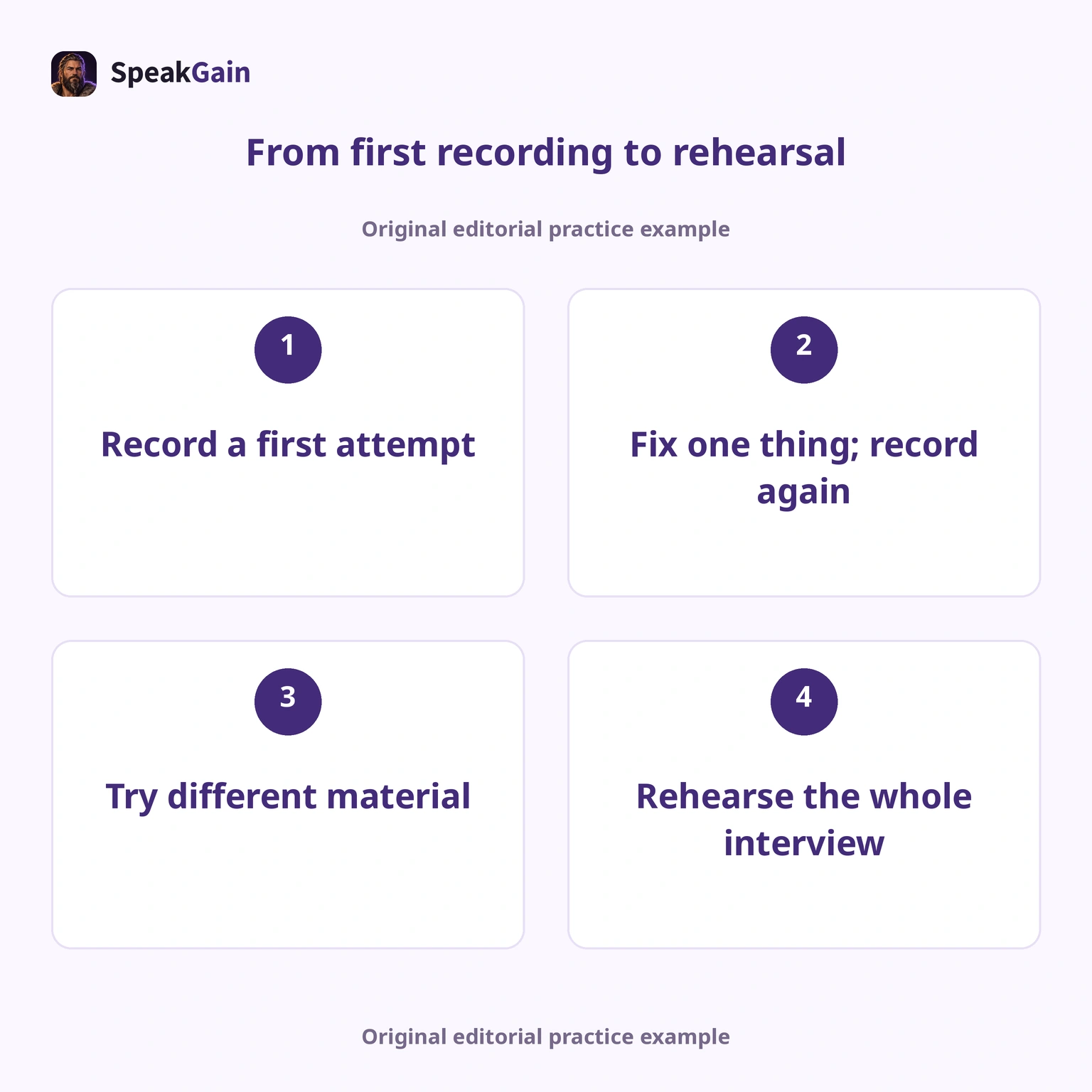
With a week, begin with narration/No.1 and then opinions/full runs, unless your first recording shows the opposite need. With three days, record first, repair the largest gap next, then rehearse. Even one day permits a first attempt, but we do not call it sufficient preparation for everyone. Study planning, Grade 2, Pre-2 and Grade 3 provide related guidance; do not transfer one grade’s timing or card handling to another. For a different recorded test, see TOEIC Speaking practice.
On the day
Check test times and your second-stage admission slip, the schedule and results instructions. Do not replace session-specific information with a fixed time from an article. Our editors check required identification/belongings and travel the day before. Return the card after finishing and leave without speaking to waiting candidates (official instructions).
Could you repeat the question, please?
This asks for the question again. The official guidance says a natural request is not penalized, but unnatural or repeated requests can be. Practise answering after the repetition, not just repeating the request.
FAQ
What is the passing score?
CSE 512 out of 750 for the second stage. Official threshold; it is not a raw-score or correct-percentage target.
How long are preparation and narration?
One minute and two minutes. Use the printed opening; the examiner stops you at the limit. Our 40-second Q&A practice window is editorial (instructions).
Did the interview change in 2024?
No.4 gained a topic introduction. Listen through it to the question (renewal).
Can I ask for repetition?
A natural request is not penalized. Unnatural or repeated requests can be (guidance).
What if no answer comes to mind?
Our editors choose one explainable position and a familiar action as an example. If the question itself is unclear, ask naturally. Official guidance notes that a stalled response may lead to the next question.
Does attitude just mean smiling or being loud?
The official criterion concerns willingness and attitude toward active communication. Our editors practise listening and conveying relevant content, not a smile-only trick (assessment).
Must I give two reasons and one example?
The checked format does not specify one universal count for every question. Our reason/example pattern is editorial; relevance matters before counting parts.
Should narration fill exactly two minutes?
Two minutes is the official time, not our target for padding. Check all necessary events first; a very short attempt may be missing actions or speech.
Can I practise alone?
Yes, using a timer and recordings for individual tasks. If you cannot identify a mismatch, ask a teacher to listen to a short recording and point out one unclear part.
How many days do I need?
Our editors recommend starting when your test plan is set. There is no universal required number or passing guarantee. Preserve record → repair → full run even with little time.
Does SpeakGain offer an EIKEN mock interview or CSE scoring here?
We make neither claim. The verified demonstration is general sentence-card study; assess answer relevance and rehearse the official sequence separately.
Editorial verdict
Prioritize reaching the fourth scene and explaining an opinion with a concrete example. Our editors do not recommend memorizing long finished answers or relying on tricks: a changed person, scene or question demands a new selection of information. Today, record one official narration, check its ending, answer one original social prompt and check whether its example explains its reason. Choose one repair for the next recording.
For another interview format, IELTS Speaking preparation explains the three parts and a solo recording-and-correction routine.
When progressing beyond picture narration, our Eiken Grade 1 interview guide explains choosing a position and handling objections.
If TEAP is another admission option, use our TEAP Speaking guide to practise leading an interview as well as answering.
For writing steps, the limits of memorized outlines and a self-review routine, see our Eiken Grade Pre-1 Writing guide.
Official sources
All checked October 10, 2026: format and assessment, English overview, 2024 change, CSE threshold, CSE calculation, samples and virtual interview. Facts follow these sources; answer patterns, practice windows and plans are editorial proposals.
EIKEN is a registered trademark of the Eiken Foundation of Japan. This article is independent editorial practice guidance, not Foundation endorsement or a guarantee of passing.