
How to study for Eiken Grade Pre-1: summaries, four skills and a realistic plan
Published
Start with one current official Eiken Grade Pre-1 paper, identify where vocabulary, reading, summary writing, opinion writing or listening breaks down, then plan practice around correcting those problems. The first stage tests reading, writing and listening; the second is an interview, and writing includes both a summary and an opinion essay. With three months left, our editorial recommendation is to work on every skill from the beginning; with one month left, prioritize recurring errors and finishing within the time limit.
This guide concerns Japan’s Eiken Grade Pre-1 conventional test, including students and working adults living in Japan whose first language is not Japanese. Test facts were checked on 16 October 2026. Schedules and methods below are editorial suggestions, not guaranteed routes to a pass. Our English example and diagrams are original; they do not reproduce official questions or answers.
For priorities across the whole exam and a realistic six-month approach, see our Eiken Grade 1 study plan.
Current format: finish both writing tasks within the shared 90 minutes
The official format gives reading and writing 90 minutes together, with no official fixed time for each individual task. Word requirements come from the current booklet.
| Skill | Task | Questions | Time / length | Source |
|---|---|---|---|---|
| Reading | Short vocabulary gaps | 18 | Shared 90 minutes | Official format |
| Reading | Passage gaps | 6 | Shared 90 minutes | Official format |
| Reading | Passage comprehension | 7 | Reading total: 31 | Official format |
| Writing | English summary | 1 | 60–70 words; within the 90 minutes | Booklet |
| Writing | Opinion essay | 1 | Suggested 120–150 words; within the 90 minutes | Booklet |
| Listening | Conversations | 12 | About 30 minutes for all listening; played once | Official format |
| Listening | Passages | 12 | Same listening session; played once | Official format |
| Listening | Real-Life situations | 5 | Listening total: 29; played once | Official format |
| Speaking | Conversation, narration, opinion questions | 1 narration + 4 questions; conversation count shown as “—” | About 8 minutes; narration preparation 1 minute, speaking 2 minutes | Official procedure |
The 2024 renewal added the summary, reduced reading to 31 questions and added a topic introduction to interview question No.4. The 2025 clarification changed the summary wording to an explicit 60–70-word range. Do not use the older “suggested length” wording as permission to ignore that range.
CSE scores and pass criteria
| Stage | Maximum CSE score | Pass threshold |
|---|---|---|
| First stage | 750 each for reading, listening and writing; 2,250 total | 1,792 across the three skills |
| Second stage | Speaking 750 | 512 |
Sources: current pass criteria and official score calculation. The four-skill maximum is 3,000, but the stages are judged separately. A combined score of 2,304 is not a way to offset a failed first stage with speaking. The official explanation says CSE cannot be calculated yourself from correct-answer counts. Avoid fixed “one question equals this many CSE points” or guaranteed raw-percentage targets. Writing has the same skill maximum as reading and listening despite containing only two tasks.
Is three months enough? Plan from your starting point
Three months alone does not determine readiness. Diagnose whether you can understand and write when given more time, or whether fundamental knowledge is missing. The official sources inspected provide no three-month pass guarantee.
| Time left | Priorities — editorial plan | What to check |
|---|---|---|
| 6 months | Vocabulary in context, paragraph relationships and careful listening; write both task types weekly; add timed work later | Can you explain the material after review? |
| 3 months | Diagnose in week one; combine reading/listening review with summary/essay revision; add full timed sessions later | Do both writing tasks fit, and can you explain the remaining problems? |
| 1 month | Keep existing materials; target recurring errors and unfinished tasks; reserve an unseen paper | Does the next attempt show an actual correction? |
| 2 weeks | Review familiar errors, missing summary points and weak reasons; continue short speaking practice | Can you reproduce the correction without the answer? |
Do not wait until a vocabulary book is “finished” before writing. With less time, restarting every textbook may be less useful than deciding which part of the next answer must change.
What changes from Grade 2?
The official guides describe Grade 2 as high-school completion level and Pre-1 as intermediate university level. They explain that passage length, content and question level vary by grade. The inspected sources do not specify an invariant passage word count or a mandatory vocabulary total.
Grade 2 summaries require 45–55 words; Pre-1 requires 60–70 (official clarification). Opinion writing grows from a suggested 80–100 words in the current Grade 2 booklet to 120–150 in Pre-1. Reading/writing time increases from 85 to 90 minutes (Grade 2, Pre-1).
Our checklist is broader than learning harder words: understand how a word works in its sentence; track cause, result and contrast across paragraphs; explain reasons rather than padding an essay. Translating every sentence does not automatically mean you understand the argument.
If you need to rebuild the earlier stage, use the Eiken Grade 2 study plan to review your foundation.
Reading: separate unfamiliar words from misunderstood relationships
Official task: 18 short gaps, six passage gaps and seven comprehension questions (format). Typical difficulty: stopping at every unknown word, misreading the subject, or choosing an option because it repeats a word from the passage.
Practice — editorial method: answer once without a dictionary and mark uncertainty. During review, classify the problem as vocabulary, sentence structure, paragraph relationships or option interpretation. Give each paragraph a short heading and locate evidence for the chosen answer. Explain why the other options do not fit; “I understand now” after seeing the key is not enough.
Review missed words in their original sentences, then hide the translation the next day. Write a short example when it helps distinguish meanings or usage; you do not need to produce an example for every word. Test whether the same reading method works on another passage, not just whether a familiar one becomes faster. Official materials: reading sections and answer keys.
Summary writing: decide what must survive before cutting words
Official task: one English summary, 60–70 words, using your own words as far as possible (current instructions). Typical difficulty: stitching copied sentences together, preserving examples but losing the point, or inserting personal opinions.
Practice — editorial method:
- Identify the actual structure: central topic, cause/result, contrast or other relationships. Do not force every passage into “introduction, benefit, problem.”
- Note the information that must remain. Ask what each example illustrates rather than retaining every detail.
- Close the original briefly and connect the points in your own sentences. Reopen it to check meaning; difficult synonyms alone do not make a summary independent.
- Compare subject, attribution, negatives, degree of certainty and causal links with the original. Restore missing essentials, then fit 60–70 words.
- Rewrite the next day without copying the model answer. Check whether the relationship you missed has survived.
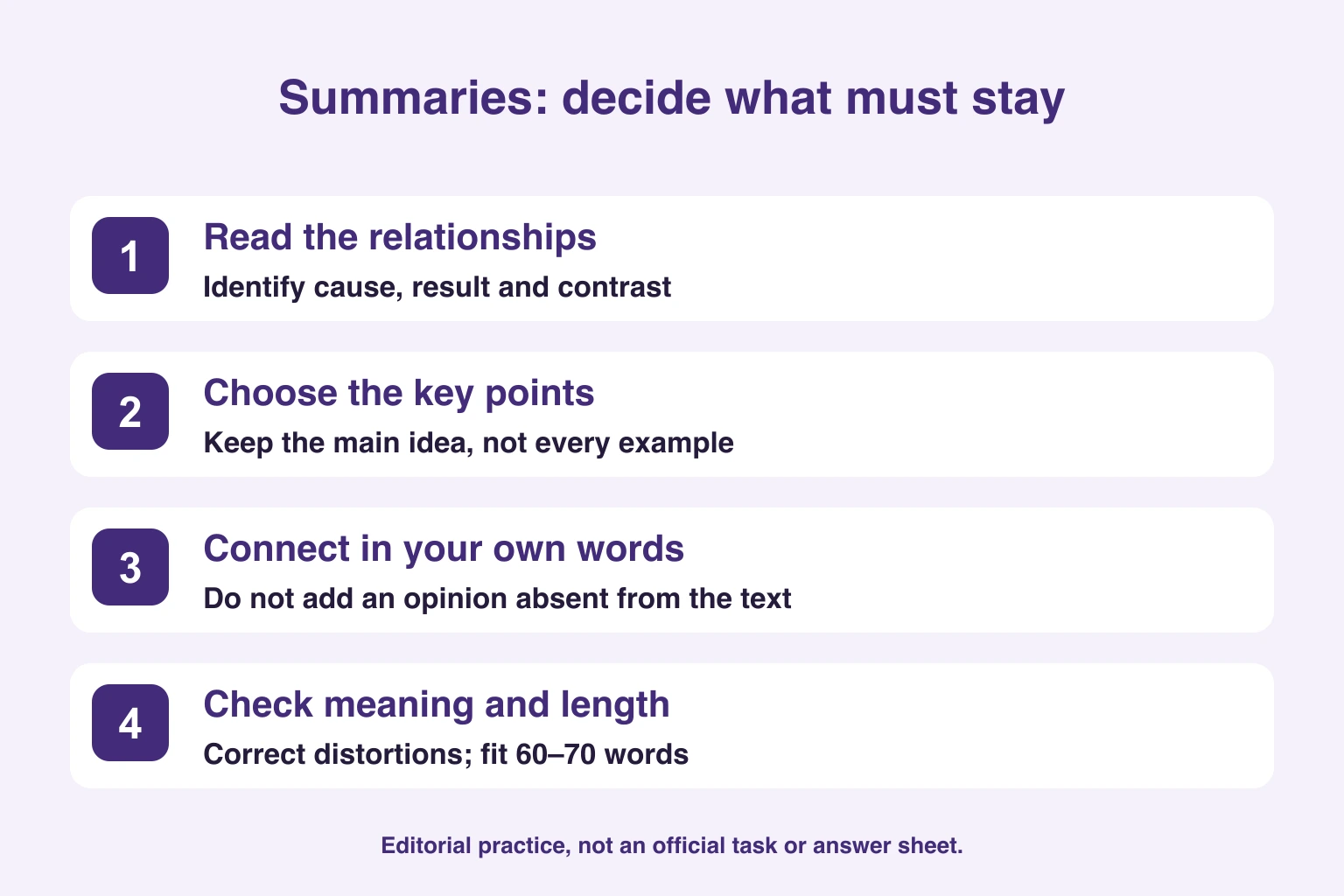
A made-up outline might be “free community sports facilities; easier access; questions about maintenance funding.” It illustrates information selection, not a complete 60–70-word answer. Official materials: summary prompts and sample answers. Compare meaning rather than identical vocabulary. If unsure, ask a teacher a precise question such as whether your version preserves the original cause and effect.
Opinion writing: take a position and explain two different reasons
Official task: one essay using two supplied POINTS, with an introduction, main body and conclusion; suggested length 120–150 words (booklet). Official assessment covers content, organization, vocabulary and grammar. Typical difficulty: discussing the topic without answering the question, giving the same reason twice, or spending too long on a general introduction.
Practice — editorial method: outline a position, reason A with explanation, and reason B with explanation. For each reason, ask who is affected and what happens. Correct the relationship between question and answer first; revise language and word count afterward.
Public parks deserve more funding because they give residents free places to exercise.
The position is increased park funding; the reason is free access to exercise space. This original sentence supplies one reason, not a complete Pre-1 essay. A real task needs two distinct reasons connected to its question and specified POINTS. Practise adding an explanation of who benefits, then try the opposite position to check that you are not forcing memorized content into every prompt. Official materials: essay tasks, sample answers and the assessment criteria.
Listening: distinguish sound problems from meaning problems
Official task: 12 conversation, 12 passage and five Real-Life questions; about 30 minutes, recordings played once (format). Typical difficulty: recognizing words without processing meaning, losing subsequent information after one missed word, or overlooking a condition in a situation.
Practice — editorial method: first listen without stopping. Revisit only the part that caused an error, record what you understood, then compare the script. Was the word unknown, its sound unrecognized, or its relationship misunderstood? Confirm meaning, match sound to text, then listen again without the script.
For conversations, track intentions and the final decision; for explanations, track the main point and support; for Real-Life tasks, identify the given conditions. You need not transcribe every recording. Work on the sentence that changes the answer. Official materials: audio, scripts and keys. Use official material directly; do not repost test text or audio into this article or an app.
Interview: keep speaking in the plan before the first stage
Official task: an approximately eight-minute individual interview, including one-minute preparation and two-minute narration followed by four questions (procedure). Typical difficulty: being able to write an opinion but not say it, or describing the first picture so fully that the ending disappears.
Practice — editorial method: record a short opinion and reason at home, then check whether it answers the question. Use the official narration sample with a timer and see whether the final event is included. Recording is for home practice: official rules prohibit notes, photography and recording during the interview.
Official materials: second-stage sample and virtual interview. Detailed practice belongs in our Pre-1 interview guide; use the all-grade interview overview for comparisons and the Grade 1 interview guide for that different task. This article keeps the focus on the whole-test plan.
Study hours: calculate available capacity, not a promised total
The inspected official sources do not publish a single required study-hour total. Starting ability and actual practice opportunities matter. All durations below are editorial examples, not survey findings.
For example, 45 minutes on five weekdays plus 90 minutes on each weekend day equals 6 hours 45 minutes a week, or 81 hours over 12 weeks. That is capacity arithmetic, not an 81-hour pass claim. After two weeks, compare the plan with the answers you actually revised. Allow for school exams, university assignments, overtime or travel. Put short review on a commute and writing/full sessions at a desk; equal minutes need not produce equal work.
Our three-month plan — editorial opinion
Week one: attempt a paper under the official time conditions; afterward, finish unanswered writing without a timer to distinguish knowledge from speed. Weeks 2–4: alternate reading/listening review and aim for at least one summary and one essay each week, with a rewrite of each. These are our practice frequencies, not official recommendations. Weeks 5–8: transfer the method to different material. Weeks 9–12: emphasize timed completion and persistent errors. Keep brief speaking recordings throughout.
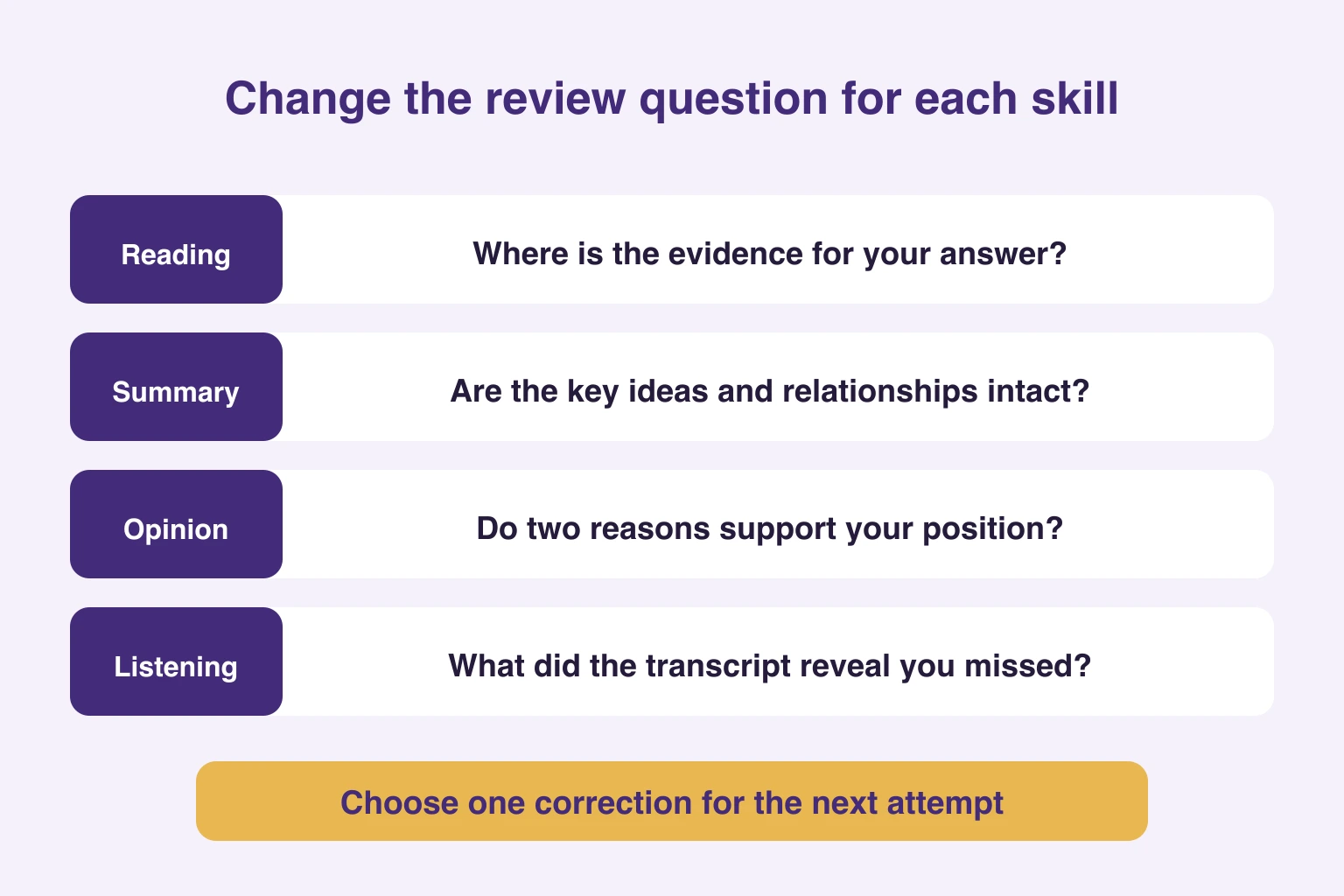
An initial editorial split of the shared 90 minutes could be reading 50, summary 15, essay 20 and checking five. Adjust it from actual performance. If summary writing stays slow, investigate content selection as well as the clock. Our answer to “what is the most effective method?” is diagnosis, targeted correction and an answer-free reattempt. That is our practical judgment, not a measured ranking of learning methods.
Use official materials for different jobs
The official page provides the past year’s three first-stage sessions, including PDFs, answers, listening audio and scripts; the second stage has sample material and a virtual interview. Pre-1 uses the main-site administration. At checking, the listed sessions were 2026 session 2, 2026 session 1 and 2025 session 3; the list changes. Do not describe the interview samples as three complete past interviews.
We would use one paper for diagnosis, another for skill practice and preserve an unseen one for timed work. Three papers are not an official sufficiency threshold. Reuse familiar material to explain evidence, rewrite a summary or understand audio without its script. No commercial books are individually recommended here. For an existing book, confirm both writing tasks and current reading structure against the publisher’s latest information and the official site; publication year alone is not enough.
Three approaches we do not recommend
Memorizing complete essays or long templates: they can lead to reasons that do not answer the actual question. Useful linking expressions still need relevant content. Vocabulary books alone: knowing words does not practise selecting summary points or explaining two reasons. Past papers without review: remembering an answer is different from finding evidence in a new passage. Keep an error explanation, a corrected version and an answer-free recheck.
Turn the original opinion sentence into speaking practice
Read the public-parks sentence, confirm its meaning, hide it and state the position and reason. Then invent a different reason so the exercise goes beyond recitation. For tools supporting short original-sentence practice, see our Eiken study-app comparison. App selections belong there. In SpeakGain, we saved the parks sentence through the normal Add flow. From Library we opened Knowledge, then Learn this card. Listening hid the English and automatically played the generated audio, prompting us to guess and say what we heard. Reveal answer displayed the exact saved sentence.
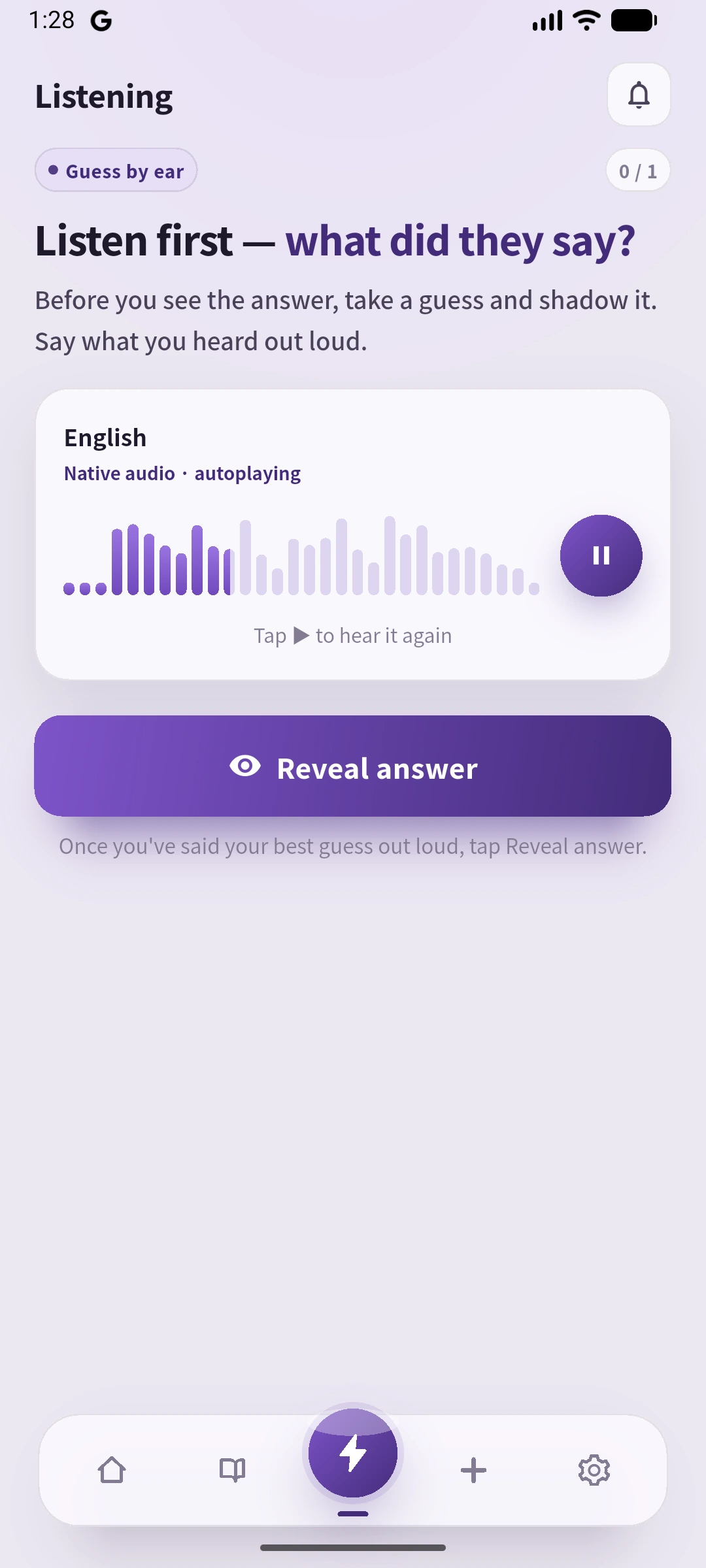
Original practice sentence · Viking AI audio
Public parks deserve more funding because they give residents free places to exercise.
Generated once for the same original sentence. Practising two developed essay reasons remains a separate task.
Frequently asked questions
What should I do first?
Try one current official paper, classify the difficulties and pair practice with review. Start both writing tasks and short speaking practice in the first week.
How many hours are necessary?
There is no universal required total in the official sources checked. Set a weekly capacity and revise it using two weeks of actual work; the hour examples here are editorial.
Can I prepare in three months?
It depends on your starting skills and available work. Check whether extra time lets you understand and write, or whether basic knowledge is still missing. No pass is promised.
How do Grade 2 and Pre-1 differ?
Besides higher-level reading, the summary grows from 45–55 to 60–70 words and the opinion target from 80–100 to 120–150. Practise relationships and explanations rather than padding sentences (summary update, Pre-1 booklet).
How should I practise summaries?
Select the original’s main information and relationships, write in your own words, compare meanings and fit the word range. Do not add an opinion. Use official tasks and samples.
What are the CSE pass scores?
First stage 1,792 across three skills; second stage 512 for speaking. Each skill maximum is 750. Correct-answer counts cannot be converted yourself (criteria, calculation).
Can working adults study independently?
You can organize independent work around official materials. Separate short commuting review from desk-based writing, and ask a teacher about errors you cannot judge yourself. Independent study need not mean refusing all feedback.
How many past papers and vocabulary words do I need?
The website publishes three sessions, but specifies no guaranteed sufficient number of papers or mandatory vocabulary total in the sources checked. Track corrected errors and understanding, not only completed papers or memorized word counts.
For writing steps, the limits of memorized outlines and a self-review routine, see our Eiken Grade Pre-1 Writing guide.
For Japan’s Eiken Pre-1 vocabulary, see our guide to choosing a wordbook or app and using words in your own sentences.
If you are deciding whether to aim for Pre-1, our guide to its official level, CEFR, adjacent grades and self-check steps helps you compare the evidence.
Editorial verdict
Diagnose with current official material, practise the specific cause, revise the answer or recording, and check again on different material. Protect time for both writing tasks from the beginning. As the deadline approaches, prioritize visible corrections over adding resources.
For university admission, study abroad, employment or teacher recruitment, check the receiving institution’s grade, score, validity and submission requirements early. The official guide describes broad uses, not a universal acceptance rule. See our English-test comparison if you are still choosing a test.
Sources checked 16 October 2026: format and procedure, past papers and samples, 2024 renewal, 2025 summary update, CSE thresholds, score calculation, writing criteria and Grade 2 format. Eiken is a registered trademark of the Eiken Foundation of Japan. This is an independent editorial guide.