
Eiken Grade Pre-1 Writing: summaries, essays and scoring
Published
Japan’s Eiken Grade Pre-1 Writing has two tasks: a 60–70-word summary and an opinion essay with a suggested length of 120–150 words. For the summary, select the passage’s main information; for the essay, support your position using two of the supplied POINTS. Start with the instructions, then review content, organization, vocabulary and grammar using the official guidance and current paper, checked on October 16, 2026.
This guide is for students and adults preparing for Japan’s exam, including people whose first language is not Japanese. We focus on writing. Use the whole-test study plan for reading, listening and overall preparation. Official requirements and our editorial practice suggestions are identified separately below.
Current tasks and word counts
| Task | What to write | Word count | Official source |
|---|---|---|---|
| Summary | Summarize the passage in English, using your own words as far as possible | 60–70 | Current paper, printed page 12 |
| Opinion essay | Answer the TOPIC using two supplied POINTS; use an introduction, main body and conclusion | Suggested 120–150 | Current paper, printed page 14 |
The official test description gives 90 minutes for reading and writing together. A fixed time allocation for each writing task is not stated in the official materials we checked. The paper says to complete both tasks and that writing outside the designated space is not graded. For official questions and answer examples, use the official past-paper page; none are reproduced here.
The two jobs differ. A summary reports the source. An essay develops your answer to a question. Adding your opinion to a summary, or merely introducing an essay topic, does not complete the intended job.
What the official scoring viewpoints mean
The official scoring page explains these four viewpoints. Its detailed examples concern opinion writing; they are not a detailed point-deduction rubric for summaries. The mistakes and checks below are our editorial applications.
| Viewpoint | Official explanation, summarized | Common mistake | How to check |
|---|---|---|---|
| Content | Include the required opinion and supporting reasons | Naming a benefit without explaining it | Identify the position, each reason and its explanation |
| Organization | Make the progression clear and logical | Connectors hide a contradiction | Describe each sentence’s role and the link to the next |
| Vocabulary | Use appropriate words accurately | A memorized difficult word changes the meaning | Check meaning and combinations in a dictionary |
| Grammar | Use varied sentence structures correctly | A long sentence loses its subject–verb relationship | Check the sentence skeleton, then unnecessary repetition |
Official advice asks for explanations or examples beyond saying something is convenient or cheap. It also calls for appropriate variety in vocabulary and structures. Our approach is to establish a clear meaning first, then express the relationships accurately, rather than making every sentence longer.
Is the scoring lenient?
Official evidence does not establish that it is lenient. The guidance warns that an essay which does not answer the TOPIC, or is judged to concern a completely unrelated TOPIC, may receive zero in every viewpoint. A general verdict of “lenient” or “strict” is not stated officially.
Do not confuse an impression of marking with CSE calculation. The official CSE explanation gives each Pre-1 skill a maximum of 750 and allocates scores equally across skills. Scores are calculated using IRT after all answers have been marked; the same number of correct answers can produce different scores in different sessions. Candidates cannot calculate their CSE score from their own correct-answer count. Multiplying a self-assessed percentage by 750, or relying on someone’s surprising result, does not establish lenient marking.
What changes from Grade 2?
| Requirement | Grade 2 | Grade Pre-1 |
|---|---|---|
| Summary | 45–55 words | 60–70 words |
| Essay | Suggested 80–100 words | Suggested 120–150 words |
| Reasons / POINTS | Two reasons; POINTS may be used as references | Use two of the supplied POINTS |
| Official writing standard | Write about topics of social relevance | Write coherent passages about topics of greater social relevance |
Sources: current Grade 2 paper, Pre-1 paper, and official grade criteria. A numerical scale of topic abstraction for these writing tasks is not stated officially. Pre-1 does not mean you should automatically write three reasons. We suggest explaining who is affected, what changes and why that supports your judgment. See the Grade 2 writing guide for its own task instructions and practice.
Summary: select information before shortening it
Official task and review viewpoints
The current instructions require 60–70 words, using your own words as far as possible. The four-viewpoint guidance does not provide a detailed summary deduction table. Our source-comparison routine below is an editorial practice method, not an official scoring formula.
Steps
- Read to the end and state the overall topic in one short sentence.
- Note each part’s role and essential information. Let the passage determine whether the relationship is a contrast, cause and effect, or a response to a problem.
- Separate illustrations from main ideas. Do not select sentences merely because they are easy to understand.
- Rebuild the information in English without changing possibility into certainty, contrast into cause, or the scope of a claim.
- Match each summary sentence to its source. Remove personal judgments or proposed solutions absent from the passage.
- Check the word count. Remove repetition or restore a missing main point before polishing expressions.
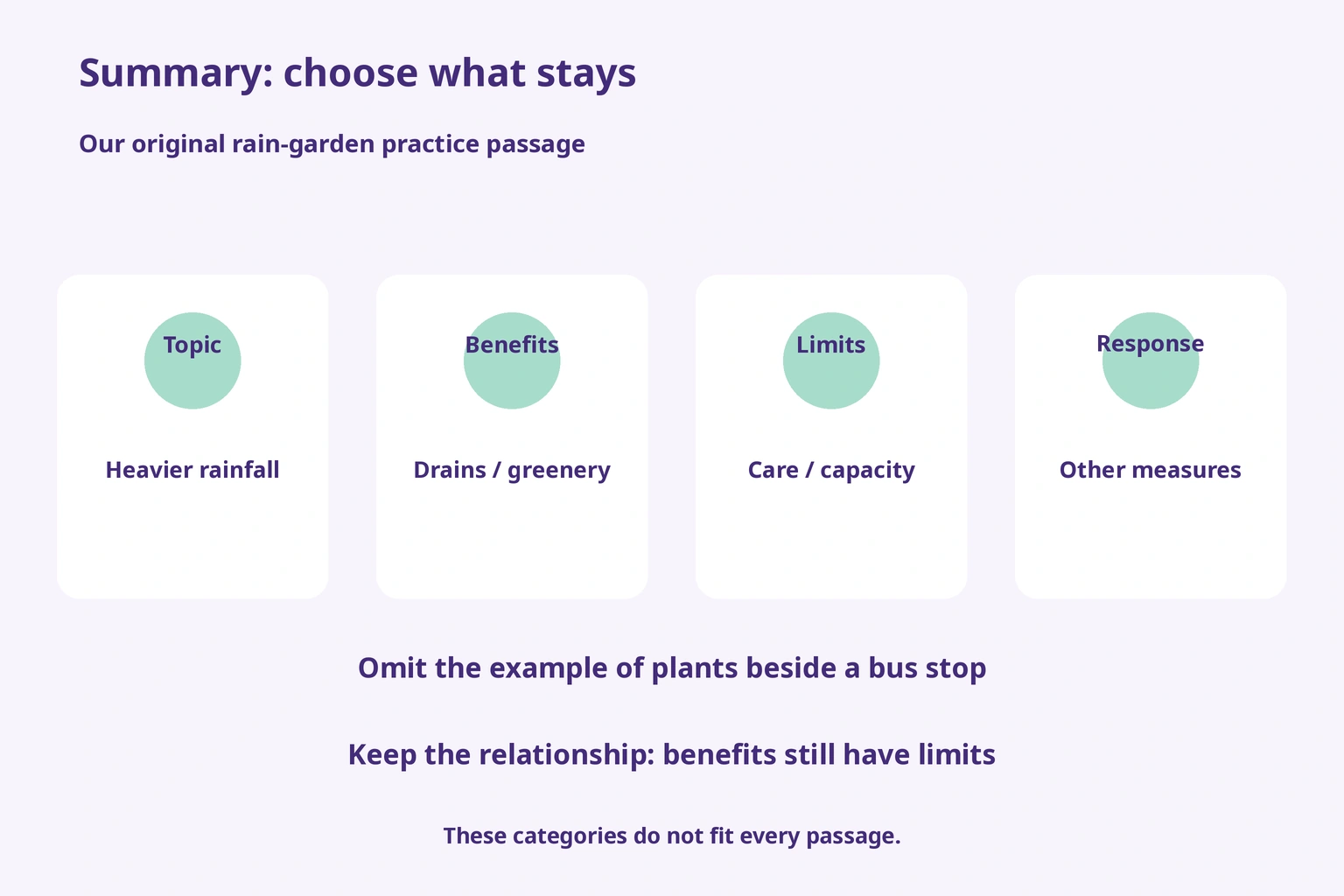
Our original passage and summary
This fictional rain-garden passage was written for this article. It is not an official question, an adaptation of a past paper or a report about a real policy.
Some towns are replacing small areas of pavement with rain gardens. These gardens contain soil and plants that hold water during heavy rain. Instead of flowing immediately into drains, some of the rain enters the ground. Town officials are considering the gardens as one part of their response to heavier rainfall.
Supporters say the gardens can reduce pressure on drainage systems. They may also create attractive green spaces on streets that have little room for large parks. For example, residents could enjoy plants near bus stops while waiting for a bus. Local groups sometimes help choose plants that suit the area.
However, the gardens need regular care. If rubbish blocks the water entrance, they may not work as planned. They also cannot absorb unlimited amounts of rain. Towns therefore need both maintenance arrangements and other measures for serious storms, rather than expecting gardens to prevent all flooding.
Original summary: 65 words by our whitespace count.
Some towns are introducing rain gardens to manage heavier rainfall. By allowing water to enter the ground, the gardens may ease pressure on drains and add greenery to streets with limited space. However, they require maintenance to remain effective and can hold only a limited amount of water. Towns must therefore combine them with other measures instead of relying on them to prevent all flooding.
We retained the response to rain, benefits for drains and greenery, maintenance and capacity limits, and the need for other measures. We omitted the bus-stop illustration and plant selection. Shortening does not mean removing the same amount from every paragraph.
Common mistakes
Keeping only greenery turns a qualified discussion into a simple introduction to gardens. Replacing “may ease pressure” with a promise to prevent flooding changes the meaning. Adding a suggestion about building gardens at every school introduces information that this source does not contain. These are meaning checks, not scores assigned to the example.
Self-review checklist
- Is the topic clear without reading the source?
- Can every claim be traced to the passage?
- Have I retained essential limitations and conclusions, not just examples?
- Do contrast, cause, possibility, negation and scope still match?
- Is it 60–70 words without my own opinion?
Number your sentences and mark their source evidence. Fix sentences without a match before changing vocabulary. Our paraphrasing guide helps with expression, but replacing nouns alone does not complete information selection.
Essay: turn POINTS into explained reasons
Official task and scoring viewpoints
The paper requires two supplied POINTS, an introduction, main body and conclusion, with a suggested 120–150 words. The scoring guidance emphasizes reasons that support your view, explanation, consistency and appropriate language.
Steps
- Identify the judgment requested: desirability, prediction or comparison. A topic word alone is not the question.
- Choose a position and two POINTS you can explain. Write how each supports the answer.
- Develop the mechanism: who gains access, what obstacle changes, or what learning becomes possible?
- Arrange introduction, body and conclusion. We would use one body paragraph per reason; four paragraphs are our practice choice, not the only officially accepted layout.
- Return to the original judgment in the conclusion, without changing sides.
- Repair missing explanation and repetition, then check length, vocabulary and grammar.
Our original essay
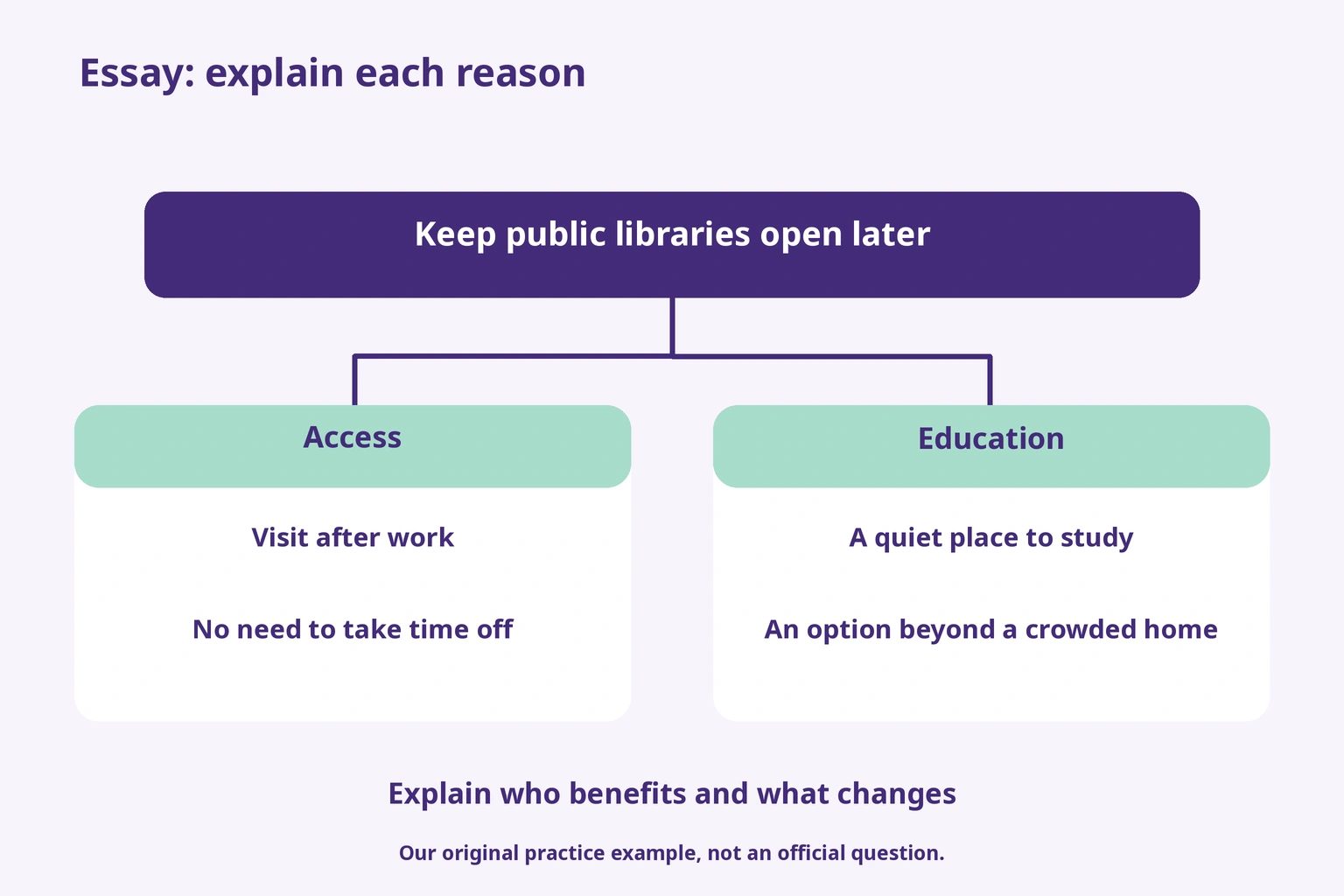
Practice question: should a city extend its public libraries’ opening hours? We explain support through access and education. This is our original exercise, not an official question. The essay has 124 words by whitespace count; we assign it no score.
Cities should keep public libraries open later because evening access supports working adults. Many residents finish work after their local library closes, so they cannot easily borrow books or use its services. Longer opening hours would allow them to visit without taking time away from their jobs.
Extended hours could also support education. Adults who want to gain new skills need places where they can read reliable materials and concentrate. A quiet library offers an alternative for people whose homes are too crowded for study. They could use the evening to prepare for a course or explore a new subject.
For these reasons, later opening hours would make public libraries more useful to residents and give more people a practical opportunity to continue learning.
The first reason addresses working hours; the second concerns a quiet study space and materials. We have not demonstrated that the costs are solved. If a question asked about funding, these paragraphs would need to be reconsidered.
Common mistakes
“Easier access” and “easier visits” can repeat one reason. Identify a genuinely different explanation. “Education matters” is too general unless you connect later opening to an actual study opportunity. Finally, an argument against your initial position can break consistency: the official guidance warns against contradictory reasons and explanations.
Self-review checklist
- Does the introduction answer the judgment requested?
- Can I identify the two supplied POINTS used?
- Does each reason explain why the position makes sense?
- Do body and conclusion support the opening position?
- Have I checked 120–150 suggested words, meaning and sentence structure?
Describe each paragraph’s job before adding connectors. A connector cannot supply missing logic.
Use a structural outline, not a memorized finished paragraph
Our suggested essay outline is judgment → reason and explanation → another reason and explanation → return to the judgment. For a summary, reserve space for the actual source’s main information and relationships. Neither task is completed by replacing a few nouns in a memorized answer.
First and Second can organize reasons, but do not create them. In conclusion cannot repair a contradictory ending. A fixed “advantages and disadvantages” summary frame may misrepresent a passage about causes and responses. A preference statement may fail to answer a prediction question.
A uniform bonus or penalty for a particular template or phrase is not stated in the official materials checked. Our objection to memorized paragraphs follows from the official viewpoints: relevance, explanation, consistency and accurate language still require decisions about this particular question.
Review your own work in a useful order
Keep the first draft and record where you stopped and how long you took. Check content against the source or TOPIC, explain the organization, then investigate vocabulary and grammar in a dictionary. Adjust length by restoring missing information or deleting repetition. Keep a revised draft and one reason for each substantial change.
The following day, find the same issue in a new task. Turn uncertainty into a specific question: does this verb take this object, or did this sentence turn a possibility into a certainty? Ask a teacher or study partner about that exact passage when possible. This process finds fixable problems; it does not reproduce official marking.
If you use AI correction, treat revisions as wording candidates. Check for invented source details or a changed position. A number supplied by a tool is not an official score or a result prediction. We do not list or rank scoring services. For recording tools see diary and writing apps; for other skills see Eiken study apps. First identify the task you need help with.
Our editorial two-week writing practice
This is a suggested practice schedule, not an official plan or a score guarantee. Split drafting and reviewing over separate days if school or work leaves little time.
| Days | Practice | Keep |
|---|---|---|
| 1–2 | Check current instructions; attempt both tasks | Drafts, time, sticking points |
| 3–4 | Match summary claims to source evidence | Missing or added ideas and corrections |
| 5–6 | Separate two essay POINTS and their explanations | Who is affected and how |
| 7 | Compare drafts; choose one recurring issue | One check for next week |
| 8–10 | Alternate tasks with new topics | Reasons for changing the outline |
| 11–12 | Time drafting and review separately | Time for each operation |
| 13 | Try official tasks with reading inside 90 minutes | Whether both tasks were attempted |
| 14 | Set a short personal review order | Your recurring checks |
As a starting experiment we would try 15 minutes for the summary, 20 for the essay and five for checking both. This 40-minute writing allocation is our suggestion, not an official rule. Adjust it after attempting reading and writing together within 90 minutes.
Three methods we would avoid
Memorizing whole reusable paragraphs: this can bypass the need to select content for the question. Learn what each part must do instead. Padding the word count: unrelated or contradictory essay material may affect organization according to the official guidance; restore relevant explanation instead. Memorizing predicted answers: even the same subject can appear as a comparison, prediction or value judgment. Practise changing the question and deciding which sentences no longer work.
Bring one written sentence into speaking practice
Our shared practice sentence is Cities should keep public libraries open later because evening access supports working adults. Explain its meaning, then try saying the view and reason without reading. Distinguish recalling one sentence from answering a new question. Use the Pre-1 interview guide for the interview’s own tasks and practice.
Listen to one sentence in SpeakGain and reveal the original
On the device, we saved this sentence as one card through SpeakGain’s normal Add flow, then opened Library → Knowledge → Learn this card → Listening. Listening hid the English and autoplayed the reference audio, with instructions to say what we heard before tapping Reveal answer. Answer showed the original sentence. We did not submit a recording or test assessment. Review the written content against the source, question and official viewpoints described above.
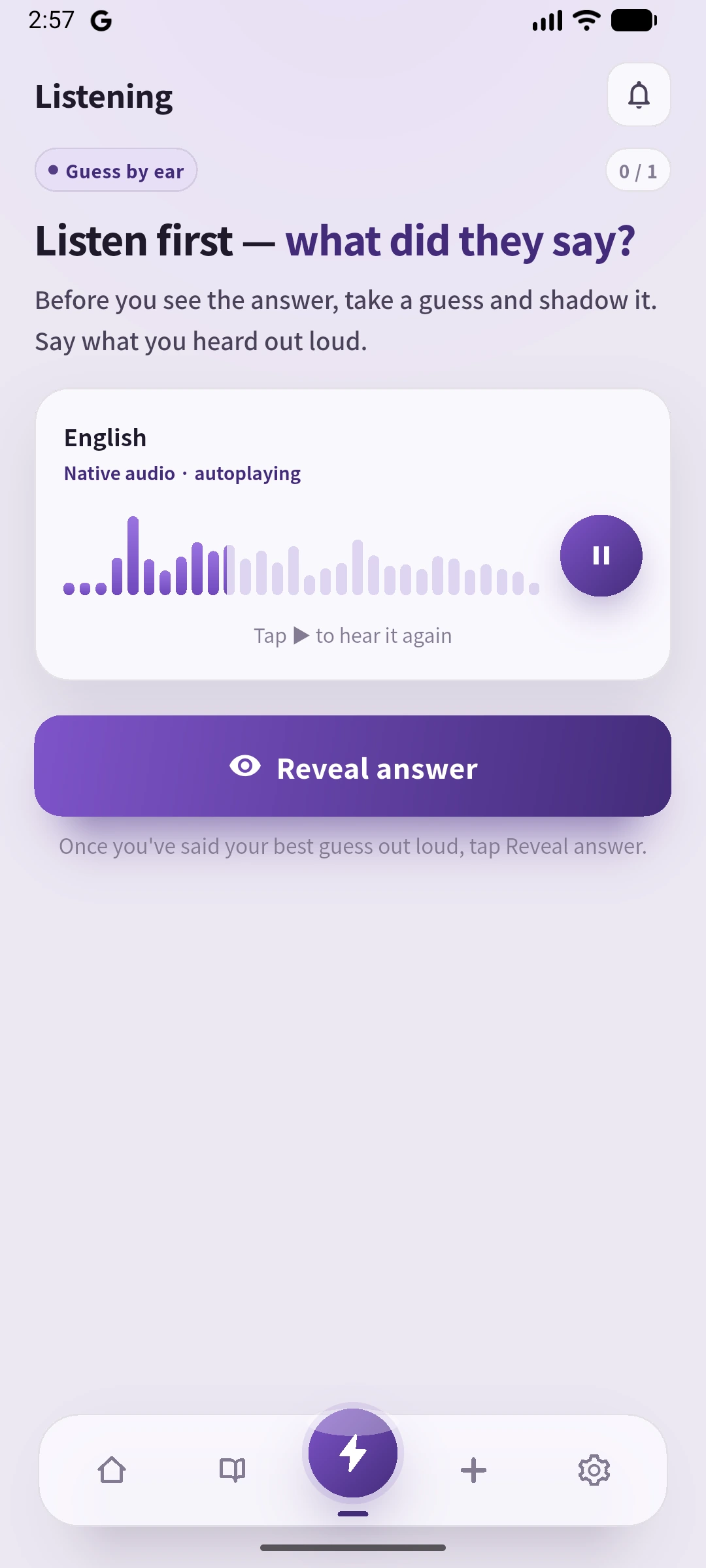
Original practice sentence: Viking AI audio
Cities should keep public libraries open later because evening access supports working adults.
Generated once for this sentence; not official exam audio or the complete essay.
Frequently asked questions
Is the marking lenient?
Official sources do not establish that. Review the four viewpoints and distinguish marking from CSE calculation; CSE cannot be calculated from your own correct-answer count.
Does going outside the word count automatically mean zero?
A universal automatic-zero rule or per-word deduction for length deviations is not stated in the official materials checked. Follow the published ranges anyway; repair omissions or repetition. Do not confuse length with the official warning about essays that fail to answer the TOPIC.
Can I use a template?
We suggest an outline that assigns a job to each section. A uniform bonus or penalty for particular phrases is not stated officially. Relevance and explanation still need checking.
Which task should I practise first?
We would try both, then isolate the difficult operation: selecting main information or explaining a reason. Do not prepare only one and leave the other untouched.
Is the time split fixed?
Reading and writing share 90 minutes. A fixed task-by-task split is not stated in the official materials checked. Test your own allocation with reading included.
Does Pre-1 require three reasons?
No: the current instruction says to use two supplied POINTS. Grade 2 also asks for two reasons, but its POINTS are optional references and its word counts differ.
Can self-review replace marking, or memorization replace interview practice?
Neither claim follows from this guide. Self-review finds problems you can check; a written sentence supplies speaking material. Uncertain language and new interview questions still require separate attention.
Editorial verdict
Build a repeatable way to select information and explain reasons before collecting complete memorized answers. Return to the passage for a summary and to the TOPIC and two POINTS for an essay. Let the outline support those decisions, then review content, organization, language and length.
For the summary and the essay with three reasons, see our Eiken Grade 1 Writing guide, with official viewpoints and newly written examples.
Sources and check date
Checked October 16, 2026: test content, current Pre-1 paper, scoring viewpoints, CSE calculation, Grade 2 paper, grade criteria, and official questions and answer examples. All practice passages and answers here are original and unscored.
Eiken is a registered trademark of the Eiken Foundation of Japan. This article is not official exam material.