
Eiken Grade 1 Writing: summaries, essays and self-review
Published
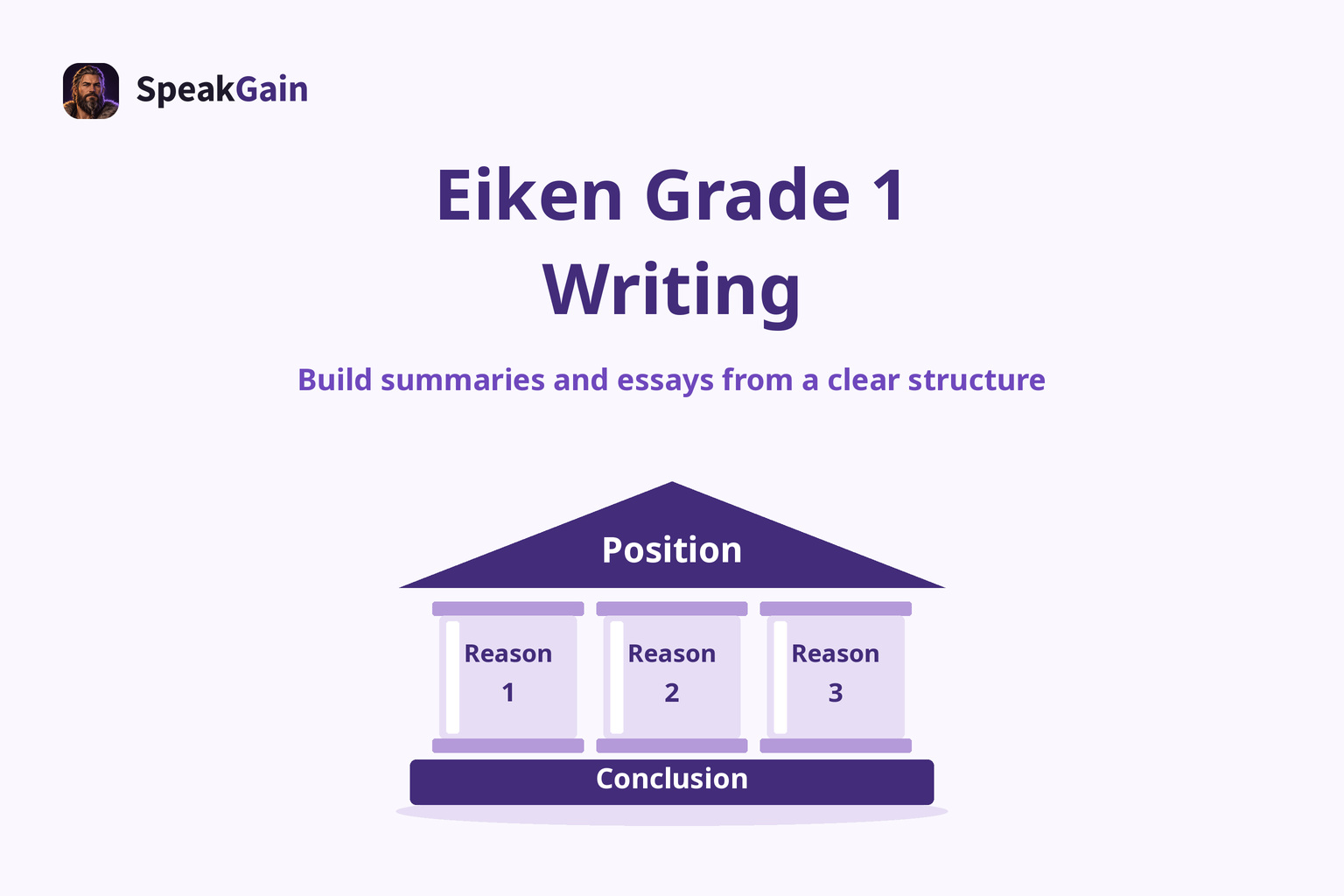
Japan’s Eiken Grade 1 Writing has two tasks: a 90–110-word summary and an opinion essay with three supporting reasons, with a suggested length of 200–240 words. The official assessment viewpoints are content, organization, vocabulary and grammar; start practice by checking fidelity to the source in summaries and relevance to the question in essays. This guide uses newly written examples and separates official instructions from our editorial advice. Official tasks · Current booklet · Assessment viewpoints, checked 16 October 2026.
The current tasks
| Task | What to write | Length | Official source |
|---|---|---|---|
| Summary | Summarize the supplied passage in English, using your own words as far as possible | 90–110 words | Booklet, p.12 |
| Opinion essay | Answer the topic with three reasons; introduction, main body and conclusion | Suggested 200–240 words | Booklet, p.14 |
The booklet requires both tasks and says writing outside the designated spaces will not be graded. Reading and Writing share 100 minutes; a fixed allocation to each writing task is not stated in the official materials checked. Practise finishing both alongside Reading rather than preparing only an essay. Official format
Turn the four viewpoints into questions
The first column and official summaries below follow the official assessment page. The mistakes and checks are our editorial applications. Its detailed examples concern opinion essays; they are not a published, point-by-point summary rubric.
| Viewpoint | Official meaning, summarized | Common mistake | How to check |
|---|---|---|---|
| Content | Include the required position and supporting reasons | Name a benefit without explaining it | Ask why the reason supports the answer |
| Organization | Make the flow clear and logical | Use connectors while changing position or subject | Label each paragraph’s role |
| Vocabulary | Use suitable words correctly | Replace a familiar word with an inaccurate difficult one | Check meaning and combinations in context |
| Grammar | Use varied structures appropriately and accurately | Lose the subject or condition in a long sentence | Find each subject and main verb |
The official page warns that an answer which does not address the question, or is judged completely unrelated to the topic, may receive zero in every viewpoint. This is not a rule that every small digression automatically earns zero. Check what judgment the question asks you to make before polishing expressions. Official cautions
How difficult is “80% in Writing”?
The official sources do not establish a single difficulty level, study time or probability for reaching 80%. Also distinguish 80% of your own estimated marks from 80% of the CSE maximum. Grade 1 has a maximum of 850 CSE points per skill. Although 80% of 850 is arithmetically 680, this is not a conversion from an 80% self-marked answer. CSE explanation
CSE scores are calculated statistically after all responses are marked; the official explanation says candidates cannot calculate them from their own number of correct answers. Do not multiply a self-assigned percentage by 850, or treat someone else’s reported percentage as a reliable score forecast. Historical pass-rate comments do not establish a guarantee for the current Writing tasks.
If you are not confident about your score, separate what you can verify from what you cannot. You can count three reasons; that does not establish how persuasively they are explained. Record “reason two repeats reason one” or “the conclusion never answers whether public money should be spent,” rather than assigning a reassuring percentage. Use official results for the actual score; use self-review to identify revisions.
What changes from Pre-1?
| Item | Grade 1 | Grade Pre-1 |
|---|---|---|
| Summary | 90–110 words | 60–70 words |
| Essay | Suggested 200–240 words | Suggested 120–150 words |
| Reasons | Three supporting reasons | Use two supplied POINTS |
| Official writing scope | Coherent writing on a wide range of socially significant topics | Coherent writing on socially significant topics |
Sources: Grade 1 booklet, Pre-1 booklet, grade criteria. A numerical increase in “abstractness,” or a rule that every Grade 1 question is more abstract, is not stated officially. For the separate Pre-1 procedure, see Pre-1 Writing; for broader preparation, see the Pre-1 study plan.
Summary: keep the meaning and relationships
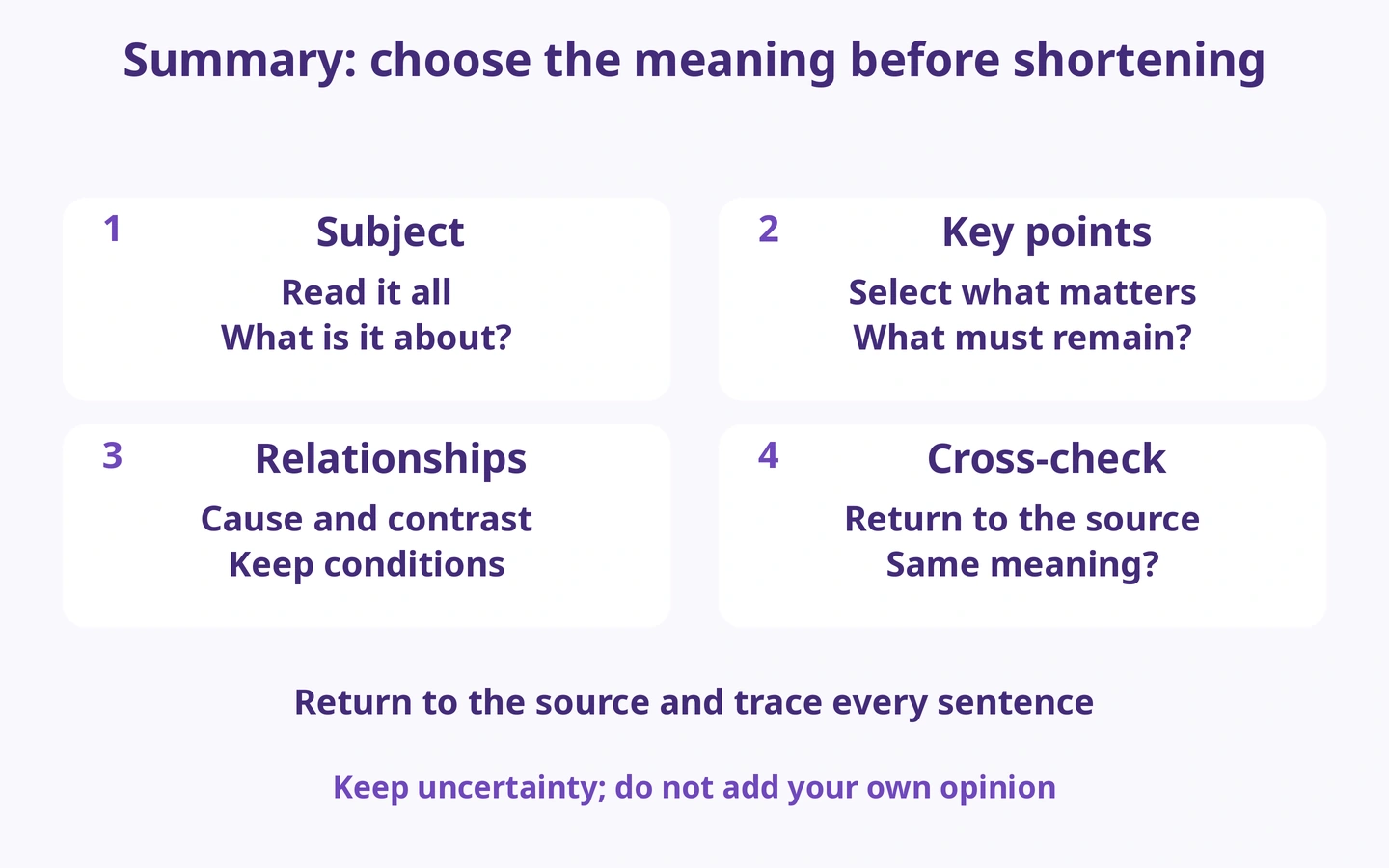
The current instructions require 90–110 words, using your own words as far as possible. Our practice method is to preserve the main information and relationships before shortening sentences. Do not force every source into a benefits–problems–solution pattern; identify the actual passage’s structure.
- Read the entire passage and state its subject in one line.
- Note the main information and each paragraph’s role, including conditions and limitations.
- Combine details at a useful level of generality. Understand before replacing words.
- Draft from your notes, then return to the source.
- Check causation, contrast, uncertainty and who does what; only then adjust length.
Newly written practice example
The following source passage and summary are our original, fictional exercise, not a report of a real program or research, an official question or a scored model answer. Use the official past-paper page for authentic questions and answers.
Original practice passage
A coastal city is considering a program that would pay part of the cost of coating building roofs with reflective materials. These surfaces absorb less sunlight than dark roofs, so supporters expect participating buildings to stay cooler during hot weather. They argue that lower demand for air conditioning could reduce household electricity bills and relieve pressure on the local power network. The proposal initially covers rental housing in neighborhoods with little shade, where residents have limited control over building improvements.
However, the program would not benefit every building equally. Roofs shaded by taller structures may receive too little direct sunlight for the coating to make a substantial difference. Maintenance also matters: dirt can reduce a surface’s ability to reflect sunlight, and regular cleaning creates additional costs. Critics worry that public money could be spent on installations that owners later fail to maintain. They also point out that cooler roofs alone cannot provide shade for people walking outdoors.
To address these concerns, the city plans to test the coatings on a small number of buildings before expanding the program. Engineers would assess each roof’s exposure to sunlight, and participating owners would have to submit maintenance plans. The city would compare indoor temperatures and electricity use over two summers. Funding for street trees would remain separate, because officials see reflective roofs and outdoor shade as serving different needs. A wider rollout would depend on the results and the cost of keeping the coatings effective.
Keep four things: the proposed roof support, expected cooling and electricity effects, sunlight/maintenance limitations, and a trial before expansion. Outdoor shade remains a separate need.
Our summary: 100 words by our space-separated count
A coastal city proposes subsidizing reflective roof coatings to cool buildings and reduce electricity demand, initially targeting rental housing in areas with little shade. However, benefits depend on sunlight exposure and continued maintenance, while the coatings cannot replace shade for pedestrians. Critics therefore question whether installations will remain effective after receiving public support. Before expanding the program, the city will assess suitable roofs, require owners to plan maintenance, and test temperatures and electricity use over two summers. Officials will keep funding for street trees separate and decide on a wider rollout after reviewing performance and the costs of maintaining it.
Notice that an expected benefit has not become a proven result. The separate role of street trees remains. Point to the source of every sentence in the summary; matching the length alone is insufficient. Our count is not a statement of the official word-counting convention.
Common mistakes and a self-review checklist
Adding “the city should adopt this policy” introduces your own position. Saying the roofs “will solve power shortages” strengthens an expectation into a claim. Treating roof coatings and street trees as identical removes the distinction in the source.
- Does the summary represent the whole passage’s subject?
- Have you kept important benefits and limitations?
- Have you preserved conditions, contrast and uncertainty?
- Have you added an opinion or explanation absent from the source?
- Have you expressed understood meaning rather than stitched together source sentences?
- Is it 90–110 words, with vocabulary and grammar checked?
This is our revision aid, not an official mark scheme. Paraphrasing practice explains how to change wording without changing the claim.
Essay: answer the question with three explained reasons
The official booklet asks for three reasons, an introduction, main body and conclusion, and a suggested 200–240 words. The assessment guidance stresses explanation supporting your position. Connectors and advanced vocabulary cannot replace that explanation.
- Identify the judgment requested: desirability, prediction or comparison, for example.
- State your position clearly, including any necessary qualification.
- Choose three reasons with different roles; do not count synonymous labels as separate arguments.
- Explain a mechanism or concrete situation for each reason. Never invent statistics.
- Return to the question in the conclusion; avoid introducing a new unsupported reason.
- Review content, flow, language and length in that order.
Newly written essay example
Our original practice question: Should public funding help workers retrain when automation changes their jobs?
This is newly written practice, not copied from an official or third-party question. No score is claimed. Our essay: 207 words by our count.
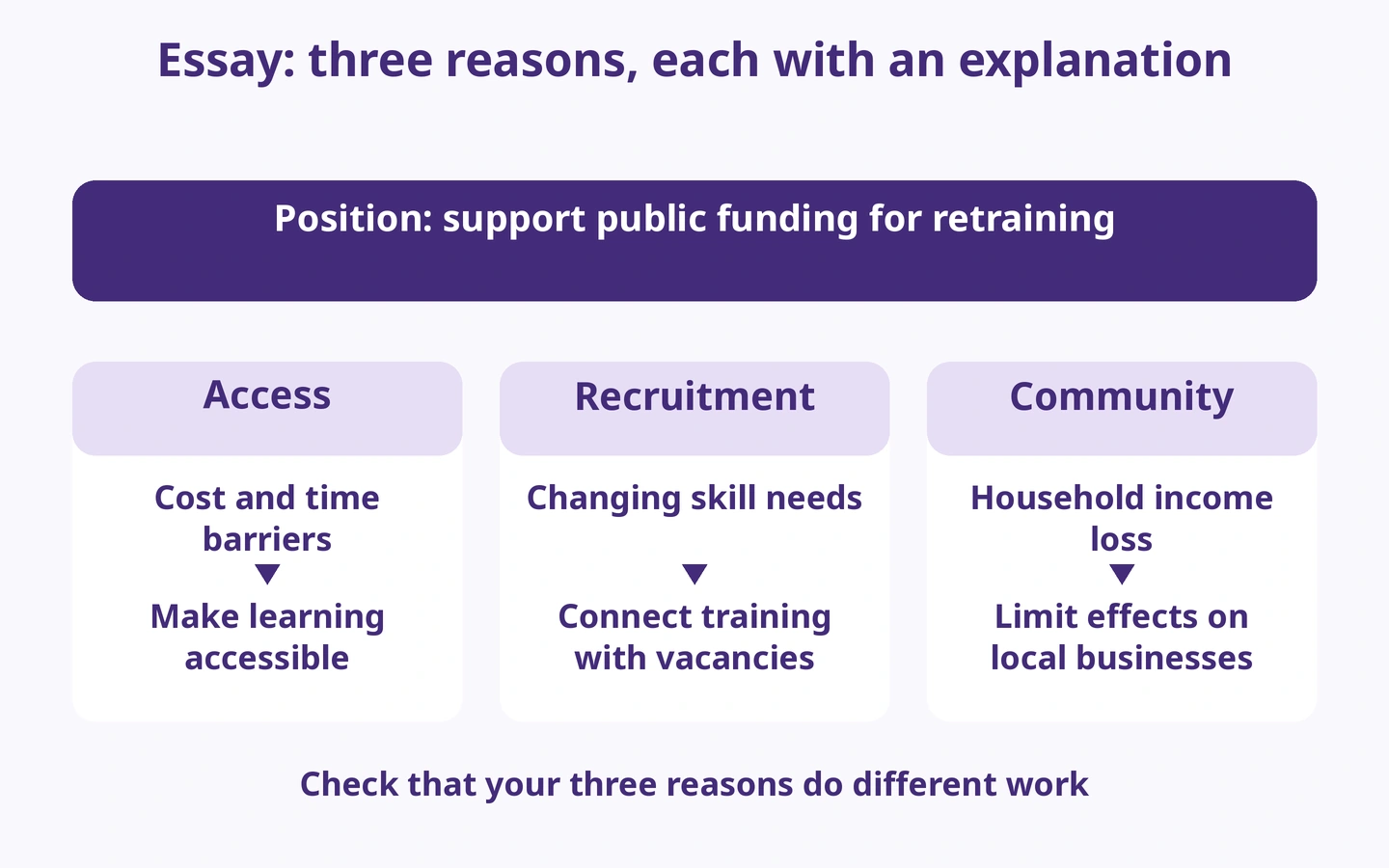
Public funding should help workers retrain when automation changes their jobs. Carefully designed support can make access to training fairer, help employers fill new roles, and protect communities from prolonged economic disruption.
Automation can deepen inequality when workers cannot afford to learn new skills. An employee whose routine tasks disappear may lack both tuition money and time to study. Public support for affordable courses and flexible study hours would give such workers a practical chance to move into different occupations rather than simply telling them to adapt.
Second, retraining can help businesses recruit people for emerging roles. Companies introducing automated systems still need staff who can operate, maintain, and evaluate them. Programs developed with local employers could connect relevant training to actual vacancies, reducing the gap between available workers and the skills businesses require.
Third, helping displaced workers remain employed can support local communities. When many households lose income, nearby shops and services may also struggle. Accessible retraining offers a way to limit this wider damage without attempting to preserve every existing task indefinitely.
Public funding therefore has a useful role, provided that programs are reviewed for accessibility and relevance. Supporting workers through change is a more constructive goal than leaving them to bear its costs alone.
The reasons concern access to learning, recruitment and effects on the local economy. They are related, but the third explains effects on surrounding businesses rather than merely repeating a household’s lost income. Our short shared practice sentence is Automation can deepen inequality when workers cannot afford to learn new skills. It expresses one reason, not a complete answer by itself.
Common mistakes and a self-review checklist
“Fairness,” “equality” and “reducing inequality” may describe the same argument. Remove the labels and ask whether the explanations differ. If you qualify support for retraining, explain how relevance and accessibility checks serve that position, rather than adding an unexplained contradictory claim.
- Do the introduction and conclusion answer the actual question?
- Are there three reasons supporting your position?
- Does each explain why or how the effect happens?
- Are the explanations distinct rather than the same example rewritten?
- Have unrelated memorized sentences slipped in?
- Are the wording, sentence structures and suggested length appropriate?
Use a template for roles, not ready-made content
Our suggested scaffold is position → reason and explanation × three → conclusion. Five paragraphs are our editorial option, not an official paragraph-count requirement. The official instruction specifies introduction, main body, conclusion and three reasons. Booklet
Fill the roles with the current question’s content before choosing an opening phrase. Official sources checked do not state automatic bonuses or penalties for a particular template itself. However, irrelevant memorized material, contradictions and unexplained reasons conflict with the published viewpoints. A summary scaffold must remain flexible: do not invent an opposition or solution merely because a template has space for one.
Reviewing alone and our two-week practice proposal
Read three times: first against the source or question, then as a reader following the logic, then for vocabulary, grammar and length. Record each revision’s reason. “Retraining is fair” can become an explanation of the tuition/time barrier and how support provides a practical opportunity. If uncertain about a phrase, isolate the sentence and the exact doubt for a dictionary or someone you can ask.
AI correction tools, if used, offer suggestions to verify, not official marks or a CSE forecast. Check that revisions preserve meaning and answer the question. See writing practice tools and Eiken study tools for the wider division of practice tasks.
| Days | Our editorial proposal | What to retain |
|---|---|---|
| 1–2 | Read current instructions; write both tasks and time them | Where you got stuck |
| 3–4 | Rework a summary against its source | Missing or altered meaning |
| 5–6 | Revise three essay reasons and explanations | Repetition and improved support |
| 7 | Recheck unresolved wording | One priority for next week |
| 8–10 | Try a new source and topic | Whether the revised method transfers |
| 11–12 | Include Reading and both tasks within 100 minutes | Actual time use and unfinished work |
| 13–14 | Revise, then say one reason aloud | A next practice priority |
This is an editorial schedule, not a two-week score promise. Revise an answer before accumulating more topics; then test the method on an unfamiliar one. We do not recommend memorizing whole paragraphs for arbitrary topics, padding length with repetition, or memorizing predicted-question answers. These approaches can crowd out relevant explanation and fail to practise reading a new question. This is our judgment, not a claim that the association bans a study method.
Take one written reason into speaking practice
Use the shared sentence to check meaning, then explain the idea without reading it. Add an answer to “What support would help?” rather than treating recitation as preparation for every question. The Grade 1 interview guide covers the separate speaking task.
Listen to and say your written sentence with SpeakGain
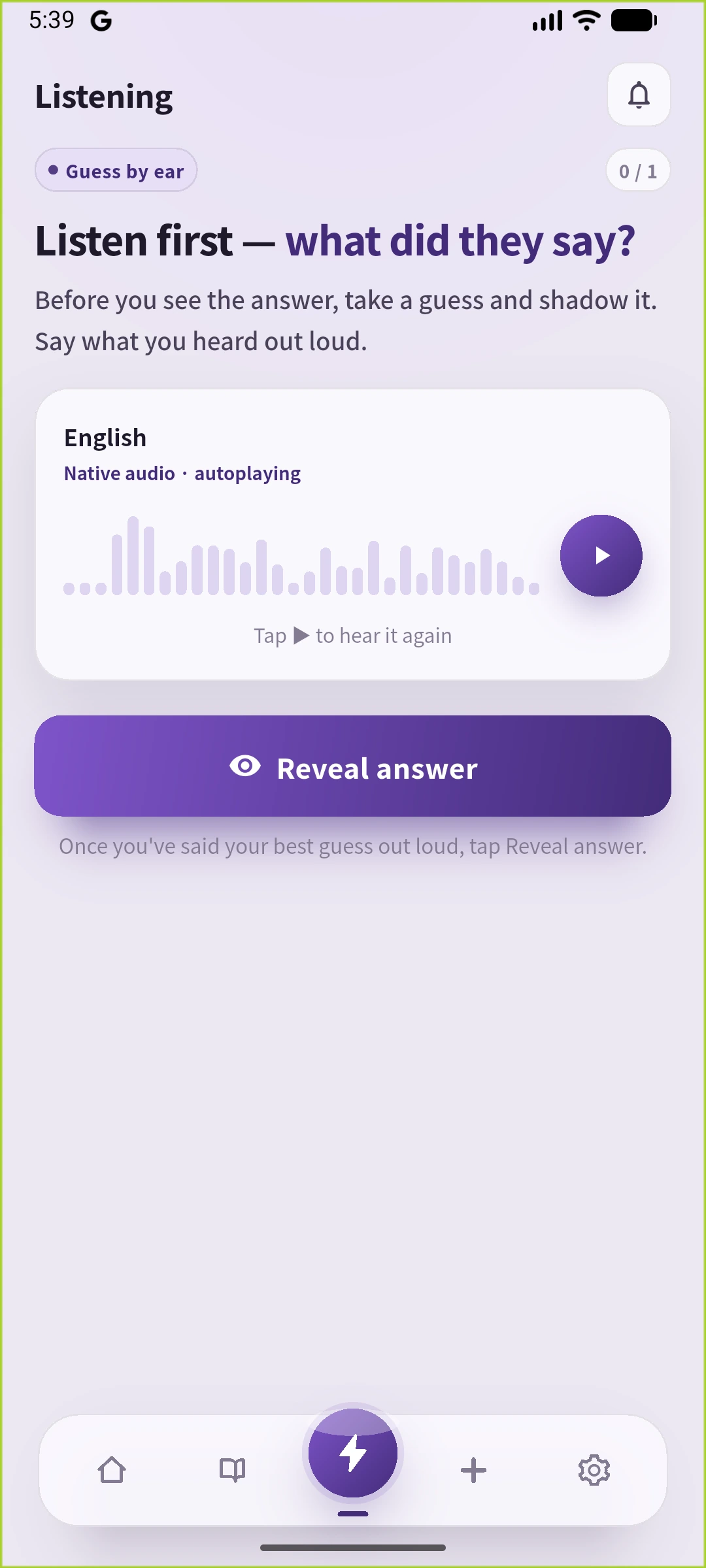
On the device, we saved this sentence once through the normal Add flow, opened Knowledge in Library, and selected Learn this card. Listening hid the English and prompted listening and saying the sentence aloud; Reveal answer then displayed the saved English. This supports listening, speaking and checking a reason you wrote. We are not describing essay correction, marking or a predicted score.
Original sentence · Viking AI audio
Automation can deepen inequality when workers cannot afford to learn new skills.
Generated once for this sentence; not official test audio or the complete essay.
FAQ
Does 80% guarantee a pass?
No. A self-marked percentage cannot be converted to CSE, and one Writing percentage does not establish the overall result. Official CSE explanation
What if I am below or above the word count?
A universal deduction per missing/excess word, or automatic zero solely for length, is not stated in the official materials checked. Follow the summary range and essay guidance; do not confuse length with the official warning about unrelated essays. Booklet · Cautions
Which task should I practise first?
Our view: try both once, then isolate the difficult operation—understanding the source, selecting information or explaining a reason. Do not prepare only one task.
Is there an official time split?
The official total is 100 minutes for Reading and Writing. A fixed split per task is not stated in the checked sources. Use timed full practice to adjust your allocation. Format
How should I build background knowledge?
Our suggestion: note who is affected, what happens and why the judgment is disputed. Practise connecting that information to a new question. Do not manufacture figures or studies to sound authoritative.
Can a template or AI tell me my score?
No official score follows from filling a structure or accepting a correction. Use the four viewpoints to locate problems; wait for official results for the score. Specific template bonuses/penalties are not stated officially.
Our editorial verdict
Choose repeatable information selection and reason explanation over memorized complete answers. Return to the source for summaries and the question plus three reasons for essays; then polish language. A structure supports that work, while a self-assigned percentage does not predict the official score.
Sources and check date
All official sources below were checked 16 October 2026. The practice source, question, summary and essay are newly written by us, with no score claim. Eiken is a registered trademark of the Eiken Foundation of Japan; this is an independent guide.