
Eiken Grade 1 interview preparation: choose, speak and handle follow-ups
Published
Japan’s Eiken Grade 1 interview is an approximately ten-minute test with two examiners: free conversation, one minute to choose and prepare one of five topics, a two-minute speech and four minutes of related questions. The second-stage pass threshold is Speaking CSE 602; the official English page lists Short Speech, Interaction, Grammar and Vocabulary, and Pronunciation. Our editors suggest first recording a one-minute preparation plus two-minute speech without notes, correcting one link between a claim and its reasons, then practising follow-ups about cost, exceptions and implementation (format, categories, threshold, checked 11 October 2026, Japan time).
This guide is for people taking the Japanese exam. The response patterns, original examples, internal time splits and practice plan are editorial suggestions, not official model answers or scoring rules. We explain a preparation method rather than predict topics or compare schools and apps.
For the big picture first, see our all-grade Eiken comparison and common preparation guide before choosing your grade’s practice.
For priorities across the whole exam and a realistic six-month approach, see our Eiken Grade 1 study plan.
Interview flow and question structure
| Order | Task | Official timing | What to watch |
|---|---|---|---|
| Enter and sit | Hand the interview card to the attendant; sit when instructed | No separate duration specified | Communication is in English |
| Name check and conversation | Confirm your name and engage in everyday conversation | Conversation: 1 minute in the English guide | Respond to what was asked; this table assigns no stage-specific marks |
| Choose and prepare | Choose one of five topics and prepare your speech | 1 minute | No notes; selection is part of preparation |
| Speech | Speak about the selected topic | 2 minutes | Relevant to Short Speech; stopped if it runs longer |
| Q&A | Answer questions related to the speech or topic | 4 minutes | Relevant to Interaction; no fixed question count or per-answer duration in the official table |
| Return and leave | Return the topic card and leave | No separate duration specified | Do not return to the waiting room or talk to waiting candidates |
Checked 11 October 2026 against the Japanese procedure and English table. Grammar and Vocabulary and Pronunciation concern your spoken performance; we do not assign them exclusively to one stage. Taking notes, photographs or recordings during the exam is prohibited. Every recording recommended here is home practice.
The 2024 renewal table says Grade 1 second-stage Speaking was unchanged. The addition of a summary task in the written exam does not change these interview timings. Do not transfer the Pre-1 change to Grade 1. Recheck current official guidance before your test. Use the official virtual interview and sample resources; we do not reproduce past questions or topic cards.
Scoring: do not turn CSE 602 into a home accuracy percentage
Second-stage decisions use Speaking alone, with a threshold of CSE 602 (CSE explanation). The official calculation guidance explains that statistical methods are used and candidates cannot calculate CSE from the number of correct answers. A recording and a few successful phrases cannot certify a pass.
| Official category | Our editorial recording check |
|---|---|
| Short Speech | Does the position answer the question, with reasons and examples supporting it? |
| Interaction | Does the answer address the new question and add the needed explanation? |
| Grammar and Vocabulary | Are causes, conditions and comparisons expressed accurately enough to follow? |
| Pronunciation | Are key words, negatives and contrasts understandable? |
The left column comes from the official English page; the right is a practice checklist, not a score calculator. Grade 1 does not list a separate Attitude category. That does not make attentive interaction irrelevant.
The solo loop: record, listen, fix one thing, transfer
Our editors recommend a timer and recorder. Check official materials, prepare without notes for one minute, record a speech capped at two minutes, and answer a related question. Listen for one concrete issue: duplicated reasons, a missing causal link or an answer that ignores cost. Correct that part and record again. Next time, change the question rather than memorise the recording.
Start with relevance, then reasoning, then sounds that obscure meaning. Correcting every grammar and pronunciation issue at once makes improvement hard to track. For sentence-level work see reading aloud and building sentences from meaning.
Free conversation: answer first, add one detail
What is asked
The official description is name confirmation and simple everyday conversation. The following practice question is ours, not a guaranteed exam question: What do you enjoy learning about?
Editorial pattern and example
Use a direct answer followed by one relevant detail.
I enjoy learning about urban planning. I am interested in how public spaces affect everyday life.
The speaker identifies an interest and explains the specific aspect of it. Stop while there is room for the examiner’s next question; do not launch an entire rehearsed biography.
Practise alone
Prepare three questions about yourself, shuffle them and record each answer. Listen for whether the first sentence answers the question, fix one irrelevant detail and record again. Try them within the official one-minute conversation period without imposing equal answer lengths.
Common mistakes
Starting a memorised introduction before hearing the question, answering about work when asked about interests, or stopping at “yes.” Practise responding to the actual prompt.
One-minute preparation: choose reasons you can explain
What you do
Choose one of five topics and prepare within the same minute, without notes (official procedure). You do not receive another minute after choosing.
Editorial decision rule and example
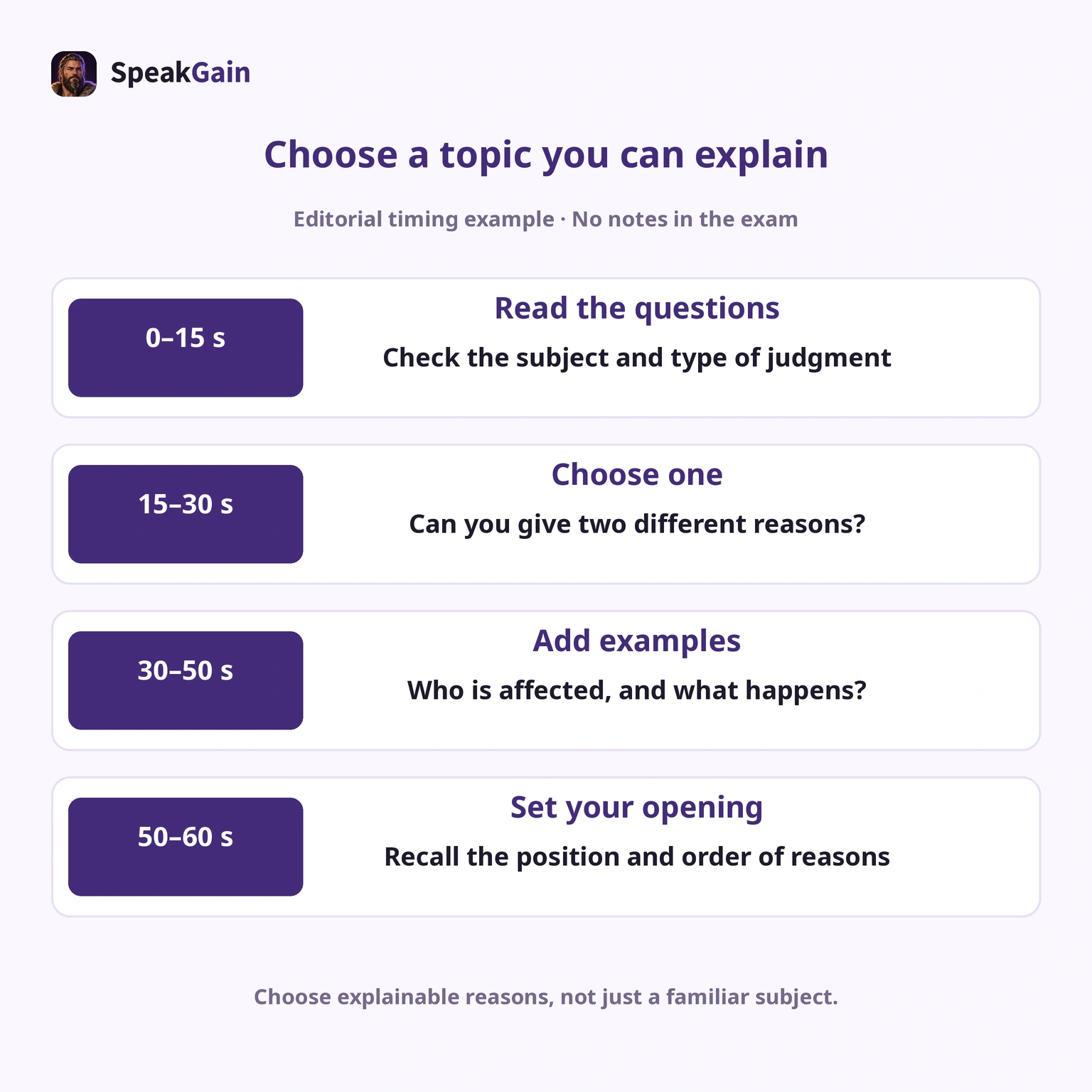
Check: understand the question → state a position → find two different reasons → attach examples. Familiar vocabulary is insufficient if both reasons are just synonyms for “useful.” Our timing example is:
| Home-practice split | Mental task |
|---|---|
| 0–15 seconds | Read the subject and requested judgment: agreement, comparison or degree |
| 15–30 seconds | Choose a topic with a position and two distinct reasons |
| 30–50 seconds | Add who is affected and what happens |
| 50–60 seconds | Recall the opening sentence and order of reasons |
These splits are editorial, not examiner instructions. Avoid repeated last-second changes. Our original question is Should cities invest more in shaded public spaces?. It is neither a past question nor a prediction. For support, recall “heat / access”: helping essential travel in hot weather, and enabling more residents to use public space. A bus-stop passenger and a family using a square give different examples.
Practise alone
Open an official sample at its source, choose with a one-minute timer, then record two minutes. Listen to whether the chosen reasons actually developed. Write your observations afterwards, not during preparation. Fix either the selection delay or the missing example, then try another topic. If you first organise reasons on paper at home, remove the paper on the next attempt.
Common mistakes
Choosing a favourite field without usable reasons, leaving your position undecided, or inventing statistics to sound knowledgeable. Prefer explanations you can express to unsupported specialist claims.
Two-minute speech: position, reasons with examples, conclusion
What is asked
Speak on the selected topic for two minutes; the examiners stop a longer speech. The official format does not prescribe a word count or number of reasons.
Editorial pattern and example
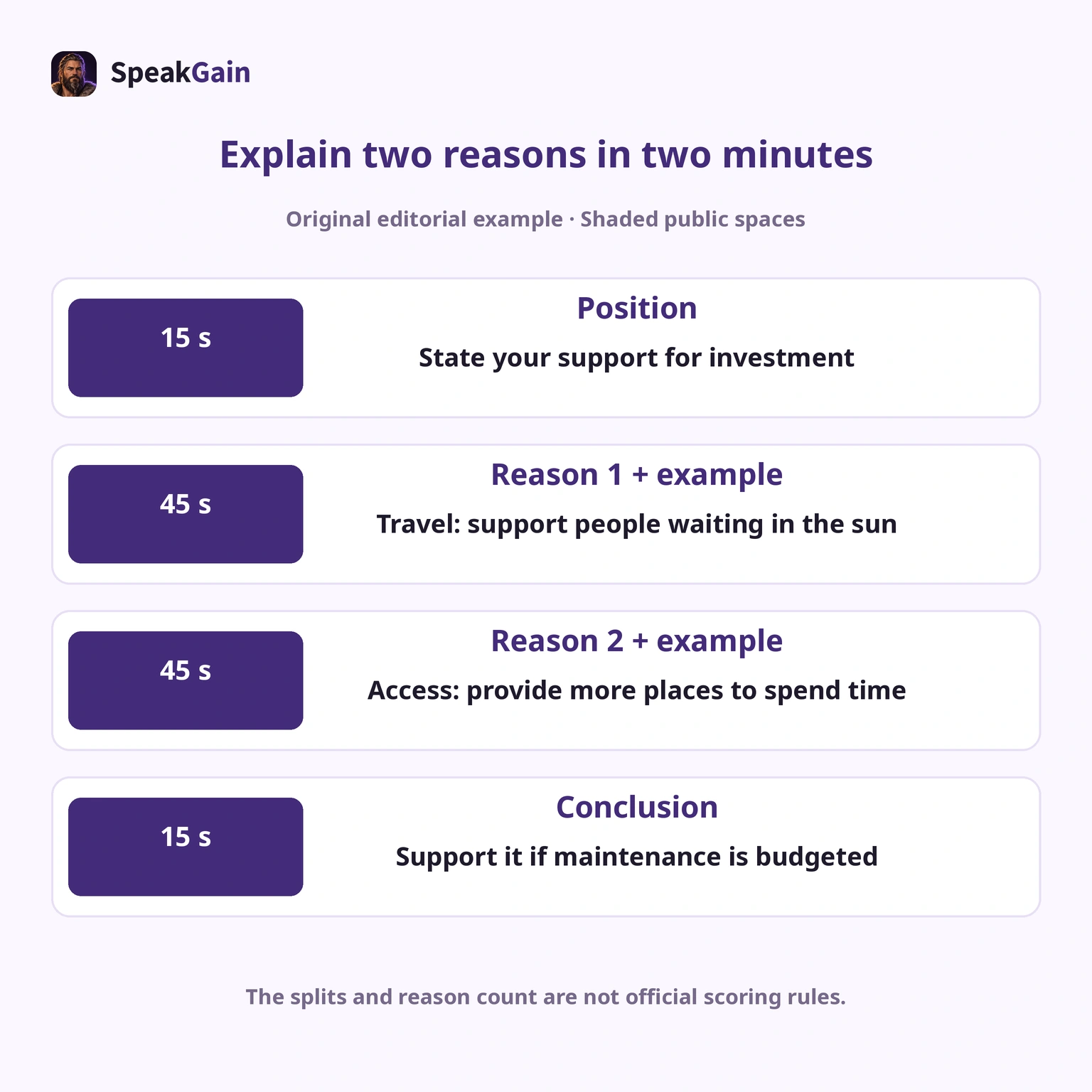
Start with position → reason 1 and example → reason 2 and example → conclusion. Three reasons can work if you can develop them; listing three thin points is not our recommendation.
Cities should invest more in shaded public spaces for two reasons. First, shade can make essential journeys more manageable in hot weather. For example, a shaded bus stop gives people a place to wait out of direct sunlight. Second, comfortable public spaces can be accessible to more residents. A shaded square gives older people and families another place to spend time. These benefits justify greater investment, provided that maintenance costs are planned from the start.
This is a short structural illustration, not a completed two-minute answer. It supports investment through travel and access, with maintenance as a condition. Expand who needs the bus and why waiting cannot be avoided; explain how the example supports the reason. Our practice split is 15 seconds for the position, 45 for each reason, and 15 for the conclusion.
Avoid repeating “convenient” in different words. If reasons overlap, consider a different axis such as access, cost or long-term upkeep. Do not introduce an unexplained major reason in the conclusion.
Practise alone
After one-minute preparation, stop the recording at two minutes. Check whether each reason explains why its example matters. Repair one missing connection and record again; next time change the conditions or topic. If too long, cut a duplicated example instead of racing. If too short, add a concrete cause and consequence rather than more linking words.
Common mistakes
Presenting both sides without deciding, listing reasons without explanation, or losing the conclusion while searching for impressive vocabulary. Whole-answer memorisation can push an old answer into a new question. English presentations can help with organisation, but their notes are not allowed here.
Four-minute Q&A: explain, respond to objections, adjust conditions
What is asked
Questions concern the speech or topic. Four minutes is official; the following three practice directions are our classifications, not a fixed question sequence.
Editorial pattern and examples
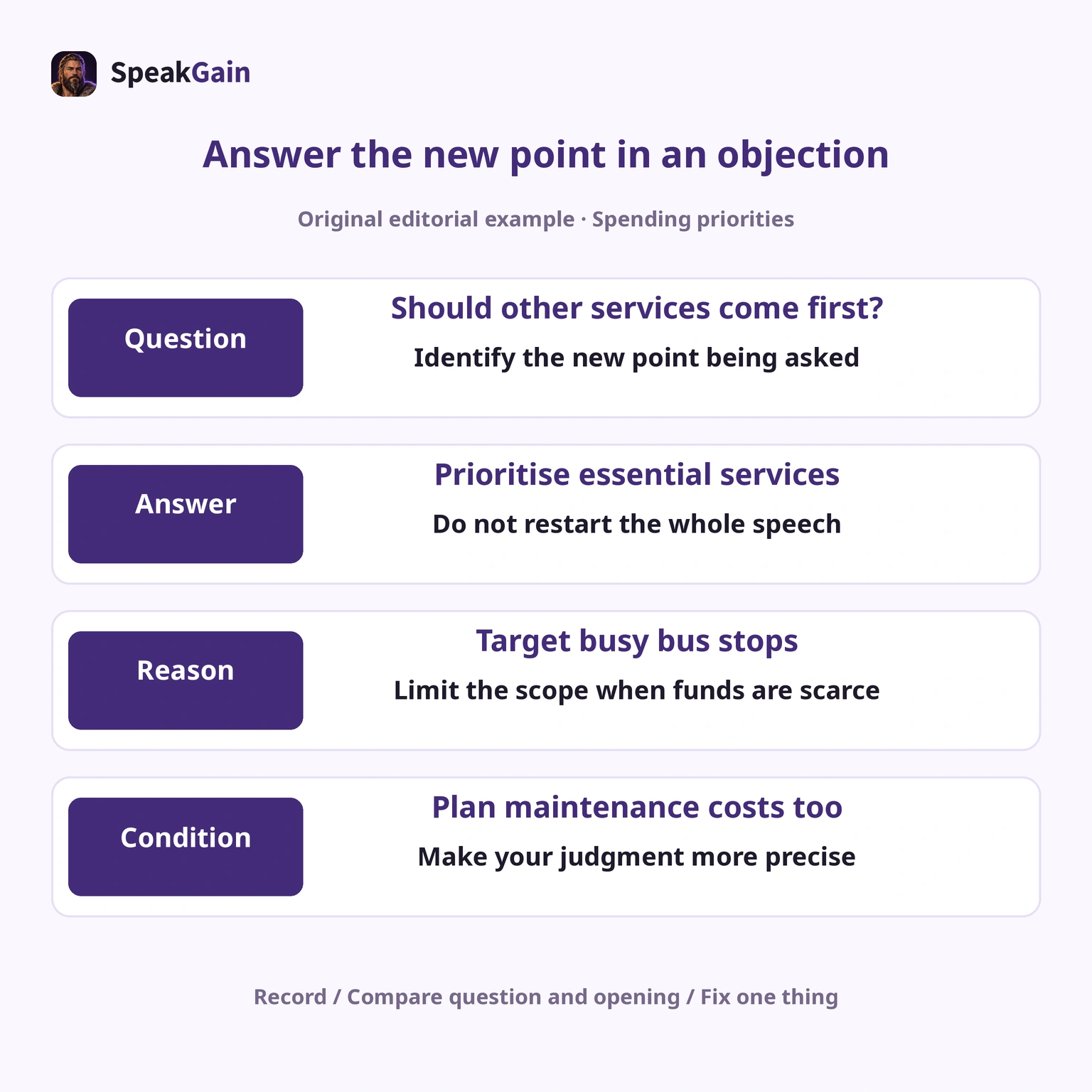
Use answer this question → reason → example or condition if needed. Do not restart the speech.
| Original follow-up | Short response | New point |
|---|---|---|
| How would you decide where to provide shade first? | I would prioritise places where people have to wait, such as bus stops, because they have fewer options to avoid the sun. | Prioritise unavoidable waiting |
| Would the money be better spent on other services? | Essential services should come first. However, targeted improvements at busy stops could still be worthwhile if the budget is limited. | Compare spending and limit the scope |
| What if a city cannot afford ongoing maintenance? | In that case, I would support a smaller project with a clear maintenance budget rather than a large expansion. | Adjust when upkeep cannot be afforded |
The responses prioritise essential services and a manageable project. Conditions can refine support without abandoning it. Do not reverse your position after every objection without explaining why.
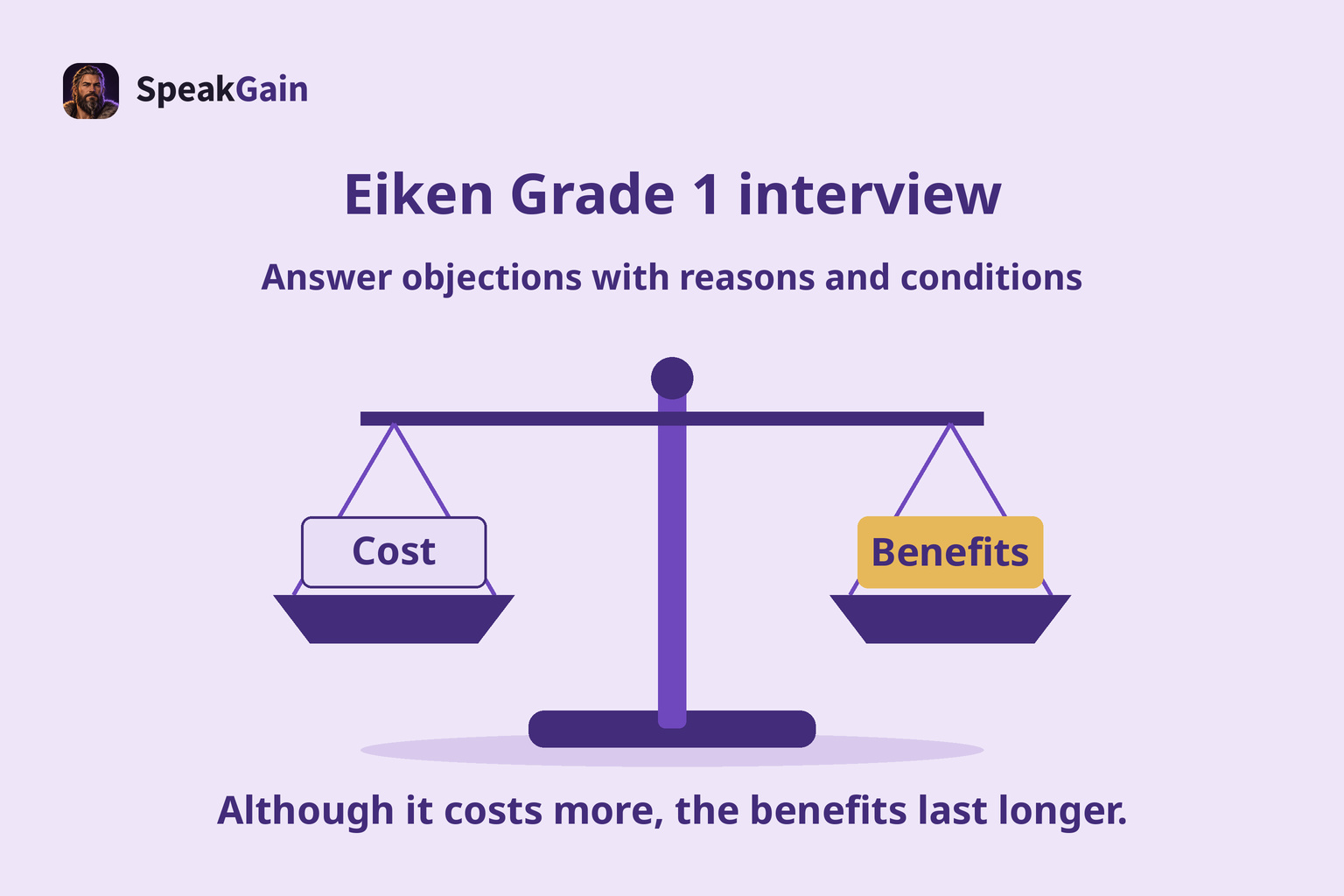
Although the initial cost is high, the long-term benefits justify the investment.
This sentence acknowledges high initial cost and claims long-term value; it still needs an explanation of which benefits justify the expense. The hero uses the shorter original line “Although it costs more, the benefits last longer.”. Specify the comparison and the lasting benefit rather than use either line for every objection.
When an exact figure is unknown, do not invent one. Our example is “I do not have an exact figure, but the cost would depend on the scale and design of the project.”. Admit the limit and return to a defensible decision criterion; this is not a scoring rescue phrase.
Practise alone
After your speech ask why, what about cost, what are the exceptions, and how it would work. Shuffle written prompts, separate question-reading time from answering, and record. Compare the question’s key point with your first sentence. If asked about cost but you repeated benefits, fix the opening. A solo four-minute exercise cannot fully reproduce someone else choosing unexpected questions; include a partner-led run if possible.
Common mistakes
Rejecting an objection without a reason, answering before hearing the whole question, inventing evidence, or requesting an explanation of the question. Official precautions allow natural English requests to repeat, but unnatural or repeated requests may lose marks. Requests to speak more slowly or clarify the meaning/content are not allowed. Practise “Could you repeat the question, please?”, then answer the repeated question; it is not unlimited protection from penalties.
A sentence card: the SpeakGain flow we checked
The whole interview is practised with official materials, a timer and your own recordings. We develop SpeakGain and show it here only for a short sentence: “Although the initial cost is high, the long-term benefits justify the investment.”. We created one card through the normal Add flow. Library → Knowledge → Study this card opened Listening with the English hidden and model playback, then Show answer opened the reference sentence, explanation, replay and review intervals.
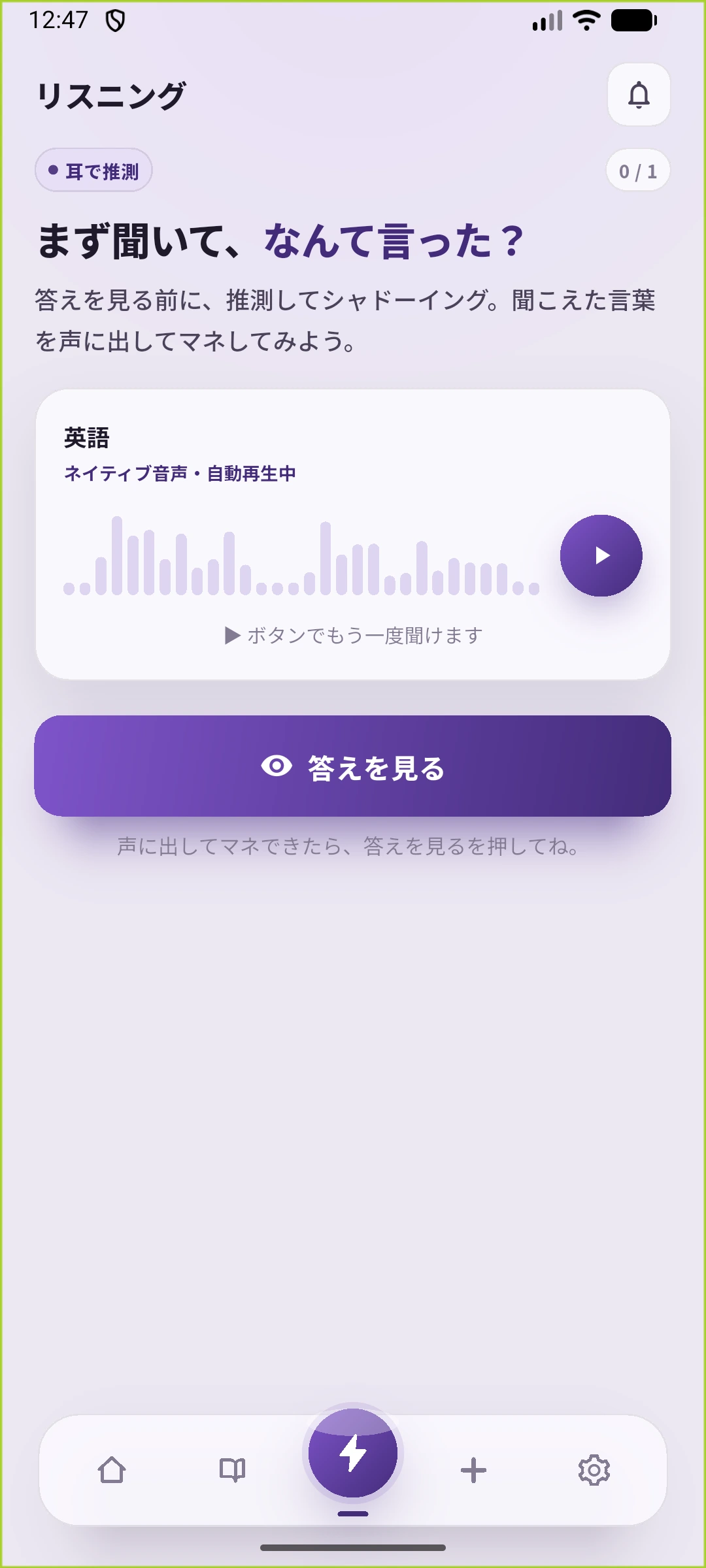
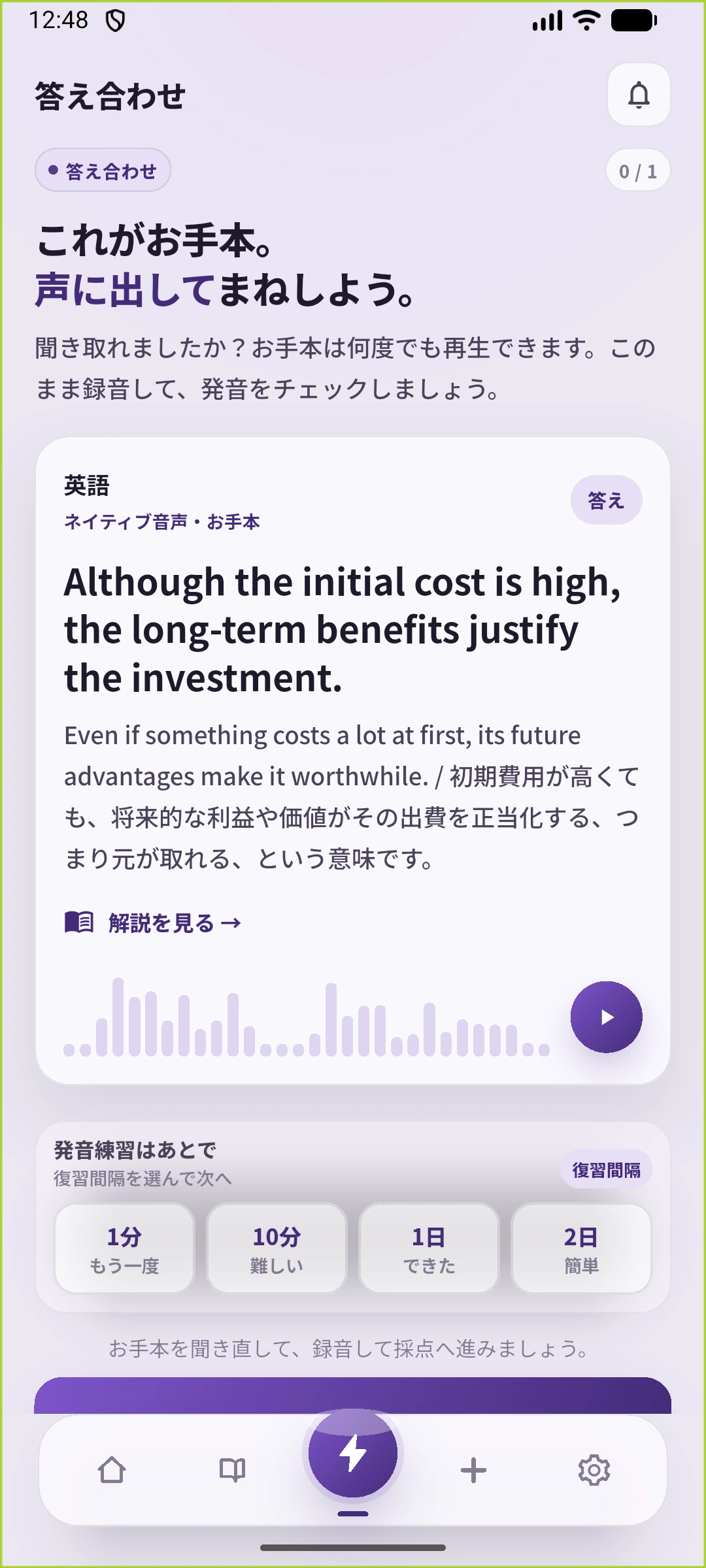
The original publication had no audio player; the same card now has Viking audio below. We show the observed screen flow; no extra cards or audio were generated for translations. Record and assess led, after permission, to a recording-in-progress display and Stop and assess. We did not inspect an assessment result and make no precision or Eiken-score claim. See what SpeakGain is. After checking the sentence, leave the screen and explain a benefit yourself; playback alone does not complete speech or follow-up practice.
This AI-generated Viking sample comes from a card created through the app’s normal Add flow; it is not a human native speaker’s recording.
Although the initial cost is high, the long-term benefits justify the investment. — Acknowledge a high initial cost while explaining the value of long-term benefits.
Practice until interview day
Our editors start with a baseline recording and allocate time to its largest weakness. This example assumes roughly 20 minutes daily; it is not a four-week pass promise.
| Period | Practice | Keep |
|---|---|---|
| 4–3 weeks before | Check the format; try conversation, no-note preparation, speech and questions | Baseline and where selection or reasoning stalled |
| 3–2 weeks before | Separate selection from structure; fix one reason/example connection | Before/after recordings |
| 2–1 weeks before | Change prompts; answer cost, exception and implementation questions | Whether the opening answered the new point |
| Final week | Full run, preferably with a questioner; repeat-request followed by response | One remaining correction |
| Day before/day | Check admission documents, time, identification and venue; briefly speak aloud | Travel and materials |
With one week, baseline first, concentrate on two weaknesses, then keep a full run. With three days: baseline, one correction, full run. With ten minutes: preparation, speech, listening and a partial repair; practise questions the next day. Do not record many speeches while omitting Q&A.
Compare Pre-1 preparation: picture narration becomes a speech with your own position at Grade 1. Grade 2, Pre-2, Grade 3, IELTS and TOEIC Speaking have different conditions. Fit practice into your English study plan.
Test day, dates and results
Follow the actual attendants’ and examiners’ instructions, return the topic card, and leave without going back to waiting candidates. No notes, photographs or recording during the interview (procedure). Check your admission notice and the official schedule; use the official results service for your session. We do not freeze a session-specific date here.
FAQ
What is the pass threshold?
Speaking CSE 602, not a home-recording accuracy percentage (official table).
How much preparation and speaking time?
One minute including choice, then two minutes speaking, with no notes (format).
How many follow-up questions, and how long per answer?
The official table specifies four minutes of Q&A, not a fixed count or per-answer duration. Answer the new point and develop it as needed.
Can I ask for repetition?
Yes, naturally in English, subject to the official limits on unnatural/repeated requests; slower speech and meaning clarification are not allowed (precautions).
What about Attitude?
Grade 1 lists no separate Attitude category (categories). Our editors practise attentive responses rather than a rehearsed smile.
What if I have no idea?
Narrow the subject and state one explainable judgment. Consider who is affected and under what condition you support it; invent no data.
Must I give three reasons?
The checked official format sets no required reason count. Our editors start with two different reasons developed properly.
Can I practise alone?
Timing, recording, listening and one correction are possible alone. A partner can add unanticipated follow-ups that solo practice cannot fully reproduce.
How many days are enough?
It depends on your current speech and available time. Start with a baseline; keep correction and a full run even if time is short.
Does SpeakGain provide Grade 1 mock interviews or CSE scoring?
This article presents only the observed general sentence-card flow. Practise the whole interview separately; no exam-scoring function is claimed.
Editorial verdict
Choose an explainable topic in one minute, connect reasons over two minutes, then answer the new point in a follow-up. Long scripts and difficult vocabulary alone do not reveal selection delays or irrelevant replies. Today, record one no-note attempt, check whether the reasons differ, ask a cost or exception question, fix one thing and transfer the routine to another topic tomorrow.
For the summary and the essay with three reasons, see our Eiken Grade 1 Writing guide, with official viewpoints and newly written examples.
Official sources checked
Checked 11 October 2026, Japan time: Japanese format, English format/categories, 2024 renewal, CSE threshold, score calculation, virtual interview, official samples, interview precautions, schedule, results. Examples, diagrams and plans are original editorial practice materials. Eiken is a registered trademark of the Eiken Foundation of Japan; no endorsement or pass guarantee is implied.