
How to give a presentation in English: opening, transitions, closing and Q&A
Published Updated
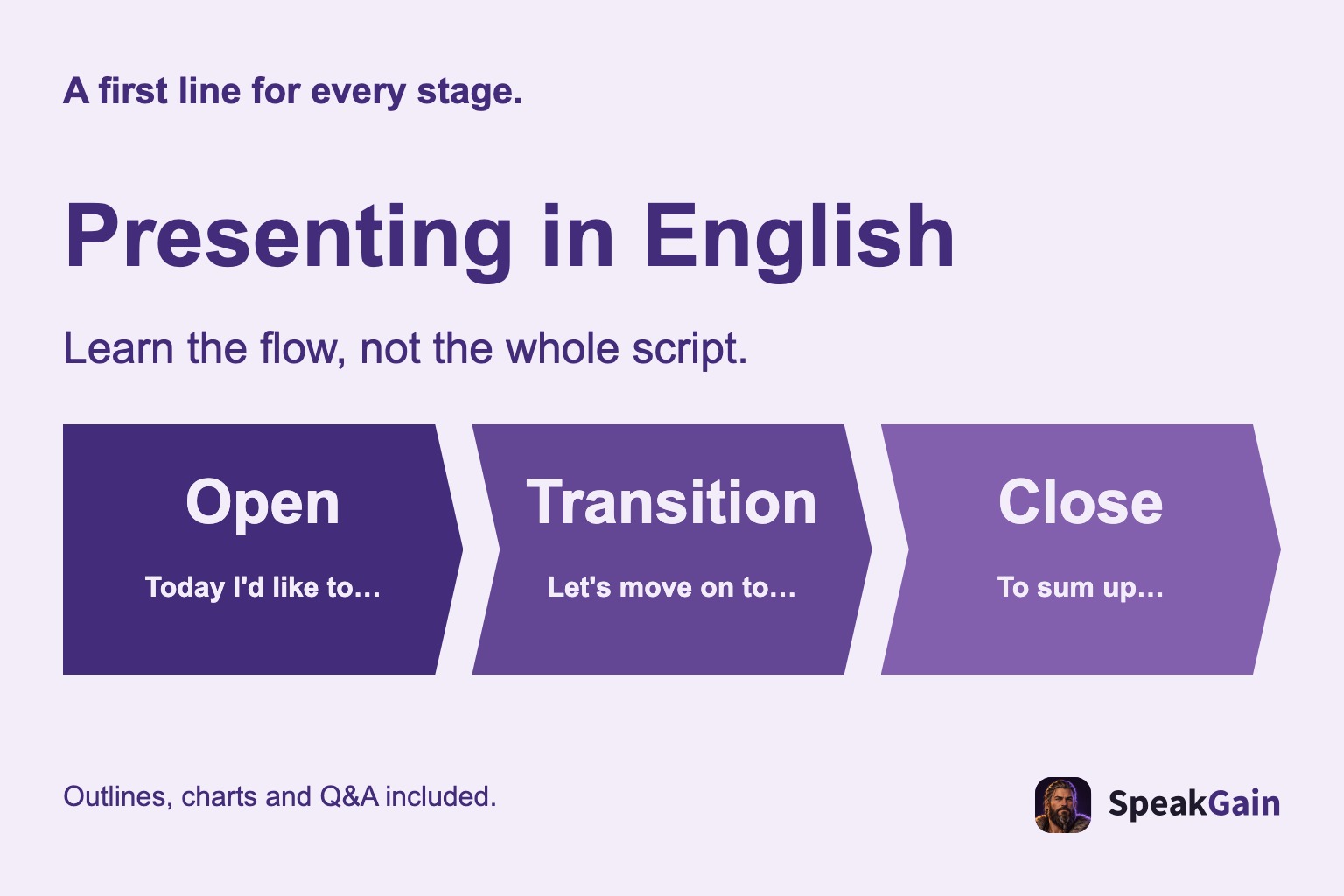
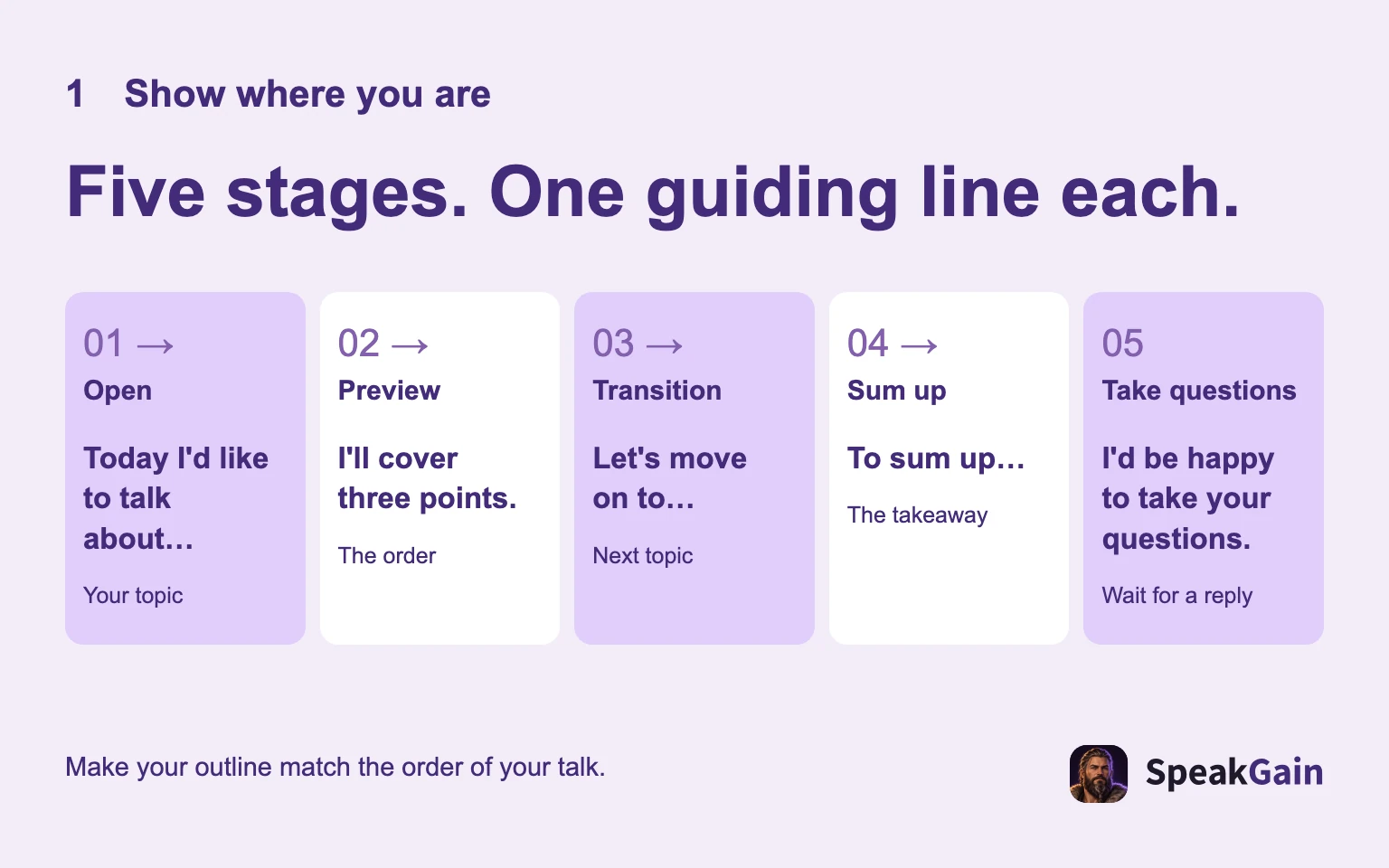
Prepare an English presentation in five stages: open → preview → transition → summarize → take questions. Start with Today I’d like to talk about…, I’ll cover three points, Let’s move on to…, To sum up…, and I’d be happy to take your questions. Put one key message on each slide, then rehearse your opening three lines, transitions, closing and Q&A replies aloud. You do not need to memorize the whole script.
For a brief greeting without slides, use our short English speech guide to develop one experience and a closing line.
Our editorial advice: write to organize your ideas, but do not make reproducing every word your goal. Decide and learn the opening three lines. Begin with your topic rather than an apology for your English. A short set of reliable phrases gives you something specific to prepare while you work out how to explain the substance in your own words.
If you also join the discussion as a listener, prepare how to enter, give a reason and check actions in English meetings.
For ideas you want to discuss in a presentation, our TED study method shows how to explain a talk in your own words and add a reasoned response.
1. Know the flow and the first line at each stage
These five stages are a practical starting point for an internal update. At a conference, use your research topic and findings; online, check screen sharing first. Politeness comes from fitting the situation and managing questions considerately, rather than choosing the longest words.
The British Council — Business presentations recommends telling listeners what you will cover, covering it, then summarizing. We have divided that guidance into five practice stages. This is an editorial structure, not an experimentally proven formula for a successful talk. If you promise three points, deliver three; change the preview when the outline changes.
| English phrase | Meaning / use |
|---|---|
| Today I’d like to talk about our project update. | State that you will give a project update. |
| I’ll cover three points. | Announce three points; change the number if needed. |
| Let’s move on to the next steps. | Move to the next actions. |
| To sum up, we’re on schedule. | Summarize that progress is on schedule. |
| I’d be happy to take your questions. | Invite questions politely. |
2. Open with a greeting, your role and your purpose
If listeners need an introduction, prepare three lines: greeting, role, purpose. The table separates them and gives alternatives for a familiar team, a conference and an online meeting. With colleagues who already know you, shorten the introduction. With another department, mention your role instead of reading a long biography. See the self-introduction guide if you need to build that part first.
After Today I’d like to talk about, add a noun phrase such as our sales results, the new process or our research findings. Use Thank you for the introduction. only if someone introduced you. Across time zones, Hello, everyone. avoids choosing a greeting that does not fit the audience’s time.
We advise against opening with I’m sorry for my poor English. It shifts the first moment toward judging your language rather than understanding your topic. British Council advises speakers not to apologize for English being a second language. That is presentation advice, not evidence that one apology always lowers a score. Ask for specific help instead: Please let me know if anything is unclear. Apologizing for an actual error or a late start is a separate matter.
| English phrase | Meaning / use |
|---|---|
| Good morning, everyone. | Greet the audience in the morning. |
| I’m Misaki from the product team. | Give your name and team. |
| Today I’d like to talk about our project update. | State that you will give a project update. |
| Hi everyone. Thanks for joining. | A friendly opening for a familiar internal meeting. |
| Thank you for the introduction. Today I’d like to present our findings on energy use. | A conference opening after the chair introduced you. |
| Can everyone see my screen? | Ask whether screen sharing is visible; wait for a reply. |
3. Preview the route and signal transitions
Preview progress, the main issue and the next steps, then follow that order. Use topic names with first, second and finally so a listener who missed a sentence can find their place again. Explain a new acronym once before relying on it. The preview is a map, not a second version of the whole talk.
Let’s move on to the next steps. signals the next item. This brings me to the main issue. links an issue to what you just explained: make sure the word This has an identifiable referent. At a conference, clear everyday transitions are still useful; you do not need to replace all of them with formal connectors you cannot explain. Pause, change the slide, then introduce its message.
| English phrase | Meaning / use |
|---|---|
| I’ll cover three points: our progress, the main issue, and the next steps. | Preview progress, the issue and actions in that order. |
| First, let’s look at our progress. | Introduce the first topic: progress. |
| Let’s move on to the next steps. | Move to the next actions. |
| This brings me to the main issue. | Connect the preceding explanation to the main issue. |
| Before we move on, let me clarify one point. | Clarify one point before moving on. |
| As I mentioned earlier, the deadline is Friday. | Refer back to an already stated Friday deadline. |
4. Explain a chart: orientation, change, meaning
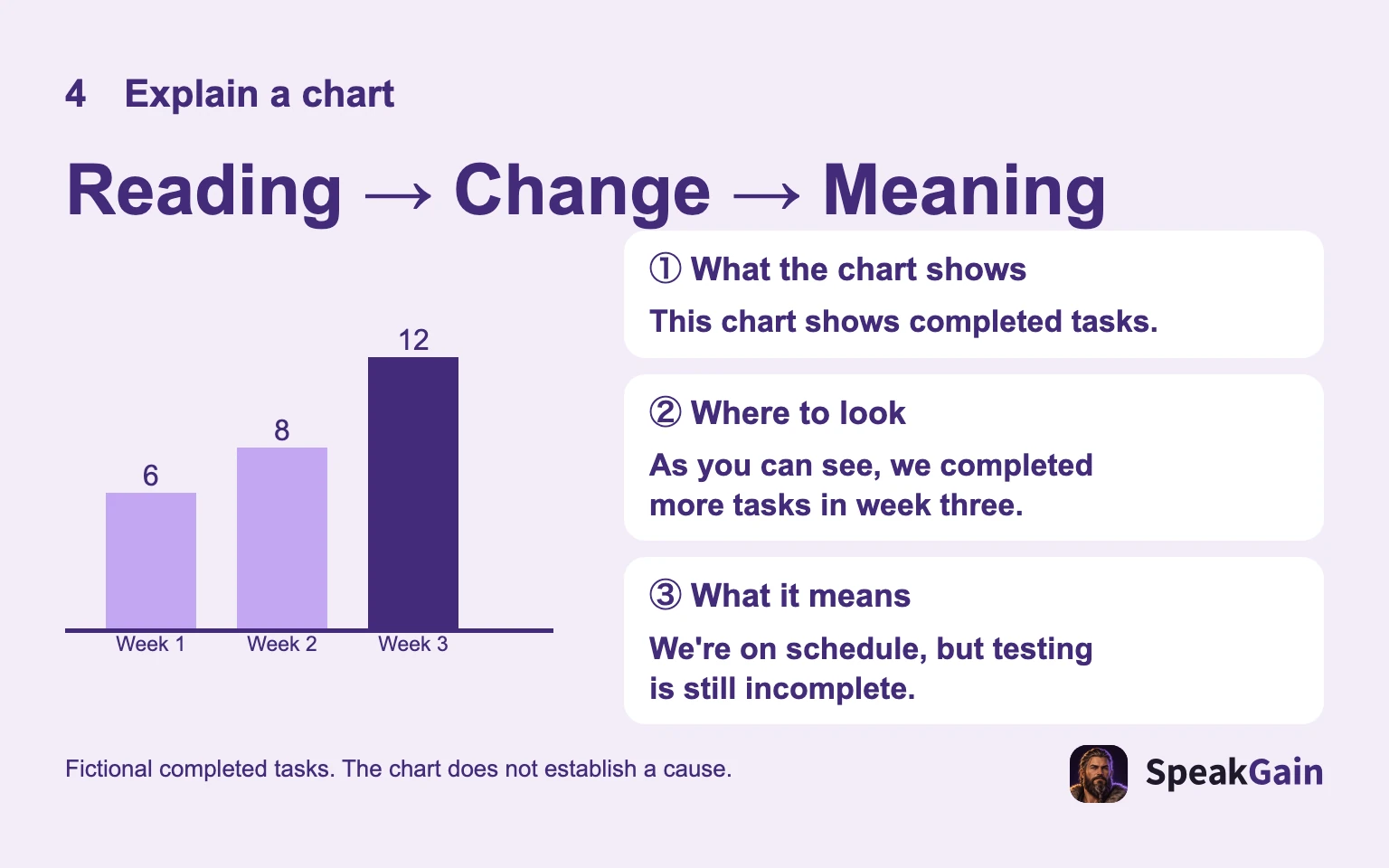
As you can see, … does not tell the audience where to look by itself. First identify the chart, its axes or period; point out one important comparison; then explain what it means for your report. Read only the numbers listeners need to understand that comparison.
MIT EECS — Slide Presentation advises orienting listeners to what axes and data points mean and directing attention to relevant patterns. Our three-line example applies that guidance to fictional task counts. These are not SpeakGain usage figures or learning results.
increased by 10% means the size of the increase; increased to 10% names the final value. Keep percentages distinct from percentage points, and state units and comparison conditions. An increase alone does not establish its cause. Do not memorize an English calculation you cannot explain.
| English phrase | Meaning / use |
|---|---|
| This chart shows the number of completed tasks each week. | Identify the chart: tasks completed each week. |
| As you can see, we completed more tasks in week three. | Point out more completed tasks in week three. |
| We’re on schedule, but testing is still incomplete. | State both on-schedule progress and incomplete testing. |
5. Summarize, give the next action and close
Put the conclusion after To sum up. For an internal report, add one concrete request and its deadline, then thank the audience and invite questions. Do not introduce a new issue in the closing. Thank you for your time. is another suitable thank-you.
Are there any questions? is a direct, standard invitation. I’d be happy to take your questions. emphasizes willingness. At a conference, follow the chair’s Q&A procedure. Online, say Please put your questions in the chat. or Please raise your hand if you have a question. only when those are the meeting’s actual tools and rules. Allow time to check the chat.
| English phrase | Meaning / use |
|---|---|
| To sum up, we’re on schedule, but we need to finish testing. | Restate progress and the remaining need to finish testing. |
| Please send me your feedback by Friday. | Request feedback by Friday. |
| Thank you for listening. | Thank the audience. |
| I’d be happy to take your questions. | Invite questions politely. |
6. Handle questions: acknowledge, clarify, answer
Acknowledge a question before rushing into a long answer. Separate not hearing the words from not knowing the data: they require different replies. The short repeat request is polite in a workplace meeting; adding the question, please makes the request explicit and also fits a conference.
After Let me make sure I understand., say what you want confirmed. For example, Are you asking about the cost or the timeline? Do not leave the listener guessing what to repeat. You can restate a question for the room without calling every question a great question.
I’ll get back to you on that. is a commitment to follow up. Decide whom to ask and how to respond. Internally, you might say I’ll check with the testing team and email you tomorrow. At a conference, do not promise tomorrow if you need further analysis. British Council — Questions and answers describes preparing for anticipated questions, unknown answers and follow-up; the phrases here are our examples, not quotations from the session. Our preference is an honest short follow-up over guessing a number.
| English phrase | Meaning / use |
|---|---|
| Thank you for the question. | Acknowledge the question. |
| Could you repeat that? | Ask politely for repetition. |
| Could you repeat the question, please? | Explicitly ask for the question to be repeated. |
| Let me make sure I understand. Are you asking about the deadline? | Check whether the question concerns the deadline. |
| I don’t have that figure with me. I’ll get back to you on that. | State the missing figure and promise follow-up. |
7. Prepare messages and linking phrases, not a memorized script
You can write a full draft to discover what you want to say, then reduce it to one key message per slide. Turn a title such as “Progress” into a claim: the main features were completed on schedule. Keep exact numbers and technical terms in your notes. If a slide has two unrelated messages, split it or choose the one your audience needs.
MIT’s slide guidance recommends one message per slide and a title that expresses it. MIT — Delivery discusses problems with reading or memorizing a whole manuscript and describes rehearsed, flexible delivery. Our choice of three opening lines is a manageable editorial target, not a scientifically optimal number.
Roediger & Karpicke (2006) compared restudying prose with recalling it in tests. Repeated study performed better at a five-minute test; prior retrieval testing produced better retention at two days and one week. The study did not test English presentations, pronunciation, these three opening lines or SpeakGain. We use it as context for trying to recall a line before checking it, not as proof of fluency gains or a promised practice schedule.
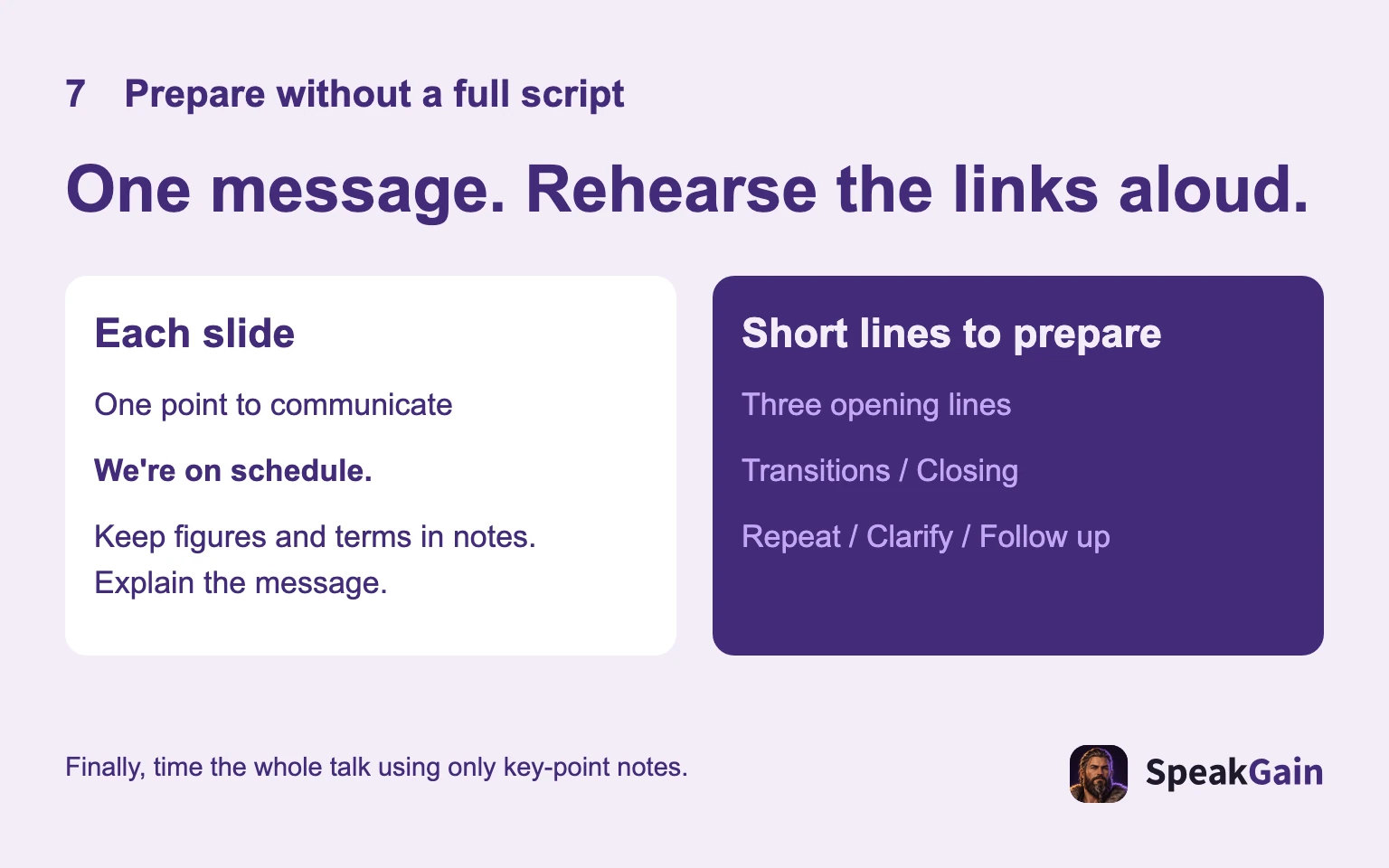
- Opening three lines: greeting, role, purpose, with your first slide showing.
- Transitions: say the actual topic name while changing slides.
- Closing: conclusion, request, thanks, invitation to questions.
- Q&A replies: ask for repetition, clarify meaning, arrange follow-up.
Check whether you can explain the message and move to the next point. Reproducing every word is not the only test.
Then time a complete run using key-message notes. If it exceeds five minutes, remove background or duplicated examples before speaking faster. Ask a listener what they took away, or record yourself and check that the conclusion and next action are audible. For smaller exercises, see memorizing useful sentences and reading aloud.
8. Hear and say the lines in a five-minute internal update
Misaki is a fictional learner giving a five-minute online update to an international product team. The main features are finished; some testing remains; she wants feedback by Friday. This is a worked example, not a customer success story. The table follows her talk from screen check to a colleague’s question.
She waits for a reply to the screen check before beginning. If needed, she asks Can you hear me clearly? If sharing fails, she says I’ll share my screen again. She then uses the opening three lines and previews the three points. Between the anchor phrases, she explains the completed features and remaining tests from brief notes; she can insert the chart explanation from section 4.
| English phrase | Meaning / use |
|---|---|
| Can everyone see my screen? | Ask whether screen sharing is visible; wait for a reply. |
| Good morning, everyone. | Greet the audience in the morning. |
| I’m Misaki from the product team. | Give your name and team. |
| Today I’d like to talk about our project update. | State that you will give a project update. |
| I’ll cover three points: our progress, the main issue, and the next steps. | Preview progress, the issue and actions in that order. |
| We’ve completed the main features on schedule. | Report that the main features are complete on time. |
| This brings me to the main issue. | Connect the preceding explanation to the main issue. |
| We’re on schedule, but testing is still incomplete. | State both on-schedule progress and incomplete testing. |
| Let’s move on to the next steps. | Move to the next actions. |
| To sum up, we’re on schedule, but we need to finish testing. | Restate progress and the remaining need to finish testing. |
| Please send me your feedback by Friday. | Request feedback by Friday. |
| Thank you for listening. | Thank the audience. |
| I’d be happy to take your questions. | Invite questions politely. |
| Will testing be finished by Friday? | The colleague asks whether testing will finish by Friday. |
| Let me make sure I understand. Are you asking about the deadline? | Check whether the question concerns the deadline. |
| I’ll check with the testing team and get back to you tomorrow. | Promise to check with testing and reply tomorrow. |
The feedback deadline and the testing completion date are different. Misaki does not assume both are Friday. She confirms what her colleague means, then checks with the testing team and promises a reply tomorrow. Rehearse a second version where you did not hear the question: first say Could you repeat that?, then clarify. If you know the schedule, a short Yes, we plan to finish on Thursday. is enough.
Save the short lines you will actually use
Use SpeakGain’s normal Add and Create flow to save the purpose, transition and question reply as three separate cards. The screenshots and audio use the same English sentences in every language. Choose a short useful line rather than putting the whole presentation on one card; later say it again with your own project topic.
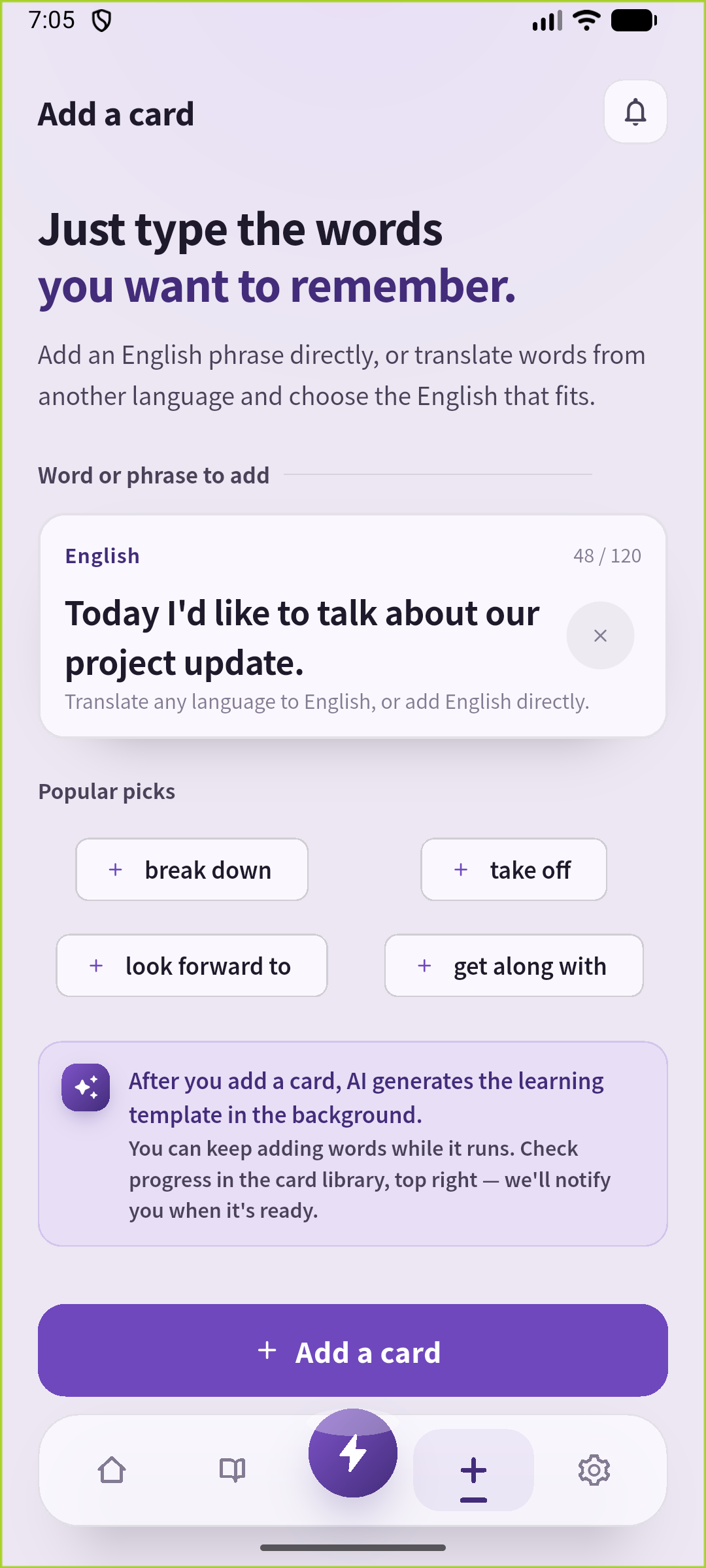
Listen, pause and say the line from the situation
These three recordings use SpeakGain’s AI voice, Deep-voiced Viking. They are practice audio, not recordings of a real meeting. Imagine opening the report, changing topic or asking someone to repeat. Try the sentence without looking, then play the audio to check it. You do not need to copy the voice’s pitch or speed.
Today I'd like to talk about our project update.
State that you will give a project update.
Let's move on to the next steps.
Move to the next actions.
Thank you for the question. Could you repeat that?
Acknowledge the question. Ask politely for repetition.
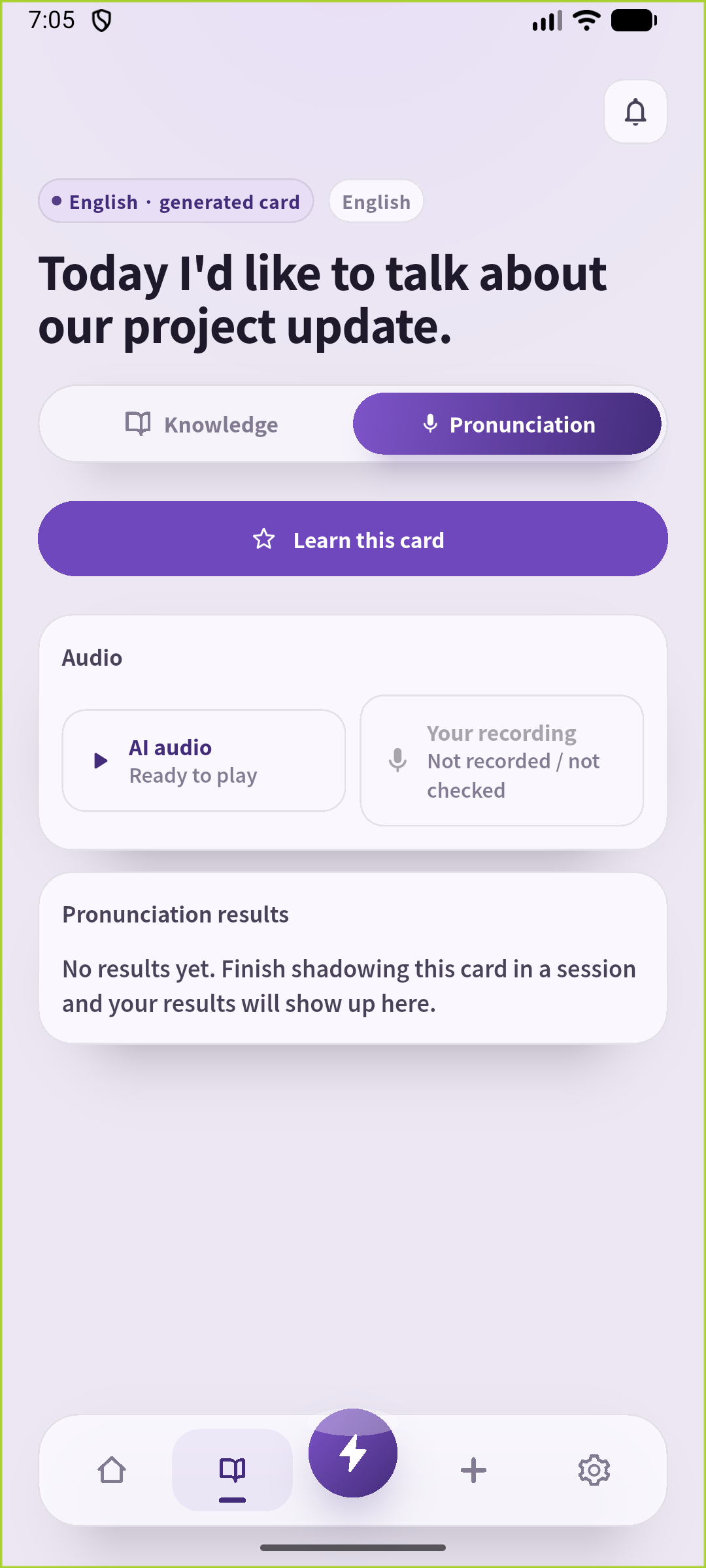
After listening, look away and say the line. For the transition, change to the next slide; after asking for repetition, pause as though waiting for the reply. Finally, hide the English text and give the whole five-minute update from slide messages. If you get stuck, use the current message to rephrase briefly rather than restarting everything.
Saving and playing a card does not establish that you can deliver the full report. Check accuracy, timing and answers separately. This is our practice suggestion; SpeakGain is not being presented as an automatic meeting partner or an evaluator of the whole talk. See what SpeakGain does and the English study guide.
For short arguments followed by questions, our Eiken Grade 1 guide shows how to build reasons and examples without notes.
Frequently asked questions
Opening, memorization, closing and asking for repetition
What should I say first?
Greet the audience, give your role if needed, and say Today I’d like to talk about… Online, first check Can everyone see my screen?
Must I memorize the whole script?
No. Prepare one message per slide and fixed opening, transition, closing and Q&A lines. Then time a full run from brief notes. Keep exact figures in your notes.
Is just saying thank you enough?
It can be a short thank-you, but an internal update also needs a conclusion and next action. Add an invitation to questions when appropriate and follow the conference chair’s rules.
What if I cannot understand a question?
Ask Could you repeat the question, please? If the meaning remains unclear, confirm the specific point. If you do not know the data, arrange a follow-up you can actually deliver.
For your next report, start with the three opening lines and one message per slide. Add transitions, a conclusion and a repeat request. Prepare to guide listeners through the content, not merely to reproduce a script.