
English meetings: four moments to speak up and prepare beforehand
Published
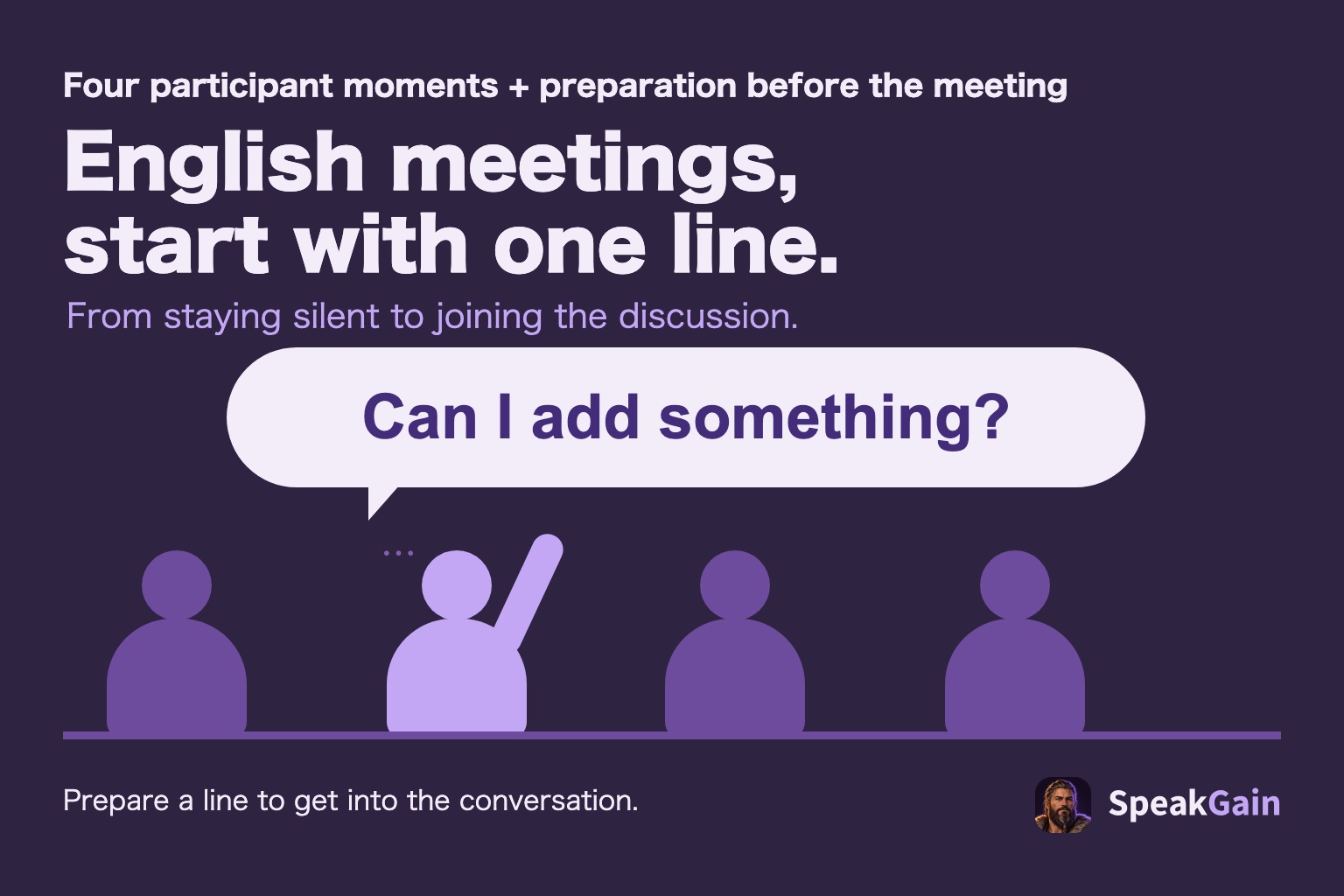
For an ordinary work discussion, meeting is the usual word. As a participant, prepare four moments: joining the discussion, giving an opinion with a reason, asking again and confirming the next action.
For an assigned-side, judged exchange, see how to debate in English for role-based rebuttals and practice.
If you need to discuss prices, delivery or terms, use English negotiation practice to adapt one sentence per stage to your company and rehearse a reply to push-back before the meeting.
| Moment | First line | Meaning |
|---|---|---|
| Join in | Can I add something? | Ask permission to add a point. |
| Opinion + reason | I think we need more time because testing isn't finished. | Ask for more time and explain why. |
| Ask again | Sorry, could you say that again? | Politely ask for repetition. |
| Confirm action | So the next step is to finish testing, right? | Check that finishing testing is the next action. |
Our editorial recommendation: speak once during the first agenda item that concerns you. If a small target helps, aim to speak within the first ten minutes. This is a preparation goal, not a research finding or a rule for every meeting. A clarification or factual addition counts as participation. Prefer one reason to waiting for a perfect long sentence.
To move from brief meeting contributions to explaining work experience, use English interview preparation to practise STAR and follow-up answers aloud.
For classes, training and group tasks, joining English discussions covers opinion exchanges beyond the workplace meeting setting.
1. Meeting, conference and call: keep the distinction simple
Dictionary meanings and the invitation
A weekly team update can be a weekly meeting or a team meeting. Cambridge Dictionary describes a meeting as a planned occasion for people to come together, in person or online, to discuss something. A conference can mean an event with talks on a subject or a formal discussion; it is not always a multi-day event with a fixed minimum number of people. A call refers to using the telephone; a conference call involves several people on a phone call. Follow the wording and connection instructions in your invitation rather than inventing strict company-wide definitions.
2. Join in: ask, wait for a reply, then add your point
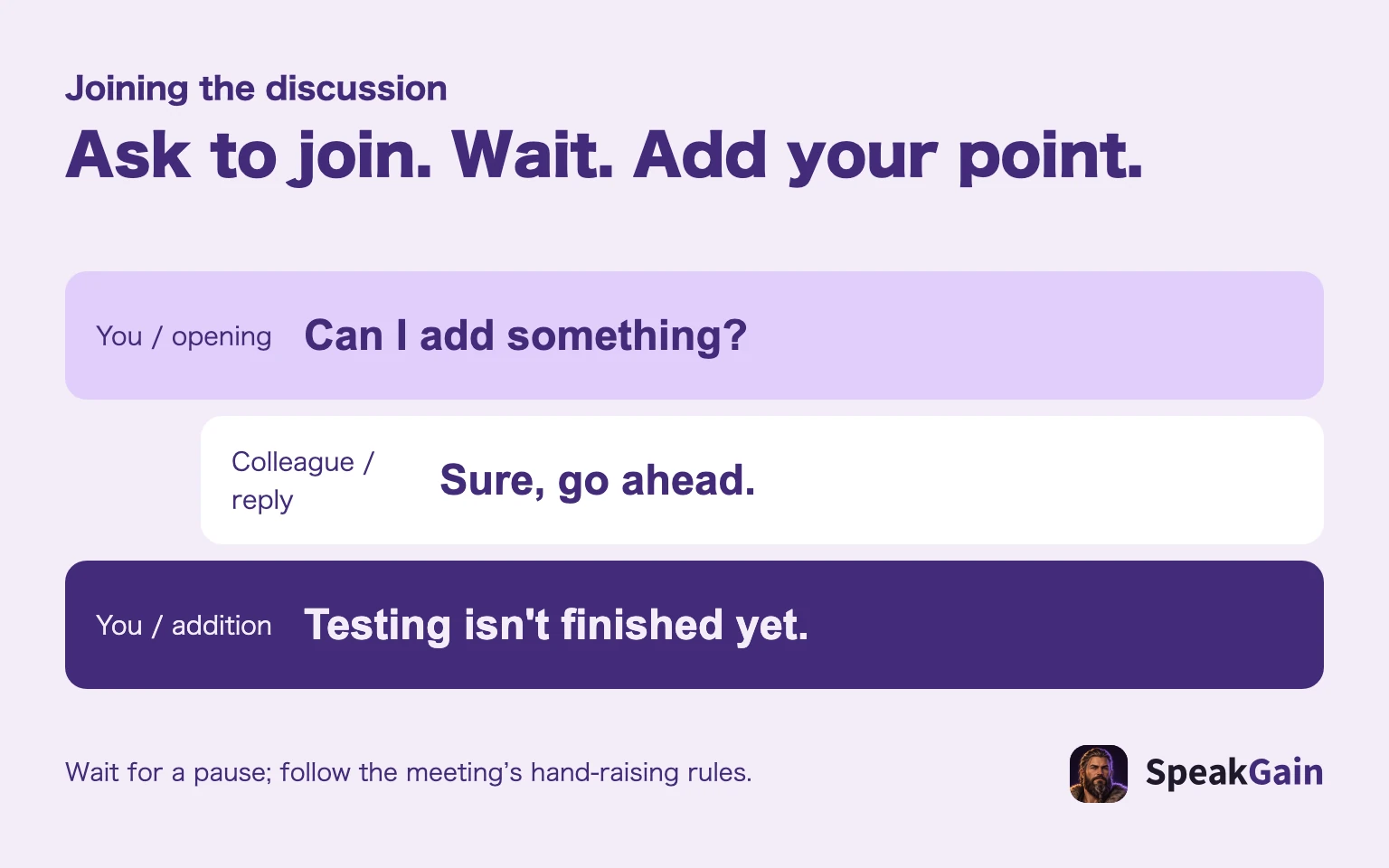
Can I add something? is a standard way to ask to add a point. Could I add something? is a more tentative request; Sorry to jump in. briefly acknowledges interrupting. Cambridge’s jump in entry includes interrupting someone who is speaking. These are options, not permission to repeatedly cut people off. Wait for a pause or use the meeting’s raise-hand convention. After the opening line, pause for Sure, go ahead., then add Testing isn’t finished yet.
Match the opening to your purpose
I have a question. is appropriate when you have a question. There is no basis here for saying that native speakers never use it or that it is inherently rude. If you actually have an opinion or addition, choose an opening that names that purpose. For a question, ask the missing point: What is the deadline? This is our editorial advice about clarity, not a grammar prohibition.
3. Give an opinion and one reason
I think we need more time because testing isn’t finished.
Ask for more time and explain why.
Use I think … because …. to give one judgment and one reason.
More examples and politeness
I think Friday would be better because the team needs more time. offers an alternative. To acknowledge a view before disagreeing, try I see your point, but I think we need to finish testing first. British Council’s agreeing and disagreeing lesson provides expressions for responding to another person’s view; the project examples here are ours. Politeness also depends on listening, tone and leaving time for a reply. Add a verified detail such as We have two tests left. Do not turn an uncertain estimate into a fact by adding I think. Say I need to check that. and agree on when you will respond.
4. Ask again or check what you understood
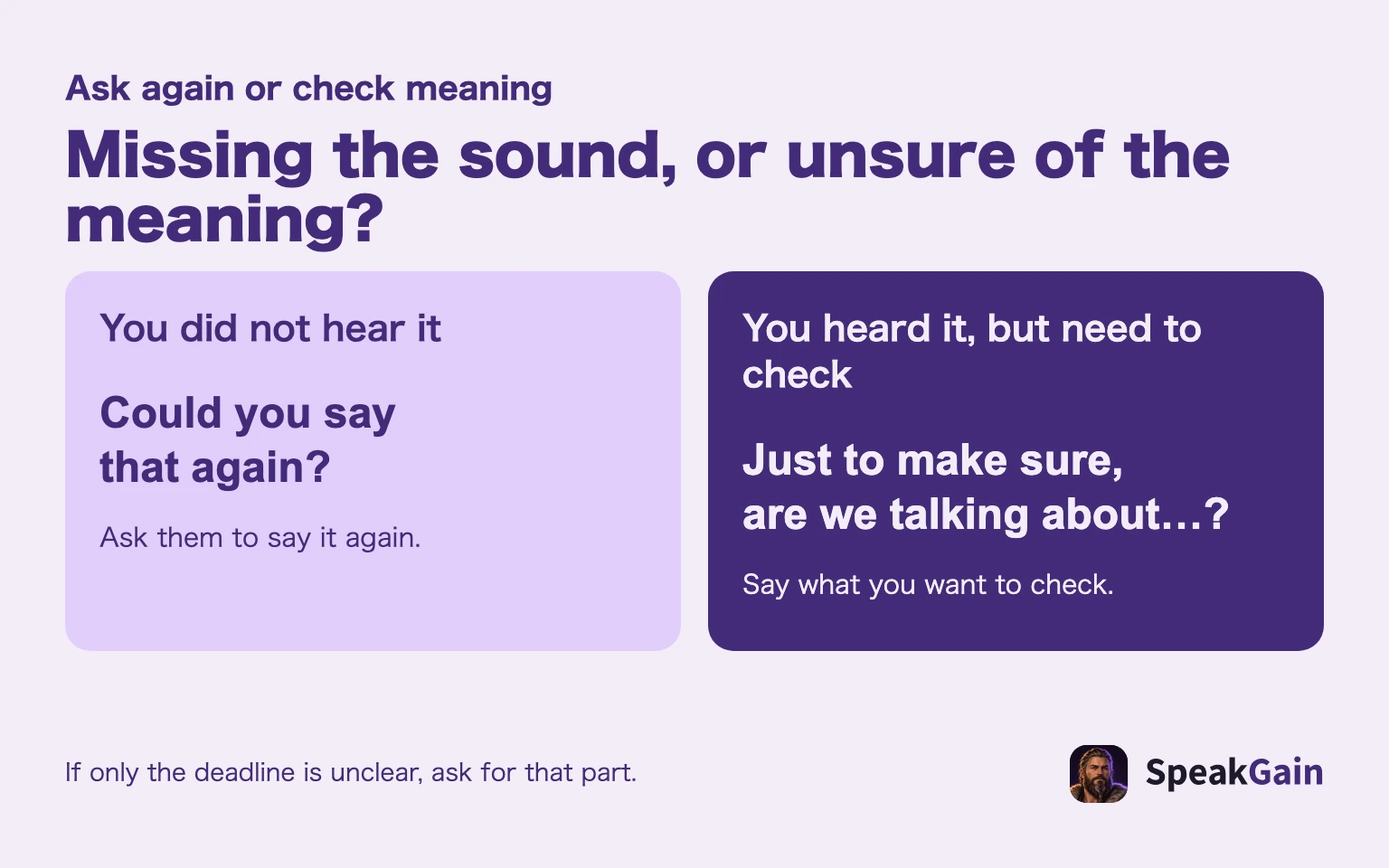
If you missed the sound, use Sorry, could you say that again? If you heard the words but need to check their meaning, use Just to make sure, are we talking about the testing deadline? The first is a polite repetition request; the second names your understanding. If only one part is missing, ask Could you repeat the deadline, please? If Friday is clear but the week is not, ask Do you mean this Friday or next Friday? British Council’s checking understanding lesson distinguishes requests for reformulation and checks with Do you mean. Could can make a request more tentative, but tone and time to answer still matter. Do not guess a date when you heard nothing, and do not stop at Just to make sure without saying what needs checking.
5. Confirm the action, owner and deadline
So the next step is to finish testing, right?
Check that finishing testing is the next action.
Leave room for the answer to be no: right? checks your understanding rather than pressing for agreement. Is that correct? is another option. If an action is agreed, check who will do it and by when: So I’ll send the test results by Friday, right? If the owner is undecided, ask Who will send the results? British Council’s managing meetings guidance recommends clarification and recording actions and responsibility. Do not silently promote a proposal into a decision. If you also chair, two extra lines may be enough to start: Let’s start with the first item on the agenda. and Let’s move on to the next item.
6. Prepare one line per agenda item and rehearse five lines
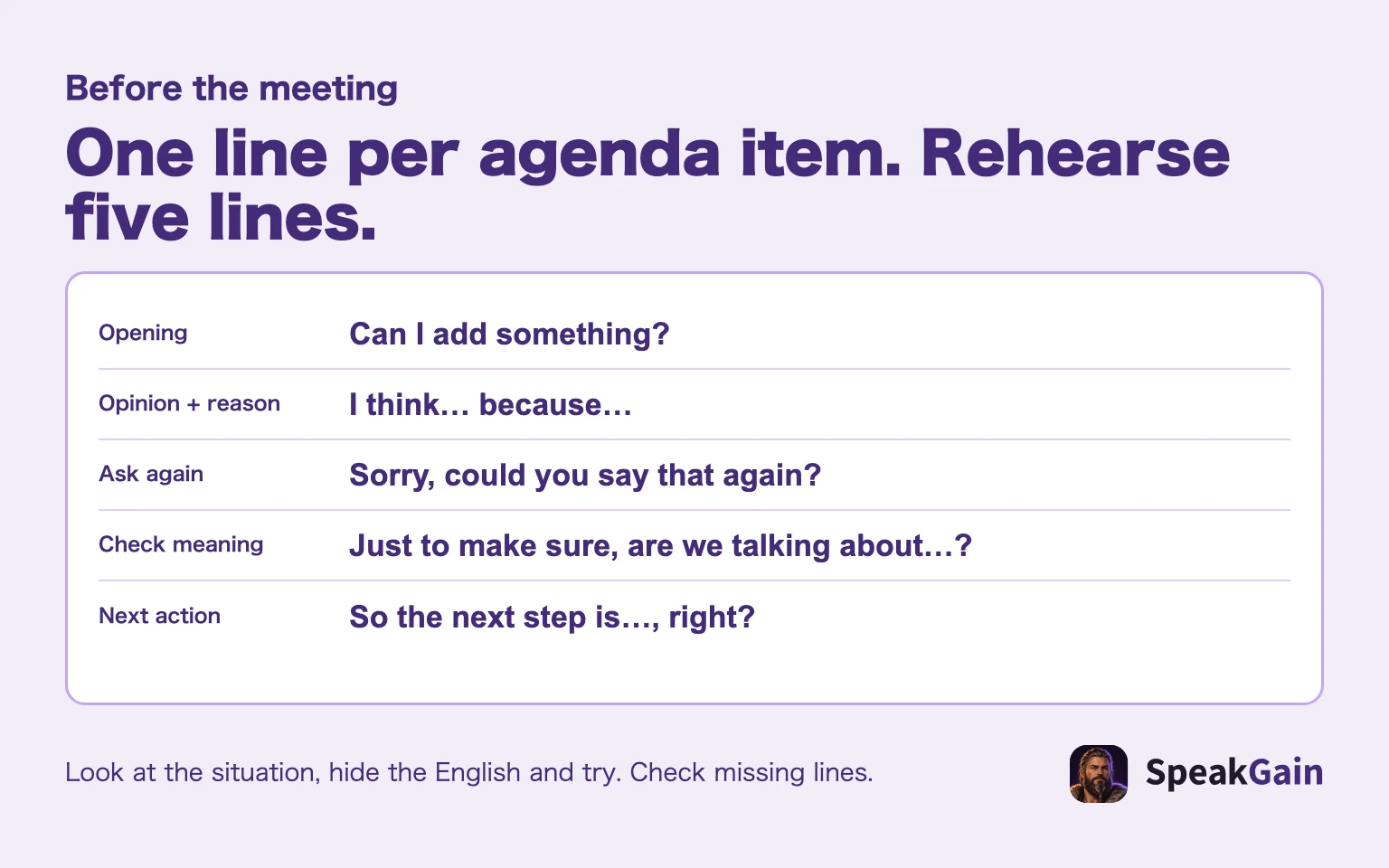
For each item on the agenda, write one thing you need to communicate. In a weekly update, that might be We’ve finished the main features., We still have two tests left., and the opinion about needing more time. Check the current task list, dates and owners before the meeting. Notes are useful for names and numbers; a fluent line with last week’s information is still wrong.
Five lines and how to rehearse
-
Can I add something? — Ask permission to add a point.
-
I think we need more time because testing isn’t finished. — Ask for more time and explain why.
-
Sorry, could you say that again? — Politely ask for repetition.
-
Just to make sure, are we talking about the testing deadline? — Check whether the discussion concerns the testing deadline.
-
So the next step is to finish testing, right? — Check that finishing testing is the next action.
First say the five lines while looking. Then hide the English and use a situation cue such as “add a point” or “ask for repetition.” Check a line you could not retrieve, try it again, and finally substitute the real project details. Rehearse the pause after asking to join and after a confirmation question too. Five is our manageable starting target, not a scientifically optimal number.
What the research shows and does not show
Roediger and Karpicke’s 2006 study compared rereading prose with recalling it in writing among university students. Rereading was better at the five-minute test, while prior retrieval produced better retention at tests two days and one week later. It did not test English meeting participation, five spoken lines, pronunciation or SpeakGain. We use it as a limited reference for trying to recall and then checking; it does not prove that reading aloud guarantees you will speak up.
7. Add two lines for online meetings
You’re on mute. tells someone their microphone is muted; I think you’re on mute. is an option when the cause is uncertain. If the connection is poor, say I can’t hear you clearly. I’ll put it in the chat. lets people know you will share a date, name or link in writing. Microsoft’s meeting chat guidance explains sharing messages and links; these English lines are our examples for the operation. Sending a message does not establish that everyone read it. Confirm important dates aloud and follow the meeting’s settings.
8. Kenta’s weekly progress meeting: listen, then say it
Kenta is a fictional participant in a weekly update with colleagues in another office. The main features are complete and two tests remain. A colleague proposes releasing this week; Kenta thinks testing needs more time. This example is a practice situation, not a real user testimonial.
A worked conversation: what is decided, and what is not?
Colleague: Can we release it this week?
Kenta: Can I add something?
Chair: Sure.
Kenta: I think we need more time because testing isn’t finished. We still have two tests left.
Chair: Let’s finish testing before we set the release date.
Kenta: Sorry, could you say that again?
Chair: Finish the tests first. Then we’ll decide when to release it.
Kenta: So the next step is to finish testing, right?
Chair: Yes. Kenta, please send the test results by Friday. I’ll put the date in the chat.
Kenta: Just to make sure, are we talking about this Friday?
Chair: Yes, this Friday.
The result deadline is Friday; the release date is still undecided. Kenta should not report that the release is on Friday. If the opinion is too long, split it into We need more time. Testing isn’t finished. Keep the reason even when shortening the wording.
Save the next line you want to use
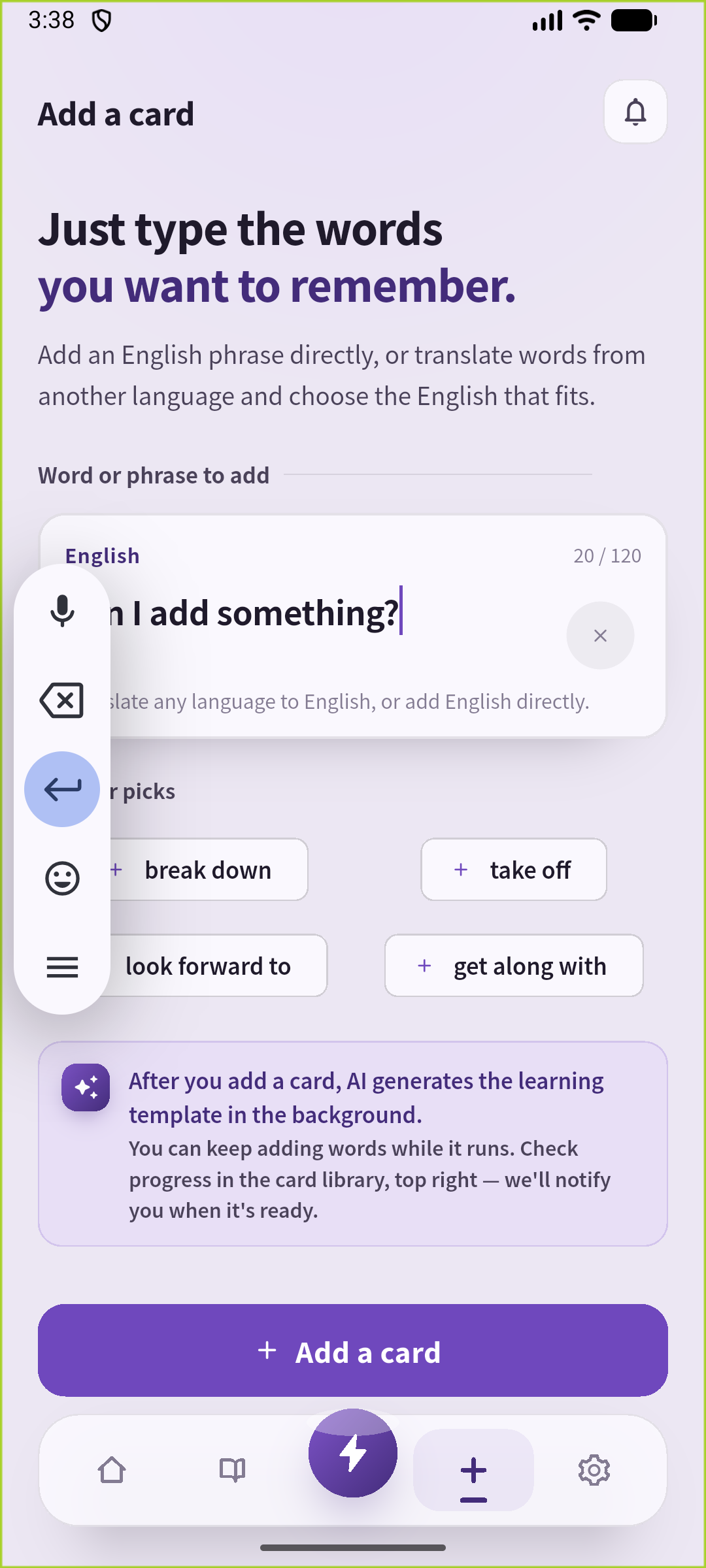
For this scene, save the three shared English lines: the opening, repetition request and next-action check. Enter each sentence in SpeakGain’s Add screen and use the normal create button. Keep the project-specific opinion in your agenda notes rather than putting the whole meeting into one card.
Listen, stop and say the line from the situation
These three practice clips were generated with SpeakGain’s Deep-voiced Viking AI voice; they are not meeting recordings. Listen once to check the words, stop playback, imagine the situation and say the line yourself. The screenshots use the English interface; they show entering a sentence and its pronunciation/audio screen, not a locale-specific explanation.
Can I add something?
Ask permission to add a point.
Sorry, could you say that again?
Politely ask for repetition.
So the next step is to finish testing, right?
Check that finishing testing is the next action.
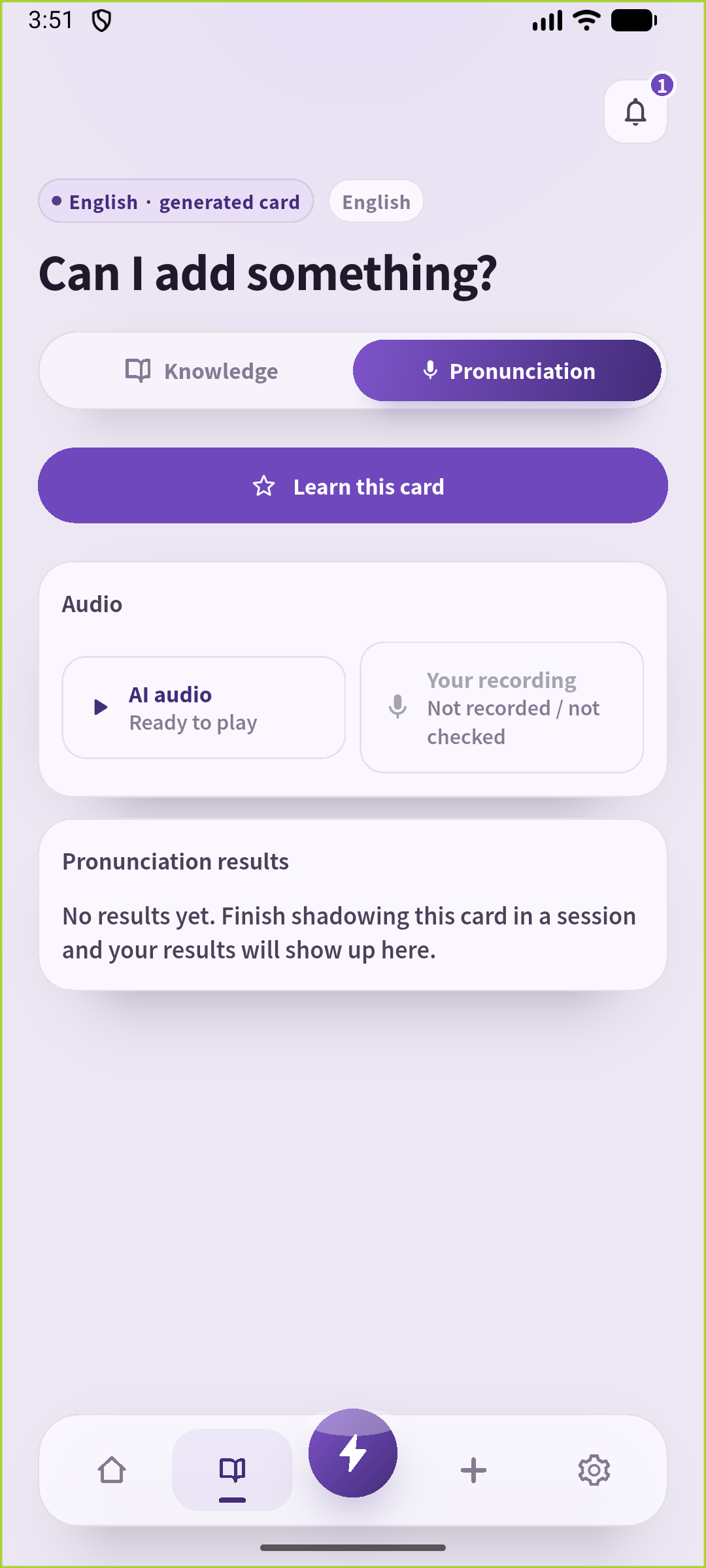
Matching the Viking’s deep voice is not the goal. Check whether your own question is clear and whether you wait for an answer. After the opening, add Testing isn’t finished yet. Replace the next action with your actual task. Next, ask a partner to change Friday to Monday, or hide Kenta’s lines and practise from the dialogue. Record what you will do and by when. Saving cards and playing audio are preparation tools; they do not guarantee comprehension of the whole meeting or the right timing.
For a scheduled report, see English presentation openings; for names and dates on calls, English phone calls. A short response does not always mean agreement: see English backchannel responses. For longer-term listening practice, use improving English listening; to plan daily practice, use how to study English.
Common questions
Word choice, first line, clarification and preparation
Should I say meeting or conference?
For a normal team discussion, meeting is usually sufficient. Check the invitation for the event’s name and format.
What should I say first?
Can I add something? is a useful opening for a contribution. Wait for a reply and have your next sentence ready.
Should I avoid interrupting even if I did not understand?
Ask at an appropriate pause, using a specific repetition or clarification request. Nodding does not resolve missing information.
How many phrases should I memorize?
Start with five for this agenda as an editorial target. There is no claim that five is an optimal number or that memorization alone guarantees participation.
Prepare one addition for the next meeting
Read the agenda, write one relevant line, and rehearse the opening, one reason and a check of the next action. You can use notes. Begin with the point your colleagues need, then listen to their answer.
When confirming instructions or accepting a task in a meeting, try a short acknowledgment followed by your next action.
If a Japanese employer asks you to take PROGOS, our PROGOS preparation guide explains the official format and CEFR result labels, then shows solo practice for workplace answers.
If you are preparing for an overseas assignment, use our work-and-life speaking plan to choose first-week sentences and practice for accompanying family members by the time you have left.