
Got it, Will do or Noted? Choose an English reply by role and politeness
Published
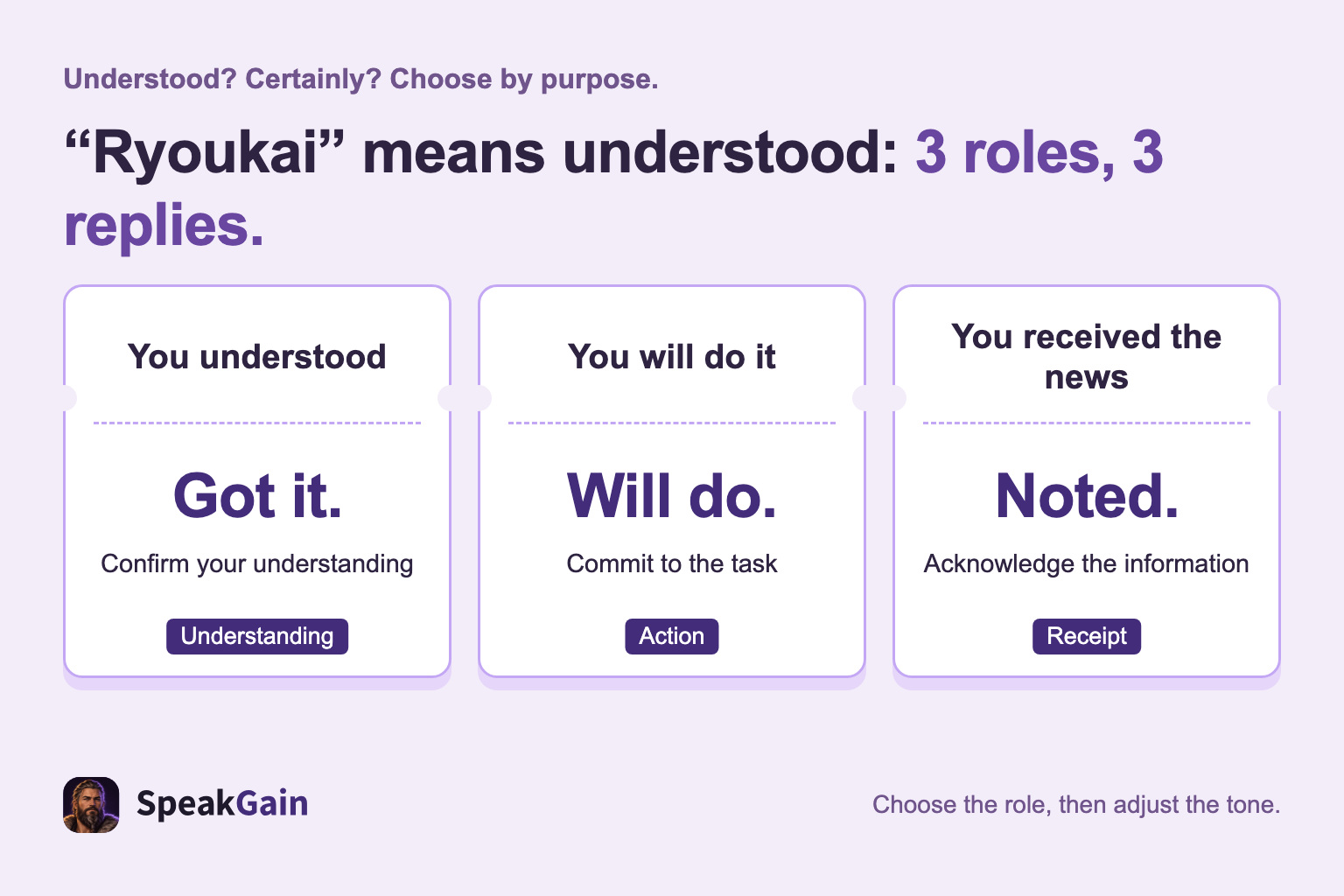
Use Got it. to confirm that you understood, Will do. to accept a task, and Thanks for letting me know. to acknowledge news. For a polite client reply, start with Certainly. and say what you will do next. Choosing the purpose of your reply is more useful than looking for one universally polite replacement for “understood.”
| Your purpose | First choice | Useful next sentence |
|---|---|---|
| Confirm understanding | Got it. | We’re using the latest figures. |
| Accept responsibility | Will do. | I’ll send it by five. |
| Acknowledge information | Thanks for letting me know. | I’ll update my calendar. |
Our editorial recommendation: learn Got it. and Will do. for ordinary work chat, and Certainly. plus a concrete action for clients. Japanese ryoukai roughly means “understood” or “acknowledged,” but it can serve all three roles. Japanese wakarimashita, shōchi shimashita and kashikomarimashita also depend on context. English does not offer a matching ladder of honorific replies: the words, relationship and promised action all matter.
1. Decide whether you understood, accepted or received something
A colleague explains which numbers to use. Your boss asks you to send a report. Someone tells you a meeting has moved. All three could prompt a short acknowledgment, but only the second necessarily calls for a commitment to do something.
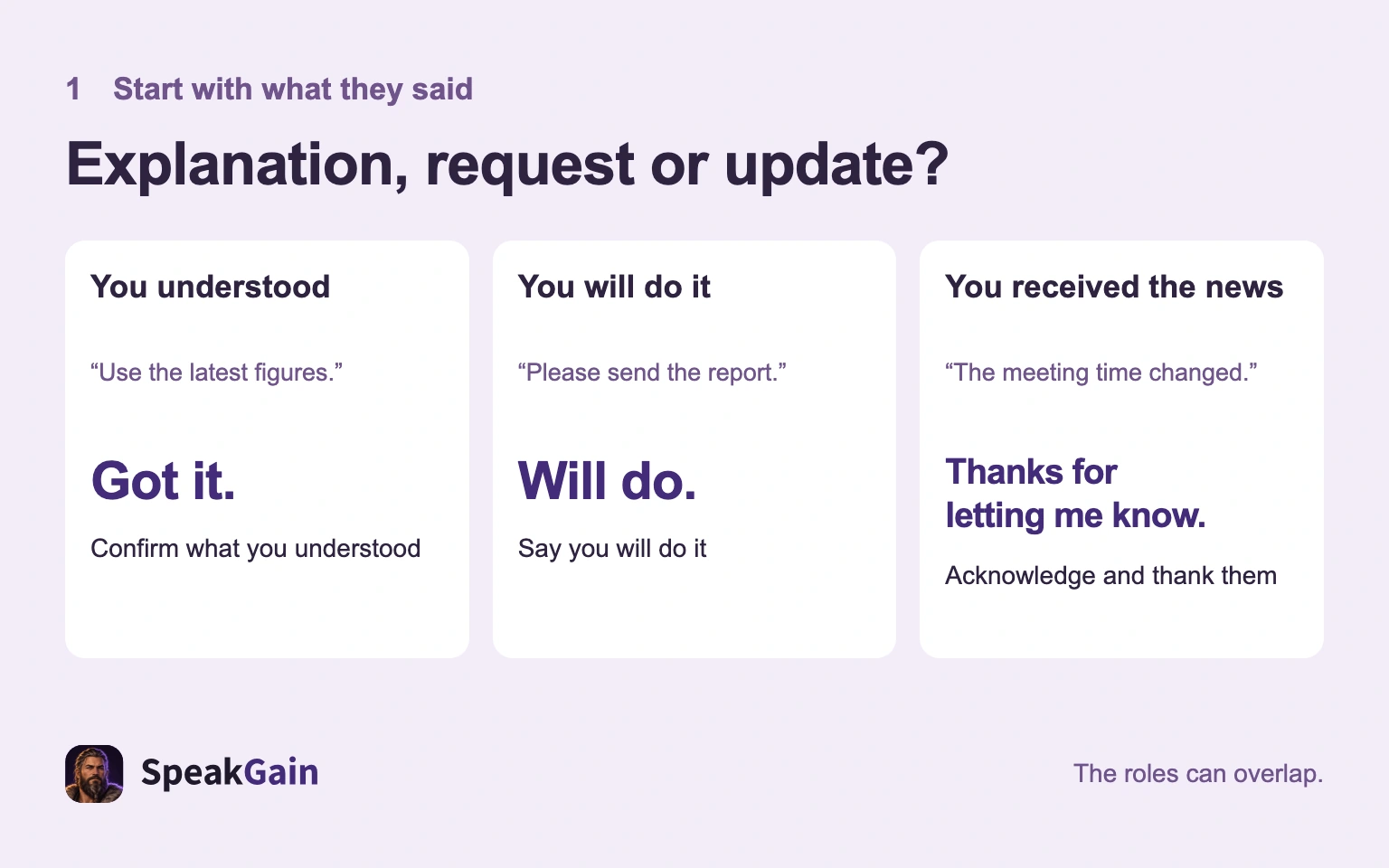
These roles can overlap. Got it. I’ll send it by five. both confirms understanding and promises action. Treat the categories as a check on the meaning of your reply, rather than a rule that confines each expression to one box.
Read the message before choosing your wording. “Use confirmed sales only” explains a condition. “Please send the spreadsheet today” requests action. “The recipient has changed” supplies an update. I see. can show that you understand a request without clearly saying that you will carry it out.
Then consider the relationship and channel. A quick chat with your usual manager and a first email to a client can need different wording. Our advice is to add the one detail that matters: the file, the deadline or who will handle it. There is no need to repeat an entire message just to sound polite.
2. Understanding: Got it, I see, Understood and That makes sense
Got it. is a short acknowledgment of understanding. Cambridge’s entry for get includes this understanding sense. If a colleague explains that a column excludes tax, Got it. can acknowledge the explanation; a short restatement can check the important detail.
Alex: Use the latest figures for this report.
Misaki: Got it. We’re using the latest figures.
I see. focuses on understanding an explanation. Cambridge’s learner entry for see includes the sense of understanding, with an example of understanding what someone means. If you also intend to take action, continue with something like I’ll check it.
Understood. explicitly confirms a condition or instruction. We suggest it when a concise, businesslike confirmation fits, while avoiding the claim that it is an English honorific equivalent. Understood. I’ll use the updated file. is easier to act on than a bare acknowledgment.
That makes sense. says an explanation is clear or reasonable. Cambridge defines make sense in terms of being clear and easy to understand. It fits an explanation of why a team uses one file to avoid duplicates. Receiving an update does not always require you to say that you agree with its reasoning.
| Tone or situation | Reply | Main meaning |
|---|---|---|
| Casual, brief confirmation | Got it. | I have understood. |
| Conversational response to an explanation | I see. | I now understand the point. |
| An explanation is reasonable | That makes sense. | The reasoning is clear. |
| Explicit work confirmation | Understood. I’ll use the updated file. | I understood the instruction and will act on it. |
These are different meanings, not four rungs that increase politeness without changing the message. Moving from I see. to That makes sense. adds an assessment of the explanation.
3. Accepting a task: add the next action to Will do
Will do. means you agree to do what was requested. Cambridge marks it informal. Its central purpose is a commitment, rather than simply understanding what you heard.
Boss: Could you send me the report by five?
Misaki: Will do. I’ll send it by five.
Will do. alone can be enough in a short chat where the task and deadline are already clear. Add an action when several tasks are being discussed or when the deadline needs an explicit record. By five means no later than five; at five promises a particular sending time instead.
Sure, I’ll … . lets you accept and state the action together: Sure, I’ll check the numbers. Replace the action with something you actually handle—send, check, update or bring.
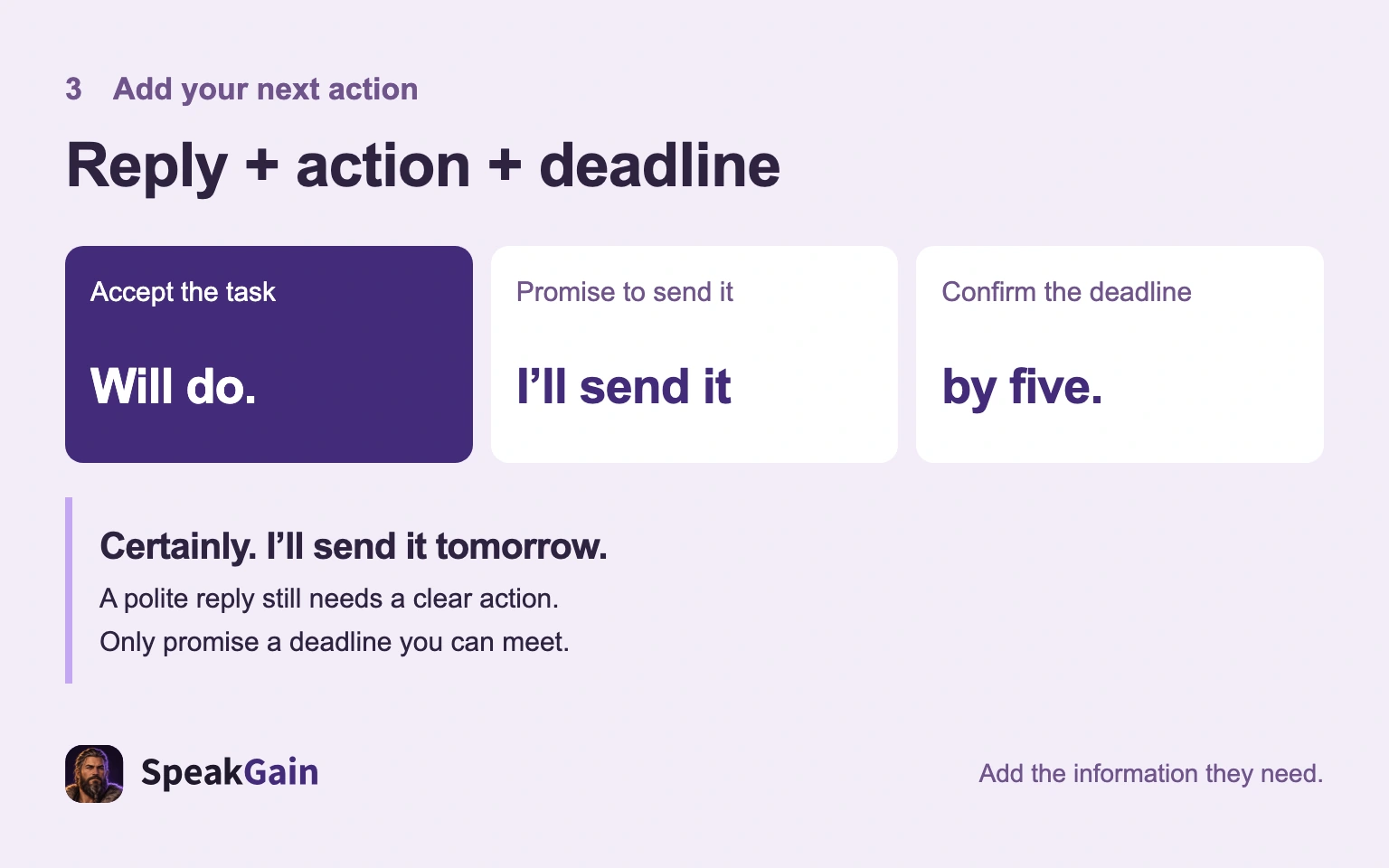
No problem. is also a response to a request in Cambridge’s grammar guide. No problem. I’ll update it. makes the commitment clearer. Certainly. is a useful choice for a polite acceptance: VOA describes it as more formal than Of course. Our recommendation for a client is Certainly. I’ll send the revised quote tomorrow.
| Suggested setting | Reply |
|---|---|
| Brief, informal chat | Will do. |
| Ordinary conversation or chat | Sure, I’ll check it. |
| A straightforward favor | No problem. I’ll update it. |
| A polite email or customer request | Certainly. I’ll send it tomorrow. |
Only promise what you can do. If you need to check feasibility, I’ll check and get back to you. states your actual next step. A more formal opening cannot make an impossible deadline realistic. For the person making the request, see how to make requests in English.
4. Receiving news: what Noted means and how it can sound
Noted. acknowledges information or a point to bear in mind. The verb note can mean noticing, recognizing or recording something; see Cambridge’s entry. A reply of Noted. does not necessarily report that you wrote a physical note. The adjective noted meaning “well known” is a different use.
Alex: The meeting now starts at ten thirty.
Misaki: Thanks for letting me know. I’ll update my calendar.
Noted. alone supplies no thanks, feeling or next action. For a helpful update, our first choice is Thanks for letting me know. You can also add warmth briefly with Noted, thanks.
We do not treat Noted. as universally rude or angry. Its effect depends on the relationship, surrounding message and delivery. Our editorial judgment is to add thanks or an action when a client is new to you or someone has taken trouble to notify you. That gives them more than a receipt acknowledgment.
Thanks for the update. fits a progress report or a change in an ongoing matter. Thank you for the update. is an option for a more formal email.
| Reply | Possible follow-up |
|---|---|
| Noted. | I’ll keep that in mind. |
| Noted, thanks. | I’ll update the file. |
| Thanks for letting me know. | I’ll update my calendar. |
| Thank you for the update. | I’ll review the details. |
Receiving information is also different from agreeing to it. Thanks for letting me know. I have another meeting at ten thirty. acknowledges a changed meeting time without pretending you can attend.
5. Clients and customers: Certainly, Of course and I’ll take care of it
For the polite acceptance expressed by Japanese shōchi shimashita or kashikomarimashita, choose the role first. If a client asks for a revised quote tomorrow and you can provide it, write:
Dear Ms. Lee,
Certainly. I’ll send the revised quote tomorrow.
Best regards,
Misaki
This is a short reply within an existing exchange. It does not replace greetings or answers to other questions when those are needed.
Of course. also accepts a request. Cambridge’s guide to short responses includes both Certainly and Of course for requests and services. Of course. I’ll bring some water. can respond to a customer asking for water.
I’ll take care of it. says that you will handle the matter. Cambridge’s take care of entry includes dealing with something and taking responsibility. When “it” is unclear, a specific promise such as I’ll update your reservation. is more useful.
| What the customer needs | Opening | What to add |
|---|---|---|
| Polite acceptance | Certainly. | The item and delivery date |
| A service provided now | Of course. | What you will bring or provide |
| Someone to handle the matter | I’ll take care of it. | The specific action, if needed |
We favor replies that let the other person know what to expect. That is an editorial recommendation, rather than a rule that every customer needs the same length of message.
6. Short chat and email replies: OK, Roger that and K
Got it, thanks! can acknowledge an explanation or useful information in chat. Will do. accepts a task. Keep that difference even when both replies are very short.
OK. can express understanding, acceptance or agreement. Cambridge describes these uses as informal. We therefore avoid a blanket rule that OK is forbidden with a boss. If the commitment is unclear, add it: OK. I’ll send the file.
Roger that. draws on radio communication, where roger confirms receipt and understanding; Cambridge records that background. We do not recommend it as your default professional reply. It can fit when that style is intended or shared by the speakers, but the evidence does not establish it as a universal fashionable acknowledgment.
You may see K, a one-letter shortening of OK. The OK source inspected here does not define K as carrying a fixed emotion. We cannot conclude that it always means anger or disrespect. Our practical advice is to start with Got it, thanks. or a clear action when you do not know how a coworker will interpret an extremely short reply.
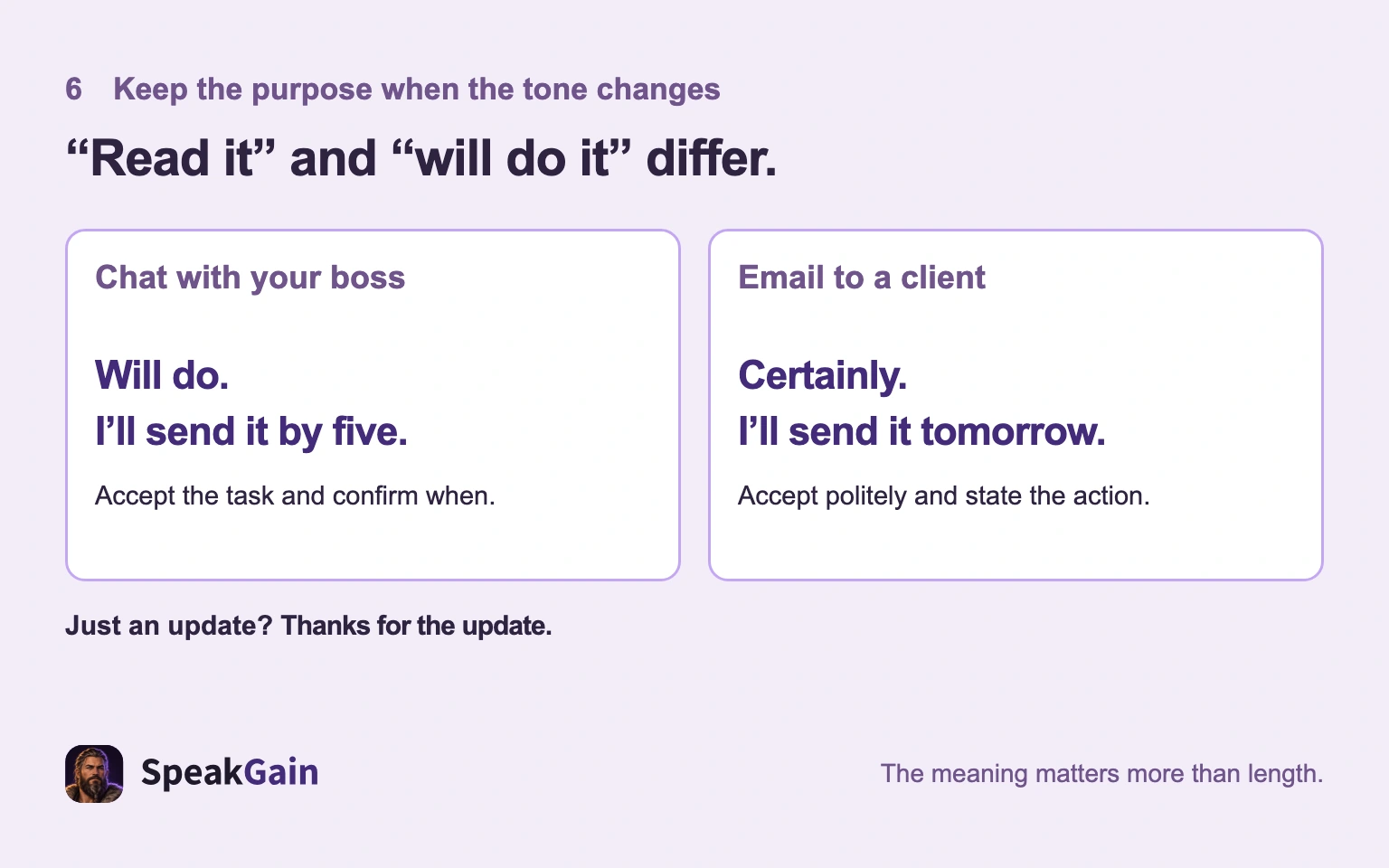
An exclamation mark does not automatically add politeness. A cheerful Got it, thanks! in familiar chat and Thank you for the update. in a formal email have different styles. Let the relationship guide the punctuation, while keeping the needed information.
7. Does I understand imply “but…”?
I understand. can simply state understanding. Cambridge’s understand entry also includes understanding another person’s feelings or reasons for acting. The sentence does not always imply objection or annoyance.
I understand how you feel, but … . is possible, and the dictionary includes that pattern. The contrast comes from but and what follows. If you accept a request, make that clear: I understand. I’ll revise the report. If you are acknowledging someone’s circumstances, identify them: I understand why you need more time.
Do not say you understand when you are unsure. Do you mean the latest version? can check which file to use. See speaking up in English meetings for clarification, and English backchannel responses for showing that you are listening as someone continues speaking.
8. Hear and say three replies during Misaki’s working day
Misaki has started using English at work. Instead of memorizing a table in order, she chooses a reply from the situation.
Morning: a chat from her boss
Her boss asks, Could you send me the report by five? She can meet the deadline, so she replies Will do. I’ll send it by five. Saying only I see. would leave her commitment unstated.
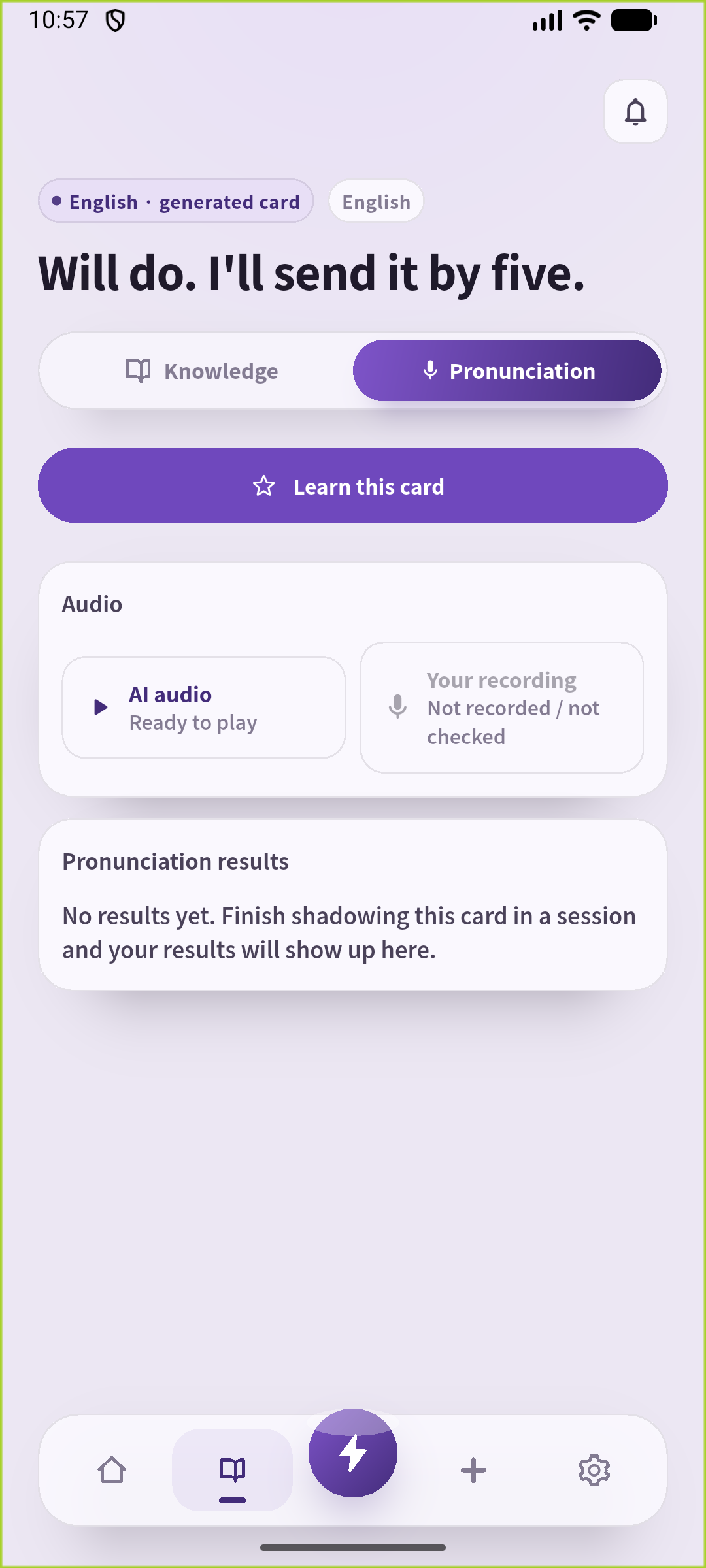
In SpeakGain, she adds the reply and action as one practice card. The real screenshots below use English so the same practice sentence can be used throughout this article’s locales. For an introduction, see what SpeakGain is.
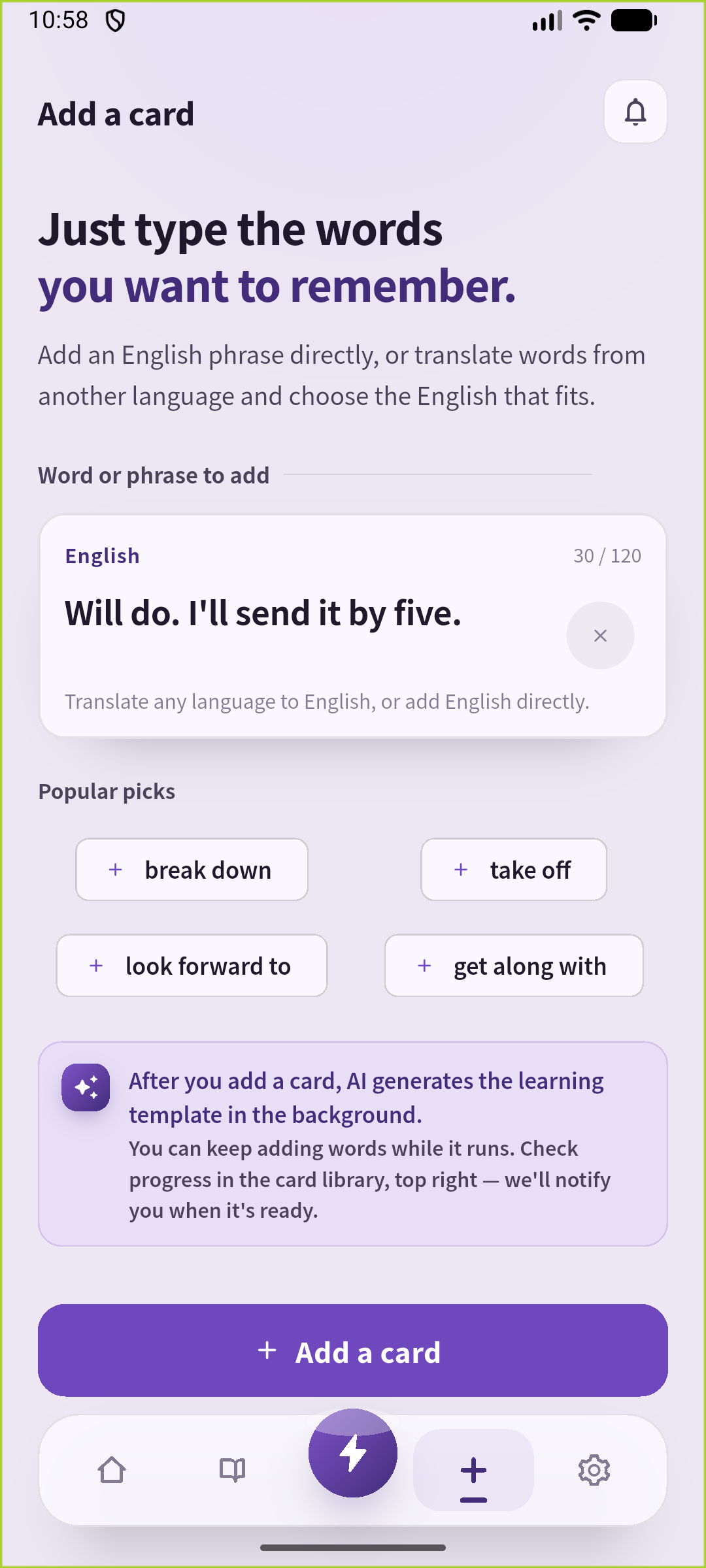
Will do. I'll send it by five.
Accept the task and confirm the five o'clock deadline.
Listen to SpeakGain’s Deep-voiced Viking audio, pause briefly after Will do., and say the complete promise. The aim is to answer the request, rather than imitate the voice’s pitch perfectly. Try once while reading, then once looking away.
Midday: an email to her client
The client wants a revised quote the next day. Misaki can send it, so she gives a polite acceptance and a delivery promise:
Certainly. I'll send the revised quote tomorrow.
Accept politely and promise the revised quote tomorrow.
Say the email aloud once to check that you did not stop at Certainly. Replace the item or date only with a promise you can keep. A memorized sentence does not set your real deadline.
Afternoon: a condition in a meeting
Alex says the report should use the latest figures. Misaki states what she understood:
Got it. We're using the latest figures.
Confirm that the latest figures are the ones to use.
Now hide the English sentences and mix the prompts: report by five, revised quote tomorrow, latest figures in the meeting. Recall a reply from each situation, then return to the text or audio if necessary. Add a notification-only situation with Thanks for letting me know.
Karpicke and Roediger’s 2008 study found that continued retrieval after a correct response helped university students recall Swahili–English word pairs a week later. It did not test workplace replies or SpeakGain. We use it as a reason to suggest recalling a sentence from a situation, rather than ending practice after listening.
Frequently asked questions
Is Got it polite enough?
It can work as a short understanding acknowledgment. For a task, use Will do. or add your action. For a client, our starting recommendation is Certainly. plus a clear promise.
Is Understood the same as Certainly?
Understood confirms understanding; Certainly accepts a request politely in the situations here. Neither maps perfectly to a Japanese honorific rank.
Does Noted mean I wrote it down?
In a reply it acknowledges or takes account of the information. It need not report writing on paper. Add thanks if that is part of what you want to express.
How can I say “understood, thank you” briefly?
Try Got it, thanks! in chat. For a task, Will do, thanks. can work. For new information, Thanks for the update. names what you are thanking them for.
Can these replace yoroshiku onegaishimasu?
Accepting someone else’s request differs from asking for help, introducing yourself or starting a collaboration. See how to say yoroshiku onegaishimasu in English for those roles.
Choose one role and one next action
Use Got it. for understanding, Will do. for doing, and Thanks for letting me know. for receiving news with thanks. For a polite acceptance, combine Certainly. with what you will do. Our advice is to practice one reply you actually need today: listen, say it, then recall it later from the situation.