
64 English backchannel responses: what to say, how to sound, when to respond
Published
English backchannel responses are short reactions that show you are listening: “I see.” for understanding, “Really?” for surprise, “That sounds difficult.” for empathy, “Tell me more.” to invite details, and “I agree.” when you actually agree. Listen to the message first, give a brief response, and add a question only when you want an answer.
Our first three choices to learn are “I see.”, “That sounds difficult.” and “Tell me more.” They do three different jobs. Add “Really?” next, with a spoken model: it can express interest, surprise or annoyance, so memorising its spelling is not enough. This is an editorial starting point, not a ranking of the most frequent English words.
When you want to move from a listening response to your own opinion or clarification, try four moments for participating in English meetings.
To move from a listening response to your own idea, practise agreement with an addition or a question in joining English discussions.
To move from a short response into a fuller exchange, prepare an answer and follow-up with English conversation topics and solo practice.
To turn useful expressions into ten sentences from your own day, see everyday English conversation phrases and practice.
1. Choose a function before a phrase
The linguistic term backchannel often refers to small responses that leave the main speaker in control of the floor. This practical guide also includes questions and polite disagreement after a speaker finishes. A follow-up question takes a turn; a brief acknowledgment may simply invite the person to carry on.
| Function | Starting phrase | Check before choosing |
|---|---|---|
| Understanding | I see. | Understanding is different from endorsing |
| Surprise | Really? | Was it unexpected? Add your actual feeling |
| Empathy and good news | That sounds difficult. | Respond to their experience |
| Continue or clarify | Tell me more. | Ask one question and wait |
| Agreement | I agree. | Decide what you agree with |
| Gentle disagreement | I see what you mean, but … | Wait for a turn and add a reason |
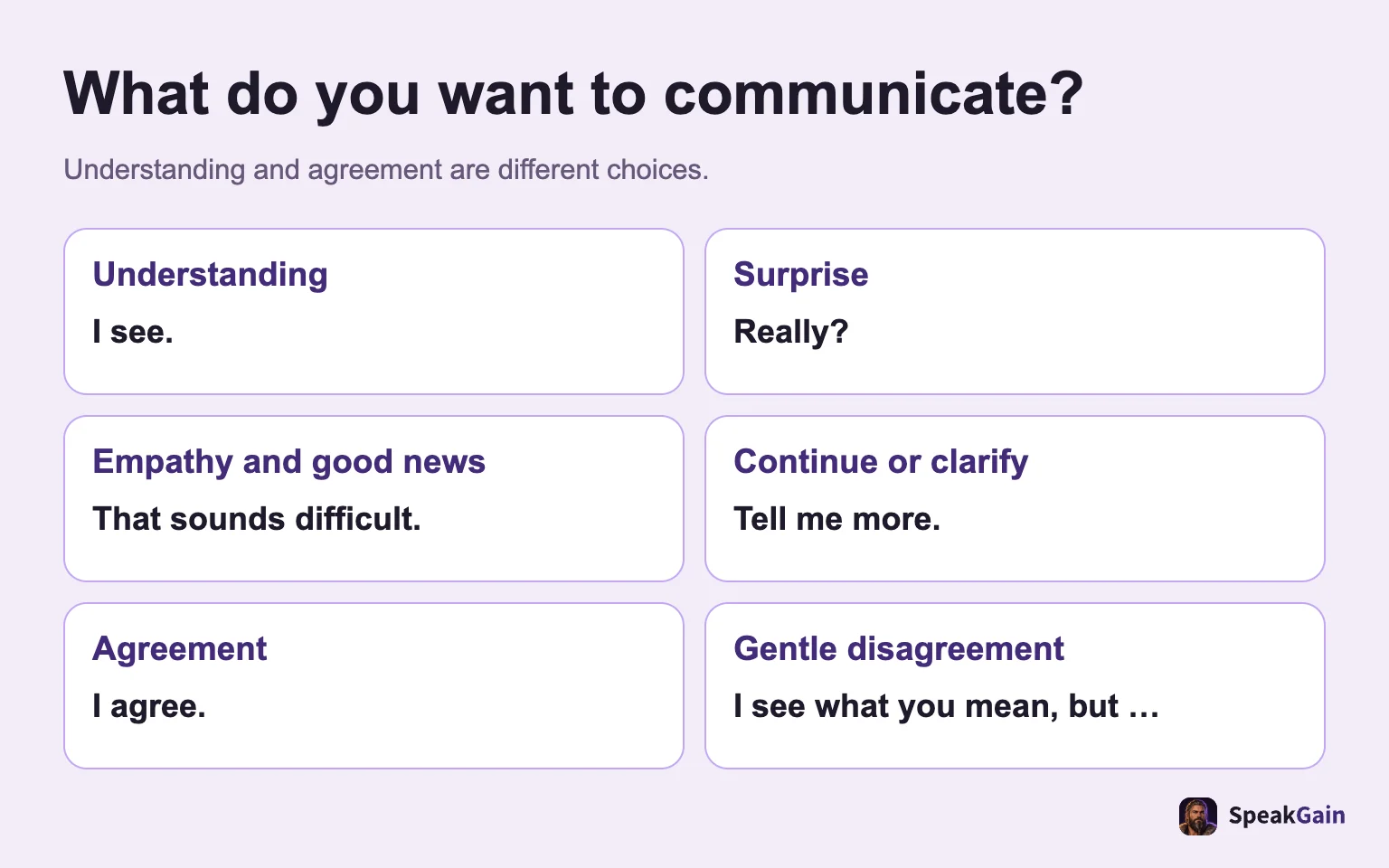
“I see.” says you understand; it does not automatically approve a proposal. If a colleague explains a delay, you might understand the reason but disagree with the new deadline. Try “I see what you mean, but we need a decision today.” The distinction matters more than collecting synonyms. Cambridge explains listener response tokens.
The 64 options below have plain-English meanings, situations and a register guide. “Neutral” means a useful starting choice in ordinary conversation, including many work conversations. “Casual” suggests trying it with people you know. “More polite” offers a longer request for someone you know less well. These are editorial recommendations for these situations, not permanent politeness scores.
Understanding: 10 choices
Keep acknowledgments short while someone is explaining. “That makes sense.” can respond to clarity or reasonable reasoning; it need not endorse every part of an idea. Cambridge make sense. The verb “get” can mean understand. Cambridge get.
Understanding: meanings, situations and register
| English | Meaning | Situation | Register guide |
|---|---|---|---|
| 1. I see. | I understand | Understanding an explanation | Neutral |
| 2. Oh, I see. | Now I understand | Understanding an explanation | Neutral |
| 3. Right. | Acknowledging or agreeing | Understanding an explanation | Neutral |
| 4. OK. | Acknowledging or accepting | Receiving an instruction | Neutral |
| 5. I understand. | The meaning is clear to me | Understanding an explanation | Neutral |
| 6. I get it. | I understand it | Understanding an explanation | Casual |
| 7. Got it. | I have understood the instruction | Receiving an instruction | Casual |
| 8. That makes sense. | The explanation is clear or reasonable | Understanding a reason | Neutral |
| 9. I see what you mean. | I understand your meaning | Responding to an opinion | Neutral |
| 10. Uh-huh. | Informal yes or acknowledgment | Understanding an explanation | Casual |
Original example: “Please send the report to Mina, not to me.” → “Got it.” For a consequential instruction, repeat the recipient or deadline too. Acknowledging it is not the same as checking you understood it correctly.
We would leave “Uh-huh.” until after the first three. It is a valid informal acknowledgment, not universally rude; Cambridge labels it informal. A clearly understood phrase is easier to practise deliberately than an unfamiliar sound repeated on autopilot.
Surprise: 10 choices
React to what is unexpected, then make your feeling clear. “Wow!” after a good achievement and a bright “Wow!” after painful news do different social work. Our recommendation for a serious disclosure is to move from surprise to sympathy, rather than performing excitement.
Surprise: meanings, situations and register
| English | Meaning | Situation | Register guide |
|---|---|---|---|
| 11. Really? | Expressing interest or surprise | Learning new information | Neutral |
| 12. Oh, really? | Reacting to new information | Learning new information | Neutral |
| 13. Wow! | A strong reaction | Unexpected news | Casual |
| 14. That’s amazing! | Expressing admiration | Good news | Neutral |
| 15. That’s incredible! | A very strong positive reaction | Unexpected news | Neutral |
| 16. That’s surprising. | Something was unexpected | Unexpected news | Neutral |
| 17. No way! | Strong informal disbelief or surprise | Unexpected news | Casual |
| 18. You’re joking! | Expressing surprised disbelief | Unexpected news | Casual |
| 19. Are you serious? | Checking whether it is true | Unexpected news | Casual |
| 20. I didn’t know that. | This information is new to me | Learning new information | Neutral |
“I used to live in Canada.” → “Oh, really? What was that like?” “I finished my first marathon.” → “Wow! That’s amazing!” These are original practice exchanges. British Council’s interest lesson provides spoken examples of surprise and sympathy.
Empathy and good news: 12 choices
You do not need to claim the same experience to respond warmly. Acknowledge difficulty or share someone’s pleasure. We recommend listening before offering advice: you have not yet established whether they want a solution.
Empathy: meanings, situations and register
| English | Meaning | Situation | Register guide |
|---|---|---|---|
| 21. I’m sorry to hear that. | Responding sympathetically to bad news | Bad news | Neutral |
| 22. That’s a shame. | Reacting to disappointment | Bad news | Neutral |
| 23. That’s too bad. | Something is unfortunate | Bad news | Neutral |
| 24. Oh no! | An unhappy surprise | Bad news | Neutral |
| 25. That sounds difficult. | Acknowledging difficulty | Difficult experience | Neutral |
| 26. That must be hard. | Inferring that it is hard | Difficult experience | Neutral |
| 27. That sounds frustrating. | Acknowledging frustration | Difficult experience | Neutral |
| 28. I can imagine. | Imagining the other person’s experience | Difficult experience | Neutral |
| 29. You must be tired. | Inferring tiredness | Tiring experience | Neutral |
| 30. That’s great! | Sharing good news | Good news | Neutral |
| 31. That’s wonderful! | Expressing pleasure | Good news | Neutral |
| 32. I’m happy for you. | Sharing the other person’s happiness | Good news | Neutral |
“I had to redo the whole presentation.” → “That sounds frustrating.” “I got the job.” → “I’m happy for you.” “I’m sorry to hear that.” responds to bad news; it need not mean you caused the problem. “You must be tired.” is an inference from the situation, not a command to feel tired. British Council, Berlitz examples.
Continue or clarify: 10 choices
Choose one detail from the speaker’s account, ask one question, then wait. Do not turn a short response into an interview. Asking about an experience and asking for repetition are different decisions.
Follow-up and clarification: meanings and situations
| English | Meaning | Situation | Register guide |
|---|---|---|---|
| 33. Tell me more. | Asking for more information | Asking for details | Casual |
| 34. Go on. | Encouraging continuation | Continuing a story | Casual |
| 35. What happened next? | Asking for the next event | Continuing a story | Neutral |
| 36. How was it? | Asking about the experience | Asking about an experience | Neutral |
| 37. What was that like? | Asking what the experience was like | Asking about an experience | Neutral |
| 38. How did you feel? | Asking about a feeling | Asking about feelings | Neutral |
| 39. Could you tell me more about that? | Requesting further details | Asking for details | More polite |
| 40. And then? | Asking for the next part | Continuing a story | Casual |
| 41. What do you mean, exactly? | Checking the intended meaning | Clarifying meaning | Neutral |
| 42. Could you say that again? | Requesting repetition | You did not hear | More polite |
“Something strange happened on the train.” → “What happened next?” If you did not hear, choose “Could you say that again?” If you heard the words but not the meaning, choose “What do you mean, exactly?” Cambridge go on, British Council clarification.
Agreement: 14 choices
Use agreement when you mean it. “Exactly.” and “Absolutely.” are clear affirmations, so do not use them merely to fill a silence while you are still deciding. At work, separate a listening response from an approval someone needs you to give.
Agreement: meanings, situations and register
| English | Meaning | Situation | Register guide |
|---|---|---|---|
| 43. Yes. | Affirming or agreeing | Responding to an opinion | Neutral |
| 44. Yeah. | Informal yes | Responding to an opinion | Casual |
| 45. Exactly. | Strong precise agreement | Responding to an opinion | Neutral |
| 46. Absolutely. | Strong agreement | Responding to an opinion | Neutral |
| 47. Definitely. | Firm agreement | Responding to an opinion | Neutral |
| 48. Certainly. | Confident affirmation | Responding to an opinion | Neutral |
| 49. That’s true. | Agreeing with a statement | Responding to an opinion | Neutral |
| 50. You’re right. | Agreeing with the person | Responding to an opinion | Neutral |
| 51. I agree. | Stating agreement | Responding to an opinion | Neutral |
| 52. I think so too. | Sharing the opinion | Responding to an opinion | Neutral |
| 53. Me too. | Sharing a positive experience | Same experience: positive | Casual |
| 54. Same here. | Sharing the same situation | Same experience: positive | Casual |
| 55. So do I. | Sharing a positive statement with do | Same experience: positive | Neutral |
| 56. Neither do I. | Sharing a negative statement with do | Same experience: negative | Neutral |
“I walk to work.” → “So do I.” “I don’t drive.” → “Neither do I.” Match the auxiliary: “I’m tired.” → “So am I.”; “I can’t swim.” → “Neither can I.” For an informal starting pair, try “Me too.” with a positive statement and “Me neither.” with a negative one. Cambridge so, neither.
Gentle disagreement: 8 choices
Wait for a turn, acknowledge the part you understand, then give a reason. A polite opening does not remove the need for a clear position. “I’m not convinced by that idea.” is a real objection even when delivered calmly.
Disagreement: meanings, situations and register
| English | Meaning | Situation | Register guide |
|---|---|---|---|
| 57. I take your point, but … | Acknowledging a point before a reservation | Responding to an opinion | Neutral |
| 58. I see what you mean, but … | Understanding before giving another view | Responding to an opinion | Neutral |
| 59. I’m not so sure. | Expressing doubt | Responding to an opinion | Neutral |
| 60. I’m not convinced by that idea. | Saying the idea has not persuaded you | Responding to an opinion | Neutral |
| 61. I think I disagree. | Stating a different view | Responding to an opinion | Neutral |
| 62. Not necessarily. | Challenging an absolute claim | Responding to an opinion | Neutral |
| 63. I agree up to a point. | Agreeing only partly | Responding to an opinion | Neutral |
| 64. I see where you’re coming from, but … | Understanding the reasoning before a reservation | Responding to an opinion | Neutral |
“Let’s finish everything today.” → “I take your point, but we need time to check the figures.” “The cheaper option is always worse.” → “Not necessarily.” Follow with a reason or counterexample. British Council B1, B2, Cambridge necessarily, up to a point.
2. Repair the voice and timing, not just the word
There is no response quota to meet. A brief acknowledgment can accompany a story; a long question needs room. In a video call, if you overlap, stop and listen for the other person’s continuation.
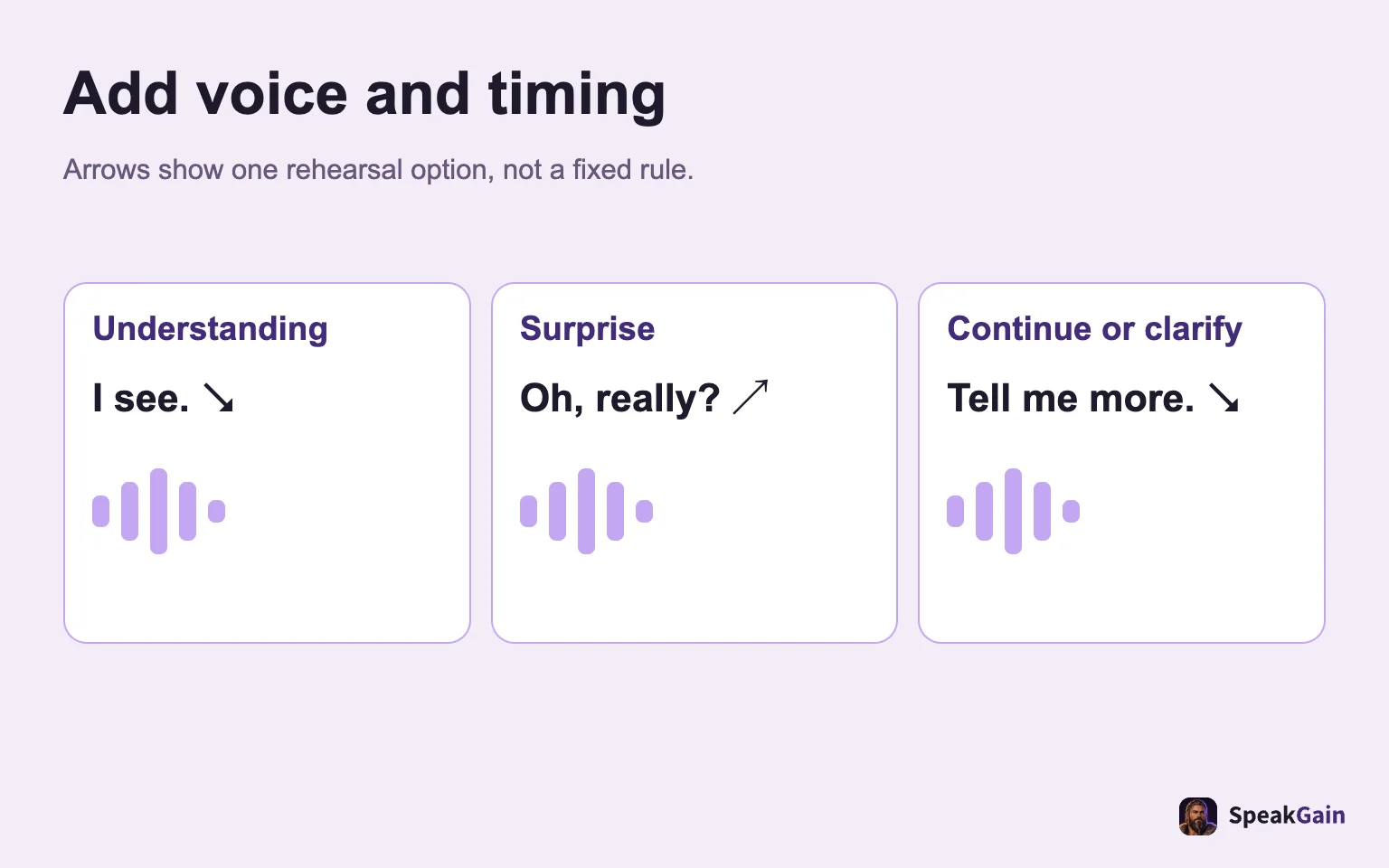
The arrows show one rehearsal option. A rising ending does not always mean friendly and a falling one does not always mean rude. Listen to the whole situation. Cambridge intonation, British Council on showing interest.
Five useful repairs for overuse or misinterpretation
- Repeating “I see.” after every sentence: acknowledge a fact, then respond to the feeling, then ask about one detail. “I see. That sounds difficult. How is it going now?” is a sequence to match to content, not a script to recite on every occasion.
- A sharp “Really?” after good news: try “Oh, really? That’s great!” so the pleasure is explicit. The word can express interest, surprise or anger; one contour alone cannot guarantee the intended effect. Cambridge really.
- “Yes.” while you are only listening: if the question was “Shall we send this version?”, it answers a request for approval. If undecided, say so and ask about the missing detail.
- Hearing “Tell me about it!” as a demand for details: it can mean that the speaker shares your frustrating experience. To request details clearly, choose “Tell me more about that.” Cambridge idiom.
- “Me too.” after “I don’t like crowded trains.”: for shared dislike, choose “Me neither.” or “Neither do I.” Do not guess if you missed the negative.
For a learner using this English-language guide, focus on intent rather than swapping every acknowledgment for a new synonym. Variety is useful only when it reflects something you heard. A bright reaction to sad news, or an extended personal story halfway through theirs, needs a change of response and turn timing.
3. Try the choices in one conversation
Maya and Alex are fictional adults meeting for the first time. Bold responses show what the listener does after the introduction. The pauses are rehearsal instructions for this scene, not universal waiting times.
| Speaker | English / meaning | Timing and delivery |
|---|---|---|
| Maya | Hi, I’m Maya. I work in customer support. A short introduction and job. |
Keep the introduction short |
| Alex | Nice to meet you. I’m Alex. I usually go hiking on weekends. A name and a weekend interest. |
Listen for a topic |
| Maya | Oh, really? Where do you go? A reaction, then a specific follow-up. |
Try a gentle rise; ask after the introduction |
| Alex | Usually near the lake. A usual location. |
Listen to the location |
| Maya | I see. A brief acknowledgment. |
Keep it brief; leave room |
| Alex | But last weekend I had to spend the whole time moving house. A change of plan and a difficult task. |
Listen for the difficulty |
| Maya | That sounds difficult. A response to the difficulty. |
Use a calm voice; do not stack questions |
| Alex | It was. But my new neighbours helped me. A helpful neighbour. |
Listen for the good news |
| Maya | That’s great! Tell me more. A positive reaction and an invitation to continue. |
Show pleasure; pause before the invitation |
| Alex | They were very welcoming. What do you do on weekends? An answer, then a question back. |
Receive the question |
| Maya | I usually cook. I enjoy trying new recipes. A personal answer to that question. |
Now take your own turn |
Notice the shift from understanding to difficulty, then to good news and a question back. You do not need to reply after every sentence. If you also enjoy hiking, “Me too.” is possible; if you do not, ask “What do you enjoy about it?” rather than inventing a shared interest. Prepare your opening with the introduction guide if needed.
4. Listen, rehearse, then use it with a person
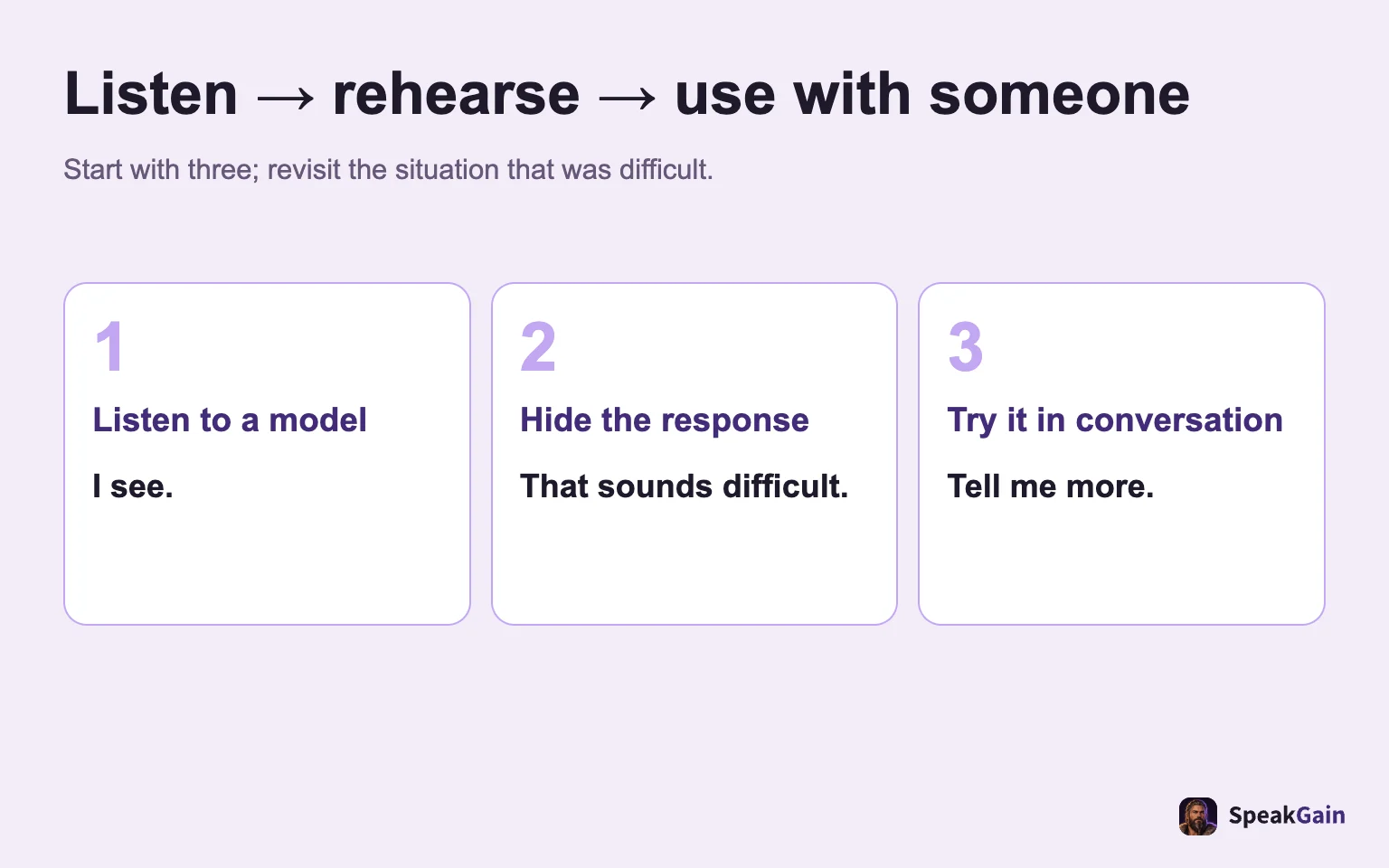
Step 1: Hear a model in context
Use the official British Council video. Choose one response, hear the preceding sentence, pause, then imitate the voice and gap. The original media remain on the official page.
These three practice clips were generated with SpeakGain’s Deep-voiced Viking voice. Listen and imitate one, then respond to the preceding line in section 3. Check conversational timing with the official lesson or a teacher too; the character’s pitch alone does not convey your feelings to another person.
I see.
That sounds difficult.
Tell me more.
Step 2: Hide the response and choose from the situation
Cover Maya’s lines in the dialogue. Read Alex’s sentence, choose the function, and answer aloud. Another suitable phrase is acceptable: this is not a test with only one correct response. Check separately whether you recalled a phrase and whether it matched the feeling.
If you use SpeakGain, save a short practice phrase and the material that reminds you of its situation. Use listening and speaking to rehearse it; the product guide explains the basic workflow. A character voice cannot by itself reproduce human conversational intent.
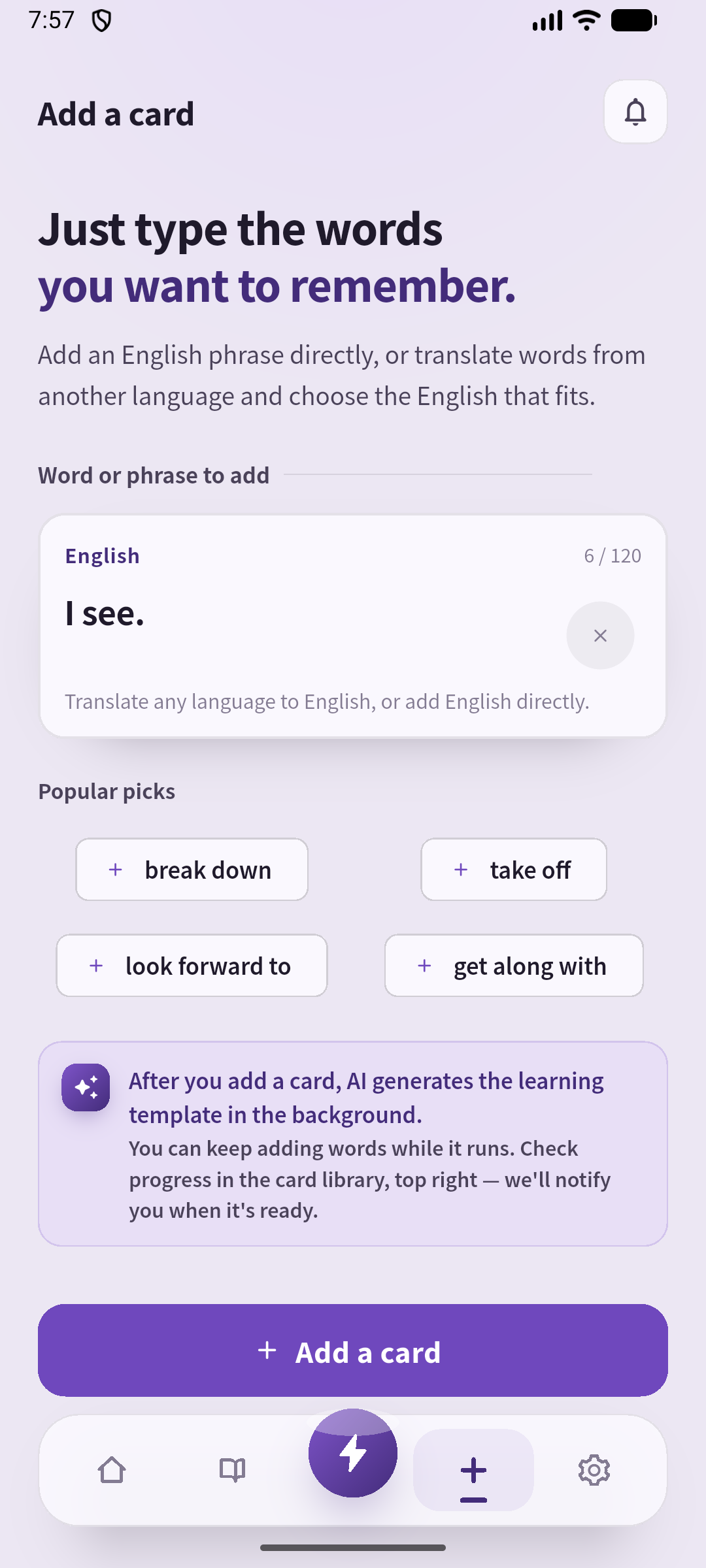
Try the situations in another order on another day. Keep the difficult situation for the next session instead of adding twenty more phrases at once.
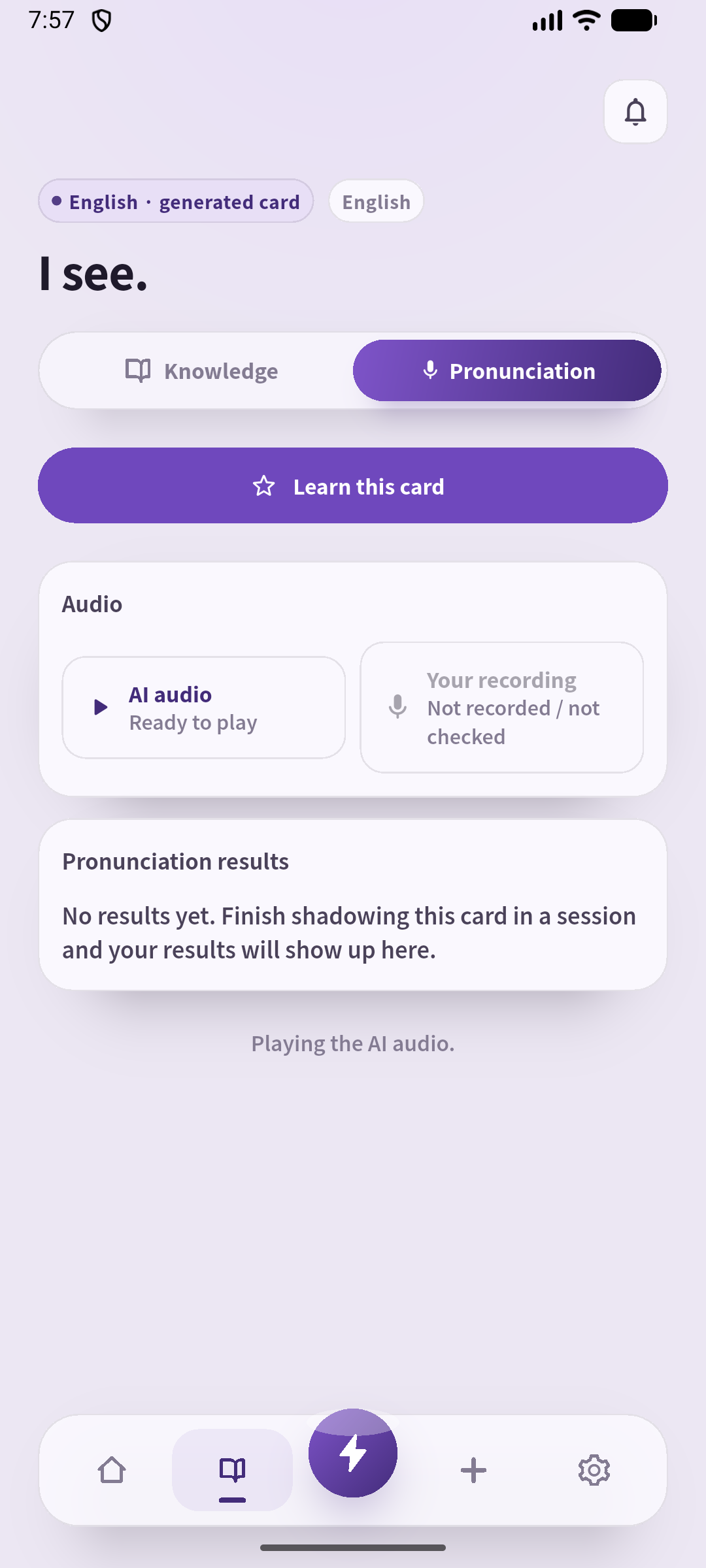
Step 3: Get a real response to your delivery
Ask a teacher: “I’d like to practise short responses. Could you tell me about your weekend?” Try an acknowledgment, a response to a feeling and a question when useful. That is a small exercise, not a prescribed number of responses in real conversation. Afterwards ask “Did that sound interested or doubtful?” and revisit the moment that was unclear. Use lesson review to keep that observation.
What the research does and does not show
Bavelas and colleagues (2000) reported two experiments with 63 unfamiliar pairs telling close-call stories. Distracting listeners reduced their responses, especially content-specific ones, and narration quality suffered. We inspected the abstract, not the full paper. It did not test this phrase list or an English-learning app.
Our practical interpretation is to practise responding to the actual story rather than producing a fixed number of acknowledgment sounds. The study does not establish that learning 64 phrases or using a Viking voice guarantees improved fluency. Keep the conversation step after solo rehearsal.
Questions learners ask
Is I see. enough?
It works for understanding. Add one response to a feeling and one way to invite more, so you can express more than acknowledgment. The first three are an editorial starting set, not the only acceptable responses.
Are Yeah. and Uh-huh. forbidden at work?
No universal ban follows from their informal label. Relationship and context matter. For a first conversation with someone you know less well, this guide recommends clearer choices such as “I see.” or “I understand.” Check important commitments explicitly.
For a broader plan, use how to study English. If the problem is finding your own words, use when words will not come out; for a speaking task beyond this exercise, use the speaking guide.
To practice the opening and ending of a conversation, use English greetings and replies to How are you? to choose a reply and one short update.
For choosing a thank you, adding a reason and receiving thanks, practise thanking in English by situation.
Usage, teaching and research sources
- Cambridge 1
- British Council A2 2
- British Council 3
- British Council B1 4
- British Council B2 5
- British Council B1 6
- Cambridge 7
- Cambridge 8
- Cambridge 9
- Cambridge 10
- Cambridge 11
- Cambridge 12
- Cambridge 13
- Cambridge 14
- Cambridge 15
- Berlitz 16
- Cambridge 17
- Cambridge 18
- Cambridge 19
- Cambridge 20
- Bavelas, Coates & Johnson (2000) 21
To turn your daily life into practice sentences, follow the three-sentence English diary: write, check, listen and say.
For a practical call, use English phone-call phrases and how to ask again to rehearse introductions, messages, spelling and number checks.
For apologies, attention requests and thanks, see how to apologize in English and choose a phrase for the situation.
For a visitor asking the way, use giving directions in English to practise one action, a landmark and a check.
When you want to do more than acknowledge a story, choose what to praise with the guide to compliments in English.
To move from listening to committing to a task, compare “Got it,” “Will do,” and replies to updates.
When you want to respond positively to a story or suggestion, positive reactions in English helps you choose the intensity and add one follow-up.