
English conversation topics: 10 ways to start, answer and practise alone
Published
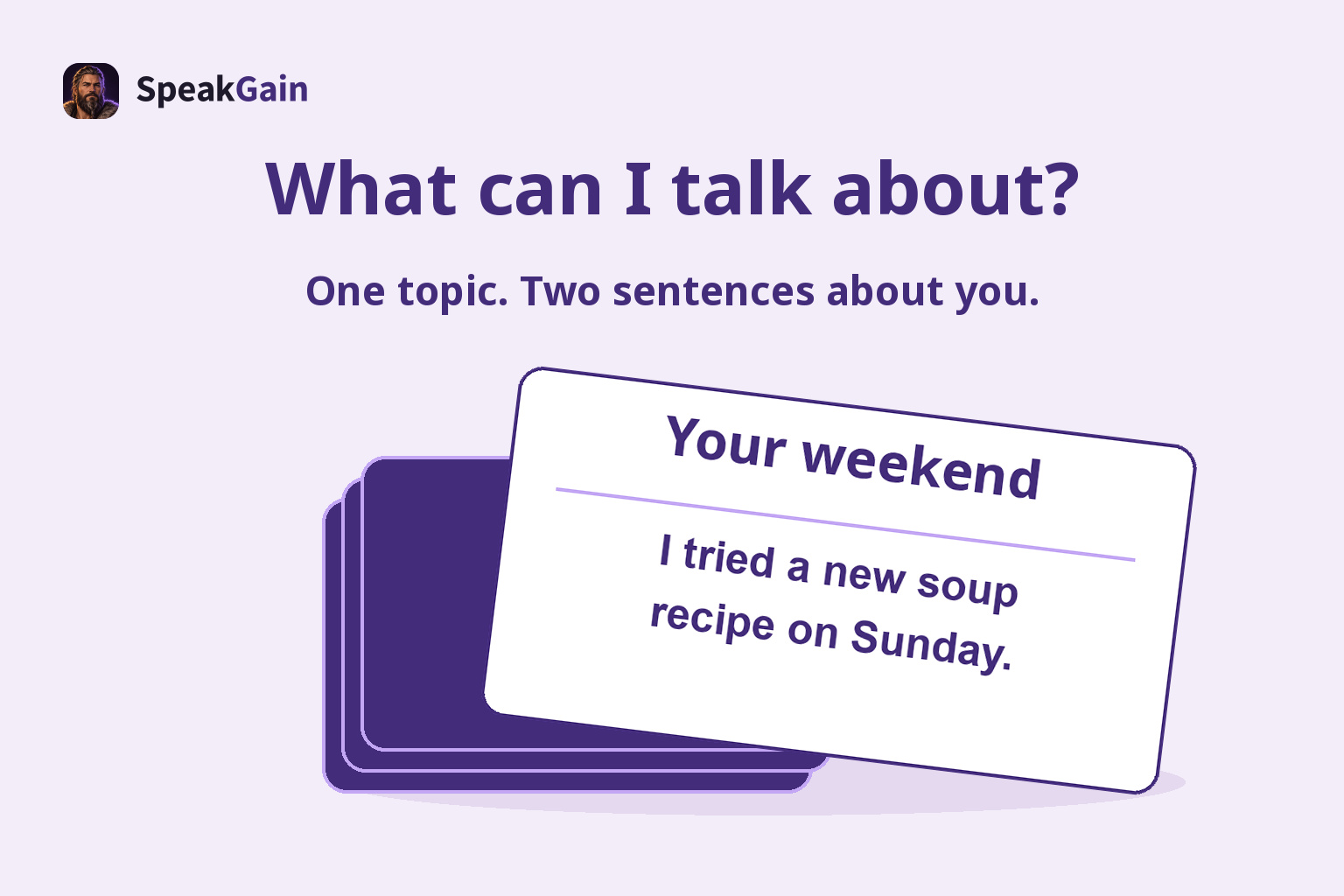
A conversation topic is something to talk about; topic and subject both refer to the matter being discussed.
For English small talk, choose one familiar topic—your weekend, food or recent activities—and prepare an opening question, your own two- or three-sentence answer and one question back. Our recommendation is to speak for about 30 seconds, record yourself, fix one thing and practise returning the conversation to the other person.
This guide is for English learners in speaking lessons, at work, while studying abroad and on trips. Casual conversation means responding to another person without reading a fixed script. You can tell a teacher, I’d like to practise casual conversation. We focus on preparing what to say, without comparing schools or apps.
1. What can you talk about? Ten useful starting topics
Start with something you did recently, something you enjoy or a small plan. You do not need an unusual trip or impressive news. Yesterday’s dinner, a walk or something you learnt this week can be enough. We selected ten topics because they allow small everyday answers, work with short English, let the other person choose what to share and can be reused in different situations. They are not guaranteed to suit everyone.
Cambridge defines topic as the subject being discussed. Cambridge: topic Here we move from the dictionary meaning to preparing an actual exchange. All examples are authored by our editorial team. Replace their facts with your own. The question is an opener for another person; the sample answer shows what you might say if asked the same question; the follow-up explores related information. Reading all three aloud does not simulate a real partner’s reply.
| Topic | Best situation | Opening question | Your answer: two sentences | Follow-up question |
|---|---|---|---|---|
| Weekend | Monday at work; lesson | How was your weekend? | I tried a new soup recipe on Sunday. It was easy, so I’ll make it again. | What do you like to do on a quiet weekend? |
| Food | Lunch break; travel | What do you like to cook? | I often make vegetable pasta. It’s quick, and I can use whatever I have. | Is there a dish you’d like to learn to make? |
| Free time | First meeting; study abroad | What do you do to relax? | I take short walks after dinner. They help me switch off. | Do you prefer being indoors or outdoors? |
| Something you watched | Lesson; friends | Have you watched anything interesting lately? | I watched a short film about a mountain village. I liked the quiet scenes. | What kind of stories do you enjoy? |
| Music | Friends; conversation group | What do you usually listen to? | I listen to instrumental music when I cook. I like songs with a steady rhythm. | When do you usually listen to music? |
| Nearby places | Study abroad; travel | Is there a place nearby you like? | There’s a small park near my home. I go there when I need a break. | What do you like about that place? |
| Trips and day trips | Lesson; travel | Where would you like to go for a day trip? | I’d like to visit a town by the sea. I want to walk around and try the local food. | Would you rather plan ahead or decide on the day? |
| Work or study updates | Colleagues; classmates | What have you been working on lately? | I’ve been making a short guide for my team. I’m trying to keep the instructions simple. | What’s been interesting about it? |
| Weather and activities | First meeting; short wait | What do you like to do on a rainy day? | I usually stay home and read. Rainy afternoons are a good time for a slow break. | Does the weather change your plans much? |
| Small plans or challenges | Lesson; acquaintances | Is there something you’d like to try soon? | I’d like to grow herbs on my balcony. I’ll start with one small pot. | What would be your first step? |
We would begin with weekend, food and free time rather than prepare all ten. These cover a recent event, a habit and a preference. It is easier to start with things you can truthfully describe than to invent a travel story.
2. Choose for the situation and open the conversation
Start from something shared in the situation and go deeper if the other person offers more. A work break invites weekend talk; travel invites nearby places; studying abroad offers classes and meals; a lesson can focus on an everyday event you want to practise describing.
At lunch, you might say I made pasta last night. and ask Do you cook much? Sharing a little gives your question context. If they do not cook, stop asking recipe questions and move to lunch or a favourite place to eat.
In a lesson you can ask Could we talk about weekends today? If there is already a planned syllabus, agree the format with the teacher. Casual conversation can still have a clear practice purpose.
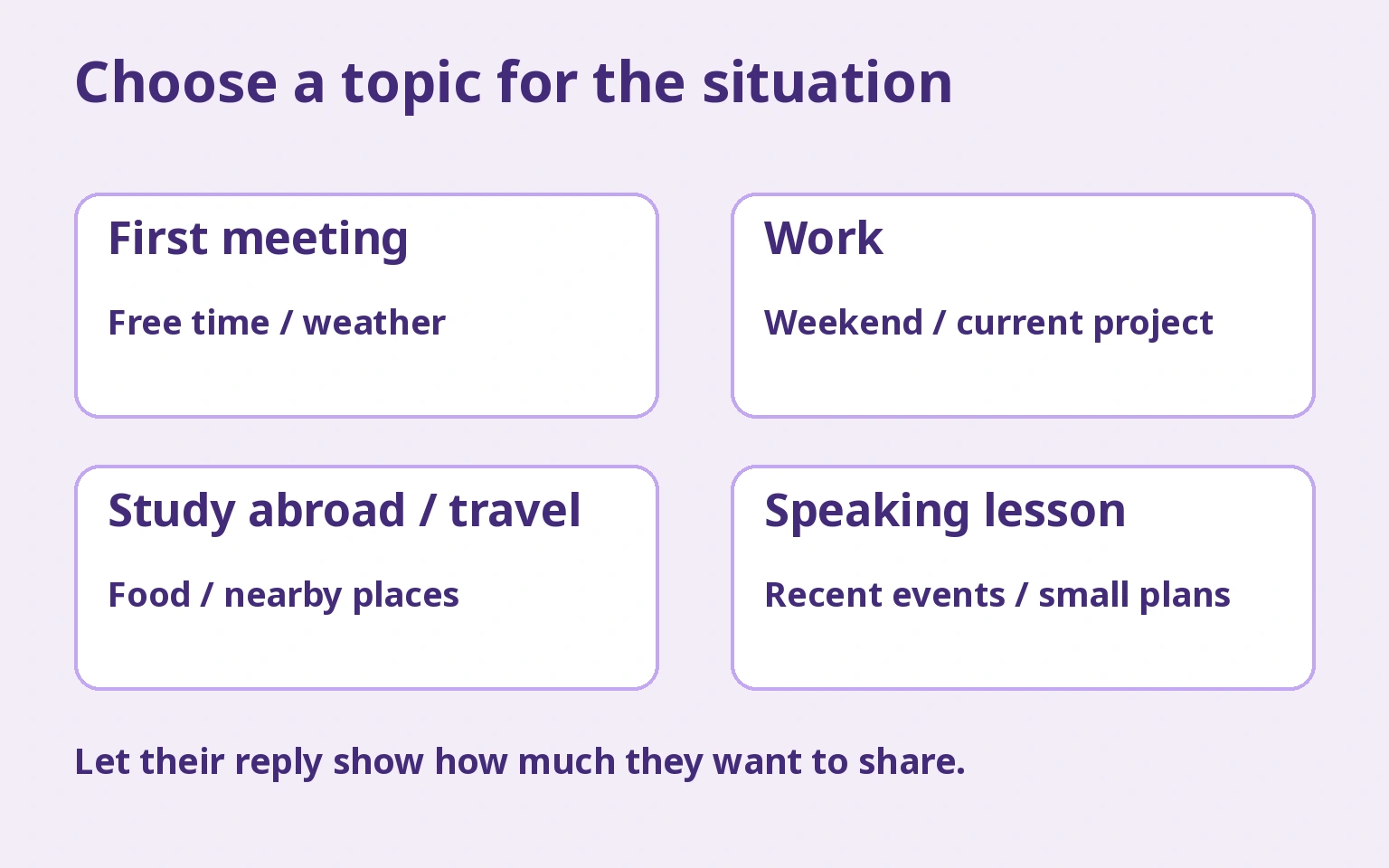
Prepare the first greeting with English greetings and How are you? replies and the personal introduction with an English self-introduction. This article focuses on what comes after that.
3. Each topic: start, answer, extend and avoid mistakes
Use one sentence for a fact or preference and another for a reason, reaction or next plan. Add a third specific example when useful. You do not need because in every answer; two short sentences can work.
Weekend
Situation: Use this with colleagues on Monday or for a lesson update. If their days off are not at the weekend, adapt to their schedule.
Opening: How was your weekend? Ask about their weekend. You can also briefly mention cooking on Sunday before asking.
Your answer pattern: I tried a new soup recipe on Sunday. It was easy, so I’ll make it again. Say what you did, then add a feeling or a next plan. Here you tried a soup recipe and plan to make it again because it was easy. It works even when you stayed home.
Extend it: What do you like to do on a quiet weekend? If they mention walking, ask about the place or their favourite time of day. Choose one detail rather than an entire list.
Common mistake: Do not stop at ‘nothing happened’ or narrate every hour. Resting, cooking or sleeping well is enough. Do not invent an event to sound interesting.
Food
Situation: Try a lunch break, a meal or a brief travel conversation. Dietary restrictions can relate to religion, allergies or health; do not pressure someone to eat something.
Opening: What do you like to cook? Ask what they enjoy cooking. If they do not cook, move to a meal or dish they like.
Your answer pattern: I often make vegetable pasta. It’s quick, and I can use whatever I have. Name something you often make and why. Vegetable pasta is quick and lets you use ingredients already available; whatever I have means what is on hand.
Extend it: Is there a dish you’d like to learn to make? When they name a dish, ask about one ingredient or what made them want to learn it.
Common mistake: Do not treat a person as a representative of an entire national diet. Ask about their own preferences.
Free time
Situation: This fits a first meeting, study-abroad socialising or a conversation group. A way to relax counts even without a named hobby.
Opening: What do you do to relax? Ask what they do to relax. It leaves room for an ordinary activity, without demanding a special talent.
Your answer pattern: I take short walks after dinner. They help me switch off. Name the activity and what it does for you. The example describes short evening walks; switch off here means mentally taking a break, rather than turning off a device.
Extend it: Do you prefer being indoors or outdoors? Use the indoor/outdoor preference as a starting point, then listen for their reason.
Common mistake: A single hobby word gives little to respond to. Add when you do it or what you like. Do not pretend to know a sport you know little about.
Something you watched
Situation: Use this with friends or in a lesson. A short video, film or exhibition can be a starting point.
Opening: Have you watched anything interesting lately? Ask about something interesting they have watched, without assuming they pay for a particular service.
Your answer pattern: I watched a short film about a mountain village. I liked the quiet scenes. Say what it was about and what you liked. A mountain-village film and its quiet scenes give enough context even if the title is unfamiliar.
Extend it: What kind of stories do you enjoy? Check whether they know the work before discussing particular plot details.
Common mistake: Avoid a long plot summary or revealing the ending without checking. Start with one reaction and expand only if they are interested.
Music
Situation: This fits friends, study-abroad socialising or a conversation group. Go into detail once you know they enjoy music.
Opening: What do you usually listen to? In a music conversation, ask what they normally listen to. Accept that they may not listen much.
Your answer pattern: I listen to instrumental music when I cook. I like songs with a steady rhythm. Name what you listen to and when, then a feature you enjoy. You can describe instrumental music and rhythm without remembering artist names.
Extend it: When do you usually listen to music? Their listening routine can lead to a conversation about commuting or relaxing.
Common mistake: Different taste is not bad taste. Separate describing your preference from judging theirs.
Nearby places
Situation: Use this when getting to know a new town or chatting on a trip. Do not expect a busy worker to spend time giving you a tour.
Opening: Is there a place nearby you like? Ask about a place nearby that they like. A park or café can be discussed without asking for a home address.
Your answer pattern: There’s a small park near my home. I go there when I need a break. Name the place and what you do there. A park you visit for a break is enough; no precise address is needed.
Extend it: What do you like about that place? Pick up what they like: quiet, scenery or food, for example.
Common mistake: Ask one question and thank them before continuing. Do not assume every local person wants to be your guide.
Trips and day trips
Situation: This suits lessons and people interested in trips. A nearby day out works; overseas travel and a large budget are not prerequisites.
Opening: Where would you like to go for a day trip? Ask about a possible day trip rather than how many countries they have visited.
Your answer pattern: I’d like to visit a town by the sea. I want to walk around and try the local food. Name a place you would like to visit and what you would do there. You can talk about a seaside town even before booking anything.
Extend it: Would you rather plan ahead or decide on the day? If they want to share, their planning preference can lead to a past day-trip example.
Common mistake: If they do not travel, do not probe finances or reasons. Return to nearby places or days off.
Work or study updates
Situation: Try this with colleagues, classmates or a teacher. For students, use classes and assignments as the context.
Opening: What have you been working on lately? Ask what they have been working on. Their answer might describe a task, a project or schoolwork.
Your answer pattern: I’ve been making a short guide for my team. I’m trying to keep the instructions simple. Name the task and one thing you are trying to do well. The short team guide explains the work without naming clients or sharing internal information.
Extend it: What’s been interesting about it? If they cannot discuss details, accept that and move to a general lesson learnt.
Common mistake: Do not begin with pay or promotion. If work is not something they want to discuss, choose free time.
Weather and activities
Situation: This works for first meetings, short waits and lessons connecting different locations. If the subject becomes a disaster or damage, change the light tone.
Opening: What do you like to do on a rainy day? Link a brief weather comment to what they like doing on a rainy day.
Your answer pattern: I usually stay home and read. Rainy afternoons are a good time for a slow break. Name your routine and a personal feeling about it. Reading at home on a rainy afternoon is one person’s preference, not everyone’s experience.
Extend it: Does the weather change your plans much? Their reply can lead to outdoor plans or daily habits.
Common mistake: A weather report alone may end quickly. If they want to talk, add one thing you do because of the weather rather than just more weather vocabulary.
Small plans or challenges
Situation: Use this with a teacher, acquaintances or learning partners. Ask about something small they could try soon, not their entire life plan.
Opening: Is there something you’d like to try soon? Leave room for the answer ‘nothing in particular’. Do not make a goal compulsory.
Your answer pattern: I’d like to grow herbs on my balcony. I’ll start with one small pot. Name something you want to try and a first step. One herb pot is a small start; adapt it to cooking or reading if a balcony does not fit your home.
Extend it: What would be your first step? Listen before giving advice. A plan is not an invitation to instruct or evaluate them.
Common mistake: A goal does not have to be impressive. Making a new dish or reading one book can be enough if they want to discuss it.
4. Continue after the first exchange
Choose your follow-up from what they just said, rather than from a memorised order. A place, reason, reaction or next plan can give you one detail to ask about. These four categories are our practice aid, not a requirement to ask four questions.
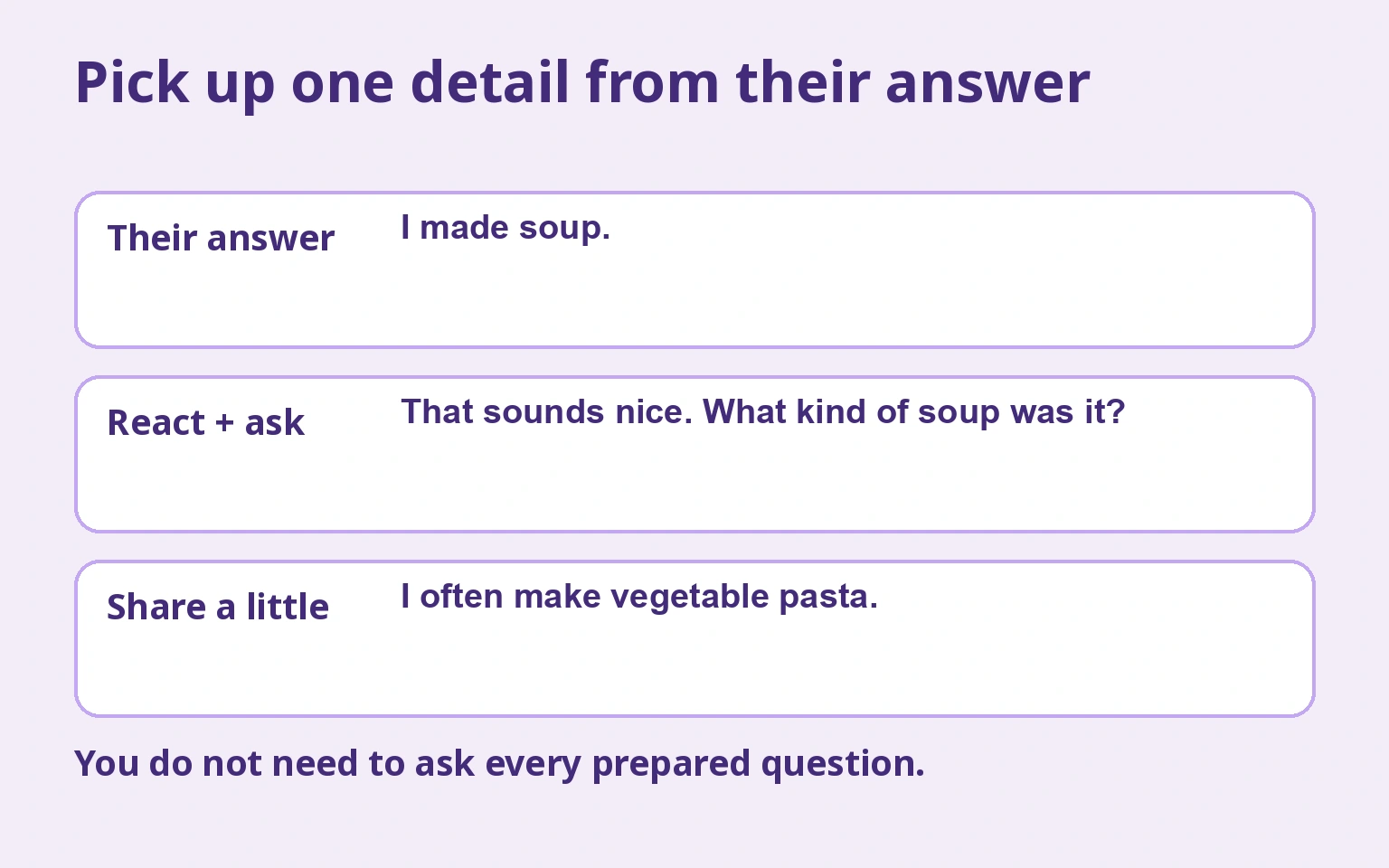
If they say I made soup., you could respond That sounds nice. What kind of soup was it? After hearing about the vegetables, briefly add your own cooking experience. Let them finish before moving on. For different kinds of short responses, use English backchannel responses; the British Council lesson British Council: Responding to news also distinguishes reactions to good and bad news.
Question after question can feel like an interview. Our suggestion is to ask briefly, wait and share two related sentences yourself. Do not mechanically split time in half. Listen longer when they want to explain; speak when they ask you. Yes/no questions are useful too if you respond to what follows.
5. Sensitive topics and personal boundaries
Our editorial policy for a new acquaintance is not to probe money, religious or political positions, relationship or family circumstances, detailed health information or confidential work. This is a cautious starting choice, not a universal ban by nationality. Consider the relationship, purpose and person’s willingness. The British Council guide British Council: small talk also advises care with private or controversial subjects.
| Topic | Why use care | Alternative opening |
|---|---|---|
| Pay, rent, assets | Asks for private or financial circumstances | An interesting part of work; a nearby place |
| Religion or political positions | May require sensitive background and disagreement | Something watched; daily activities |
| Marriage, children, family ties | May assume circumstances they do not want to discuss | Free time; an update they volunteered |
| Age, body, detailed illness | Can impose personal judgement or explanations | Relaxing; a small manageable plan |
| Clients or workplace problems | May involve confidential information | Public work descriptions; general learning |
Even if someone brings up family or faith, it does not invite every possible question. Stop if they decline, change the subject or show that they do not want to expand. Do not generalise their story to everyone from a country or culture.
To set your own boundary, say I’d rather not go into that. You can add Could we talk about something else? You do not owe a long explanation. A lesson does not require practising a subject you do not want to discuss.
6. Restart a conversation that stalls
First distinguish not hearing, needing time to think and a topic that does not suit the person. A pause is not necessarily your failure; online, connection trouble is another possibility. Do not rush to pile on questions.
| Situation | A useful phrase | Next step |
|---|---|---|
| Did not hear | Could you say that again? | Listen again before answering |
| Did not understand the meaning | What do you mean by that? | Clarify the unclear part |
| Need thinking time | Let me think. | Say one thing you remember |
| Short replies; unsure about continuing | Would you like to talk about something else? | Check whether they want another topic |
| A natural break for a new subject | By the way, I tried a new recipe. | Offer one new piece of information |
The British Council’s British Council: Keeping a conversation going teaches phrases for thinking time, returning the conversation and moving to another subject. Our situation-based choices are an editorial interpretation of that teaching material.
If you did not hear, changing topics leaves their question unanswered: ask again first. If short replies continue and they seem uninterested, offer another topic. If they are busy, you can finish. Success in small talk does not mean eliminating every pause.
7. Solo practice: draw a topic, speak and fix one thing
Draw a topic → speak for about 30 seconds → record → listen back → fix one thing → ask one question back. You can record while making the first attempt. Thirty seconds is our manageable practice cue, not a duration with guaranteed learning effects. If two sentences take 20 seconds, go to the question instead of padding the answer.
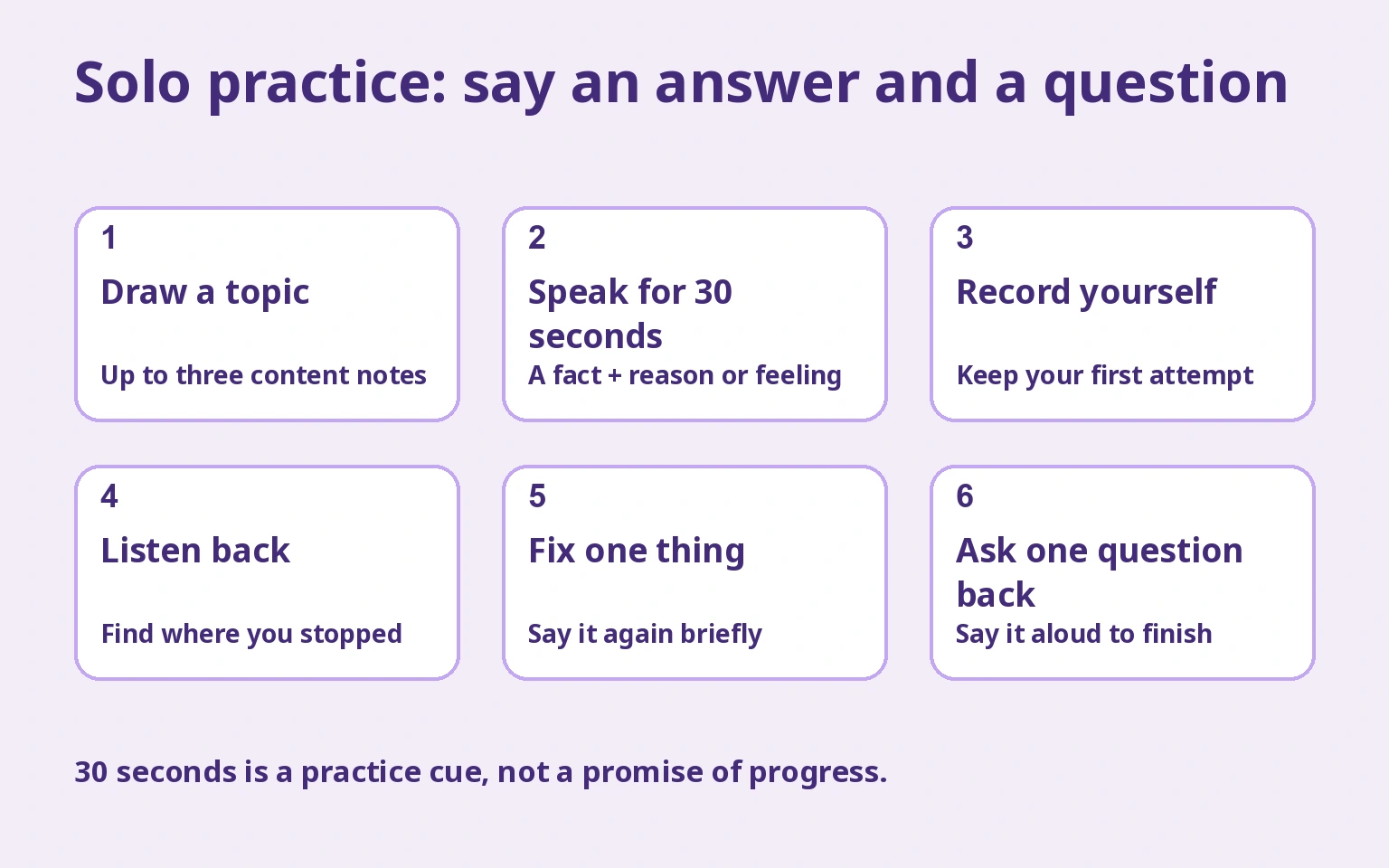
- Draw a topic. Write weekend, food and free time on separate slips of paper. Turn them over and draw one. Note up to three content cues, such as Sunday, soup and easy, rather than writing the whole answer on the card.
- Speak for 30 seconds. Read the question once and speak two or three sentences about a fact and your reaction. At first you can look at the example; next time use your own content notes. Replace an unknown word with a short expression you know.
- Record yourself. Use an available recording feature to save your answer. The aim is to hear what you actually said, not to produce a score.
- Listen back. Check whether the subject is clear, whether you gave a reason or feeling and where you stopped. You do not need to judge every aspect of your voice.
- Fix one thing. Choose one change: past tense for yesterday’s event, a shorter sentence if you ran out of breath, or a missing reason. Check uncertain meaning or grammar with a dictionary or teacher; listening to yourself alone cannot establish the correct answer.
- Ask one question back. Say one related question aloud to finish, such as What do you like to cook? Try the same topic once more briefly before drawing another card.
For the weekend card, start with I tried a new soup recipe on Sunday. Add It was easy, so I’ll make it again. If you did not make soup, change the food or action to something true. The task is to retrieve your own experience, rather than recite an impressive memorised sentence.
Keep one useful sentence and its meaning somewhere you can return to. For taking a sentence you could not say back into practice, see reviewing online English lessons; for the larger study plan, see how to study English.
Save one sentence in SpeakGain and check its audio and answer
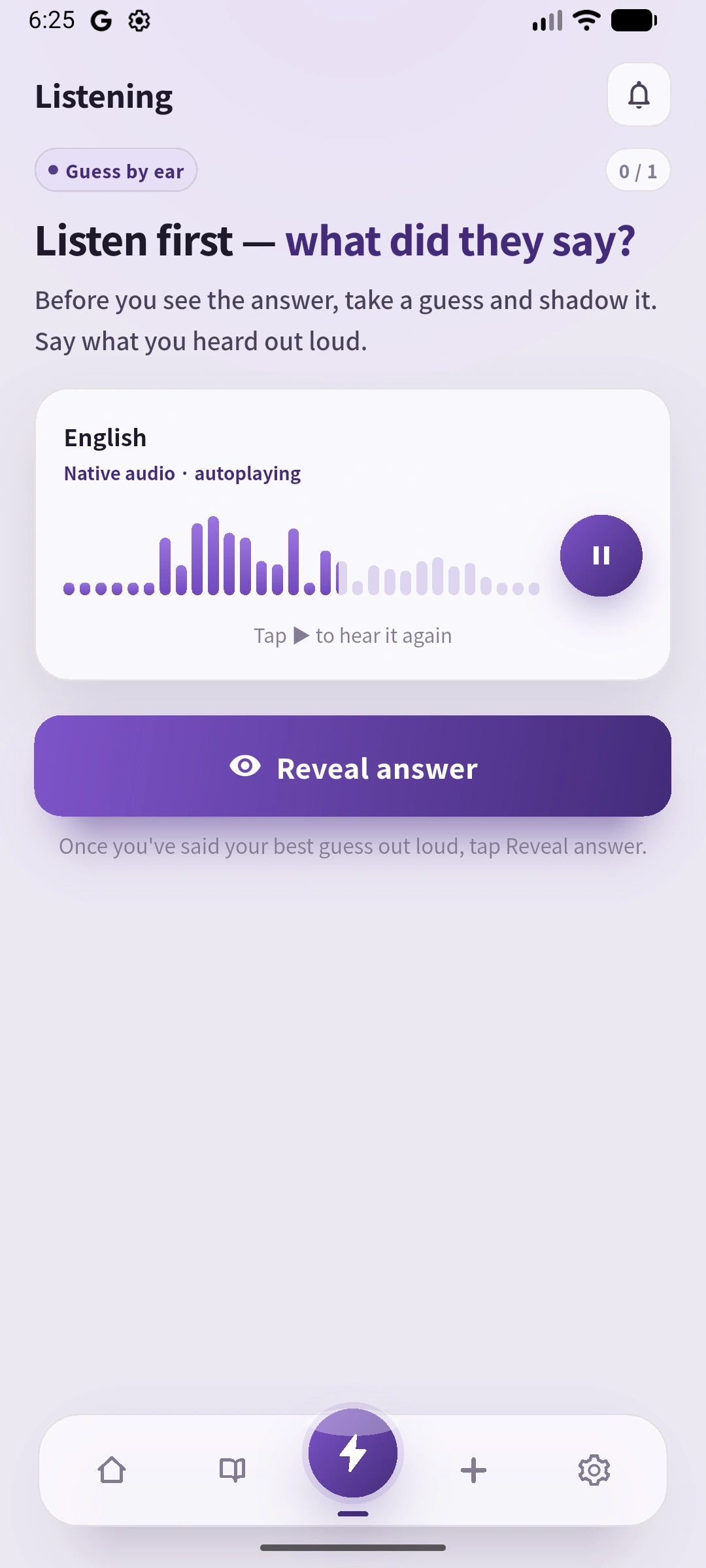
In this device example, we saved the first sentence of our answer through the normal Add flow. Card library → Knowledge displayed the English and generated explanation. Learn this card opened Listening with the English sentence hidden and Viking audio playing. Reveal answer showed the same sentence, an English explanation and Again/Hard/Good/Easy interval choices. Those choices select a review interval; they are not a conversation score.
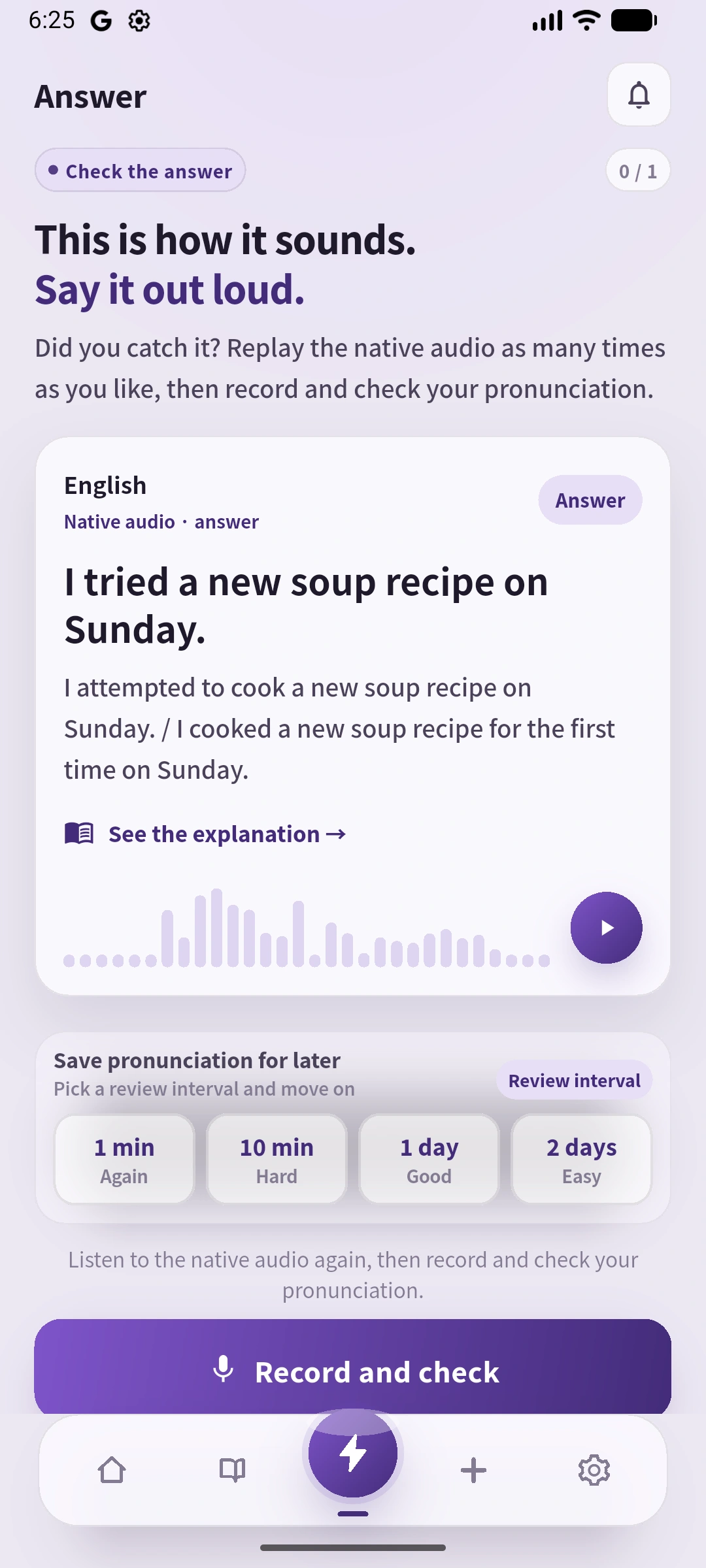
After allowing the microphone for this session through Record and check, we reached the Recording… and Stop and check display. We did not verify a completed result or playback of our own voice. Use an available device recorder for the 30-second recording/listen-back routine above, and use SpeakGain here for the verified saved sentence, reference audio and answer display. We do not present it as a topic generator, conversation partner, role-play or conversation-scoring tool.
AI-generated Viking audio for this practice sentence
8. Common practice mistakes and what to change
We do not recommend memorising topic names and stopping there. Knowing a topic does not necessarily mean being able to say your answer aloud. Prepare one exchange on three useful topics first.
| Problem | Change |
|---|---|
| Forget a long memorised answer | Separate fact and reaction; use content notes |
| Only ask questions | Prepare two related sentences about yourself |
| Recite without listening to the reply | Ask once, wait and pick up one detail |
| Repeat exactly the same story | Change yesterday, usually or next time |
| Try to fix everything in a recording | Choose one change for the next attempt |
| Wait until you know difficult vocabulary | Use familiar verbs to say who did what |
Prioritise something you needed in a real conversation. If meaning was unclear, start there. If one sound needs work, practise the word and put it back into a sentence. After your basic answer works, everyday English slang can help choose informal language that suits the relationship.
Frequently asked questions
What can I say when I have nothing to talk about?
Choose yesterday’s food, how you relax or a small next plan. You do not need a remarkable experience. A fact and a reaction make a two-sentence start.
Can a beginner choose a free-conversation lesson?
Agree the format with the teacher and try one prepared topic. We prefer that to arriving unprepared for a long conversation. If it is too difficult, discuss set questions or a textbook activity.
Can I let the teacher choose the topic?
Yes. Tell them one area you can talk about and prepare short answers. You can also ask to practise asking one question yourself, rather than only responding.
Is two or three sentences too much about myself?
Sentence count alone does not decide. Pause after a short answer and watch their reaction. Add detail if asked, or return the turn when they want to speak.
Which topics should I avoid with a new acquaintance?
Our starting policy is not to probe money, political or religious positions, relationships, family circumstances or detailed health information. Let the context and individual reply guide you, not nationality alone.
Should I change the topic as soon as there is silence?
First check whether someone did not hear or needs thinking time. Clarify or wait. Offer another topic if they are not interested, or finish if they are busy.
Can solo practice replace an actual conversation?
It prepares your answer and question, but reacting to an unexpected reply needs separate practice with someone. After a lesson or real exchange, bring one unsaid sentence back into solo practice.
How do I say I want to change the topic?
You can say change the subject. At a natural break, By the way, … can introduce new information. Do not interrupt an important story simply to use your prepared topic.
Our editorial verdict: three topics, two sentences and one question
We would begin with weekend, food and free time. For each, prepare your own two-sentence answer and one related question, say them aloud, record and choose one correction. Prioritise something you can actually say and listening to the reply over collecting a huge list.
The other person’s time and interest also shape the conversation. Practise asking again, giving a short answer, returning the turn and ending when appropriate. Choose one topic for your next exchange and turn one true fact from today into two sentences.
Teaching sources
- Cambridge: topic
- British Council: Responding to news
- British Council: Keeping a conversation going
- British Council: small talk
The ten-topic selection, situation categories and 30-second routine are editorial suggestions. Short examples are our own; no question collection or teaching transcript has been reproduced.