
English greetings: how to answer How are you? in different situations
Published
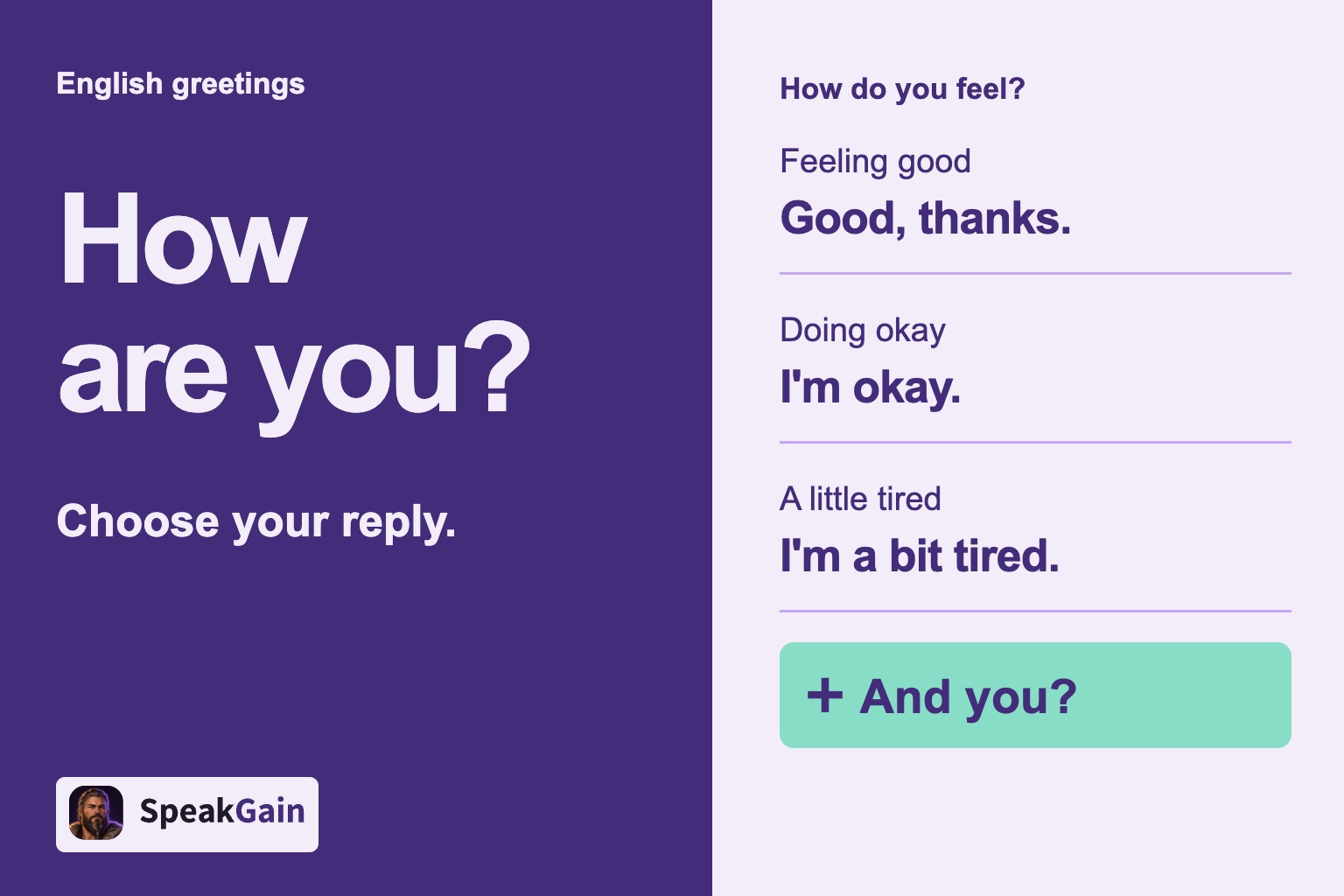
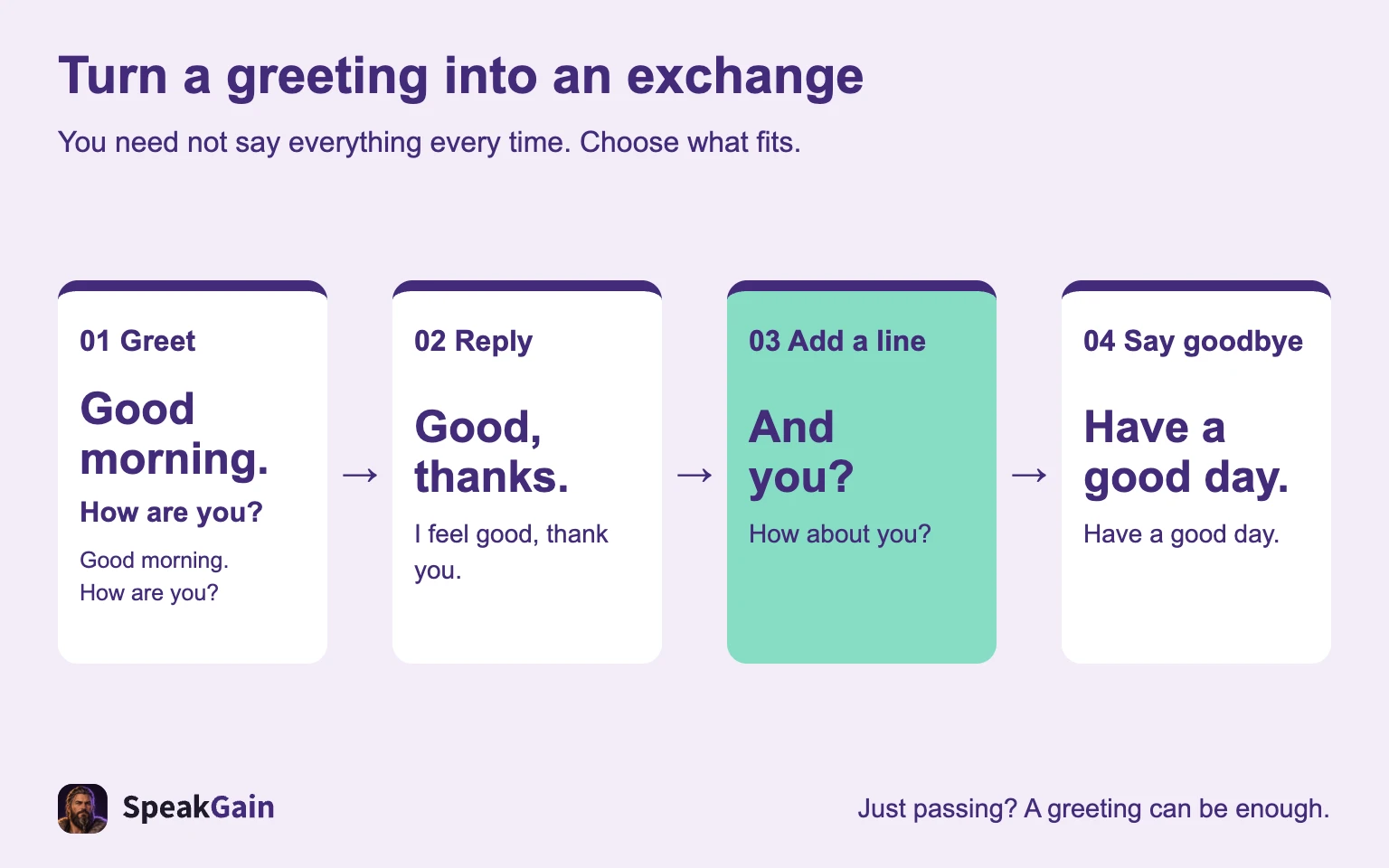
Start with “Hello.”, or “Good morning.” in the morning. If someone asks “How are you?”, a useful short reply is “Good, thanks. And you?” Choose a reply that matches how you feel, add one question or a short update if you want to continue, and finish with “Bye.” or “Have a good day.” You need not perform all four stages when simply passing someone in a corridor.
Our starting set is “Good, thanks.”, “I’m okay, thanks.” and “I’m a bit tired.” This is an editorial choice to make practice manageable, not a ranking of the most frequent expressions. “I’m fine, thank you.” is also valid. Learn to respond to the actual question rather than replacing one compulsory script with another.
For words of care at the end of a conversation, practice choosing between a farewell, a warning, and your own promise, including what to say before a trip or a journey home.
After the greeting, English conversation topics and solo practice helps you choose a subject and prepare your own short answer.
To turn useful expressions into ten sentences from your own day, see everyday English conversation phrases and practice.
1. Greet: choose for the situation
These labels describe a starting point, not a politeness score. Tone, familiarity and workplace habits matter. English “you” does not distinguish forms like Spanish tú/usted: a learner cannot reproduce that distinction by changing the pronoun. Choose the greeting and level of detail instead. Even in an English-speaking workplace, listen to how the particular people around you greet one another.
| Situation | English | Meaning and register |
|---|---|---|
| First meeting | Hello. I’m Misaki. Nice to meet you. | Introduce yourself; neutral, suitable at work |
| More formal introduction | It’s a pleasure to meet you. | A more formal expression of pleasure |
| Meeting again | It’s good to see you again. | Acknowledges that you have met before |
| Friend after a long gap | Long time no see! How have you been? | Casual; asks about the intervening period |
| Work contact after a gap | It’s been a while. How have you been? | A neutral way to reconnect |
| Morning at work | Good morning. How are you? | Neutral to polite |
| Starting an online lesson | Hello. Can you hear me? | Greeting followed by an audio check |
| Familiar person | Hey! How’s it going? | Casual |
For a first meeting, give your name before “Nice to meet you.” If the other person says it first, “Nice to meet you, too.” works. The British Council’s workplace dialogue illustrates this exchange. For someone you already know, use “Good to see you again.” Our advice is to remember first meeting versus reunion, rather than translate every instance of “meet” the same way.
“Good afternoon.” and “Good evening.” can start conversations later in the day. “Hello.” avoids uncertainty about the time. Online, greet the person before checking the connection. “Can you hear me?” asks about sound, so answer “Yes, I can hear you.” If not, “I can’t hear you clearly.” is more useful than a reply about your mood.
2. Listen: these three questions are different
| Question | What to listen for | A short reply |
|---|---|---|
| How are you? | How you are feeling; sometimes a brief greeting | Good, thanks. |
| How’s it going? | How things are going; an informal greeting | Pretty good, thanks. |
| What’s up? | A friendly greeting, or a question about a problem | Not much. / Just working. |
Cambridge’s entry for how includes “How’s it going?” as an informal greeting. Its What’s up? entry also covers asking what is wrong. If a friend notices your worried expression and asks “What’s up?”, a fixed “Nothing much.” might miss the question. Explain what you want to share.
Likewise, “How are you?” in passing need not lead to a detailed report, but a close friend who stops and asks with concern may want one. Check whether the person has time and whether they ask another question. Do not assume every greeting is either empty or an invitation to disclose everything.
3. Reply: match your mood and relationship
| Your situation | English | What it communicates |
|---|---|---|
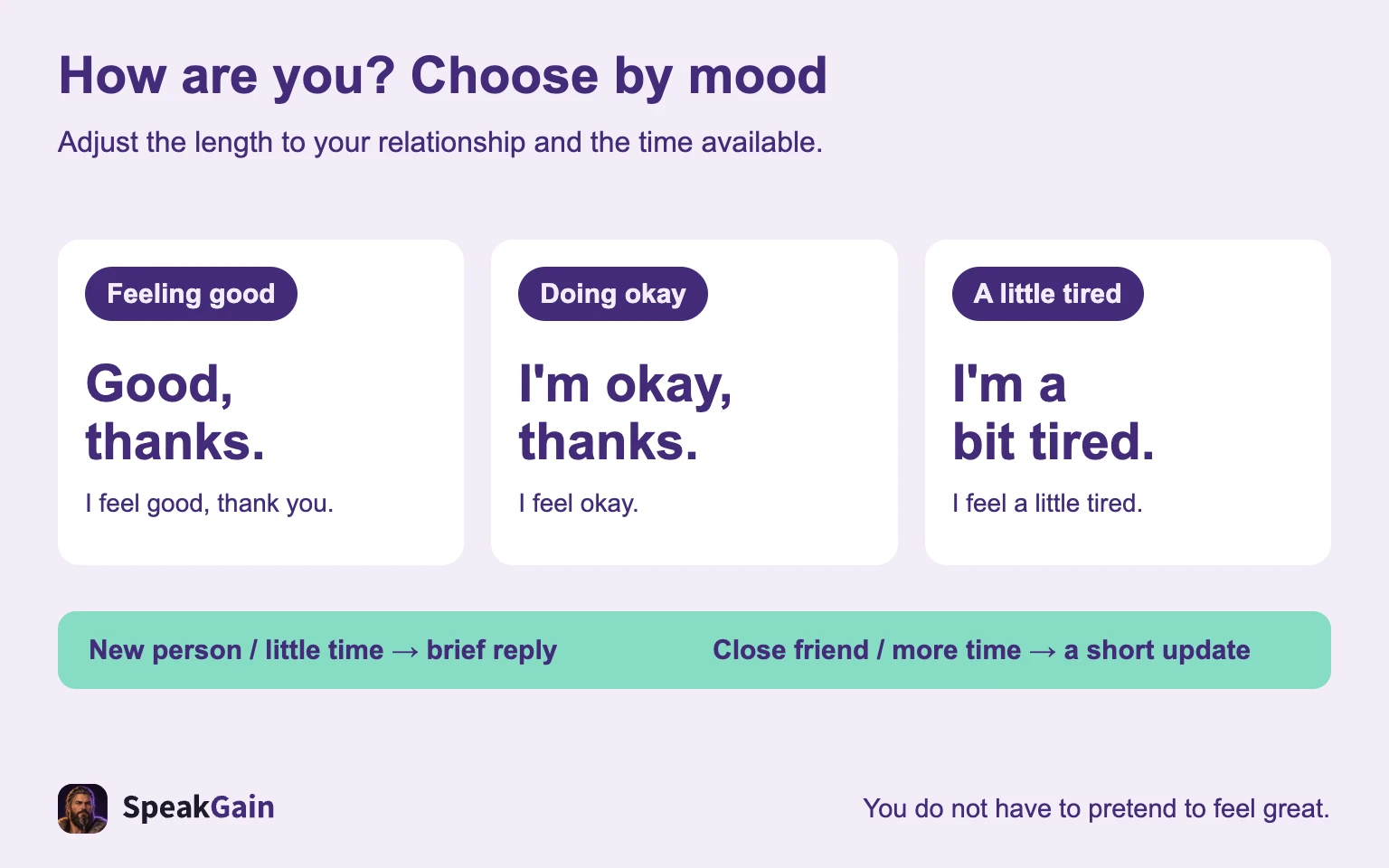
| Feeling good | Good, thanks. | A brief positive reply |
| Especially well | Great, thanks. | A stronger positive reply |
| Doing okay | I’m okay, thanks. / Not bad, thanks. | An acceptable, less enthusiastic day |
| Some tiredness | I’m a bit tired. | A small amount of tiredness |
| Feeling ill | I’m not feeling well today. | You are not well today |
| Difficult period, trusted person | It’s been a tough week. | A short opening to talk about difficulty |
Use “a bit” only if it fits. You do not have to downplay serious tiredness. With a new client and little time, a short truthful reply can be enough; with a friend, you may add a reason. “I’m okay, thanks.” need not be followed by private information. Our advice is to prepare a reply you are comfortable saying, rather than pretend to be cheerful or turn every greeting into an explanation.
4. Add one line: ask back or give an update
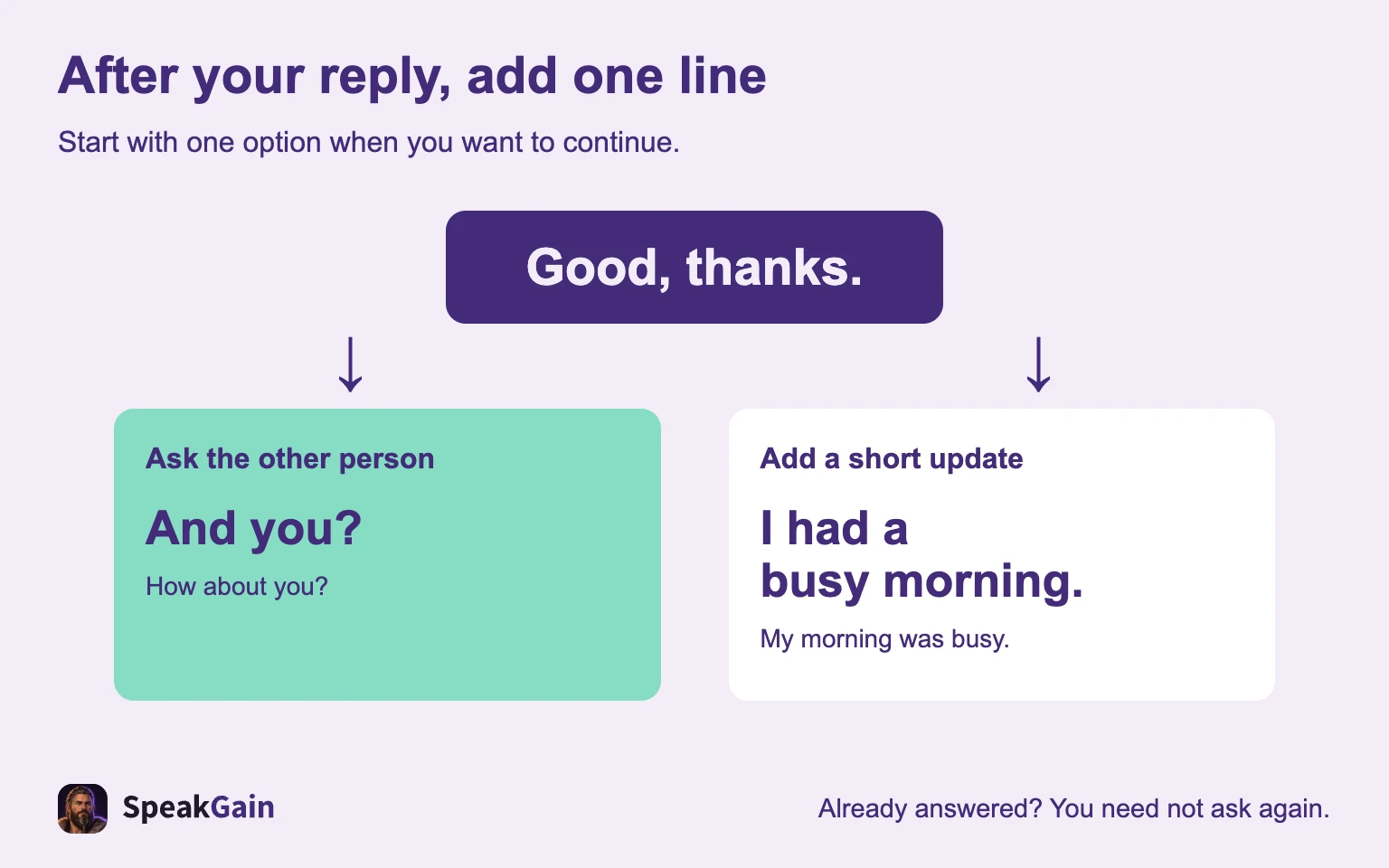
“And you?” or “How about you?” returns the question. If the person has already said “I’m good. How are you?”, you need not ask again. Listen before adding the phrase automatically. For an update, “I had a busy morning.” or “I’m getting ready for a meeting.” is enough to offer the other person something to respond to.
You can combine an honest reply and a reason: “I’m a bit tired. I had a busy morning.” Start with one addition rather than several questions at once. If the other person says “Oh, really?”, let that guide the next turn. Our recommendation is a usable exchange, not a memorized speech.
5. Say goodbye: end the conversation clearly
| Situation | English | Meaning and register |
|---|---|---|
| General goodbye | Goodbye. / Bye. | Neutral / casual short form |
| Seeing a colleague tomorrow | See you tomorrow. | Only when you expect to meet tomorrow |
| Casual goodbye | See you later. | A familiar farewell |
| Morning or daytime departure | Have a good day. | A friendly wish |
| Before the weekend | Have a good weekend. | A wish for the weekend |
| End of a first meeting | It was nice meeting you. | Neutral to polite |
| End of an online lesson | Thank you for the lesson. See you next time. | Thanks and a farewell |
| Leaving at night or going to bed | Good night. | Ends an evening encounter |
Reply to “Have a good day.” with “You too.” To “See you tomorrow.”, “See you.” fits. “You too.” is not a universal response to every farewell. Cambridge’s grammar guide distinguishes “Good night.” when leaving or going to bed from greetings at the start: “Good evening.” is appropriate when you arrive.
If you must leave while a conversation continues, try “I need to get back to work. It was nice talking to you.” Do not invent a next meeting just to fill the silence. “Bye.” is enough when you do not know when you will meet again.
6. Is “I’m fine, thank you.” unnatural?
It is not inherently incorrect, and the evidence does not support banning it. Cambridge’s Please and thank you guide gives this exact sentence as a polite response. That establishes a legitimate use; it does not establish its frequency in every country, age group or relationship. We have not conducted a spoken-corpus comparison and do not claim that one reply is always the most natural.
“Thanks” is a less formal alternative to “thank you”, as Cambridge explains. Keep “thank you” if a more polite opening suits you; use “thanks” in a brief familiar exchange. The editorial position is to expand your choices, not discard everything you learned at school.
Choose by what the phrase needs to do in the conversation:
| Situation | Choose | Why |
|---|---|---|
| Meeting someone again | Good to see you again. | Nice to meet you. belongs to a first introduction |
| Arriving in the evening | Good evening. / Hello. | Good night. ends an evening encounter |
| Brief casual What’s up? | Not much. / Just working. | Start short; add more when the context calls for it |
| The person has already answered | Good, thanks. | You need not repeat the question with And you? |
Our criterion is the phrase’s role in context, rather than a blacklist of sentences.
7. One learner, two situations: hear the cue and speak
Misaki is a fictional learner. In the morning she feels good and meets a colleague; later, after a busy morning, she starts an online lesson feeling a little tired.
Colleague: Good morning. How are you?
Misaki: Good, thanks. And you?
Colleague: Good, thanks.
Misaki: Great. See you at the meeting.
The final line assumes they really share a meeting. Otherwise “Have a good day.” fits. She waits for the colleague’s answer before moving on.
Misaki: Hello. Can you hear me?
Tutor: Yes, I can. How are you today?
Misaki: I’m a bit tired. I had a busy morning.
Tutor: I see. Shall we start?
Misaki: Yes, let’s start.
This scenario assumes she feels well enough to take the lesson. She gives a short truthful reply, adds a reason and begins. Afterwards she can say “Thank you for the lesson. See you next time.” Practice the ending as well as the opening.
① Save the three sentences you will use
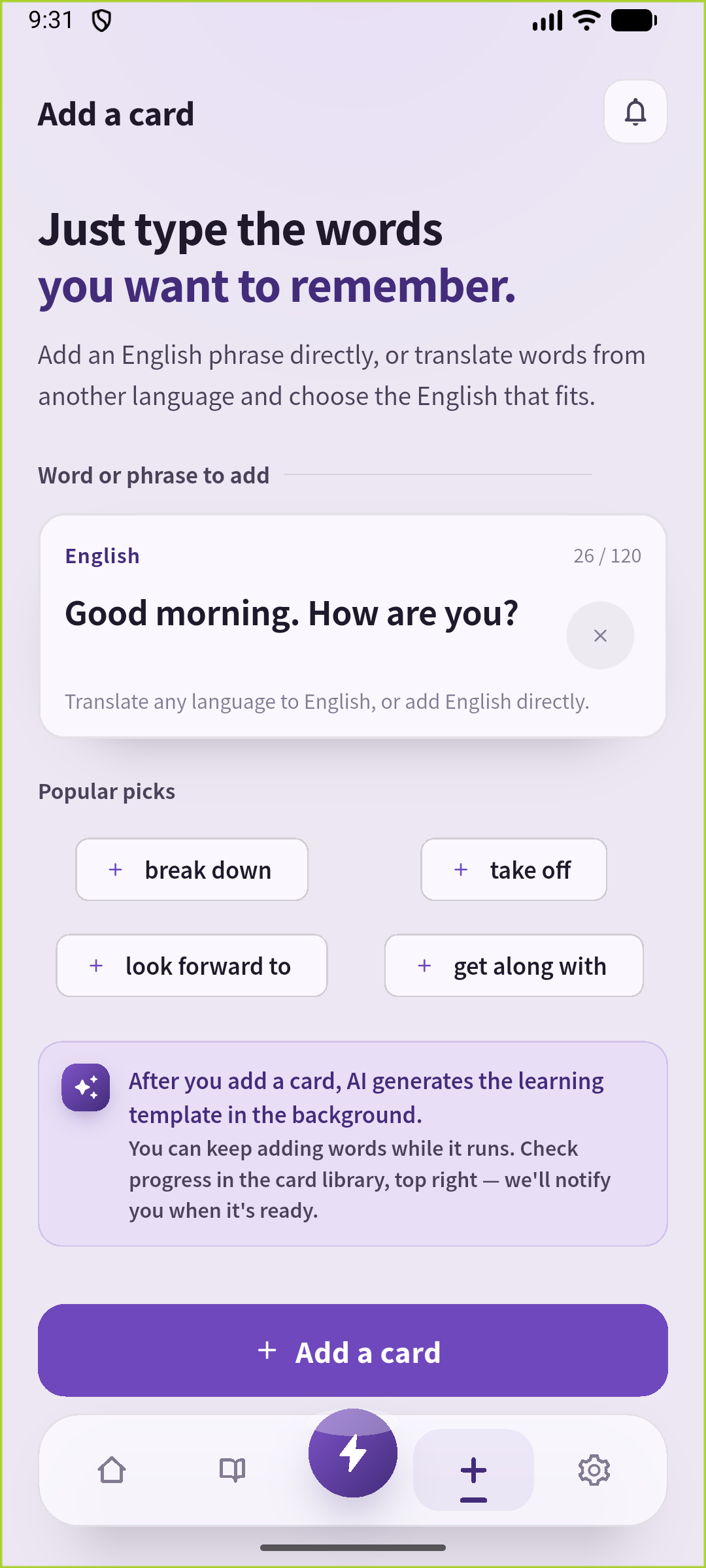
In SpeakGain’s Add screen, enter a sentence and create a card. We saved the question, positive reply and tired reply with an update as three separate cards. Our advice is to save tomorrow’s exchange before adding a whole greeting list.
② Listen to the cue, speak, then check
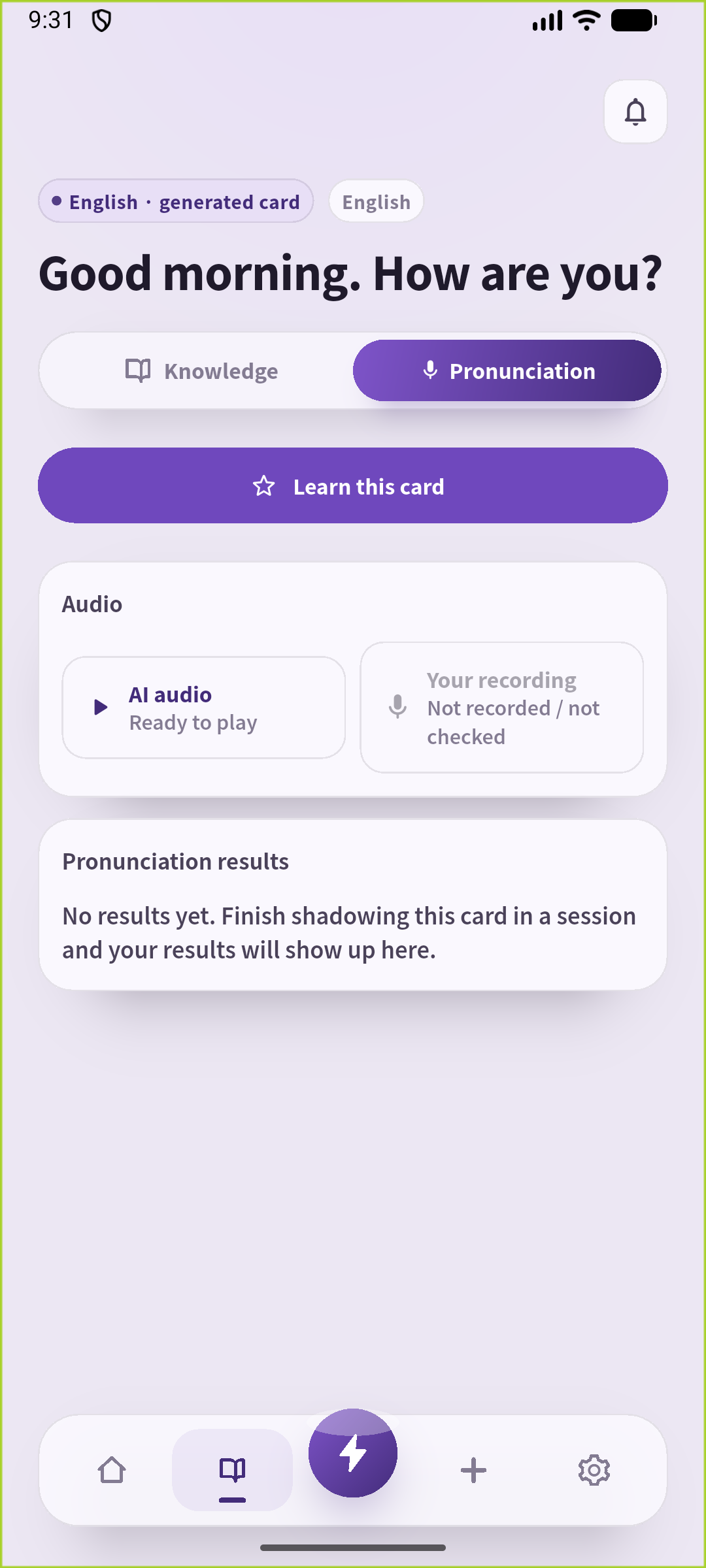
These three clips were generated in SpeakGain with the AI voice Deep-voiced Viking, once per sentence. They play saved sentences; the AI does not automatically continue a conversation. Listen to the question, pause, say your reply first, then check against the reply clip. Choose the tired reply after a busy morning.
Good morning. How are you?
Good morning. How are you?
Good, thanks. And you?
I feel good, thank you. How about you?
I'm a bit tired. I had a busy morning.
I feel a little tired. My morning was busy.
③ Hide the words and recall a reply
Hide the English and use only the situation: a colleague asks how you are in the morning. Say Good, thanks., then add And you? if appropriate. For the busy-morning scenario, choose I’m a bit tired. and a reason if you wish. Check a missing phrase, hide it again and retry.
The original 2008 study by Karpicke and Roediger found that continued retrieval after an initial correct answer helped university students recall foreign-language word pairs one week later. It did not test greeting conversations or SpeakGain. We use it as a basis for proposing recall from a situation, rather than only reading visible text. Karpicke & Roediger (2008)
Tomorrow, change just one part: start with Hi., answer I’m okay, thanks., or end with See you tomorrow. One voice does not cover every real accent or speed; ask the speaker to repeat when needed.
Common questions
Replies, politeness and endings
Must I always add “And you?”
No. Add it when you want to ask back and the other person has not already answered. A brief greeting in passing can end after your reply.
Is “Hi” rude to a manager?
The word alone does not settle that. Follow the relationship and workplace habits. When unsure, our starting recommendation is “Good morning.” or “Hello.”
Will “Nothing much” stop the conversation?
A short greeting may end there without a problem. To continue, add “You?” or a short update. If “What’s up?” asks about a problem, answer that question instead.
Does “Goodbye” mean we will never meet again?
No. “Bye.” and “See you tomorrow.” are useful alternatives for particular situations, but “Goodbye” is not restricted to a final separation.
Tomorrow, rehearse one exchange without looking at the words. Choose a reply for your actual mood, add one line if you want to continue, and finish. Success is choosing something you can use, not memorizing the largest list.
For everyday conversations at home, see what to say when leaving and coming home, with short exchanges and an explanation of the Japanese greetings tadaima and okaeri.
Continue practicing
- How to introduce yourself in English: examples and your own 30-second introduction
- 64 English backchannel responses: what to say, how to sound, when to respond
- How to apologize in English: Sorry, Excuse me and Thank you
- How to study English: choose by your goal and what stops you
- What Is SpeakGain? Learn English Phrases with a Character Voice
For choosing a thank you, adding a reason and receiving thanks, practise thanking in English by situation.
For a colleague in the hallway or at the end of work, our guide to otsukaresama in English helps you choose between a greeting, a goodbye and thanks.
Sources
- British Council — Meeting new people
- Cambridge — How are you?
- Cambridge — how
- Cambridge — What’s up?
- Cambridge — Please and thank you
- Cambridge — thank you
- Cambridge — Greetings and farewells
- Oxford Online English — Greetings and Introductions
- Karpicke & Roediger (2008) — The Critical Importance of Retrieval for Learning
For birthdays and New Year, how to say congratulations in English explains when to use Happy and when to congratulate someone on an achievement.