
Take care vs be careful: choose a goodbye, warning or promise
Published
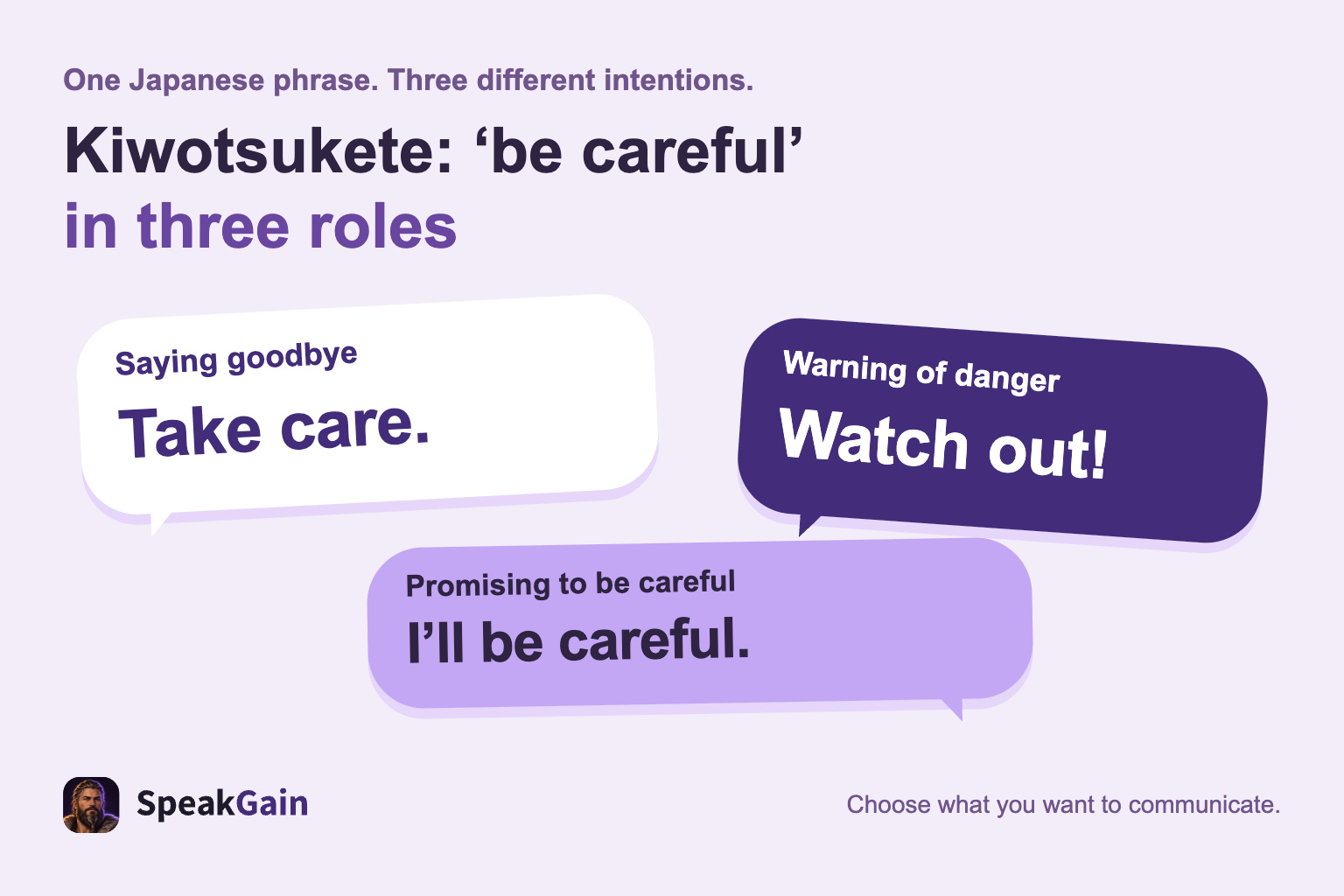
For a goodbye, start with Take care. For a warning, use Watch out! For your own promise, say I’ll be careful. Japanese kiwotsukete can cover all three intentions. English usually makes you choose what you want the other person to hear. Someone going home? Get home safe. Someone leaving on a trip? Have a safe trip.
| Your intention | One starting phrase | What it does |
|---|---|---|
| Say goodbye | Take care. | Wish the person well. |
| Warn about danger | Watch out! | Get their attention. |
| Promise care yourself | I’ll be careful. | Commit to acting carefully. |
Our editorial recommendation is to practise the role before collecting synonyms. For an ordinary goodbye, choose Take care. or Get home safe. For immediate danger, practise Watch out! first. After a work mistake, add the check you will actually perform rather than leaving your promise vague.
1. Decide who needs to take care, and why
After dinner, “take care” can be a parting wish. At a slippery step, the same thought becomes a warning. After putting the wrong date on a document, it becomes your own commitment. These categories help you choose a sentence; they are not rigid rules that put every expression in only one box.
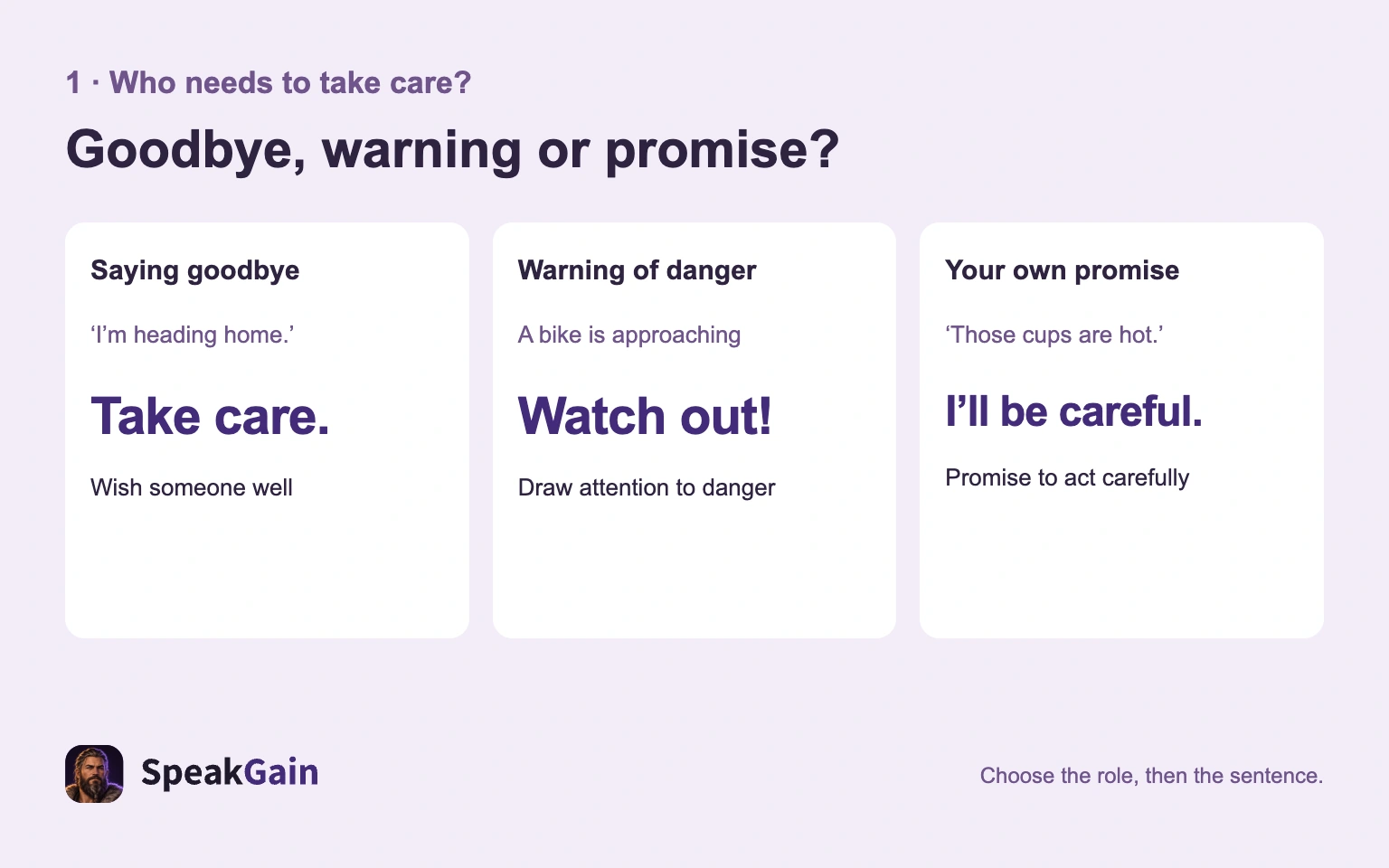
A goodbye can include a warning: Get home safe. The steps are slippery. The first sentence wishes someone a safe return; the second gives useful information. Ask: are they leaving, is there a specific danger, or am I promising to change my own action?
2. Say goodbye: home, travel and driving
Going home: Get home safe.
Get home safe. means you hope the person reaches home safely. Get home safely. is also an option. Text me when you get home. adds a request to contact you; it is not simply another way to say goodbye. Use it when you genuinely want that message and the relationship makes the request appropriate.
Alex: I’m heading home now.
Misaki: Get home safe. Text me when you get home.
In this sentence, say get home, without to. Practise the short wish first; add the request when you need it.
A trip: Have a safe trip. / Safe travels.
Have a safe trip. works as a wish for someone leaving on a holiday or business trip. Safe travels. is another travel wish, including in a short message. We choose Have a safe trip. for the first practice because trip keeps the situation clear. We do not claim that Safe travels. is always more polite or only suitable for long journeys.
Alex: I’m flying to Seoul tomorrow for work.
Misaki: Have a safe trip. See you next week.
| Situation | Phrase | Focus |
|---|---|---|
| Going home | Get home safe. | Arriving home safely. |
| Want an arrival message | Text me when you get home. | A specific request. |
| Leaving on a trip | Have a safe trip. / Safe travels. | The journey. |
| An ordinary goodbye | Take care. | A general parting wish. |
| Driving | Drive safe. / Drive safely. | Safe driving. |
Collins records Take care. as something you can say when saying goodbye. Drive safe. suits someone who will drive. If they are taking the train home, Get home safe. fits the situation better. For the wider leaving-and-returning exchange, see Japanese tadaima, okaeri and ittekimasu in English.
3. Be careful vs take care, and Drive safe
Be careful. asks someone to pay attention to avoid harm or mistakes; compare Collins careful. Be careful with that hot cup. identifies the object that needs care. Take care. has a goodbye use, but can also be a serious caution. Cambridge’s explanation describes both parting and danger contexts.
| Expression | Supported distinction | Our first choice |
|---|---|---|
| Take care. | Can be a goodbye or caution. | An ordinary goodbye. |
| Be careful. | Attention to avoid harm or mistakes. | A specific caution. |
| Drive safe. / Drive safely. | Both accepted in the cited dictionary explanation. | Someone who is driving. |
This is a practical preference, not a ban on Be careful. at the end of a conversation. Be careful. The roads are icy. makes sense when you have a real warning. The dictionaries do not establish that Be careful. is automatically rude or patronizing to a colleague.
Merriam-Webster accepts Drive safe and Drive safely. Here safe can function as a flat adverb, an adverb with the same form as an adjective. This does not mean you can remove -ly from every adverb. If unsure, Drive safely. is a straightforward choice; Drive safe. remains a valid conversational option.
4. Warn of danger, then name it
Watch out! is a short warning; Collins and the Cambridge explanation support that use. Careful! is another short call for attention, for example when someone holds something hot. Our first practice phrase for an immediate warning is Watch out!
Misaki: Watch out! There’s a bike behind you.
Alex: Thanks!
Say the short warning first, then add the information when there is time. These are language examples; do not create a dangerous situation to rehearse them.
| Danger or notice | Phrase | What to notice |
|---|---|---|
| Immediate danger | Watch out! / Careful! | Something approaching or about to happen. |
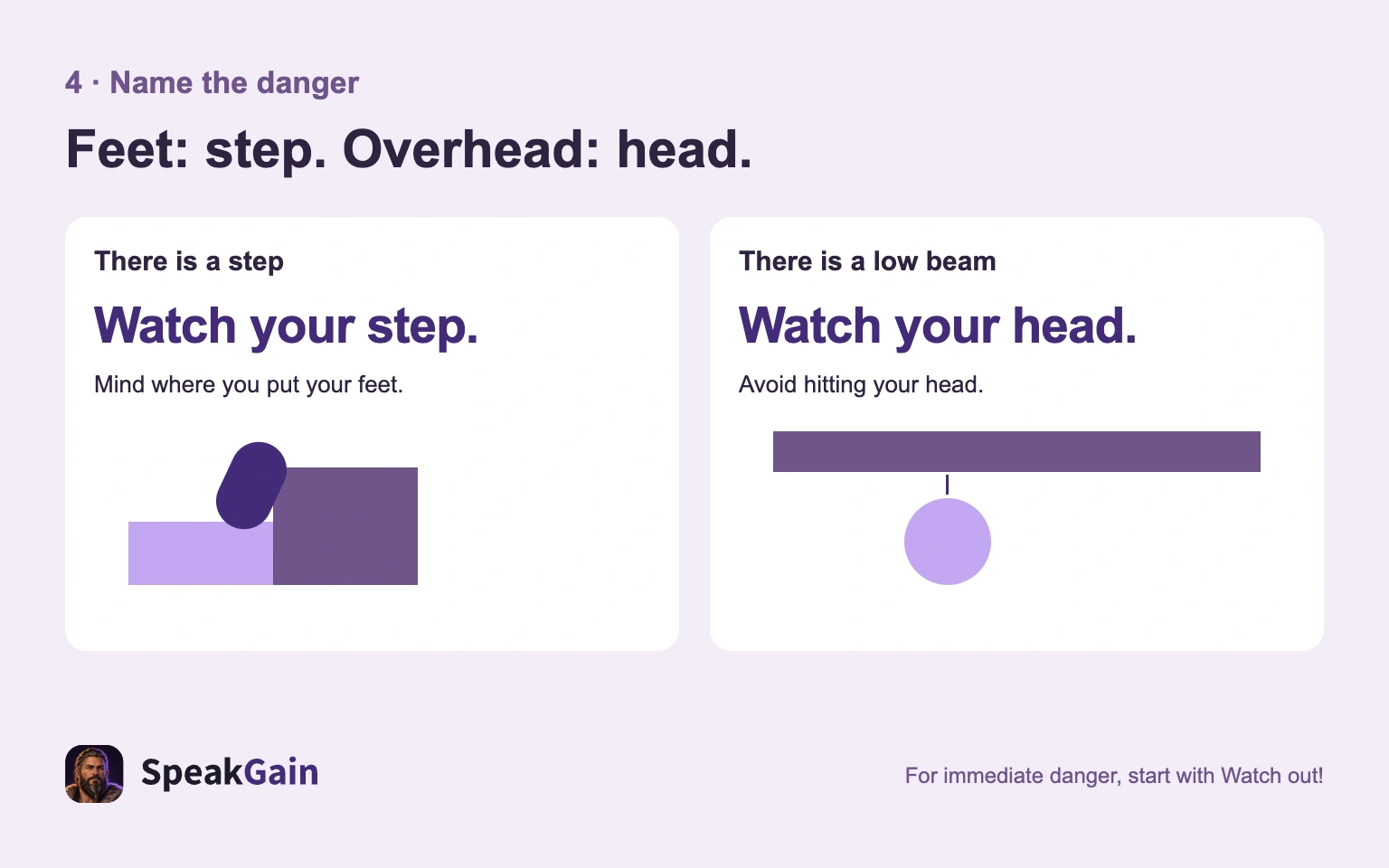
| A step | Watch your step. | Where you put your feet. |
| A low beam | Watch your head. | Something above your head. |
| A notice | Caution: Wet floor. | The information after the warning. |
| A train/platform gap | Mind the gap. | The gap while boarding or leaving. |
Cambridge step includes a warning to someone getting off a bus. Please watch your step. There’s a small step here. is a useful example for guiding a visitor. Watch your head. warns against hitting your head; it is not a question about how your head feels.
Collins caution includes a warning or warning notice. Read what follows Caution; the word alone does not give you a universal severity rating. The Greater London Authority’s official answer describes announcements and platform markings warning of Underground gaps. Mind the gap. is not a general goodbye wish.
5. Promise what you will do
I’ll be careful. is your own commitment. Be careful. addresses the other person. If someone says Be careful with those cups., you can reply I will. I’ll carry them one at a time.
| Reply | Commitment | Possible action |
|---|---|---|
| I’ll be careful. | Act with care. | Carry one cup at a time. |
| I’ll keep that in mind. | Remember advice. | Remember to copy a file before editing. |
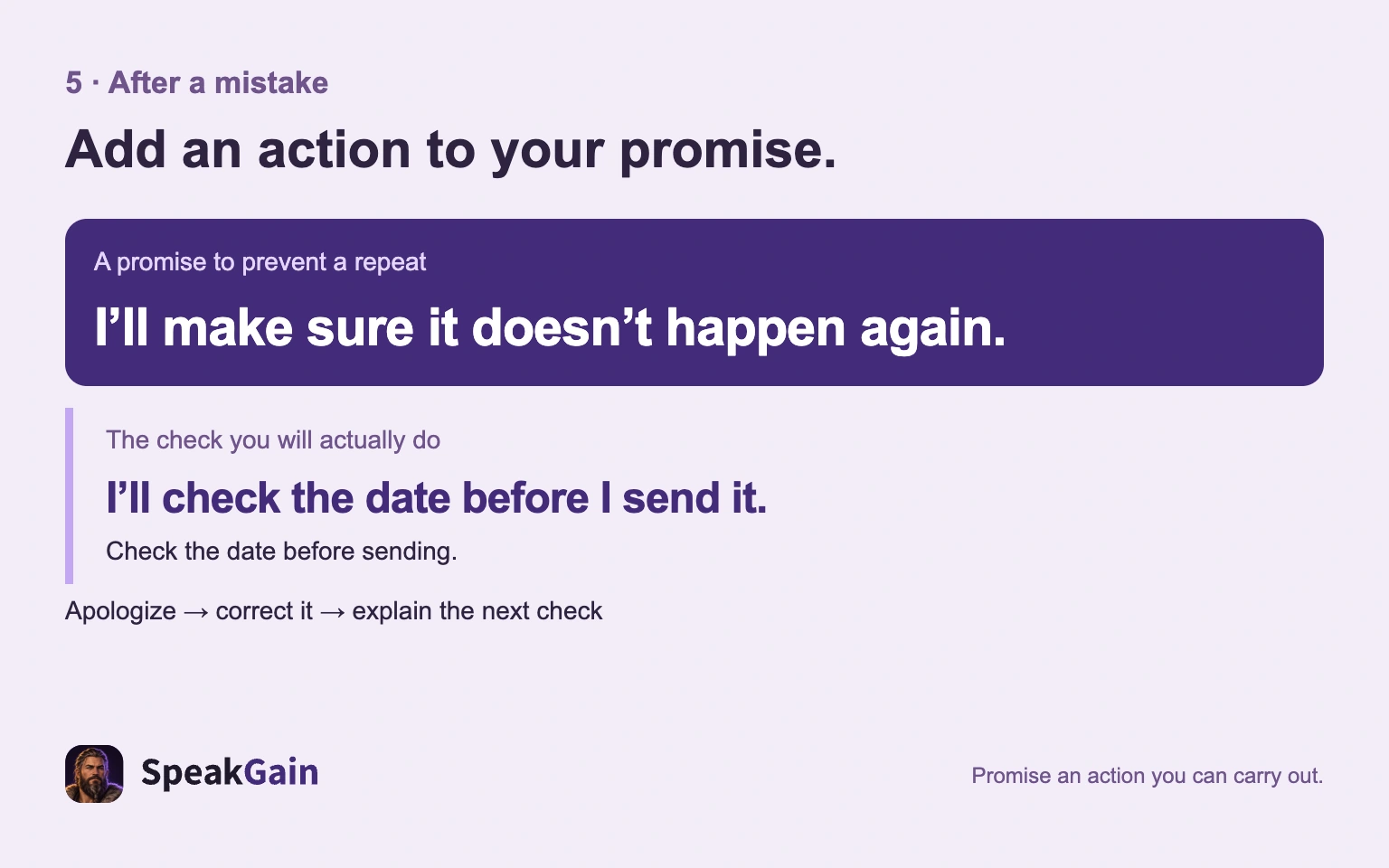
| I’ll make sure it doesn’t happen again. | Prevent the same mistake. | Check the date before sending. |
I’ll keep that in mind. means you will remember the information when thinking or deciding; see Cambridge. It does not report that a mistake has already been corrected. If an immediate correction is needed, respond to that task: I’ll correct it now.
I’ll make sure it doesn’t happen again. promises to prevent a repeat after your mistake. It is stronger in responsibility than an ordinary parting wish. We recommend a short apology, a correction if needed, and one realistic check.
Misaki: I’m sorry. I used the wrong date.
Alex: Please check it before sending it next time.
Misaki: I’ll make sure it doesn’t happen again. I’ll check the date before I send it.
Saying the phrase does not guarantee forgiveness. For choosing the apology itself, see how to apologize in English.
6. Reply to the intention
| What you hear | A reply | Reason |
|---|---|---|
| Take care. | Thanks, you too. | Return the kind wish. |
| Get home safe. | Thanks. You too. | If the other person is also going home. |
| Have a safe trip. | Thanks! | The other person may not be travelling. |
| Be careful. | I will. / Thanks, I will. | Accept the caution. |
| Text me when you get home. | I will. | Promise to send the message. |
Do not use You too. automatically. Match what the other person is actually doing. I will. refers to the action just requested, so practise it with the previous line. For wishes to someone who is ill, see odaijini and feeling sick in English. For broader conversation openings and endings, see English greetings and How are you?.
7. Misaki’s three scenes: listen, then speak
Misaki works with Alex. After a work dinner he leaves for home; the next day he goes on a business trip; later she notices a wrong date on a work schedule. The recordings below are practice models generated with SpeakGain’s Deep-voiced Viking, not recordings of a real conversation.
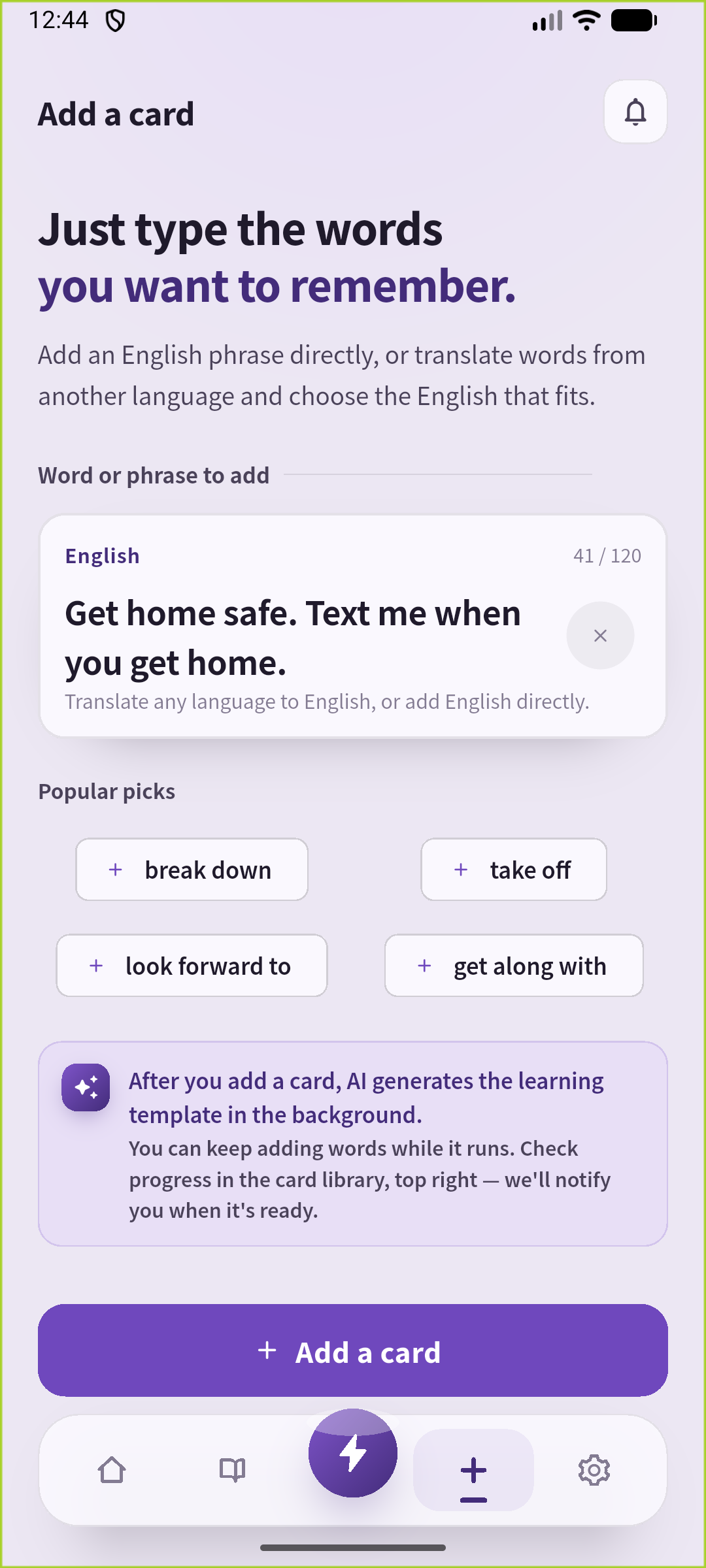
Seeing a colleague home: Get home safe. Text me when you get home.
Wish them a safe return, then ask for an arrival message if appropriate.
Listen once, pause, and say the sentence. Then hide the English and recall it from the scene. Save the sentence in SpeakGain’s Add screen using Add a card; the real screenshot shows that shared English input.
When Alex leaves for his business trip, Misaki chooses trip rather than home.
A colleague leaving on a business trip: Have a safe trip.
Wish them a safe journey.
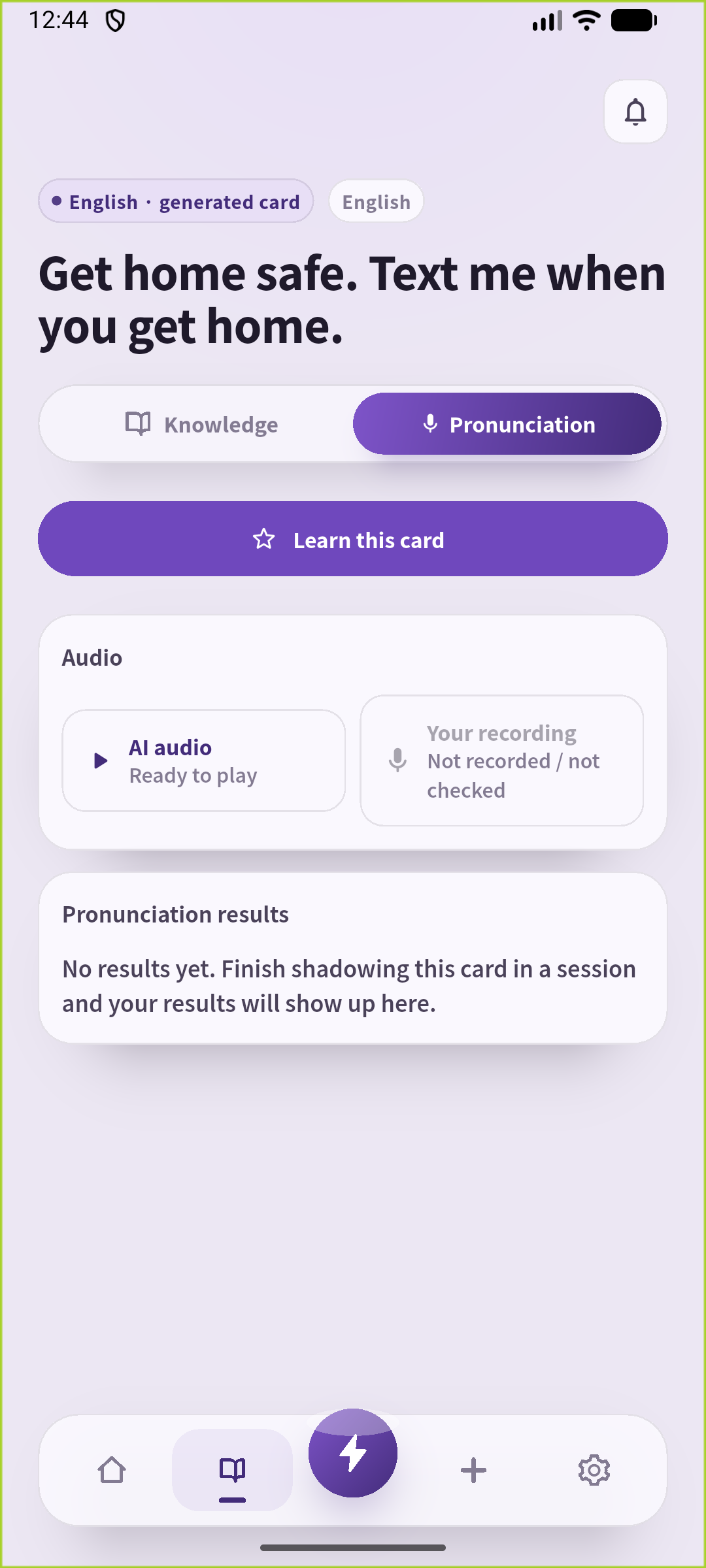
Open the card’s Pronunciation screen to hear the model, stop playback, and say it yourself. The actual screen below shows a playable recording. What is SpeakGain? explains the basic workflow. Listening alone is not a claim of acquired fluency.
After the date mistake, Misaki corrects it and commits to checking before sending.
After a small work mistake: I'll make sure it doesn't happen again.
Add your own next action: I'll check the date before I send it.
Later, pick one of the three scenes and retrieve the sentence before looking at the answer. Karpicke and Roediger (2008) studied Swahili–English word pairs in university students and found benefits from continued retrieval practice for later recall. The study did not test these sentences, spoken fluency or SpeakGain. Hiding the English and recalling it from a scene is our editorial application, without a guaranteed time-to-fluency claim.
8. Common questions
Goodbyes, cautions and replies
Can every kiwotsukete become Be careful.?
It can fit a specific caution. For an ordinary goodbye, we prefer Take care.; for a return home, Get home safe.; for travel, Have a safe trip. Choose the intention, not just a literal equivalent.
Is Drive safe. wrong?
The cited Merriam-Webster explanation accepts both Drive safe. and Drive safely. It does not authorize dropping -ly everywhere.
Does “I’ll keep that in mind” mean “I have fixed it”?
No. It acknowledges information to remember. Report the correction separately if it is needed.
Should I always reply “You too”?
Only when returning the wish makes sense. Someone seeing you off at an airport may not be travelling; Thanks! is enough.
Choose one person and one scene today. Wish them well, warn them, or commit to your own action. Listen, pause and say the sentence, then recall it later without looking.