
Get well soon in English: care for someone and say you are feeling unwell
Published
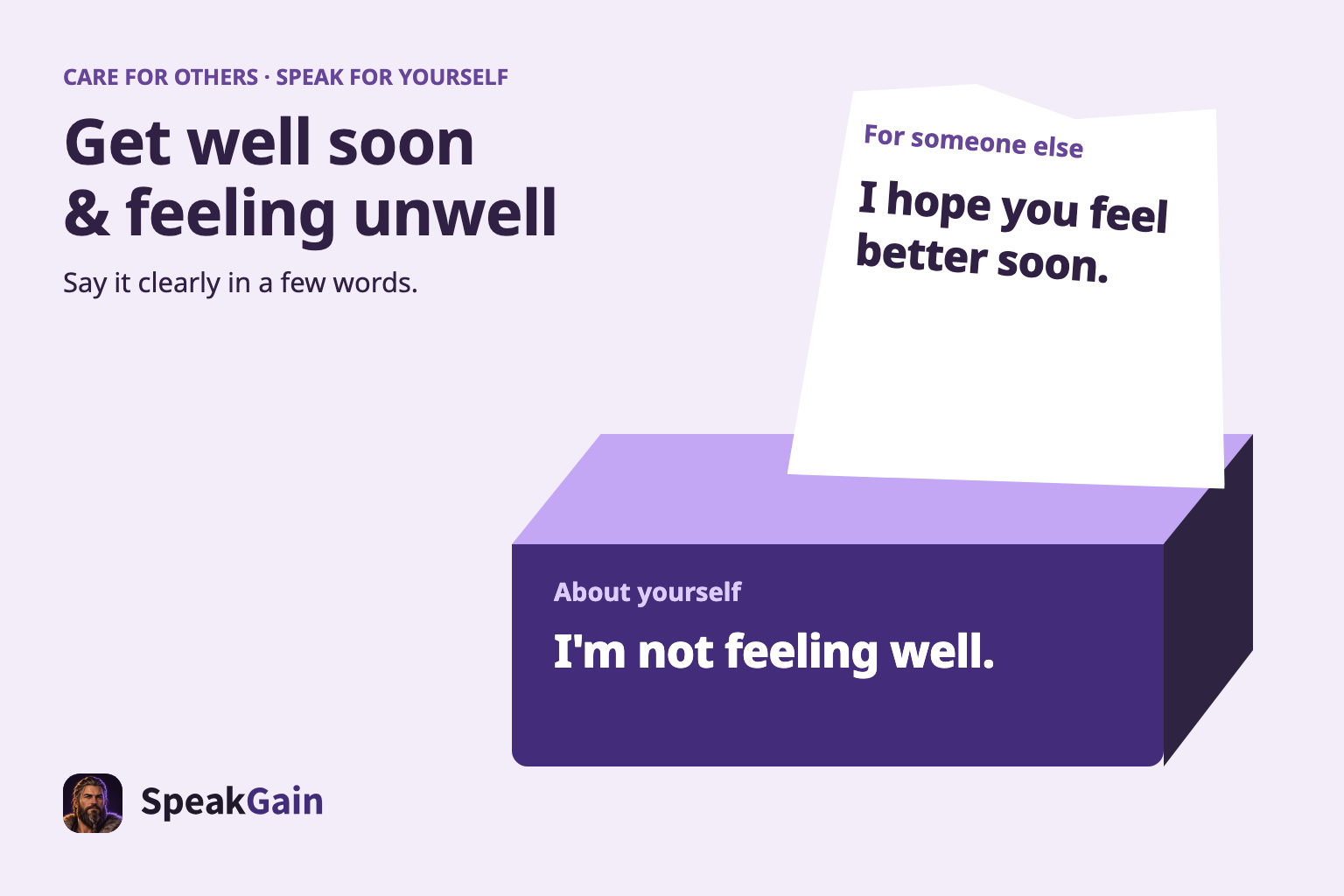
To wish someone well when they are ill, start with these three lines:
- Take care. — A caring closing line.
- Get well soon. — A short wish for recovery.
- I hope you feel better soon. — An explicit wish that they feel better.
To describe your own condition, start with these three:
- I’m not feeling well. — A general report of feeling unwell.
- I don’t feel well. — Another way to report feeling unwell.
- I have a cold. — A specific statement that you have a cold.
Our editorial recommendation is to learn Take care. and I hope you feel better soon. first. One closes an exchange briefly; the other makes your wish clear. For your own condition, begin with I’m not feeling well. and add I won’t be able to come in today. when your message is about absence. A caring reply and a sick-day notice do different jobs.
Misaki is our worked example. She replies to Alex, a colleague who is off sick. On another day, she has a fever and messages her boss, Sam. The examples concern everyday communication, not treatment or decisions about medical care.
For words of care at the end of a conversation, practice choosing between a farewell, a warning, and your own promise, including what to say before a trip or a journey home.
1. Choose a closing line or a recovery wish
Take care. is also a goodbye, not a phrase reserved for illness. After someone says they are unwell, it can be a caring “look after yourself.” After a normal visit, it may simply close the conversation. Let the preceding message supply the context.
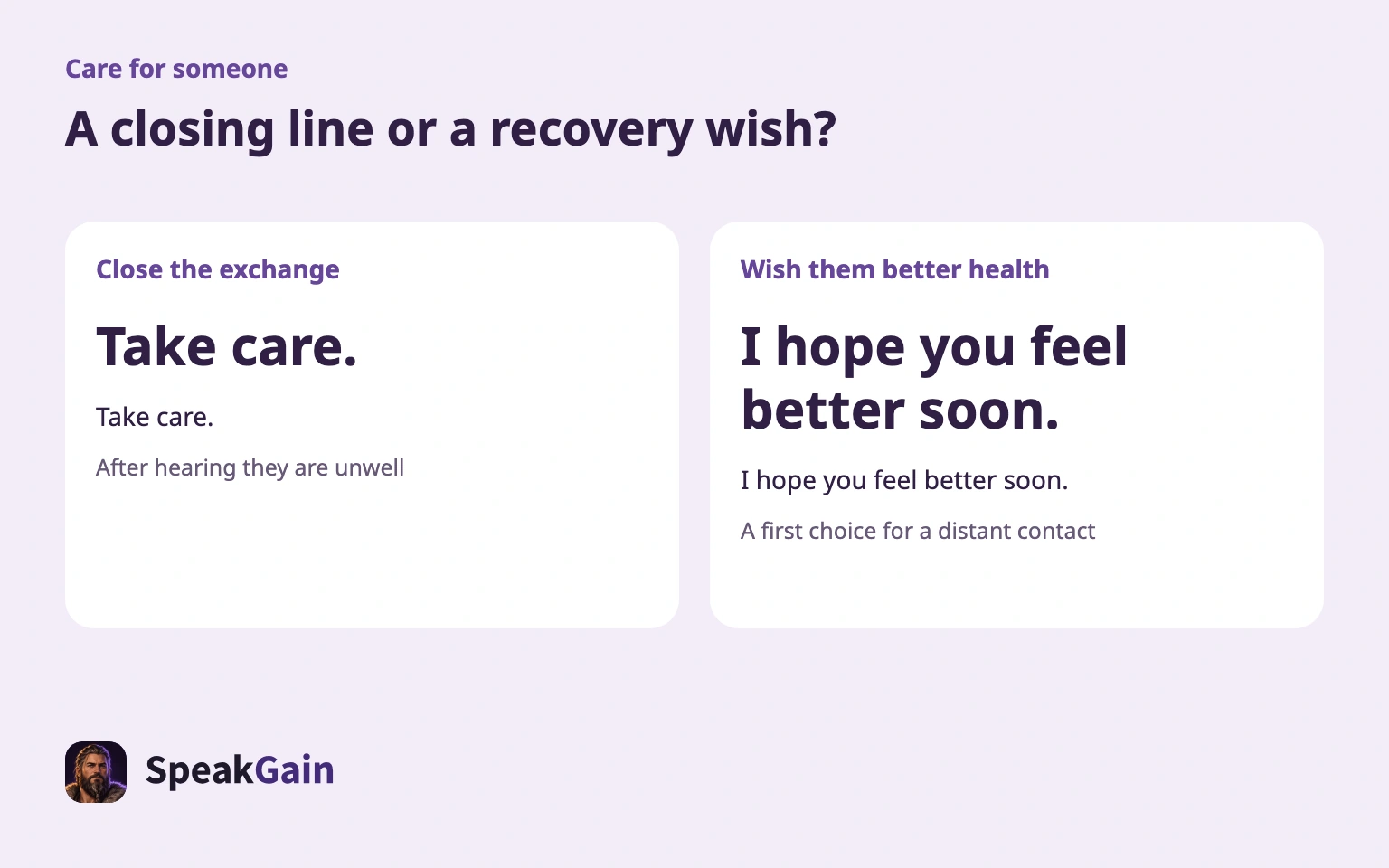
Get well soon. wishes the person recovery. I hope you feel better soon. states what you hope for. Our first choice for a colleague you do not know well, a boss or a client is the full sentence: it expresses care without asking when they will return. Feel better! is a shorter option for a friend’s usual brief messages. These are choices about communication, not a scale of how serious an illness is.
Dictionary evidence: Take care (of yourself), Well, Better.
2. Write to a colleague, boss, client or friend
Alex writes that he is unwell and cannot come in. Misaki acknowledges the news and wishes him well. She does not need a diagnosis or a return date to reply kindly.
Alex: I’m not feeling well. I won’t be able to come in today.
Misaki: I’m sorry to hear that. I hope you feel better soon.
Alex says he is unwell and cannot come in today. Misaki replies that she is sorry to hear that and hopes he feels better soon.
| Who | Example | Editorial choice |
|---|---|---|
| Colleague | I hope you feel better soon. Take care. | A clear wish plus a short closing line. |
| Boss | Thank you for letting me know. I hope you feel better soon. | Thank them for the update, then express care. |
| Client | I’m sorry to hear you’re not feeling well. I hope you feel better soon. | Refer only to what they told you. |
| Close friend | Feel better! Take care. | Match your usual short chat style. |
This is not a rigid hierarchy of English politeness. A short line is not automatically forbidden with a boss. Consider how you normally address the person and how they wrote to you. For email, an opening, a brief acknowledgment and one caring sentence are enough to build from.
Dear Taylor,
Thank you for letting me know. I’m sorry to hear you’re not feeling well.
I hope you feel better soon.
Best regards,
Misaki
Thank Taylor for the update, acknowledge that they are unwell and wish them better health. Add a scheduling response only when you can actually arrange it.
To a friend, Take it easy. can add “rest or relax.” Keep it a conversational expression; do not turn the reply into treatment instructions. We recommend a recovery wish before encouragement about effort. Support before an exam or presentation is a different task; see encouragement in English.
Dictionary evidence: Take it easy.
3. Report your condition without overstating it
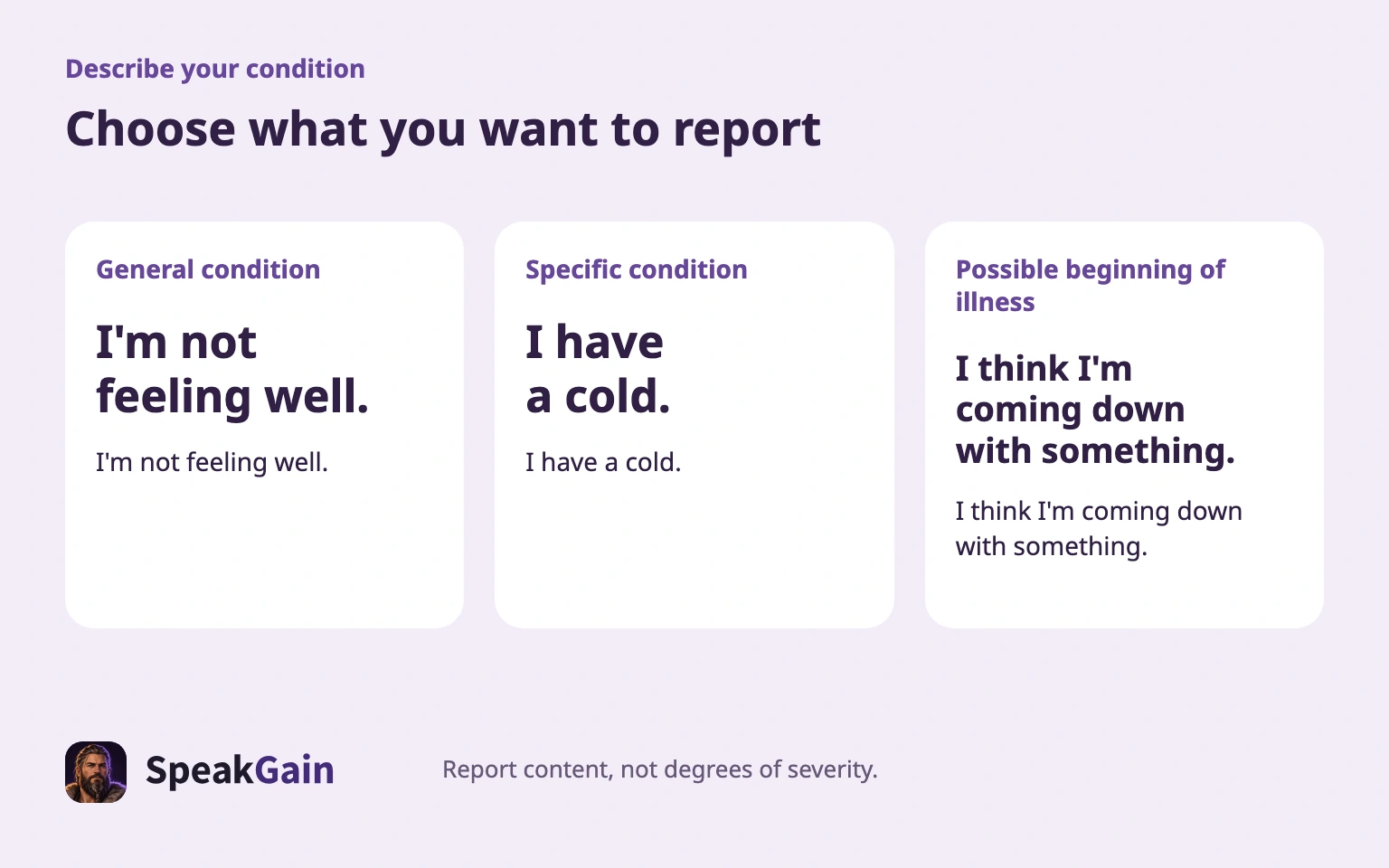
I’m not feeling well. and I don’t feel well. both report that you feel unwell. Dictionary examples use both forms. We do not infer sudden versus long-term illness, or severity, from this tense difference. Pick the line you can say readily, then add the information the listener needs.
I have a cold. describes a specific condition. I’m cold. means that you feel cold: the temperature meaning differs from the noun phrase a cold. Learn the whole sentence, not only the word.
I think I’m coming down with something. reports a possible beginning of illness. Come down with concerns starting to suffer from an illness; I think and something make this a tentative, unspecified statement. It does not say you have identified a cold. In our scenario Misaki knows she has a fever, so she adds I have a fever..
| What to report | English | What it tells the listener |
|---|---|---|
| General condition | I’m not feeling well. | No illness named |
| General condition | I don’t feel well. | Do not rank it as more or less serious |
| Specific condition | I have a cold. | A cold |
| Possible onset | I think I’m coming down with something. | A tentative report, without a named illness |
Dictionary evidence: Well, Feel, Come down with something, Cold.
4. Six basic words for illness and symptoms
Use a word for the condition you want to communicate. This table gives basic dictionary meanings, not a way to diagnose yourself. The first two are illness words; the others describe temperature or pain.
| Word | Basic meaning | Example |
|---|---|---|
| cold | A common infection, especially in the nose and throat. | I have a cold. |
| flu | Influenza, an infectious illness. | I have the flu. |
| fever | Body temperature higher than usual. | I have a fever. |
| headache | Pain inside the head. | I have a headache. |
| sore throat | A painful throat, especially when swallowing. | I have a sore throat. |
| stomachache | Pain in the stomach or belly. | I have a stomachache. |
Do not use flu merely as a stronger synonym for cold. I have the flu. names influenza. The dictionary includes the form with or without the; here we practice one complete sentence. For the other five examples, keep I have a… with the condition. You do not need to list all six when a short statement will do. Clinic conversations require different detail and are outside this guide.
5. Tell work what changes today
I’m calling in sick today. announces a sick-day notification. Dictionaries describe call in sick as informing an employer, normally by phone, that illness prevents you from working. On the phone it is a useful way to name your purpose.
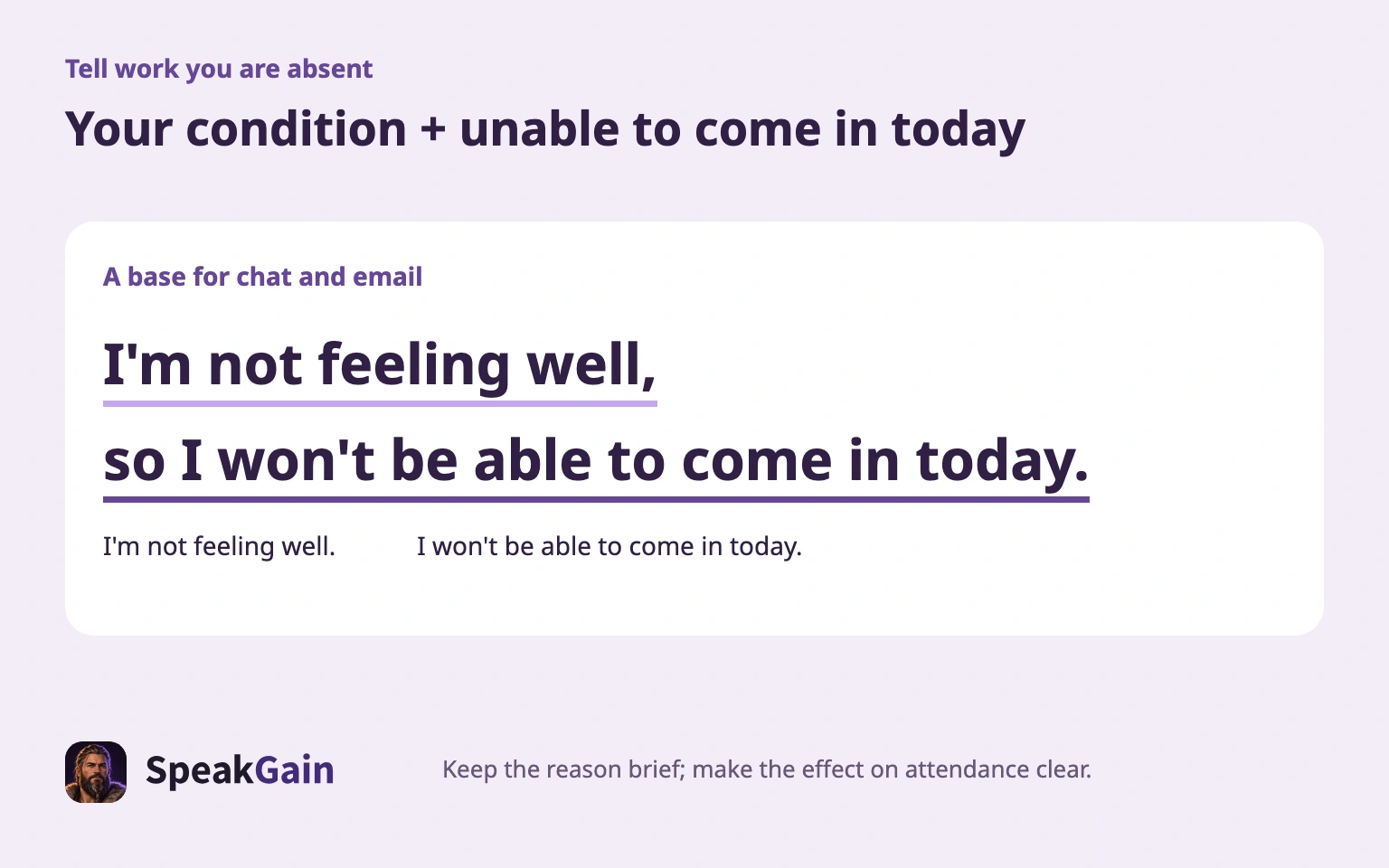
For chat or email, we recommend I’m not feeling well, so I won’t be able to come in today. It states your condition and today’s attendance clearly. Come in refers to coming to work in this example. For a class or an online meeting, name that activity instead.
Our editorial rule is to keep the reason brief and the effect on attendance explicit. I’m not feeling well. alone does not say whether you will attend. A long history without today’s decision is no clearer. Use the reporting channel and required information you have confirmed with your workplace; do not add a promised recovery date or availability merely to sound helpful.
Dictionary evidence: Call in sick, Sick.
Phone: identify yourself and state your purpose
Hi Sam, this is Misaki. I’m calling in sick today.
I’m not feeling well, so I won’t be able to come in today.
Misaki identifies herself, says she is calling in sick and explains that she cannot come in today. For call openings and clarification, see English phone calls.
Chat: Misaki tells Sam about her fever
Hi Sam, I’m not feeling well. I have a fever, so I won’t be able to come in today.
Misaki states her condition, fever and today’s absence. If she does not need to name the symptom, she can leave out the fever clause. When Sam wishes her well, she can reply Thank you. I appreciate it..
Email: put today’s absence in the subject
Subject: Sick leave today — Misaki
Hi Sam,
I’m not feeling well, so I won’t be able to come in today.
Thank you for your understanding.
Misaki
The subject identifies today’s sick leave and the sender. The body gives the condition and absence briefly. Add only a handover or task update that you can actually provide.
6. Cancel the specific plan
For dinner with a friend, I’m not feeling well, so I won’t be able to come to dinner tonight. names the plan you cannot attend. I’m sorry for the short notice. apologizes for late notice; Can we reschedule? asks to find another time. Wait for a reply before fixing the replacement date.
For a teacher, use I’m not feeling well and won’t be able to attend class today. For a host family outing, change the activity to go out with you today. The condition can stay the same while the affected plan changes. See requests in English for asking to rearrange things, and checking if someone is okay for responding honestly to a check on your condition.
Hi Alex, I’m not feeling well, so I won’t be able to come to dinner tonight.
I’m sorry for the short notice. Can we reschedule?
Misaki cannot attend dinner tonight, apologizes for the short notice and asks Alex whether they can reschedule.
7. Practice both sides as Misaki
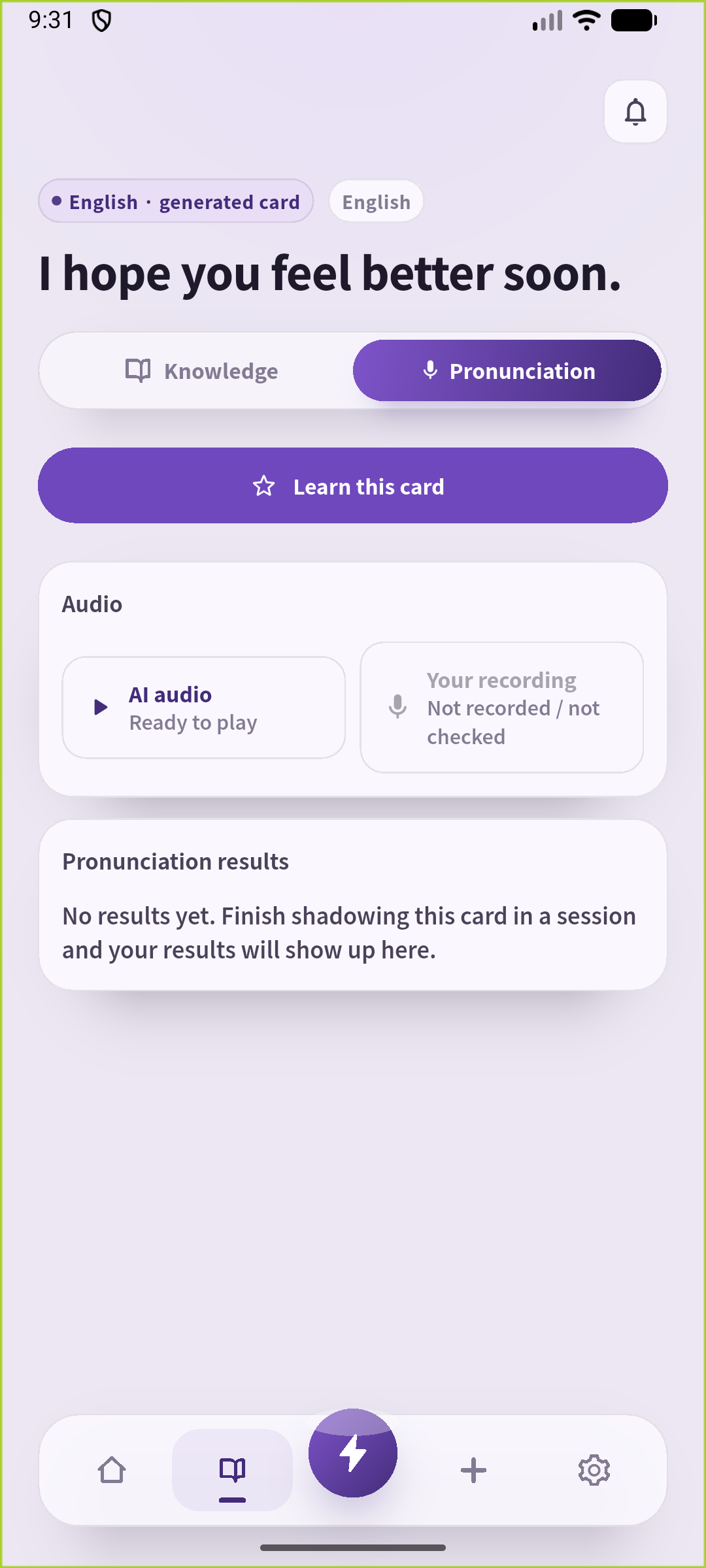
Save one sentence per card in SpeakGain: I hope you feel better soon., I’m not feeling well. and I won’t be able to come in today.. The English Add screen shown here contains the first sentence. Separating care, your condition and attendance gives each card a clear role.
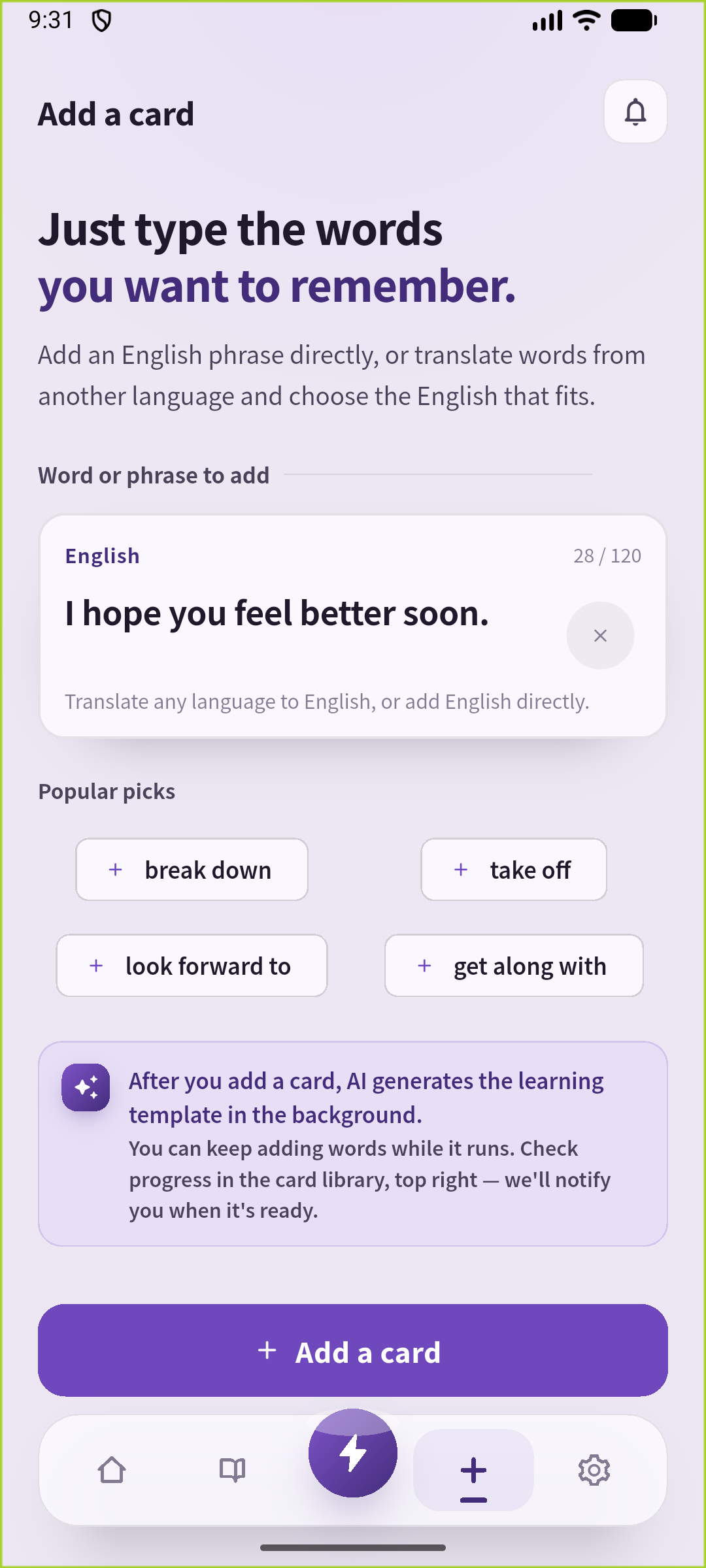
Listen to the first clip, modeled by SpeakGain’s Deep-voiced Viking voice. Then say it as Misaki replying to Alex’s sick-day message. Aim to communicate the wish, rather than imitate the depth of the voice. Imagine Alex replying Thank you. to complete the exchange.
I hope you feel better soon.
An explicit wish that they feel better.
Now switch roles: Misaki has a fever and needs to tell Sam she will be absent. Listen to I’m not feeling well., then say it yourself. Add I have a fever. for this scenario. Finally listen to the absence line and put it after the condition. On the phone, add your name and the purpose of the call; in chat, type the short notice.
I'm not feeling well.
A general report of feeling unwell.
I won't be able to come in today.
Say you cannot come in today
Hide the English and use only the scenes: “Alex is off sick” and “I have a fever and must tell Sam I cannot come in.” Say the appropriate sentence or pair of sentences. If you cannot recall it, check once and hide it again. Notice whether you refers to the colleague or I refers to you, and whether you included today in the notice.
the original 2008 paper by Karpicke and Roediger reports an experiment with university students learning 40 Swahili–English word pairs. Continuing retrieval after a first correct answer benefited recall one week later. It did not test sick-day conversations, pronunciation or SpeakGain. Our practical application is to add recall from a scene to listening, not to claim the app reproduces the experiment’s results. Tomorrow, change a single condition: a friend instead of a colleague, or class instead of work. For planning review, see English study habits.
Common questions
Common questions
Must I add Please to a get-well wish?
No automatic addition is needed. We recommend Take care. or the complete wish I hope you feel better soon. as starting choices.
Which feeling-unwell sentence is more serious?
We do not rank I’m not feeling well. and I don’t feel well. by seriousness. Both report feeling unwell; add the relevant condition or attendance information.
Is I’m cold the same as having a cold?
No. I’m cold. concerns feeling cold. I have a cold. reports a cold. Practice the complete noun phrase and verb together.
How do I answer a caring message?
Thank you. is enough; you can add I appreciate it.. Thank the person for caring without pretending you are already well.
Keep a caring reply and an absence notice ready
For someone else, choose a caring closing line or a recovery wish. For yourself, report your condition and, when relevant, today’s absence. Hear the three lines, recall them from Misaki’s two scenes and replace the people and plans with your own.
Sources
- Cambridge Dictionary — Take care (of yourself)
- Cambridge Dictionary — Well
- Cambridge Dictionary — Better
- Cambridge Dictionary — Feel
- Cambridge Dictionary — Take it easy
- Cambridge Dictionary — Come down with something
- Cambridge Dictionary — Call in sick
- Cambridge Dictionary — Sick
- Cambridge Dictionary — Cold
- Cambridge Dictionary — Flu
- Cambridge Dictionary — Fever
- Cambridge Dictionary — Headache
- Cambridge Dictionary — Sore throat
- Cambridge Dictionary — Stomachache
- Karpicke & Roediger (2008) — The Critical Importance of Retrieval for Learning