
How to say daijoubu in English: checking, reassuring, declining and permission
Published
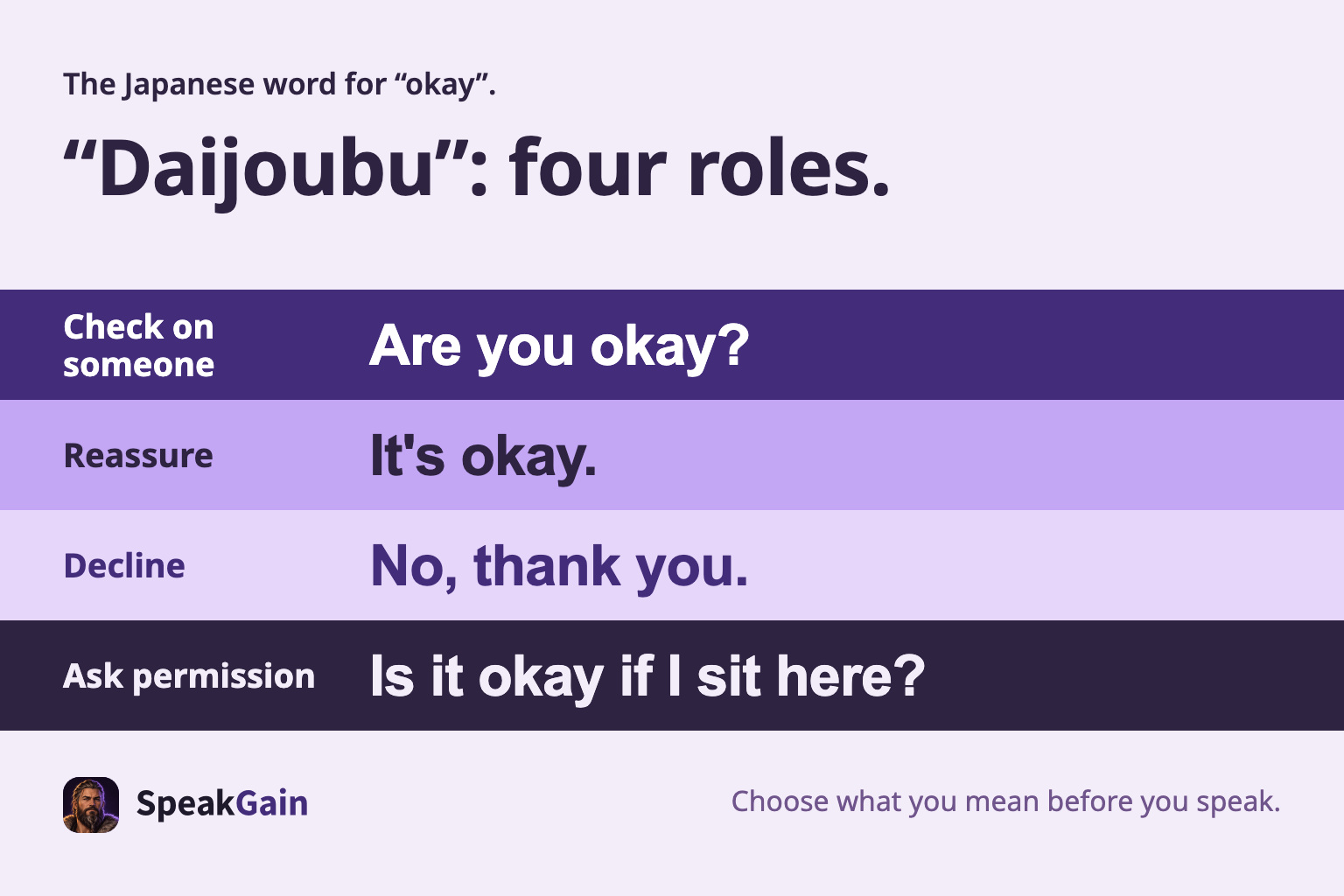
Japanese daijoubu has four useful conversational roles: check on someone with Are you okay?, reassure with It’s okay., decline with No, thank you., or ask permission with Is it okay if I sit here?. For a schedule, choose Does Tuesday work for you?. Translate what the speaker is doing, rather than assigning one English word to every occurrence of 大丈夫.
| Role | English starting point |
|---|---|
| Check on someone | Are you okay? |
| Reassure | It’s okay. |
| Decline | No, thank you. |
| Ask permission | Is it okay if I sit here? |
1. Choose the conversational role
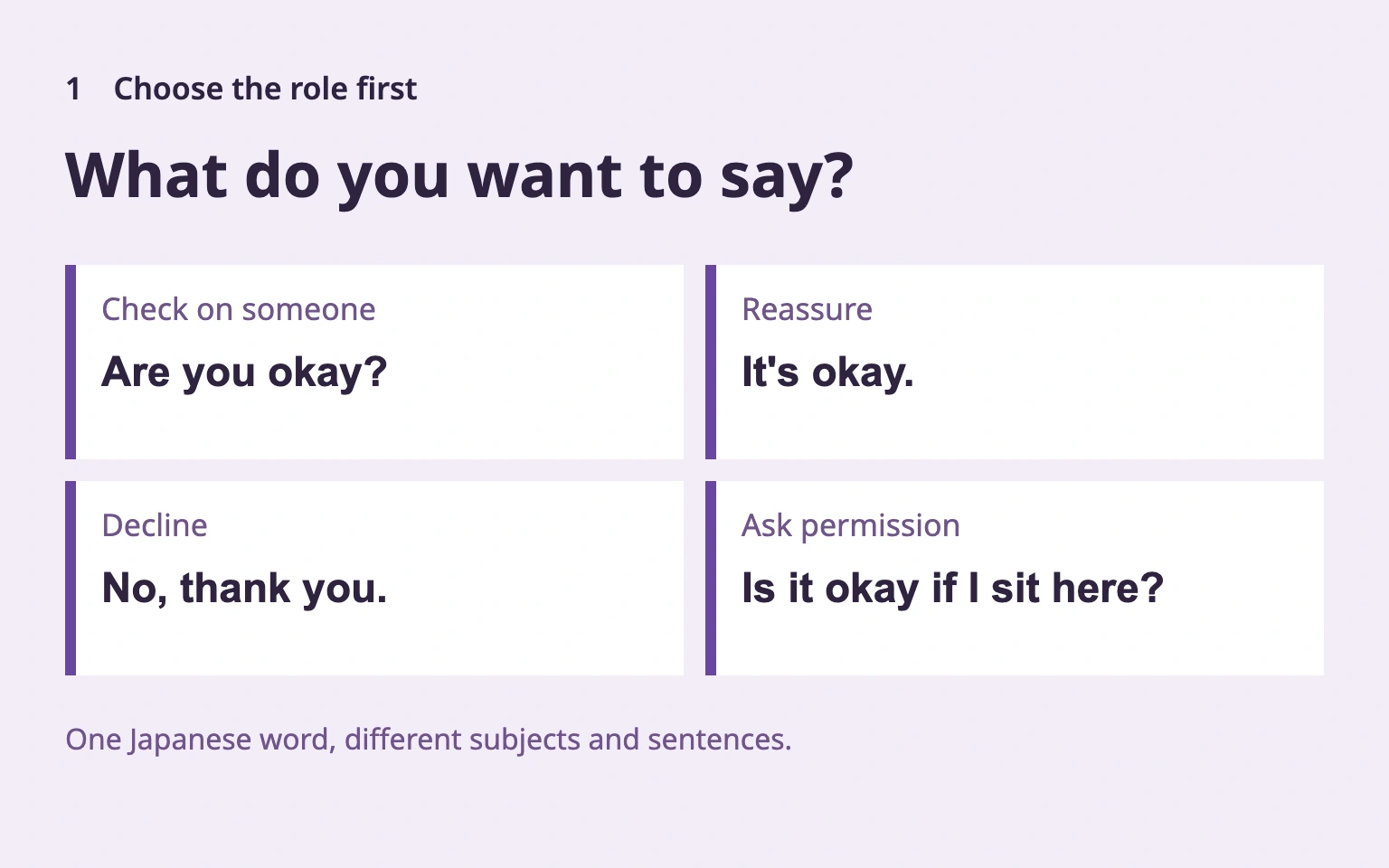
English speakers already distinguish ‘Are you okay?’, ‘It’s okay’ and ‘I’m okay’. Japanese can use daijoubu across these situations, including turning down something offered. That does not make every English okay a refusal. Our first choice for learners declining an offer is No, thank you: it makes the decision explicit before any reason. These are starting points, not rigid rules that exclude other natural expressions.
Dictionary and grammar examples 1 · Dictionary and grammar examples 2
The same role-first approach helps with yoroshiku onegaishimasu in English.
2. Check on the person or the situation
Use Are you okay? when a colleague looks unwell or a friend seems upset. Are you all right? also asks whether someone is safe or well, for example after a fall. They overlap: okay is not reserved for illness, and all right is not reserved for accidents. With Is everything okay?, you open the question to the wider situation, such as a colleague who has gone quiet during a task. Ask once and listen before guessing the problem.
Dictionary and grammar examples 1 · Dictionary and grammar examples 3
Are you okay?
Actually, I’m not feeling well.
3. Reassure: what is okay?
If a friend apologizes for keeping you waiting, It’s okay. responds to the incident. Add We still have time. only when it is true. Don’t worry about it. directs attention to the thing they are worried about. No problem. can answer thanks for help. I’m fine, thanks. reports your own condition: its subject is I, whereas It’s okay refers to the situation. We recommend naming what you can actually do rather than promising that an uncertain outcome will definitely be fine.
Dictionary and grammar examples 2 · Dictionary and grammar examples 4
Sorry I’m late.
It’s okay. We still have time.
For the other side of reassurance, see apologizing in English.
4. Decline an offer clearly
At a café, a refill you do not want calls for No, thank you.. I’m good, thanks. is another informal option. Oxford University Press describes I’m good as an indirect refusal of an offer, as well as having other contextual meanings. I’m okay, thanks. can also turn down a drink or help. A bare I’m okay. is not automatically incorrect or impolite; without the preceding question, it could be a report about health rather than a refusal. The sources do not establish a universal misunderstanding rate. We recommend an explicit refusal first, followed by a short, true reason such as I have enough.. A reason is optional, and you need not invent one. To accept the refill, say Yes, please.; thank you alone can accept an offer, so thanks is not a magic refusal marker.
Dictionary and grammar examples 4
Oxford University Press on indirect refusals 5
Teacher’s example of declining 6
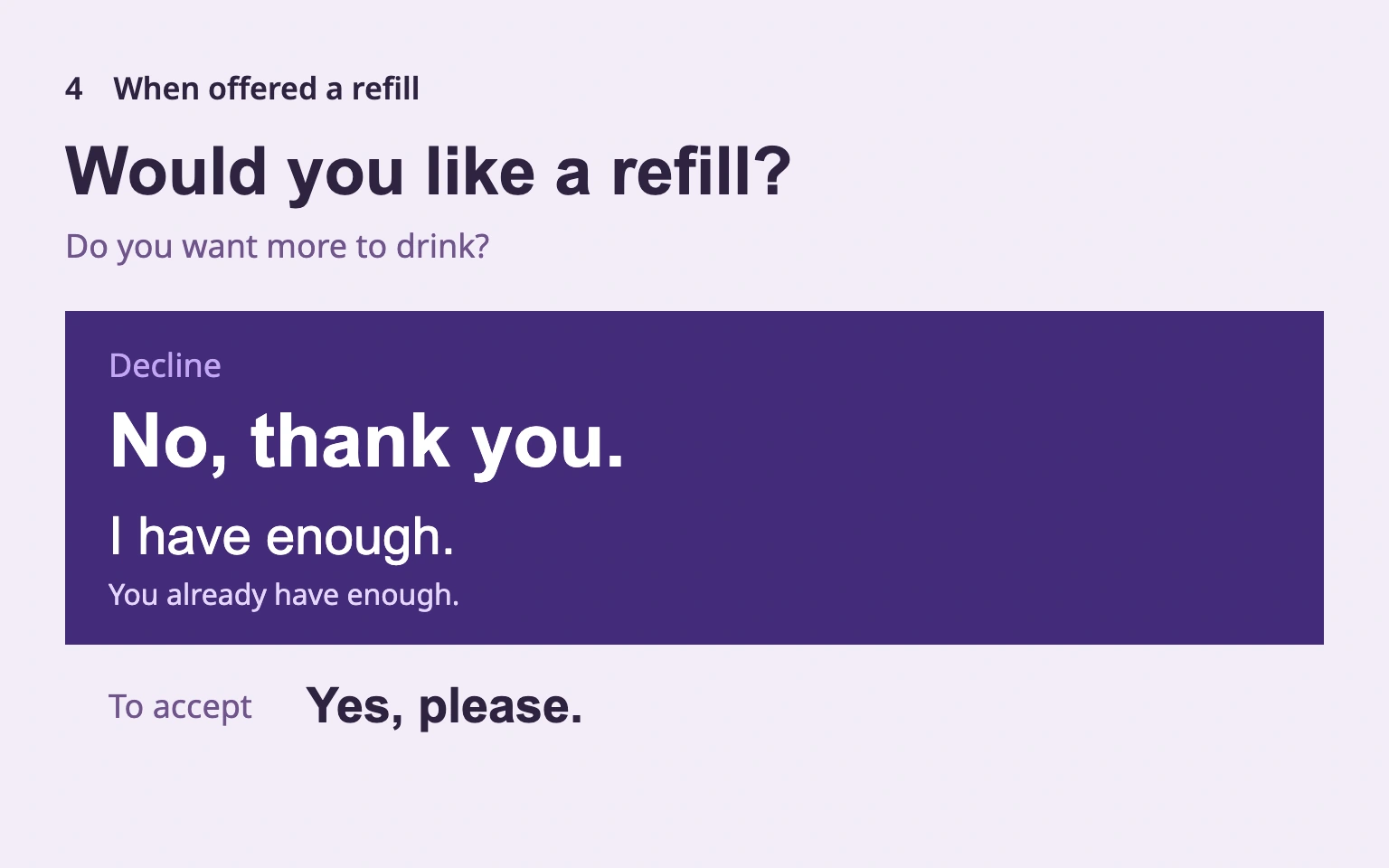
Would you like a refill?
No, thank you. I have enough.
5. Ask permission or check availability
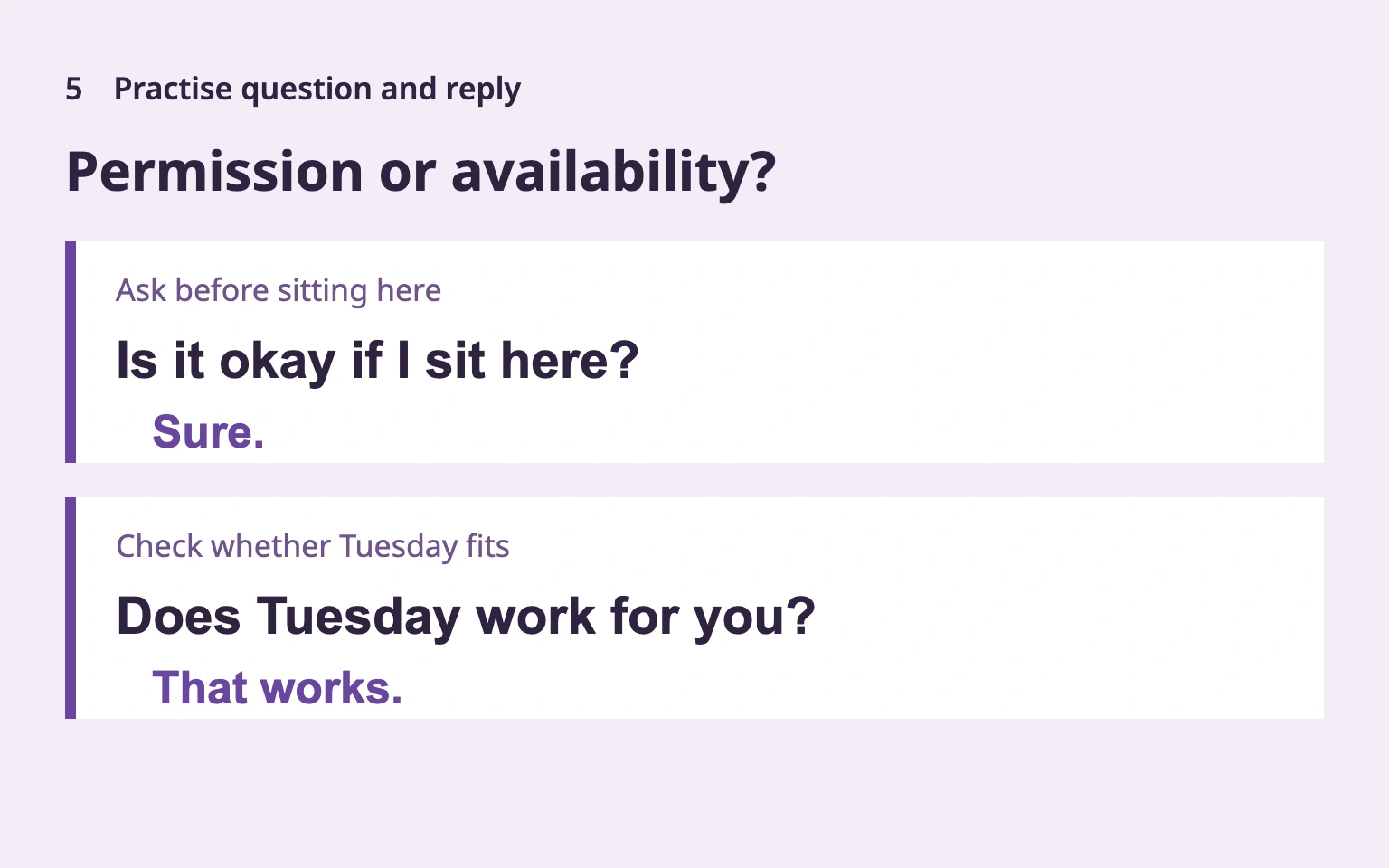
Ask Is it okay if I sit here? before sitting, then wait for Sure. or another answer. Is this okay? checks the proposal or object you both can see; if this is unclear, name it, as in Is this time okay?. For availability use Does Tuesday work for you?, with That works. as a positive reply. Here work means that the arrangement is suitable, not employment. If Tuesday is unsuitable, say Tuesday doesn’t work for me., then suggest How about Wednesday?. Asking whether you may act is different from asking the other person to do a task: Could you check this document? is a request.
Dictionary and grammar examples 1
| Question | Reply |
|---|---|
| Is it okay if I sit here? | Sure. |
| Is this okay? | It’s okay. |
| Does Tuesday work for you? | That works. |
For asking another person to act, see making requests in English.
6. Give an honest reply
When someone checks on you, I’m okay, thanks. thanks them and reports that you are okay. If you are not, you can say Actually, I’m not feeling well., followed by I need a break. if that is what you need. You do not have to give a positive answer to be polite. Listen to the actual question: a schedule needs a schedule reply, while an offer needs acceptance or refusal. Backchannel responses that show you are listening serve a different purpose.
Are you okay?
I’m okay, thanks.
Actually, I’m not feeling well. I need a break.
For listening signals rather than answers, see English backchannel responses.
7. Practise one person’s three scenes
Imagine Misaki at work. In the morning Alex looks unwell; at lunch a server offers a refill; in the afternoon they arrange a meeting. Misaki must hear the preceding line and choose what to say. Save three separate English cards in SpeakGain rather than putting every translation into one card.
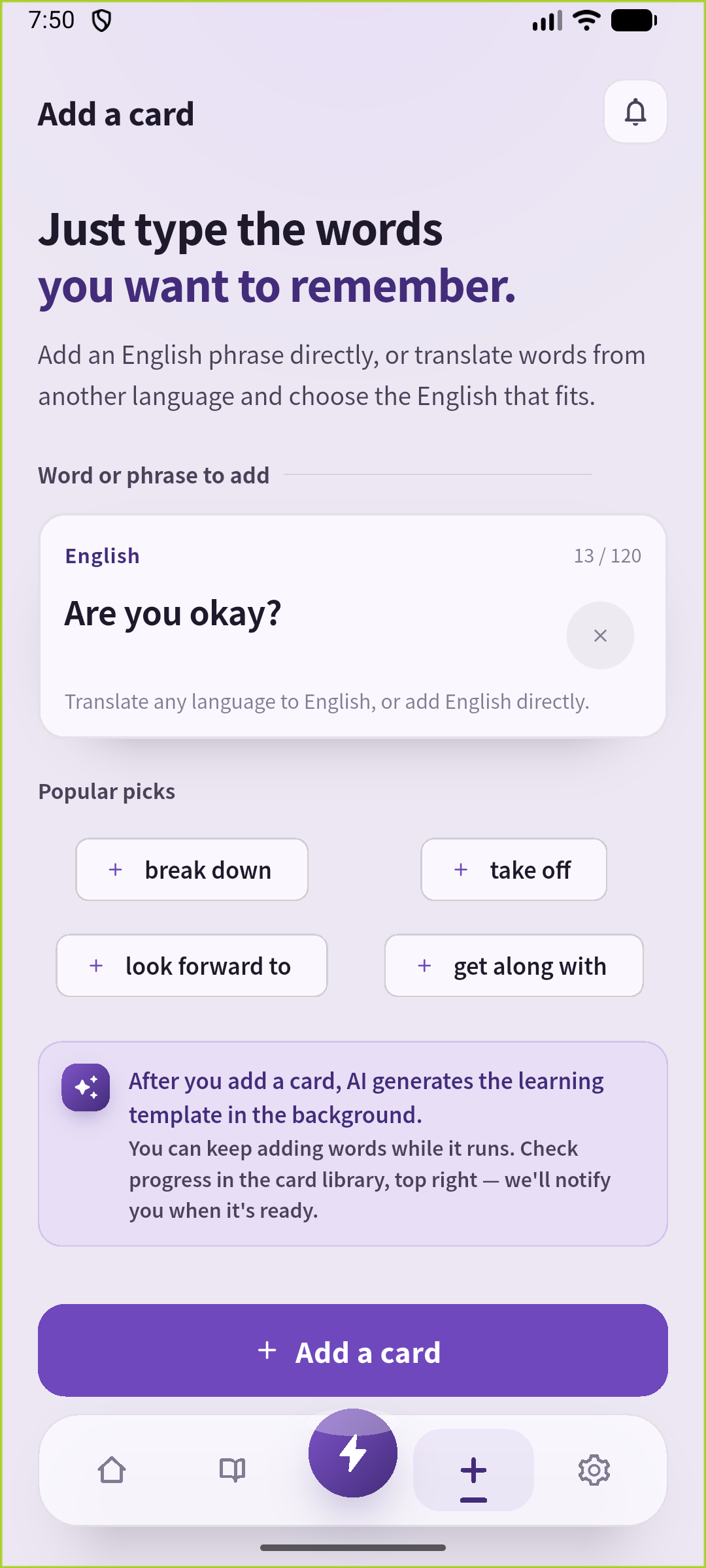
Save one sentence
- Are you okay?
- No, thank you. I have enough.
- Does Tuesday work for you?
The real app screen shows one English sentence entered for a card. The app screenshots use English in every locale so the practice sentences stay the same.
Listen, then say it
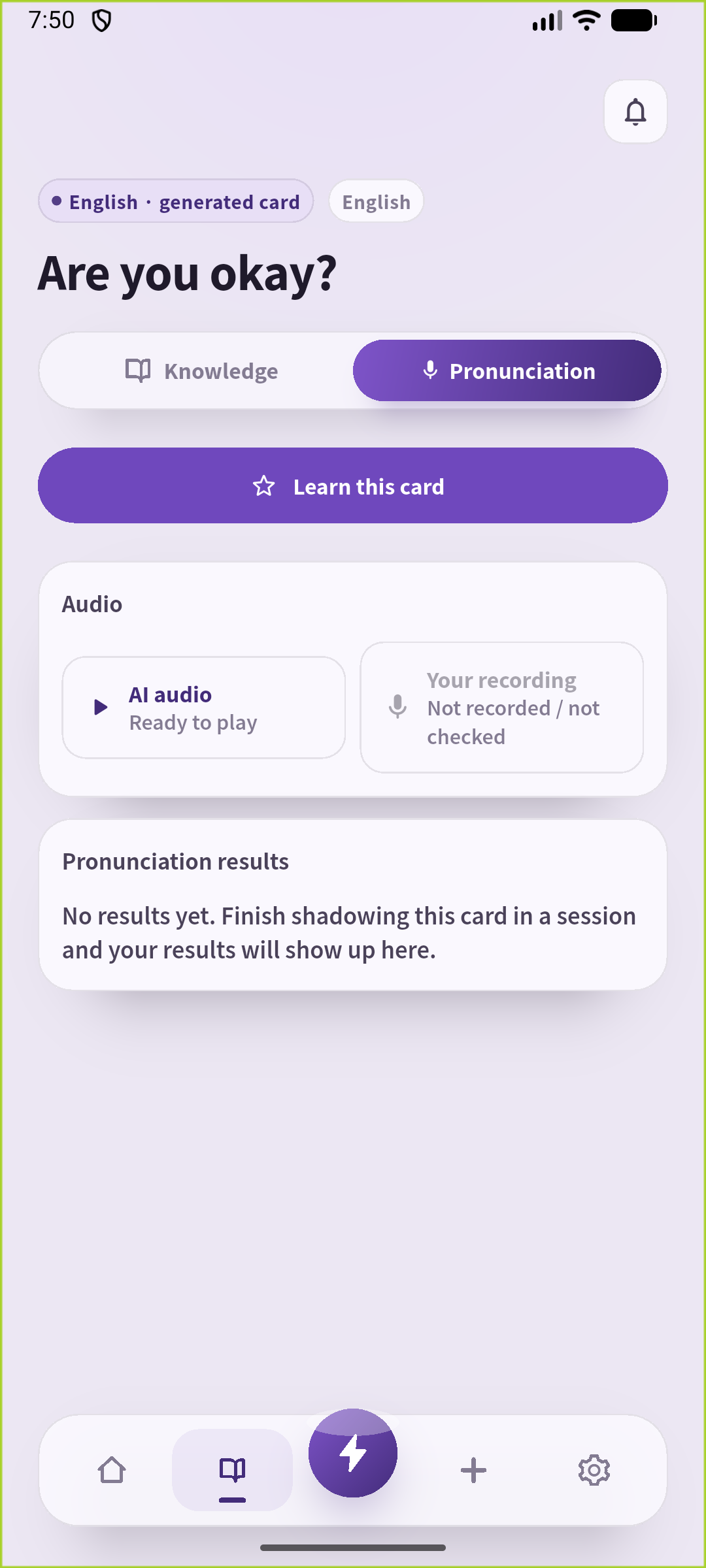
Morning: listen to Are you okay?, then ask Alex yourself. Alex answers Actually, I’m not feeling well. Your job is to check on Alex, before deciding whether to offer water or other help.
Are you okay?
The model is SpeakGain’s Deep-voiced Viking audio. Listen to the whole question, look away, and say it as a question addressed to a person. Matching the speaker’s voice is not the goal.
Lunch: the server asks Would you like a refill? Misaki still has a drink and does not need more. Say No, thank you. I have enough. Put the refusal before the explanation.
No, thank you. I have enough.
Afternoon: ask Does Tuesday work for you? Alex replies That works. If Alex apologizes for a late reply, switch roles and answer It’s okay. The same two people can move between checking, scheduling and reassurance.
Does Tuesday work for you?
Recall from the scene
Hide the English and use only the three scene cues. Recall the sentence, check it if needed, then hide it again. Tomorrow change one condition: want the refill, or make Tuesday unsuitable. Check whether your reply matches the changed scene, not only whether you recite the same list.
Karpicke and Roediger’s 2008 experiment used Swahili–English word pairs with university students. Continued retrieval after the first correct response helped recall one week later. It did not test daijoubu conversations or SpeakGain. Our suggestion to recall a sentence from a scene is an editorial application of that result, not evidence of a product benefit.
Plan your practice and review with how to study English.
Frequently asked questions
Four questions about choosing a line
Is daijoubu always ‘Are you okay?’?
Only when checking on the person. A refusal, reassurance, permission question or schedule check needs a line that fits that role.
Is ‘I’m okay’ wrong when declining?
No. It can decline an offer in context, but it also describes your condition. We recommend No, thank you as the first explicit refusal for learners.
Must I say ‘I’m fine’ when someone asks?
No. You can thank them and describe your real condition, including saying that you are not feeling well.
How do I accept a proposed time?
That works or That works for me. If it does not fit, name the day that is unsuitable and suggest an alternative.
Sources
Inspected sources
For a friend facing an exam or presentation, choose an encouragement line by timing—and a reply for your own effort—in how to say ganbatte in English.
For caring replies and your own sick-day notice, practice the short examples in get-well wishes and talking about feeling sick.