
How to apologize in English: Sorry, Excuse me and Thank you
Published Updated
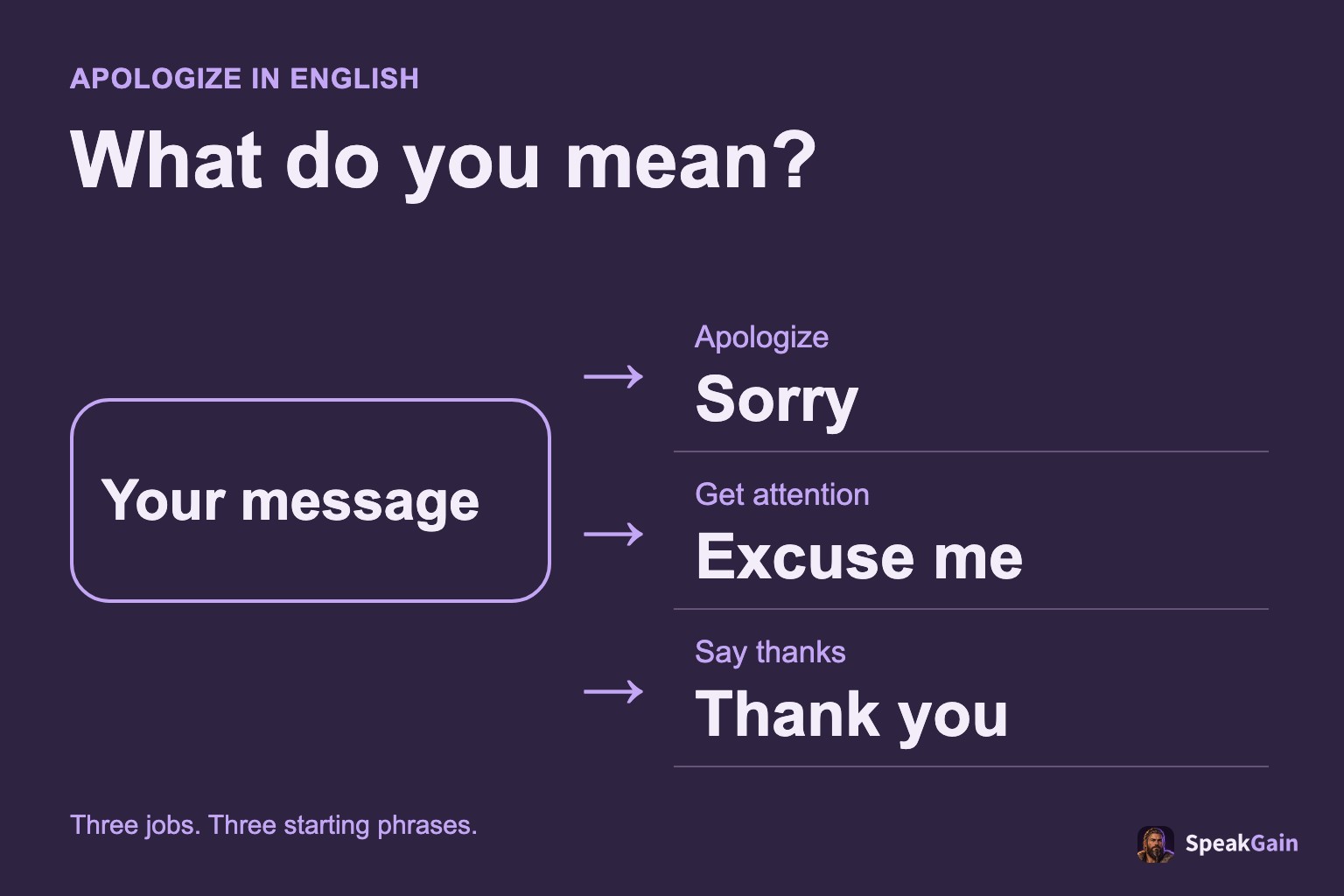
Say I'm sorry. to apologize, Excuse me. to get attention or ask to pass, and Thank you. when someone has helped you. For a work mistake, name the problem with I apologize for the error., then say what you will do to fix it. Start with the job the sentence needs to do, rather than searching for a more impressive synonym for “sorry.”
When your workplace cannot meet a request, practise customer-service lines for limits and checking that pair a short apology with verified facts.
Our editorial recommendation is to learn four starting phrases: I'm sorry., Excuse me., Thank you. and That's all right. The last one gives you a reply when someone else apologizes. These are starting choices, not a universal ranking of politeness.
1. Choose the job: apologize, get attention or give thanks
Japanese sumimasen can serve all three jobs. English has overlapping expressions too, but you do not need to apologize every time you approach a server or receive help. If you stepped on someone’s foot, apologize. If you need directions, get attention and ask your question. If someone picked up your wallet, make the thanks clear.
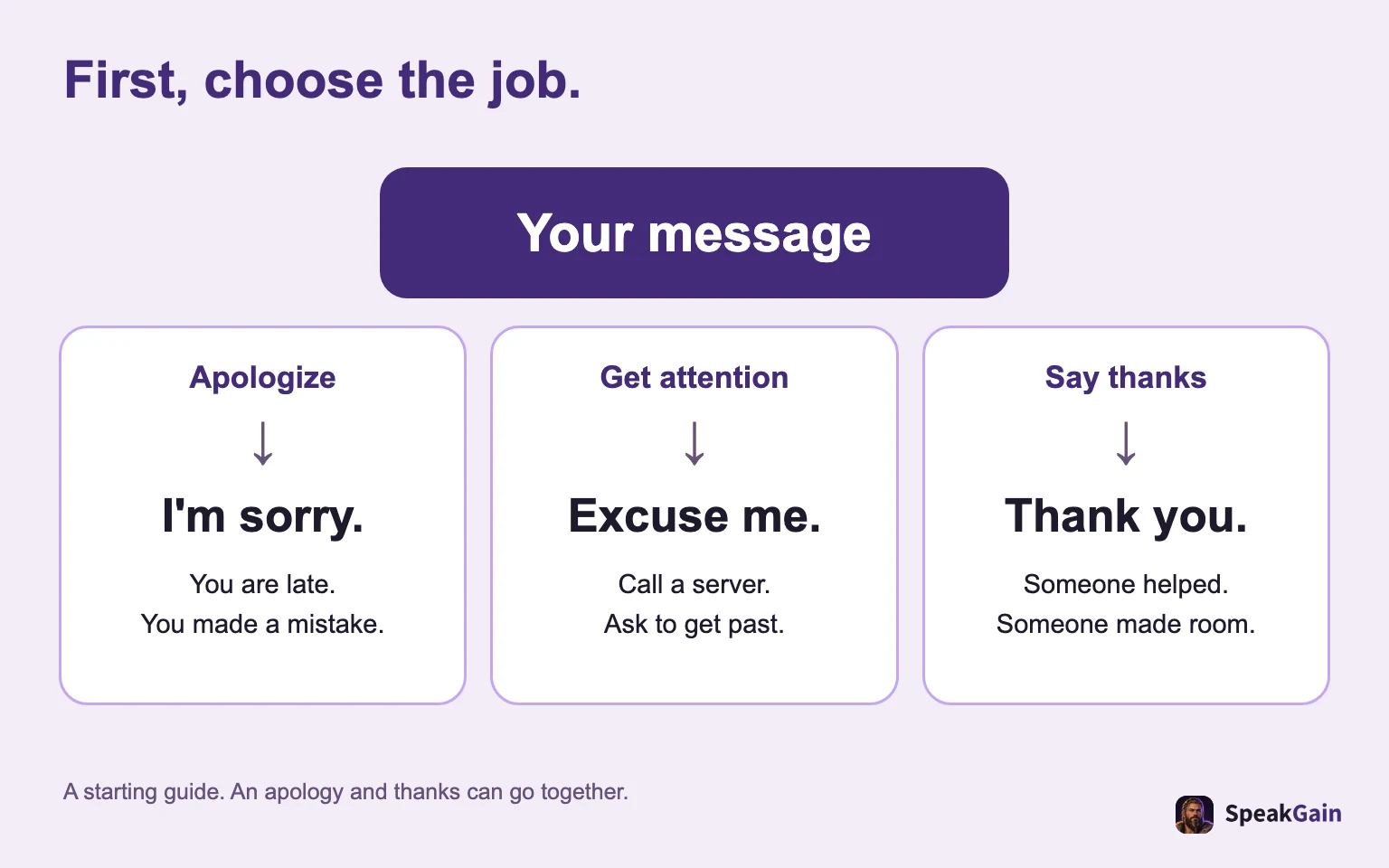
Excuse me also has apologetic uses, and sorry can express sympathy or soften a refusal. The BBC lesson on Excuse me and Cambridge’s sorry entry show that the boundaries overlap. Avoid the absolute rule that saying “sorry” always admits fault, or that English speakers never apologize.
2. Match the impact and the setting separately
A friend can be badly hurt by your mistake; a work conversation can involve a tiny correction. Seriousness and formality are different decisions. We recommend adding the specific thing you did before adding stronger words such as really or very.
A small mishap: a brief apology and a correction
Five short apologies
| English | Meaning and use |
|---|---|
| Sorry! | A quick apology after a small mishap |
| I'm sorry. | A neutral everyday apology |
| Sorry about that. | A conversational apology for what just happened |
| Sorry, I meant Tuesday. | Correct the day you just said |
| My bad. | Very informal: acknowledge a small mistake |
My bad. is very informal and suits a small mistake, as the BBC apology lesson explains. It is a poor first choice for a serious client problem. If you said the wrong day, correct the day; if you bumped someone, move out of the way. Repeating the apology is less useful than repairing the immediate problem.
Being late or forgetting: name what happened
Five specific apologies
| English | Meaning and use |
|---|---|
| I'm sorry I'm late. | Name your late arrival |
| I'm sorry for keeping you waiting. | Acknowledge that you made someone wait |
| I'm really sorry I forgot our meeting. | Say explicitly that you forgot the meeting |
| I'm sorry about the mistake. | Apologize for a known mistake |
| It was my fault. I'm sorry. | Own your responsibility, when established |
There is no fixed number of late minutes that requires really or so. Those words strengthen the feeling; they do not supply an explanation or repair. It was my fault. belongs where you have established your responsibility, rather than where you are guessing about the cause.
A work error or a serious personal apology
Five more substantial phrases
| English | Meaning and use |
|---|---|
| I apologize for the error. | A more formal apology for an error |
| I apologize for the delay. | A more formal apology for a delay |
| I'm very sorry for the inconvenience. | Apologize for a specific inconvenience |
| I'm really sorry I hurt you. | Apologize for hurting someone |
| I should have checked the time. | Recognize what you should have done |
I apologize is a more formal option; I'm sorry remains possible at work. Merely replacing the contraction with I am sorry does not automatically make the whole message adequate. For a serious issue, name the impact and give a realistic next action. Do not promise a delivery time you have not checked.
3. Get attention with a request; thank people for actual help
Five ways to get attention or interrupt
| English | Meaning and use |
|---|---|
| Excuse me, could we order, please? | Get a server’s attention, then ask to order |
| Excuse me, where is the station? | Get attention, then ask for directions |
| Excuse me, could I get past? | Ask someone to let you pass |
| Excuse me, may I ask a question? | Ask to join a discussion with a question |
| Sorry to interrupt, but could I ask a question? | Acknowledge the interruption, then ask |
Prepare the request after Excuse me. If the server is already looking at you and taking your order, you can simply order. Sorry to interrupt acknowledges an interruption; it is not automatically wrong because you are getting attention. For a clear request to repeat, start with Could you say that again, please? A sharply delivered Excuse me? can convey displeasure too. See English phone calls for checking names and numbers.
Four useful expressions of thanks
| English | Meaning and use |
|---|---|
| Thank you. | Neutral thanks |
| Thanks. | Conversational thanks |
| Thank you for your help. | Name the help you received |
| Thank you for waiting. | Thank someone who actually waited |
We recommend putting thanks first when someone simply helped. But gratitude does not replace an apology for a mistake that actually cost someone time. I'm sorry I'm late. Thank you for waiting. can do both jobs. Thank people for waiting only if they waited; do not add the sentence mechanically.
4. A short spoken apology at work
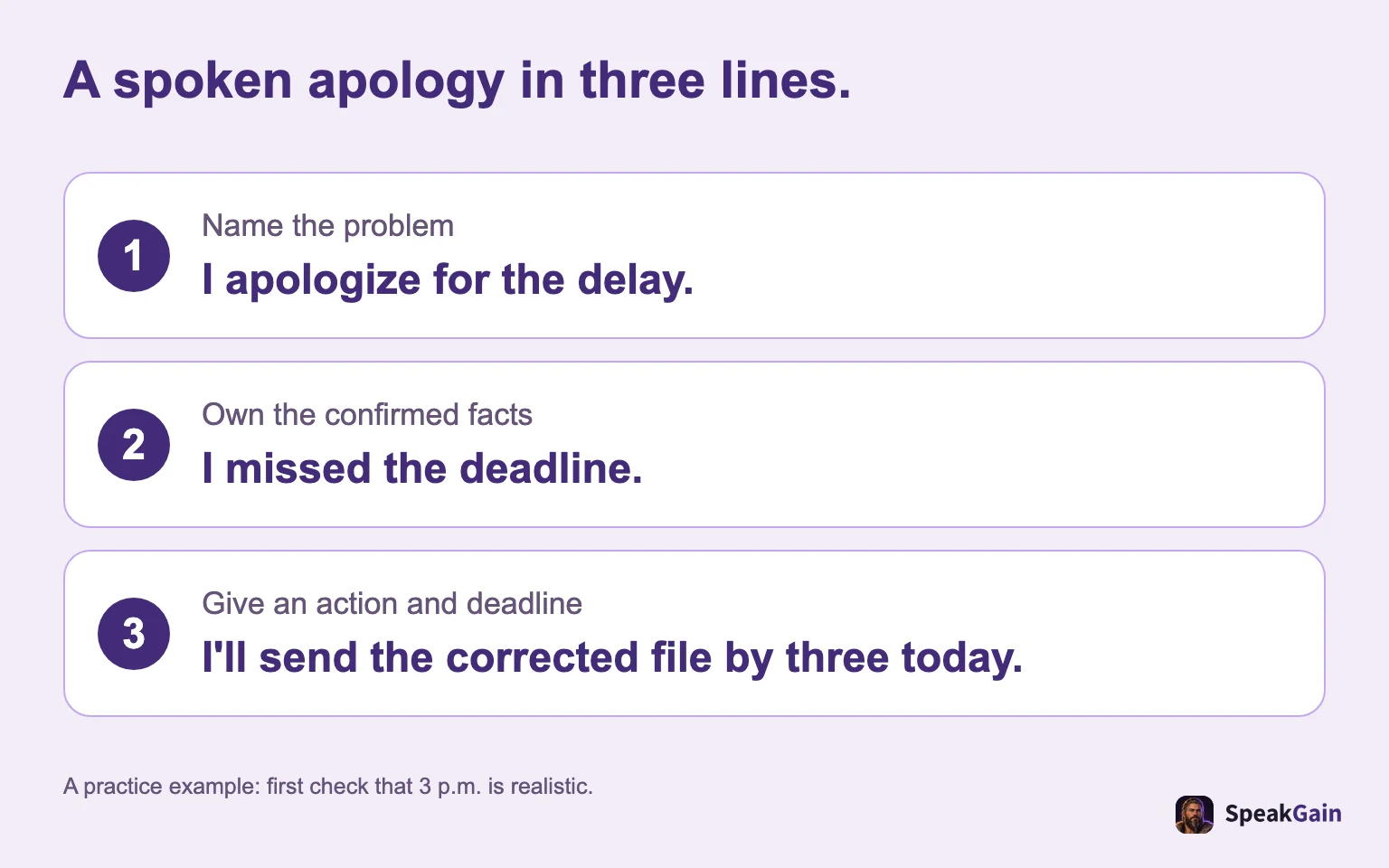
Use three lines: apologize for the problem, own the confirmed facts, and state a repair with a realistic deadline.
I apologize for the delay.
I missed the deadline.
I'll send the corrected file by three today.
This means acknowledging the delay and your missed deadline, then promising a corrected file by 3 p.m. today only if you can deliver it. If you cannot yet confirm the fix, say I'll check and update you by three today. and keep that update commitment. This is a spoken template, not a requirement to recite three formal sentences after every small mistake.
5. Respond without pretending everything is resolved
Five replies to an apology
| English | Meaning and use |
|---|---|
| That's all right. | Accept a small apology |
| No problem. | Reassure someone about a minor problem |
| No worries. | An informal reassuring reply |
| Thank you for letting me know. Please send the corrected file. | Accept the notification and request the repair |
| I appreciate your apology. I need some time. | Acknowledge an apology without immediate forgiveness |
That's all right. is a useful first reply for a minor issue. No worries. is informal. If you still need a corrected file, acknowledge the apology and ask for it. In a painful personal situation, you can recognize the apology while needing time. Accepting an apology is not the same as saying the consequences have disappeared. The British Council dialogue provides a small-apology exchange; our suggestions about repair and taking time are editorial choices. For listening responses beyond apologies, see English backchannel responses.
6. Fix the pattern, rather than banning Sorry
For learners who habitually begin every request with “sorry,” choose one real situation to change. Saying Thank you for your help. after help makes gratitude explicit. Saying Excuse me, could we order, please? gives attention and a purpose. These are recommendations for clearer communication, not claims that every use of “sorry” in those situations is ungrammatical.
Three language errors and two meaning traps
- Change I'm sorry for late. to I'm sorry I'm late. or I'm sorry for being late. After for, use a noun or an -ing form, not the adjective late alone.
- Change I apologize you. to I apologize to you for the mistake. Use to for the person and for for the thing you apologize about. Cambridge’s apologize entry and the BBC lesson support these patterns.
- Do not use I feel sorry for you. as an apology for hurting someone: it expresses sympathy or pity. Use I'm sorry I hurt you. for your action. By contrast, I'm sorry to hear that. can appropriately express sympathy when you hear bad news.
- Sorry, but … can soften a refusal or disagreement; it is not inherently rude. For practicing an apology for your own clear mistake, we recommend ending the sentence, then stating the repair instead of shifting blame after but.
- Do not assume that pardon is a universally “more polite” apology. Choose a full sentence for the actual job; a request to repeat is different from a serious apology.
7. Hear and say one meeting scene
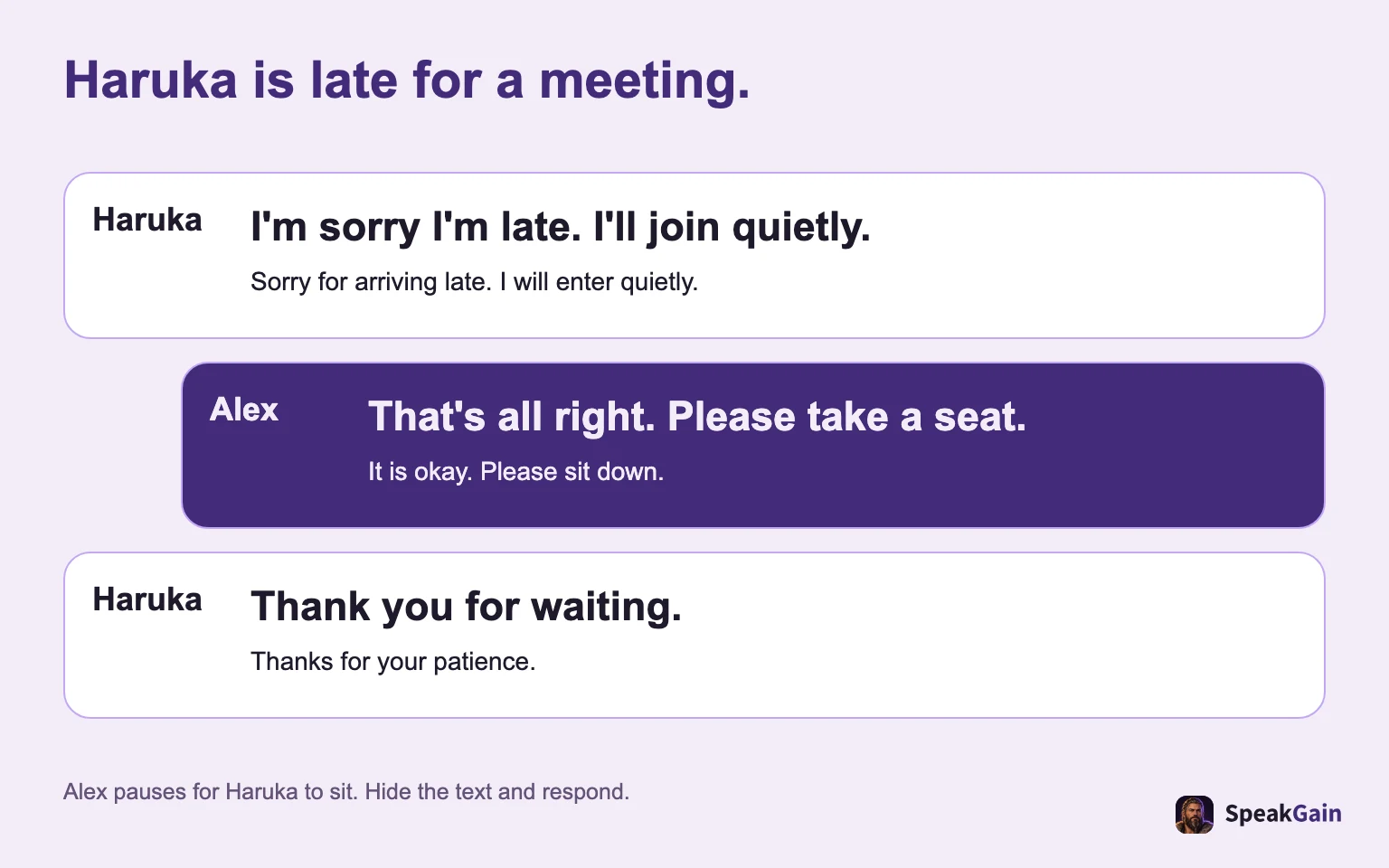
Imagine Haruka arriving three minutes late to an internal meeting. Alex sees her at the door. She apologizes briefly and joins quietly; Alex pauses a moment for her to sit. Her final thanks refers to that pause, not to the whole meeting waiting for her. If nobody waited, a simple Thank you. may fit better.
Save three sentences, then listen and speak
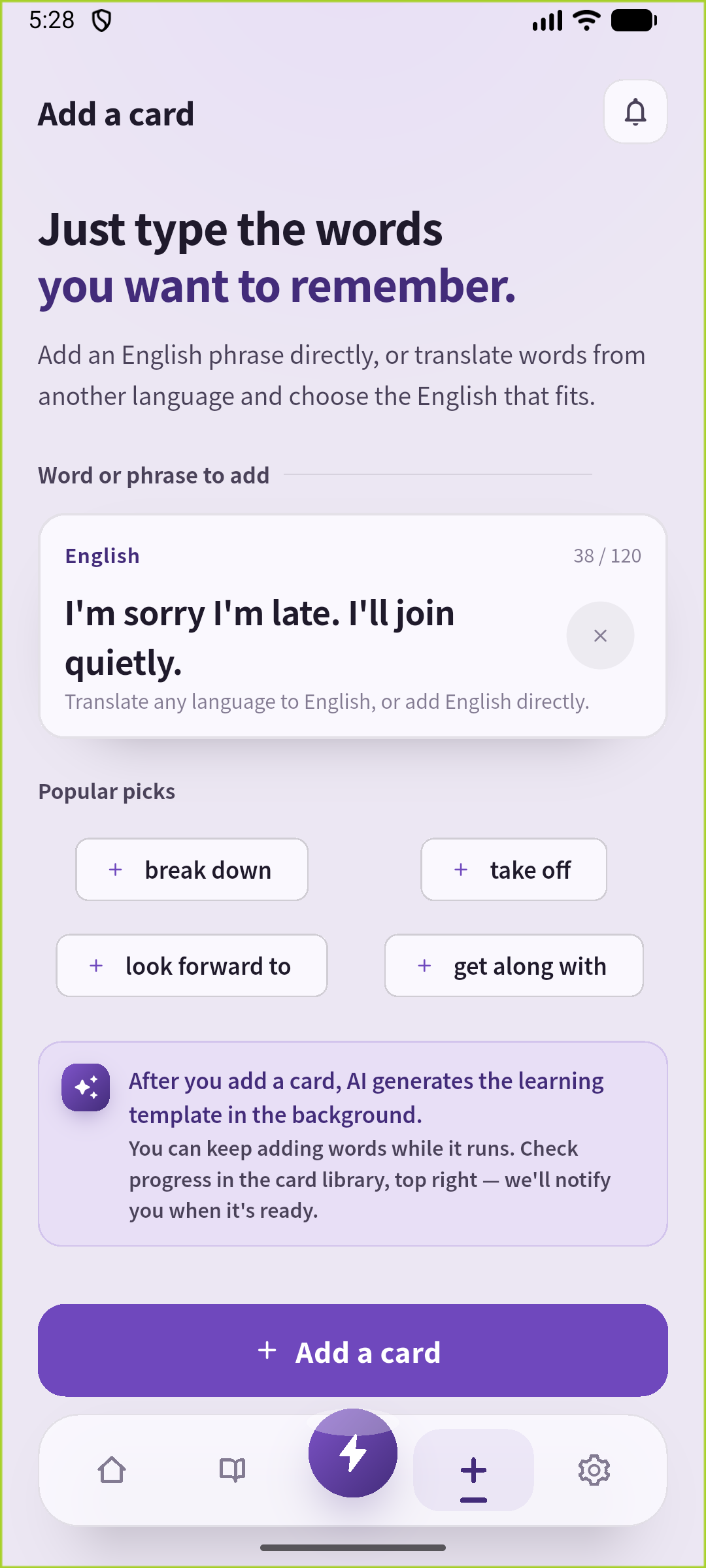
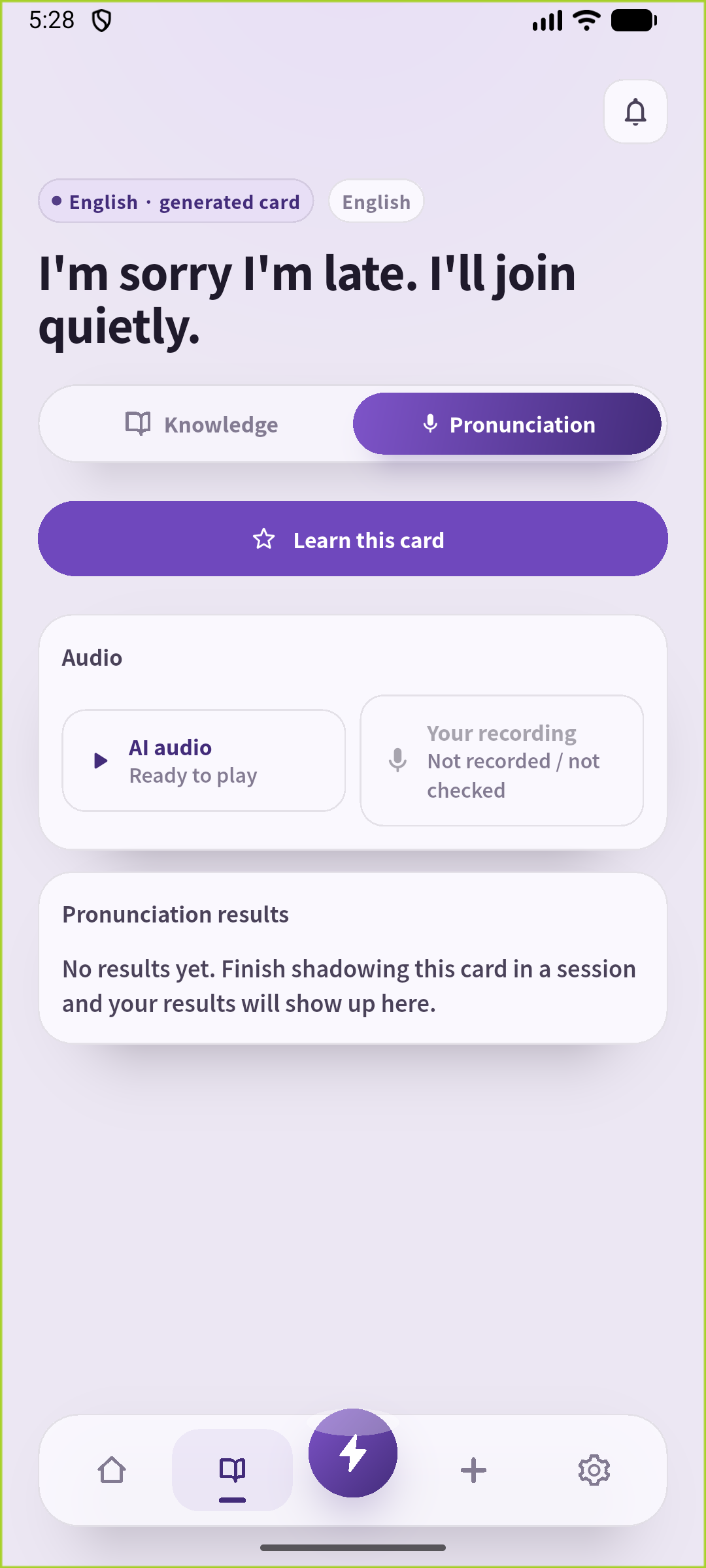
Enter each practice sentence through SpeakGain’s Add flow to make a card. The SpeakGain introduction explains the basic flow. These clips were generated once per sentence with SpeakGain’s AI voice, Deep-voiced Viking. Real speakers vary in voice and speed, so hearing this one voice is one part of preparing for a meeting.
Haruka: I'm sorry I'm late. I'll join quietly.
Sorry for arriving late. I will enter quietly.
Alex: That's all right. Please take a seat.
It is okay. Please sit down.
Haruka: Thank you for waiting.
Thanks for your patience.
Pause after each line, check its meaning, and say it yourself. If the first line is difficult, split it at I'm sorry I'm late. and I'll join quietly., then join the parts. Make the reason late audible, rather than focusing only on sorry.
Hide the text and respond to the situation
Use “I have just arrived late” as the cue, say your apology, listen to Alex, and finish with the appropriate thanks. Reading all three lines in order does not check whether you can select one from the situation. If you cannot recall it, look, correct yourself, and try again from the cue.
Karpicke and Roediger’s 2008 experiment found an advantage in later recall when learners continued retrieving foreign-language word pairs after answering correctly. It did not test apology conversations or SpeakGain. We adapt that finding into recalling a sentence from a situation rather than only rereading it; no fixed number of repetitions guarantees fluency. Revisit the late arrival, help and server situations tomorrow. For a broader routine, see how to study English; for your opening introduction, see introducing yourself in English.
Frequently asked questions
Must a formal apology start with I apologize?
No. I apologize for … is an option, and I'm very sorry … can work too. A serious problem also needs clear facts and a response, not just a formal word.
Can Thank you replace every apology?
Use thanks for help. Keep an apology where your mistake caused a burden. You can say both.
Is Excuse me before an action and Sorry after it?
That is a useful starting example for passing someone and then accidentally bumping them. It is not an absolute timing rule: Excuse me also has apologetic uses. Check the purpose first.
Should I always reply No worries?
It suits informal reassurance for a small issue. Learn That's all right. first, and add the action you need if the problem is still unresolved.
Choose one upcoming situation now. Decide whether you need an apology, attention or thanks; then practice the whole exchange, including the other person’s reply.
To practice the opening and ending of a conversation, use English greetings and replies to How are you? to choose a reply and one short update.
For choosing a thank you, adding a reason and receiving thanks, practise thanking in English by situation.
Sources consulted
For a visitor asking the way, use giving directions in English to practise one action, a landmark and a check.
For the Japanese phrase yoroshiku onegaishimasu, choose an English line by what you mean: a greeting, a request, future teamwork or thanks.
For a phrase that can reassure someone or decline an offer, daijoubu in English shows how to choose a line for checking, reassuring, declining, or asking permission.