
Customer service English: 20 core lines and a five-minute speaking routine
Published
For face-to-face customer service in English, start with short lines for six situations: welcoming, guiding, orders or questions, payment, problems and farewells. Our editors suggest selecting about 20 lines, replacing products, places and prices with your workplace’s facts, then practising aloud for five minutes: read, speak from a cue in your first language, record, listen back and fix one thing. Ask again when you miss something and check information before giving an answer.
You may recognise words when a customer speaks, yet struggle to give the first reply. A translated menu explanation may also be too long to say comfortably. Our recommendation is to prepare the next action at your own station, then wait for the customer’s response. Memorising an entire phrasebook before using anything is not our preferred starting point.
The examples are written by our editors. Prices, stock and waiting times are fictional; the yen price is a shared example, not your local currency or store policy. Twenty lines and five minutes are practical starting choices, not a scientifically established minimum. For the customer’s side, see ordering in English. This guide is for staff receiving requests and giving directions.
What English should staff learn first? Six situations
Choose a line that welcomes, guides or confirms a customer’s next step. The order can change at your workplace; clarification is useful at any stage.
| Situation | Core English line | Purpose in plain language | Delivery tip |
|---|---|---|---|
| Welcome: greet, then ask one question | Hello. How can I help you today? | Greet and invite the customer to explain their request | Pause after the greeting and wait |
| Guide: name the place and the next action | Please follow me. | Invite the customer to walk with you | Show the route, then walk at their pace |
| Orders and questions: offer a choice, then confirm | Which one would you like? | Ask the customer to select from visible options | Make the menu or options visible |
| Payment: show the total and confirm the method | Your total is 2,400 yen. | State a total of two thousand four hundred Japanese yen | Say the amount slowly and show it |
| Problems: clarify, ask for a wait and explain a limit | Could you say that again, please? | Ask the customer to repeat what they said | Do not approve a request you did not understand |
| Farewell: finish the handover, then thank them | Thank you. Have a lovely day. | Thank the customer and wish them a good day | Keep the final greeting audible |
Unless a source is named, advice about delivery and choosing expressions is our editors’ view. What you say must match the service your workplace actually provides.
1. Welcome: greet, then ask one question
Ask one necessary question after your greeting. A host needing a party size has a different job from a shop assistant letting someone browse.
| Core line | Meaning or function | When to use it |
|---|---|---|
| Hello. How can I help you today? | Greet and invite the customer to explain their request | Reception or a request needing explanation |
| How many people are in your party? | Ask how many people need seats | Before arranging a table |
| Please take your time. | Give the customer time to browse or choose | While someone is looking at products |
Adapt it to your workplace: Match the greeting to the time and your workplace’s style. At reception, ask about the request; at a restaurant, establish the party size. If a shopper says they are only looking, our suggestion is to give them time and remain available. Add the business name only when it helps identify where they are.
Delivery: Say Hello., look towards the customer, then ask. You can confirm the number they show with their fingers by repeating it. Avoid joining several questions into one breath; a short greeting does not need to reproduce a long welcome announcement.
Common mistake: Asking about numbers, a reservation and a name all at once makes a single reply ambiguous. Finish one question before the next. In this context, party means the group visiting together, not a celebration.
Is Can I help you? rude?
Do not label the sentence itself rude. British Council’s can/could reference gives Can I help you? as an offer of help.
Our editors would ask How can I help you today? when someone is ready to explain a request, and use a greeting with Please take your time. for a browser. This is a choice of purpose, not a universal politeness ranking.
2. Guide: name the place and the next action
Combine a short direction with something the customer can see. Lead the way if you can leave your station; otherwise show a clear landmark.
| Core line | Meaning or function | When to use it |
|---|---|---|
| Please follow me. | Invite the customer to walk with you | Taking someone to a seat or counter |
| The fitting room is just over there. | Indicate the nearby changing area | Showing a visible fitting room |
| Please wait here for a moment. | Ask the customer to stay in a specific place briefly | Before checking something elsewhere |
Adapt it to your workplace: Replace the fitting room with the counter or the lift when appropriate. If over there does not identify the place, add a visible landmark or ask a colleague to guide the customer. When you say here, show a waiting area that does not block the passage.
Delivery: Finish Please follow me. before moving, so you can see whether the customer heard. Say the place slowly and indicate the direction with an open hand. A written label or floor plan can help when gestures are not useful.
Common mistake: Saying This way. while facing another corridor gives conflicting information. Align your words and movement. Do not use a moment to hide a long wait; give a checked estimate when you have one. For outdoor routes, see giving directions in English.
3. Orders and questions: offer a choice, then confirm
Confirm the item, quantity and preference before processing the request. This might be a drink, a shirt size or a hotel arrangement.
| Core line | Meaning or function | When to use it |
|---|---|---|
| Are you ready to order? | Check whether the customer has chosen their order | After giving time to read the menu |
| Which one would you like? | Ask the customer to select from visible options | Choosing a product, size or service |
| Would you like to try this on? | Offer a clothing fitting | When a garment can be tried on |
| So that’s one small coffee, is that right? | Check that the order is one small coffee | Before sending the order through |
Adapt it to your workplace: Replace one small coffee with what you actually heard, such as two blue shirts. Use size names matching the menu or label. Leave a pause so the customer can correct the order before you take payment or send it to the kitchen. Remove the fitting offer if your products cannot be tried on.
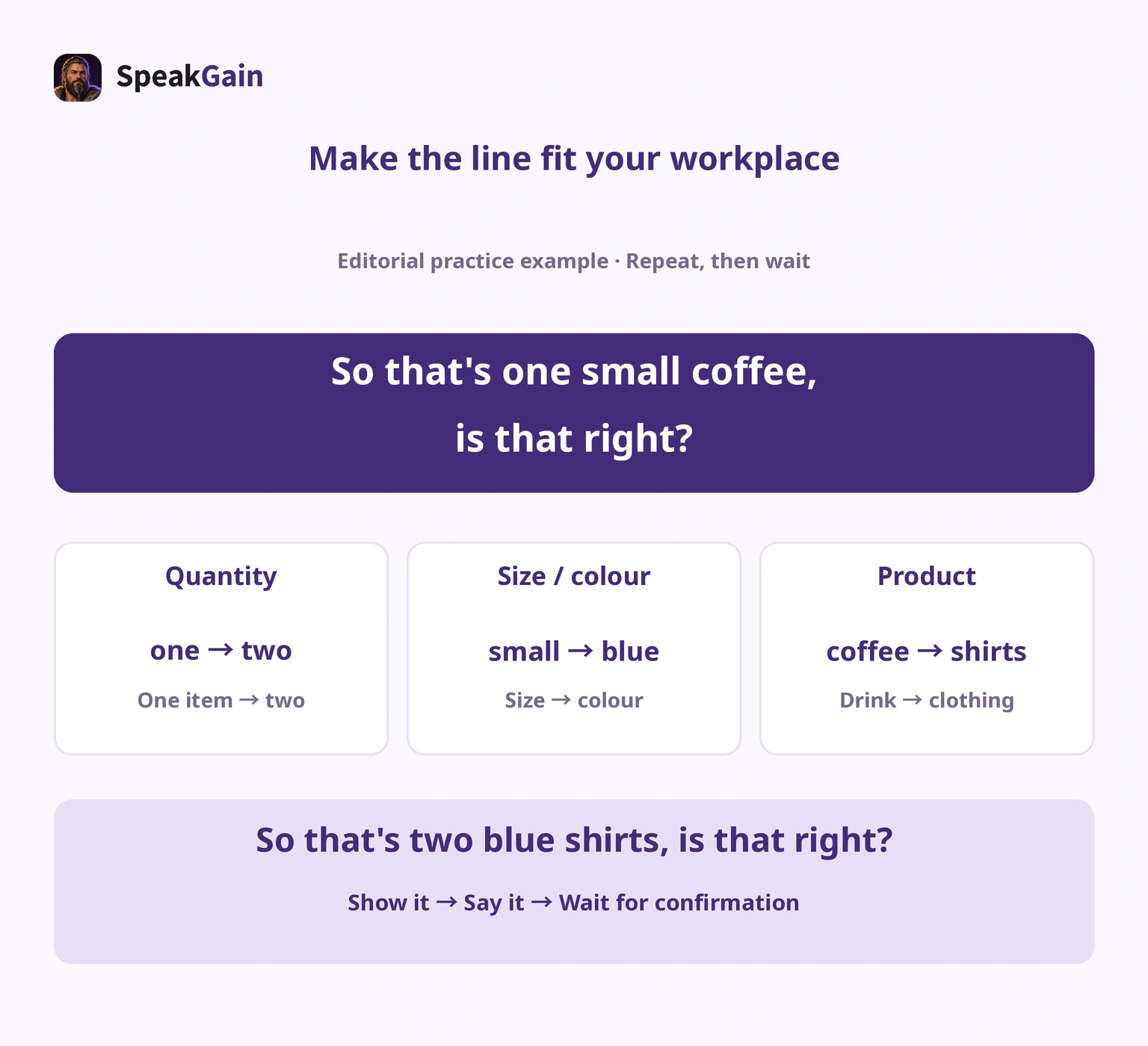
Delivery: Show the menu or products before asking Which one would you like? Product photos and numbers can help when a name is difficult. Make quantity and size audible in the repeat-back, then stop and wait. Our advice is short, unhurried speech, not equal emphasis on every word.
Common mistake: Asking Which one? without visible choices leaves the customer guessing. Do not finalise an order from one recognised word. Confirm an unclear size or quantity, and distinguish your recommendation from the customer’s actual selection.
4. Payment: show the total and confirm the method
Match the spoken total to the displayed amount. Offer only methods that your workplace accepts.
| Core line | Meaning or function | When to use it |
|---|---|---|
| Your total is 2,400 yen. | State a total of two thousand four hundred Japanese yen | Showing the bill |
| How would you like to pay? | Ask which available payment method they prefer | After stating accepted payment methods |
| Here’s your receipt. | Hand over the payment receipt | At the handover |
Adapt it to your workplace: Change both the amount and currency. Practise reading 2,400 yen as two thousand four hundred yen, then use actual local prices. If your workplace accepts only cash, We accept cash only. is a possible replacement line; explain the condition at the stage your workplace requires, not as a surprise after the order.
Delivery: Show the bill or display while saying the amount. If asked again, slow down rather than repeat faster. Wait for the preferred method before reaching for a card or payment terminal.
Common mistake: An unclear fifteen or fifty changes the transaction even if the grammar is fine. Do not guess about tax, fees, refunds or eligibility for a service. Check the information with the responsible person before explaining it.
5. Problems: clarify, ask for a wait and explain a limit
Use a clarification line instead of saying yes to a request you missed. If repeating does not help, switch to a menu, writing or another staff member.
| Core line | Meaning or function | When to use it |
|---|---|---|
| Could you say that again, please? | Ask the customer to repeat what they said | When you missed a request |
| Could you point to it on the menu, please? | Ask them to identify an item visually | When a product name is unclear |
| I can check that with my colleague. | Offer to confirm information with a coworker | When you cannot yet give a reliable answer |
| I’m sorry, we can’t offer that today. | Explain that the requested item or service is unavailable today | When unavailability has been confirmed |
Adapt it to your workplace: Replace on the menu with in the catalogue if that is the available reference. Replace my colleague with my manager when that is the real contact. Name the item if that is vague. Keep today only for temporary unavailability; omit it for a service the business never offers.
Delivery: After an unsuccessful repeat, ask the customer to point, write or let you check. Before leaving, use Please wait here for a moment. and show where. Add about five minutes only when it is a checked estimate. A substitute product is useful only if you know it is available.
Common mistake: Offering to check but never checking leaves the request unresolved. A quiet can’t can also sound like permission. In your recording, check that the negative is clear. Our editors prefer a short apology and a specific limit to No. alone. For correcting wrong information, see apologising in English.
British Council describes could you as a polite way to request an action. It does not mean the form makes every possible message polite; specify what you need the customer to do.
6. Farewell: finish the handover, then thank them
Complete the necessary handover before the closing greeting. You do not need to add a question just to obtain a reply.
| Core line | Meaning or function | When to use it |
|---|---|---|
| Thank you. Have a lovely day. | Thank the customer and wish them a good day | At a daytime departure |
| Thank you for waiting. | Acknowledge the time they spent waiting | When returning to the customer |
| Enjoy your stay. | Wish a guest a pleasant period at the hotel | At the start of a hotel stay |
Adapt it to your workplace: In the evening, use Have a lovely evening. Enjoy your stay. suits the start of a stay, not necessarily a guest leaving after checkout. Enjoy your meal. is a possible line when serving food. Match the phrase to what is about to happen.
Delivery: Pause after the thanks and keep your last words audible. Hand over bags, keys or receipts first. Our view is that a simple thanks can be enough when a customer is rushing.
Common mistake: A farewell before the request is resolved may sound like an attempt to end the interaction. Thank you for waiting. acknowledges a wait that has already happened; it is not the request to wait. Learn the timing with the sentence.
What changes for food, clothing and hotels?
Keep the short patterns and change the information you confirm. Prepare the nouns, numbers and actual conditions at your station before adding more phrases.
| Workplace | Confirm | Show | Check internally |
|---|---|---|---|
| Restaurant or café | Party size, item, quantity, size, eat-in or takeaway | Menu, product photos, price display | Ingredients, changes, serving time |
| Retail or clothing | Product, colour, size, fitting request | Size labels, products, fitting-room sign | Stock, returns, exchanges, fitting rules |
| Hotel | Reservation name, arrival or departure, requested arrangement | Booking confirmation, floor plan, times | Check-in/out, luggage storage, extra charges |
A café may add Is that for here or to go? A clothing store may replace a broad choice question with Which size would you like? At hotel reception, Could I have the name on your reservation, please? can support the booking check. Remove unused core lines and replace them with the ones your role requires; you do not need all three industries’ additions.
Do not guess about ingredients or allergens. Food Standards Agency guidance covers allergen information for food businesses in the UK. It is not a statement of the law at every workplace. Check your own ingredient records and responsible person; an English phrase alone cannot settle an uncertain answer.
Share the place and procedure for checking names, bookings or purchase details as well as the words. Follow the workplace’s privacy process rather than reading personal information aloud around other customers.
For requests beyond service, practise making requests in English; for calls without visible gestures or menus, use English phone phrases as a separate practice task.
How do you memorise about 20 lines? Use situation cues
Hide the English and speak from a short cue in your first language. The six groups contain 3 + 3 + 4 + 3 + 4 + 3 core lines. We would start with frequent greetings, order checks, repeats, waiting, payment and thanks rather than memorise everything on day one.
Write cues such as ‘ask the number of guests’, ‘confirm one small coffee’ and ‘check with a colleague’. Put the English on the reverse or in a covered column. If it does not come, read once, hide it and try again. Then change the product or quantity. If replacing coffee with shirts stops you, practise that noun separately.
Karpicke and Roediger’s study found benefits of repeated retrieval for delayed retention in foreign-language vocabulary learning. It did not test these 20 service lines or a five-minute routine. Using situation cues here is our editors’ practical application of that idea.
At the next shift, test the cue again and mark what did not come. Practise those lines first instead of adding more. See English study planning and memorising English sentences for related practice.
A five-minute pre-shift speaking routine
Pick three lines you will use at today’s station. This is our suggested time split, not a requirement to read all 20 every shift. Use a suitable practice time and place; record your own practice, not customers.
| Time | Action | What to check |
|---|---|---|
| 0:00–1:00 | Read the English aloud | Meaning, item, quantity and negative |
| 1:00–2:00 | Hide it and speak from your own-language cue | Can you produce the colleague-check line? |
| 2:00–3:00 | Record your three lines | A usable voice level and pauses |
| 3:00–4:00 | Listen back | Can you hear amounts, quantities and can’t? |
| 4:00–5:00 | Fix one thing and say it again | Slow down the amount and point to the display |
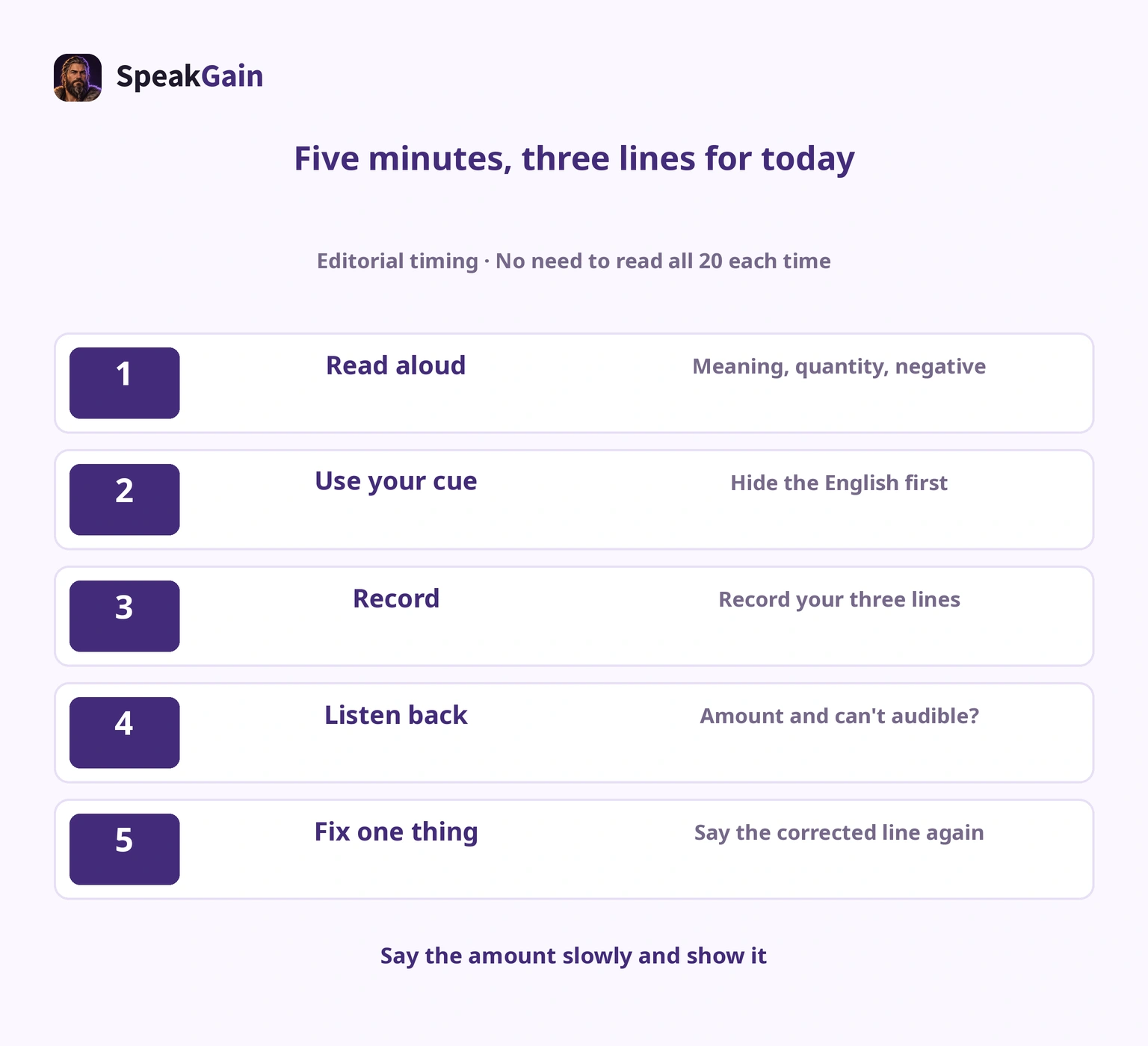
Listen for whether the instruction is understandable rather than judging only how English-like you sound. Fix a weak negative, a rushed amount or the absence of a pause after a question. Choose one change so that you can compare a second attempt with the first.
With a colleague, take turns playing the customer and confirming a menu choice. Change the item, size or quantity each time. Include one missed request and practise asking again before confirming. This is staff-to-staff practice, not an app feature.
Saving one workplace line in SpeakGain
Save an English line you have checked at work and use it for aloud practice. We entered I can check that with my colleague. through the normal Add flow. It is an answer pattern for checking rather than asserting information you do not yet know.
The verified device sequence was Library → Knowledge → Learn this card → Listening → Reveal answer → Answer. Listening hid the sentence while the audio was available; Answer displayed the practice sentence and an English explanation. Add your own-language situation cue on paper for the separate recall exercise.
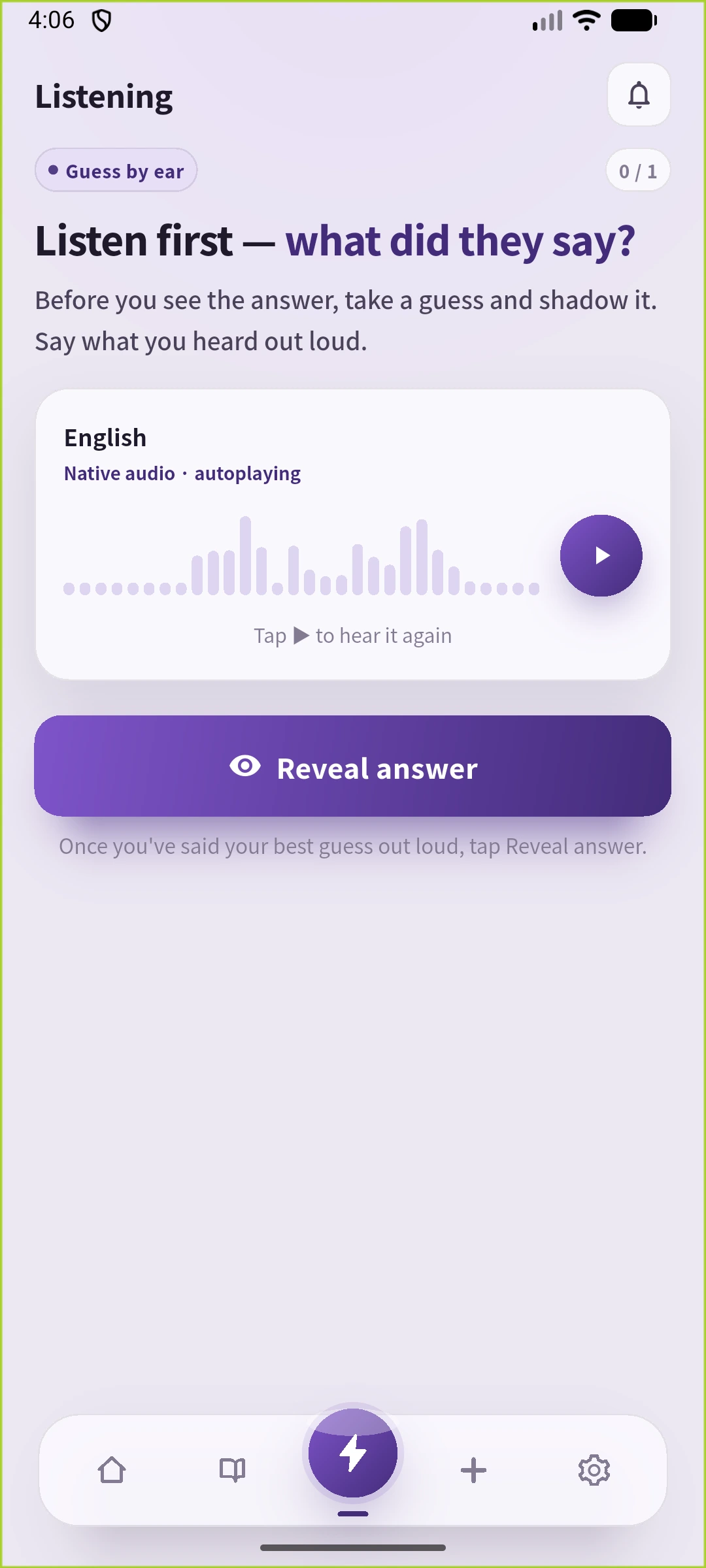
Answer showed the same sentence, an explanation, replay, review-interval choices and Record and check. We did not reach a recording-in-progress screen after operating that button, so we describe no recording result or assessment. Use your own recording method for the five-minute routine if needed.
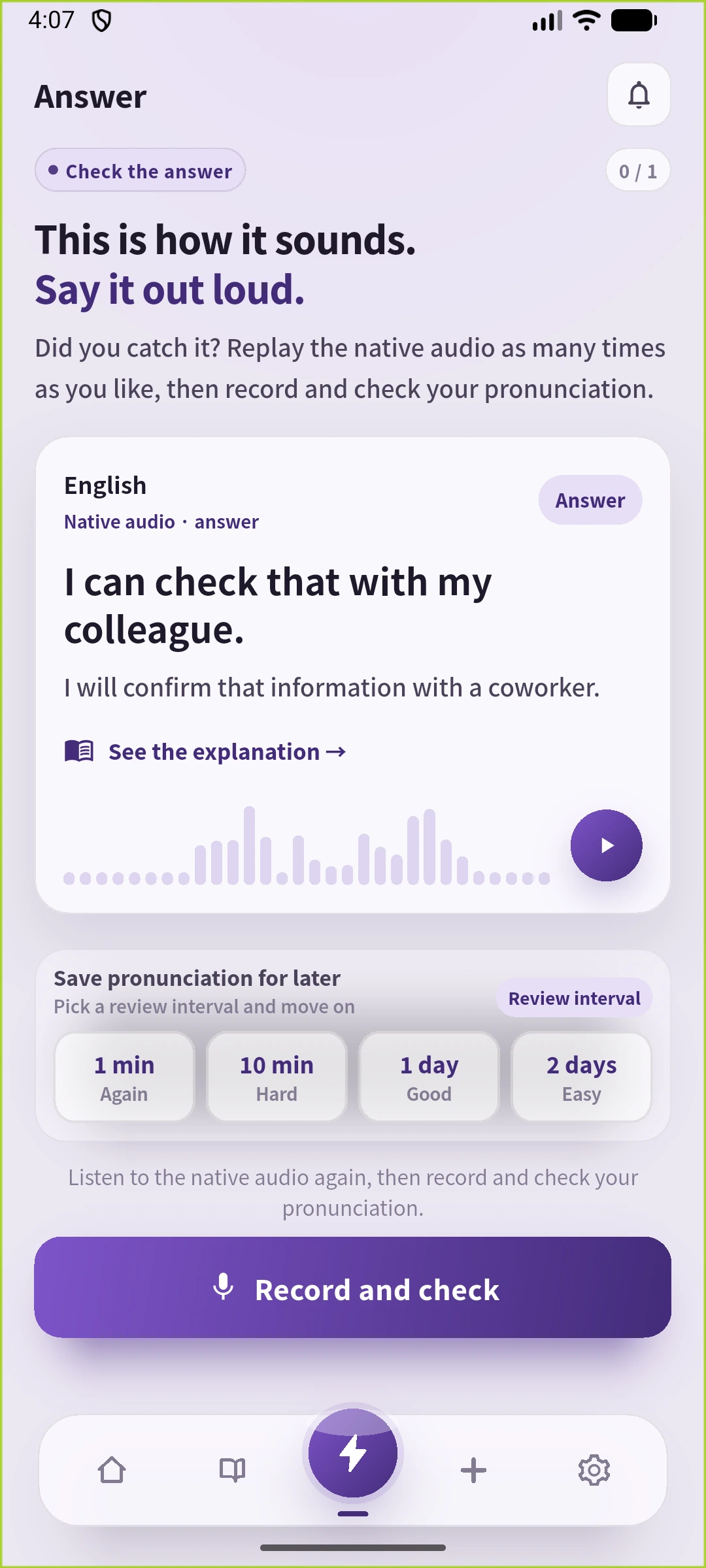
The player below is the AI-generated Viking audio from that single card. The screen’s Native audio label is not being presented as a human native speaker’s recording.
I can check that with my colleague. — Offer to confirm information with a coworker
Confirm store information with your supervisor first. This example demonstrates saving a line, Listening and Answer; it does not establish customer-service role-play, service scoring or workplace translation. Read about SpeakGain for the product overview.
A shared staff sheet: situation, line and workplace facts
Make one useful sheet for the station instead of distributing a huge phrase list. Put the situation cue, English, replaceable facts and person to contact on the same row.
| Cue | English | Workplace information |
|---|---|---|
| Confirm an order | So that’s one small coffee, is that right? | Match product and size to the menu |
| Show where to wait | Please wait here for a moment. | Actual waiting area and estimate contact |
| Check with a colleague | I can check that with my colleague. | Who to contact and how |
| State the total | Your total is 2,400 yen. | Actual amount, currency and fee display |
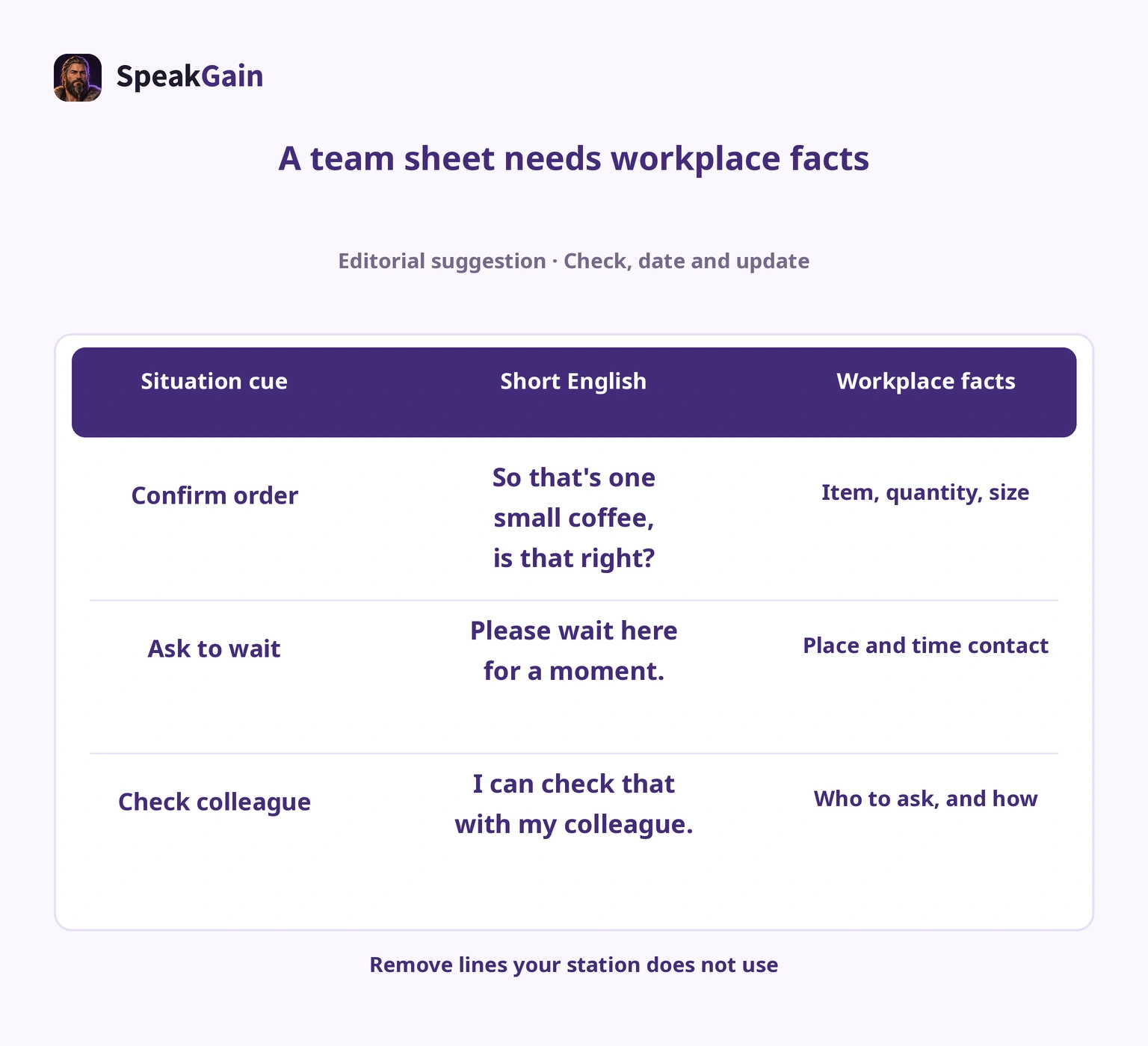
Have the responsible person check prices, stock procedures and limits. Ask an English-speaking colleague to check that the wording matches the intended meaning. Date the sheet and update it when the facts change. Select lines by station rather than display all 20 everywhere.
Ask new staff to say a line from a situation, not just read the sheet. Everyone need not imitate the same accent; check that the information confirmed and the handoff when uncertain are shared.
Frequently asked questions
Can I serve customers if I make grammar mistakes?
Keep the necessary checks going even if you notice a small mistake. An incorrect quantity, amount, time or negative can still change the service. Use displays and repeat unclear information.
What if I cannot understand the customer?
Ask Could you say that again, please? Then switch to pointing, writing or another staff member if needed. Do not approve an order from a guess.
Should I avoid Can I help you?
No. British Council presents it as an offer. Our editors choose between offering help, asking the request and giving browsing time according to the situation.
Can I use a translation app?
Our editors would use it as a supplement when workplace policy allows. Verify prices, availability and ingredients separately, confirm the meaning with the customer and follow the privacy procedure. Prepare routine short lines in advance.
Which phrases should I learn first?
Pick the greeting, confirmation, repeat, wait, payment and thanks that your own station needs. Start today’s practice with three lines.
How can all staff learn the same information?
Share a sheet with cues, short lines, facts and contacts, then practise from the situation. Update it when services or prices change.
Do I need long English to sound polite?
Our editors prioritise short questions and clear confirmation. Could you …, please? can make a request, but word count alone is not the measure. Practise voice level and waiting for replies too.
Our editorial verdict: say three real workplace lines first
Use the 20 core lines as a starting set, remove what you do not use and adapt the products, places, sizes and amounts. Today, choose three, speak from your own-language cue, record and fix one issue with numbers, negatives or pauses.
A large phrase collection is not useful if it produces an inaccurate instruction. Confirm the request with short English, clarify when unsure and check the answer before giving it. Practise that whole sequence aloud.