
How to Memorize English Sentences: A 5-Step Method for Usable Phrases
Published

To memorize English sentences, do not begin by copying a long list word for word. Choose a short sentence you can picture yourself using, understand how it works, and practise retrieving it from the situation rather than repeatedly reading it.
A useful routine is: choose → understand and chunk → recall without looking → check the sound and say it → retest after a gap. Speaking aloud lets you practise the sound and physical act of producing the sentence. It does not, by itself, guarantee that the sentence will stay in memory or appear automatically in conversation.
Is memorizing English sentences actually useful?
It can be, when the sentence and the practice match your goal.
Word-for-word recitation makes sense when an exam, speech, or performance requires an exact script. If your goal is conversation or writing, a shorter reusable pattern is often more practical than storing a textbook sentence unchanged.
Suppose you need to reschedule a meeting:
Could you move our meeting to Friday afternoon?
Instead of treating it as one unbroken string, split it into parts:
Could you move ...?— a polite request to change somethingour meeting— the event to changeto Friday afternoon— the new time
Now the reusable pattern is Could you move [event] to [time]?. Replace the slots with the call or next Monday and the sentence becomes useful in a new situation. The goal is not merely to recite the original. It is to retrieve the pattern when you need it.
Three checks before you learn a sentence
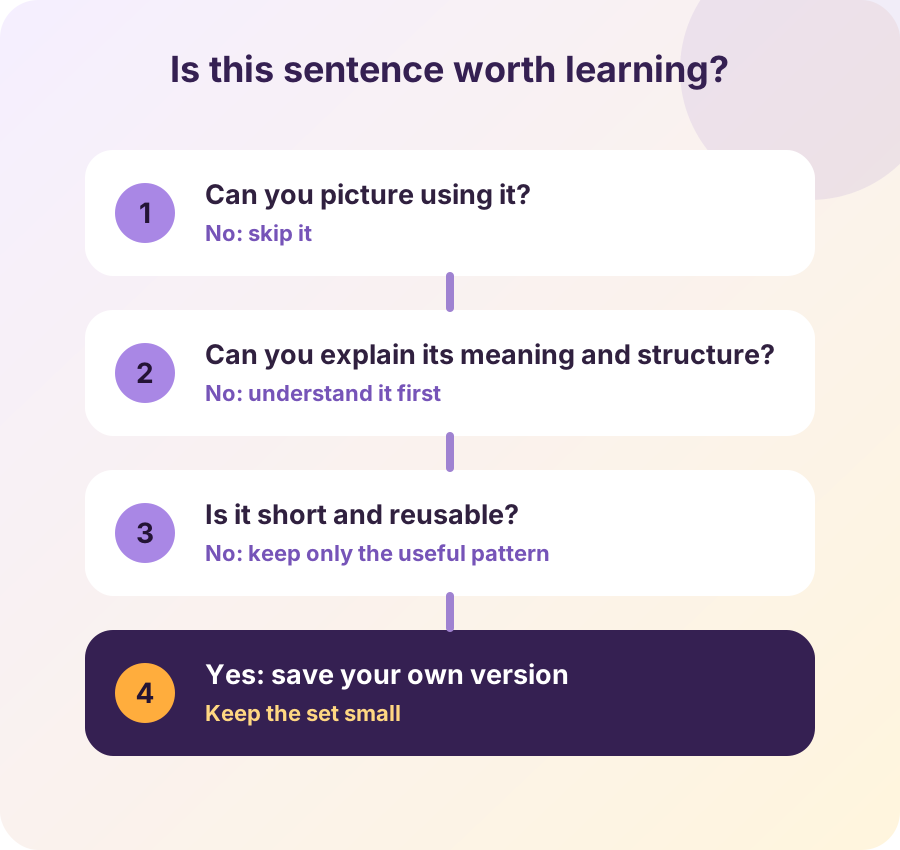
1. You can picture a real use for it
Choose from situations you actually meet: work, travel, games, films, books, or daily conversation. Make the situation specific, such as “ask to move Friday’s meeting” or “leave my luggage at a hotel,” rather than “this might be useful someday.” A sentence with no plausible use can wait.
2. You can explain its meaning and structure
Do more than match it to a translation. Identify who does what, why the tense or modal is used, and what each chunk contributes. If you cannot explain it yet, investigate before trying to memorize its sound.
3. It is short and reusable
Keep a sentence you can say in one breath, or trim it to the clause you need. Replace names and details with your own, then mark at least one slot you can change.
More example sentences do not automatically produce better learning. Mizugaki (2024) compared no-context, same-sentence, and varied-sentence conditions in tasks involving recall of English word meanings. The same-sentence condition helped meaning recognition, but the conditions did not differ for form recall or meaning recall. That finding does not support the claim that adding examples improves every kind of knowledge equally. Study summary and paper (J-STAGE)
A five-step method for learning an English sentence
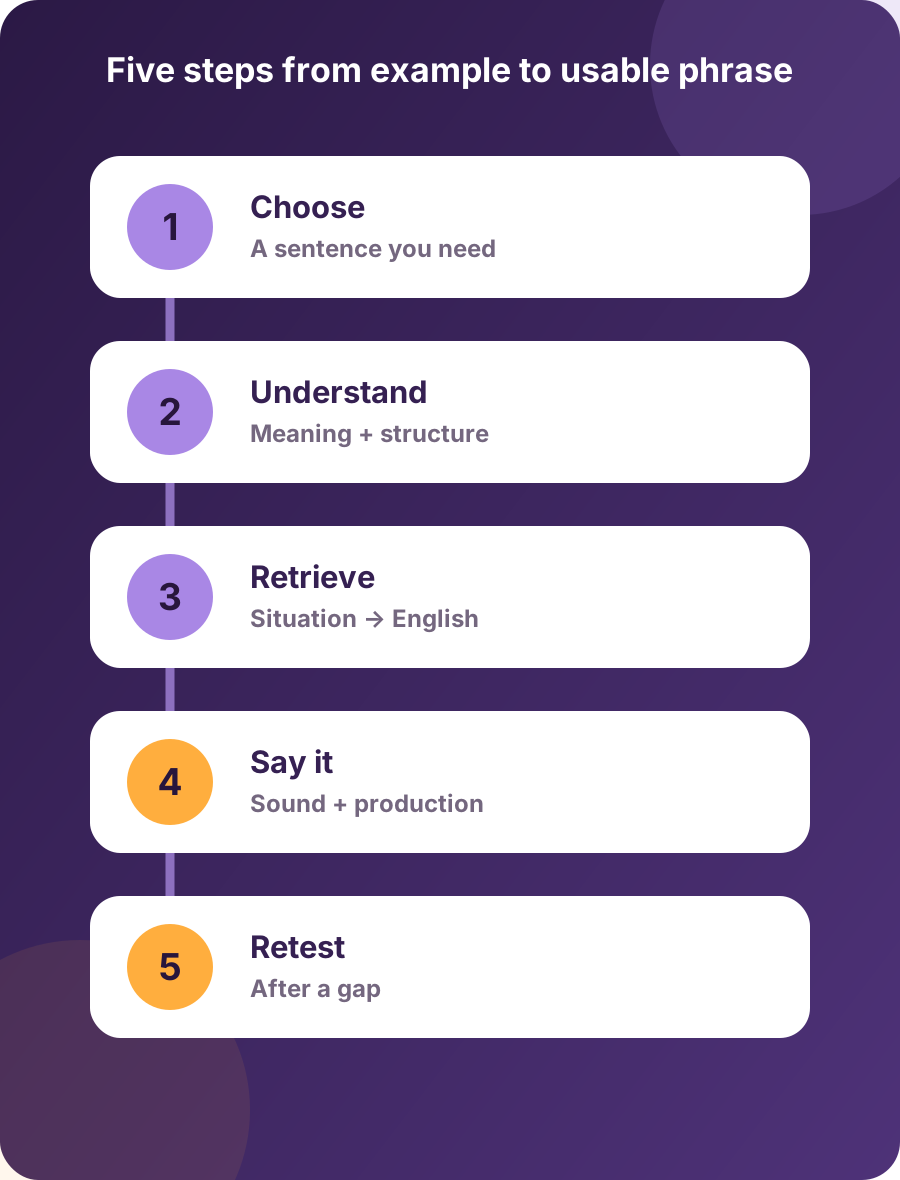
Step 1: Choose a small number of sentences you need
Start with a few sentences you may use today or this week. If a textbook example does not fit your life, change the subject, object, place, or time.
For a line from a film or YouTube video, save only the short part you need instead of copying a long passage. Record the source and situation too; that context can help you reconstruct the meaning later.
Step 2: Confirm the meaning and divide it into chunks
Explain the whole sentence in one line, then group the words by function. In the meeting example, the chunks are the request pattern, the event, and the new time.
Research has examined practice with formulaic multiword sequences. Nergis (2021) compared advanced English for Academic Purposes learners who practised corpus-derived sequences for five weeks with a group that practised academic vocabulary. The formulaic-sequence group performed better on some speech-rate measures, but the study was small, limited to advanced academic learners, and did not improve every pause or repair measure. It does not guarantee the same result for every learner or everyday conversation. Study abstract (Lingua)
The practical takeaway here is modest: find a short meaningful chunk and a slot you can replace, rather than carrying an entire long sentence as a single block.
Step 3: Hide the English and retrieve it from the situation
Use the situation as the prompt instead of translating one word at a time:
- Look only at “ask to move the meeting to Friday afternoon.”
- Say or write the English without looking.
- Compare it with the original.
- Check only the missed part, then try again later.
Roediger and Karpicke (2006) compared students who restudied prose with students who freely recalled it without the material. Restudy performed better after five minutes, while retrieval practice produced better retention after two days and one week. The study was not about English example sentences, but it is a reason not to treat repeated reading as proof of recall. Study abstract (PubMed)
In foreign-language word-pair experiments, Karpicke and Roediger (2008) likewise found that continuing to study items after a correct response did not improve delayed recall, while continuing to test them mattered greatly. This was a vocabulary task, not a study of conversational ability, but it supports adding a retrieval attempt before revealing the answer. Study abstract (Science)
Step 4: Check the sound, then say the sentence
If audio is available, notice stress, connected speech, and phrasing. Read the sentence aloud while looking, then try to say it using only the situation prompt. A place where you hesitate becomes a useful target for the next attempt.
Evidence about speaking aloud needs careful interpretation. Icht and Mama (2019) reported better memory for words read aloud than silently when Hebrew speakers learned Esperanto words. Candry and colleagues (2018), however, did not find oral repetition superior to written repetition for one-week retention among Dutch-speaking learners of German. Both studies mainly concerned words. We therefore cannot conclude that saying any sentence aloud guarantees memory. Icht & Mama (2019) / Candry et al. (2018)
Say the sentence to check its sound, practise moving your mouth, and test production in a form closer to speaking. Test memory by hiding the text and producing it, rather than by repeating it while it remains visible.
Step 5: Retest after a gap
Instead of reading the sentence ten times in one sitting, leave it and later see whether the situation still brings the English back. Retest a missed sentence sooner; extend the interval when retrieval is easy.
Spacing research does not provide one perfect calendar for everyone. Cepeda and colleagues (2006) reviewed 184 articles covering 317 experiments and found that a useful study gap changes with how far into the future the learner needs to retain the material. A meta-analysis of second-language learning by Kim and Webb (2022) also found an advantage for spaced practice, but the learners, activities, and retention periods varied. Cepeda et al. (2006) / Kim & Webb (2022)
As an editorial starting point, test the sentence just after learning, the next day, and again a few days later. Shorten the gap after an error and lengthen it after repeated success. This is a workable starting routine, not a universal schedule established by those studies.
What are reading aloud, writing, and recitation for?
Choose a practice for the result you want to check.
| Practice | What it mainly checks | Limitation |
|---|---|---|
| Reading aloud | Whether you can pronounce and phrase the English while seeing it | Reading from the page is different from recalling it from a situation |
| Writing from memory | Spelling, word order, and exact detail | Conversation practice does not require copying every sentence repeatedly |
| Recitation | Exact reproduction of a sentence or script | Useful for a test or presentation; transfer to a new situation needs a separate check |
| Speaking from a situation | Whether you can retrieve English when it is needed | Compare with a reliable answer so errors do not go unchecked |
If your goal is speaking or writing, include that kind of production rather than stopping after comprehension. Shintani, Li, and Ellis (2013) found benefits for both comprehension-based and production-based grammar instruction in their meta-analysis, with production-based instruction more favorable for delayed productive knowledge. The analysis was not specifically about memorizing sentences, but it supports aligning practice with the target skill. Study abstract (Language Learning)
Connect your own sentence to audio, speaking, and review with SpeakGain
You can use the method above with a notebook, an audio source, and a timer. If you prefer to keep self-selected sentences and their practice in one place, SpeakGain, which we develop, is another option.
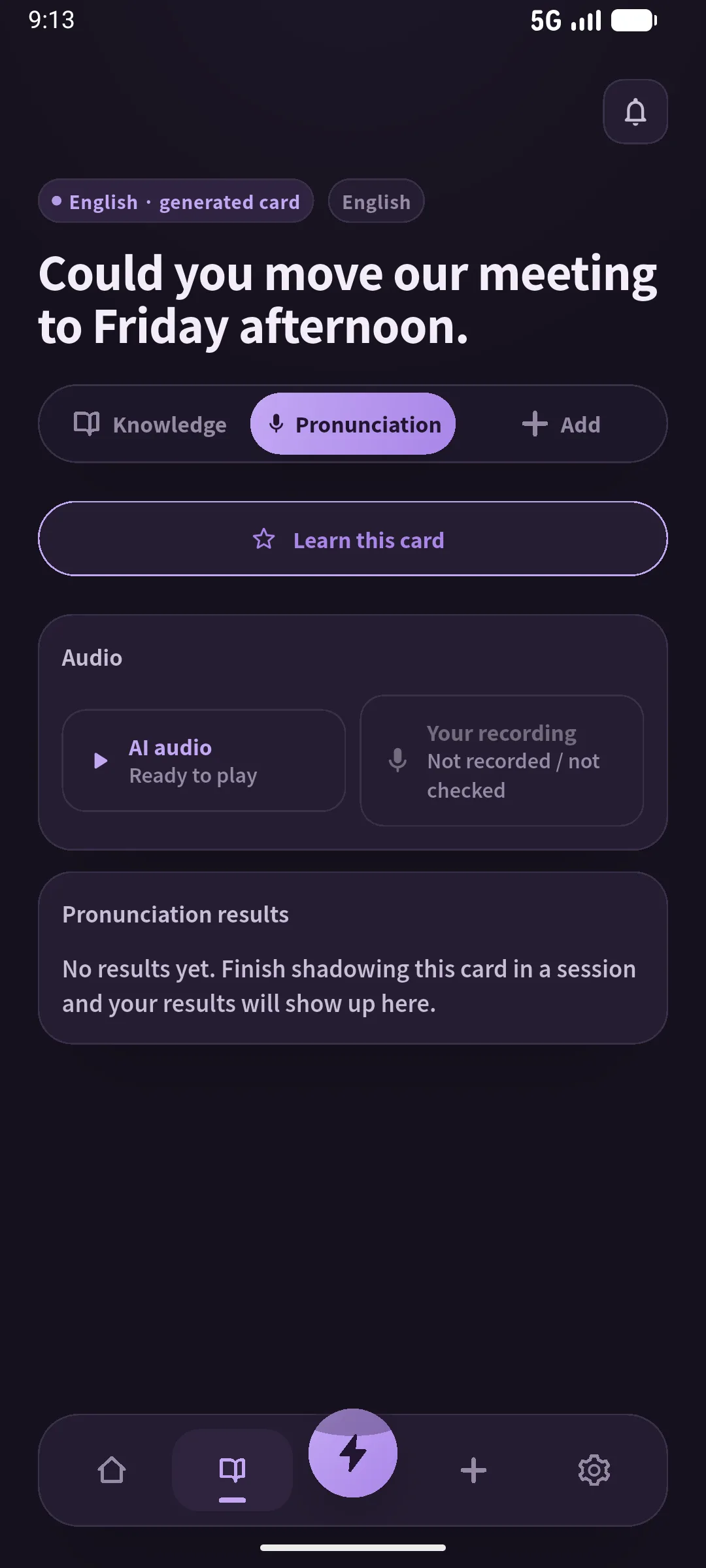
When you enter a sentence, SpeakGain creates a card with generated English audio and an AI explanation that can include meaning, structure, alternatives, and examples using the same pattern. You can check the audio, say the sentence, and optionally record it to inspect word-level pronunciation feedback. Practice history and self-ratings help surface cards for later review.
SpeakGain does not decide whether a sentence is worth learning for you. Apply the three checks first and keep your own note about the situation. Pronunciation assessment is feedback on a recording, not evidence that the sentence is memorized or that conversational ability is guaranteed.
How to fix common problems
- The sentence is too long and you stop halfway: keep only the clause or pattern you need now.
- You understand it when you see it but cannot say it: hide the English and retrieve it from the situation more often.
- You can only repeat the original: create one variation by changing the person, object, or time.
- It is gone the next day: forgetting is not a failure; check the answer and retest after a shorter gap.
- You can read it aloud but cannot explain it: pause recitation and examine the meaning and chunks.
- Your card collection keeps growing: stop adding new items and remove sentences with no real use case.
Summary
- Memorizing large numbers of examples does not guarantee long-term retention or conversation ability.
- Choose short sentences with a real use case and a meaning and structure you can explain.
- Break the sentence into meaningful chunks and one reusable pattern.
- Hide the English, retrieve it from the situation, and check the answer.
- Use reading aloud to practise sound and production, not as a universal memory shortcut.
- Retest after a gap and adjust the interval according to your errors and successes.
Begin with one sentence. Write down where you would use it and which part you can replace. Then hide it and make your first attempt from the situation alone.
References
- Roediger, H. L., & Karpicke, J. D. (2006). Test-enhanced learning: Taking memory tests improves long-term retention. Psychological Science, 17(3), 249–255.
- Karpicke, J. D., & Roediger, H. L. (2008). The critical importance of retrieval for learning. Science, 319(5865), 966–968.
- Cepeda, N. J., et al. (2006). Distributed practice in verbal recall tasks: A review and quantitative synthesis. Psychological Bulletin, 132(3), 354–380.
- Kim, M., & Webb, S. (2022). The effects of spaced practice on second language learning: A meta-analysis. Language Learning, 72(1), 269–319.
- Mizugaki, R. (2024). Effects of sentential contexts on retrieval practice: Perspectives from test formats. Language Education & Technology, 61, 125–154.
- Nergis, A. (2021). Can explicit instruction of formulaic sequences enhance L2 oral fluency?. Lingua, 255, 103072.
- Candry, S., et al. (2018). Written repetition vs. oral repetition: Which is more conducive to L2 vocabulary learning?. Journal of the European Second Language Association, 2(1), 72–82.
- Icht, M., & Mama, Y. (2019). The effect of vocal production on vocabulary learning in a second language. Language Teaching Research.
- Shintani, N., Li, S., & Ellis, R. (2013). Comprehension-based versus production-based grammar instruction: A meta-analysis of comparative studies. Language Learning, 63(2), 296–329.