
Reading English aloud: five steps, benefits and fixes
Published Updated
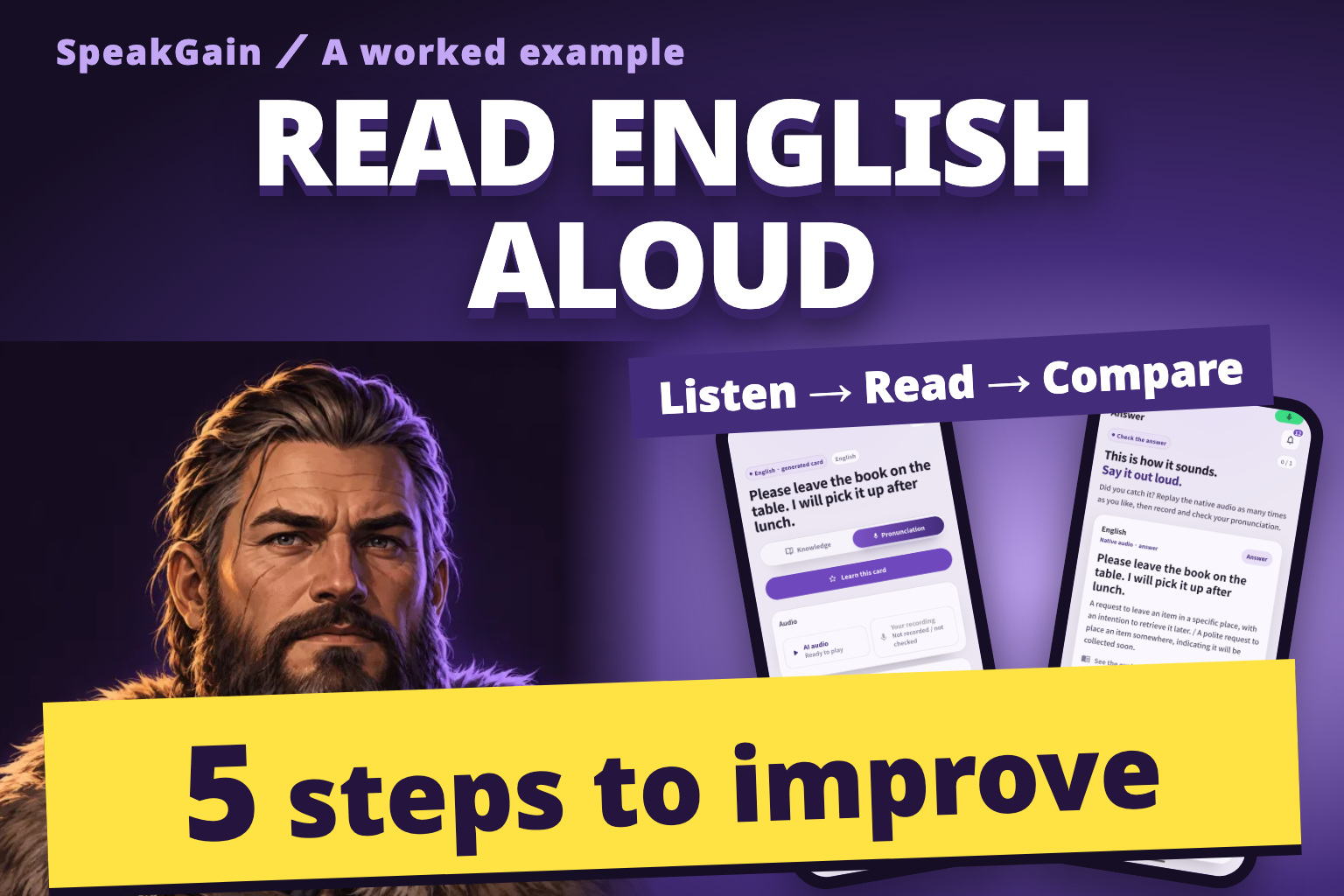
To practise reading English aloud, choose a short passage you understand, listen to a model, read in meaningful chunks, try it without the text, then record and fix one specific problem. Complete that loop before increasing your repetition count. The useful result is knowing what you said and what to change next.
When you are ready to speak without the text, try keyword practice for a short English speech, then record the whole speech and check its duration.
This is a good starting task when you understand written English but stop between every word when speaking. Our editorial recommendation is to finish two easy sentences with a recording comparison before attempting ten readings of a long article. If you cannot understand the text, work on vocabulary and sentence meaning first.
How to study English: choose by your goal and what stops you
To choose a sound, ending or stress pattern to fix, follow our English pronunciation practice method and compare one feature in a recorded sentence.
If you are taking Japan’s EIKEN Pre-2 second stage, use our interview flow, answer patterns and solo practice guide to record an answer and repair one point at a time.
For Japan’s EIKEN Grade 3 second stage, our interview flow, five-question answer patterns and solo practice guide helps you record a response and correct one point at a time.
When reading aloud gives every word equal weight, use English stress, rhythm and intonation to compare one prominent part or ending in a recording.
Once you can read the text aloud, move to retelling practice and explain the content with the text hidden and only keywords visible.
Before choosing what to read, compare English read-aloud materials with short sections and matching model audio.
Reading aloud, repeating and shadowing
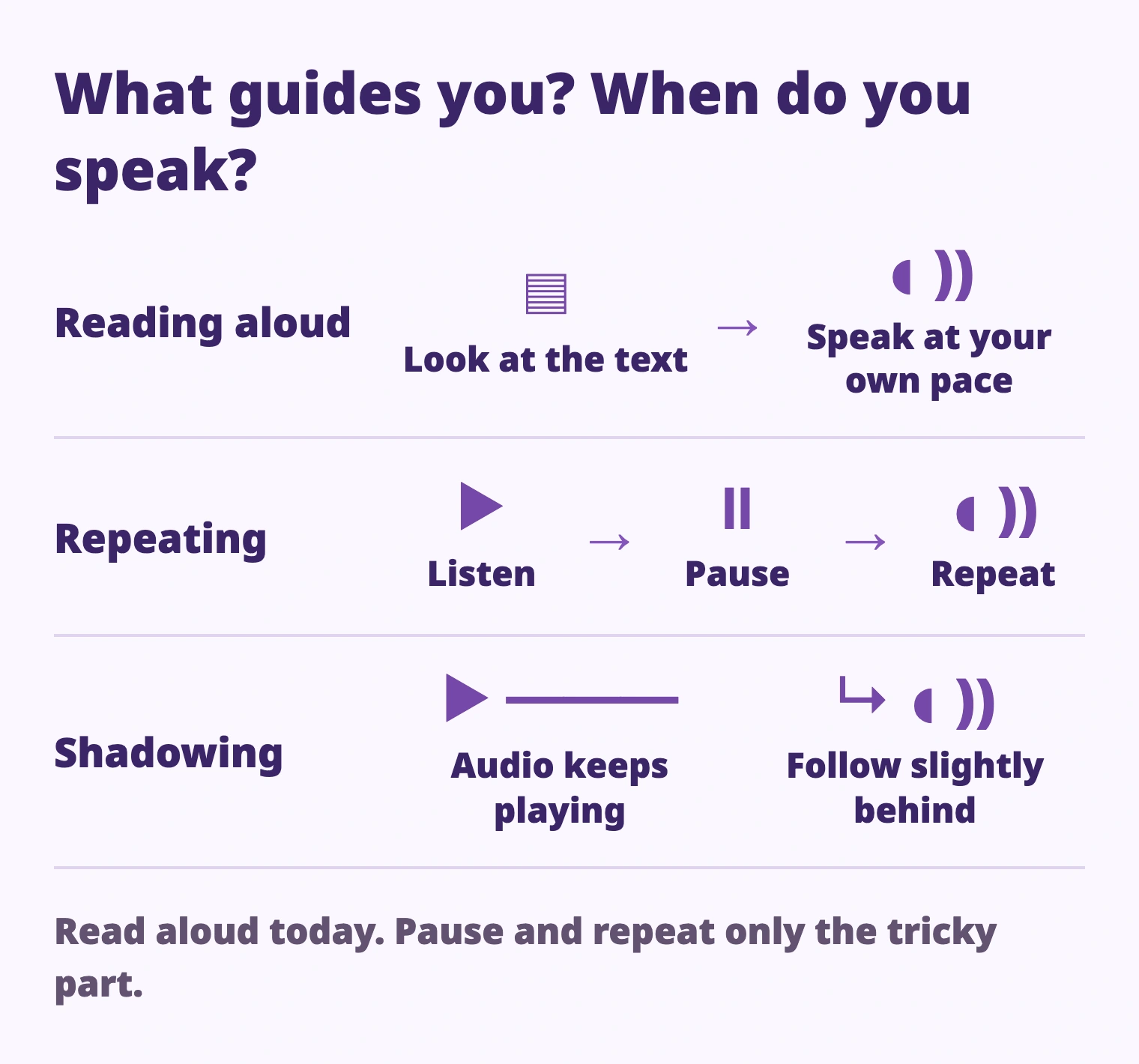
| Activity | What guides your speech | Use here |
|---|---|---|
| Reading aloud | Written text at your own pace | Keep the meaning together while speaking |
| Repeating | A model you pause before speaking | Repair a short difficult phrase |
| Shadowing | Audio that continues as you follow behind | A separate listening task |
Speaking without the text is a recall check, rather than reading aloud. Being able to recite a familiar passage does not establish that you can understand new audio. See the shadowing guide if following incoming sound is your main goal.
If reading at your own pace works but the model’s rhythm does not, try reading in sync with English audio and repair the difficult chunk.
Your practice passage
Please leave the book on the table. I will pick it up after lunch.
Imagine asking someone to leave a book where you can collect it later. This original passage is used throughout all five stages. The model is SpeakGain’s Deep-voiced Viking AI voice.
1. Understand the scene before speaking
Read silently and answer three questions: what should the other person leave, where, and when will you collect it? Your answers are the book, on the table, and after lunch. In this scene, leave means to put something somewhere and let it remain there. It refers to the book; pick it up means collect it.
Follow the sentence from left to right: Please leave the book gives the request; on the table adds the location. I will pick it up gives your plan; after lunch adds the time. You do not need to translate every word while speaking, but you should be able to explain the scene before and after the reading. If after and before are confused, repair the meaning first.
2. Listen and choose one target
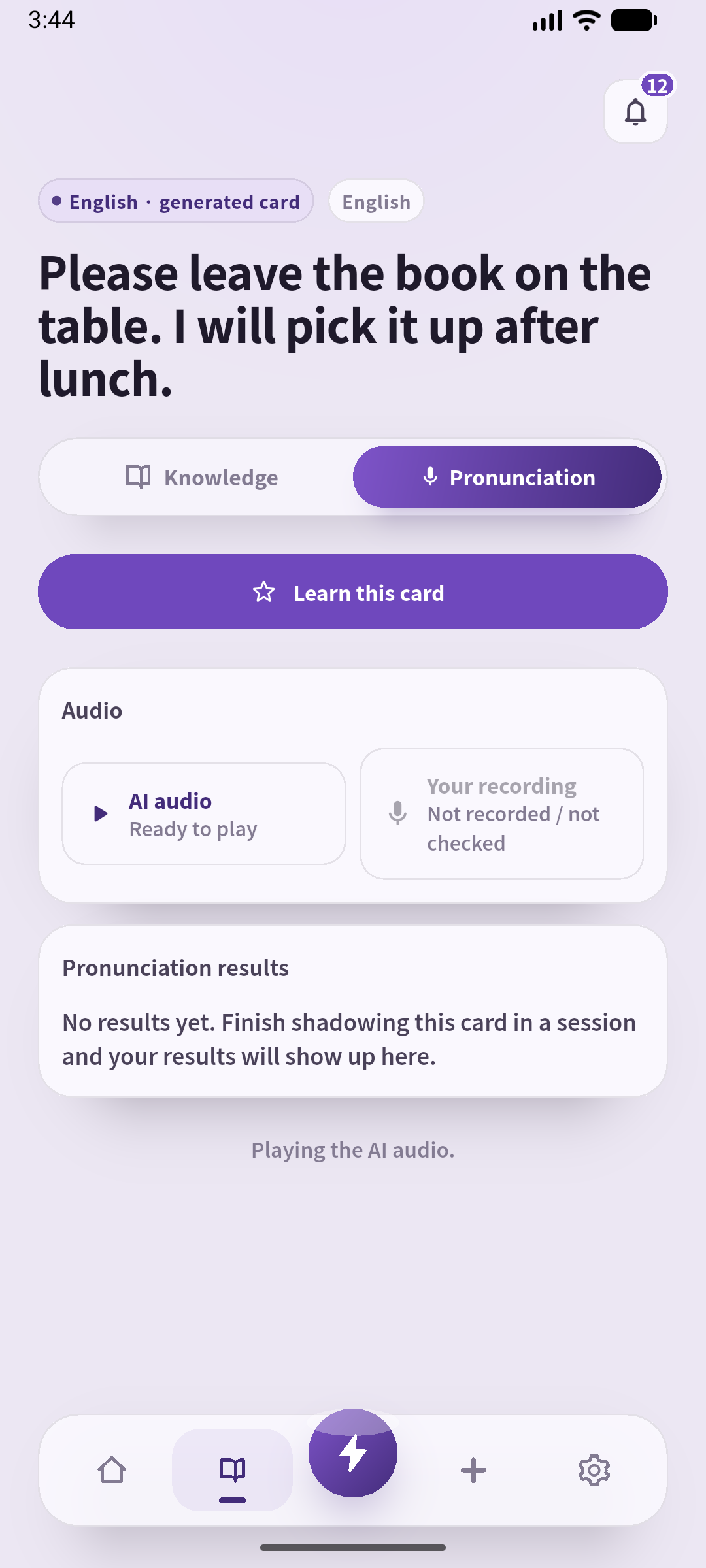
Listen once without speaking, then follow the printed words as you listen again. Focus on pick it up: how do the three words join in this particular recording? Pause and repeat that phrase. If necessary, start with it up, then restore pick it up.
Alternatively, make your target the end of the sentence: keep lunch audible rather than rushing or fading out. Notice how the model highlights the object, location and time. Copy a useful rhythm or connection; you do not need to copy the speaker’s low pitch or personality. If you cannot hear or produce a particular sound, consult a pronunciation explanation or teacher instead of replaying the entire passage indefinitely.
3. Read meaningful chunks, then reconnect them
Please leave the book / on the table.
I will pick it up / after lunch.
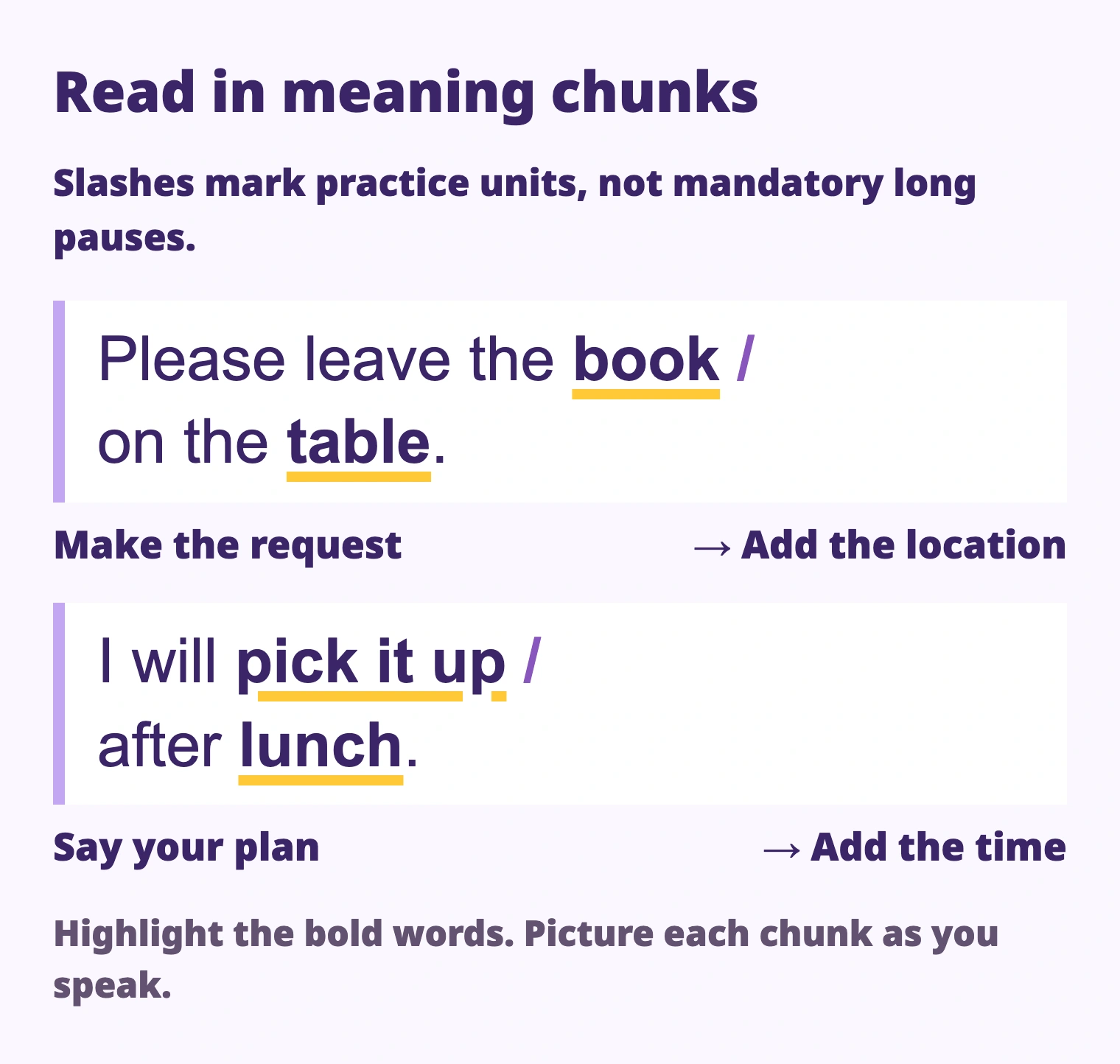
The slashes mark practice units, not compulsory long pauses. Say each chunk once, each sentence once, then both sentences together. Picture the request, location, plan and time as the information arrives. Avoid giving every word an identical isolated beat.
If pick it up breaks down, practise it two or three times, restore I will pick it up, then add after lunch. A phrase that works alone but falls apart in the sentence still needs repair. Read at a pace that preserves all the words and their meaning; matching the model’s exact duration is optional.
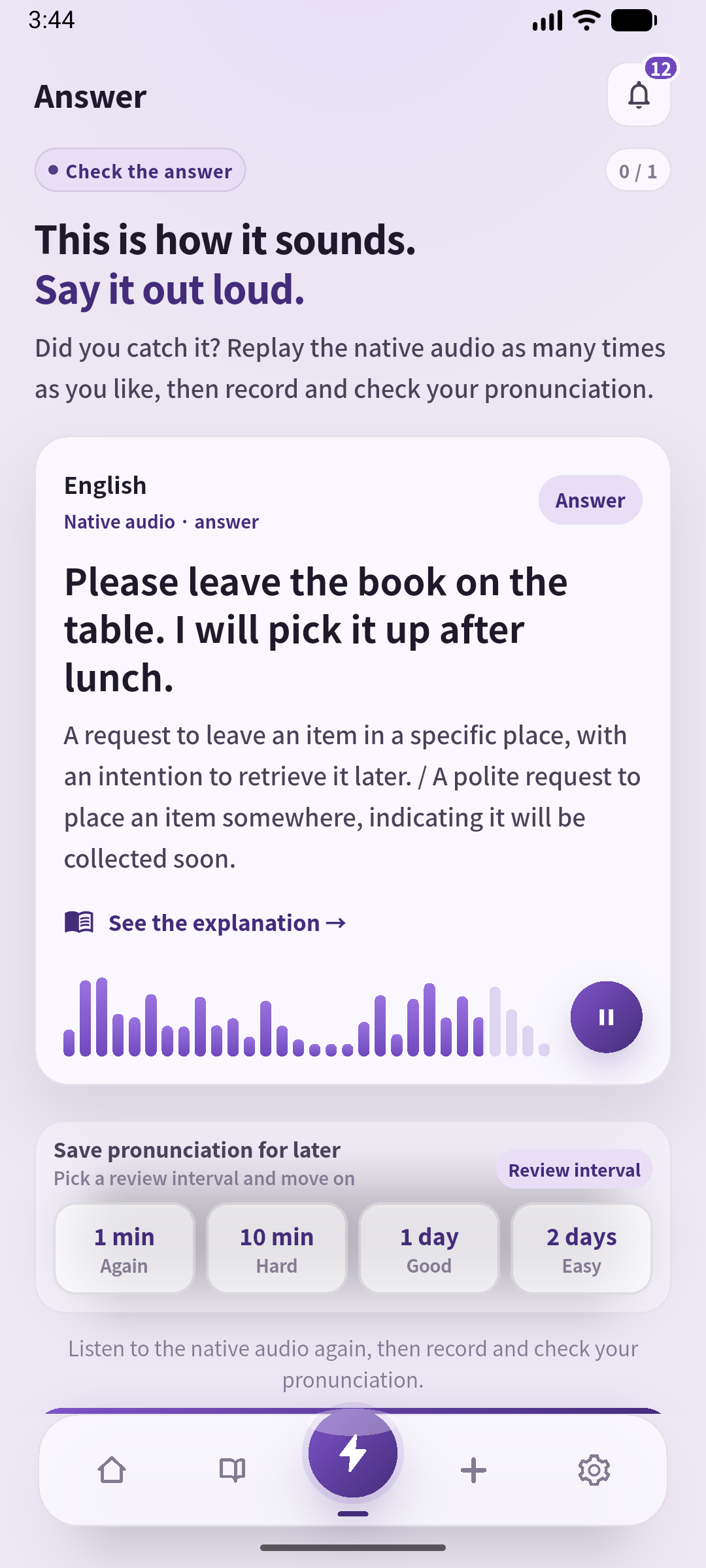
Our suggested repetition rule is simple: use the first attempt to locate trouble and another attempt after a short repair to check it. This is an editorial routine, not a scientifically established optimal number. If your tenth reading has the same problem as your third, shorten the task or change the repair.
4. Hide the text and retrieve the message
Hide the passage. Use the scene—book, table, collection after lunch—to say the two sentences. Look back only at the missing chunk, then hide it again. If the location disappears, practise on the table while imagining the table. If the word it disappears from the second sentence, identify what you are collecting and restore pick it up as a unit.
You can do this one sentence at a time. Perfect memorisation is not a requirement for proceeding to the recording. Then change book to key and try once more. That variation is a separate speaking task, absent from the model recording. Learning sentences for later use explains how to retrieve an expression from a situation.
5. Record, compare and repair
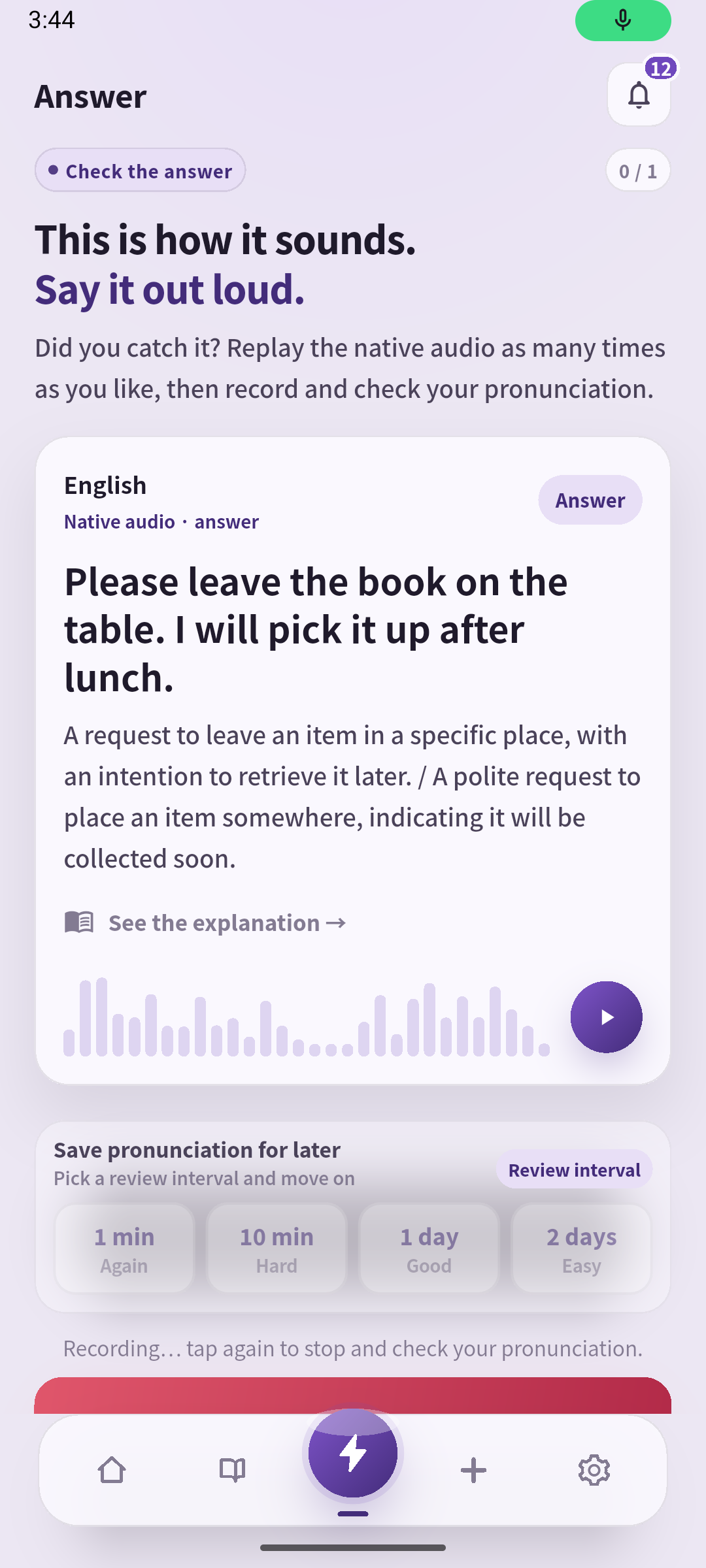
Stop the model audio and record only your own voice. You may look at the text. Use normal speaking volume and finish the final word. Compare the same short section in this order: model, your recording, model.
| Check | Listen for | Repair |
|---|---|---|
| Missing words | Does pick it up retain it? | Repeat the short phrase, then reconnect it |
| Long stops | A break inside on the table | Treat the location as one unit |
| Sentence ending | Is after lunch audible? | Keep your voice through the final word |
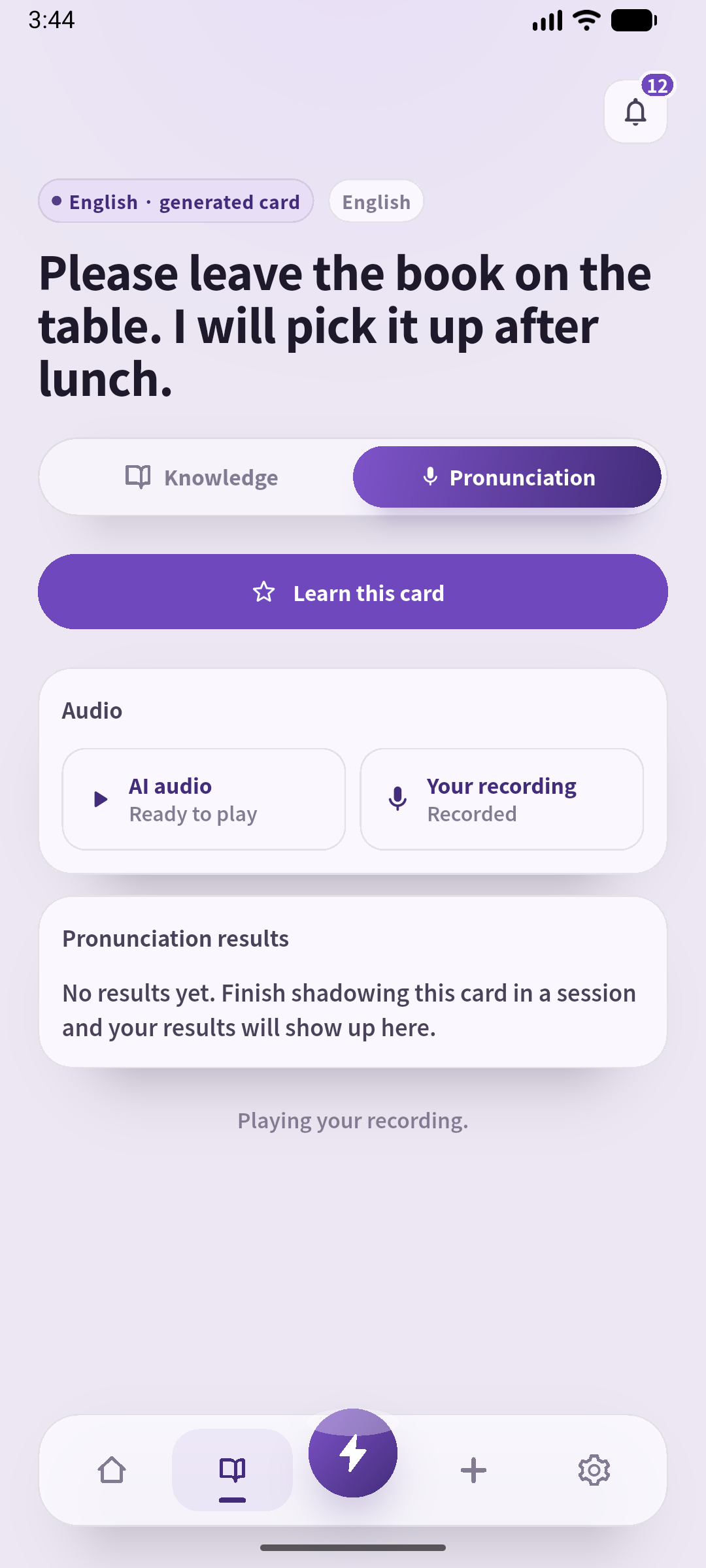
A useful note is “First attempt: missing it. After repair: it present. Next target: sentence ending.” It is an example of a practice log, not a learner result. If you cannot hear the difference, ask a teacher which word is unclear and request one specific correction. Pronunciation apps differ in the information they provide; a score alone is not a repair plan.
Benefits: what the research measured
Martínez Adrián (2014) studied 20 first-year university students with ten weeks of reading-aloud tasks. The course also included explicit pronunciation instruction, model comparison and reflection on errors. Instructors assessed articulation, stress and intonation in two different approximately 200-word texts, tasks 5 and 10. The mean overall score rose from 6.61 to 7.75 out of ten, with significant improvements reported in all three categories. This was not a controlled comparison isolating repetition from instruction or feedback. Our practical inference is to include noticing and correction when pronunciation is the goal. Full paper, methods and Table 2.
Kim (2025) analysed speech-to-text word recognition during ten weeks of repeated reading aloud by university learners. The public abstract reports more students reaching complete word recognition and fewer with low recognition rates. We read the abstract, not the full paper. Machine word recognition is not the same measure as human comprehensibility or spontaneous conversation. Public abstract.
Neither study, as inspected here, establishes gains in reading speed or automatic word-order processing. Chunking in this guide is a practical way to check meaning in English order. To assess reading progress, also read a new easy passage silently and answer content questions. To assess speaking, answer a question without a supplied script. Neither study tested SpeakGain or these two sentences.
Seven failure patterns and immediate fixes
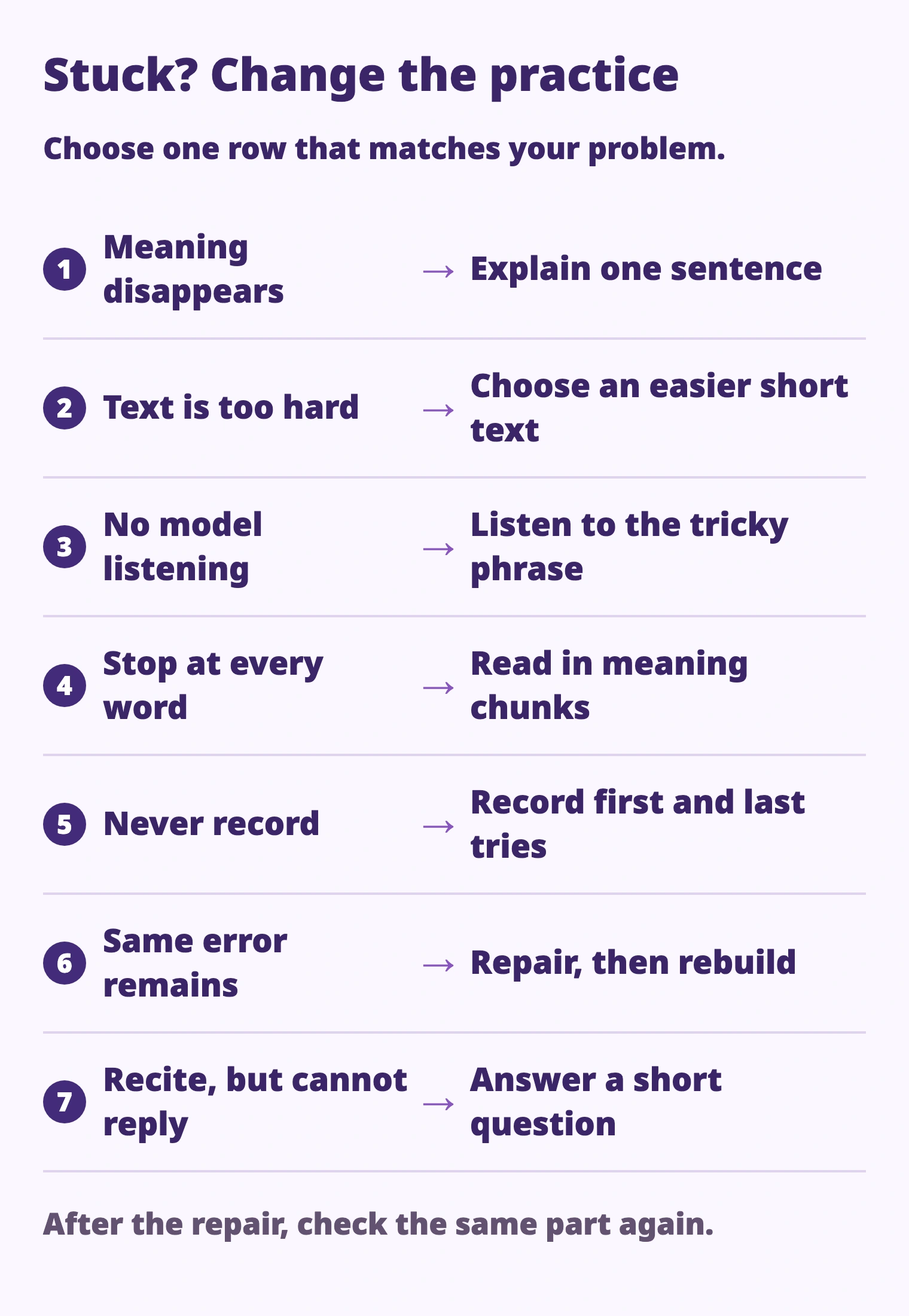
- Your mouth moves but meaning disappears: after reading, answer what goes where. If you cannot, return to stage 1 and explain one sentence at a time.
- Most of your time goes into dictionary searches: keep that text for intensive reading and choose an easier, shorter passage for spoken practice.
- You invent pronunciation from spelling: listen to the model or a dictionary entry, then repair the difficult phrase before reading the full passage again.
- You pause after every word: group on the table as a location and say it together. Shorten the passage rather than adding more one-word breaks.
- You never record: capture the first and final attempts and compare just one feature, such as the presence of it. The recordings can stay private.
- You count readings but repeat the same error: stop full-passage repetition, isolate the problem, repair it and restore the sentence.
- You can recite but cannot reply: ask “Where should I leave it?” and answer On the table. Then answer “When will you collect it?” with After lunch. When English words will not come out addresses choosing a response.
Choose material you can finish
Choose one or two sentences whose situation you can explain, with matching clear audio, easy replay controls and an expression or sound you want to practise. Avoid music, overlapping speakers and passages you cannot understand. We prefer a short comprehensible dialogue with audio to a difficult news article without a model. Not every text needs to become an oral exercise: when your goal is understanding a long explanation, silent reading and a summary may fit better.
Use SpeakGain for the model and your recording
A player and a recorder are sufficient for this routine. SpeakGain, which we develop, is one example of keeping a model and your own recording around a saved sentence. Listen, stop the model, speak, then replay your recording.
Compare the target section even if you also use scoring. What SpeakGain is covers the broader features.
Your first session and the next day
Complete one loop of the five stages. Around ten minutes is a convenient starting allocation, not a proven minimum effective dose. Stop after checking one repair and note any remaining difficulty. Tomorrow, try the scene before replaying today’s audio. Revisit only forgotten or broken chunks; then try a different easy sentence to distinguish familiarity from broader progress.
Beginners do not need a universal daily repetition quota. Silent mouthing can prepare the text but cannot reveal your actual recorded sound. Hiding the text is a check, not a perfect-recall gate. Start today by recording the passage once, choosing one repair and comparing a second recording.
If you are taking Tokyo’s speaking test, our ESAT-J preparation guide explains the current tasks and practice for each part at home.
Families preparing Japan’s Eiken Grades 4 and 5 can use our Speaking Test and home-practice guide to check official entry rules and practise short, relevant answers together.
References
- Martínez Adrián, M. (2014). The efficacy of a reading aloud task in the teaching of pronunciation. Journal of English Studies, 12, 95–112. Full text inspected.
- Kim, J. (2025). The Effects of Reading Aloud on Korean University EFL Learners’ Pronunciation Accuracy and Learning Perceptions: A Speech-to-Text (STT)-Based Analysis. Journal of Language Sciences, 32(2), 1–28. Public abstract inspected.
To turn your daily life into practice sentences, follow the three-sentence English diary: write, check, listen and say.
Before a talk, use the guide to presenting in English to rehearse your opening three lines, transitions and closing with your slides.