
How to keep an English diary: write three sentences, then listen and say them
Published Updated
Start an English diary with three sentences: what happened, how you felt and what you will do next. Check one uncertain expression, choose a sentence you expect to use again, then listen, say it aloud and try recalling it tomorrow.
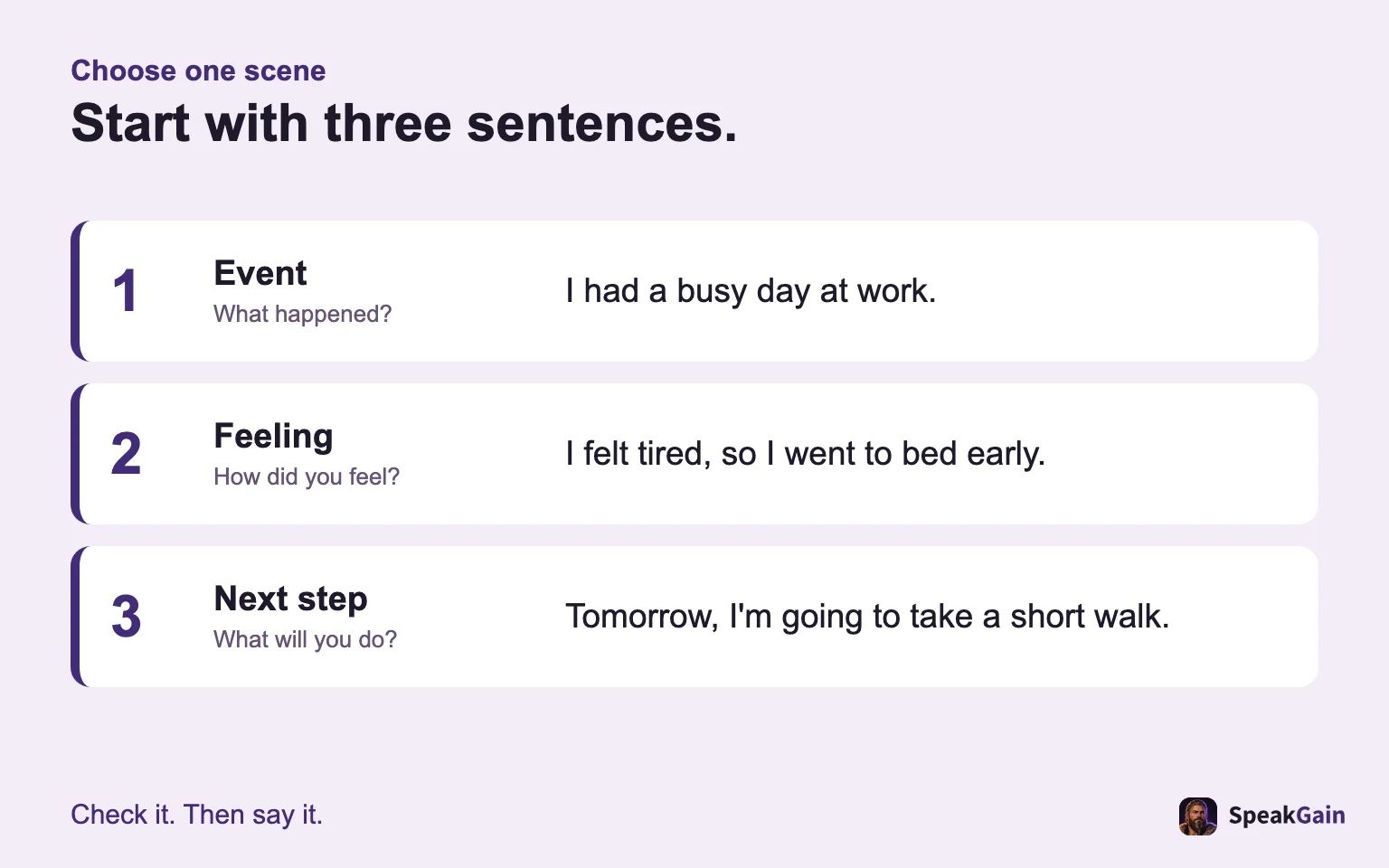
For example: “I had a busy day at work.” “I felt tired, so I went to bed early.” “Tomorrow, I’m going to take a short walk.” That is a complete entry. You do not need to translate a long account of your whole day.
Our editorial recommendation is three sentences per entry, about three times a week to begin. This is a manageable starting plan that leaves time for checking and speaking, not a research finding about the optimal dose. Keep a useful sentence rather than filling a page you never revisit.
To adapt short diary practice to exam tasks, our Pre-2 email and opinion guide separates personal experience from a general supporting reason.
1. Use an event, a feeling and a next step
Write the date and pick one scene: finishing a meeting, making dinner or walking home. You are making a personal practice record, so you can leave out background that you already know.
| Job | Possible opening | Question |
|---|---|---|
| Event | Today, I … / I went to … / I had … | What happened? |
| Feeling | I felt … / It was … / I enjoyed … | How did you feel? |
| Next step | Tomorrow, I’m going to … / Next time, I’ll … | What will you do? |
These are prompts, not blanks you must fill. If you have no plan, write a present state: “I feel better now.” Do not invent a promise merely to complete the template.
When an idea is difficult to express
If an elaborate idea in your first language is hard to express, break it up: “I finished the report. I felt relieved.” Write directly in English when you can; a full draft in another language is optional. If every sentence needs ten dictionary searches, narrow the scene. Avoid replacing ordinary diary language with a thesaurus word you cannot confidently explain.
2. Scene-by-scene examples: change them to match your day
These are editorial examples, not quotations from users. They describe ordinary activities; use only what actually happened to you.
Work
- I had a busy day at work. — Work kept me busy.
- I felt tired, so I went to bed early. — This describes a completed action.
- Tomorrow, I’m going to take a short walk. — This describes a plan.
If you have not gone to bed yet, use “I feel tired, so I’m going to bed early tonight.” Keep the timing true rather than copying the example’s tense.
Cooking at home
- I cooked dinner at home. — An event.
- I enjoyed trying a new recipe. — A feeling about an activity.
- Next time, I’ll use less salt. — A change for next time.
Hobbies, weather, shopping and an ordinary day
Hobby: “I played a game with a friend.” “It was fun, but I stayed up too late.” “Tomorrow, I’ll stop playing earlier.”
Weather: “It rained this morning.” “I was happy to see the sun in the afternoon.” “Tomorrow, I’m going to take a short walk.”
Shopping: “I bought a new notebook today.” “I liked its simple design.” “I’m going to use it for my English diary.”
An ordinary day: “I stayed home today.” “I felt relaxed after lunch.” “Tomorrow, I’ll call a friend.”
Nothing remarkable needs to happen. Reuse yesterday’s structure and change the activity or feeling. Completed events usually use the past; present feelings and future plans use the corresponding forms. The British Council’s past-simple guide explains the basic tense.
3. Fix the meaning or pattern you actually need
The following revisions serve the stated intention. They do not make every original expression impossible in every context.
| Intended meaning | Draft | Revision | What to check |
|---|---|---|---|
| I felt uninterested | I was boring. | I was bored. | My feeling or my effect on others? |
| I enjoyed the party | The party was funny. | The party was fun. | Enjoyable or amusing/strange? |
| I enjoyed the activity | I enjoyed to cook. | I enjoyed cooking. | Verb form after enjoy |
| I returned home | I went to home. | I went home. | No to before home here |
| I had lots of homework | I had many homeworks. | I had a lot of homework. | Usually uncountable |
Check the usage and sources behind the table
“I was boring” can describe the impression you gave others. For your own feeling, check British Council: -ed and -ing adjectives. “Funny” can describe humour or something strange; simple enjoyment calls for “fun”: Cambridge: fun or funny.
The other patterns are documented in Cambridge’s guides to enjoy doing, go home and uncountable nouns. The complete sentences in the table are our examples based on those usages.
Save one reason for the correction, then use the pattern with different content: “enjoy + -ing” becomes “I enjoyed walking in the park.” We recommend one meaningful reuse rather than repeatedly copying a correction without understanding it.
4. Choose a check according to your question
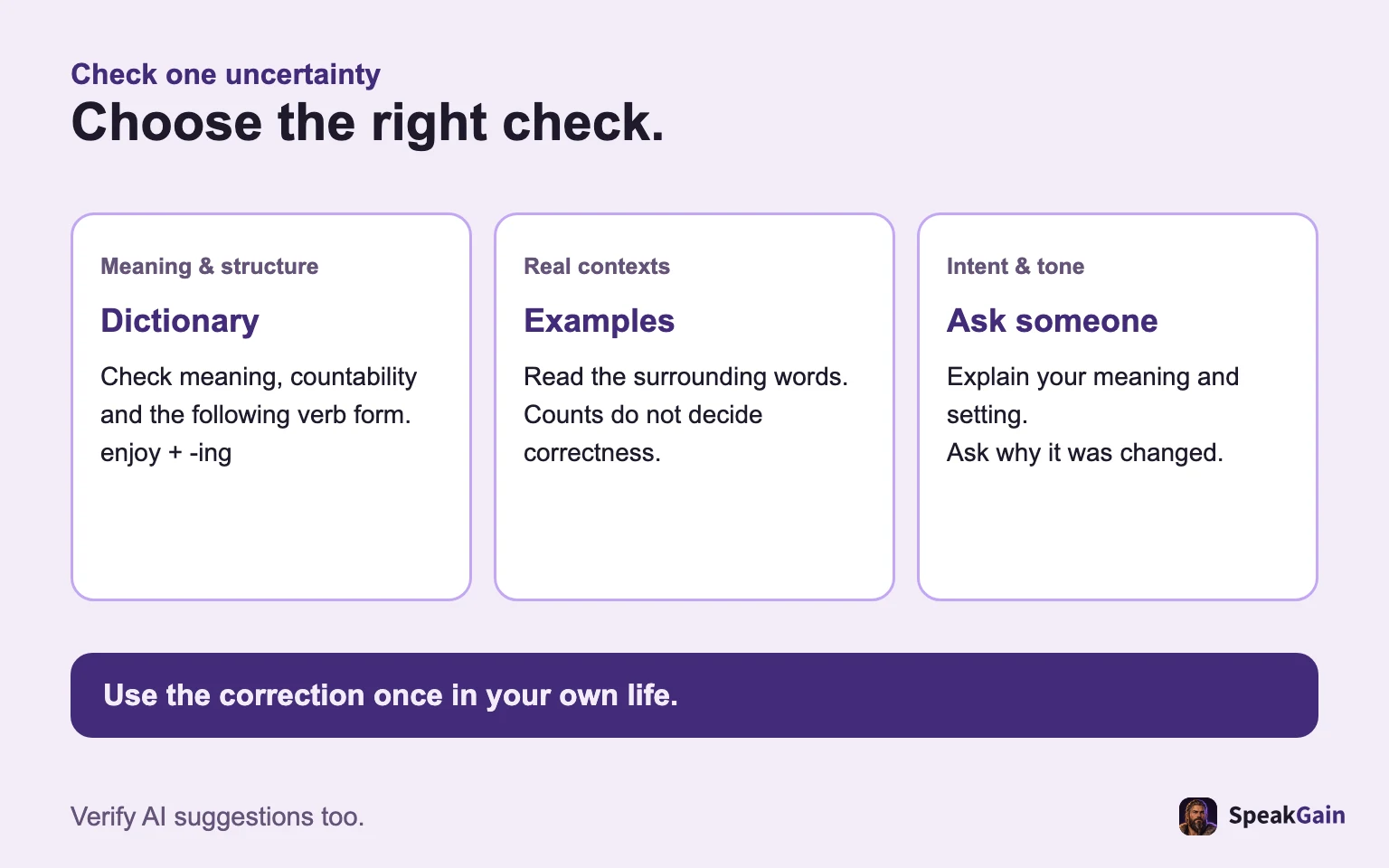
Dictionary or grammar material
check the part of speech, countability, example sentences and the form that follows a verb. Search “enjoy doing” rather than hoping your entire diary sentence appears as a dictionary entry. Keep a usable chunk such as “enjoy cooking”.
Example search or a corpus
read the surrounding words and situation. Start with dictionary examples; COCA is another place to examine contexts. Search results mix teaching material, translations, adverts and learner writing. A large count is not a correctness test; a rare but valid personal experience may have few exact matches.
A teacher or another experienced English user
give the intended meaning and setting, not just the sentence. Ask, “I want to say this in a casual conversation about a tiring day. Can you keep that meaning and explain the change?” Clarify whether a suggestion repairs an error or offers a different style.
AI or a grammar checker
proposals can be useful, but verify meaning and reasons. UNESCO’s guidance discusses output validation and human judgment. Our suggested request is to check one sentence, preserve its meaning and explain each change. Check the service’s data terms before including personal details. Compare your own draft with the suggestion, then select one change to use next time.
5. Haruka’s three days: reuse before adding length
Haruka is a fictional office worker, not a user testimonial. These three days illustrate a process, not the time needed to improve.
Day 1, written the following morning: “I had a busy day at work.” “I felt tired, so I went to bed early.” “Tomorrow, I’m going to take a short walk.” Haruka leaves out the meeting’s details and underlines the first sentence because it will be useful in a conversation about work.
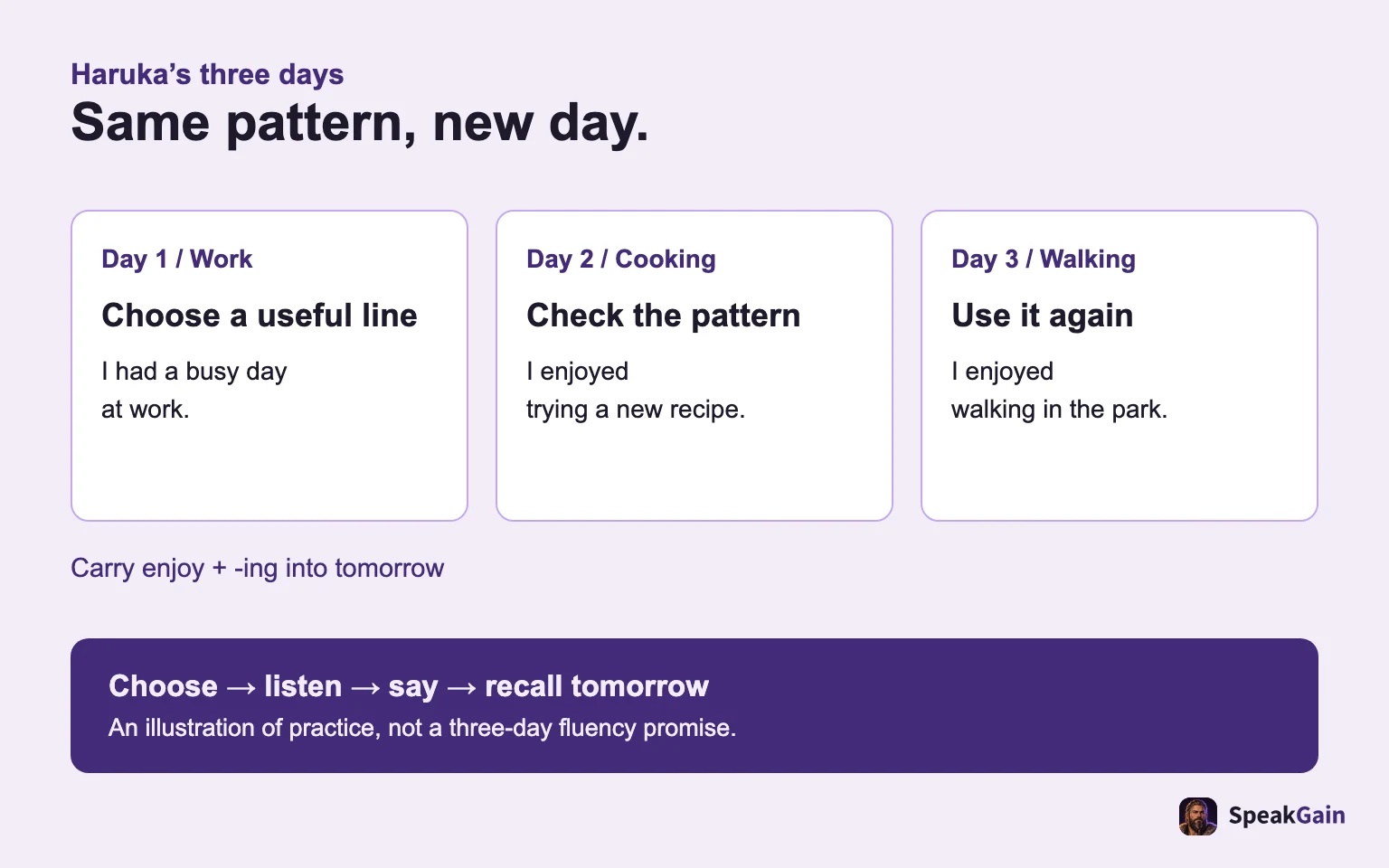
Day 2: “I cooked dinner at home.” “I enjoyed trying a new recipe.” “Next time, I’ll use less salt.” The day did not follow the earlier walking plan; a diary records reality. Haruka starts with “I enjoyed to try …”, checks a dictionary and notes “enjoy + -ing”.
Day 3: “I took a short walk after work.” “I enjoyed walking in the park.” “Tomorrow, I’m going to take a short walk again.” Yesterday’s pattern now uses “walking”; the earlier plan gains “again”. The test is whether the checked structure can be used again, not how many new words appear.
6. Listen to one sentence, say it, then recall it tomorrow
Haruka chooses “I had a busy day at work.” Choose a sentence whose meaning you understand, that fits your life and that you expect to say to someone. The hardest line is not automatically the best choice.
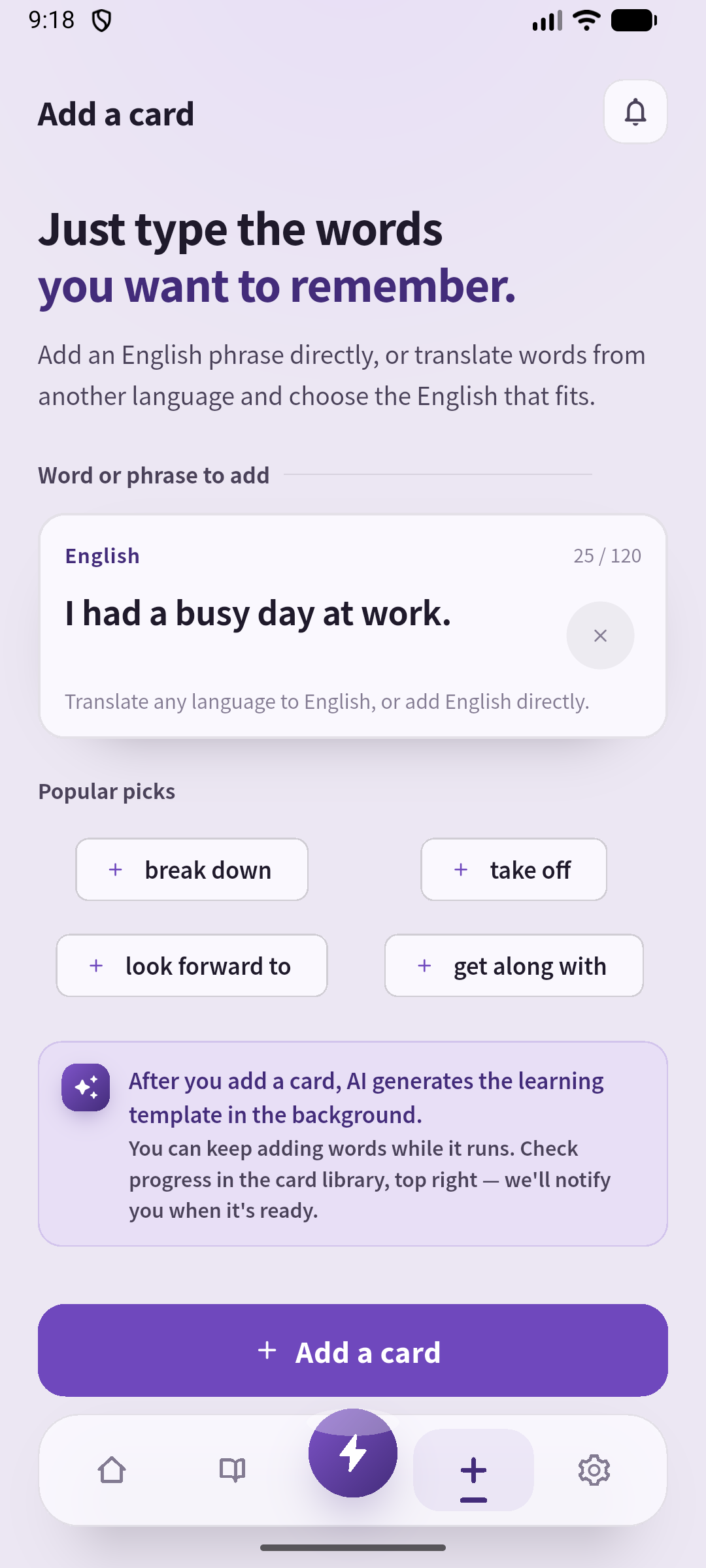
- Confirm the meaning. Use dictionary audio for individual unfamiliar words.
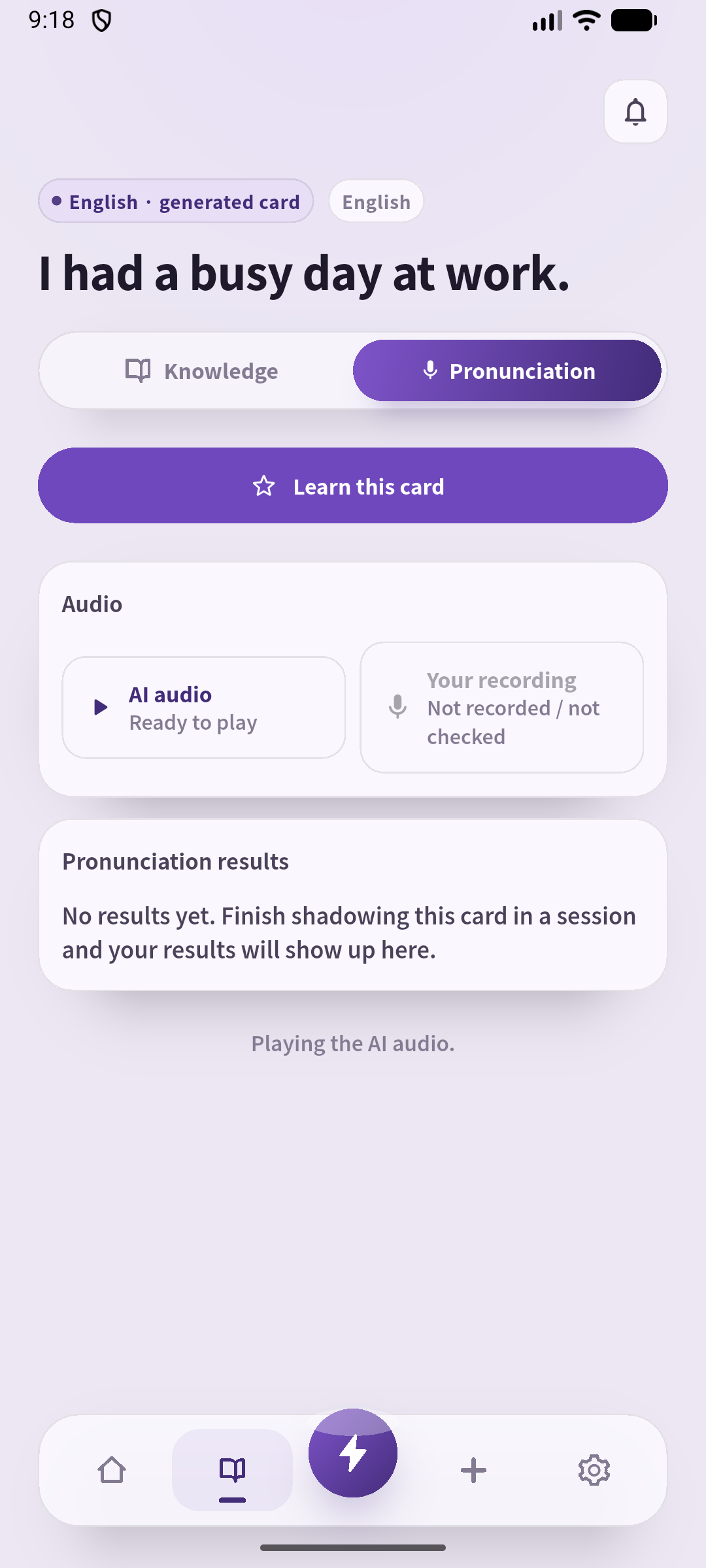
- Listen to the sentence and match sound to text. Notice a difficult part such as “busy day”.
- Say it aloud, reading if necessary. Focus on conveying a meaningful phrase before matching speed.
- Close the text and recall the line from its meaning. Return only to the part where you get stuck.
- Try again at another time tomorrow. On a genuinely busy day, use “I had a busy day at work yesterday” in conversation and respond to the other person.
These are editorial practice steps, not a required number of repetitions. If you cannot speak where you are, listen now and say it later. Keep the diary on paper or in notes and save only the chosen practice sentence in SpeakGain.
English models from the three-day diary
Work — I had a busy day at work.
Trying a recipe — I enjoyed trying a new recipe.
Walking in the park — I enjoyed walking in the park.
These three clips use the app’s Deep-voiced Viking voice. Each sentence was generated once and the same English recording is shared across all article languages. A model you can play is a starting point; being able to communicate the sentence needs a separate check. Continue with reading aloud or responses in a conversation.
7. What the research measured
A diary can expose a word or construction you wanted but could not produce. Our proposal is to check and reuse it; writing alone does not guarantee conversational fluency.
Study details and the limits of our starting plan
Song (2012) studied 25 university EFL learners doing written and recorded English diaries almost daily for about 13 weeks. The public abstract reports significant mean differences in pre/post writing and speaking test scores. We inspected the abstract only. Combined writing and recording does not isolate the effect of short written entries, three days of practice or any particular app. Confidence and anxiety were questionnaire responses. Our three sentences, three weekly entries and one practice line are editorial choices, not that study’s protocol.
At the weekend, close an earlier entry and try saying one line. Did you use a previously checked form without looking it up? Can you now say a part that caused difficulty? Use those observations to choose next week’s work.
8. Choose tools you can return to
Start with the notebook or notes app you already have. Write an entry before spending an hour comparing diary products. Choose a tool once you can name the task it needs to help with.
| Tool | Useful for | Check before choosing |
|---|---|---|
| Paper notebook | Keeping edits beside the original | Can you find old entries? |
| Notes app | Quickly capturing a scene | Search, export and storage terms |
| Template | Choosing a topic and order | Can you change it and remove blanks? |
| Feedback tool | Checking a doubtful sentence | Reasons and preservation of meaning |
| Listening/speaking tool | Practising your selected line | Your own sentences and later access |
If writing is cumbersome, prioritise quick entry; if corrections disappear, keep original and revised versions; if you never speak, look for listening and speaking practice. Check current provider terms and prices when you start.
Missing a day does not create a debt of two entries. Attach practice to an existing moment, such as after breakfast. On a tiring day, keep one line and return to three later. We prioritise revisiting an old sentence over filling every calendar square. For the broader routine, see how to study English.
Common questions
How many words should a beginner write?
Start with three short sentences, or one if that is all you can produce. Understanding and using the sentence matters more than meeting a word count.Do I need Dear Diary and a date?
The date helps you find the entry again. A greeting is optional for personal practice; school assignments may have their own requirements.Can I repeat the same content?
Yes, if it matches your day. Change a detail and check the meaning instead of copying an unrelated example.Do I need paid correction for every entry?
No. Writing can reveal questions; check one uncertain form with a dictionary or person rather than repeatedly practising it unchecked. Every sentence need not receive paid feedback.Will the diary alone make me fluent?
Writing cannot guarantee spontaneous replies in a conversation. Add listening, speaking and using a line with another person. See the speaking roadmap and recalling English sentences.Choose today’s scene, write the three lines and check one expression. Underline a sentence worth saying again, listen and say it. Leave yourself something useful to return to tomorrow.
To choose a tool for your own entries, compare English diary and writing apps by correction type, consistency support and free limits.