
How to learn to speak English: a self-study roadmap you can use
Published
To learn to speak English, choose one situation, collect the sentences you need, listen and imitate, recall them without reading, then use them with a person and revise. Your first target is to complete a small exchange and respond to the other person, rather than to speak fluently about every topic.
Self-study can prepare the meaning, sound and retrieval of your sentences. A conversation shows whether another person understands you and whether you can handle an unexpected reply. Here we arrange a Tuesday meeting, using six sentences from preparation through to an actual exchange.
How to study English: choose by your goal and what stops you
For an upcoming TOEIC Speaking test, use our task-specific answer patterns and solo practice guide to plan timed recordings around the official limits.
If you keep translating before speaking, try a daily routine for thinking in English to practise one short sentence from a familiar situation.
To choose your solo routine, compare English speaking practice methods by level and goal and select two exercises for your daily menu.
Take a useful sentence into a conversation.
Turn ‘I want to speak English’ into something you will do this week. Ask a colleague about a meeting, order a meal and confirm it, or explain a small problem. Choose a situation you genuinely expect to use. If introductions are already easy, practise your next difficulty instead of repeating the same introduction indefinitely.
The official CEFR scale describes different kinds of speaking: A1 includes simple interaction with help and slow speech; A2 includes familiar, routine exchanges. Saying these six sentences does not establish an A2 level. The scale is a reminder to define the task before judging yourself. Council of Europe: CEFR global scale
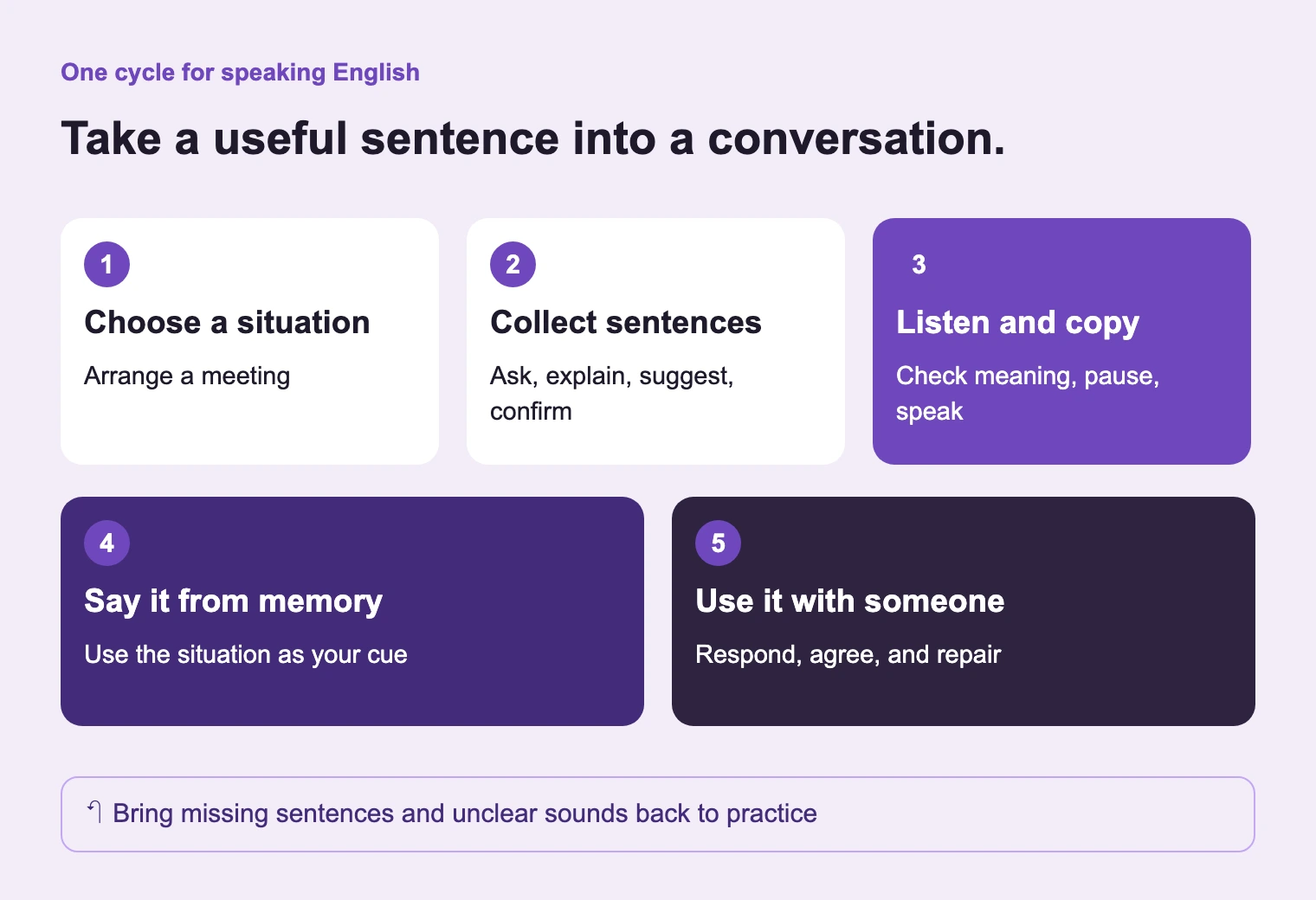
Our editorial recommendation is to take one situation all the way to another person before adding several new courses. Four weeks is a trial and review interval, not a promise of fluency. Keep vocabulary and grammar resources, but use them to resolve a specific obstacle in your chosen exchange.
1. Choose a situation
You want to agree a time on Tuesday morning. You already have a team call at ten. The other person’s availability is unknown. Write three intentions in your own language: ask when they are free, explain a conflict and suggest eleven, then confirm the agreement.
Give a partner several possible replies, including an unavailable time or a different day. The success condition is choosing a time and checking the day and time together. Reciting six lines in order is a different task. Pauses and a request to repeat are acceptable if you still complete the exchange.
2. Collect sentences
Choose short sentences from a trusted textbook or dictionary and check their meaning. Ask a teacher about uncertain wording. The ten-o’clock proposal belongs to the other person here: you already have a call. You do not have to say every line yourself.
Check the pieces you will change: the time after ‘at’ and the day after ‘on’. Learn just enough grammar to understand and adapt the sentence. Waiting until you finish a whole grammar book postpones the speaking practice you are trying to start.
SpeakGain, which we develop, can save each sentence through its normal Create flow and provide an explanation and model audio. Read the generated explanation and check it against your intention. A generated explanation is not a substitute for checking uncertain usage.
| Purpose | English sentence |
|---|---|
| Ask about availability | Are you available on Tuesday morning? |
| Suggest a time | Could we meet at ten on Tuesday? |
| Explain a conflict | I have a team call at ten. |
| Offer an alternative | Would eleven be a good time for you? |
| Ask for repetition | Sorry, could you repeat the time? |
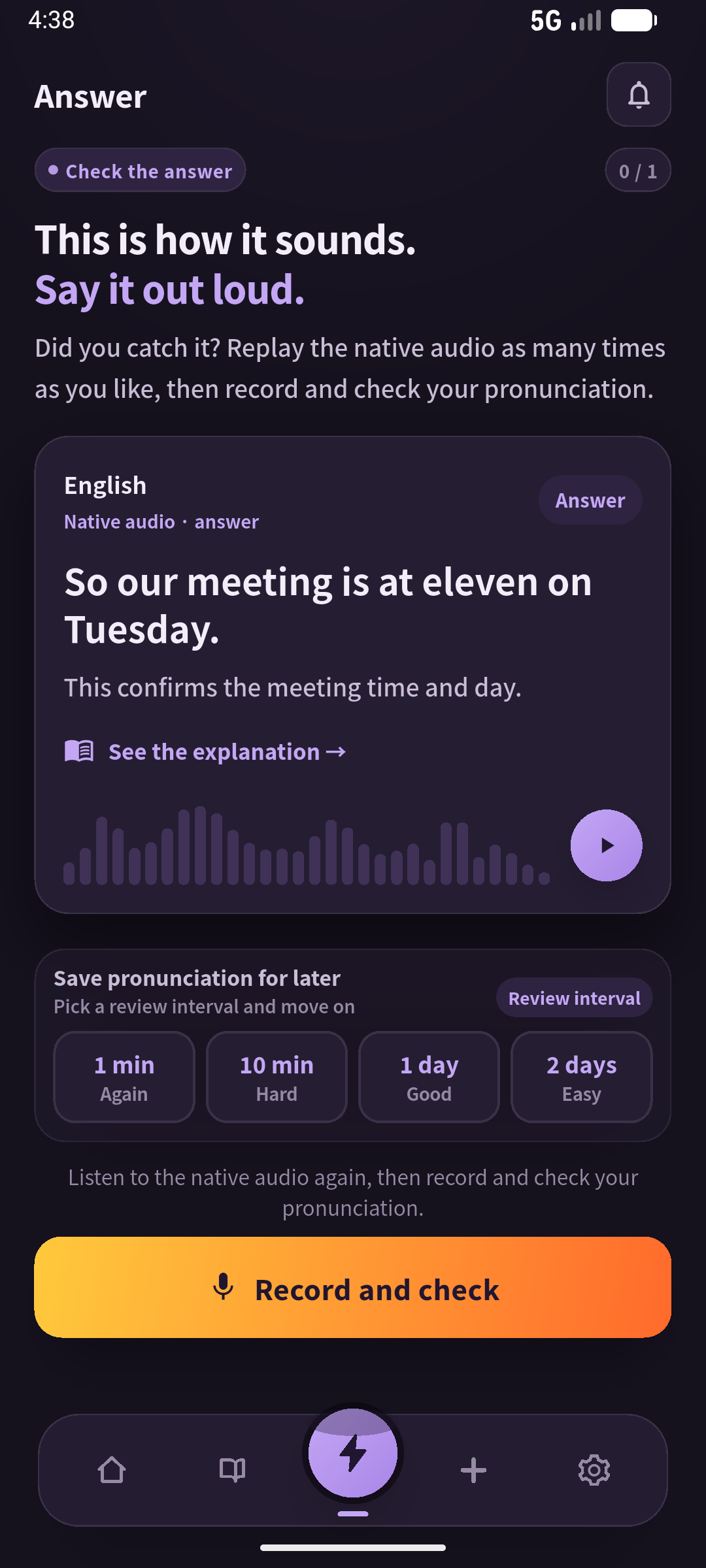
| Confirm the agreement | So our meeting is at eleven on Tuesday. |
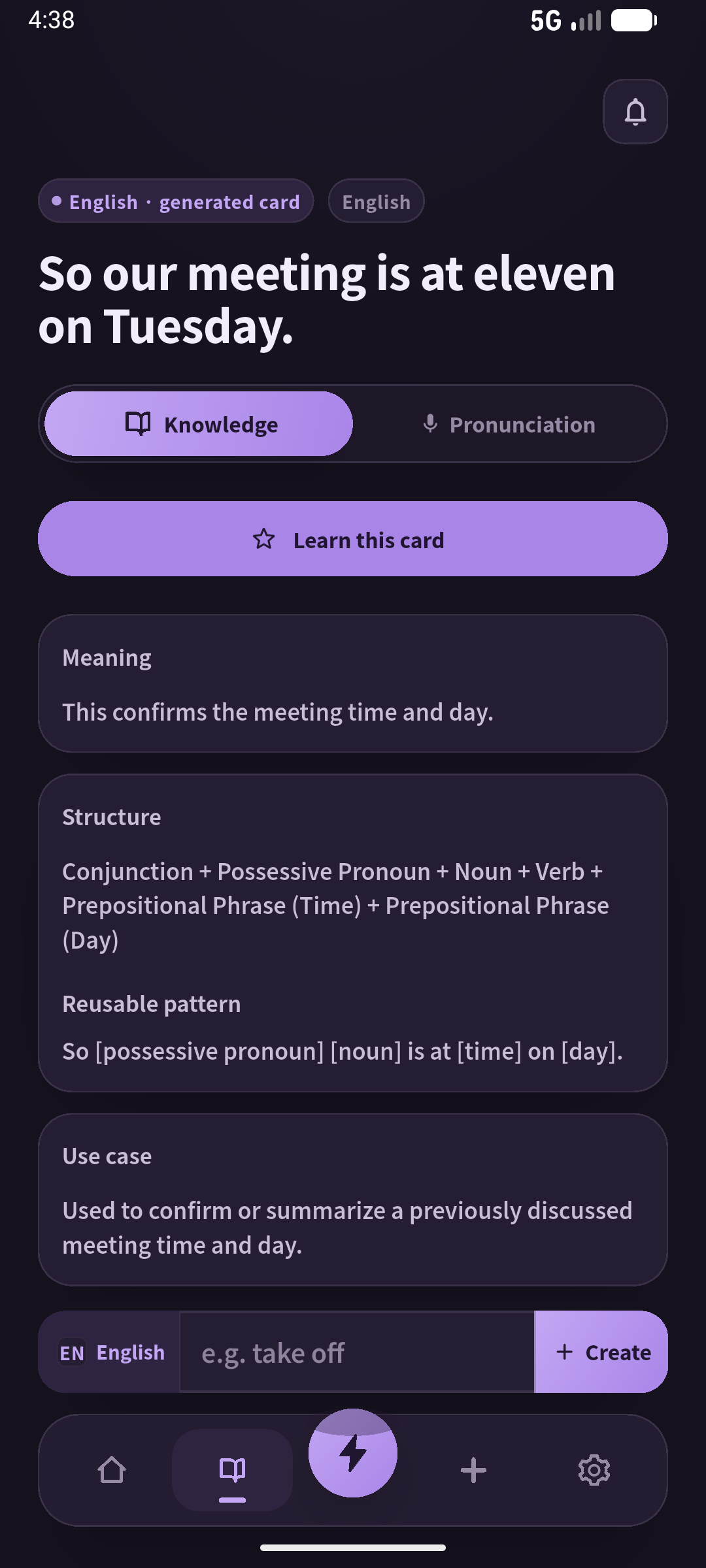
These models were generated in SpeakGain with its AI voice, Deep-voiced Viking. Choose one sentence at a time. You are practising clear information, not trying to reproduce the depth of the character’s voice.
Ask about availability: Are you available on Tuesday morning?
Ask whether the other person has time on Tuesday morning.
Suggest a time: Could we meet at ten on Tuesday?
Suggest ten o’clock on Tuesday.
Explain a conflict: I have a team call at ten.
Explain that a team call prevents you from meeting at ten.
Offer an alternative: Would eleven be a good time for you?
Offer eleven instead and check that it suits the other person.
Ask for repetition: Sorry, could you repeat the time?
Ask for the time again because you missed it.
Confirm the agreement: So our meeting is at eleven on Tuesday.
Check that you both agreed on Tuesday at eleven.
3. Listen and copy
First listen without reading and identify what the speaker is doing. If you cannot tell, check the text and meaning and listen again. Then listen with the sentence visible, stop the audio and say it yourself. Split a long line into meaningful chunks, then put it back together.
Record yourself and compare one feature with the model: did the day or time disappear, or did a pause interrupt the message? Replay that short part, say it, and return to the whole sentence. Our priority is correcting what could make the listener misunderstand the appointment. Speed and removing every trace of your accent are not the first-day target.
4. Say it from memory
Close the English text and audio. Look only at an intention such as ‘ten is impossible; suggest eleven’, and try to speak. If nothing comes, check the sentence once, say it, practise another line, then hide it and try again. Avoid turning a long silence into a required ordeal.
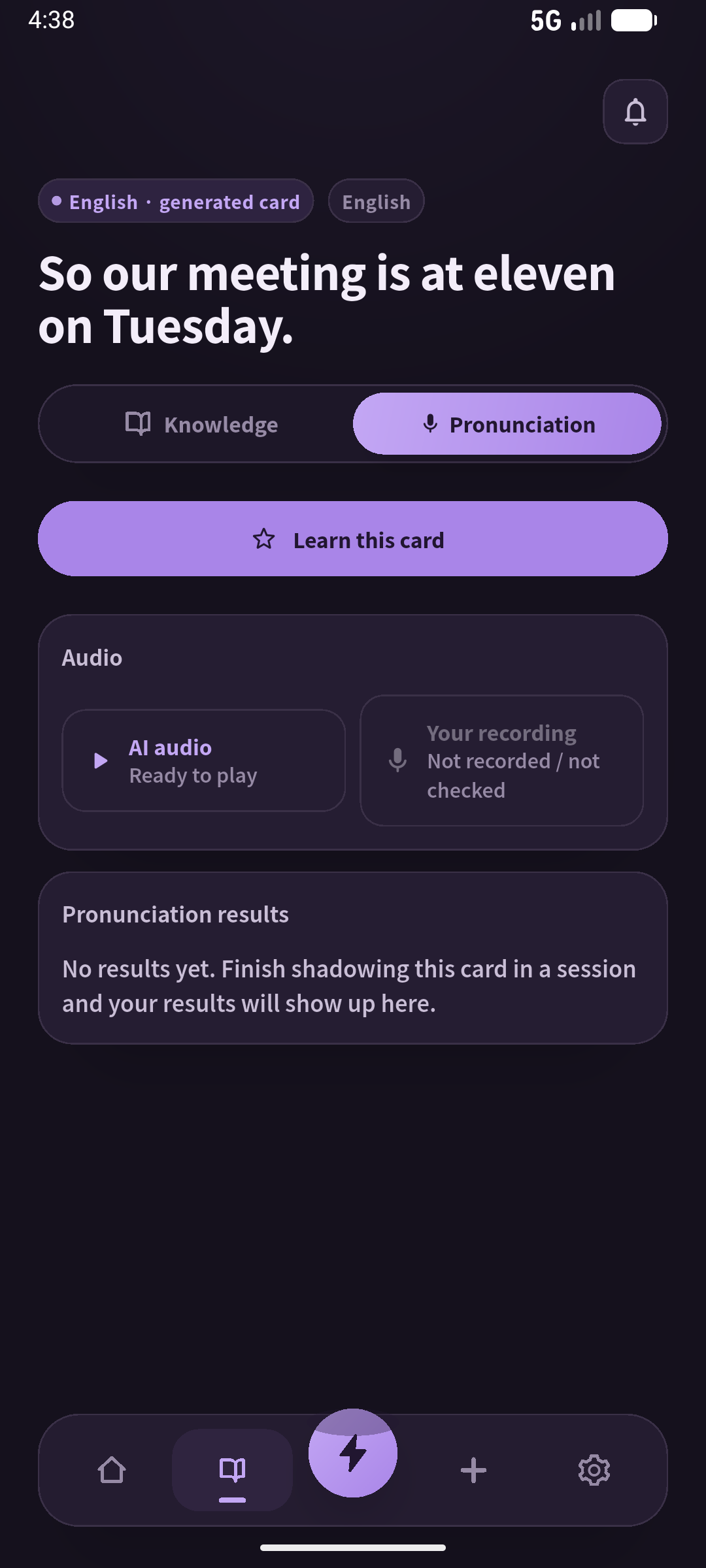
Begin tomorrow with the same check before opening the model. Change Tuesday to another day and eleven to another time. Randomise the prompts so you have to select a sentence. Being able to recite the same sequence does not show that you can choose the needed reply. In SpeakGain’s answer screen, check the model after your attempt; reading the displayed answer is not evidence of recall.
5. Use it with someone
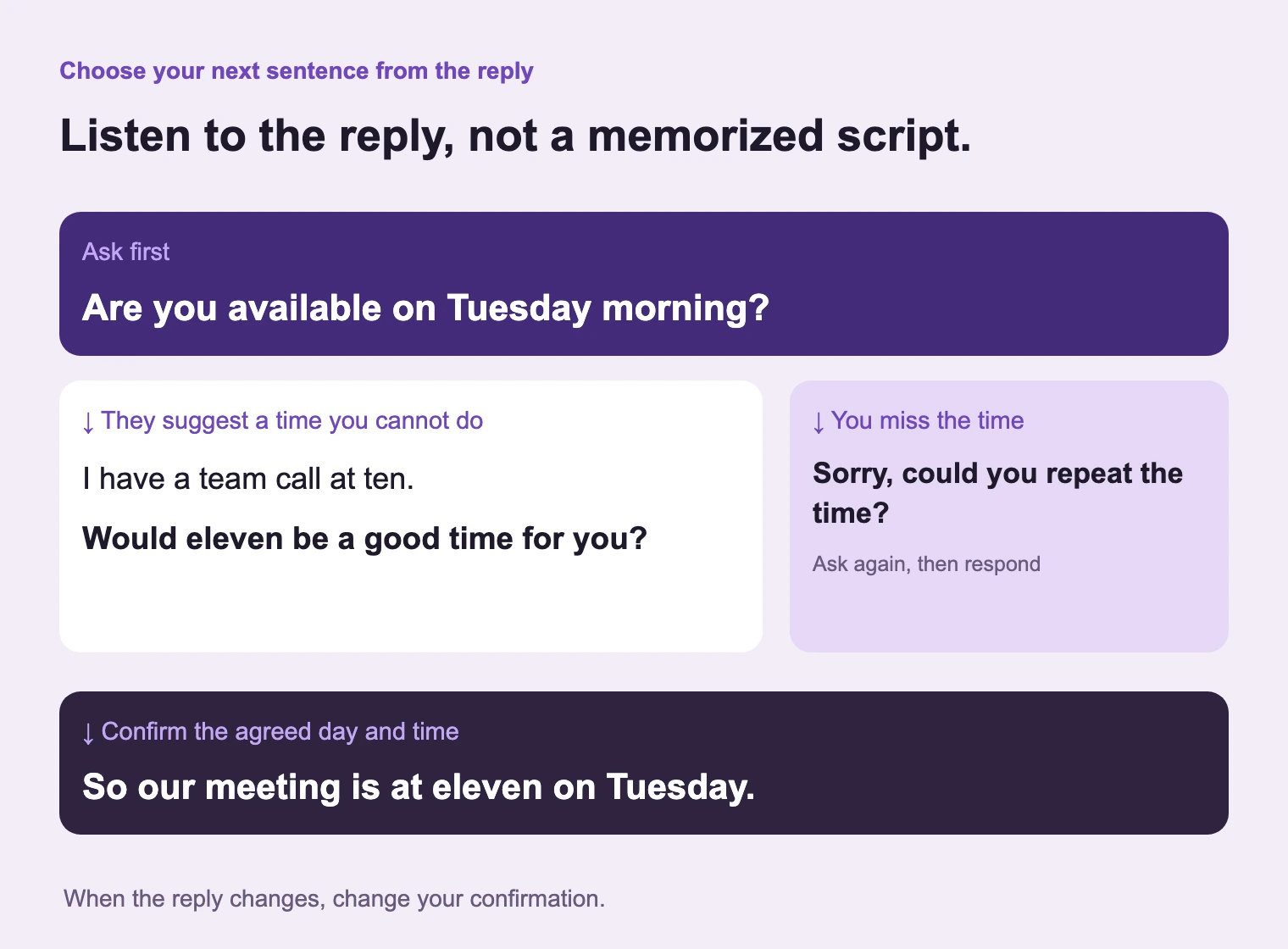
Practise with a colleague, friend, teacher or conversation partner. Explain the task and allow an unexpected reply. Ask about Tuesday, respond to the suggested time with your conflict and alternative, request repetition if you missed the time, and confirm the final agreement. Do not guess an unclear time merely to keep the conversation moving.
| Purpose | English sentence |
|---|---|
| Explain a conflict | I have a team call at ten. |
| Offer an alternative | Would eleven be a good time for you? |
| Ask for repetition | Sorry, could you repeat the time? |
| Confirm the agreement | So our meeting is at eleven on Tuesday. |
Your partner can ask about a different day or reject eleven. Stop reciting and work out what is still undecided. If a sentence is missing, finish with the language you can manage, then note the exact intention for your next practice. Ask the partner whether the agreed day and time were clear and for one correction. This feedback is more useful than asking only whether your English was ‘good’.
Write down what happened: completed the arrangement, needed help with the day, or could not offer a second alternative. Review the missing line and repeat the situation with different details. A pronunciation score can guide a local correction; it cannot prove that you can manage a conversation.
An online English lesson can be the human-use step: tell the teacher your task, ask them to vary their availability, complete the arrangement, and request one correction. Save the missing sentence after the lesson rather than collecting every possible expression. If your practice has been listening and reading only, add the hidden-text attempt before buying more input material.
First four weeks: track what you can do.
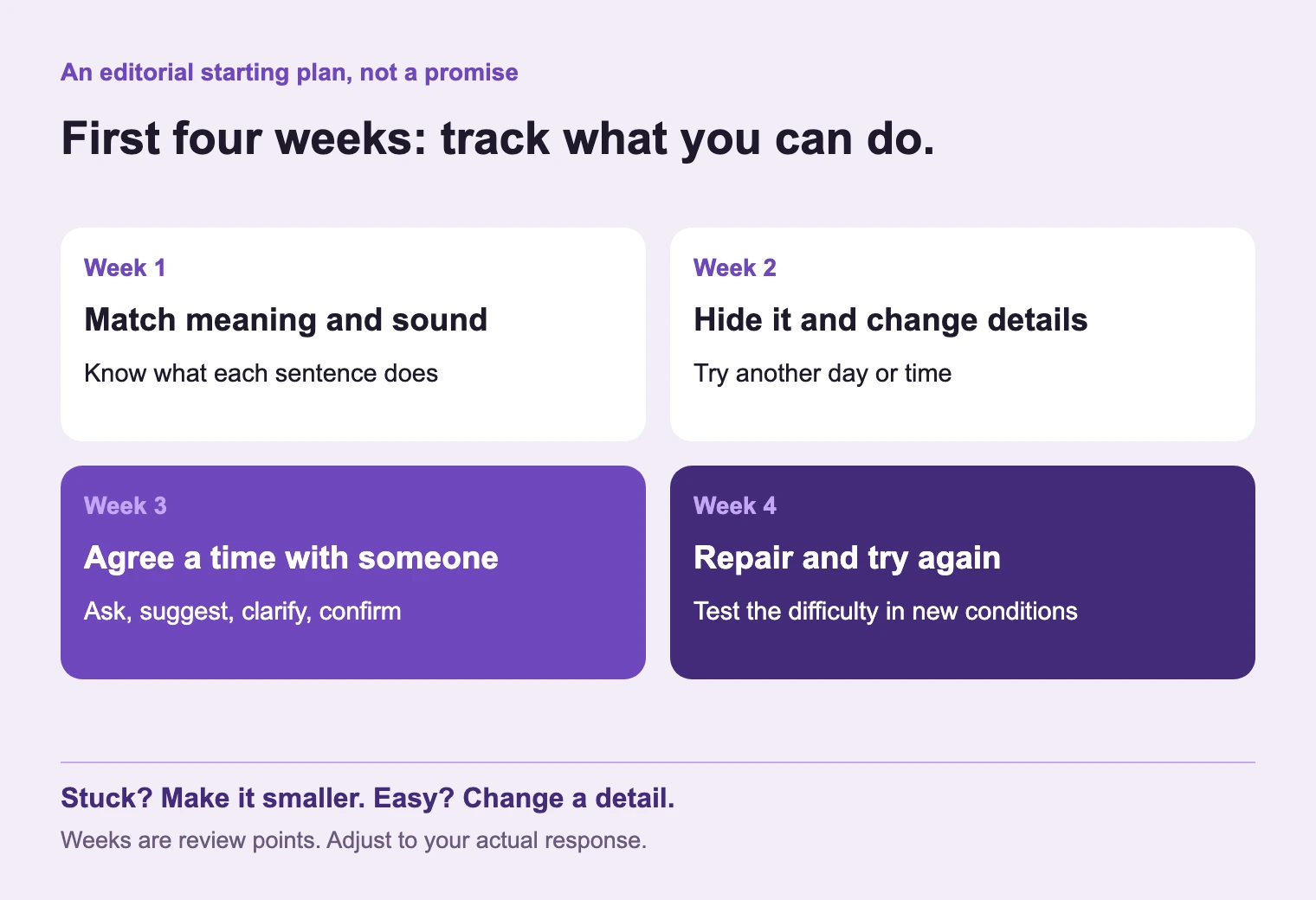
A practical starting allocation is 15 minutes: three to recall yesterday’s sentences, four to listen and imitate, five to respond to shuffled situation prompts, and three to record a difficulty and schedule the next conversation. This allocation and the four-week plan below are editorial proposals, not research-established optimal doses.
In week one prepare the situation and six lines. In week two hide the script and change the details. In week three use them with a person. In week four repair the missing sentences and try again. Arrange the conversation early; otherwise preparation can continue forever. If a session is too long, practise one intention completely instead of rushing all six.
Fix the cause of the difficulty
You cannot form a useful sentence
Write the intended information first; find a short example and check its meaning.
You know the sentence but cannot hear it
Listen to one short line, check its text, and replay the unclear part.
You can repeat but cannot start alone
Hide the model and retrieve a line from a situation prompt; check again tomorrow.
You freeze when the reply changes
Vary the partner’s reply and practise choosing a response, including asking again.
The time or day is misunderstood
Record that information, compare it, and ask a listener for one specific correction.
You keep preparing but avoid conversation
Book one small exchange with a person and use its result to choose the next sentence.
You are afraid of making mistakes
Agree on one small task and one correction with your partner. Prepare a request to repeat, so a misunderstanding becomes something you can repair.
How long will it take?
There is no defensible deadline for becoming able to speak based only on these exercises. Cambridge English gives cumulative guided-learning estimates from beginner level of about 180–200 hours to A2 and 350–400 to B1. These are not self-study-only figures or measurements of speaking alone. Do not divide them by 15 minutes a day and promise a calendar date.
Instead track tasks you can now complete: propose a time without reading, ask again when you miss it, and confirm the agreement. Add a new situation when the present one is usable. Improve range and independence gradually; one successful exchange is meaningful progress without being a language-level certificate. Cambridge English: guided learning hours
What the research supports—and its limits
Karpicke & Roediger (2008)
Karpicke and Roediger (2008) studied Swahili–English word pairs and a later retention test. Continued retrieval supported retention more than continued study in that experiment. It supports including a recall check here; it does not establish an effect on free conversation or prove this six-sentence routine. Original source
de Jong & Perfetti (2011)
De Jong and Perfetti (2011), abstract only inspected, studied 24 learners giving repeated four-, three- and two-minute speeches over three sessions. Both groups improved during training; gains were maintained in post-tests by the group repeating the same topics. This is evidence about repeated speech, not a tested prescription for six short phrases. Original source
Lyster & Saito (2010)
Lyster and Saito (2010), abstract only inspected, synthesised 15 classroom studies with 827 learners and reported durable effects of oral corrective feedback. It supports making room for feedback; it does not validate app pronunciation scores as a measure of conversational ability. Original source
Questions before you start
Can I learn speaking on my own?
You can check meaning, imitate audio and practise retrieval alone. Include another person to find out whether your message is understood and to respond to unpredictable replies.
Should I finish grammar first?
Check the grammar needed to understand and adapt today’s sentence. Combine that study with speaking now; finishing every chapter is not a prerequisite for a small exchange.
Is listening every day enough?
Listening prepares you to recognise the reply. Also practise producing a line without the model and choosing it in an exchange. Listening time alone does not show that you can do either.
What should I do today?
Choose one situation you can use soon, write three intentions, collect short sentences, and arrange a chance to use them. Begin with one sentence you will actually need.
For short-sentence practice, use our guide to who sentence drills help and how to do them to move from textbook answers to your own plans.
Practise the part that is holding you back
- Reading aloud
- Shadowing
- Remembering English sentences
- When English will not come out
- English listening
- Vocabulary for use
- Practising pronunciation
- How to review an online English lesson in 10 minutes
For a first conversation, prepare a short introduction: How to introduce yourself in English: examples and your own 30-second introduction.
Related practice: 64 English backchannel responses: what to say, how to sound, when to respond
To turn your daily life into practice sentences, follow the three-sentence English diary: write, check, listen and say.
For a practical call, use English phone-call phrases and how to ask again to rehearse introductions, messages, spelling and number checks.
For choosing a speaking partner and checking free limits, see our English conversation app comparison with picks by practice type.
If you are leaving to study abroad, use the pre-departure speaking plan to choose priorities for three months, one month or one week and prepare a first-week sentence.