
English speaking practice alone: compare 10 methods and choose your routine
Published
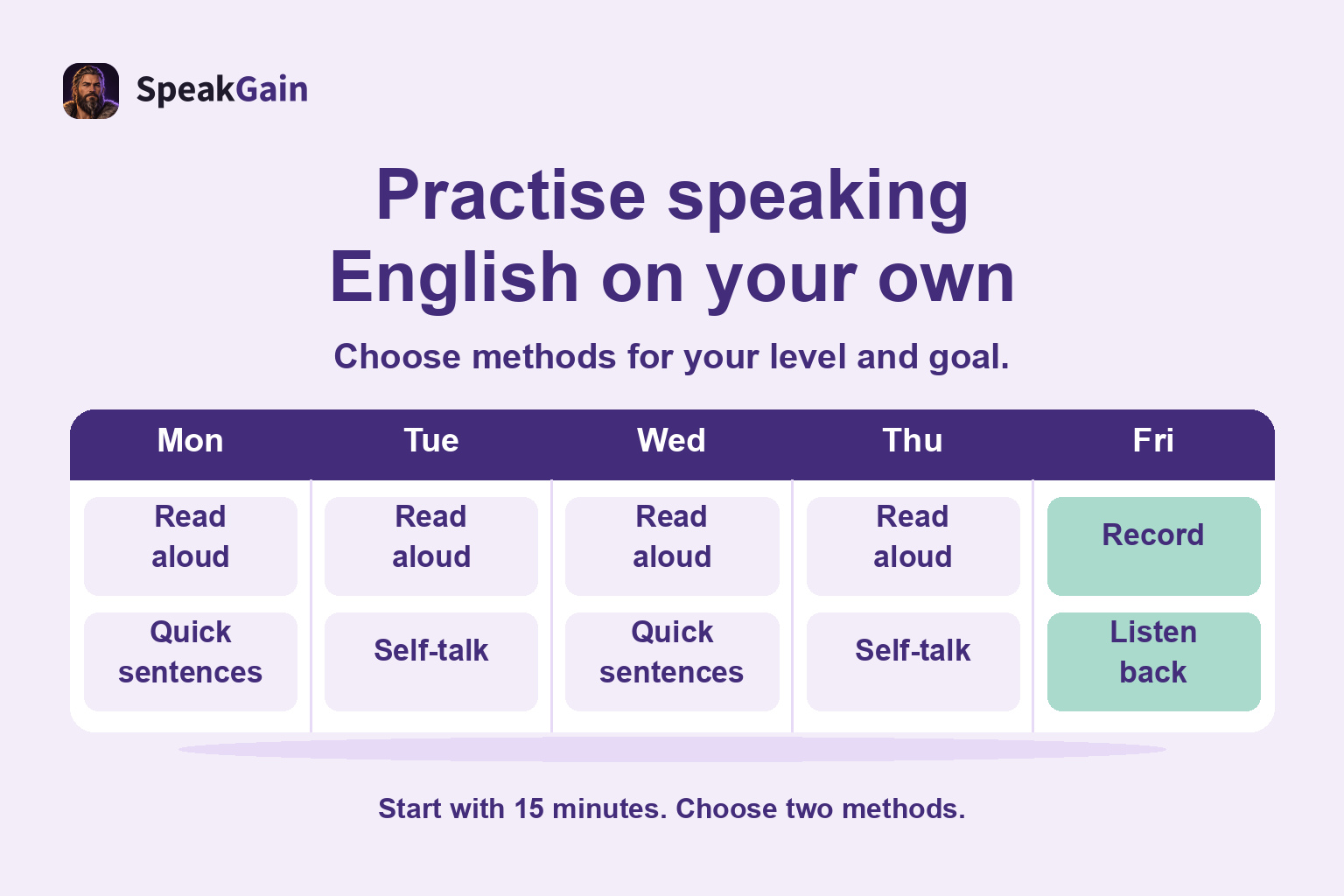
For solo English speaking practice, start by reading a short, understood sentence aloud, then hide it and say something of your own. Our recommendation is read-aloud practice plus quick sentence production for beginners, speaking with model audio for sound problems, and retelling plus paraphrasing when you need to develop a topic. Start with 15 minutes a day, or 30 when available, including time to listen back and correct one point.
This guide compares practice methods, rather than apps, schools or books. For the wider journey from preparation to actual interaction, use the speaking roadmap; for your overall study balance, see how to study English.
Compare ten methods you can practise alone
Imitation gives you content and lets you focus on sound. Producing your own speech requires you to choose the message, but also to arrange a way to check uncertain language. The levels and times below are editorial starting points, not experimentally established doses. “Beginner” means working with understood short sentences; “intermediate” means explaining a familiar topic in several sentences. These labels do not award a CEFR level.
| Method | Main skill practised | Suitable stage | Minutes/session | Alone? | Common failure |
|---|---|---|---|---|---|
| Read aloud | Say written language with attention to sound | Beginner onward | 3–5 | Yes, with meaning/audio checks | Mistaking reading for independent speech |
| Shadowing | Follow heard sounds and phrases | Later beginner onward, with understood audio | 3–5 | Yes, with audio and transcript | Chasing fast, incomprehensible audio |
| Overlapping | Speak with model audio while reading | Beginner onward | 3–5 | Yes, with audio and transcript | The model masks your voice |
| Quick sentence production | Retrieve word order and grammar from meaning | Beginner/intermediate | 5–8 | Yes, with checked answers | Memorising the answer order |
| Retelling | Select information and organise several sentences | Later beginner onward | 5–10 | Yes, with a short source | Reciting the original |
| Paraphrasing | Explain with words you know | Later beginner onward | 3–5 | Yes, with usage checks | Changing the intended meaning |
| Self-talk | Say your own sentence from a daily situation | Beginners who can form a short sentence onward | 1–3 plus checking | Yes; check uncertain phrases later | Long, unchecked monologues |
| Speak an English diary aloud | Turn your experience into spoken material | Beginner onward | 5–8 | Yes; check the wording as needed | Only writing and reading |
| Record and listen back | Notice omissions and sticking points | All stages | 2–5 | Yes; ask a person about uncertain sounds | Never listening to saved recordings |
| Prepare for an online lesson | Prepare replies and questions for an upcoming exchange | All stages | 5–10 | Preparation yes; interaction needs a partner | Merely reading a script |
Recording is a checking step, rather than a rival to the other nine methods. Choose one main exercise and one supporting exercise, then listen back. You do not need all ten every day.
Recommendations by goal
| Your difficulty/goal | Our suggested combination | Why | End-of-session check |
|---|---|---|---|
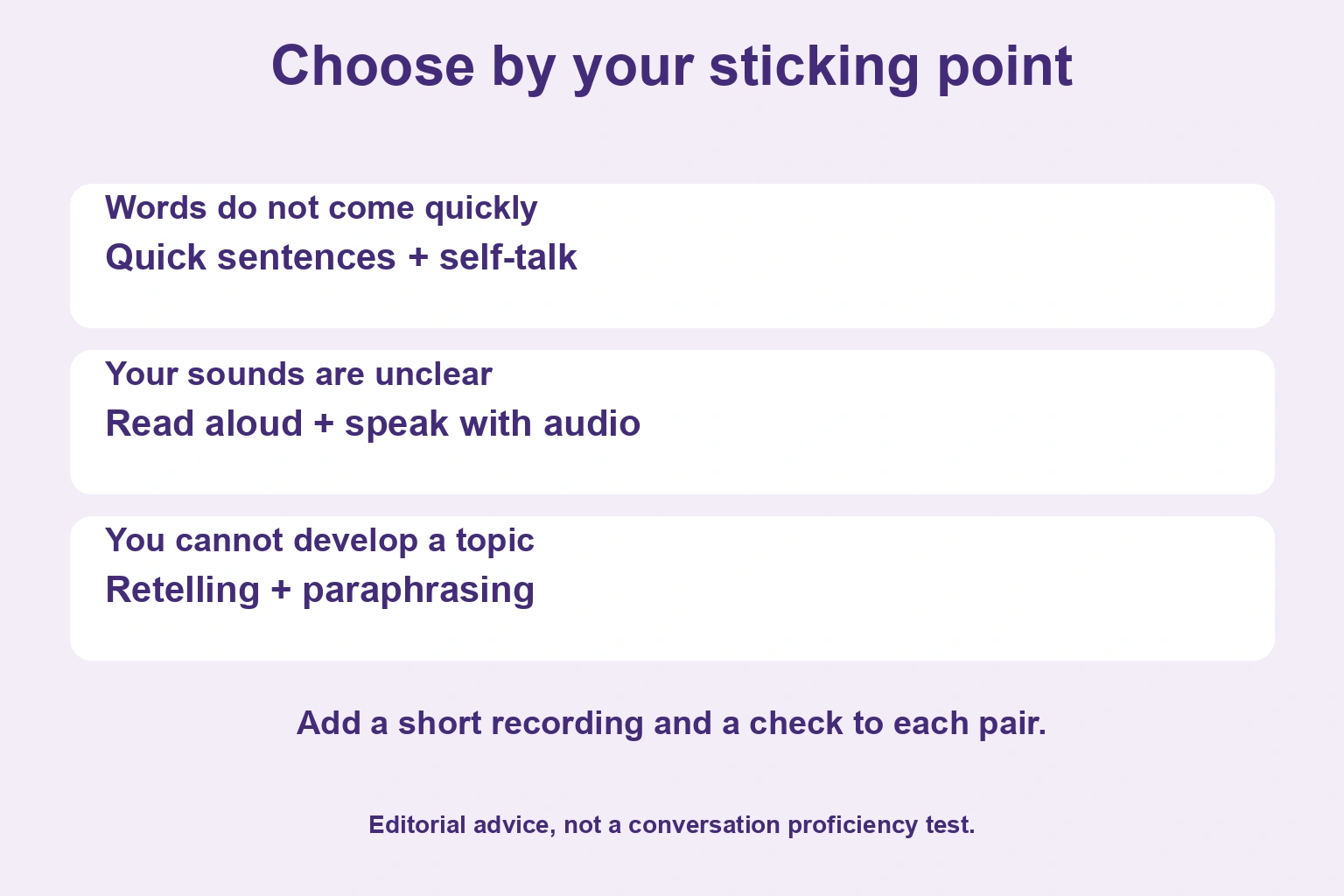
| You understand but cannot respond quickly | Quick sentences + brief self-talk | Retrieve the form, then choose your own information | Hide the answer and change the content |
| People ask you to repeat your pronunciation | Read aloud + overlapping + recording | Check a sound separately, then its timing | Say it without the model; later check with a person |
| You can say one sentence but cannot continue | Retelling + paraphrasing | Add reasons and explain around missing words | Convey two main points and one reason |
| A speaking test | Record the test task + a targeted supporting exercise | Match the actual question and time limit | Answer the question with relevant information in time |
If you cannot continue because you did not understand the other person’s question, retelling alone will not address that. Practise listening to questions and asking for clarification too. Being misunderstood may involve wording or missing information as well as pronunciation; your own recording cannot show whether another person understood.
What each method helps with, and when to choose something else
Our original shared example is I usually make tea after lunch. Keep it unchanged when imitating sound; change it to match your real life when producing your own message. These worked examples are not experimental evidence for a product.
1. Read aloud
Editorial view: Use this when you understand a sentence but stop at each word. The printed text reduces the need to invent content. Reading smoothly does not establish spontaneous conversational ability.
Minimum exercise: Check the meaning and audio of our example, pause the audio, and read. Listen for the complete ending, after lunch. Finally hide the sentence and try it once. If your first language encourages a different rhythm, compare phrase timing rather than just individual letters.
Poor fit as the main exercise: You already read smoothly and only struggle to create an answer. Spend more time on sentence production or self-talk. See the read-aloud guide.
2. Shadowing
Research: Hamada’s 2009 abstract reports listening improvement in the easier-text group after 13 lessons. This concerns listening, not proof of spontaneous speaking gains. Original abstract.
Editorial use and minimum exercise: Choose it as support when you understand a transcript but lose words in the audio. Check one sentence, hide the text, and follow slightly behind the speaker. If usually repeatedly disappears, isolate it and return to the sentence.
Poor fit: You do not understand the material, or you can hear it but cannot formulate a reply. Those require comprehension or message-production work. See shadowing step by step.
3. Overlapping: read while speaking with the audio
Editorial view: This helps you compare timing with a model while keeping the transcript as support. We do not claim it outperforms read-aloud practice.
Minimum exercise: Read our sentence simultaneously with the audio. Then switch the model off and record yourself alone. Following the model and speaking independently are separate checks.
Poor fit: Your own voice is masked, you are chasing excessive speed, or your main problem is choosing content. See overlapping practice.
4. Quick sentence production from a meaning prompt
Editorial view: This is for grammar you understand but cannot retrieve aloud. It is not a speed test for unfamiliar grammar or a demand to match one answer exactly. Use a short prompt in your own language initially if that helps.
Minimum exercise: Prepare a meaning cue in your strongest language about your usual tea after the midday meal, then produce the English without looking. Check it, then change tea to coffee or after lunch to after dinner. Confirm that the changed meaning survives.
Poor fit: Short sentences already come easily, but organising a longer explanation does not. Try retelling. See quick oral sentence drills.
5. Retelling
Research: Lambert, Kormos and Minn’s 2017 abstract reports immediate same-task fluency gains in 32 Japanese learners repeating oral tasks. It does not establish long-term transfer to new conversations. Original abstract.
Editorial use and minimum exercise: Develop a topic using a short source. Add It helps me relax. and Today I made green tea. to the example. Close the source and retell from three cues: habit, reason, today. Restore one omitted point on your next attempt.
Poor fit: You cannot yet understand the short source, or you want to memorise its exact wording. See retelling and reproduction.
6. Paraphrasing
Editorial view: Use it when one missing word stops the whole explanation. The Council of Europe’s spoken-language descriptors consider range, accuracy, fluency, interaction and coherence. That framework informs our priorities; it is not an experiment proving this drill.
Minimum exercise: Rephrase make tea as prepare tea. If kettle is unavailable, describe it as something I use to boil water. Preserve the relevant meaning instead of searching for sophisticated synonyms.
Poor fit: You do not understand the original meaning. Changing usually to always changes the fact, rather than simply rephrasing it. See paraphrasing with familiar words.
7. Self-talk
Institutional advice: British Council suggests self-talk and listening to recordings, while also stressing actual communication with people. This is advice, not a controlled comparison of self-talk methods.
Editorial use and minimum exercise: Imagine yourself after lunch and say our sentence. Then say one sentence about what you are doing now. Stop after 1–3 minutes, check one uncertain phrase and say it again.
Poor fit: You cannot form even a short sentence reliably. Return to checked sentences and basic structure. You do not have to think in English all day. See situation-based English thinking practice.
8. Speak an English diary aloud
Editorial view: Choose this when an empty speaking prompt leaves you with nothing to say. Writing gives you a chance to choose and check content; writing gains alone do not prove spontaneous speaking gains.
Minimum exercise: Treat our example as a habit. For today’s event, change it to I made tea after lunch today. Check the sentence, say it, close the diary and report the event again.
Poor fit: Polishing long entries uses all your time before you speak. Start with one sentence. See writing and speaking a short English diary.
9. Record and listen back
Advice and editorial view: British Council recommends listening for mistakes, uncertainty and pronunciation difficulties. We use recording to inspect a performance, not as an automatic improvement mechanism.
Minimum exercise: Record our sentence and check one point: did after lunch survive? Compare, revise and record again. Listen to the actual audio if a transcript looks wrong; speech recognition can mishear you.
Poor fit as a standalone main exercise: You accumulate files without deciding what to inspect. Ask a teacher about a short sound you cannot judge. See recording and revision in read-aloud practice.
10. Prepare for an online lesson
Editorial view: Make preparation your main task on a day when you have a real lesson coming up. Prepared speech and responding to a partner are different checks.
Minimum exercise: If the topic is routines, prepare our sentence, a reason and one question for the partner. Practise from keywords rather than a complete script. Afterwards, bring one phrase you could not say into the next preparation session.
Poor fit: You keep preparing imaginary scripts with no upcoming exchange. Use your own diary or short self-talk instead. See lesson review and next-session recall.
Our combinations by level
Uncertain short sentences: Read aloud + quick sentence production. Check meaning and sound, then hide the text and retrieve the structure. If English requires an explicit subject where your first language often omits one, check that subject and verb deliberately rather than translating every word.
You form sentences but lose the sounds: Overlapping + brief self-talk. Establish timing, then speak without the model. Substitute short shadowing for overlapping when appropriate; making both compulsory can crowd out your own speech.
You need to develop a topic: Retelling + paraphrasing. Include events and reasons, and explain around a missing word. If only the familiar story becomes faster, try a different short source. Speed alone is not the success criterion.
A test or work deadline: Centre the actual task and a recording. Add read-aloud work for sound problems or retelling for organisation. Match the format using TOEIC Speaking preparation or IELTS Speaking preparation.
A 15–30-minute daily menu
| Task | 15-minute day | 30-minute day |
|---|---|---|
| Recall | 2 min: yesterday’s sentence without text | 3 min: yesterday’s content without text |
| Model and meaning | 3 min: check and read a sentence | 5 min: check a short source |
| Main practice | 6 min: one chosen method | 12 min: main method plus changed content |
| Listen back and revise | 3 min: correct one point | 7 min: check key points and redo |
| Next-session note | 1 min: save one return point | 3 min: note a prompt and criterion |
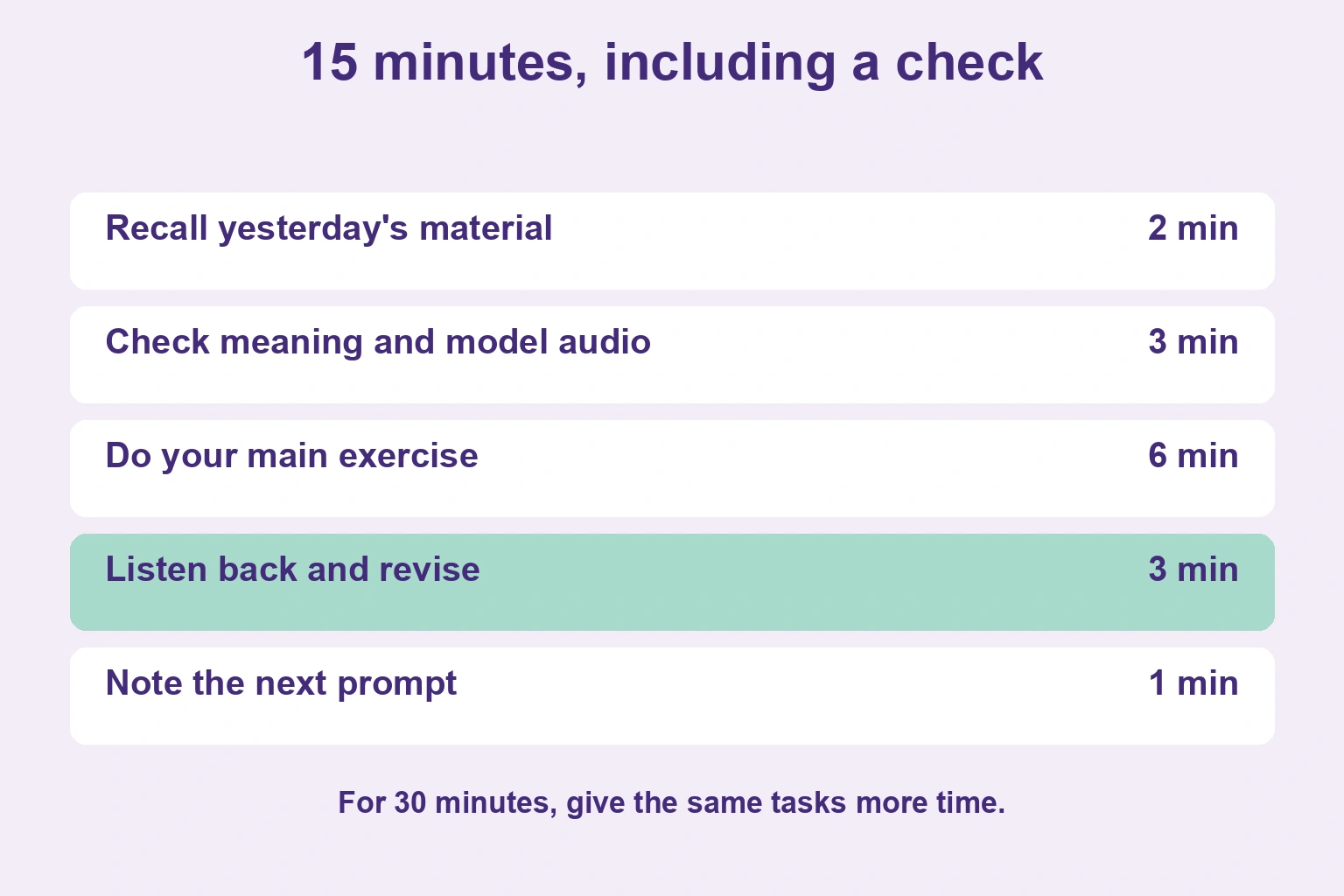
On day one, use the recall slot to understand the sentence. If finding material consumes the session, reuse the same source tomorrow. With our example, you can check the audio, produce it from meaning, change your drink or time and listen to one recording within this menu. That is a completed practice cycle, not a completed conversation course.
A tool for keeping your own sentence
Choose the exercise before the tool. SpeakGain, which we develop, belongs in the short-sentence practice part of this plan. See what SpeakGain is, or types of English conversation apps if you need to compare tools.
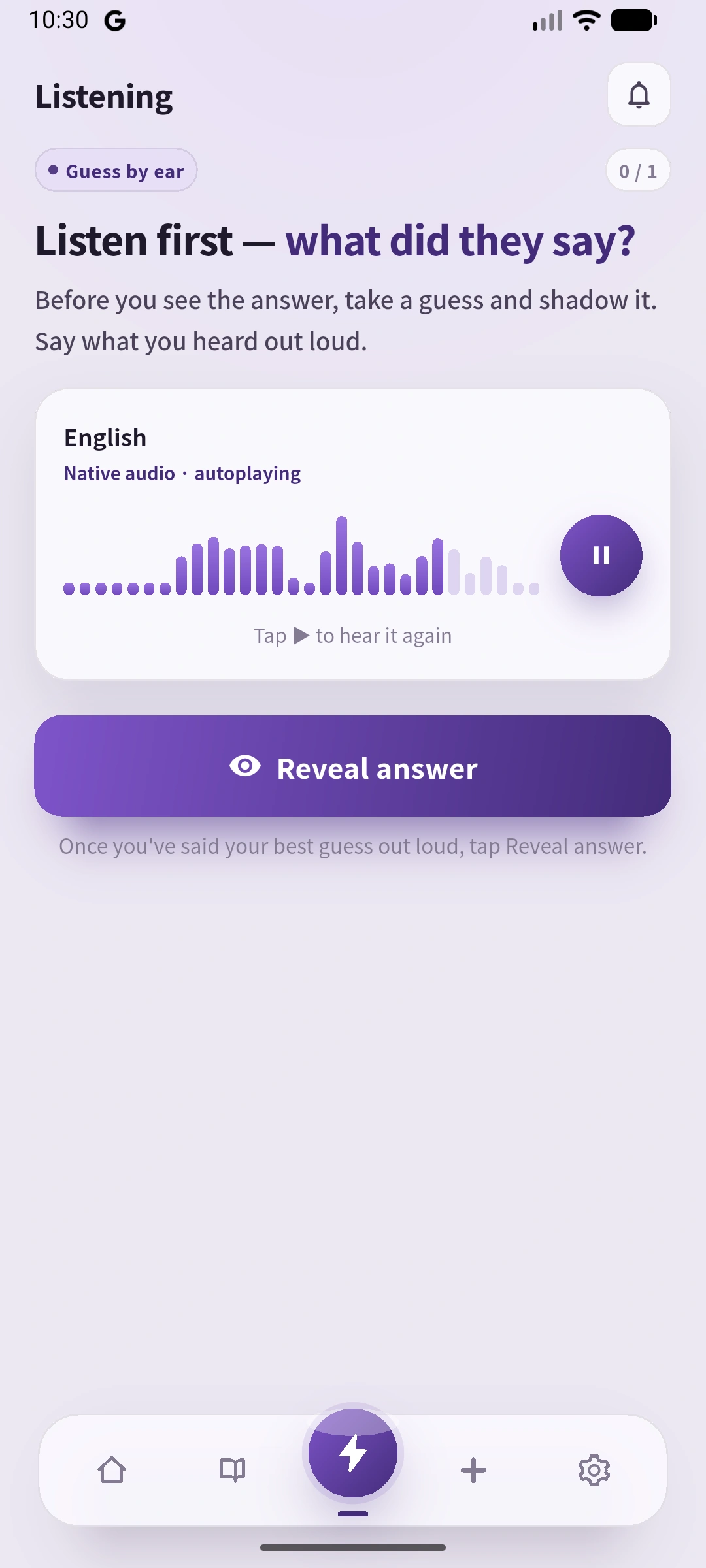
We saved I usually make tea after lunch. through SpeakGain’s normal card-creation flow on Android. Opening study played the reference audio before revealing the sentence. After “Reveal answer,” we saw the saved English, meaning, playback, review-interval choices and the “Record and check” entry. This is audio-first short-sentence study; we do not present it as free AI conversation or a dedicated meaning-to-English drill mode.
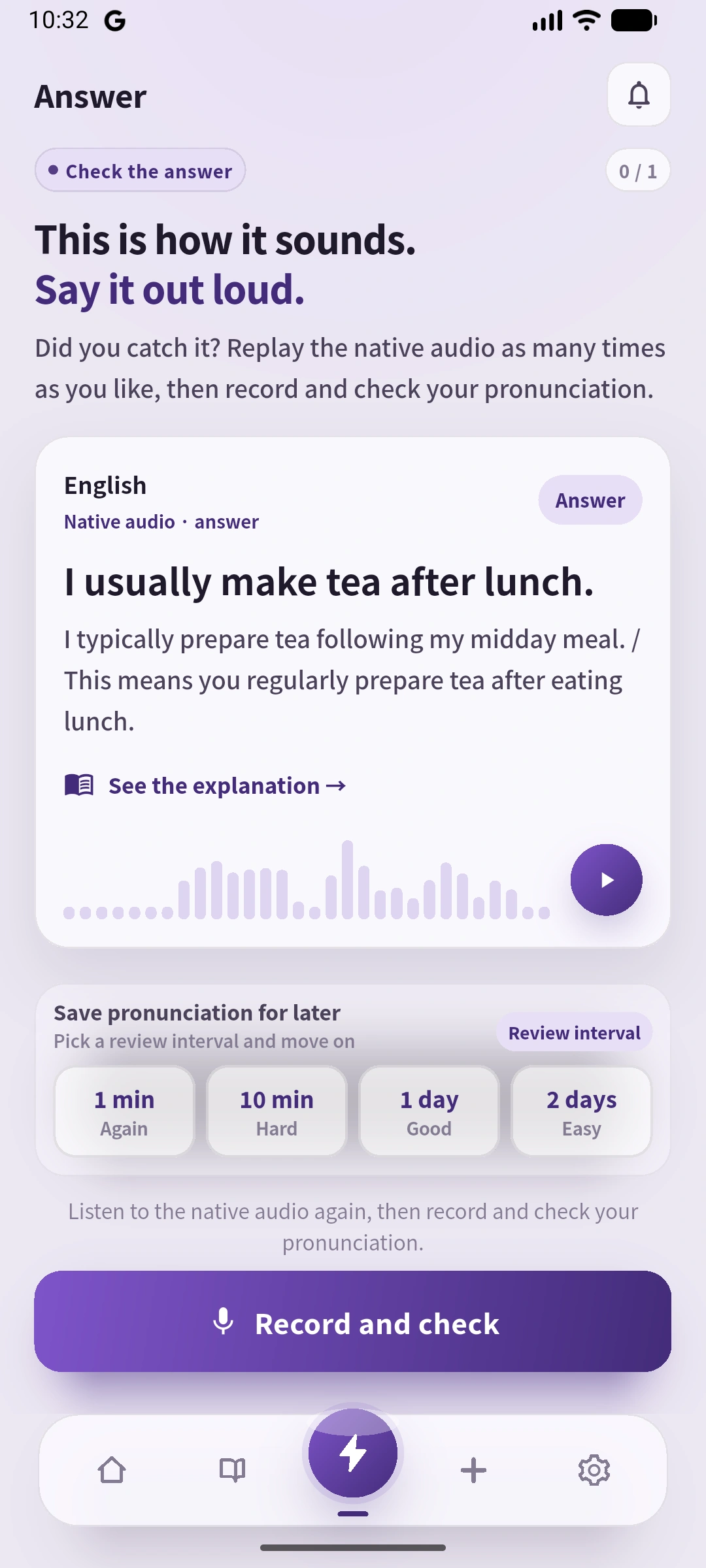
Open or save the practice audio
This is AI-generated audio, produced once for this sentence using SpeakGain’s Viking voice, not a human native-speaker recording. You do not need to imitate the low voice. Use a separate device recorder for the self-check exercise if you wish. We make no claim that SpeakGain scores pronunciation.
Try the combination for 2–4 weeks
Two weeks is a review point, not a fluency promise. If you extend to four weeks, change the topic or conditions later. After a missed day, resume the same recall task.
| Period | Practice | Record | Adjust |
|---|---|---|---|
| Week 1 | One goal, two methods, short material | What came without text; omissions; one correction | Shorten overly hard material |
| Week 2 | Change one detail; recall yesterday’s work | Does it return next day? Is the new meaning intact? | Add own-message production if reading alone improves |
| Week 3, optional | Try a different topic or question | Did you force the old answer onto the new question? | Add a reason if the topic ends too soon |
| Week 4, optional | Check in an exchange or test format | Clarification requests; missing timed content | Change just one method |
Keep an early and later recording under similar conditions. Do not compare a read script with an improvised answer and label the difference “fluency improvement.” Check changed content separately, and ask a person about uncertainties you cannot resolve alone.
What we do not recommend
Counting exclusively silent study as spoken output. Mental rehearsal, reading and writing can prepare you, but do not reveal what happens when you pronounce the sentence. Prepare in public if necessary, then reserve a time to speak.
Long self-talk with no recording or checking. Shorten it to a minute, retain one uncertain phrase, check and repeat. This is an editorial choice, not a claim that longer speech necessarily harms learning.
Changing methods constantly or doing all ten daily. Return to two and use the same goal-based check. Before replacing the app or material, ask whether you actually completed speaking and correction.
Chasing audio speed or every possible error. Preserve the message first. Choose one check before recording: a missing fact, tense or sound. An unresolved question is a valid result; you do not have to invent your own pronunciation grade.
FAQ
Can solo practice be enough?
You can prepare sentences and explanations alone. Understanding a partner and checking what they understood require interaction. Arrange a small real exchange alongside self-study.
How long each day?
Start with 15 minutes, or 30 if available. This is our practical starting menu, not a universal research-established dose. Keep speaking, revision and next-day recall.
Does self-talk help?
Use it to select and express your own message. Check one uncertain sentence rather than counting monologue minutes. It cannot assess real interaction alone.
Read aloud or shadow first?
Read aloud if meaning or sound is uncertain. Add short shadowing when following understood audio is the difficulty. Add message production if replies still do not come.
When should I start online lessons?
When you can prepare a short task and a clarification request, you can try slowly. Perfection is not a prerequisite. Review one phrase that did not come out afterwards.
Must I record every attempt?
No. Our recommendation is one short recording near the end, actually listened to and revised. Checking matters more than file count.
What if my grammar is uncertain?
Return to understood, checked sentences and the relevant structure. Check one doubt with a dictionary or teacher; do not begin by translating a long, elaborate thought.
Which method is best for a speaking test?
Start with the actual task and its time limits. Add retelling for organisation, paraphrasing for lexical gaps or read-aloud work for an oral reading task.
Editorial verdict
Choose one sound-focused exercise and one exercise that makes you choose the content. Record briefly and correct one point. Read aloud + quick sentence production is our beginner starting pair; retelling + paraphrasing fits learners who need to expand a topic. Spend your time on the present difficulty rather than repeating what is already easy.
Try the 15-minute menu today. At the two-week review, check whether you can change the content, not just recite the original. Replace one method if necessary. Your criterion is a message you can express, revise and use again.
Sources and limits
- Hamada, 2009: shadowing and text difficulty, public abstract.
- Lambert, Kormos & Minn, 2017: task repetition, public abstract.
- Council of Europe: qualitative aspects of spoken language, public framework.
- British Council: listening and speaking for busy learners, institutional advice.
Checked on 14 October 2026. Times, pairings and weekly plans are editorial advice. These sources do not establish the effectiveness of SpeakGain or any particular material.