
English read-along practice: overlapping vs shadowing, with a six-step drill
Published
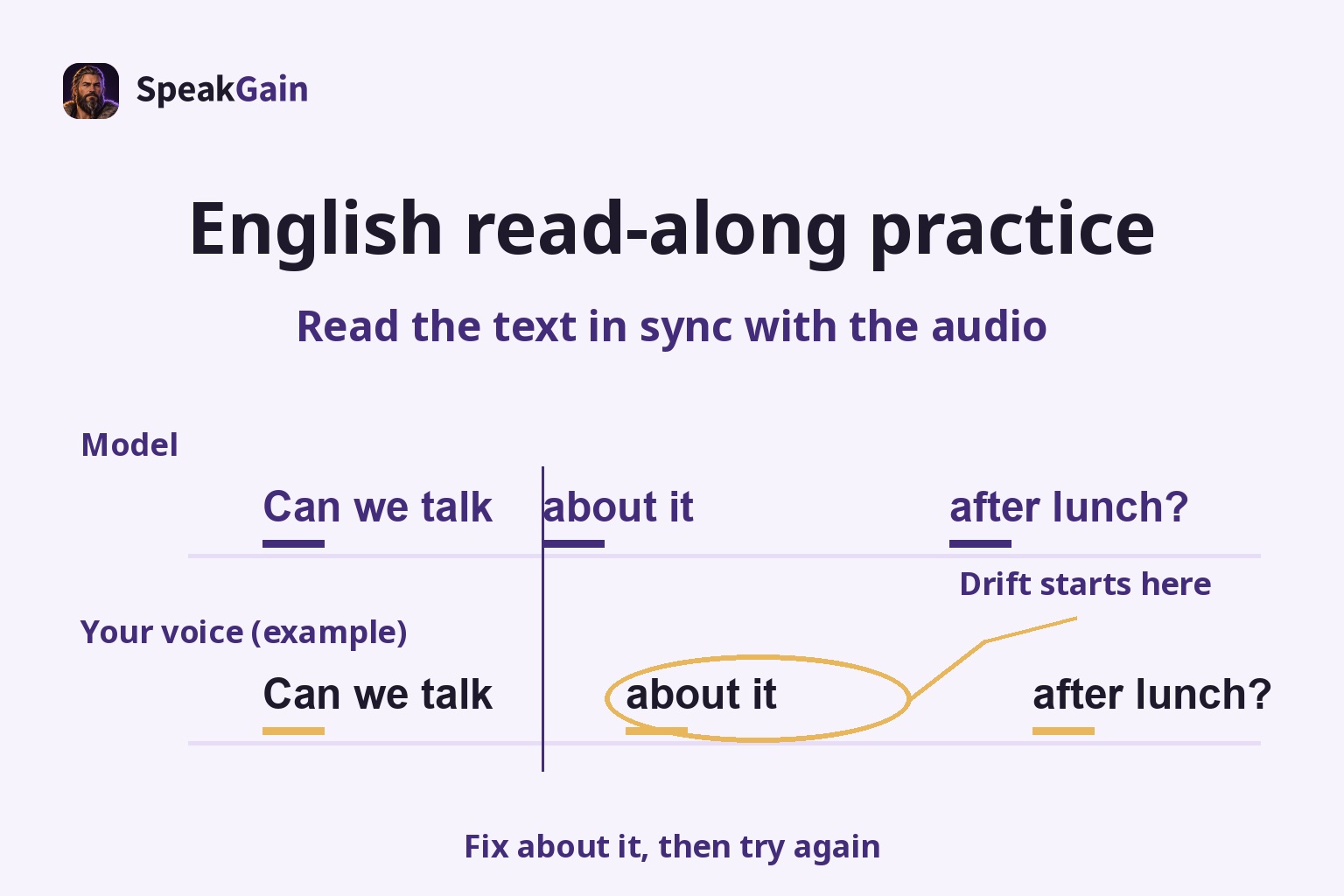
Reading aloud in sync with English audio means looking at the transcript and speaking at the same time as the model. Our editors recommend it when you understand the written sentence but lose the rhythm or connected sounds, or find shadowing too hard to follow. Start with one short sentence for about five to ten minutes: check its meaning, listen, read in sync, compare a recording, fix one fragment and try without text. That dose is an editorial starting point, not a proven optimum.
The useful question is where your voice begins to drift. Rushing the last words to finish together can conceal a problem earlier in the sentence. Here, “overlapping” means this language drill. App selection belongs in our shadowing app guide and pronunciation app guide; see our English study guide for the broader plan.
To choose a sound, ending or stress pattern to fix, follow our English pronunciation practice method and compare one feature in a recorded sentence.
Overlapping, shadowing, reading aloud and repeating: what differs?
Separate the text support from the speaking timing. Different courses use “shadow reading” or “shadowing” differently. This article distinguishes speaking simultaneously with visible text from following slightly behind the audio.
| Method | Support | When you speak | Our editorial use |
|---|---|---|---|
| Overlapping / synchronized reading | Visible transcript and model audio | At the same time | Compare stress, connections and phrasing |
| Shadowing | Mainly the sound; check the transcript in preparation | Slightly behind the model | Follow the sound with less text support |
| Reading aloud | Written sentence; optional model comparison | At your own pace | Understand the sentence and find stumbling points |
| Repeating | A short recording; text may help preparation | After pausing the model | Practise a fragment you cannot yet say in sync |
British Council’s Shadow reading activity has learners inspect stress and connected speech, practise chunks and start and finish reading with the teacher. It is teaching guidance, not a trial establishing how many minutes produce lasting improvement.
Our editors would repeat a troublesome chunk, read it in sync and then remove the text. This is not a compulsory ladder for everyone. If you already follow a suitable recording without text, try shadowing practice. If you cannot read the sentence even at your own pace, begin with reading aloud.
Who does this suit, and when should you change the material?
Choose a sentence you understand and can say when the audio is paused. Years of study alone do not determine suitability.
| Your current difficulty | Our recommendation | Try today |
|---|---|---|
| You read every word with equal length and stress | Try synchronized reading | Compare one short sentence’s strong and short parts |
| Shadowing moves on before you can follow | Use text support | Watch where your voice first drifts |
| You can repeat a chunk but not say it during playback | Prepare the chunk first | Pause, repeat, then synchronize |
| The written sentence is unclear | Change or study the material first | Check vocabulary and grammar |
| You skip much of a fast news clip | Reduce length and difficulty | Use one understandable sentence |
| It works only while you look at the words | Add a separate check | Repeat without text and check tomorrow |
Falling behind does not diagnose a lack of talent. Reading, understanding, listening and speaking are several demands at once. A familiar short sentence makes the difficulty easier to isolate. Our editors prefer fixing one usable phrase to repeatedly struggling through an impressive but poorly understood recording.
What can you expect, and what does success not prove?
We use this drill to compare your reading with a model, not to promise fluency. British Council’s connected speech guidance explains that speech is continuous and that some words have weak and strong forms depending on context. Written spaces are not necessarily audible pauses.
Our practical inference is to compare prominent syllables and shorter words instead of simply speeding up everything. Do not assume that can must be weak or it must disappear in this particular recording. Listen to the model you are actually using; emphasis and speaker choices vary.
| What you can check | What it does not establish |
|---|---|
| You start and finish one practised sentence closer to the model | You understand every unfamiliar conversation |
| You say a troublesome chunk more smoothly | You can express any original thought |
| You notice strong and short parts | Your accent has become identical to a native speaker’s |
| You reproduce the sentence tomorrow without text | The skill transfers automatically to another speaker |
Immediate success also benefits from remembering the example. Separate the practised sentence, a next-day check and a new recording. For conversation, add a meaningful reply or a sentence of your own. Imitation and choosing what to say are different tasks.
Step 1: choose a short sentence and understand it
You need matching audio and text, plus a way to replay it. For comparison, add a recorder. Our example is a request to discuss something after a meal:
Can we talk about it after lunch?
A request to discuss the matter later, after lunch.
We identifies the people speaking; talk about it refers to discussing the matter; after lunch gives the time. What it refers to depends on the preceding conversation. Imagine a work question raised in the morning that you want to discuss after lunch.
This is an AI model generated once with SpeakGain’s Deep-voiced Viking, not a spontaneous conversation recording. For your own material, read the transcript and explain the situation before speaking. If many words or the grammar remain unclear, choose an easier sentence. If a word stops your mouth even at your own pace, check it separately, then return to the phrase containing it.
Step 2: listen silently and choose one feature
Hear the model alone before adding your voice. Otherwise your own voice can mask the short word you meant to observe.
| Feature | What to listen for |
|---|---|
| Stress | Which words, perhaps talk or lunch, stand out? |
| Short words | How long are can, we and it within the sentence? |
| Connections | Is there a pause between about and it? |
| Phrasing and ending | How does the voice move into after lunch and finish? |
Can we / talk about it / after lunch? is a useful meaning breakdown, not an instruction to pause at every slash. Follow the actual model’s pauses. Our editors would initially focus only on getting through about it without stopping, and check another feature on a later pass. A fixed phonetic approximation in your first language should not replace listening.
Step 3: read the transcript at the same time as the model
Scan the sentence, play the audio and join its opening. You need not match perfectly on the first attempt. Notice how far you stay together and where the drift begins.
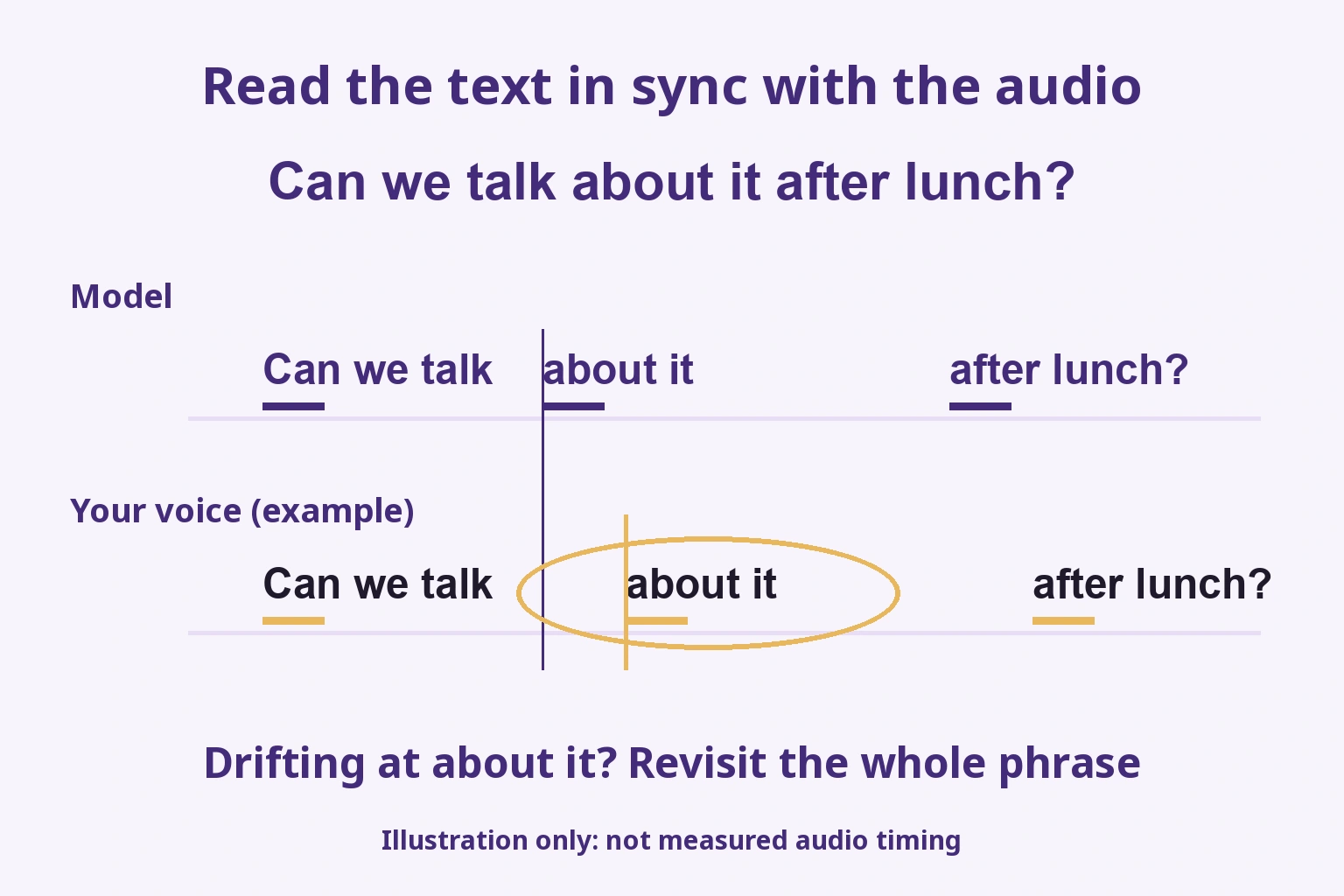
Suppose Can we talk stays together, but you stretch about and it into separate long words while the model reaches after lunch. Note “drift begins at about it.” Do not race through the ending or drop a word to catch up. Matching lunch alone does not show that the middle matched.
Speak softly enough to hear the model. Alternate a silent listening pass with a speaking pass if you are masking it. Our editors suggest pausing after two or three attempts to inspect one problem. That is a practical stopping point, not an experimentally optimal repetition count. If you cannot say the chunk after pausing, prepare it before continuing synchronized reading.
Step 4: compare a recording and use SpeakGain’s actual flow
Replace “I think I matched” with a specific comparison. A recording of both voices can help reveal drift, if both are audible. If it is hard to capture both, pause the model and record your voice alone. Alternate the model and your recording to compare hesitation, rhythm and the ending. Separate recordings do not measure the exact delay during simultaneous reading.
We created this card through the normal Add flow. On the device, the sequence was Knowledge → Learn this card → Listening / Guess by ear → Reveal answer → Answer. Listening hides the English sentence. Answer shows it, its meaning, replay, review intervals and Record and check.
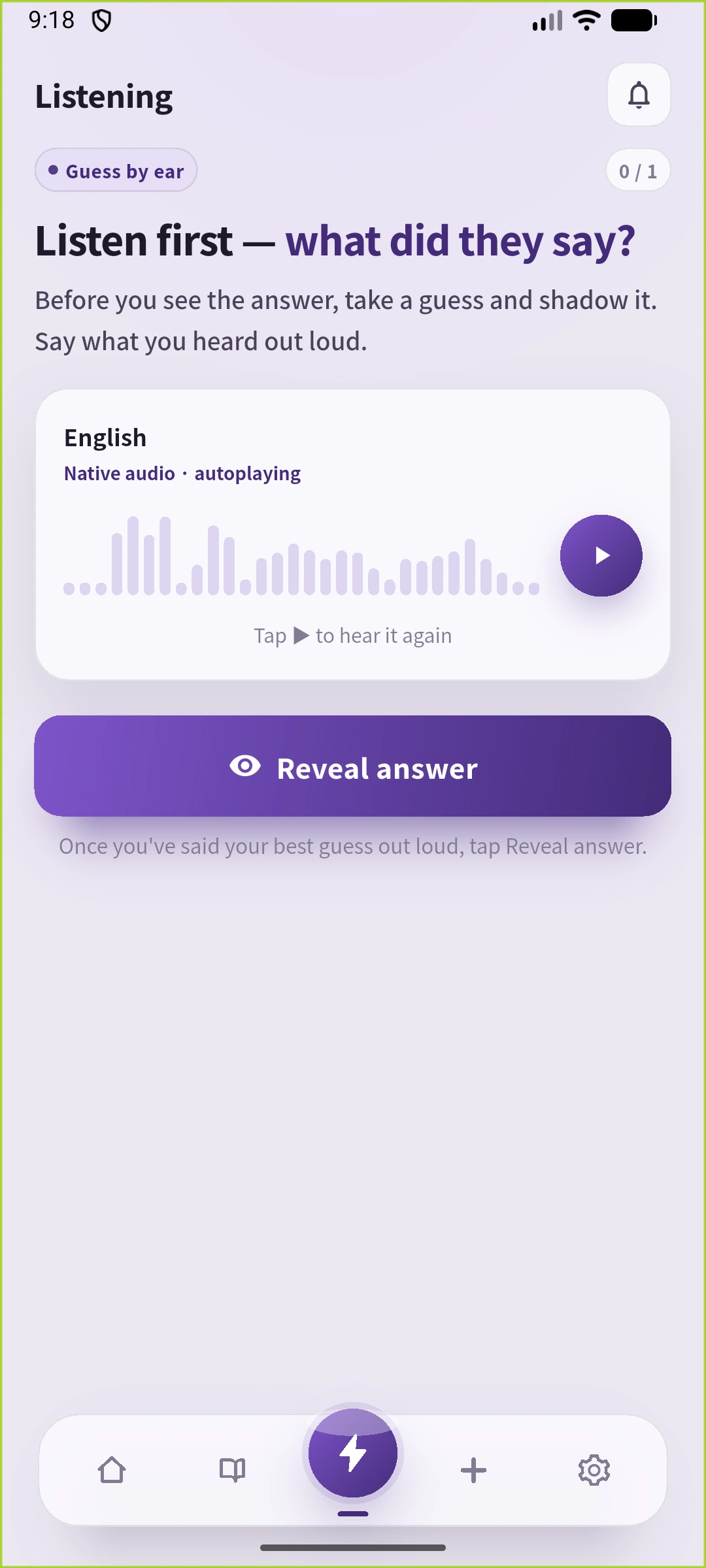
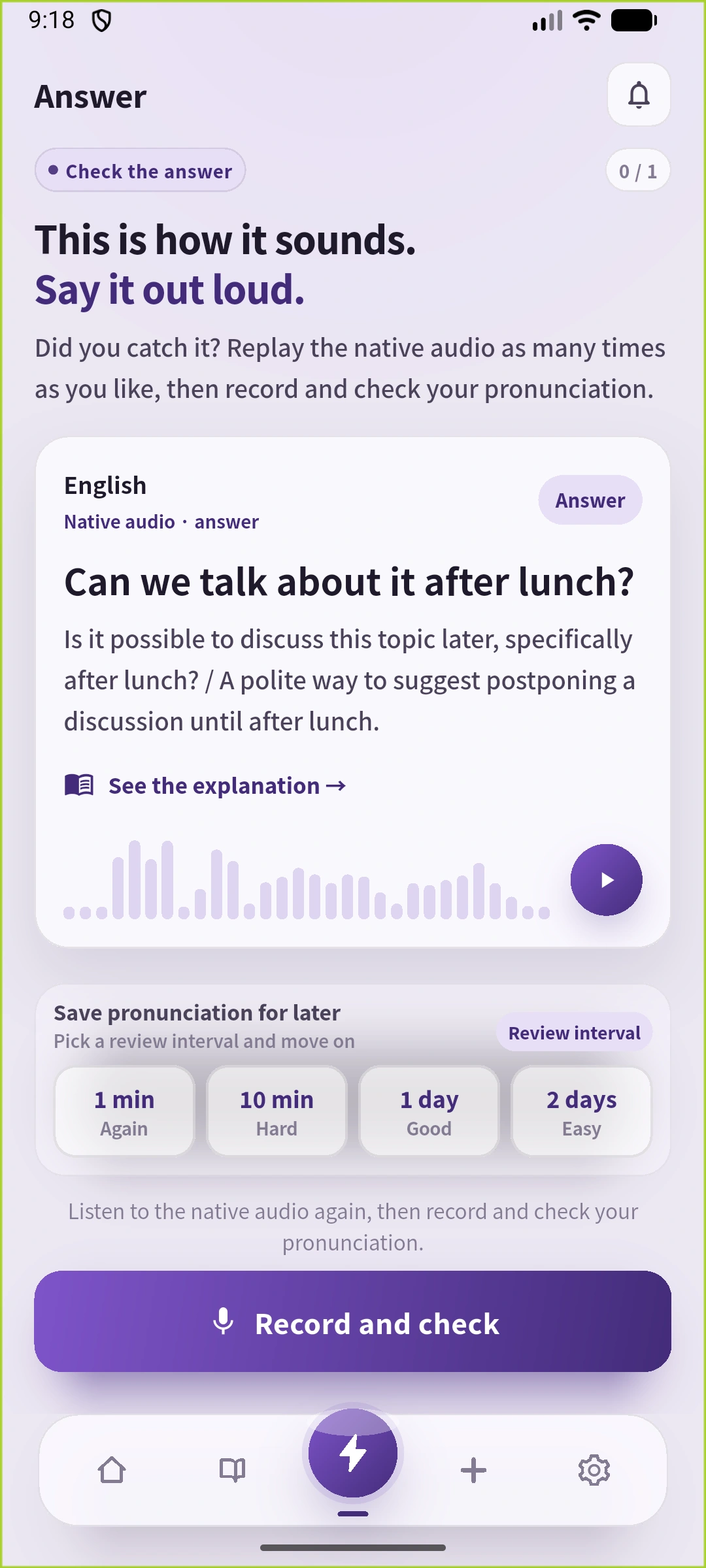
SpeakGain does not provide a dedicated overlapping mode. Looking at the revealed sentence and independently speaking over playback is your own drill. Treat the app’s recording action separately; do not assume synchronized highlighting, simultaneous recording or automatic scoring of timing drift. We checked model playback and the recording entry as far as Android’s microphone-permission request, not a learner score or a learning outcome.
See what SpeakGain does for the feature boundaries. If your purpose is to follow the original textbook speaker, retain that recording rather than substituting generated audio for every comparison.
Step 5: fix the short fragment and return to the whole sentence
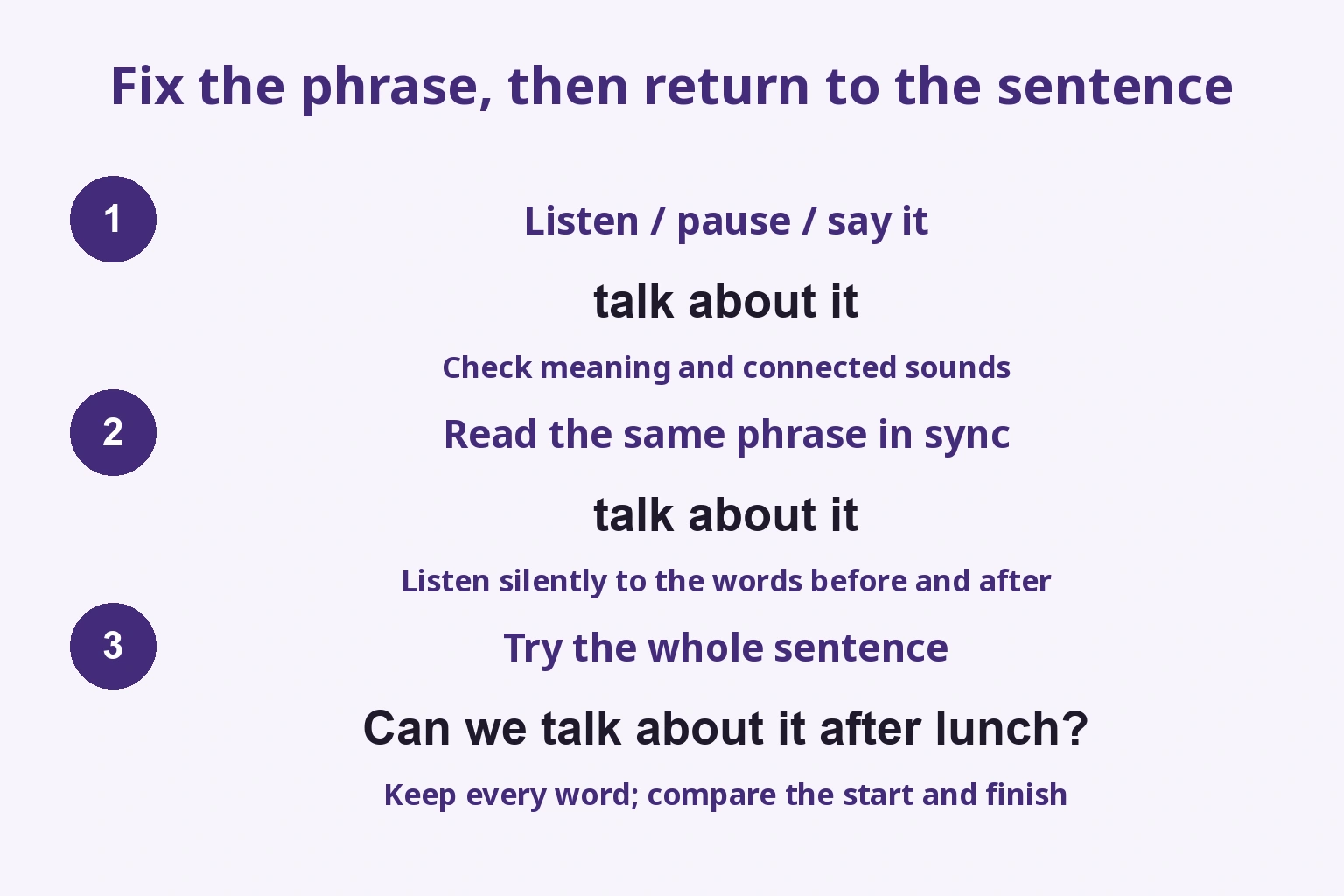
Include the surrounding words, not only the troublesome word. Listen to talk about it, pause and say it, then speak that chunk during another playback. Finally start again from Can we.
| Drift pattern | Check | Our suggested repair |
|---|---|---|
| Late from the opening | Did you know where speech starts? | Listen once, then join Can |
| Stuck at about it | Meaning, sound and connection | Repeat talk about it before synchronizing |
| Every word strong and long | Are short words stretched too? | Compare one prominent part with its surroundings |
| Running out of breath | Length and added pauses | Shorten the material and follow the model’s grouping |
| Only the ending matches | Did you omit words? | Return to the first missing or delayed fragment |
If the player supports slower playback, use it temporarily, then return to normal speed. A slowed success is a separate observation. You do not need new audio for every chunk: during the same full recording, speak only talk about it and listen silently before and after. Then try the whole sentence. This retains the same model and its context.
Step 6: hide the transcript and check again tomorrow
Listen, pause and say the sentence without reading. If that works, try following slightly behind the audio as shadowing. Neither check is the same task as synchronized reading with text.
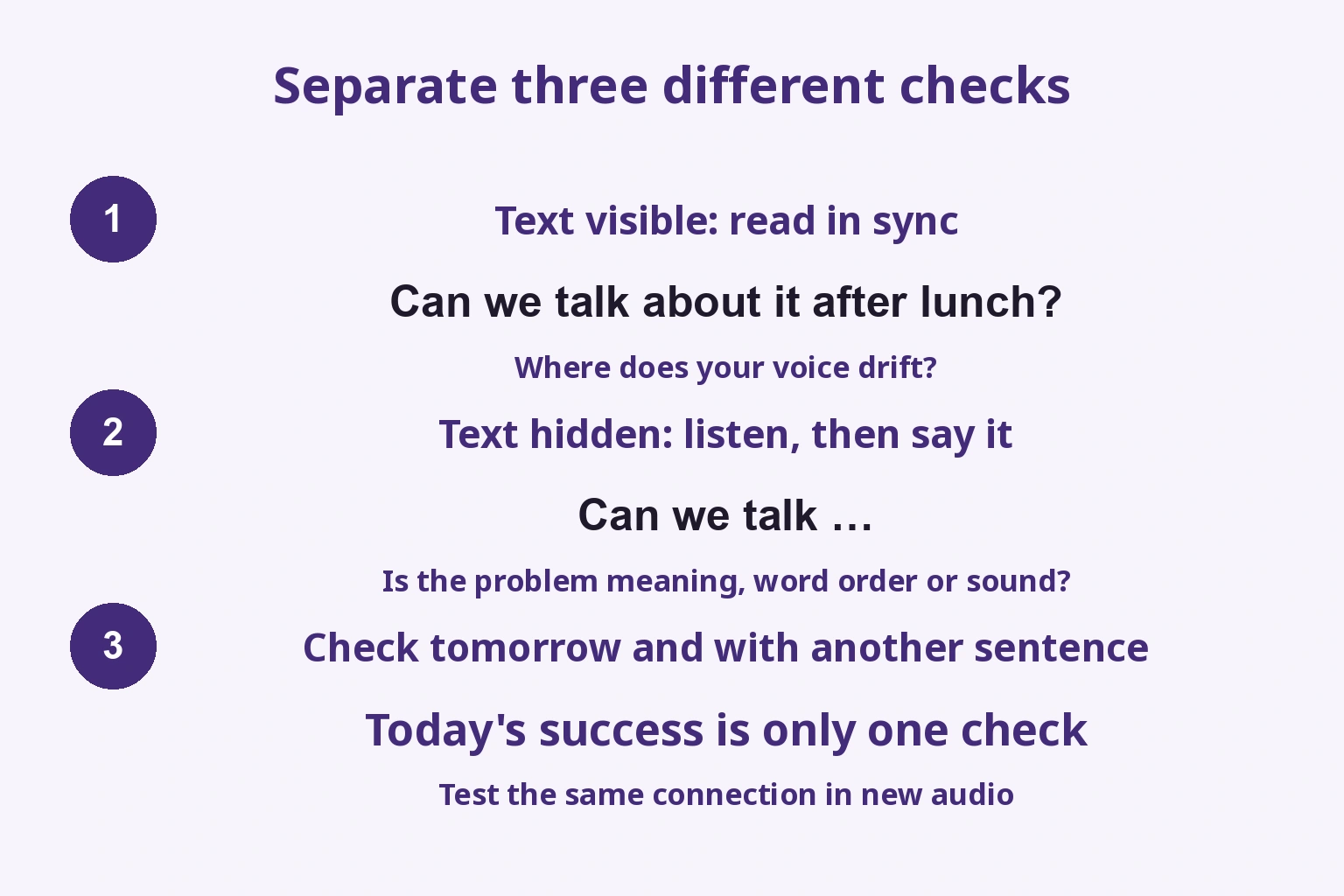
If you get stuck, distinguish meaning, word order and sound. Reopen the transcript for word order; return to a chunk for sound. Keep a short note: “Stopped at about it → practised chunk → no stop in full sentence.” Tomorrow, listen once and try without text. Check a similar connection in another short sentence separately.
For a conversation extension, reply Sure. Let’s talk after lunch. This adds a response to the speaker’s intention. For building your own message, see sentence production practice.
Common mistakes and fixes
Change the material, listening pass or check when repetition is not solving the problem.
| Mistake | Fix |
|---|---|
| Reading before understanding | Check meaning and grammar or use an easier sentence |
| Drowning out the model | Add a silent listening pass |
| Skipping words to finish together | Return to where the drift started |
| Fixing every sound at once | Choose one stress, connection or boundary |
| Stopping after success with text | Add a text-free and next-day check |
| Trying to finish a long video | Practise one sentence through the repair stage |
Remembering a sentence is useful; it simply differs from understanding unfamiliar audio. If you want to locate missing words, use dictation practice to preserve what you heard and what remained uncertain.
What material should you use?
Choose replayable audio, an accurate transcript and understandable meaning. A matching sentence in a learning resource works; a podcast can work if one speaker’s short turn has a reliable transcript. Check automatic subtitles before trusting them. A generated sentence can provide a stable model for something you want to say, but does not represent every real speaker’s delivery.
Our editors would avoid a long film scene or a song for the first drill: background sounds, overlapping voices and performance rhythms add difficulties. If using a favourite programme, pick one person’s short, clearly transcribed sentence. Before adding an app, check text visibility, sentence replay and voice comparison. The shadowing app guide and pronunciation app guide cover tool choices.
Frequently asked questions
Which comes first, overlapping or shadowing?
We suggest text-supported synchronized reading first if you cannot follow without text. Repeat the hard chunk before synchronizing. If you already shadow the material comfortably, there is no compulsory preliminary stage.
How many minutes or repetitions each day?
Try one sentence for five to ten minutes, stopping after two or three attempts to compare. This is editorial advice, not a research-established optimum. Leave time for repair and a text-free check.
Can a beginner do it?
Yes, with a short sentence they understand and can say after pausing. Unfamiliar grammar or fast news is not required. Suitability depends on the sentence, not a level label alone.
Will pronunciation and listening improve?
The drill gives you a way to compare rhythm, connections and phrasing; it does not guarantee general improvement. Separate the practised sentence from next-day and new-audio checks. Add specific pronunciation guidance when an individual sound remains unclear.
Is recording essential?
Not on every pass, but we recommend it when you cannot judge the difference. A separate recording can reveal hesitation; it cannot measure the exact simultaneous delay. Make sure your voice is audible.
What if I cannot keep up?
Shorten the sentence and repeat the troublesome chunk after pausing. Temporary slower playback can help, followed by normal speed. Do not treat unclear meaning or difficulty producing a sound as speed alone.
Does SpeakGain have an overlapping mode?
No dedicated mode was verified. The checked flow is listen and guess, reveal, view the sentence and audio, then the recording action. Reading over replay and recording are separate uses.
Our editorial verdict
Use synchronized reading to fix one sentence’s rhythm or connections when its meaning is already clear. Find the first drift, practise the surrounding chunk and return to the whole sentence. We would not spend the session repeating a long, poorly understood recording.
Then remove text support, check tomorrow and try another sentence. A matched practice sentence is not proof of unrestricted conversation skills. Start with Can we talk about it after lunch? and finish one complete check rather than trying to finish a long lesson.
To choose a book, free audio or video for practice, compare levels and transcript access in our shadowing-material guide.
Sources and verification scope
- British Council / Lucy Baylis, Shadow reading: teaching procedure, not an experiment on duration or long-term effects.
- British Council / Vanessa Steele, Connected speech – part 1: general speech features, not evidence for this AI voice’s every sound change or SpeakGain’s effectiveness.
- Editors’ Android check: normal Create, playback, listening, answer reveal and recording entry. No assessment-accuracy or learning-effect experiment. The practice dose, order and material choices are our editorial recommendations.