
6 shadowing materials: books, free audio and video compared
Published
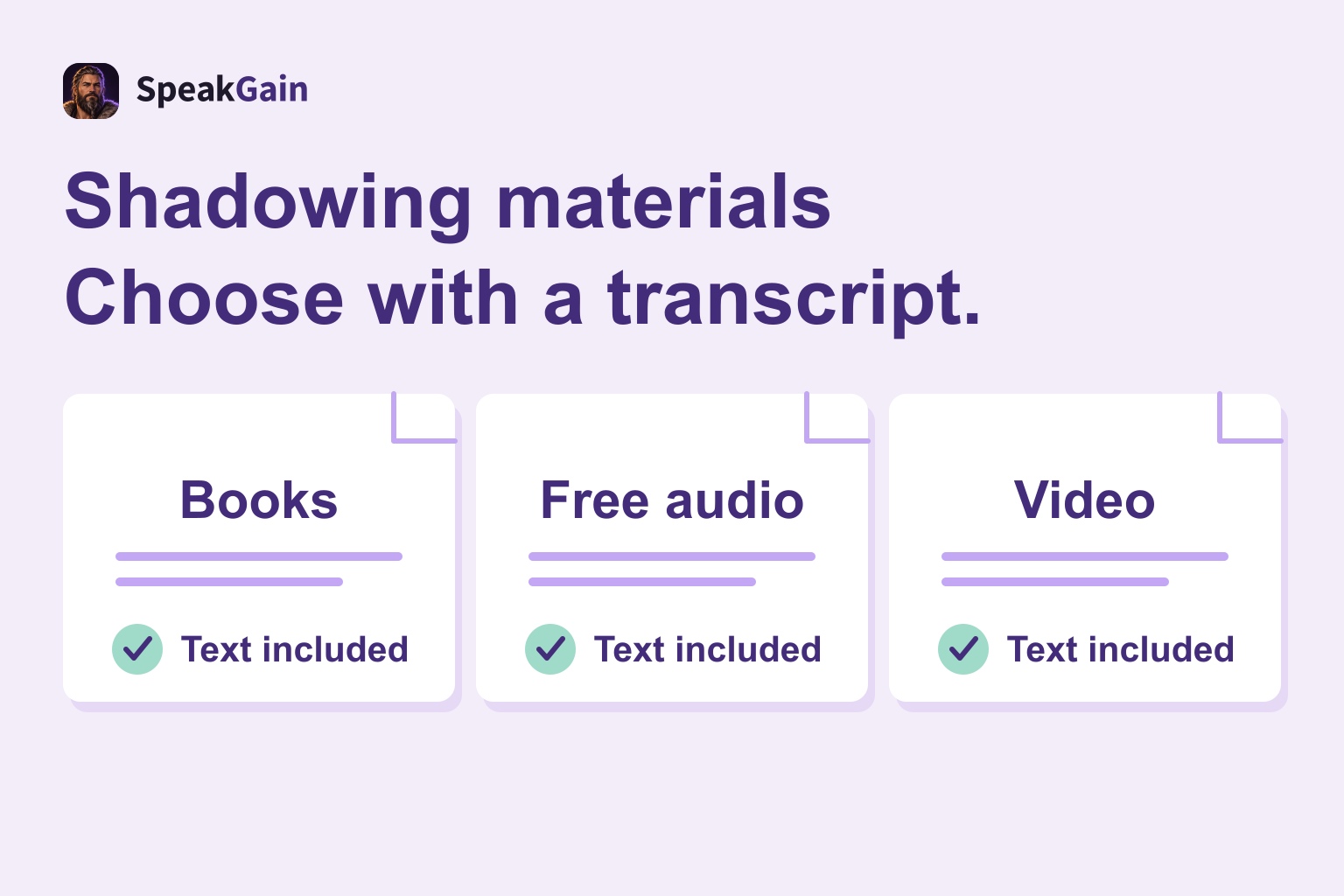
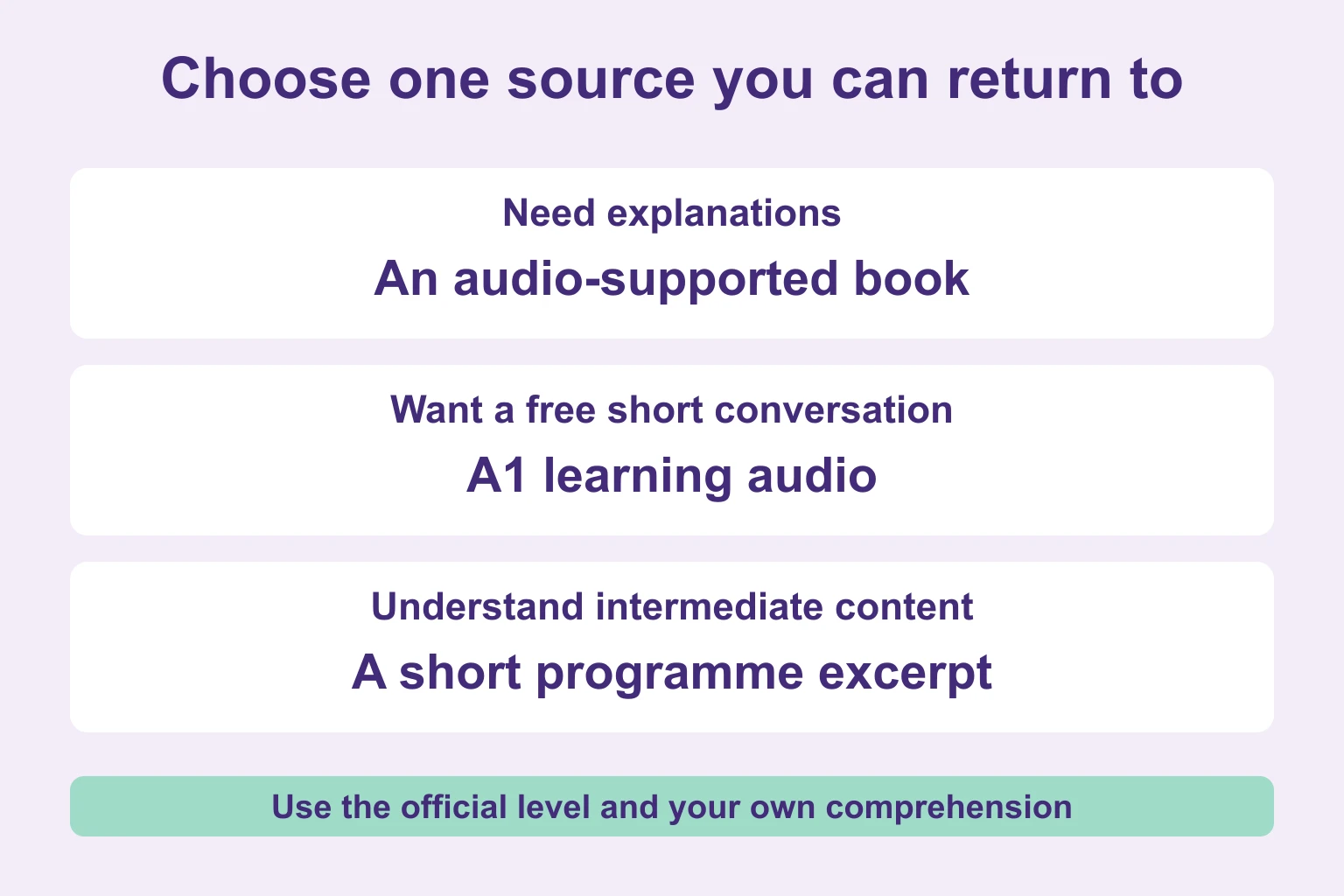
For a free beginner resource, we would start with British Council A1 listening and a transcript; if you read Japanese and need Japanese explanations, consider CosmoPier’s introductory shadowing book. For intermediate learners who understand the subject, BBC 6 Minute English is another option. Choose a short passage you can understand, then listen → check the transcript and meaning → read along → shadow → write and say one sentence about your own life.
This compares materials, rather than apps. For playback or feedback tools, see our shadowing app comparison; for reading at your own pace, see materials for reading English aloud. We inspected official descriptions, public transcripts and audio-access information on 15 October 2026. We did not listen to these recordings or read the books. Suitability judgments below are editorial inferences from that information, not hands-on reviews or measured learning results. All practice examples are our own.
Compare six materials before choosing
Levels retain the provider’s wording. A beginner label is not automatically CEFR A1. Free means the public material described here, not paid courses, data charges or guaranteed regional access.
| Material | Type | Provider | Official level | Transcript | Length | Cost | Checked |
|---|---|---|---|---|---|---|---|
| Introductory shadowing book, revised second edition | Book with audio | CosmoPier | Introductory; slow material | English and Japanese in book | Tracks around 1 minute | Japan edition ¥1,870 incl. tax | 2026-10-15 |
| A1 listening | Learning audio | British Council | A1 Elementary | Lesson Transcript | Varies; no uniform duration | Free public lessons | 2026-10-15 |
| Let’s Learn English Level 1 | Video/audio course | VOA | Beginners | Conversation text | Lesson 1: video 5 min; conversation 29 sec | Free public lessons | 2026-10-15 |
| 6 Minute English | Learning programme | BBC | Intermediate and above | Transcript and worksheet | Approximately 6-minute format | Free public material | 2026-10-15 |
| Starting Out | Story videos | British Council | A1–A2 | Page and PDF | Check each episode | Free public videos | 2026-10-15 |
| One Minute English A1 | Topic videos | ELLLO | A1 Beginner | Script; check the selected item | One-minute series; individual length varies | Free public lessons | 2026-10-15 |
Speed: the book and British Council A1 explicitly describe slow material. We found no single verified words-per-minute figure covering the other collections, so we do not rank their speed. Try one sentence: if you cannot follow even while reading, shorten it or choose slower learning audio. We have not assessed sound quality by listening.
Which type would we choose first?
If English instructions and transcripts are manageable, start with one free A1 conversation. If understanding the text already requires constant dictionary work, use explanations you can read; the Japanese book below is conditional on reading Japanese, not a recommendation of an unverified local edition. For other book-selection criteria, see our conversation-book guide.
If familiar conversations are manageable and you want explanations or opinions, try a BBC passage whose meaning you understand. If visual context helps, Starting Out is an alternative; if you prefer one everyday topic, choose an ELLLO A1 item. You do not need all six.
An audio-supported book: guided practice in Japanese
CosmoPier’s introductory shadowing book
Who it suits: readers of Japanese who want explanations, translations and an ordered practice routine.
Official facts: Tamai Ken’s revised second edition was published in March 2025 at ¥1,870 including Japanese tax. The publisher describes slow material divided into tracks of about one minute, with English/Japanese meaning checks and staged practice. This edition removes the CD; the edition-specific official page offers MP3/ZIP audio. Publisher description
Our judgment from official information: its value is the combination of short tracks and explanations, not a promise that buying it produces quick results. We would choose it when finding and preparing free passages becomes the obstacle.
How to use it: select one track, listen, check the book, read along, then shadow. Finish with an independent personal sentence such as I want to make more time for reading.. This is our example, not a line from the book.
Caution: confirm the exact edition and audio route. Audio access does not make the paid text free. The yen figure describes the Japanese edition; we have not verified local translations, stock, delivery or international prices.
Free audio and courses
British Council A1 listening
Who it suits: beginners and returning learners who want a short conversation before buying anything.
Official facts: British Council describes slow, clear speech, familiar situations and A1 Elementary lessons with preparation and comprehension tasks. The inspected A request from your boss page has a Transcript and worksheet. These are free resources, separate from paid lessons.
Our judgment from official information: this is our first free choice because the text lets you locate what you missed. A1 is also a useful restart point for adults; it is not a guarantee that everyone will find every recording easy.
How to use it: choose one exchange, listen, check what was requested, read along and shadow it. Then write your own work-related sentence: I’ll check the schedule after lunch.. It is not quoted from the lesson.
Caution: do not assume a translation into your language. Check that the particular audio and transcript open on your network. If reading is still too difficult, shorten the passage or use accessible explanations.
VOA Let’s Learn English Level 1
Who it suits: beginners who prefer an existing course sequence to searching for a new topic every day.
Official facts: VOA presents a beginner course arranged over 52 weeks. Lesson 1, dated 10 September 2019, provides conversation text and an MP3 link; the page shows a five-minute main video and a 29-second conversation. Course description
Our judgment from official information: separating the lesson video from its short conversation makes the practice unit easier to define. We would start with the conversation rather than shadow every explanation. Level 1 is not a CEFR conversion.
How to use it: listen to a short conversation, check the speakers and meaning, read along, then shadow. For your own introduction, write I work at a small hotel near the station. if it is true for you. This is our sentence.
Caution: this is an available course archive, not a claim of new weekly releases. Pronunciation and speaking clips have different lengths. We checked text and access links, not successful media playback everywhere.
BBC 6 Minute English
Who it suits: intermediate learners who understand the transcript and want a short explanation or opinion to practise.
Official facts: the BBC resource guide describes a free programme for intermediate learners and above, with transcripts and worksheets. We also checked a 2026 episode transcript. Six minutes describes the programme format, not a measured length or uniform speed for every file.
Our judgment from official information: we would not make this the first beginner resource. Understanding an explanation while following its sounds adds work; it suits someone who can first establish the meaning.
How to use it: understand the topic, choose a few complete sentences, then apply the same four audio/text stages. Finish with an original reaction such as I find it easier to focus in the morning..
Caution: switch topics if unfamiliar vocabulary prevents comprehension. Check the chosen transcript against the audio; do not force yourself to follow mismatched wording. Listening to the full programme and shadowing an excerpt are different tasks. See our learning-podcast comparison for more listening choices.
Video sources
British Council Starting Out
Who it suits: learners who need the situation to be visible before choosing a short exchange.
Official facts: Starting Out is a free A1/A2 story series with transcripts and activities. Episode 01 provides page text, a Transcript PDF and a Support pack.
Our judgment from official information: it is an alternative entry point to A1 audio, not an inherently superior format. The speaker-labelled text helps define a short practice passage.
How to use it: establish the situation, listen to one exchange, check its meaning, read one speaker’s part along with the audio, then shadow it. Make your own plans the final task: I’m meeting a friend after work..
Caution: watching with text visible and following audio without text are different stages. Return to the same passage with text hidden. We recommend the available series, without asserting a release schedule.
ELLLO One Minute English A1
Who it suits: learners who want one everyday topic they could also talk about themselves.
Official facts: ELLLO offers free learning material and an A1 Beginner video collection. The inspected lunch-topic lesson has video/audio elements, Script and a free PDF worksheet. The site says most activities have supporting text; it does not promise identical features for every item.
Our judgment from official information: a short, familiar topic provides a manageable route from understanding a transcript to speaking about your own life.
How to use it: choose one topic and apply listen → meaning → read-along → shadow. For the personal stage, use our original sentence I’m taking a short walk after lunch these days.. It is not reproduced or rewritten from the lesson text.
Caution: A1 does not guarantee one speaking speed. “One Minute” is the collection’s name; check individual length and access. The inspected page does not state a publication/update date, so we describe its availability on the check date only.
A five-step routine for any material
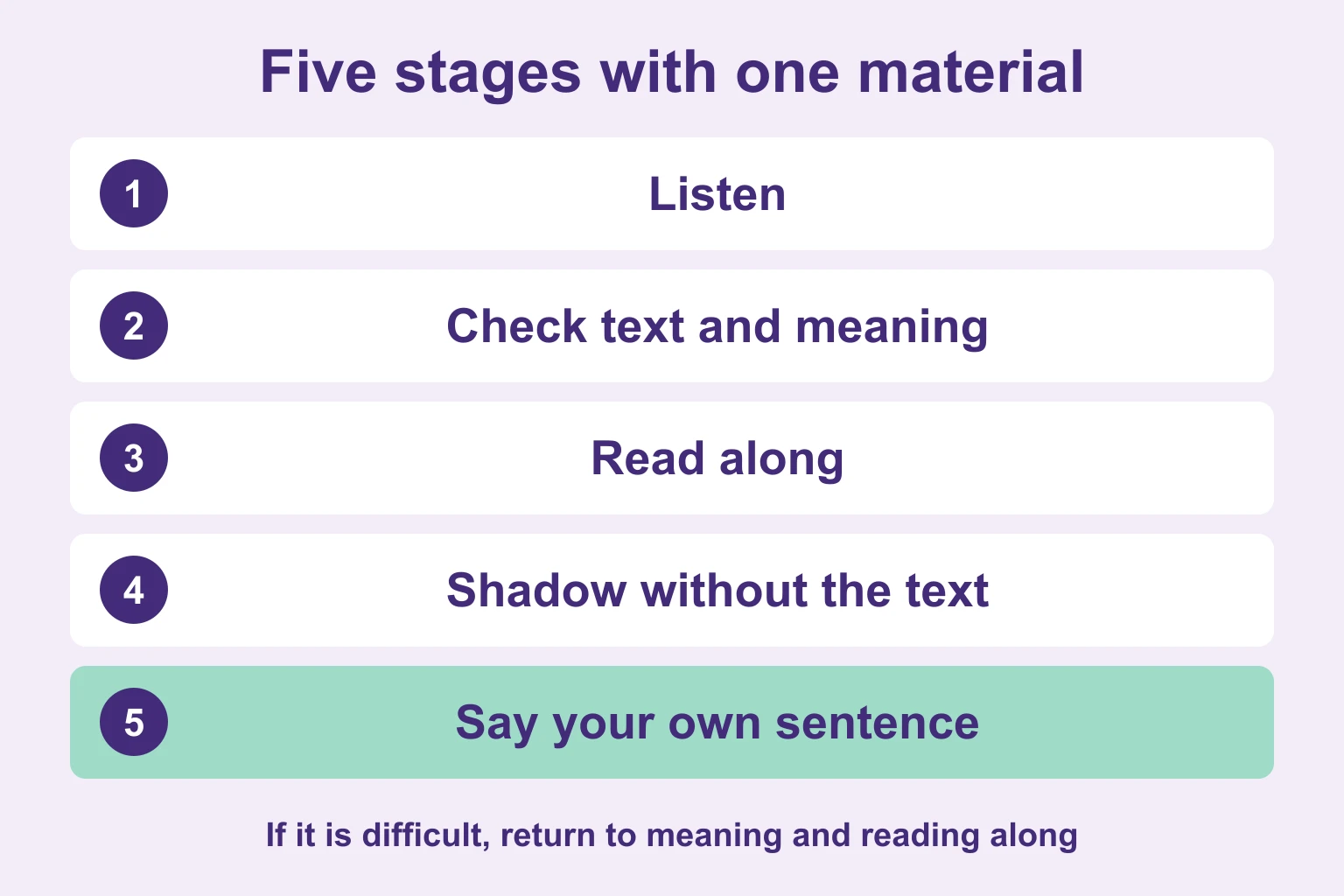
- Listen. Choose a short passage and find one place where you lose the thread. If even the topic is unclear, shorten it or choose easier material.
- Check the transcript and meaning. Work out what the sentence communicates and where its meaningful groups lie. Do not add repetitions while its meaning remains unknown.
- Read along. Keep the text visible and speak at the same time as the audio. If that is still difficult, practise a single sentence before hiding the words. See the read-along method.
- Shadow. Hide the transcript and follow a little behind the speaker, continuing to listen. If you stop, return to the text and audio at that point. This is different from reciting from memory.
- Write and say your own sentence. Switch to a real situation in your life. Our shared example is I’m taking a short walk after lunch these days.. This final task is self-expression, not another test of copying the source.
This is our beginner-friendly practice proposal, not the only valid protocol or a replacement for a book’s own instructions. For more detail, see our shadowing method guide.
A ten-minute starting plan
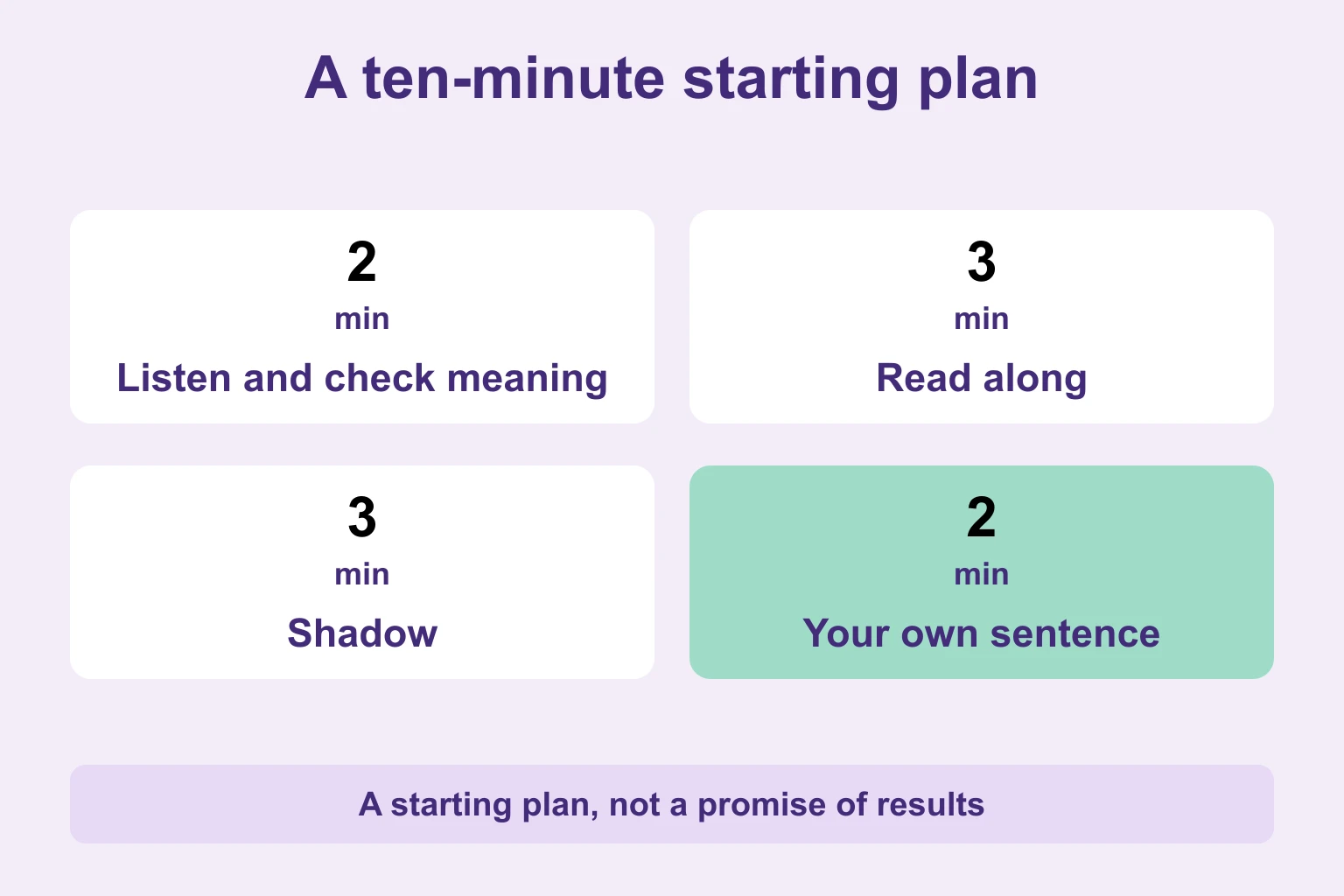
Try two minutes listening and checking meaning, three reading along, three shadowing and two saying your own sentence. This is an editorial starting plan, not a minimum dose or a promise of results. If comprehension takes the session, stop after the read-along stage and continue tomorrow.
The next day, revisit the same passage before choosing another. Keep the passage if reading along is still unstable; change it for a concrete reason, such as inaccessible audio, unreadable language or excessive difficulty. A returning learner can restart with one sentence rather than compare themselves with a previous level.
What we would avoid
Starting with very fast general-interest material: comprehension and speaking may both break down, making the problem hard to locate. Shorten it first; if reading along still fails, choose slower learning audio.
Repeating without understanding: a repetition count does not tell you whether you can use the idea. Explain the meaning first, then return to the sound.
No transcript or only unchecked automatic subtitles: beginners lose a useful way to verify missed words. Prefer provider-supplied text matching the chosen audio. Changing resources every day also spends practice time on searching; finish one short cycle before collecting more.
Keep your own sentence for tomorrow
Save the independently written sentence with the situation in which you want to say it. For I’m taking a short walk after lunch these days., imagine discussing a recent habit with a colleague, then say it again tomorrow.
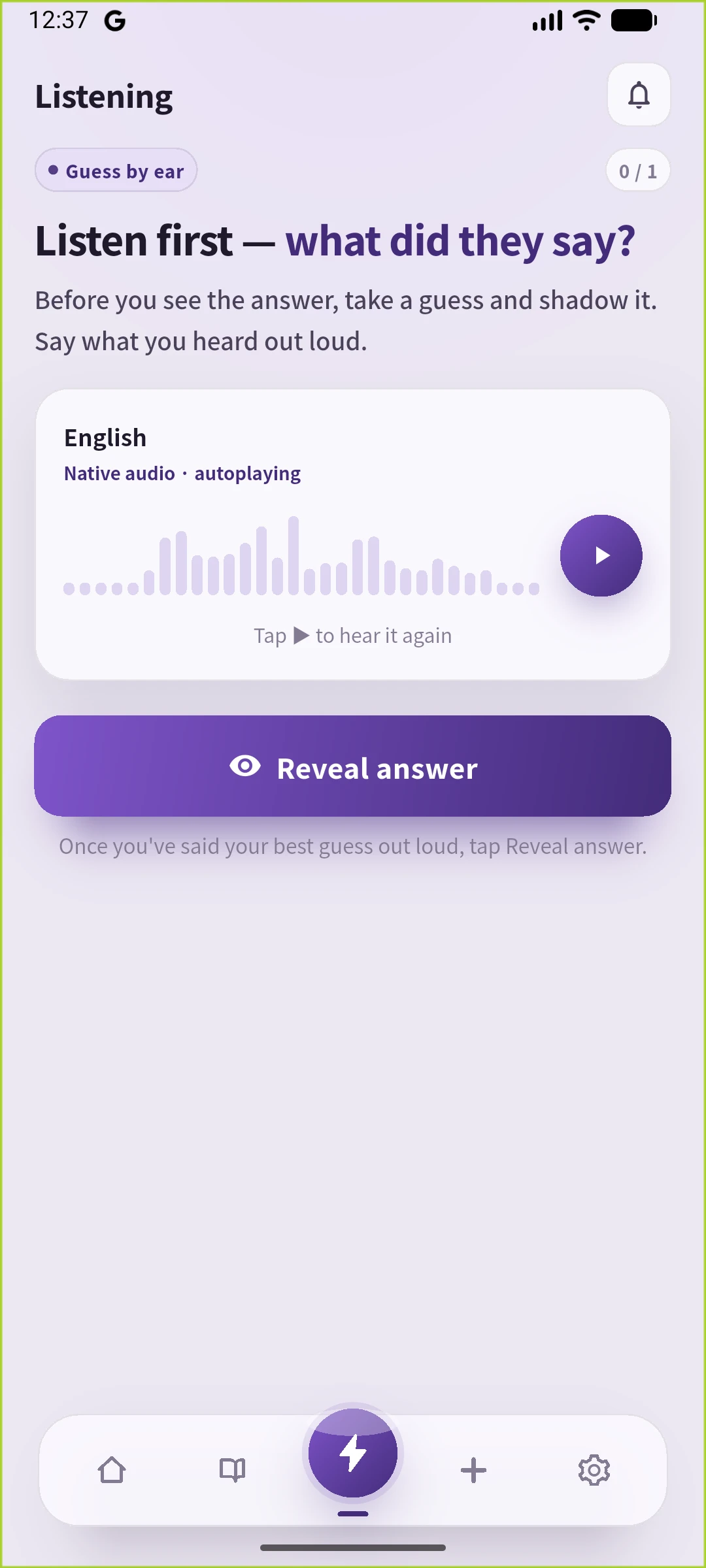
SpeakGain is our own product. We saved the original sentence above as one card through the normal Add flow. From Library → Knowledge → Learn this card, we reached Listening, which hides the sentence and prompts the learner to listen and say it aloud. We verified that Reveal answer displays the saved sentence and that the play button replays the same audio.
This example uses only a sentence we wrote ourselves, without importing a material’s text or recording. It is not a shadowing assessment or score. The shared screenshots use the English interface and the generated explanation is in English. The material selection and five-step routine also work with a notebook.
FAQ
What should beginners choose first?
Start with a free A1 conversation with a transcript. Choose an audio-supported book if its explanations are in a language you can read. Ease of checking meaning matters more than popularity.
Can I start with free material only?
Yes. The public resources above provide options. Verify the particular transcript and media access in your region; free availability is not a guarantee for every network.
Do I need a transcript?
For a first beginner resource, we recommend one. A translation is optional if you can establish the meaning yourself; verifiable wording is the priority.
What if it is too fast?
Reduce the passage to one sentence and return to meaning checks and reading along. Speed control, where available, is temporary support. Switch to slower material if needed.
Book or app?
A book can supply explanation and sequence; an app can help with playback or other practice tools. Choose the material and the tool separately. Try an existing audio-supported book before adding another subscription.
Can I use YouTube?
Yes, if the official source offers corresponding text and a short passage you understand. General-interest entertainment is not automatically beginner material. Do not reproduce videos or subtitles.
How many minutes or days?
Ten minutes is a starting suggestion. Choose the scope by comprehension and ability to read along, not a promised number of days. One sentence is acceptable on a difficult day.
Our editorial verdict
Start free with British Council A1 listening; use a Japanese explanation book only if you read Japanese. VOA provides sequence, Starting Out and ELLLO offer visual/everyday entry points, and BBC suits intermediate passages whose meaning is already accessible. Choose one, finish a short cycle, and end by saying something you actually want to communicate.