
6 podcasts for learning English: choose by level, purpose and transcript access
Published
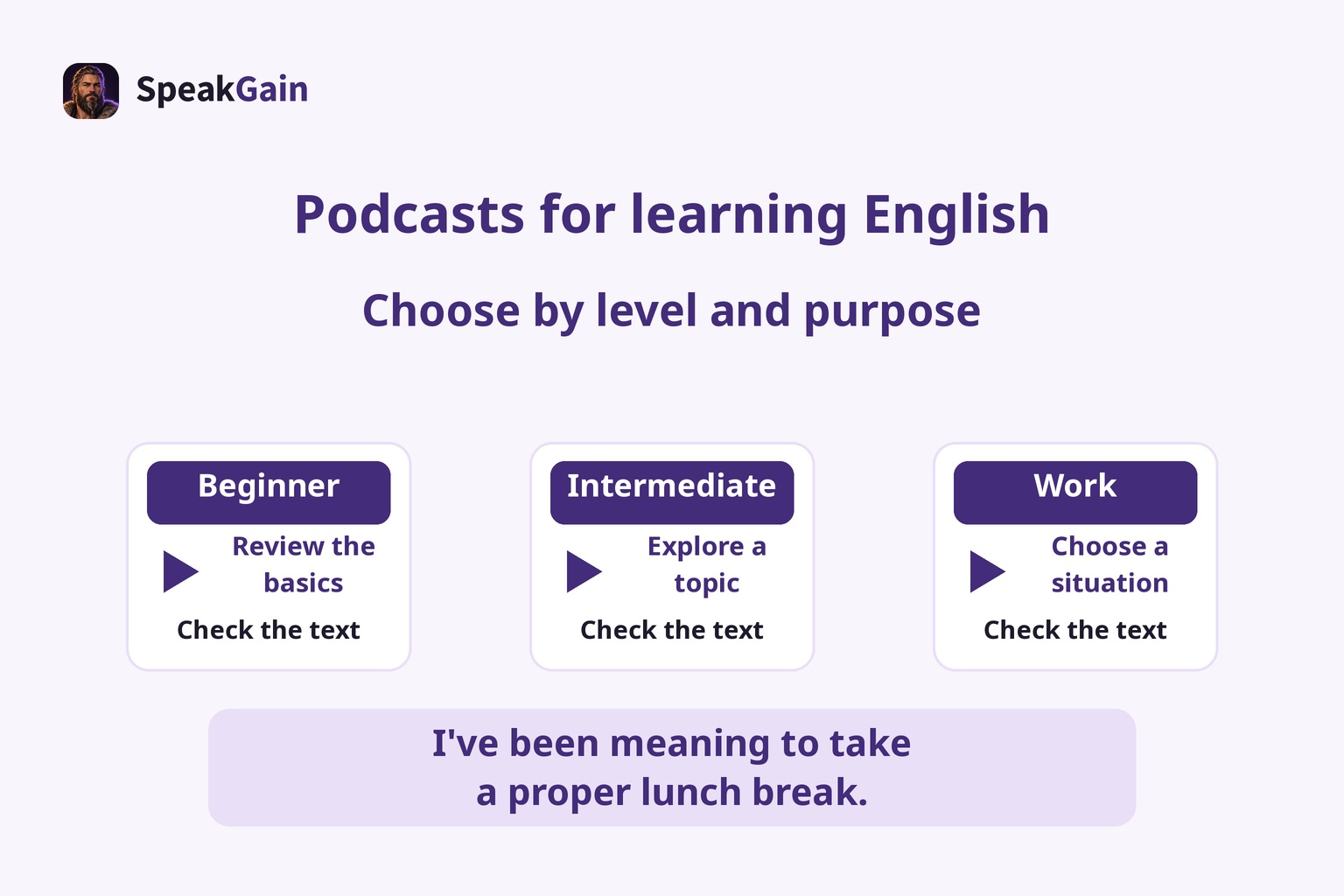
For basic revision, consider Coffee Break English; for a short topic with a free script, start with BBC 6 Minute English if you can already follow intermediate English. All Ears English suits American small talk, while Business English Pod suits a specific workplace task. Choose one show by level, purpose and access to the actual episode text, then add focused listening, shadowing and one sentence you can say in your own situation.
These are conditional recommendations, not a ranking. We inspected official transcripts, descriptions and episode metadata on 15 October 2026; nobody in this editorial process listened to the episodes. The judgments below are explicitly based on those written sources. We use no affiliate links, referral codes or reproduced covers.
Compare the six shows
Lengths are ranges from recent official entries, not lifetime averages. Speaking speed was not measured. A summary, vocabulary list or course text is not automatically a full episode transcript.
| Show | Level | Purpose | Transcript | Recent length | Speed | Free/paid | Checked |
|---|---|---|---|---|---|---|---|
| Coffee Break English | Basic revision; official season-one A1/A2 labels conflict | Everyday language | Paid course text; full current Show transcripts unverified | 7–11 min, Show | Course described as slow; Show unmeasured | Audio free; course paid | 2026-10-15 |
| 6 Minute English | Official: intermediate | Topics and vocabulary | Free; not word-for-word | 6–7 min | Unmeasured | Checked audio/script free | 2026-10-15 |
| All Ears English | Official: intermediate–advanced | American small talk | Paid app or email, separately | 14–21 min | Unmeasured | Audio free; full text paid | 2026-10-15 |
| Business English Pod | Official: intermediate–advanced | Meetings, calls, work | Paid member PDF | BEP lessons 15–24 min | Unmeasured | Public MP3 free; materials paid | 2026-10-15 |
| English Learning for Curious Minds | Official: intermediate–advanced | History and culture | Selected free texts; wider resources paid | 21–29 min | Unmeasured | Public and member-only episodes | 2026-10-15 |
| Luke’s English Podcast | Editorial: intermediate upwards | British English, longer stories | Depends on episode; #1005 has full PDF | 89–159 min | Unmeasured | Main show free; Premium paid | 2026-10-15 |
Recent length/date sources: Coffee Break, BBC, All Ears English, Business English Pod, Curious Minds and Luke. Access and prices can change; check the specific episode before paying.
Pick by the practice you can finish
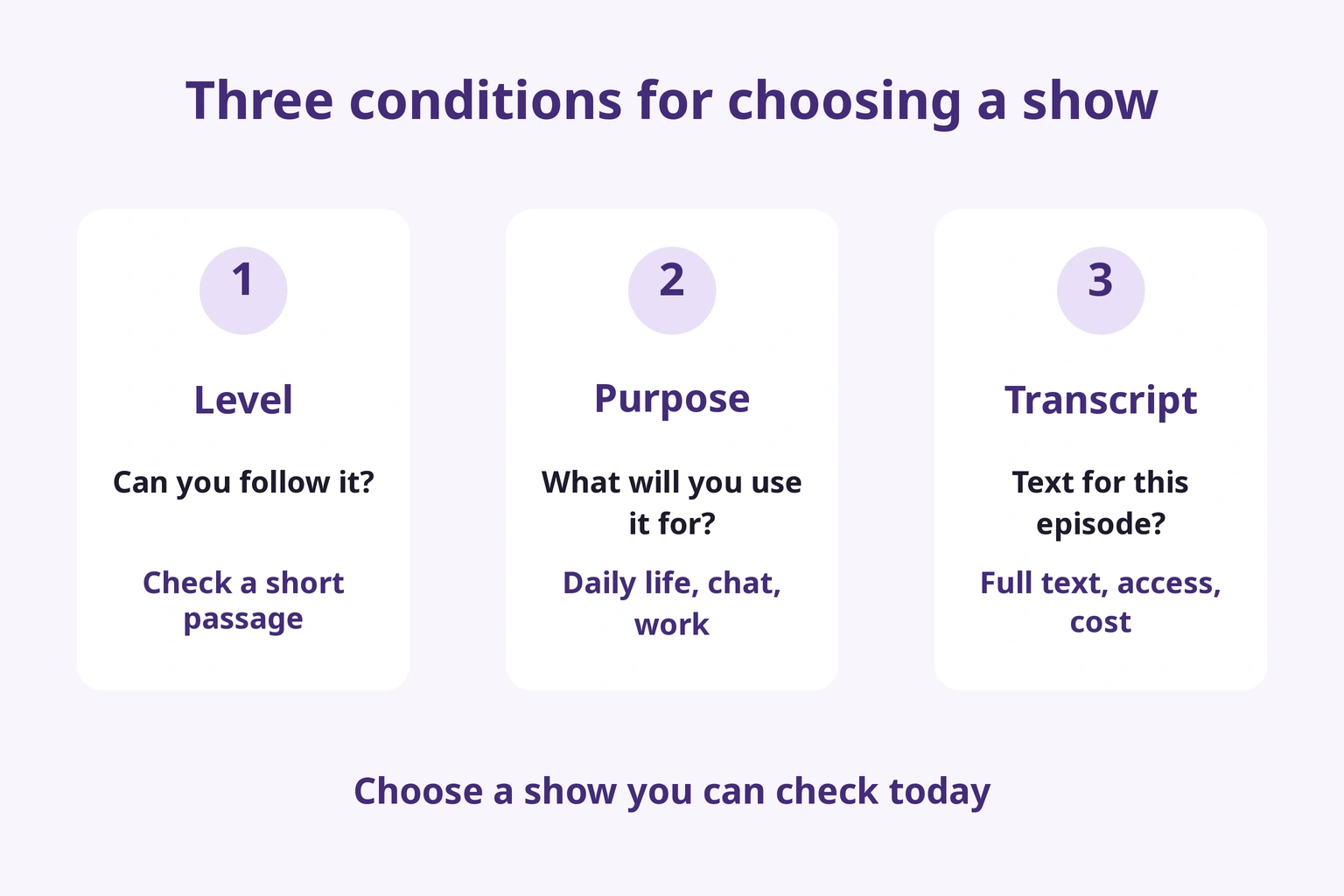
Beginners should first read a short passage and decide whether its meaning is manageable. A familiar everyday topic is often a more practical starting point than a long specialist discussion. If English explanations are themselves a struggle, use a short read-aloud resource first. Intermediate learners can choose a social, cultural or work topic they actually want to discuss.
If you need free focused listening, prioritize free access to the corresponding text over free audio alone. See listening apps for app selection; this guide selects shows. For accent differences, use our British and American English guide, without treating one presenter as representative of an entire country.
Coffee Break English: revise the basics
Suitable for: learners returning to school-level English. Verified: Coffee Break Languages, a Radio Lingua Ltd product, provides free audio and paid course notes containing the lesson text. The publisher describes the course as slow English and mentions UK, US, Canadian and Australian contributors. Its season-one level labels conflict, so we do not assign a definite CEFR level. The current Show’s latest checked episode is a seven-minute adjective quiz dated 12 October 2026. Publisher / feed.
Editorial judgment from the description: a contextual vocabulary quiz offers a clear checking task. One-sentence task: use a verified example pattern to write about your own plans. Caution: paid course notes are not verified as full transcripts for every current Show episode. Do not buy on that assumption.
6 Minute English: a short topic with text
Suitable for: intermediate learners who can read English explanations. Verified: BBC Learning English labels it intermediate. The latest checked feed entry, 8 October 2026, runs 6:49 and discusses drinking habits. Its page offers free text, download, worksheet and quiz, but warns the transcript is not verbatim. Episode / feed.
Editorial judgment from the script: the opening question, conversation and vocabulary give a useful structure for checking a paragraph. One-sentence task: adapt a pattern about habits to your own day. Caution: choose another topic if alcohol is not suitable for you; do not use a nonverbatim script as an exact dictation answer key. A British publisher does not guarantee one accent across every clip.
All Ears English: American social language
Suitable for: intermediate or advanced adults interested in small talk. Verified: the official feed states that audience and American-English focus. Its latest checked entry is AEE2704, 14 October 2026, 17:14. Audio is free; full texts are paid through the app or weekly email. Official access / feed.
Editorial judgment from the publisher description and recent titles: search by a conversational purpose, such as expressing interest. We did not inspect purchased full transcripts. One-sentence task: keep a short response together with the situation it answers. Caution: app and email subscriptions are separate entitlements; check the official terms. A web summary is not the full text.
Business English Pod: choose a workplace action
Suitable for: intermediate–advanced learners with a defined task. Verified: the team’s free MP3 lessons use dialogues and explanation; full PDFs are for Premium Members. Latest checked BEP425, 27 September 2026, runs 22:26 and is tagged Advanced. About / episode.
Editorial judgment from the description: campaign strategy is useful for relevant marketing work, not a universal beginner lesson. One-sentence task: choose an episode about confirming, requesting or arranging something you need to do. Caution: public listening questions are not a full transcript; no uniform accent specification was verified. Short news episodes belong to a different subseries.
Curious Minds: follow an interest
Suitable for: intermediate–advanced learners who enjoy history or culture. Verified: Leonardo English, hosted by Alastair Budge, provides public and member-only episodes and selected free full texts. Latest #637 is member-only, dated 13 October; public #636 is dated 9 October and listed at 24 minutes. The FAQ says most content uses a British accent, with occasional other varieties. Catalogue / access FAQ.
Editorial judgment from the official narrative and description: #636’s historical fraud story offers a reason to follow events. One-sentence task: summarize one event, then use a checked pattern for something you did yesterday. Caution: free audio does not imply free full text. Start with the explicitly marked free-transcript selection. Do not assume regional playback or payment access.
Luke’s English Podcast: longer British storytelling
Suitable for: learners ready to follow longer material; this suitability is our judgment, not a CEFR certificate. Verified: Luke Thompson’s main show is free, with separate Premium material. Latest checked #1006 is dated 13 October 2026; #1005, dated 7 October, is 95:48 and offers a separate full transcript PDF. Publisher / #1005.
Editorial judgment from the notes: its David Attenborough topic can suit someone interested in nature or British culture. One-sentence task: choose one paragraph, then describe a person or work you like. Caution: not every free episode has a full transcript. #1006’s story PDF was not verified as a transcript of all speech. Official explanation.
A listening routine that ends in speaking
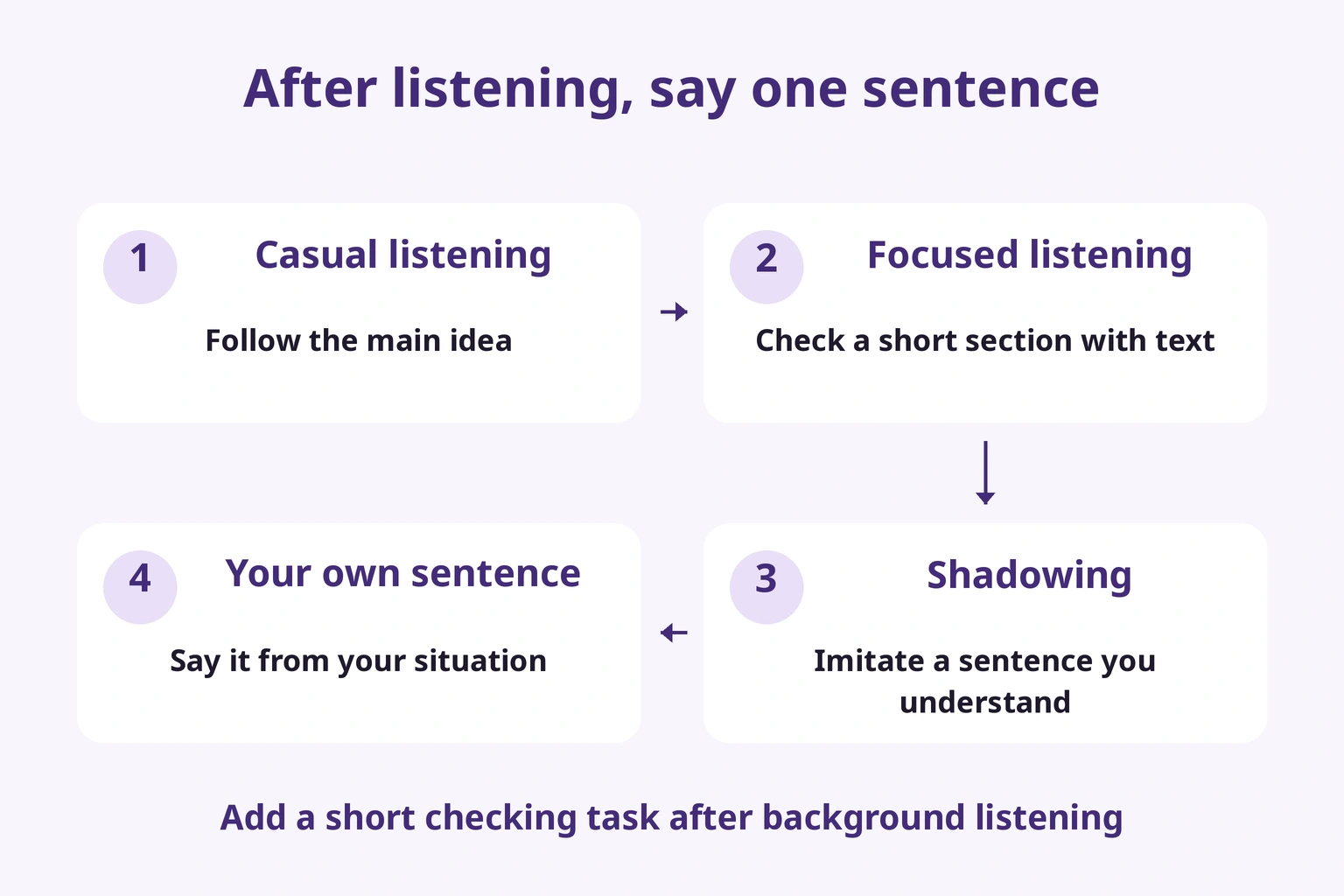
- Casual listening: follow the gist on a commute or while doing chores. Mark one place to revisit; leave screen checking for a safe, quiet time.
- Focused listening: replay a short section with the corresponding text. Separate unfamiliar meaning from familiar words you missed in sound. See listening practice.
- Shadowing: after understanding, follow a short sentence a little behind the voice. If that is hard, read along with the audio first; then use the shadowing steps.
- One sentence of your own: write something relevant to your life, then say it from the situation without reading.
Our original example, I’ve been meaning to take a proper lunch break., expresses a plan you have had in mind. It is not quoted from any episode. Imagine discussing your lunch habits, read it once, then put the text away and say it. Keep the same sentence rather than collecting a large unused list.
SpeakGain is a possible place to save a sentence you wrote and practise hearing and saying it. This is not a podcast player, podcast importer or transcription workflow.
On the device, we saved the sentence above through the normal Create flow, then opened Library → Knowledge → Learn this card. Listening asks you to hear the audio and say your best guess aloud; Reveal answer shows the same sentence. Answer offers review intervals: we selected 1 day / Good. This is an interval chosen by the learner.
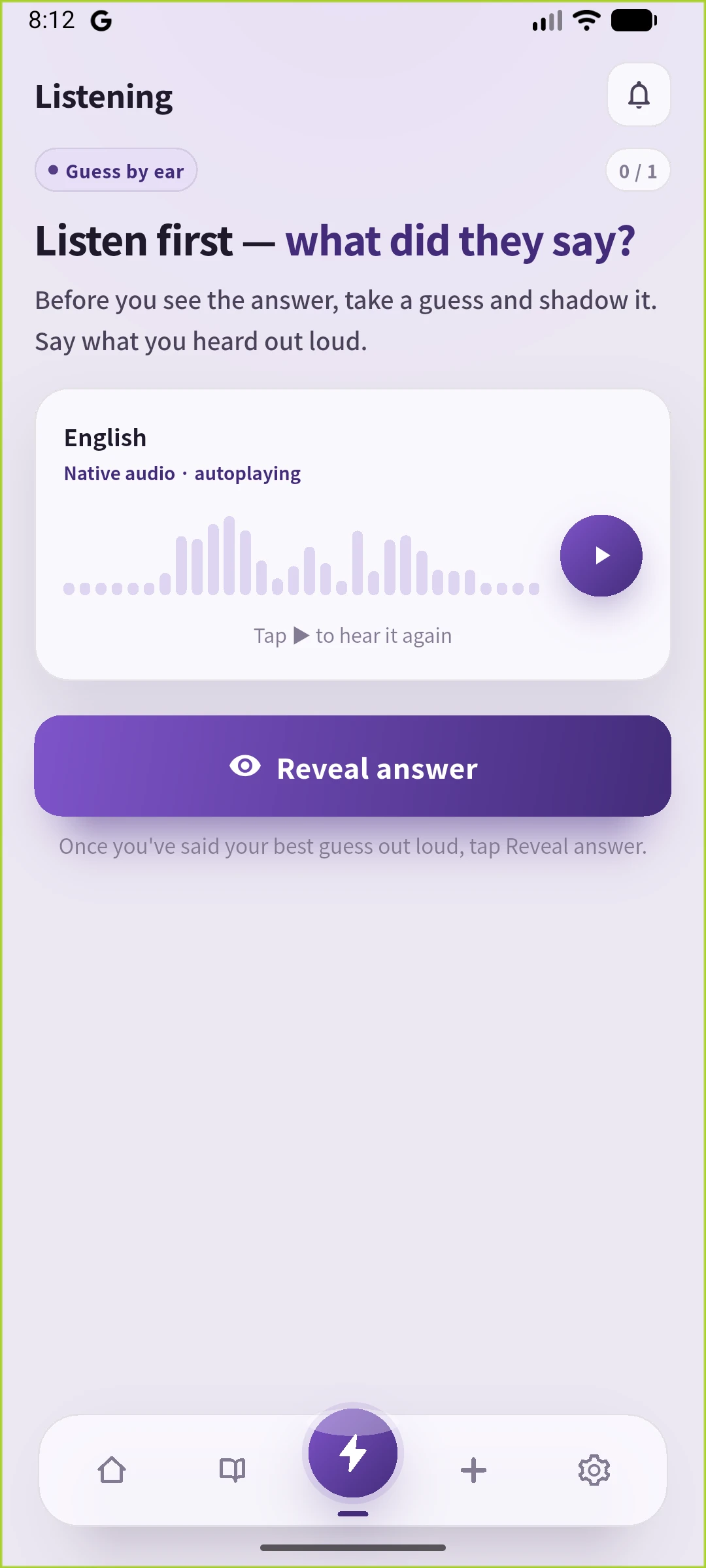
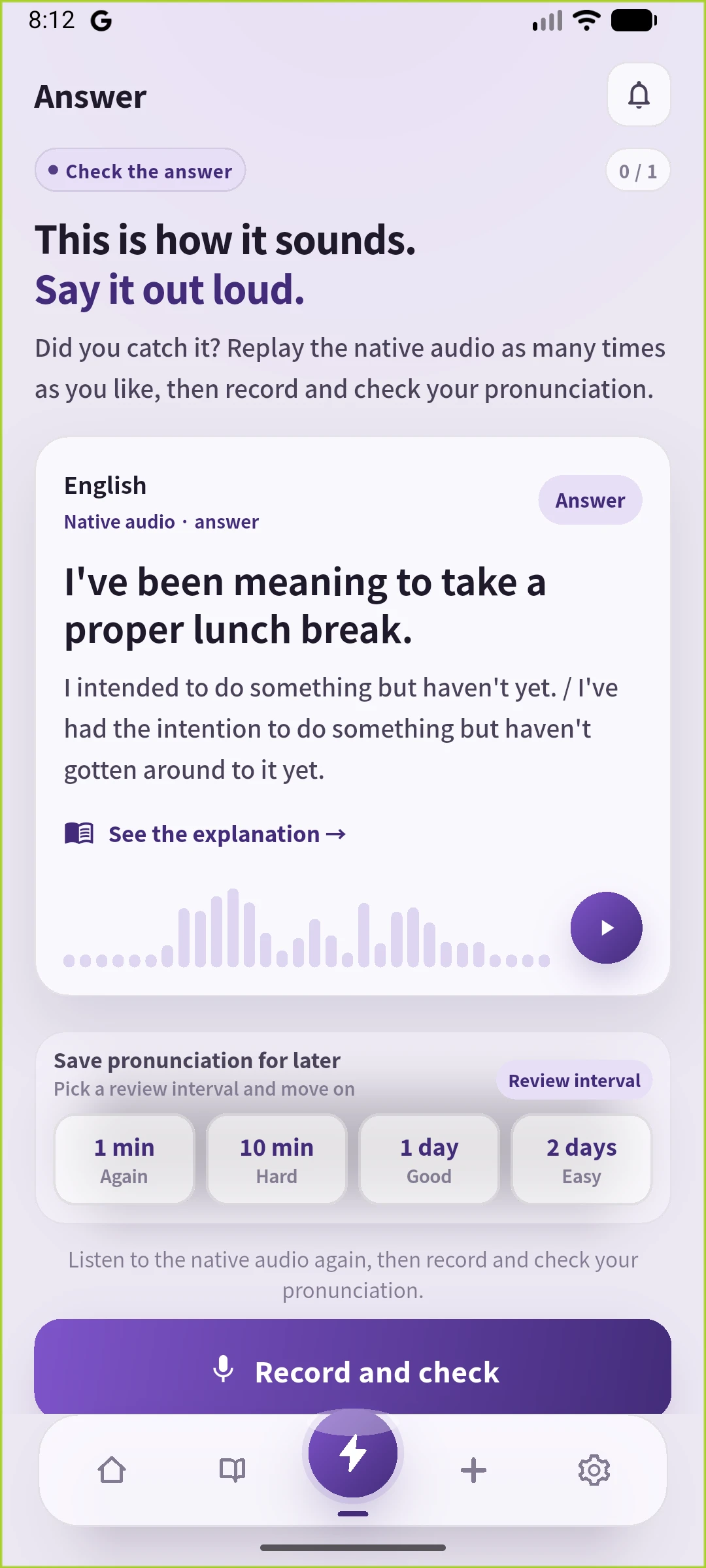
Viking-generated audio for this sentence. This is AI audio, not a recording of a human native speaker.
What we would do in the first week
Choose one show and locate its text on day one; check a paragraph on day two; imitate and say one sentence on day three. On the next two days, revisit it or choose another episode for the same purpose. At the weekend, change shows only for a concrete reason: difficulty, lack of relevant situations or unavailable text. This is an editorial schedule, not a scientifically required dose.
We do not recommend hours of incomprehensible background audio as the whole study plan: it leaves no checking or speaking task. Nor would we ask a beginner to shadow an entire long conversation or subscribe to many shows at once. For the role of background listening, see passive listening.
Frequently asked questions
Which is best for a beginner?
Coffee Break is a basic-revision candidate if English explanations are manageable. Otherwise start with shorter supported material, not a long show simply labelled easy.
Which offers free text?
The checked BBC episode does; Curious Minds offers explicitly selected free transcripts. Check the exact episode, not just the show’s audio price.
Will background listening alone make me speak?
We do not promise that. Add a short checking task and one spoken sentence; playback hours are not evidence of speaking ability.
Must I always use a transcript?
Not when enjoying a story you understand. For checking a missed sentence, corresponding text is useful; a summary is insufficient.
Spotify or Apple Podcasts?
Use what you already use, provided you can revisit the episode and reach official material. We did not compare platform performance.
How long should I listen, and what if it is too fast?
Choose a section you can check afterwards. If the text is difficult too, choose easier material; if its meaning is clear, try a shorter replay or a speed control your player actually supports. No fixed minutes or speed promises.
Which show for British English, or an old archive?
Luke explicitly focuses on British English; Curious Minds describes mostly British speech. Archives can still be useful, but do not promise new episodes: Easy Stories in English last showed a 5 May 2026 update explaining that fortnightly releases could not continue.
Our editorial verdict
We would start an intermediate learner wanting free short checking with BBC 6 Minute English. Choose Coffee Break for basic revision, All Ears for American small talk, Business English Pod for work, Curious Minds for an absorbing topic or Luke for longer British stories. This choice comes from official written material and access conditions, not listening impressions. Finish one cycle—gist, text, imitation, your own sentence—before adding another show.
For topical practice alongside podcasts, our English news sites and apps comparison shows how to turn a short item into a two- or three-sentence summary and one opinion.