
English News for Learners: 7 Sites and Apps, Plus Speaking Practice
Published
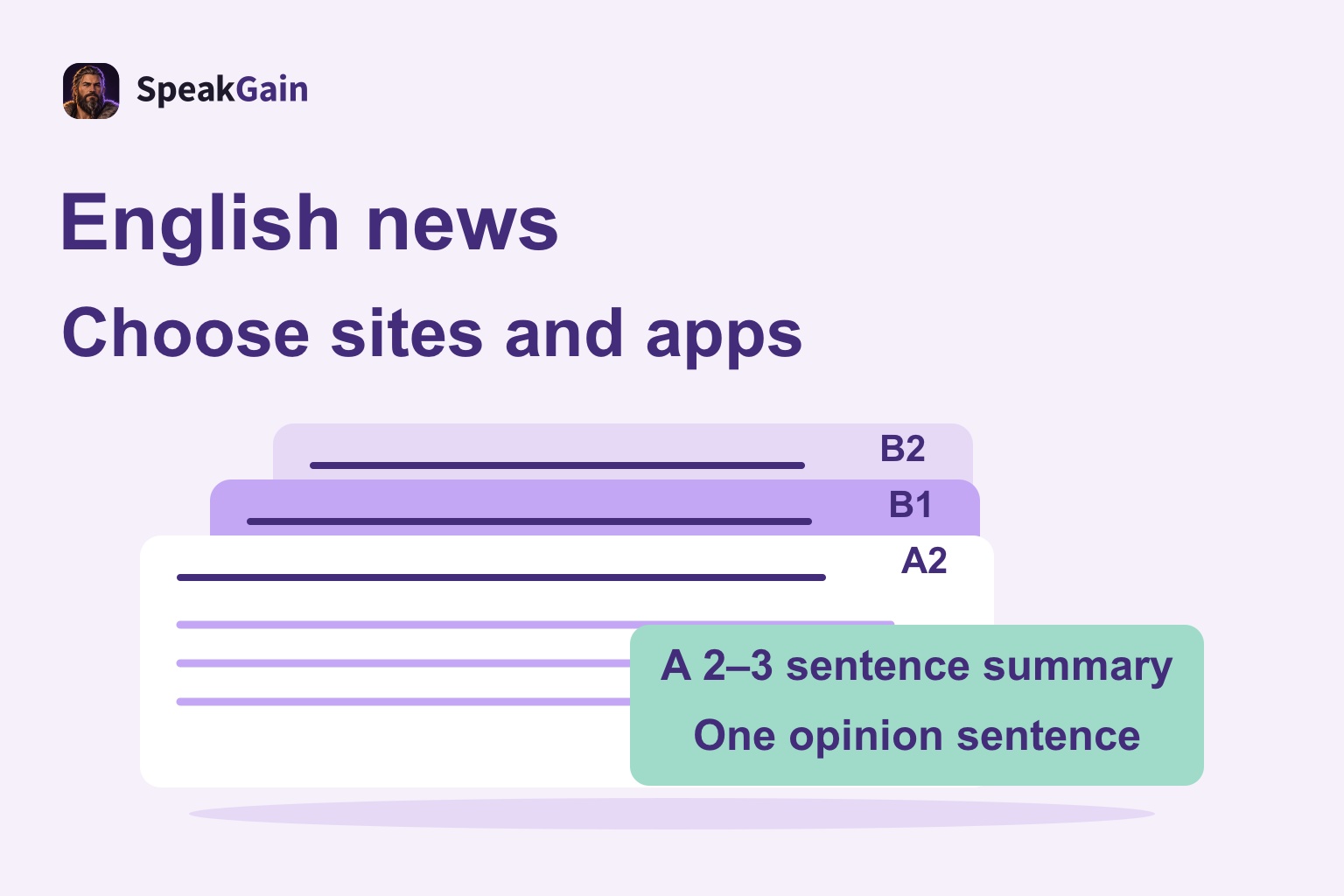
Start with News in Levels or Breaking News English if you want short, levelled English news; choose Engoo Daily News if discussion questions help you start speaking. BBC Learning English’s news series suits learners ready for upper-intermediate explanations, while NHK WORLD-JAPAN and AP News are options for short sections of general reporting; ELEC is an additional option for readers who use Japanese translations. Compare level, matching text, audio, length and free access, then finish with a spoken summary in two or three sentences and one opinion sentence.
These are conditional recommendations, not a ranking. We inspected official descriptions and selected sample pages on 15 October 2026. We did not read every article, compare recordings by listening, or use the news apps daily. Editorial judgments below are based on that limited official information; they are not trial results.
Compare the seven services before installing anything
A readable article is not necessarily a transcript of its accompanying video. “Unconfirmed” means this research did not establish the feature, not that it can never exist. Lengths are official guidelines or one inspected example, not catalogue averages. Providers’ numbered levels are not interchangeable CEFR certificates.
| Service | Website/app | Provider | Level | Audio | Matching text/transcript | Length | Cost/access | Checked |
|---|---|---|---|---|---|---|---|---|
| News in Levels | Web, iOS, Android | English in Levels s.r.o. | Three vocabulary bands: 1,000/2,000/3,000 frequent words | Article audio | Text in checked sample | About 120 words in Level 1 sample | Checked web text/audio free; app free download with purchases | 2026-10-15 |
| Breaking News English | Web | Sean Banville | 0–6; Level 0 officially low A2 | Five listening speeds | Reading/listening text corresponds | Official guide: 120–250 words, about 70 seconds–2 minutes | News lessons free; separate teaching ebook for sale | 2026-10-15 |
| ELEC easy news | Web | English Language Education Council | Japanese junior/senior high-school vocabulary | Downloadable audio | English, Japanese translation and key phrases | About 80 words in sample | Checked text, translation and audio available free | 2026-10-15 |
| Engoo Daily News | Web | Engoo | Checked listing 4–9; sample 4 = Intermediate | Sample marked AI Generated Audio | Article text | About 210 words; audio display 1:24 | Daily News free; tutor lessons separate | 2026-10-15 |
| Learning English from the News | Web, podcast | BBC Learning English | Officially upper intermediate | Downloadable audio/video | Overview, headlines and vocabulary; full transcript unconfirmed | Two recent regular episodes: 6:33 and 7:07 | Checked episode page, audio and PDF free | 2026-10-15 |
| NHK WORLD-JAPAN | Web, iOS, Android | NHK | General audience; our suggestion: intermediate readers choosing short items | Broadcast/on-demand audio and video | Exact article/audio correspondence unconfirmed | Varies; standard word count unconfirmed | Official app free | 2026-10-15 |
| AP News | Web, iOS, Android | The Associated Press | General audience; our suggestion: familiar topics at intermediate level | Video; universal article narration unconfirmed | Article text; verbatim video transcript unconfirmed | Varies; app describes read-time indicators | Official app free; checked web page readable without payment | 2026-10-15 |
Platform and payment references: official News in Levels iOS and Android, NHK iOS and Android, AP iOS and Android. Availability and purchase terms can differ by country and platform; check your current listing.
Our starting point depends on what you can explain
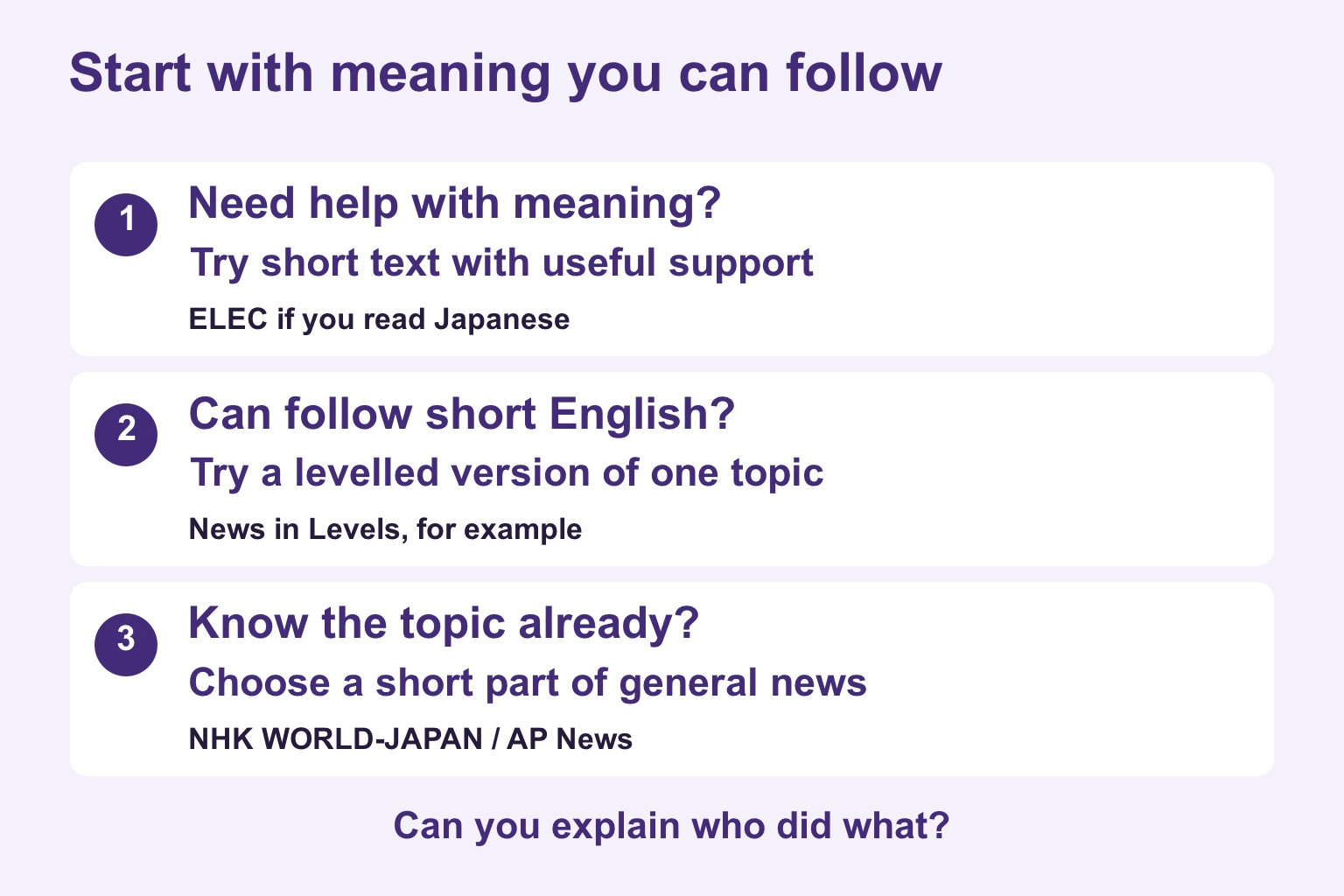
If short English-only sentences are manageable, try News in Levels Level 1. If meaning remains uncertain even after rereading, Japanese-reading learners can use ELEC’s translation. Breaking News English is another option, but its lowest level is described as A2, not a promise of accessibility from zero.
Read a few sentences and say who did what. If that is difficult, shorten the material or move down a level. You do not need to understand every word, but guessing the main event is not enough either. For intermediate learners, Engoo’s questions offer a route into discussion; BBC focuses on headline vocabulary and requires more English comprehension.
General reporting is optional. Choose an NHK or AP topic you already understand and set a boundary, such as the opening paragraphs. Familiar background may help you choose; it does not make every sentence easy.
Start in a browser if that is sufficient. A free web article does not establish that every app feature is free. Check the developer rather than assuming an app with “BBC” in its name belongs to the broadcaster. For different materials, compare listening apps or English-learning podcasts.
News in Levels: short English-only reading with adjustable difficulty
Suitable for: learners who can follow basic sentences and want an easier version of the same topic.
Official facts: the provider’s About page describes three frequent-vocabulary bands and short news every working day. The 1,000/2,000/3,000 figures are vocabulary inventories, not article lengths. The 14 October Level 1 sample contained about 120 words, word explanations and an audio embed accessible without payment. The official app listing shows purchases in addition to a free download.
Our judgment, based on official information: keeping the topic while reducing difficulty makes this a useful first trial. We would explain one version before adding all three.
How to use it: write a simple statement such as “A town is opening a new park.” Replace its details with something you have actually understood. This is our original practice sentence, not a quotation.
Caution: do not convert its levels into exam scores. Older-story features mean publication date and event date need separate checks.
Breaking News English: compare the same text with audio
Suitable for: readers who understand a sentence but lose it in audio and want a choice of speeds.
Official facts: Sean Banville’s level guide lists levels 0–6, 120–250 words, roughly 70 seconds to two minutes and five listening speeds. Easier lessons have levels 0–3; harder ones have 4–6, so every story does not have seven versions. About says lessons are free and new lessons appear twice weekly; the newest checked lesson was dated 15 October.
Our judgment, based on official information: explicit reading/listening correspondence makes this a candidate for checking one missed sentence.
How to use it: read, listen, revisit one unclear sentence, then make your own comment: “I think this change will help families.” Explain which change you mean.
Caution: a short reading can come with many pages of activities. Choose a task boundary instead of making every worksheet compulsory. Audio duration is not total learning time.
ELEC: a Japanese-supported option, not multilingual translation support
Suitable for: readers who can use Japanese to check meaning.
Official facts: ELEC’s collection describes Japanese junior/senior high-school vocabulary, English, Japanese translation, key phrases and downloadable audio. The provider is the English Language Education Council, with Japanese education ministry cooperation. Its newest listed pair was dated 12 October; the selected sample had about 80 English words and was publicly accessible without payment.
Our judgment, based on official information: useful when Japanese genuinely assists comprehension. Readers who do not read Japanese should begin with another service in this comparison.
How to use it: predict the event from English, check only the relevant translation, then return to English. An original practice example is “More people are using the local library.”
Caution: understanding a Japanese translation does not establish that you understood the English audio. Look away from the translation for an audio-only check.
Engoo Daily News: questions to start a discussion
Suitable for: intermediate readers who understand the news but need a prompt for their own response.
Official facts: the collection says it is free, adds articles every day and is intended for teacher-supported use while allowing self-study. The checked listing showed levels 4–9. The 12 October Level 4 sample was labelled Intermediate, had about 210 words, a 1:24 audio display, vocabulary, comprehension and discussion questions. The audio was labelled AI generated.
Our judgment, based on official information: the move from checking content to personal questions offers a practical speaking prompt.
How to use it: choose one question you can answer with a reason. For a travel topic, our example is “I would like to visit because I enjoy quiet places.”
Caution: /app/ in this URL does not mean a native app. Free materials and paid tutor lessons are separate; AI audio is not a human narrator recording.
BBC Learning English: headline vocabulary at upper-intermediate level
Suitable for: learners ready to understand vocabulary explanations in English.
Official facts: Learning English from the News is labelled Upper intermediate. The 14 October page supplied a story overview, headlines, vocabulary, video, PDF and audio download without payment. BBC’s feed describes a weekly news/headline-vocabulary series; the 14 and 7 October regular episodes were 6:33 and 7:07.
Our judgment, based on official information: useful for understanding headline language, but short duration alone is not a reason to recommend it to beginners.
How to use it: summarize the main event in easy words before adding new vocabulary. Our fictional example is “The town has a new plan for its library.”
Caution: the checked overview and vocabulary notes were not established as a full verbatim transcript. If word-for-word audio checking matters, choose material with confirmed matching text. Change topics if distressing news makes practice difficult.
NHK WORLD-JAPAN: familiar context in general news
Suitable for: intermediate readers who already know something about a Japan/Asia topic.
Official facts: NHK’s listing describes Japan’s public broadcaster’s international service, a free app, latest news, TV/radio live streams, seven-day catch-up and on-demand audio/video. The news entrance is official. Standard article length, daily article count, universal narration and verbatim transcripts were not established.
Our judgment, based on official information: familiar context can guide topic selection; this is still general reporting rather than a graded course.
How to use it: limit the scope and explain a change. Our fictional sentence is “The library will stay open later.” Then say whom you think it may help.
Caution: text and broadcast may use different wording. Check the specific item before treating the text as a transcript. We did not verify this by using NHK’s app.
AP News: general reporting with a clear stopping point
Suitable for: intermediate readers who can choose familiar topics and set their own reading boundary.
Official facts: AP’s app listing describes a free app with articles, videos, topic feeds, alerts and read-time indicators. Its Android listing describes real-time coverage. A selected official page was readable without payment. Common learner levels, standard word counts and universal narration/transcripts remain unconfirmed.
Our judgment, based on official information: an optional step into general reading, not our first long-article assignment for beginners.
How to use it: work with the introduction only. Start with our frame, “The report describes a change in the city,” then replace “a change” with the actual event you understood.
Caution: a related video is not necessarily an article reading. Read-time indicators do not include your dictionary and speaking practice. Do not invent a story from a headline if its text is unavailable.
Five steps from news to speaking
The following is our suggested routine. All library examples are fictional and written by us, not taken from a news article.
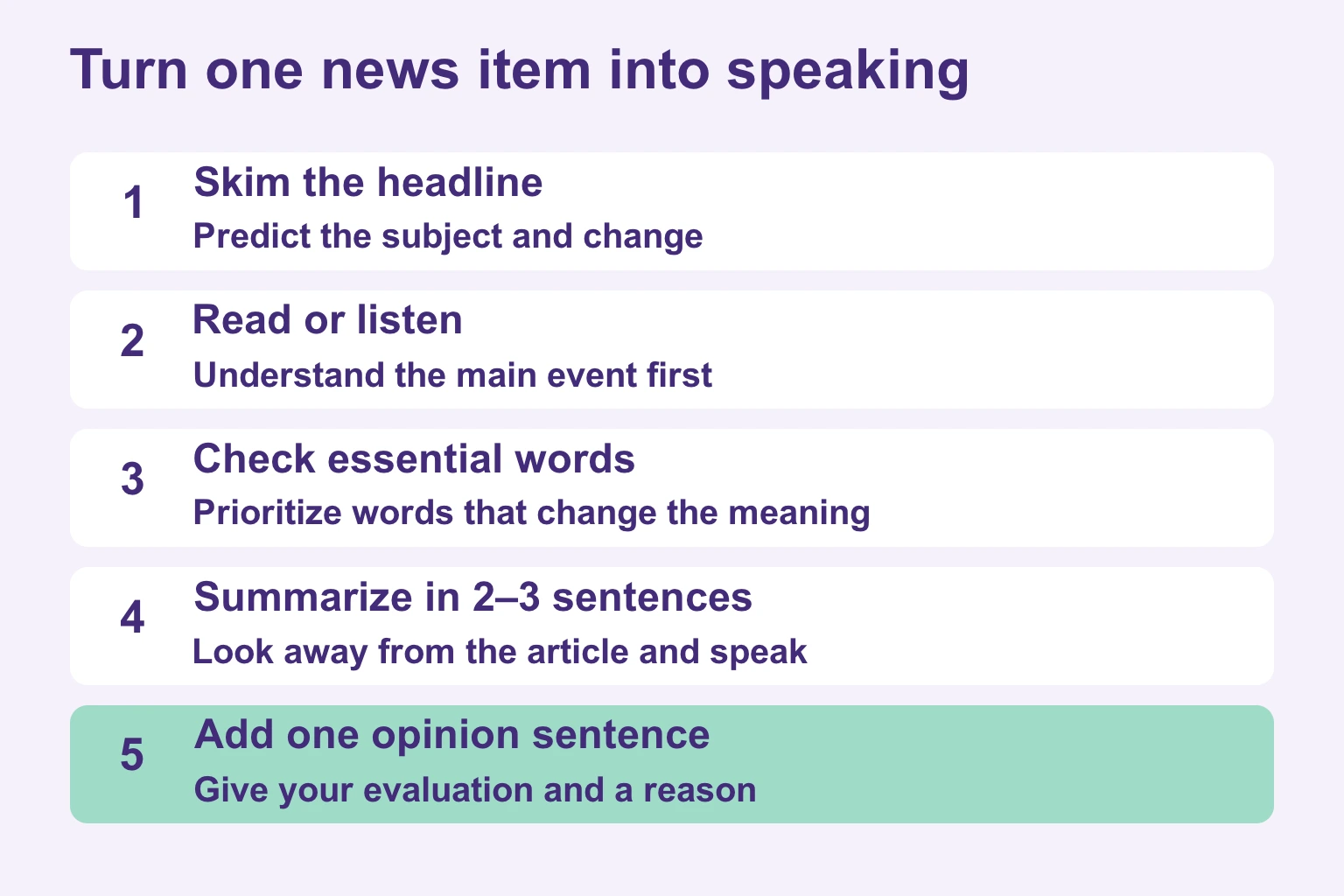
- Skim the headline. Identify a likely subject and change. Our invented headline, “Library to stay open later,” suggests opening hours; it does not establish a date or reason.
- Read/listen. Beginners may read first, then listen to matching audio. Others can listen once before checking the text. Establish who did what; do not replay an incomprehensible item endlessly.
- Check unknown words sparingly. Start with words needed for the main event, negation, important numbers and your summary. Trying one to three words is a planning suggestion, not a safety rule: check consequential meanings or choose an easier topic. See handling unknown words.
- Summarize aloud in two or three sentences. Look away from the source after using a brief note if necessary. Our example is:
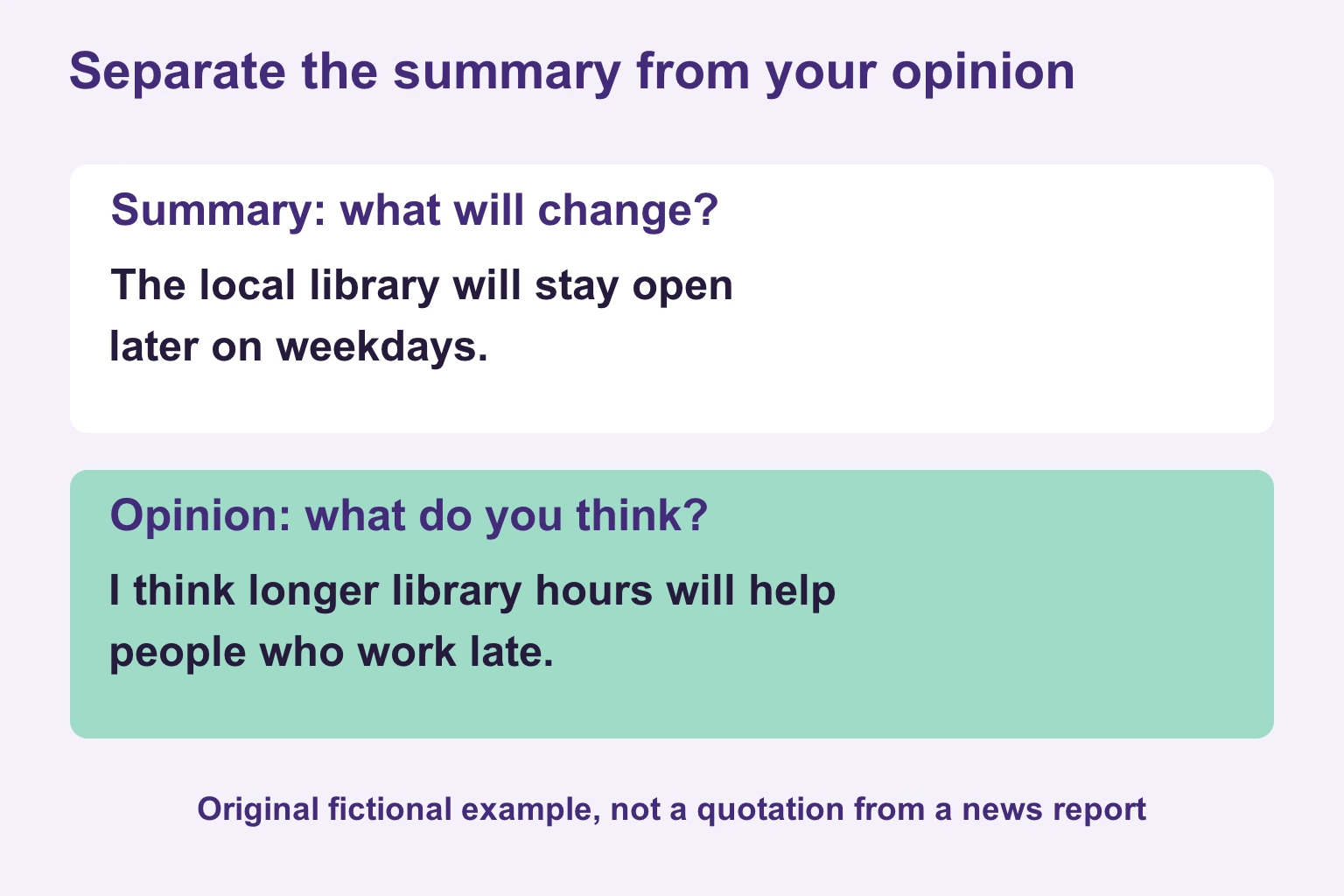
The local library will stay open later on weekdays. More people can visit after work.
- Add one opinion sentence. Separate your evaluation from the reported event:
I think longer library hours will help people who work late.
This opinion is ours; it is not a claim about what a source said. You can also say “I need more information before I decide.” For fuller practice, follow the retelling method.
Keep facts and your opinion separate
Changed opening hours belong in the fictional summary; the view that they help late workers is an opinion. Do not add an unverified reaction such as “everyone is pleased.” Check a forgotten name or number instead of filling it in. After speaking, compare the subject, action and positive/negative meaning with the source. This is an editorial checking routine, not an automated accuracy guarantee.
Save your own opinion sentence in SpeakGain, then listen and say it
To revisit one sentence later, you can save our original example in SpeakGain. Use a short sentence you wrote yourself. We verified the following flow on the dedicated Android environment for this article.
- Enter your own English sentence in Add and create a card.
- Open its Knowledge view in Library, then choose Learn this card.
- In Listening, listen and speak aloud. Choose Reveal answer to check the saved sentence. We also replayed the same audio using the answer screen’s play button.
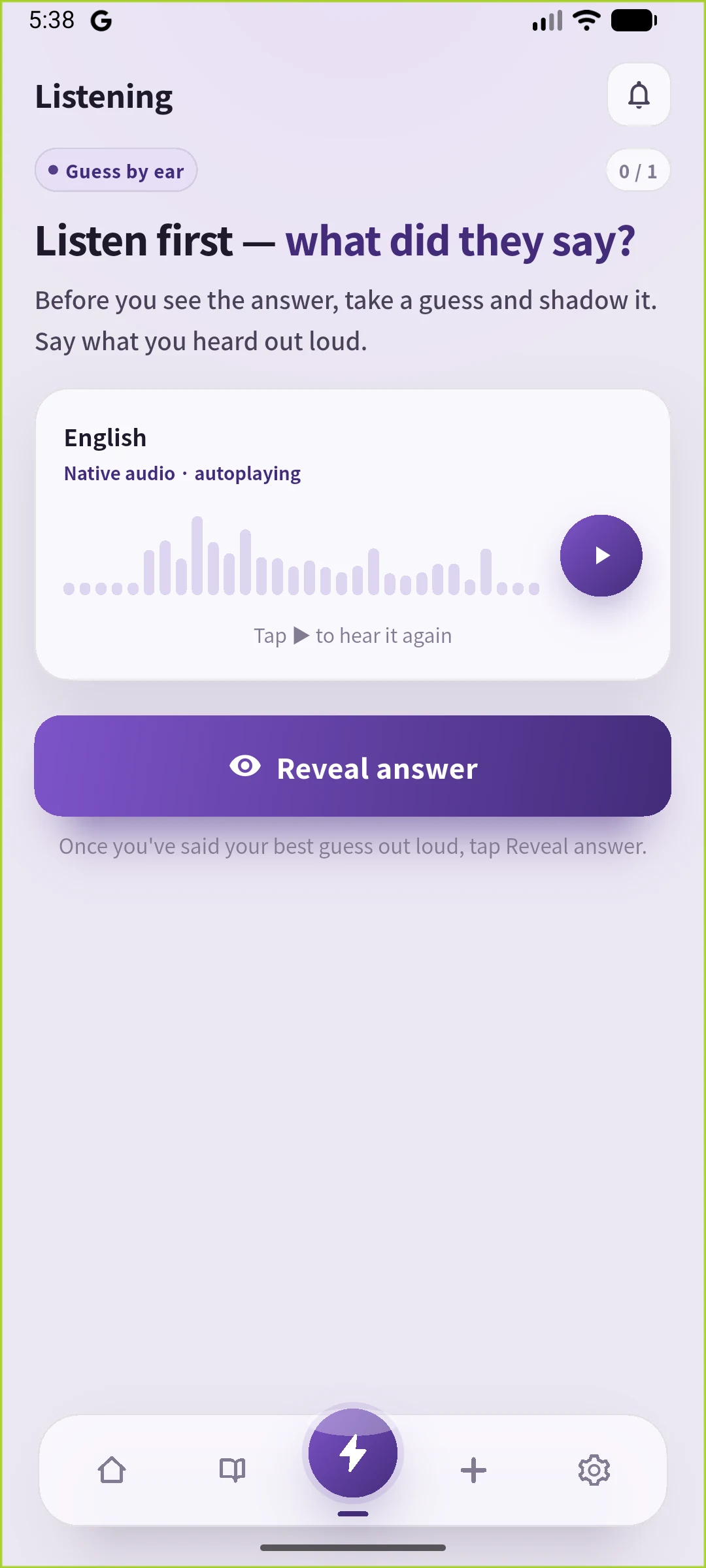
This Viking AI reference audio was generated once from our original opinion sentence and is shared across all language versions.
I think longer library hours will help people who work late. — Our own opinion about the fictional library example.
Look away after listening and say the sentence as your own opinion. We verified saving a self-written sentence, listening and saying it. We do not present SpeakGain as a news feed, article reader, article-text importer or scoring tool.
A realistic first week
Our starting plan is 10–15 minutes: one minute choosing, five to seven reading/listening, two checking words and two to five speaking. These are scheduling suggestions, not scientifically required doses. Split a longer episode over two days.
| Day | Task | Finish by checking |
|---|---|---|
| 1 | Choose one short item | Can you name the subject and event? |
| 2 | Revisit it and use matching audio if available | Can you summarize away from the page? |
| 3 | Add one opinion | Is it clearly your evaluation? |
| 4 | Try another item at the same level | Did word lookup leave time to speak? |
| 5 | Recall yesterday’s item | Did you check forgotten details? |
| 6 | Choose a topic you enjoy | Separate interest from difficulty |
| 7 | Keep one useful source | Does the routine fit your time? |
New articles every day are optional. Re-explaining yesterday’s item counts as practice. For audio difficulties, see improving English listening; for other reading, see extensive reading.
What we would not start with
We do not recommend translating a long general-news article word by word from day one when the goal is a short spoken explanation: dictionary work can consume the whole session. Close reading can have another purpose, but start this routine with a manageable item.
We would not count silent reading as completed speaking practice. Reading-only days are fine; if you want to practise speaking, include actual speech. Nor would we keep adding services solely because they publish often. Record what you explained and what opinion you expressed, rather than only minutes played or words collected.
Frequently asked questions
Which news should a beginner choose?
Try News in Levels Level 1 if short English-only prose is manageable. Japanese-reading learners can use ELEC for meaning support. Even the lowest advertised level can be too difficult; shorter foundation material is an acceptable starting point.
How is learner news different from general news?
Levelled services describe controlled vocabulary or stages. General reporting is not organized to match a learning progression, so difficulty changes with the topic and article. Reading it does not by itself demonstrate speaking ability.
Can I study for free?
The checked News in Levels sample, Breaking News English, ELEC and Engoo offer text/audio materials without payment. Free app download, paid extras and tutor lessons are separate. No claim is made that every feature will remain free indefinitely.
Does audio mean there is a transcript?
No. An overview or related article may differ from what is spoken. BBC’s checked news page had key points and vocabulary; we did not establish a full verbatim transcript. Choose confirmed text/audio correspondence when exact comparison matters.
How long should I practise?
Try a manageable part of one item in 10–15 minutes and keep time for the summary and opinion. Divide it across days if necessary. Neither a fixed number of articles nor a fixed duration guarantees progress.
Should I look up every unknown word?
Prioritize words that change the main event, important numbers and negation. If you stop constantly, simplify the material. Do not guess a consequential meaning just to stay under a word limit.
Can news help me practise speaking?
Use it as a prompt: say two or three summary sentences and one original opinion. Reproducing a passage from memory and explaining its meaning yourself are different tasks.
Is older news useful?
Yes for language practice, with dates checked. Before presenting it as current information, verify the latest situation. A rereading exercise is not the same as reporting today’s events.
Do I need an app?
Not necessarily. Try one official web item first. Install an app when you know which feature you need, and check its provider and current local terms.
Editorial verdict
We would begin with short levelled material, or ELEC when Japanese support is useful. Choose Breaking News English for explicit text/audio checking, Engoo for discussion prompts and BBC for upper-intermediate headline vocabulary. NHK and AP are optional general-news sources when you can set a manageable scope.
Before searching for another service, complete one cycle: headline → read/listen → essential words → two or three spoken summary sentences → one opinion sentence. The number of apps installed matters less than finishing that task.
All service details were checked on 15 October 2026. Official sources are linked beside the facts; this article offers an editorial interpretation of those sources, not a daily-use review.