
Extensive reading in English: levels, evidence and a one-week start
Published
Extensive reading means regularly reading English that is easy enough to follow without constantly consulting a dictionary. Start by trying a lower level of graded readers and choose a story whose main events you understand and whose next page interests you. To add speaking practice, close the book afterward and say a short summary or an original reaction you have written yourself.
This guide is for adults and teenagers starting or restarting a reading habit. Individual titles belong in our beginner book recommendations; here the decision is which difficulty to choose and how to read it.
Extensive or intensive reading? Choose your purpose
The Extensive Reading Foundation (ERF) describes extensive and intensive reading as complementary: one gives practice in following meaning, while the other studies language closely. ERF guide, printed page 2.
| Extensive reading | Intensive reading | |
|---|---|---|
| Main purpose | Follow content and build reading experience | Understand vocabulary, grammar and sentence structure |
| Difficulty | Easy for you | Contains language you want to study |
| Amount | A manageable, interesting stretch | A short passage examined closely |
| Dictionary | Frequent stops suggest excessive difficulty | Look things up and analyse as needed |
| Check afterward | Recall the main events | Explain the language you studied |
Our view: Give reading and analysis separate time slots. Writing a translation of every line can consume the entire session intended for reading. For example, after analysing a difficult school passage or work document, choose an easier story for your leisure reading. Try this: Decide before opening the book whether today’s task is following the story or studying one sentence. If analysis takes over the first task, change books.
How graded-reader levels work
Graded readers control vocabulary and grammar for language learners; they are not simply short original novels. ERF definition. The table below uses each publisher’s official guide, checked 15 October 2026. Headwords indicate the scale of the level’s core vocabulary, not the total number of running words in a book.
| Series | Publisher | Number of levels | Headwords / controlled vocabulary | Official guide; checked |
|---|---|---|---|---|
| Oxford Bookworms Library | Oxford University Press | 7: Starter + Stages 1–6 | 250–2,500 headwords | OUP; 2026-10-15 |
| Penguin Readers, current PRH series | Penguin Random House | 8: Starter + Levels 1–7 | 350–2,500 headwords | Handbook, p.3; 2026-10-15 |
| Ladder Series, a Japanese-market example | IBC Publishing | 5 numbered levels; Special Edition separate | Levels 1–4: 1,000–2,000 vocabulary items; Level 5 unrestricted | IBC; 2026-10-15 |
In order, Oxford lists 250 / 400 / 700 / 1,000 / 1,400 / 1,800 / 2,500 headwords. Penguin lists 350 / 550 / 700 / 1,000 / 1,200 / 1,600 / 2,000 / 2,500. IBC lists 1,000 / 1,300 / 1,600 / 2,000 / unrestricted under “vocabulary used”. Lists and grammar policies differ, so similar numbers do not guarantee identical difficulty. The Penguin figures come from its 2019 official handbook and must not be applied to the former Pearson Penguin Readers series.
Our view: Start with a low level you can actually inspect, not a level selected solely from your age or exam result. Oxford Stage 1 has 400 headwords; IBC Level 1 uses a 1,000-item vocabulary. Neither label is a universal “beginner” measurement. Try this: Record series, publisher, level and book length separately. Search your own public or school library catalogue by full series name; ask staff about graded readers if necessary. Check borrowing eligibility and ebook coverage locally rather than assuming free access. For the first purchase, see choosing your first English book.
Choose a starting level by reading it
The ERF guide gives roughly 98% known vocabulary as a useful condition for fluent reading with high comprehension. This is vocabulary coverage, not a demand to understand 98% of every detail and not a guarantee for an individual reader. ERF, pp.3–4.
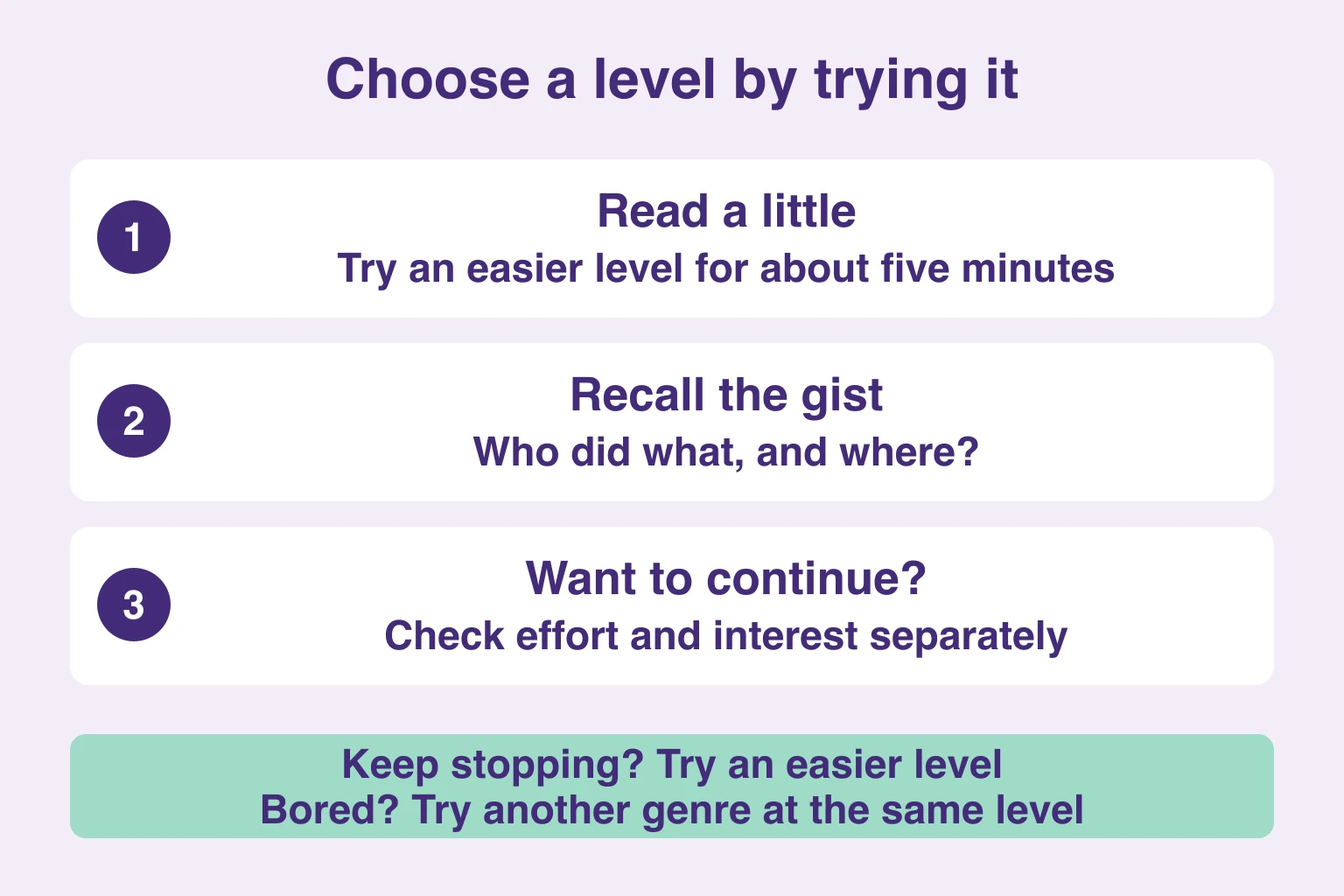
Our view: Read an easy candidate for about five minutes, close it and recall who did what and where, in your first language if needed. Try another book at that level too: familiar subject matter may have made the first one unusually easy. In a 100-word stretch, two unknown words correspond to 98% coverage, but familiar words do not help if you keep losing track of pronouns or rereading every sentence.
Try this: Write one line each for content, effort and interest. If the plot is unclear, go easier. If it is clear but boring, change genre at the same level. There is no obligation to move up immediately. Teenagers should also check content suitability; an adult topic can be inappropriate even in simple English. If a translation helps, use our bilingual-book guide to keep English reading in the session.
Principles: easy, interesting and replaceable
ERF stresses relatively easy, self-selected reading that keeps attention on meaning rather than complete word-by-word comprehension. What is ER?.
Our view: Do not turn “skip unknown words” into another endurance test. For an invented story about two friends finding a lost bag, an unfamiliar colour may not stop you following the events. If you cannot tell who lost what or who helped, the book may be too hard. Try this: Follow one short section without translating every line. Mark a word lightly if you want to revisit it, then decide whether it matters to the plot, recurs, or is useful to you. Our unknown-word guide covers those decisions. Changing an unsuitable book is a sensible adjustment, not a failed reading session.
What research shows—and what it cannot promise
Nakanishi’s 2015 meta-analysis combined 34 studies and 3,942 participants. The between-group comparison reported d = 0.46, supporting benefits for reading proficiency. A standardized effect size is not a 46% improvement or the result every reader will achieve. DOI: 10.1002/tesq.157.
Hamada (2020) examined problems including selection bias and the comparability of treatment and control groups. Teaching conditions and measurement matter when interpreting an effect. DOI: 10.3389/fpsyg.2020.00617.
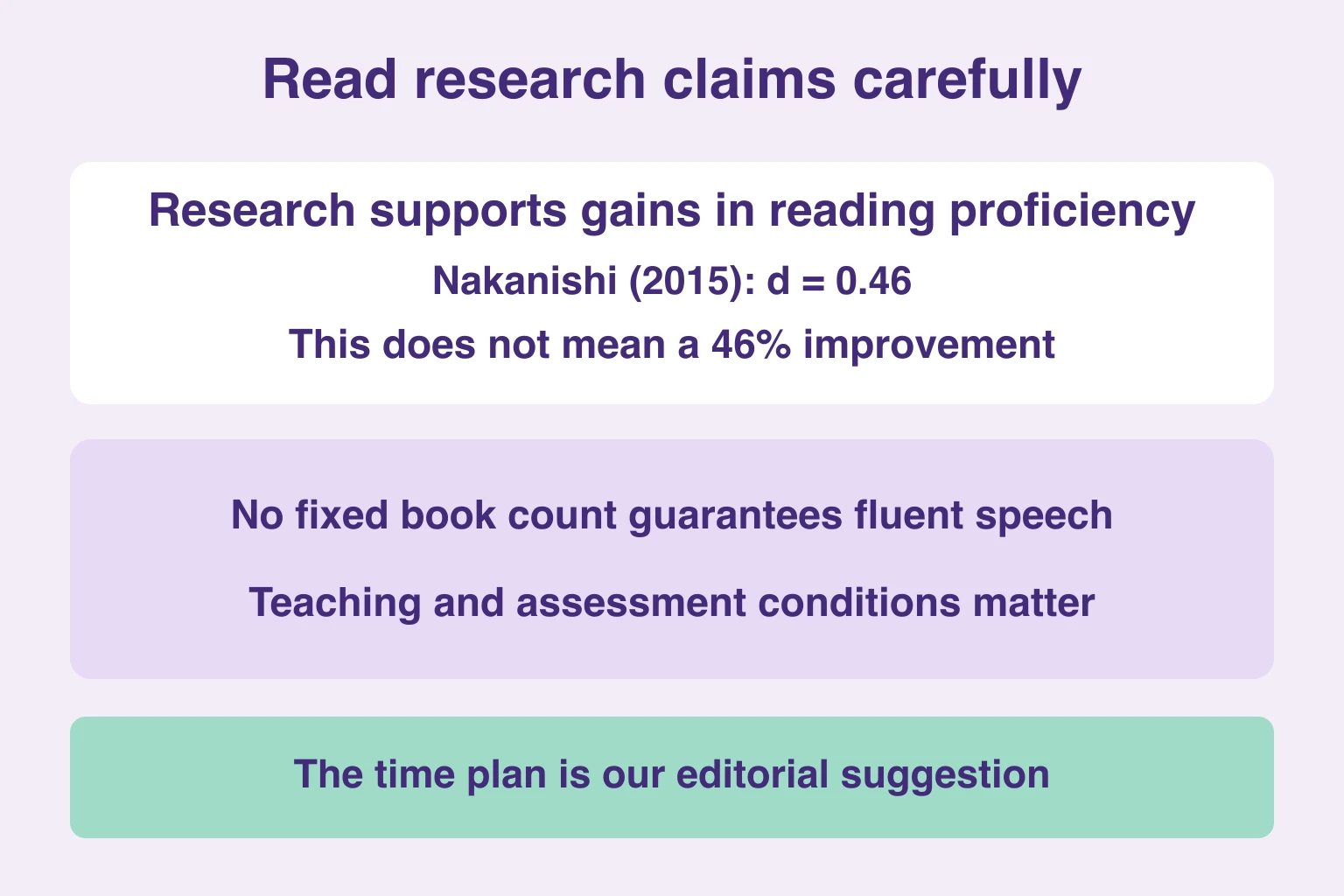
Our view: Use extensive reading to practise reading, while reserving actual speaking time if conversation is your goal. These reading findings do not establish “read this many books and become fluent”. Someone with an interview in three weeks should also practise explaining their own experience. Try this: Set one observable reading goal, such as following events with fewer stops, and one separate speaking goal, such as giving a reason for your opinion. Assess them through their respective activities.
A one-week start: our editorial routine
ERF recommends choosing by reading the actual text and checking comfort and interest. Guide, p.4. The schedule below is our starting suggestion, not a tested seven-day programme or a promise of improvement. Choose a quiet slot after homework, dinner or another regular activity. Shorten a busy day without doubling the next day’s workload.
| Day | Reading | Afterward |
|---|---|---|
| 1 | Try easy candidates for about five minutes each | Choose using gist, effort and interest |
| 2 | Read for about ten minutes | Recall who did what in your first language |
| 3 | Continue for a similar time | Go easier if stuck; change genre if bored |
| 4 | Follow the story without drafting a report as you go | Write one original English reaction |
| 5 | Continue or try another book at the same level | Say the reaction with and without the text |
| 6 | Read to a manageable stopping point | Close the book and give a short summary |
| 7 | Revisit an easy part or sample a candidate | Stay, go easier, or cautiously try the next level |
For example, an unfinished chapter after ten minutes is a place to resume, not a debt. Try this: Log only range read, ease and one remembered event: “Three pages; easy; a friend helped find a bag.” Word counts are optional. If a new level is tiring, keep an easier book available. Restart after a break with today’s comfortable level rather than your previous maximum.
From reading to speaking: a summary and an original sentence
ERF suggests brief retellings and reactions as possible checks after reading, including checks in the first language. Understanding a story and saying it in English are different tasks. Guide, p.9.
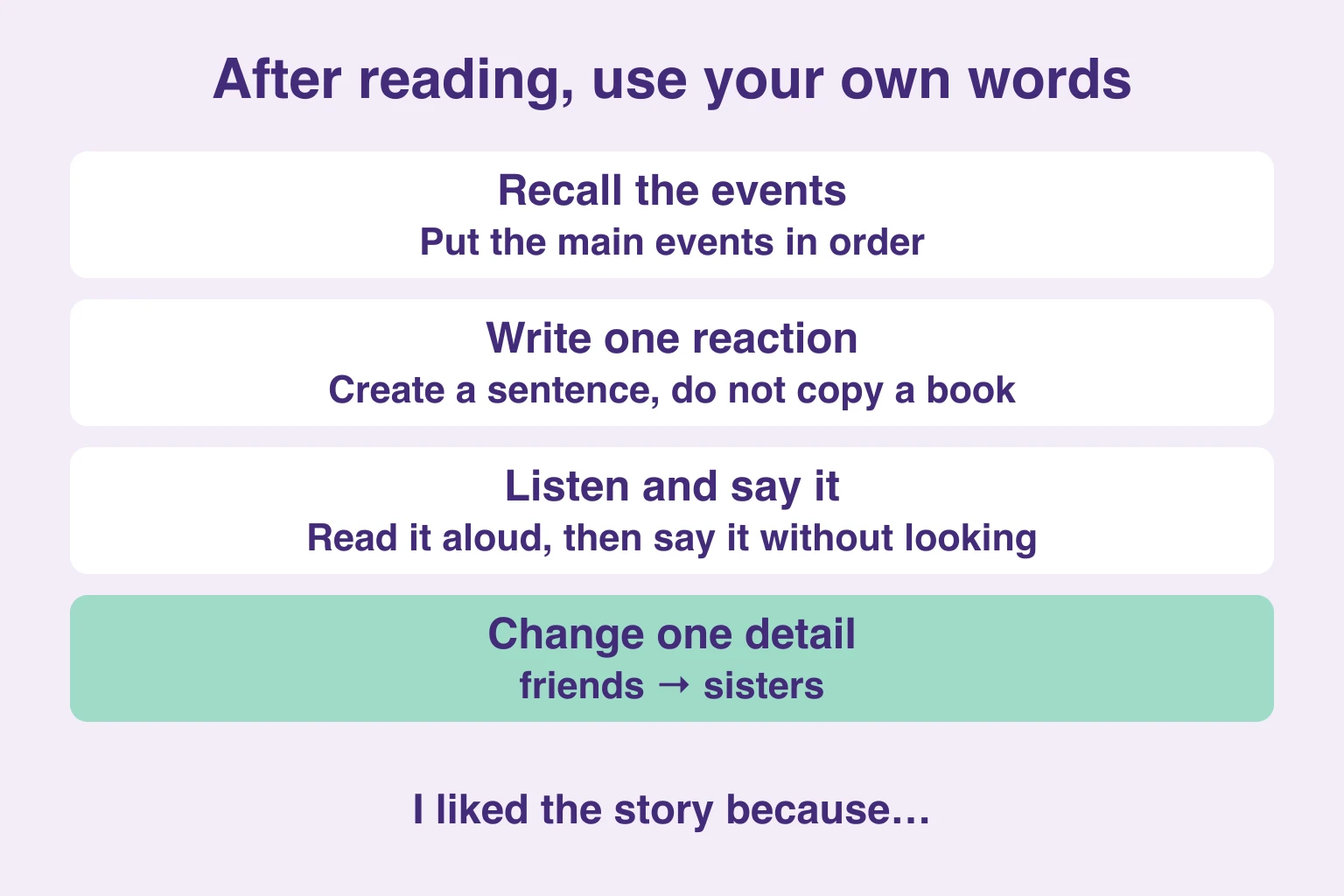
Our view: Add a short output task afterward on the days you want speaking practice. Do not require an English summary of every page. Separate events from your opinion. The following invented story and every English example below were written for this article; none is copied from a book.
Two friends were walking home. One of them lost a bag. They looked for it together.
The events form a summary. Your reaction could be:
I liked the story because the two friends helped each other.
Check that it expresses your intended meaning, say it while looking, then try without looking. If necessary, start with “I liked the story.” and add the reason later. Try this: Change one detail in your own sentence:
I liked the story because the two sisters helped each other.
Use “sisters” only for a story about sisters; a rewrite should still match what you mean. This is a practice suggestion, not a speaking effect established by the cited reading studies. If saying the words is difficult, try reading aloud. If ordering the events is difficult, see retelling practice.
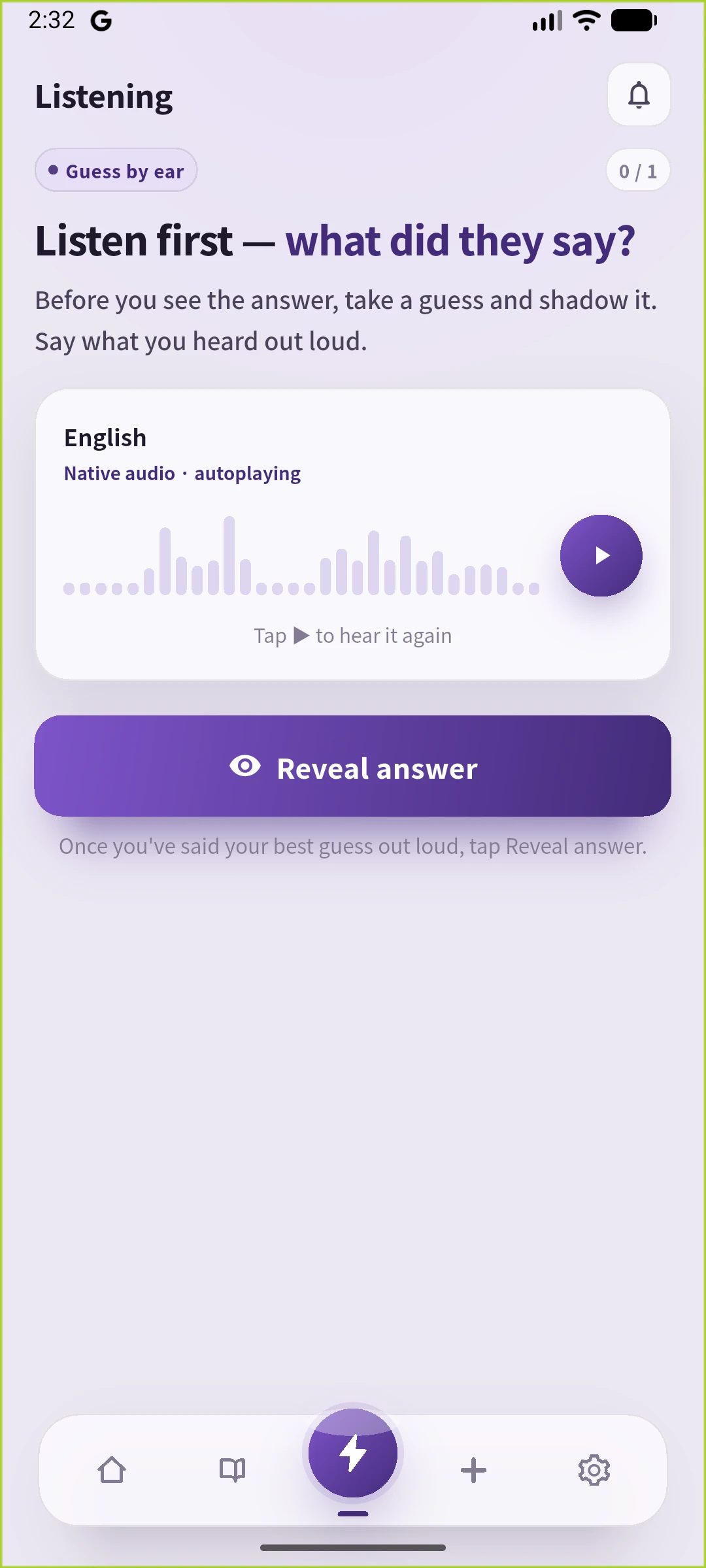
SpeakGain is our own product. For this example, we saved the original sentence above as one card through the normal Add screen. From Knowledge in the Library, Learn this card opened Listening, where the sentence was hidden and the screen prompted listening and saying it aloud. We checked the playback control and used Reveal answer to display the exact saved sentence on the device.
This use case saves only a reaction you wrote after reading, then lets you listen and say it. The shared screenshot uses the English interface; the generated explanation was also in English. A notebook is enough for the writing exercise. With audio, listen first, say it once and reveal the text when you need to check.
Methods we do not recommend
The ERF guide advises easier material when dictionary use becomes frequent. Guide, p.11. Our view: Do not use an overly hard book with constant lookups as your extensive-reading slot. Keep a favourite difficult passage for a separate close-reading task. Do not chase word counts alone: a rising total is not useful evidence that you understood the story. Finally, struggling with a famous original novel is not a verdict on all your English skills.
For example, if you turn pages only to fill a quota and remember nothing, replace tomorrow’s quota with one event you understood. Try this: Change one variable—difficulty, topic or workload—and check the next session. Exam preparation may also need vocabulary and task-format practice beyond reading.
FAQ
Does extensive reading work?
There is meta-analytic evidence supporting reading proficiency, with differences across conditions and assessments. Nakanishi, 2015. Our first check is whether you can follow meaning and return to the book willingly.
Must I never use a dictionary?
No absolute ban is needed. Frequent lookups that interrupt the story suggest the level needs adjustment. ERF guide. We would briefly check an essential word and choose easier material if interruptions persist.
Which level should I start with?
Try a low level in the series you can access. Use the official guide and the actual text; levels are not interchangeable across publishers.
How many books or words will make me fluent?
The studies discussed here do not establish a universal threshold. Assess reading through reading, and practise expressing your own thoughts aloud separately.
Are children’s books acceptable?
Yes, if they interest you and are readable. A book written for children does not necessarily control vocabulary for English learners. We would inspect the text rather than rely on its age label.
Should I read everything aloud?
No. Preserve time for following the story and add a short aloud or speaking task afterward if useful. ERF distinguishes reading and audio activities. Guide, pp.11–12.
How do I restart after giving up?
Our suggestion is a five-minute trial of something comfortable today. You do not need to reclaim your old level or make up missed word counts.
Our verdict
Choose ease before volume: sample a low level, find a story you can follow, and enjoy more reading at that level. A publisher’s chart helps you select material; it does not grade your worth as a learner. On speaking-practice days, close the book, summarize briefly and say one original reaction. Start with a few readable pages, not a large purchase or a fluency deadline.
Sources and check date
All checked 15 October 2026. Research outcomes and our suggested timings are separate.
- ERF: definition and guide.
- Nakanishi, T. (2015), TESOL Quarterly, 49(1), 6–37. DOI: 10.1002/tesq.157; study count, participants and group effect from the publisher’s abstract.
- Hamada, A. (2020), Frontiers in Psychology, 11:617. DOI: 10.3389/fpsyg.2020.00617.
- Official level guides: Oxford, Penguin 2019 handbook, IBC.